CDK4/6 Inhibitor-Induced Senescence in Cancer: Mechanisms and Therapeutic Implications




Simple Summary
Abstract
1. Introduction
2. Clinical Landscape of CDK4/6 Inhibitors in Cancer Therapy
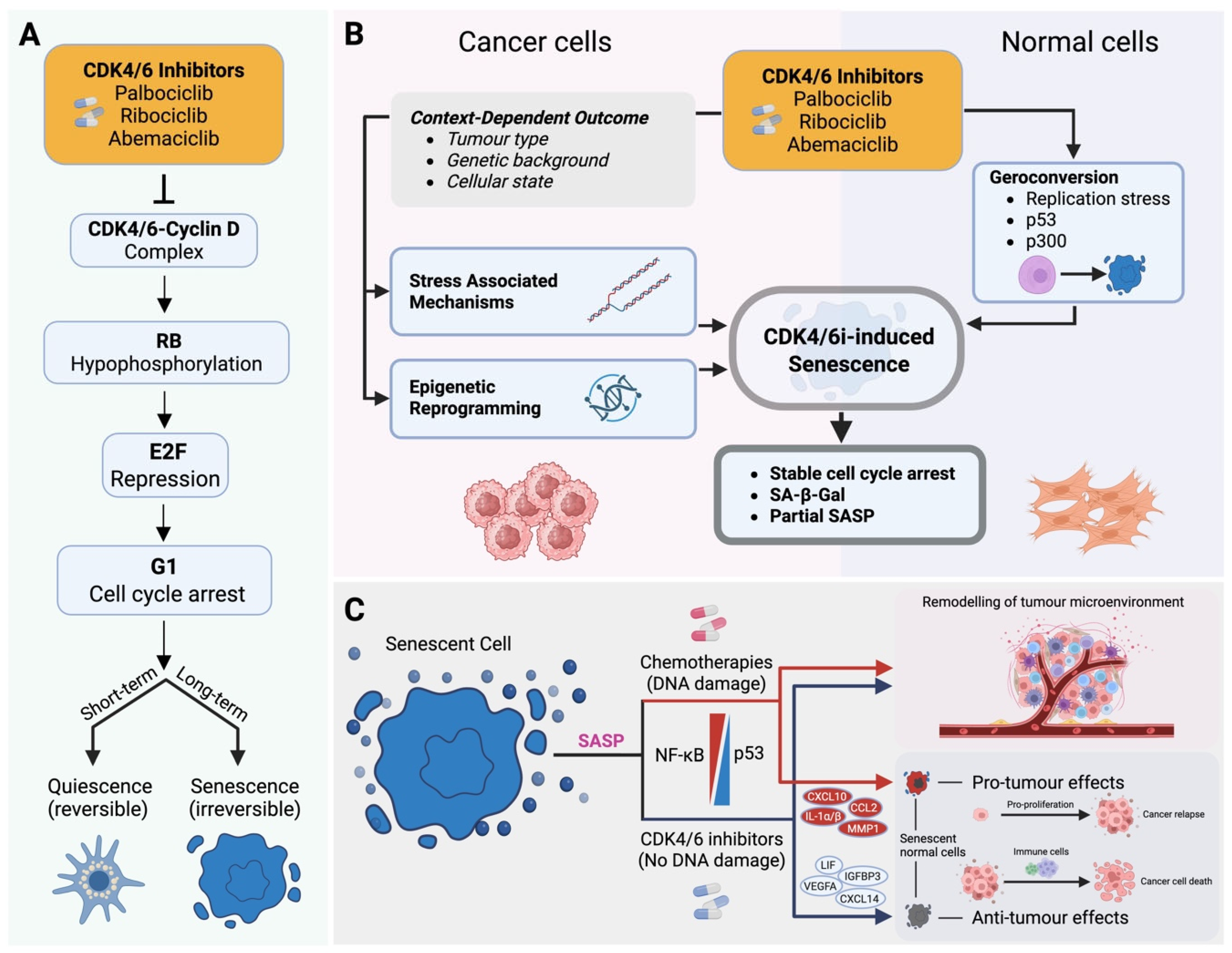
3. CDK4/6 Inhibitor-Induced Senescence: Mechanisms and Consequences
3.1. Mechanisms of CDK4/6-Induced Senescence
3.2. CDK4/6 Inhibitor-Induced SASP and Microenvironmental Remodelling
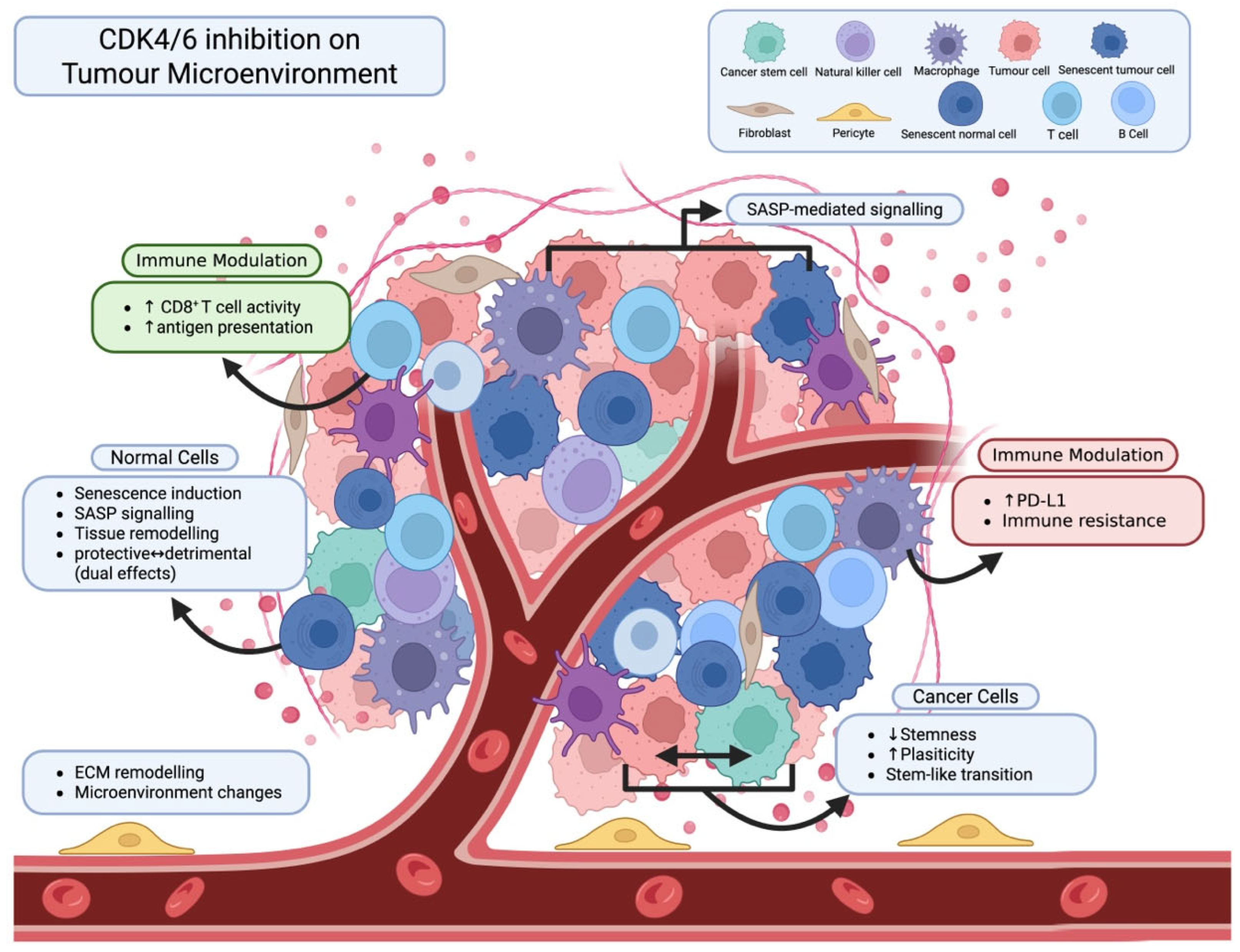
4. CDK4/6 Inhibitors and the Tumour Microenvironment
4.1. Effects on Healthy Normal Cells
4.2. Effects on Immune Cells
4.3. Effects on Cancer Stem Cells
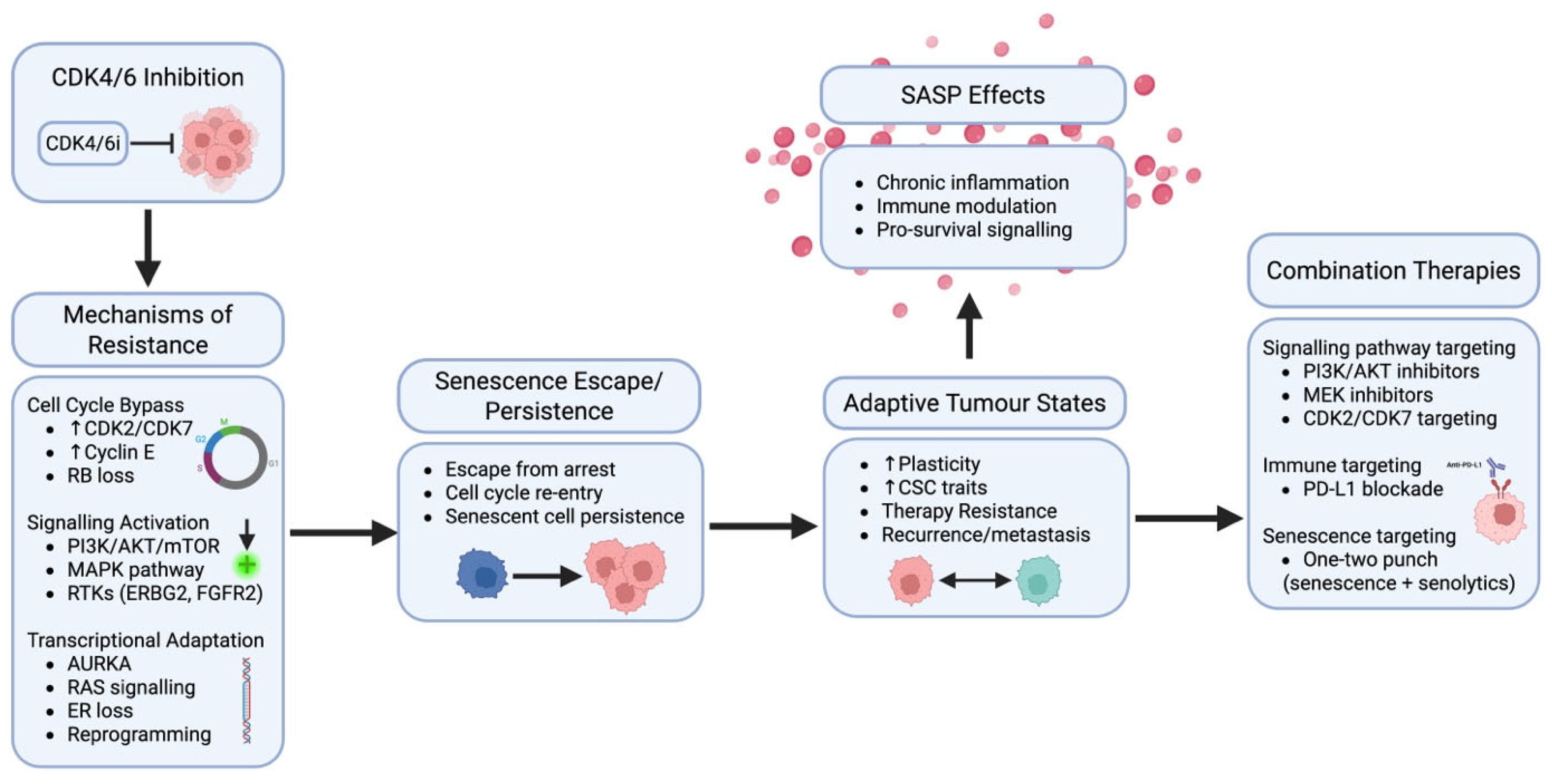
5. Resistance to CDK4/6 Inhibitors and Combination Therapies
Mechanistic Rationale for Combination Strategies
6. Discussion and Future Perspectives
7. Conclusions
Author Contributions
Funding
Data Availability Statement
Acknowledgments
Conflicts of Interest
References
- Wang, X.; Zhao, S.; Xin, Q.; Zhang, Y.; Wang, K.; Li, M. Recent progress of CDK4/6 inhibitors’ current practice in breast cancer. Cancer Gene Ther. 2024, 31, 1283–1291. [Google Scholar] [CrossRef] [PubMed]
- Spring, L.M.; Wander, S.A.; Zangardi, M.; Bardia, A. CDK 4/6 Inhibitors in Breast Cancer: Current Controversies and Future Directions. Curr. Oncol. Rep. 2019, 21, 25. [Google Scholar] [CrossRef] [PubMed]
- Dhillon, S. Trilaciclib: First Approval. Drugs 2021, 81, 867–874. [Google Scholar] [CrossRef] [PubMed]
- Sheikh, M.S.; A Satti, S. The emerging CDK4/6 inhibitor for breast cancer treatment. Mol. Cell. Pharmacol. 2021, 13, 9–12. [Google Scholar] [PubMed]
- Gallego, G.M.; Palmer, C.; Orr, S.; Bernier, L.; Chen, P.; Cho-Schultz, S.; Deal, J.G.; Dress, K.; Edwards, M.; Jalaie, M.; et al. Discovery of Atirmociclib (PF-07220060): A Potent and Selective CDK4 Inhibitor. J. Med. Chem. 2025, 68, 26085–26098. [Google Scholar] [CrossRef] [PubMed]
- Roberto, M.; Astone, A.; Botticelli, A.; Carbognin, L.; Cassano, A.; D’Auria, G.; Fabbri, A.; Fabi, A.; Gamucci, T.; Krasniqi, E.; et al. CDK4/6 Inhibitor Treatments in Patients with Hormone Receptor Positive, Her2 Negative Advanced Breast Cancer: Potential Molecular Mechanisms, Clinical Implications and Future Perspectives. Cancers 2021, 13, 332. [Google Scholar] [CrossRef] [PubMed]
- Zhou, J.; Lin, X.; Wang, S.; Xie, M.; Hu, X.; Cai, J. Toxicity profiles of cyclin-dependent kinase 4/6 inhibitors: Safety analysis from clinical trials and the FDA adverse event reporting system. Front. Oncol. 2025, 15, 1673284. [Google Scholar] [CrossRef] [PubMed]
- Shanabag, A.; Armand, J.; Son, E.; Yang, H.W. Targeting CDK4/6 in breast cancer. Exp. Mol. Med. 2025, 57, 312–322. [Google Scholar] [CrossRef] [PubMed]
- Schuler, M.; Zimmer, L.; Kim, K.B.; Sosman, J.A.; Ascierto, P.A.; Postow, M.A.; De Vos, F.Y.; van Herpen, C.M.; Carlino, M.S.; Johnson, D.B.; et al. Phase Ib/II Trial of Ribociclib in Combination with Binimetinib in Patients with NRAS -mutant Melanoma. Clin. Cancer Res. 2022, 28, 3002–3010. [Google Scholar] [CrossRef] [PubMed]
- Shi, C.; Ju, H.; Zhou, R.; Xu, S.; Wu, Y.; Gu, Z.; Wang, Y.; Chen, W.; Huang, X.; Han, Y.; et al. The efficacy and safety of dalpiciclib, a cyclin-dependent kinase 4/6 inhibitor, in patients with advanced head and neck mucosal melanoma harboring CDK4 amplification. BMC Med. 2024, 22, 215. [Google Scholar] [CrossRef] [PubMed]
- Roggero, C.M.; Ghosh, A.B.; Devineni, A.; Ma, S.; Blatt, E.; Raj, G.V.; Yin, Y. CDK4/6 inhibitors promote PARP1 degradation and synergize with PARP inhibitors in non-small cell lung cancer. Transl. Oncol. 2024, 52, 102231. [Google Scholar] [CrossRef] [PubMed]
- Lv, S.; Yang, J.; Lin, J.; Huang, X.; Zhao, H.; Zhao, C.; Yang, L. CDK4/6 inhibitors in lung cancer: Current practice and future directions. Eur. Respir. Rev. 2024, 33, 230145. [Google Scholar] [CrossRef] [PubMed]
- Schettini, F.; De Santo, I.; Rea, C.G.; De Placido, P.; Formisano, L.; Giuliano, M.; Arpino, G.; De Laurentiis, M.; Puglisi, F.; De Placido, S.; et al. CDK 4/6 Inhibitors as Single Agent in Advanced Solid Tumors. Front. Oncol. 2018, 8, 608. [Google Scholar] [CrossRef] [PubMed]
- Orlandi, A. Should CDK4/6 inhibitors replace chemotherapy in HR+ /HER2− metastatic breast cancer with visceral crisis? Evaluating the emerging evidence. Discov. Oncol. 2025, 16, 982. [Google Scholar] [CrossRef] [PubMed]
- Ballestín, S.S.; Labena, M.A.; Avedillo-Salas, A.; Continente, C.M.; Blázquez, M.A.; Bartolomé, M.J.L. Advances in CDK4 and 6 Inhibitors: Transforming Breast Cancer Treatment. Cancers 2025, 17, 760. [Google Scholar] [CrossRef] [PubMed]
- Lu, Y.-S.; Mahidin, E.I.B.M.; Azim, H.; Eralp, Y.; Yap, Y.S.; Im, S.-A.; Rihani, J.; Gokmen, E.; El Bastawisy, A.; Karadurmus, N.; et al. Final Results of RIGHT Choice: Ribociclib Plus Endocrine Therapy Versus Combination Chemotherapy in Premenopausal Women With Clinically Aggressive Hormone Receptor–Positive/Human Epidermal Growth Factor Receptor 2–Negative Advanced Breast Cancer. J. Clin. Oncol. 2024, 42, 2812–2821. [Google Scholar] [CrossRef] [PubMed]
- Johnston, S.; Martin, M.; O’Shaughnessy, J.; Hegg, R.; Tolaney, S.; Guarneri, V.; Del Mastro, L.; Campone, M.; Sohn, J.; Boyle, F.; et al. Overall survival with abemaciclib in early breast cancer. Ann. Oncol. 2025, 37, 155–165. [Google Scholar] [CrossRef] [PubMed]
- Pawlikowski, J.S.; Adams, P.D.; Nelson, D.M. Senescence at a glance. J. Cell Sci. 2013, 126, 4061–4067. [Google Scholar] [CrossRef] [PubMed]
- Ogrodnik, M.; Acosta, J.C.; Adams, P.D.; di Fagagna, F.D.; Baker, D.J.; Bishop, C.L.; Chandra, T.; Collado, M.; Gil, J.; Gorgoulis, V.; et al. Guidelines for minimal information on cellular senescence experimentation in vivo. Cell 2024, 187, 4150–4175. [Google Scholar] [CrossRef] [PubMed]
- Kumari, R.; Jat, P. Mechanisms of Cellular Senescence: Cell Cycle Arrest and Senescence Associated Secretory Phenotype. Front. Cell Dev. Biol. 2021, 9, 645593. [Google Scholar] [CrossRef] [PubMed]
- Luo, J.; Sun, T.; Liu, Z.; Liu, Y.; Liu, J.; Wang, S.; Shi, X.; Zhou, H. Persistent accumulation of therapy-induced senescent cells: An obstacle to long-term cancer treatment efficacy. Int. J. Oral Sci. 2025, 17, 59. [Google Scholar] [CrossRef] [PubMed]
- Glaviano, A.; Wander, S.A.; Baird, R.D.; Yap, K.C.-H.; Lam, H.Y.; Toi, M.; Carbone, D.; Geoerger, B.; Serra, V.; Jones, R.H.; et al. Mechanisms of sensitivity and resistance to CDK4/CDK6 inhibitors in hormone receptor-positive breast cancer treatment. Drug Resist. Updat. 2024, 76, 101103. [Google Scholar] [CrossRef] [PubMed]
- Herranz, N.; Gil, J. Mechanisms and functions of cellular senescence. J. Clin. Investig. 2018, 128, 1238–1246. [Google Scholar] [CrossRef] [PubMed]
- Varela-Eirin, M.; Demaria, M. Cellular senescence. Curr. Biol. 2022, 32, R448–R452. [Google Scholar] [CrossRef] [PubMed]
- Wang, B.; Han, J.; Elisseeff, J.H.; Demaria, M. The senescence-associated secretory phenotype and its physiological and pathological implications. Nat. Rev. Mol. Cell Biol. 2024, 25, 958–978. [Google Scholar] [CrossRef] [PubMed]
- Wang, B.; Varela-Eirin, M.; Brandenburg, S.M.; Hernandez-Segura, A.; van Vliet, T.; Jongbloed, E.M.; Wilting, S.M.; Ohtani, N.; Jager, A.; Demaria, M. Pharmacological CDK4/6 inhibition reveals a p53-dependent senescent state with restricted toxicity. EMBO J. 2022, 41, e108946. [Google Scholar] [CrossRef] [PubMed]
- Schmitt, C.A.; Wang, B.; Demaria, M. Senescence and cancer — role and therapeutic opportunities. Nat. Rev. Clin. Oncol. 2022, 19, 619–636. [Google Scholar] [CrossRef] [PubMed]
- Rajesh, A.; Havas, A.P.; Arnold, R.; Lande, K.; Evensen, K.G.; Li, K.Y.; Mamde, S.; Yang, Q.; Gandhi, A.; Miller, K.N.; et al. Targeting CyclinD1-CDK6 to Mitigate Senescence-Driven Inflammation and Age-Associated Functional De-cline. bioRxiv 2025. [Google Scholar] [CrossRef] [PubMed]
- Reynolds, L.E.; Maallin, S.; Haston, S.; Martinez-Barbera, J.P.; Hodivala-Dilke, K.M.; Pedrosa, A. Effects of senescence on the tumour microenvironment and response to therapy. FEBS J. 2023, 291, 2306–2319. [Google Scholar] [CrossRef] [PubMed]
- Barjij, I.; Meliani, M. Cancer stem cells and post-therapy tumour recurrence: A systematic review of mechanistic pathways and translational gaps. Ecancer 2025, 19, 2016. [Google Scholar] [CrossRef] [PubMed]
- Liu, H.; Lv, L.; Yang, K. Chemotherapy targeting cancer stem cells. Am. J. Cancer Res. 2015, 5, 880–893. [Google Scholar] [PubMed]
- Xiao, S.; Qin, D.; Hou, X.; Tian, L.; Yu, Y.; Zhang, R.; Lyu, H.; Guo, D.; Chen, X.-Z.; Zhou, C.; et al. Cellular senescence: A double-edged sword in cancer therapy. Front. Oncol. 2023, 13, 1189015. [Google Scholar] [CrossRef] [PubMed]
- Loh, J.-J.; Ma, S. Hallmarks of cancer stemness. Cell Stem Cell 2024, 31, 617–639. [Google Scholar] [CrossRef] [PubMed]
- Lam, Y.; Gu, J.; Yin, P. Cellular senescence in cancer: Unveiling dual roles, tumor microenvironment dynamics and therapeutic innovations (Review). Oncol. Lett. 2025, 30, 592. [Google Scholar] [CrossRef] [PubMed]
- Rugo, H.S.; Brufsky, A.; Liu, X.; Li, B.; McRoy, L.; Chen, C.; Layman, R.M.; Cristofanilli, M.; Torres, M.A.; Curigliano, G.; et al. Real-world study of overall survival with palbociclib plus aromatase inhibitor in HR+/HER2− metastatic breast cancer. npj Breast Cancer 2022, 8, 114. [Google Scholar] [CrossRef] [PubMed]
- Neven, P.; Fasching, P.A.; Chia, S.; Jerusalem, G.; De Laurentiis, M.; Im, S.-A.; Petrakova, K.; Bianchi, G.V.; Martín, M.; Nusch, A.; et al. Updated overall survival from the MONALEESA-3 trial in postmenopausal women with HR+/HER2− advanced breast cancer receiving first-line ribociclib plus fulvestrant. Breast Cancer Res. 2023, 25, 103. [Google Scholar] [CrossRef] [PubMed]
- Kalinsky, K.; Bianchini, G.; Hamilton, E.; Graff, S.L.; Park, K.H.; Jeselsohn, R.; Demirci, U.; Martin, M.; Layman, R.M.; Hurvitz, S.A.; et al. Abemaciclib Plus Fulvestrant in Advanced Breast Cancer After Progression on CDK4/6 Inhibition: Results From the Phase III postMONARCH Trial. J. Clin. Oncol. 2025, 43, 1101–1112. [Google Scholar] [CrossRef] [PubMed]
- Crown, J.; Stroyakovskii, D.; Yardley, D.; Huang, C.-S.; Fasching, P.; Bardia, A.; Chia, S.; Im, S.-A.; Martin, M.; Xu, B.; et al. Adjuvant ribociclib plus nonsteroidal aromatase inhibitor therapy in patients with HR-positive/HER2-negative early breast cancer: 5-year follow-up of NATALEE efficacy outcomes and updated overall survival. ESMO Open 2025, 10, 105858. [Google Scholar] [CrossRef] [PubMed]
- Lobo-Martins, S.; Arecco, L.; Cabral, T.; Agostinetto, E.; Dauccia, C.; Franzoi, M.; del Mastro, L.; Lambertini, M.; Piccart, M.; de Azambuja, E. Extended adjuvant endocrine therapy in early breast cancer: Finding the individual balance. ESMO Open 2025, 10, 105057. [Google Scholar] [CrossRef] [PubMed]
- Burciu, O.M.; Merce, A.-G.; Cerbu, S.; Iancu, A.; Popoiu, T.-A.; Cobec, I.M.; Sas, I.; Dimofte, G.M. Current Endocrine Therapy in Hormone-Receptor-Positive Breast Cancer: From Tumor Biology to the Rationale for Therapeutic Tunning. Medicina 2025, 61, 1280. [Google Scholar] [CrossRef] [PubMed]
- Thill, M.; Schmidt, M. Management of adverse events during cyclin-dependent kinase 4/6 (CDK4/6) inhibitor-based treatment in breast cancer. Ther. Adv. Med. Oncol. 2018, 10, 1758835918793326, Corrigendum in Ther. Adv. Med. Oncol. 2018, 10, 1758835918810116. https://doi.org/10.1177/1758835918810116. [Google Scholar] [CrossRef] [PubMed]
- Stanciu, I.-M.; Parosanu, A.I.; Nitipir, C. An Overview of the Safety Profile and Clinical Impact of CDK4/6 Inhibitors in Breast Cancer—A Systematic Review of Randomized Phase II and III Clinical Trials. Biomolecules 2023, 13, 1422. [Google Scholar] [CrossRef] [PubMed]
- Finn, R.S.; Martin, M.; Rugo, H.S.; Jones, S.; Im, S.-A.; Gelmon, K.; Harbeck, N.; Lipatov, O.N.; Walshe, J.M.; Moulder, S.; et al. Palbociclib and Letrozole in Advanced Breast Cancer. N. Engl. J. Med. 2016, 375, 1925–1936. [Google Scholar] [CrossRef] [PubMed]
- Spring, L.M.; Zangardi, M.L.; Moy, B.; Bardia, A. Clinical Management of Potential Toxicities and Drug Interactions Related to Cyclin-Dependent Kinase 4/6 Inhibitors in Breast Cancer: Practical Considerations and Recommendations. Oncol. 2017, 22, 1039–1048. [Google Scholar] [CrossRef] [PubMed]
- Zhang, J.; Xu, D.; Zhou, Y.; Zhu, Z.; Yang, X. Mechanisms and Implications of CDK4/6 Inhibitors for the Treatment of NSCLC. Front. Oncol. 2021, 11, 676041. [Google Scholar] [CrossRef] [PubMed]
- Nassar, K.W.; Hintzsche, J.D.; Bagby, S.M.; Espinoza, V.; Langouët-Astrié, C.; Amato, C.M.; Chimed, T.-S.; Fujita, M.; Robinson, W.; Tan, A.C.; et al. Targeting CDK4/6 Represents a Therapeutic Vulnerability in Acquired BRAF/MEK Inhibitor–Resistant Melanoma. Mol. Cancer Ther. 2021, 20, 2049–2060. [Google Scholar] [CrossRef] [PubMed]
- Konecny, G.E.; Davidson, T.M.; Lebreton, C.L.; Marsh, L.A.; Chetram, D.K.; Atkinson, H.J.; Larson, M.C.; Oberg, A.L.; Abdelaal, N.; Silverstein, J.; et al. Phase II study of the efficacy and safety of palbociclib in patients with recurrent ovarian cancer. Int. J. Gynecol. Cancer 2025, 35, 102028. [Google Scholar] [CrossRef] [PubMed]
- Silverstein, J.; Grande, K.; Kivork, C.; Garcia, E.; Chauv, J.; Kubalanza, K.; Konecny, G. Efficacy and safety of abemaciclib, a CDK4/6 inhibitor, combined with hormone therapy in selected patients with recurrent ovarian or endometrial cancer: An open-label phase II study. Gynecol. Oncol. 2025, 200, 103. [Google Scholar] [CrossRef]
- Sorokin, A.V.; Marie, P.K.; Bitner, L.; Syed, M.; Woods, M.; Manyam, G.; Kwong, L.N.; Johnson, B.; Morris, V.K.; Jones, P.; et al. Targeting RAS Mutant Colorectal Cancer with Dual Inhibition of MEK and CDK4/6. Cancer Res. 2022, 82, 3335–3344. [Google Scholar] [CrossRef] [PubMed]
- Palmer, C.L.; Boras, B.; Pascual, B.; Li, N.; Li, D.; Garza, S.; Huser, N.; Yuan, J.T.; Cianfrogna, J.A.; Sung, T.; et al. CDK4 selective inhibition improves preclinical anti-tumor efficacy and safety. Cancer Cell 2025, 43, 464–481.e14. [Google Scholar] [CrossRef] [PubMed]
- Wagner, V.; Gil, J. Senescence as a therapeutically relevant response to CDK4/6 inhibitors. Oncogene 2020, 39, 5165–5176. [Google Scholar] [CrossRef] [PubMed]
- Crozier, L.; Foy, R.; Adib, R.; Kar, A.; Holt, J.A.; Pareri, A.U.; Valverde, J.M.; Rivera, R.; Weston, W.A.; Wilson, R.; et al. CDK4/6 inhibitor-mediated cell overgrowth triggers osmotic and replication stress to promote senescence. Mol. Cell 2023, 83, 4062–4077.e5. [Google Scholar] [CrossRef] [PubMed]
- Nehme, J.; Maassen, S.; Bravaccini, S.; Zanoni, M.; Gianni, C.; De Giorgi, U.; Soto-Gamez, A.; Altulea, A.; Gheorghe, T.; Wang, B.; et al. Pharmacological CDK4/6 inhibition promotes vulnerability to lysosomotropic agents in breast cancer. EMBO J. 2025, 44, 1921–1942. [Google Scholar] [CrossRef] [PubMed]
- Sutanto, H.; Ahkami, A.; Fetarayani, D.; Romadhon, P.Z. A narrative review of therapy-induced senescence in cancer: Mechanisms, immune interplay, and therapeutic opportunities. J. Egypt. Natl. Cancer Inst. 2025, 37, 78. [Google Scholar] [CrossRef] [PubMed]
- Liu, Y.; Park, S.; Li, Y. Breaking Cancer’s Momentum: CDK4/6 Inhibitors and the Promise of Combination Therapy. Cancers 2025, 17, 1941. [Google Scholar] [CrossRef] [PubMed]
- Minati, R.; Cahuzac, M.; Perrault, J.; Lullier, V.; Apavaloaei, A.; Bonneil, E.; Courcelles, M.; Lanoix, J.; Kina, E.; Perreault, C.; et al. CDK4/6 inhibition reprograms the breast cancer immunopeptidome via Rb-dependent chromatin and transcriptomic remodeling. Cell Rep. 2025, 44, 116676. [Google Scholar] [CrossRef] [PubMed]
- Acevedo, M.; Vernier, M.; Mignacca, L.; Lessard, F.; Huot, G.; Moiseeva, O.; Bourdeau, V.; Ferbeyre, G. A CDK4/6-Dependent Epigenetic Mechanism Protects Cancer Cells from PML-induced Senescence. Cancer Res. 2016, 76, 3252–3264. [Google Scholar] [CrossRef] [PubMed]
- Rader, J.; Russell, M.R.; Hart, L.S.; Nakazawa, M.S.; Belcastro, L.T.; Martinez, D.; Li, Y.; Carpenter, E.L.; Attiyeh, E.F.; Diskin, S.J.; et al. Dual CDK4/CDK6 Inhibition Induces Cell-Cycle Arrest and Senescence in Neuroblastoma. Clin. Cancer Res. 2013, 19, 6173–6182. [Google Scholar] [CrossRef] [PubMed]
- Kovatcheva, M.; Liao, W.; Klein, M.E.; Robine, N.; Geiger, H.; Crago, A.M.; Dickson, M.A.; Tap, W.D.; Singer, S.; Koff, A. ATRX is a regulator of therapy induced senescence in human cells. Nat. Commun. 2017, 8, 386. [Google Scholar] [CrossRef] [PubMed]
- Kudo, R.; Safonov, A.; Jones, C.; Moiso, E.; Dry, J.R.; Shao, H.; Nag, S.; Silva, E.M.D.; Yildirim, S.Y.; Li, Q. Long-term breast cancer response to CDK4/6 inhibition defined by TP53-mediated geroconversion. Cancer Cell 2024, 42, 1919–1935.e9. [Google Scholar] [PubMed]
- Majewska, J.; Agrawal, A.; Mayo, A.; Roitman, L.; Chatterjee, R.; Kralova, J.S.; Landsberger, T.; Katzenelenbogen, Y.; Meir-Salame, T.; Hagai, E.; et al. p16-dependent increase of PD-L1 stability regulates immunosurveillance of senescent cells. Nat. Cell Biol. 2024, 26, 1336–1345. [Google Scholar] [CrossRef] [PubMed]
- Ye, C.; Cheng, Y.; Qian, X.; Zhong, B.; Ma, J.; Guo, H. The CDK4/6 Inhibitor Palbociclib Induces Cell Senescence of High-grade Serous Ovarian Cancer Through Acetylation of p53. Biochem. Genet. 2024, 62, 5115–5128. [Google Scholar] [CrossRef] [PubMed]
- Klein, M.E.; Dickson, M.A.; Antonescu, C.; Qin, L.-X.; Dooley, S.J.; Barlas, A.; Manova, K.; Schwartz, G.K.; Crago, A.M.; Singer, S.; et al. PDLIM7 and CDH18 regulate the turnover of MDM2 during CDK4/6 inhibitor therapy-induced senescence. Oncogene 2018, 37, 5066–5078. [Google Scholar] [CrossRef] [PubMed]
- Crozier, L.; Foy, R.; Mouery, B.L.; Whitaker, R.H.; Corno, A.; Spanos, C.; Ly, T.; Cook, J.G.; Saurin, A.T. CDK4/6 inhibitors induce replication stress to cause long-term cell cycle withdrawal. EMBO J. 2022, 41, e108599. [Google Scholar] [CrossRef] [PubMed]
- Yoshida, A.; Lee, E.K.; Diehl, J.A. Induction of Therapeutic Senescence in Vemurafenib-Resistant Melanoma by Extended Inhibition of CDK4/6. Cancer Res. 2016, 76, 2990–3002. [Google Scholar] [CrossRef] [PubMed]
- Chan, I.C.C.; Zhang, P.; Pan, X.; Castro, C.; Fox, N.; Lewis, A.M.; Weis, K.; Cuibus, A.; Tittley, S.; Petrone, G.; et al. CDK4/6 inhibition mitigates chemotherapy-induced expansion of TP53-mutant clonal hematopoiesis. Nat. Genet. 2026, 58, 582–592. [Google Scholar] [CrossRef] [PubMed]
- Gleason, C.E.; Dickson, M.A.; (Dooley), M.E.K.; Antonescu, C.R.; Gularte-Mérida, R.; Benitez, M.; Delgado, J.I.; Kataru, R.P.; Tan, M.W.Y.; Bradic, M.; et al. Therapy-Induced Senescence Contributes to the Efficacy of Abemaciclib in Patients with Dedifferentiated Liposarcoma. Clin. Cancer Res. 2023, 30, 703–718. [Google Scholar] [CrossRef] [PubMed]
- Gallanis, G.T.; Sharif, G.M.; Schmidt, M.O.; Friedland, B.N.; Battina, R.; Rahhal, R.; Davis, J.E.; Khan, I.S.; Wellstein, A.; Riegel, A.T. Stromal Senescence following Treatment with the CDK4/6 Inhibitor Palbociclib Alters the Lung Metastatic Niche and Increases Metastasis of Drug-Resistant Mammary Cancer Cells. Cancers 2023, 15, 1908. [Google Scholar] [CrossRef] [PubMed]
- Alqahtani, S.; Alqahtani, T.; Venkatesan, K.; Sivadasan, D.; Ahmed, R.; Sirag, N.; Elfadil, H.; Mohamed, H.A.; T.A., H.; Ahmed, R.E.; et al. SASP Modulation for Cellular Rejuvenation and Tissue Homeostasis: Therapeutic Strategies and Molecular Insights. Cells 2025, 14, 608. [Google Scholar] [CrossRef] [PubMed]
- Dong, Z.; Luo, Y.; Yuan, Z.; Tian, Y.; Jin, T.; Xu, F. Cellular senescence and SASP in tumor progression and therapeutic opportunities. Mol. Cancer 2024, 23, 181. [Google Scholar] [CrossRef] [PubMed]
- Wang, H.; Yu, Y.; Li, R.; Zhang, H.; Chen, Z.-S.; Sun, C.; Zhuang, J. Immunoregulatory mechanisms in the aging microenvironment: Targeting the senescence-associated secretory phenotype for cancer immunotherapy. Acta Pharm. Sin. B 2025, 15, 4476–4496. [Google Scholar] [CrossRef] [PubMed]
- Favaretto, G.; Rossi, M.N.; Cuollo, L.; Laffranchi, M.; Cervelli, M.; Soriani, A.; Sozzani, S.; Santoni, A.; Antonangeli, F. Neutrophil-activating secretome characterizes palbociclib-induced senescence of breast cancer cells. Cancer Immunol. Immunother. 2024, 73, 16. [Google Scholar] [CrossRef] [PubMed]
- Kale, A.; Sharma, A.; Stolzing, A.; Desprez, P.-Y.; Campisi, J. Role of immune cells in the removal of deleterious senescent cells. Immun. Ageing 2020, 17, 1–9. [Google Scholar] [CrossRef] [PubMed]
- Goel, S.; DeCristo, M.J.; Watt, A.C.; BrinJones, H.; Sceneay, J.; Li, B.B.; Khan, N.; Ubellacker, J.M.; Xie, S.; Metzger-Filho, O.; et al. CDK4/6 inhibition triggers anti-tumour immunity. Nature 2017, 548, 471–475. [Google Scholar] [CrossRef] [PubMed]
- Lee, D.H.; Imran, M.; Choi, J.H.; Park, Y.J.; Kim, Y.H.; Min, S.; Park, T.J.; Choi, Y.W. CDK4/6 inhibitors induce breast cancer senescence with enhanced anti-tumor immunogenic properties compared with DNA-damaging agents. Mol. Oncol. 2023, 18, 216–232. [Google Scholar] [CrossRef] [PubMed]
- Liu, J.; Cheng, M.; Xu, J.; Liang, Y.; Yin, B.; Liang, J. Effect of CDK4/6 Inhibitors on Tumor Immune Microenvironment. Immunol. Investig. 2024, 53, 437–449. [Google Scholar] [CrossRef] [PubMed]
- Zhao, Y.; Shen, M.; Wu, L.; Yang, H.; Yao, Y.; Yang, Q.; Du, J.; Liu, L.; Li, Y.; Bai, Y. Stromal cells in the tumor microenvironment: Accomplices of tumor progression? Cell Death Dis. 2023, 14, 587. [Google Scholar] [CrossRef] [PubMed]
- Khalaf, K.; Hana, D.; Chou, J.T.-T.; Singh, C.; Mackiewicz, A.; Kaczmarek, M. Aspects of the Tumor Microenvironment Involved in Immune Resistance and Drug Resistance. Front. Immunol. 2021, 12, 656364. [Google Scholar] [CrossRef] [PubMed]
- Zhang, S.; Xu, Q.; Sun, W.; Zhou, J.; Zhou, J. Immunomodulatory effects of CDK4/6 inhibitors. Biochim. Biophys. Acta (BBA)-Rev. Cancer 2023, 1878, 188912. [Google Scholar] [CrossRef] [PubMed]
- Knudsen, E.S.; O’Connor, T.N.; Witkiewicz, A.K. Cell Cycle Plasticity and Heterogeneity: An Underappreciated Feature of Cancer and Treatment Response. Cancer Heterog. Plast. 2025, 2, 0015. [Google Scholar] [CrossRef] [PubMed]
- Kim, J.H. Profiling the Cardiovascular Toxicities of CDK4/6 Inhibitors: A Real-World Pharmacovigilance Study. Cancers 2024, 16, 2869. [Google Scholar] [CrossRef] [PubMed]
- Wekking, D.; Lambertini, M.; Dessì, M.; Denaro, N.; Bardanzellu, F.; Garrone, O.; Scartozzi, M.; Solinas, C. CDK4/6 inhibitors in the treatment of metastatic breast cancer: Focus on toxicity and safety. Semin. Oncol. 2023, 50, 131–139. [Google Scholar] [CrossRef] [PubMed]
- Boopathi, E.; Thangavel, C. CDK4/6 inhibition protects normal cells against cancer therapy-induced damage. Transl. Cancer Res. 2020, 9, 405–408. [Google Scholar] [CrossRef] [PubMed]
- Guan, X.; LaPak, K.M.; Hennessey, R.C.; Yu, C.Y.; Shakya, R.; Zhang, J.; Burd, C.E. Stromal Senescence By Prolonged CDK4/6 Inhibition Potentiates Tumor Growth. Mol. Cancer Res. 2017, 15, 237–249. [Google Scholar] [CrossRef] [PubMed]
- He, F.; Zhang, Q.; Chen, Y.; Ge, S.; Xie, Y.; Sun, R.; Wu, Y.; Xu, J. The regulatory role of CDK4/6 inhibitors in tumor immunity and the potential value of tumor immunotherapy (Review). Int. J. Mol. Med. 2025, 56, 123. [Google Scholar] [CrossRef] [PubMed]
- Goel, S.; Bergholz, J.S.; Zhao, J.J. Targeting CDK4 and CDK6 in cancer. Nat. Rev. Cancer 2022, 22, 356–372. [Google Scholar] [CrossRef] [PubMed]
- Ruiz-Iglesias, A.; Guilbaud, E.; Galluzzi, L.; Mañes, S. Context-dependent impact of type I interferon signaling in cancer. Mol. Cancer 2025, 24, 275. [Google Scholar] [CrossRef] [PubMed]
- Gao, T.; Sun, Y.; Leng, P.; Liu, D.; Guo, Q.; Li, J. CDK4/6 inhibitors in breast cancer therapy: Mechanisms of drug resistance and strategies for treatment. Front. Pharmacol. 2025, 16, 1549520. [Google Scholar] [CrossRef] [PubMed]
- Sun, M.; Dong, L.; Wang, Y.; Liu, C.; Du, J.; Wang, B.; Xing, B.; Yao, X.; Ren, Y.; Zhou, X. The role of targeting CDK4/6 in cancer immunotherapy. Holist. Integr. Oncol. 2024, 3, 32. [Google Scholar] [CrossRef]
- Scirocchi, F.; Scagnoli, S.; Botticelli, A.; Di Filippo, A.; Napoletano, C.; Zizzari, I.G.; Strigari, L.; Tomao, S.; Cortesi, E.; Rughetti, A.; et al. Immune effects of CDK4/6 inhibitors in patients with HR+/HER2− metastatic breast cancer: Relief from immunosuppression is associated with clinical response. EBioMedicine 2022, 79, 104010. [Google Scholar] [CrossRef] [PubMed]
- Liu, J.; Cai, Y.; Liu, J.; Chen, D.; Wu, X. Immunotherapy Resistance and Therapeutic Strategies in PD-L1 High Expression Non-Small Cell Lung Cancer. Onco Targets Ther. 2025, 18, 953–966. [Google Scholar] [CrossRef] [PubMed]
- O’Sullivan, E.A.; Wallis, R.; Mossa, F.; Bishop, C.L. The paradox of senescent-marker positive cancer cells: Challenges and opportunities. npj Aging 2024, 10, 41. [Google Scholar] [CrossRef] [PubMed]
- Lee, H.; Kim, B.; Park, J.; Park, S.; Yoo, G.; Yum, S.; Kang, W.; Lee, J.-M.; Youn, H.; Youn, B. Cancer stem cells: Landscape, challenges and emerging therapeutic innovations. Signal Transduct. Target. Ther. 2025, 10, 248. [Google Scholar] [CrossRef] [PubMed]
- Al-Khreisat, M.J.; Abdulsahib, W.K.; Jasim, I.K.; Malathi, H.; Nayak, P.P.; Anand, D.A.; Mukherjee, G.; Sinha, A.; Ruziyev, O. Targeting cancer stem cell plasticity and tumor microenvironment crosstalk: A comprehensive review. Discov. Oncol. 2025, 17, 145. [Google Scholar] [CrossRef] [PubMed]
- Kishino, E.; Ogata, R.; Saitoh, W.; Koike, Y.; Ohta, Y.; Kanomata, N.; Kurebayashi, J. Anti-cell growth and anti-cancer stem cell activity of the CDK4/6 inhibitor palbociclib in breast cancer cells. Breast Cancer 2019, 27, 415–425. [Google Scholar] [CrossRef] [PubMed]
- Bonuccelli, G.; Peiris-Pages, M.; Ozsvari, B.; Martinez-Outschoorn, U.E.; Sotgia, F.; Lisanti, M.P. Targeting cancer stem cell propagation with palbociclib, a CDK4/6 inhibitor: Telomerase drives tumor cell heterogeneity. Oncotarget 2016, 8, 9868–9884. [Google Scholar] [CrossRef] [PubMed]
- Braal, C.L.; Jongbloed, E.M.; Wilting, S.M.; Mathijssen, R.H.J.; Koolen, S.L.W.; Jager, A. Inhibiting CDK4/6 in Breast Cancer with Palbociclib, Ribociclib, and Abemaciclib: Similarities and Differences. Drugs 2020, 81, 317–331. [Google Scholar] [CrossRef] [PubMed]
- Ham, A.; Cho, M.H.; Won, H.S.; Jo, J.; Lee, K.E. β-catenin blockers enhance the effect of CDK4/6 inhibitors on stemness and proliferation suppression in endocrine-resistant breast cancer cells. Oncol. Rep. 2022, 48, 130. [Google Scholar] [CrossRef] [PubMed]
- Zheng, Q.; Zhang, M.; Zhou, F.; Zhang, L.; Meng, X. The Breast Cancer Stem Cells Traits and Drug Resistance. Front. Pharmacol. 2021, 11, 599965. [Google Scholar] [CrossRef] [PubMed]
- Triana-Martínez, F.; Loza, M.I.; Domínguez, E. Beyond Tumor Suppression: Senescence in Cancer Stemness and Tumor Dormancy. Cells 2020, 9, 346. [Google Scholar] [CrossRef] [PubMed]
- Wang, D.; Liu, L. Senescence Promotes the Recovery of Stemness among Cancer Cells via Reprograming. Biomolecules 2024, 14, 288. [Google Scholar] [CrossRef] [PubMed]
- McCartney, A.; Migliaccio, I.; Bonechi, M.; Biagioni, C.; Romagnoli, D.; De Luca, F.; Galardi, F.; Risi, E.; De Santo, I.; Benelli, M.; et al. Mechanisms of Resistance to CDK4/6 Inhibitors: Potential Implications and Biomarkers for Clinical Practice. Front. Oncol. 2019, 9, 666. [Google Scholar] [CrossRef] [PubMed]
- Pandey, K.; An, H.J.; Kim, S.K.; Lee, S.A.; Kim, S.; Lim, S.M.; Kim, G.M.; Sohn, J.; Moon, Y.W. Molecular mechanisms of resistance to CDK4/6 inhibitors in breast cancer: A review. Int. J. Cancer 2019, 145, 1179–1188. [Google Scholar] [CrossRef] [PubMed]
- Papadimitriou, M.C.; Pazaiti, A.; Iliakopoulos, K.; Markouli, M.; Michalaki, V.; Papadimitriou, C.A. Resistance to CDK4/6 inhibition: Mechanisms and strategies to overcome a therapeutic problem in the treatment of hormone receptor-positive metastatic breast cancer. Biochim. Biophys. Acta (BBA)-Mol. Cell Res. 2022, 1869, 119346. [Google Scholar] [CrossRef] [PubMed]
- Wander, S.A.; Cohen, O.; Gong, X.; Johnson, G.N.; Buendia-Buendia, J.E.; Lloyd, M.R.; Kim, D.; Luo, F.; Mao, P.; Helvie, K.; et al. The Genomic Landscape of Intrinsic and Acquired Resistance to Cyclin-Dependent Kinase 4/6 Inhibitors in Patients with Hormone Receptor–Positive Metastatic Breast Cancer. Cancer Discov. 2020, 10, 1174–1193. [Google Scholar] [CrossRef] [PubMed]
- Xue, Y.; Zhai, J. Strategy of combining CDK4/6 inhibitors with other therapies and mechanisms of resistance. Int. J. Clin. Exp. Pathol. 2024, 17, 189–207. [Google Scholar] [CrossRef] [PubMed]
- Kettner, N.M.; Bui, T.N.; Navarro-Yepes, J.; Ghotbaldini, S.; Quintela, B.; Luo, C.K.; Lam, N.; Rao, X.; Raghavendra, A.S.; Wang, Y.; et al. IL-6 predicts CDK4/6 inhibitor resistance, identifying STAT3 as a target in HR + /HER2-negative metastatic breast cancer. npj Precis. Oncol. 2025, 9, 260. [Google Scholar] [CrossRef] [PubMed]
- Takasugi, M.; Yoshida, Y.; Hara, E.; Ohtani, N. The role of cellular senescence and SASP in tumour microenvironment. FEBS J. 2022, 290, 1348–1361. [Google Scholar] [CrossRef] [PubMed]
- Shi, Q.; Yang, W.; Ouyang, Y.; Liu, Y.; Cai, Z. CXCR4 promotes tumor stemness maintenance and CDK4/6 inhibitors resistance in ER-positive breast cancer. Breast Cancer Res. 2025, 27, 15. [Google Scholar] [CrossRef] [PubMed]
- Vinciguerra, G.L.R.; Sonego, M.; Segatto, I.; Dall’aCqua, A.; Vecchione, A.; Baldassarre, G.; Belletti, B. CDK4/6 Inhibitors in Combination Therapies: Better in Company Than Alone: A Mini Review. Front. Oncol. 2022, 12, 891580. [Google Scholar] [CrossRef] [PubMed]
- Alves, C.L.; Karimi, L.; Terp, M.G.; Jakobsen, M.K.; Zhou, F.H.; Policastro, B.; Nissen, N.; Johansen, L.E.; Ravnsborg, T.; Eshraghi, L.; et al. Dual PI3K/mTOR inhibition is required to combat resistance to CDK4/6 inhibitor and endocrine therapy in PIK3CA -mutant breast cancer. Sci. Transl. Med. 2025, 17, eadp5088. [Google Scholar] [CrossRef] [PubMed]
- Teo, Z.L.; Versaci, S.; Dushyanthen, S.; Caramia, F.; Savas, P.; Mintoff, C.P.; Zethoven, M.; Virassamy, B.; Luen, S.J.; McArthur, G.A.; et al. Combined CDK4/6 and PI3Kα Inhibition Is Synergistic and Immunogenic in Triple-Negative Breast Cancer. Cancer Res. 2017, 77, 6340–6352. [Google Scholar] [CrossRef] [PubMed]
- Michaloglou, C.; Crafter, C.; Siersbaek, R.; Delpuech, O.; Curwen, J.O.; Carnevalli, L.S.; Staniszewska, A.D.; Polanska, U.M.; Cheraghchi-Bashi, A.; Lawson, M.; et al. Combined Inhibition of mTOR and CDK4/6 Is Required for Optimal Blockade of E2F Function and Long-term Growth Inhibition in Estrogen Receptor–positive Breast Cancer. Mol. Cancer Ther. 2018, 17, 908–920. [Google Scholar] [CrossRef] [PubMed]
- Iida, M.; Toyosawa, D.; Nakamura, M.; Tsuboi, K.; Tokuda, E.; Niwa, T.; Ishida, T.; Hayashi, S.-I. Decreased ER dependency after acquired resistance to CDK4/6 inhibitors. Breast Cancer 2020, 27, 963–972. [Google Scholar] [CrossRef] [PubMed]
- Borges, V.F.; Chan, A.; Lin, N.U.; Tonda, M.E.; Shilkrut, M.; Alemany, C.A. A phase 1b/2 dose escalation and expansion study of OP-1250 in combination with ribociclib or alpelisib in patients with advanced and/or metastatic estrogen receptor–positive (ER+)/HER2-negative (HER2-) breast cancer. J. Clin. Oncol. 2023, 41, TPS1127. [Google Scholar] [CrossRef]
- Ma, J.; Chan, J.J.; Toh, C.H.; Yap, Y.-S. Emerging systemic therapy options beyond CDK4/6 inhibitors for hormone receptor-positive HER2-negative advanced breast cancer. npj Breast Cancer 2023, 9, 74. [Google Scholar] [CrossRef] [PubMed]
- Mishra, R.; Patel, H.; Alanazi, S.; Kilroy, M.K.; Garrett, J.T. PI3K Inhibitors in Cancer: Clinical Implications and Adverse Effects. Int. J. Mol. Sci. 2021, 22, 3464. [Google Scholar] [CrossRef] [PubMed]
- Asciolla, J.J.; Wu, X.; Adamopoulos, C.; Gavathiotis, E.; Poulikakos, P.I. Resistance mechanisms and therapeutic strategies of CDK4 and CDK6 kinase targeting in cancer. Nat. Cancer 2025, 6, 24–40. [Google Scholar] [CrossRef] [PubMed]
- Kim, S.; Leong, A.; Kim, M.; Yang, H.W. CDK4/6 initiates Rb inactivation and CDK2 activity coordinates cell-cycle commitment and G1/S transition. Sci. Rep. 2022, 12, 16810. [Google Scholar] [CrossRef] [PubMed]
- Belew, M.D.; Chen, J.; Cheng, Z. Emerging roles of cyclin-dependent kinase 7 in health and diseases. Trends Mol. Med. 2024, 31, 138–151. [Google Scholar] [CrossRef] [PubMed]
- Kim, S.; Son, E.; Park, H.-R.; Kim, M.; Yang, H.W. Dual targeting of CDK4/6 and CDK7 augments tumor response and antitumor immunity in breast cancer models. J. Clin. Investig. 2025, 135, e188839. [Google Scholar] [CrossRef] [PubMed]
- Luo, L.; Wang, Y.; Bui, T.; Jiang, X.; Chen, M.-K.; Rao, X.; Mohammadhosseinpour, S.; Li, M.; Kim, S.; Kim, R.Y.; et al. CDK2 inhibitor BLU-222 synergizes with CDK4/6 inhibitors in drug resistant breast cancers through p21/p27 induction. Nat. Commun. 2026, 17, 619. [Google Scholar] [CrossRef] [PubMed]
- Xu, X.-Q.; Pan, X.-H.; Wang, T.-T.; Wang, J.; Yang, B.; He, Q.-J.; Ding, L. Intrinsic and acquired resistance to CDK4/6 inhibitors and potential overcoming strategies. Acta Pharmacol. Sin. 2020. [Google Scholar] [CrossRef] [PubMed]
- Scheiblecker, L.; Kollmann, K.; Sexl, V. CDK4/6 and MAPK—Crosstalk as Opportunity for Cancer Treatment. Pharmaceuticals 2020, 13, 418. [Google Scholar] [CrossRef] [PubMed]
- Riegel, K.; Vijayarangakannan, P.; Kechagioglou, P.; Bogucka, K.; Rajalingam, K. Recent advances in targeting protein kinases and pseudokinases in cancer biology. Front. Cell Dev. Biol. 2022, 10, 942500. [Google Scholar] [CrossRef] [PubMed]
- Manso, L.; Sánchez-Bayona, R.; Guerra, J.A.; Cortés-Salgado, A.; Cejalvo, J.M.; Garcia-Saenz, J.A.; Morales, S.; González-Cortijo, L.; Mourón, S.; Bueno, M.J.; et al. A phase IB study of binimetinib and palbociclib in molecularly selected advanced triple-negative breast cancer. Cancer Res. Commun. 2025, 5, 1728–1737. [Google Scholar] [CrossRef] [PubMed]
- Zhu, X.-Z.; Jin, X.; Zhang, H.-Y.; Liu, X.; Zhou, Y.-F.; Chen, Y.-Y.; Fu, T.; Jin, M.-L.; Zhao, Y.-X.; Xie, Y.-F.; et al. Abstract PO1-15-07: Subtyping-directed precision treatment refines traditional one-size-fits-all therapy in HR+/HER2- breast cancer: A sub-study of the MULAN umbrella trial. Cancer Res. 2024, 84, PO1-15-07. [Google Scholar] [CrossRef]
- Deng, J.; Wang, E.S.; Jenkins, R.W.; Li, S.; Dries, R.; Yates, K.; Chhabra, S.; Huang, W.; Liu, H.; Aref, A.R.; et al. CDK4/6 Inhibition Augments Antitumor Immunity by Enhancing T-cell Activation. Cancer Discov. 2018, 8, 216–233. [Google Scholar] [CrossRef] [PubMed]
- Liu, Y.; Deng, Y.; Yang, C.; Naranmandura, H. Double-Faced Immunological Effects of CDK4/6 Inhibitors on Cancer Treatment: Challenges and Perspectives. Bioengineering 2024, 11, 1084. [Google Scholar] [CrossRef] [PubMed]
- Zhang, J.; Bu, X.; Wang, H.; Zhu, Y.; Geng, Y.; Nihira, N.T.; Tan, Y.; Ci, Y.; Wu, F.; Dai, X.; et al. Cyclin D–CDK4 kinase destabilizes PD-L1 via cullin 3–SPOP to control cancer immune surveillance. Nature 2018, 553, 91–95, Correction in Nature 2019, 571, E10. [Google Scholar] [CrossRef] [PubMed]
- Imawari, Y.; Nakanishi, M. Senescence and senolysis in cancer: The latest findings. Cancer Sci. 2024, 115, 2107–2116. [Google Scholar] [CrossRef] [PubMed]
- Bousset, L.; Gil, J. Targeting senescence as an anticancer therapy. Mol. Oncol. 2022, 16, 3855–3880. [Google Scholar] [CrossRef] [PubMed]
- Prasanna, P.G.; E Citrin, D.; Hildesheim, J.; Ahmed, M.M.; Venkatachalam, S.; Riscuta, G.; Xi, D.; Zheng, G.; van Deursen, J.; Goronzy, J.; et al. Therapy-Induced Senescence: Opportunities to Improve Anticancer Therapy. JNCI J. Natl. Cancer Inst. 2021, 113, 1285–1298. [Google Scholar] [CrossRef] [PubMed]
- Gadsden, N.J.; Fulcher, C.D.; Li, D.; Shrivastava, N.; Thomas, C.; Segall, J.E.; Prystowsky, M.B.; Schlecht, N.F.; Gavathiotis, E.; Ow, T.J. Palbociclib Renders Human Papilloma Virus–Negative Head and Neck Squamous Cell Carcinoma Vulnerable to the Senolytic Agent Navitoclax. Mol. Cancer Res. 2021, 19, 862–873. [Google Scholar] [CrossRef] [PubMed]
- Estepa-Fernández, A.; García-Fernández, A.; Lérida-Viso, A.; Blandez, J.F.; Galiana, I.; Sancenon-Galarza, F.; Orzáez, M.; Martínez-Máñez, R. Combination of palbociclib with navitoclax based-therapies enhances in vivo antitumoral activity in triple-negative breast cancer. Pharmacol. Res. 2022, 187, 106628. [Google Scholar] [CrossRef] [PubMed]
- Wang, H.; Shen, T.; Yang, S.; Zhou, X.; Cao, P.; Yu, H.; He, K.; Fu, M.; Yu, H.; Liu, X.; et al. Genome-wide CRISPR/Cas9 screen identified MCL1 as a senolytic target for clearing palbociclib-induced senescent and PD-L1-positive cells in colorectal cancer. Cancer Lett. 2026, 647, 218446. [Google Scholar] [CrossRef] [PubMed]
- Sreeram, I.; Plans-Marin, S.; Cruz-Rodríguez, M.; Aliagas, E.; Palau-Gallinat, D.; Muñoz-Pinedo, C.; Nadal, E. Pseudo-senescence induced by palbociclib does not sensitise pleural mesothelioma cells to combinations with senolytics. Cell Death Dis. 2026, 17, 388. [Google Scholar] [CrossRef] [PubMed]
- Goel, S.; DeCristo, M.J.; McAllister, S.S.; Zhao, J.J. CDK4/6 Inhibition in Cancer: Beyond Cell Cycle Arrest. Trends Cell Biol. 2018, 28, 911–925. [Google Scholar] [CrossRef] [PubMed]
- Asghar, U.; Witkiewicz, A.K.; Turner, N.C.; Knudsen, E.S. The history and future of targeting cyclin-dependent kinases in cancer therapy. Nat. Rev. Drug Discov. 2015, 14, 130–146. [Google Scholar] [CrossRef] [PubMed]
- Scordamaglia, D.; Talia, M.; Zicarelli, A.; Mondino, A.A.; De Rosis, S.; Di Dio, M.; Silvestri, F.; Meliti, C.; Cirillo, F.; De Francesco, E.M.; et al. Alternate actions of CDK4/6 inhibitors beyond cell cycle blockade: Unexplored roles in therapy resistance. Cancer Metastasis Rev. 2025, 44, 90. [Google Scholar] [CrossRef] [PubMed]
- Krishnan, B.; Sanidas, I.; Dyson, N.J. Seeing is believing: The impact of RB on nuclear organization. Cell Cycle 2023, 22, 1357–1366. [Google Scholar] [CrossRef] [PubMed]
- Watt, A.C.; Goel, S. Cellular mechanisms underlying response and resistance to CDK4/6 inhibitors in the treatment of hormone receptor-positive breast cancer. Breast Cancer Res. 2022, 24, 17. [Google Scholar] [CrossRef] [PubMed]


Disclaimer/Publisher’s Note: The statements, opinions and data contained in all publications are solely those of the individual author(s) and contributor(s) and not of MDPI and/or the editor(s). MDPI and/or the editor(s) disclaim responsibility for any injury to people or property resulting from any ideas, methods, instructions or products referred to in the content. |
© 2026 by the authors. Licensee MDPI, Basel, Switzerland. This article is an open access article distributed under the terms and conditions of the Creative Commons Attribution (CC BY) license.
Share and Cite
Türker, S.E.; Demaria, M.; Wang, B. CDK4/6 Inhibitor-Induced Senescence in Cancer: Mechanisms and Therapeutic Implications. Cancers 2026, 18, 2192. https://doi.org/10.3390/cancers18142192
Türker SE, Demaria M, Wang B. CDK4/6 Inhibitor-Induced Senescence in Cancer: Mechanisms and Therapeutic Implications. Cancers. 2026; 18(14):2192. https://doi.org/10.3390/cancers18142192
Chicago/Turabian StyleTürker, Simin Elif, Marco Demaria, and Boshi Wang. 2026. "CDK4/6 Inhibitor-Induced Senescence in Cancer: Mechanisms and Therapeutic Implications" Cancers 18, no. 14: 2192. https://doi.org/10.3390/cancers18142192
APA StyleTürker, S. E., Demaria, M., & Wang, B. (2026). CDK4/6 Inhibitor-Induced Senescence in Cancer: Mechanisms and Therapeutic Implications. Cancers, 18(14), 2192. https://doi.org/10.3390/cancers18142192