


Early-Life Exposure to DDT from Indoor Residual Spraying and Adult Risk of Reproductive Cancers: A Nationwide Study with Long-Term Follow-Up in Taiwan


Simple Summary
Abstract
1. Introduction
2. Materials and Methods
2.1. Study Population
2.2. Data Sources
2.2.1. Cancer Data
2.2.2. Population Data
2.3. Exposure Assessment
2.4. Covariates
2.5. Statistical Analysis
3. Results
3.1. Baseline Characteristics and Cancer Distribution
3.2. DDT Exposure and Age-Standardized Incidence Rates
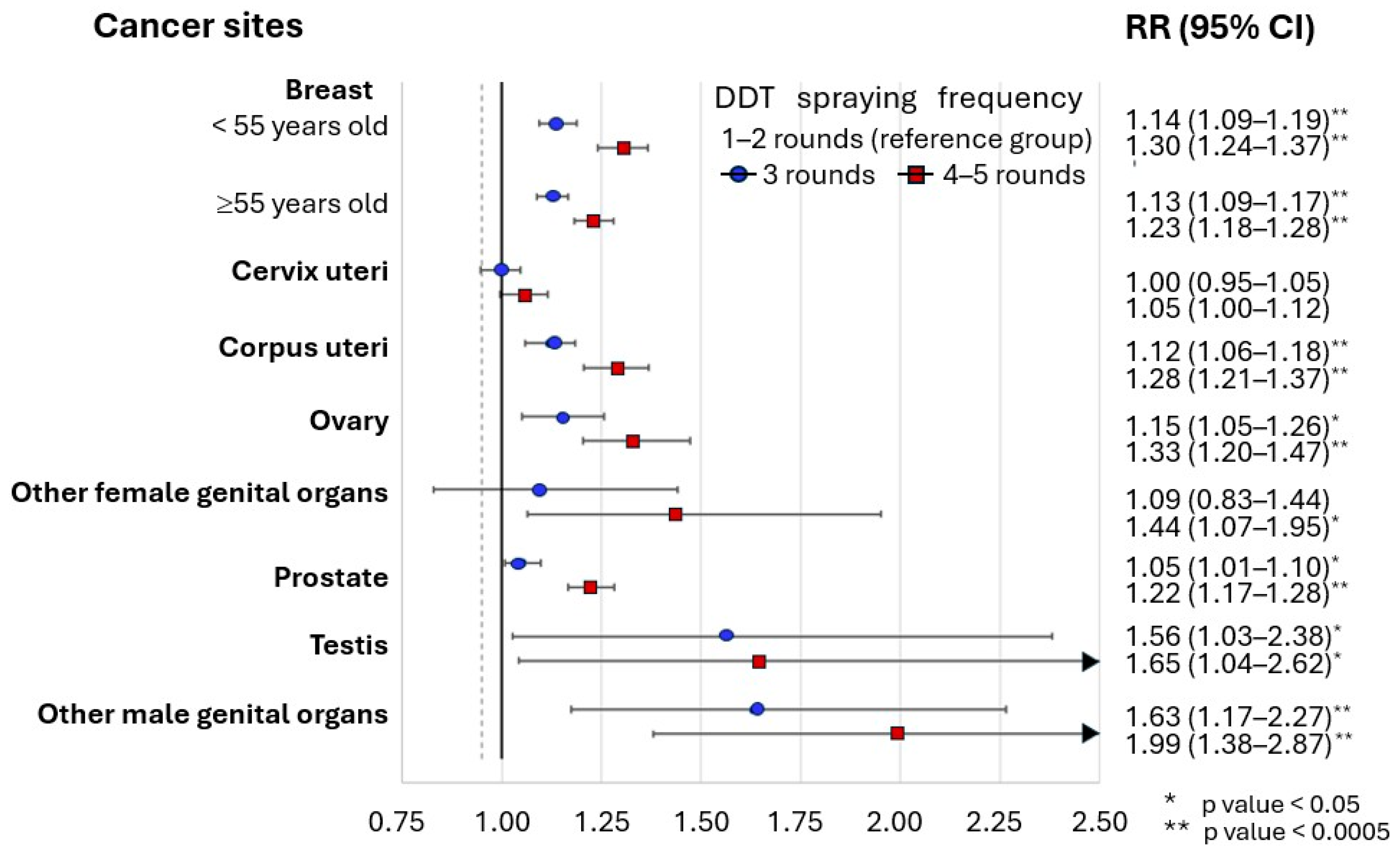
3.3. DDT Exposure Intensity and Cancer Risk
3.4. Stratified Analysis by Cancer Stage
4. Discussion
5. Strengths and Limitations
6. Implications and Future Directions
7. Conclusions
Author Contributions
Funding
Institutional Review Board Statement
Informed Consent Statement
Data Availability Statement
Acknowledgments
Conflicts of Interest
Abbreviations
| DDT | Dichlorodiphenyltrichloroethane |
| IRS | Indoor Residual Spraying |
| EDC | Endocrine-Disrupting Chemical |
| TCR | Taiwan Cancer Registry |
| AJCC | American Joint Committee on Cancer |
References
- Turusov, V.; Rakitsky, V.; Tomatis, L. Dichlorodiphenyltrichloroethane (DDT): Ubiquity, persistence, and risks. Environ. Health Perspect. 2002, 110, 125–128. [Google Scholar] [CrossRef]
- Jarman, W.M.; Ballschmiter, K. From coal to DDT: The history of the development of the pesticide DDT from synthetic dyes till Silent Spring. Endeavour 2012, 36, 131–142. [Google Scholar] [CrossRef]
- Nikonahad, A.; Khorshidi, A.; Ghaffari, H.R.; Aval, H.E.; Miri, M.; Amarloei, A.; Nourmoradi, H.; Mohammadi, A. A Time Series Analysis of Environmental and Metrological Factors Impact on Cutaneous Leishmaniasis Incidence in an Endemic Area of Dehloran, Iran. Environ. Sci. Pollut. Res. 2017, 24, 14117–14123. [Google Scholar] [CrossRef] [PubMed]
- Atafar, Z.; Mohammadi, A.; Dargahi, A.; Vosoughi Niri, M.; Hashemi Danesh, N.; Sadeghi, T. Spatial Distribution and Health Risk Assessment of Pesticide Residues in Surface Water and Tap Water in Northwest Iran. Environ. Health Eng. Manag. J. 2026, 13, 1850. [Google Scholar] [CrossRef]
- van den Berg, H.; Amwele, H.R.; Brooke, B.D.; Fortelius, L.E.; Jain, T.; Karunaratne, S.H.P.P.; Munyinda, N.S.; Rubio-Palis, Y.; Yadav, R.S.; Kleinschmidt, I. DDT: Last mile in the global phase-out of its use for disease vector control? Lancet Planet. Health 2025, 9, e101283. [Google Scholar] [CrossRef]
- Jaga, K. What are the implications of the interaction between DDT and estrogen receptors in the body? Med. Hypotheses 2000, 54, 18–25. [Google Scholar] [CrossRef] [PubMed]
- Kelce, W.R.; Stone, C.R.; Laws, S.C.; Gray, L.E.; Kemppainen, J.A.; Wilson, E.M. Persistent DDT metabolite p,p’-DDE is a potent androgen receptor antagonist. Nature 1995, 375, 581–585. [Google Scholar] [CrossRef]
- International Agency for Research on Cancer. DDT, Lindane, and 2,4-D. In IARC Monographs on the Evaluation of Carcinogenic Risks to Humans; World Health Organization: Lyon, France, 2018; Volume 113. [Google Scholar]
- Skinner, M.K.; Manikkam, M.; Tracey, R.; Guerrero-Bosagna, C.; Haque, M.; Nilsson, E.E. Ancestral dichlorodiphenyltrichloroethane (DDT) exposure promotes epigenetic transgenerational inheritance of obesity and associated disease. BMC Med. 2013, 11, 228. [Google Scholar] [CrossRef] [PubMed]
- Wu, H.-C.; Cohn, B.A.; Cirillo, P.M.; Santella, R.M.; Terry, M.B. DDT exposure during pregnancy and DNA methylation alterations in female offspring in the Child Health and Development Study. Reprod. Toxicol. 2020, 92, 138–147. [Google Scholar] [CrossRef]
- Masten, S.J.; Tian, M.; Upham, B.L.; Trosko, J.E. Effect of selected pesticides and their ozonation by-products on gap junctional intercellular communication using rat liver epithelial cell lines. Chemosphere 2001, 44, 457–465. [Google Scholar] [CrossRef]
- Burks, H.; Pashos, N.; Martin, E.; McLachlan, J.; Bunnell, B.; Burow, M. Endocrine disruptors and the tumor microenvironment: A new paradigm in breast cancer biology. Mol. Cell. Endocrinol. 2017, 457, 13–19. [Google Scholar] [CrossRef]
- Ingber, S.Z.; Buser, M.C.; Pohl, H.R.; Abadin, H.G.; Murray, H.E.; Scinicariello, F. DDT/DDE and breast cancer: A meta-analysis. Regul. Toxicol. Pharmacol. 2013, 67, 421–433. [Google Scholar] [CrossRef]
- Lewis-Mikhael, A.M.; Olmedo-Requena, R.; Martínez-Ruiz, V.; Bueno-Cavanillas, A.; Jiménez-Moleón, J.J. Organochlorine pesticides and prostate cancer, is there an association? A meta-analysis of epidemiological evidence. Cancer Causes Control 2015, 26, 1375–1392. [Google Scholar] [CrossRef]
- Cohn, B.A. Developmental and environmental origins of breast cancer: DDT as a case study. Reprod. Toxicol. 2011, 31, 302–311. [Google Scholar] [CrossRef]
- Department of Health; Executive Yuan Taiwan. Cancer Registry Annual Report, 2003 Republic of China; Bureau of Health Promotion, Department of Health: Taipei, Taiwan, 2007. Available online: https://www.hpa.gov.tw/Pages/ashx/GetFile.ashx?lang=c&type=1&sid=3d70b7e03a134c7ab39d9a6081e59214 (accessed on 17 May 2026).
- Health Promotion Administration; Ministry of Health and Welfare; Taiwan. Cancer Registry Annual Report, 2023 Taiwan; Ministry of Health and Welfare: Taipei, Taiwan, 2025. Available online: https://www.hpa.gov.tw/Pages/ashx/GetFile.ashx?lang=c&type=1&sid=19b0fbcde39a4e4da6252552cafe6176 (accessed on 17 May 2026).
- Diamanti-Kandarakis, E.; Bourguignon, J.-P.; Giudice, L.C.; Hauser, R.; Prins, G.S.; Soto, A.M.; Zoeller, R.T.; Gore, A.C. Endocrine-disrupting chemicals: An Endocrine Society scientific statement. Endocr. Rev. 2009, 30, 293–342. [Google Scholar] [CrossRef]
- Bräuner, E.V.; Lim, Y.H.; Koch, T.; Uldbjerg, C.S.; Gregersen, L.S.; Pedersen, M.K.; Frederiksen, H.; Petersen, J.H.; Coull, B.A.; Andersson, A.-M.; et al. Endocrine disrupting chemicals and risk of testicular cancer: A systematic review and meta-analysis. J. Clin. Endocrinol. Metab. 2021, 106, e4834–e4860. [Google Scholar] [CrossRef]
- Nosten, F.; Richard-Lenoble, D.; Danis, M. A brief history of malaria. Presse Med. 2022, 51, 104130. [Google Scholar] [CrossRef] [PubMed]
- Liang, K.-C. Historical review of malaria control program in Taiwan. Kaohsiung J. Med. Sci. 1991, 7, 271–277. [Google Scholar]
- Lin, Y.-P. War against mosquitoes-science, technology and society study of post- war malaria eradication in Taiwan. Taiwan Radic. Q. Soc. Stud. 2011, 81, 187–235. [Google Scholar]
- Chang, Y.-C.; Chen, C.-J.; Chen, P.-C. Increased reproductive cancer risks following early-life dichlorodiphenyltrichloroethane (DDT) exposure: Evidence from a historical population-based study in Taiwan (1952–1957). Sci. Total Environ. 2025, 995, 180067. [Google Scholar] [CrossRef] [PubMed]
- Taiwan Cancer Registry. Introduction to the Taiwan Cancer Registry. Available online: https://twcr.tw/?page_id=1822 (accessed on 20 April 2026).
- Chiang, C.-J.; You, S.-L.; Chen, C.-J.; Yang, Y.-W.; Lo, W.-C.; Lai, M.-S. Quality assessment and improvement of nationwide cancer registration system in Taiwan: A review. Jpn. J. Clin. Oncol. 2015, 45, 291–296. [Google Scholar] [CrossRef]
- Kao, C.-W.; Chiang, C.-J.; Lin, L.-J.; Huang, C.-W.; Lee, W.-C.; Lee, M.-Y. Accuracy of long-form data in the Taiwan cancer registry. J. Formos. Med. Assoc. 2021, 120, 2037–2041. [Google Scholar] [CrossRef]
- Department of Household Registration; Ministry of the Interior. Taiwan Demographic Fact Book (Annual Series); Ministry of the Interior: Taipei, Taiwan, 1978–2006. Available online: https://ghdx.healthdata.org/organizations/department-household-registration-ministry-interior-taiwan (accessed on 25 May 2026).
- Department of Household Registration; Ministry of the Interior. Household Registration Data—Population by Sex and Age at the Township Level; Ministry of the Interior: Taipei, Taiwan, 2026. Available online: https://www.ris.gov.tw/app/portal/346 (accessed on 20 April 2026).
- Tong, S. Migration bias in ecologic studies. Eur. J. Epidemiol. 2000, 16, 365–369. [Google Scholar] [CrossRef]
- Taiwan Provincial Government. Taiwan Provincial Government Bulletin (Serial Publication); Taiwan Provincial Government: Taichung, Taiwan, 1952.
- Taiwan Provincial Government. Taiwan Provincial Government Bulletin (Serial Publication); Taiwan Provincial Government: Taichung, Taiwan, 1953.
- Taiwan Provincial Government. Taiwan Provincial Government Bulletin (Serial Publication); Taiwan Provincial Government: Taichung, Taiwan, 1954.
- Taiwan Provincial Government. Taiwan Provincial Government Bulletin (Serial Publication); Taiwan Provincial Government: Taichung, Taiwan, 1955.
- Taiwan Provincial Government. Taiwan Provincial Government Bulletin (Serial Publication); Taiwan Provincial Government: Taichung, Taiwan, 1956.
- Taiwan Provincial Government. Taiwan Provincial Government Bulletin (Serial Publication); Taiwan Provincial Government: Taichung, Taiwan, 1957.
- Taiwan Provincial Government. Taiwan Provincial Government Bulletin (Serial Publication); Taiwan Provincial Government: Taichung, Taiwan, 1958.
- Liu, J.-Y.; Hung, Y.-T.; Chuang, Y.-L.; Chen, Y.-J.; Weng, W.-S.; Liu, J.-H. Incorporating development stratification of Taiwan townships into sampling design of large scale health interview survey. J. Health Manag. 2006, 4, 1–22. [Google Scholar]
- Ahmad, O.B.; Boschi-Pinto, C.; Lopez, A.D.; Murray, C.J.; Lozano, R.; Inoue, M. Age Standardization of Rates: A New WHO Standard; World Health Organization: Geneva, Switzerland, 2001; Available online: https://cdn.who.int/media/docs/default-source/gho-documents/global-health-estimates/gpe_discussion_paper_series_paper31_2001_age_standardization_rates.pdf (accessed on 20 April 2026).
- Cohn, B.A.; Cirillo, P.M.; Christianson, R.E. Prenatal DDT exposure and testicular cancer: A nested case-control study. Arch. Environ. Occup. Health 2010, 65, 127–134. [Google Scholar] [CrossRef]
- Tateo, V.; Thompson, Z.J.; Gilbert, S.M.; Cortessis, V.K.; Daneshmand, S.; Masterson, T.A.; Feldman, D.R.; Pierorazio, P.M.; Prakash, G.; Heidenreich, A.; et al. Epidemiology and risk factors for testicular cancer: A systematic review. Eur. Urol. 2025, 87, 427–441. [Google Scholar] [CrossRef]
- Cheng, L.; Albers, P.; Berney, D.M.; Feldman, D.R.; Daugaard, G.; Gilligan, T.; Looijenga, L.H.J. Testicular cancer. Nat. Rev. Dis. Primers 2018, 4, 29. [Google Scholar] [CrossRef]
- Bay, K.; Asklund, C.; Skakkebaek, N.E.; Andersson, A.-M. Testicular dysgenesis syndrome: Possible role of endocrine disrupters. Best Pract. Res. Clin. Endocrinol. Metab. 2006, 20, 77–90. [Google Scholar] [CrossRef] [PubMed]
- Huang, J.; Chan, S.C.; Tin, M.S.; Liu, X.; Lok, V.T.-T.; Ngai, C.H.; Zhang, L.; Lucero-Prisno, D.E., III; Xu, W.; Zheng, Z.-J.; et al. Worldwide distribution, risk factors, and temporal trends of testicular cancer incidence and mortality: A global analysis. Eur. Urol. Oncol. 2022, 5, 566–576. [Google Scholar] [CrossRef]
- Priyadarshini, V.; Singh, A.; Banerjee, B.D.; Radhakrishnan, G. Association of serum and cervical tissue levels of organochlorine pesticides with cervical cancer in women of east Delhi: A case control pilot study. J. South Asian Fed. Obstet. Gynaecol. 2019, 11, 190–193. [Google Scholar]
- Morgan, M.; Deoraj, A.; Felty, Q.; Yoo, C.; Roy, D. Association between exposure to estrogenic endocrine disruptors-polychlorinated biphenyls, phthalates, and bisphenol A and gynecologic cancers-cervical, ovarian, uterine cancers. J. Carcinog. Mutagen. 2016, 7, e1000275. [Google Scholar] [CrossRef]
- Medellín-Garibay, S.E.; Alcántara-Quintana, L.E.; Rodríguez-Báez, A.S.; Sagahón-Azúa, J.; Rodríguez-Aguilar, M.; Hernández Cueto, M.L.A.; Muñoz Medina, J.E.; Milán-Segovia, R.D.C.; Flores-Ramírez, R. Urinary phthalate metabolite and BPA concentrations in women with cervical cancer. Environ. Sci. Pollut. Res. 2023, 30, 21033–21042. [Google Scholar] [CrossRef]
- Ndebele, K.; Graham, B.; Tchounwou, P.B. Estrogenic activity of coumestrol, DDT, and TCDD in human cervical cancer cells. Int. J. Environ. Res. Public Health 2010, 7, 2045–2056. [Google Scholar] [CrossRef] [PubMed]
- Yang, O.; Kim, H.L.; Weon, J.I.; Seo, Y.R. Endocrine-disrupting chemicals: Review of toxicological mechanisms using molecular pathway analysis. J. Cancer Prev. 2015, 20, 12–24. [Google Scholar] [CrossRef]
- Xi, Y.; Zheng, P.; Xi, W.; Fu, T. Exploring the impact of estrogenic endocrine disruptors on cervical cancer progression: A transcriptome analysis and prognostic model development. Ecotoxicol. Environ. Saf. 2024, 285, e117025. [Google Scholar] [CrossRef]
- Buoso, E.; Masi, M.; Racchi, M.; Corsini, E. Endocrine-disrupting chemicals’ (EDCs) effects on tumour microenvironment and Cancer Progression: Emerging Contribution of RACK1. Int. J. Mol. Sci. 2020, 21, e9229. [Google Scholar] [CrossRef] [PubMed]
- Soto, A.M.; Sonnenschein, C. Environmental causes of cancer: Endocrine disruptors as carcinogens. Nat. Rev. Endocrinol. 2010, 6, 363–370. [Google Scholar] [CrossRef] [PubMed]
- Koual, M.; Tomkiewicz, C.; Cano-Sancho, G.; Antignac, J.-P.; Bats, A.-S.; Coumoul, X. Environmental chemicals, breast cancer progression and drug resistance. Environ. Health 2020, 19, e117. [Google Scholar] [CrossRef]
- Lee, D.G.; Schuetz, J.M.; Lai, A.S.; Burstyn, I.; Brooks-Wilson, A.; Aronson, K.J.; Spinelli, J.J. Interactions between exposure to polycyclic aromatic hydrocarbons and xenobiotic metabolism genes, and risk of breast cancer. Breast Cancer 2022, 29, 38–49. [Google Scholar] [CrossRef]
- LeBlanc, G.; Lee, I.; Carretta, H.; Luo, Y.; Sinha, D.; Rust, G. Rural-urban differences in breast cancer stage at diagnosis. Womens Health Rep. 2022, 3, 207–214. [Google Scholar] [CrossRef]
- Tsai, E.; Walker, B.; Wu, S.-C. Nationwide oral cancer screening and rural-urban disparities in oral cancer diagnosis, treatment and mortality: A population-based cohort study in Taiwan. BMJ Public Health 2026, 4, e003963. [Google Scholar] [CrossRef] [PubMed]
- Sun, Y.-S.; Zhao, Z.; Yang, Z.-N.; Xu, F.; Lu, H.-J.; Zhu, Z.-Y.; Shi, W.; Jiang, J.; Yao, P.-P.; Zhu, H.-P. Risk factors and preventions of breast cancer. Int. J. Biol. Sci. 2017, 13, 1387–1397. [Google Scholar] [CrossRef] [PubMed]
- Mullan, B.P.; Li, C.-H.; Gallin, R.S.; Gallin, B. Family and internal migration in Taiwan. Asian Pac. Migr. J. 1998, 7, 43–66. [Google Scholar] [CrossRef]
- Chang, S.; El-Zaemey, S.; Heyworth, J.; Tang, M.-C. DDT exposure in early childhood and female breast cancer: Evidence from an ecological study in Taiwan. Environ. Int. 2018, 121, 1106–1112. [Google Scholar] [CrossRef]
- Yland, J.J.; Wesselink, A.K.; Lash, T.L.; Fox, M.P. Misconceptions about the direction of bias from nondifferential misclassification. Am. J. Epidemiol. 2022, 191, 1485–1495. [Google Scholar] [CrossRef] [PubMed]
- Lash, T.L.; VanderWeele, T.J.; Haneuse, S.; Rothman, K.J. Modern Epidemiology, 4th ed.; Wolters Kluwer: Philadelphia, PA, USA, 2021. [Google Scholar]
- Morgenstern, H. Ecologic studies in epidemiology: Concepts, principles, and methods. Annu. Rev. Public Health 1995, 16, 61–81. [Google Scholar] [CrossRef]
- Levin, K.A. Study Design VI-Ecological Studies. Evid. Based Dent. 2006, 7, 108. [Google Scholar] [CrossRef]

| DDT Indoor Residual Spraying Frequency | ||||||
|---|---|---|---|---|---|---|
| 0 | 1 | 2 | 3 | 4 | 5 | |
| Total population (N) | 313,415 | 395,047 | 13,588 | 1,151,292 | 281,530 | 339,170 |
| Sex | ||||||
| Man (%) | 49.9 | 51.6 | 52.3 | 50.6 | 51.9 | 52.7 |
| Woman (%) | 50.1 | 48.4 | 47.7 | 49.4 | 48.1 | 47.3 |
| Age in 1979 (%) | ||||||
| 20–24 | 58.2 | 60.8 | 61.8 | 59.8 | 61.1 | 63.1 |
| 25–29 | 41.8 | 39.2 | 38.2 | 40.2 | 38.9 | 36.9 |
| Urbanization 1 | ||||||
| Level I (%) | 71.9 | 33.9 | 0.0 | 19.4 | 3.3 | 0.0 |
| Level II (%) | 28.1 | 22.6 | 0.0 | 47.8 | 57.7 | 33.3 |
| Level III (%) | 0.0 | 28.3 | 45.5 | 23.1 | 23.4 | 35.1 |
| Level IV (%) | 0.0 | 15.1 | 54.5 | 9.7 | 15.6 | 31.6 |
| Reproductive Cancer Cases (Person) | Man | Woman |
|---|---|---|
| Total N | 21,401 | 87,843 |
| Age at diagnosis (years old) | ||
| <45 (%) | 164 (0.8) | 12,874 (14.7) |
| 45–55 (%) | 1006 (4.7) | 28,126 (32.0) |
| 56–71 (%) | 20,231 (94.5) | 46,843 (53.3) |
| Year at diagnosis of cancer | ||
| 1979–1990 (%) | 81 (0.4) | 2651 (3.0) |
| 1991–2000 (%) | 125 (0.6) | 14,387 (16.4) |
| 2001–2010 (%) | 1359 (6.4) | 26,557 (30.2) |
| 2011–2022 (%) | 19,836 (92.7) | 44,248 (50.4) |
| Cancer site (ICD-O-3) | ||
| Female reproductive organs (C50–C58) | ||
| Breast (C50) | ||
| <55 years old | -- | 21,892 |
| ≥55 years old | -- | 31,760 |
| Cervix uteri (C53) | -- | 14,154 |
| Corpus uteri (C54–C55) | -- | 12,304 |
| Ovary (C56) | -- | 6993 |
| Other female genital organs (C51–C52, C57–C58) | -- | 740 |
| Male reproductive organs (C60–C63) | ||
| Prostate (C61) | 20,721 | -- |
| Testis (C62) | 256 | -- |
| Other male genital organs (C60, C63) | 424 | -- |
| Cancer stage at diagnosis (%) 1 | ||
| Stage 0 | 0.0 | 5.0 |
| Stage I | 13.0 | 41.3 |
| Stage II | 37.5 | 31.5 |
| Stage III | 23.3 | 11.9 |
| Stage IV | 26.2 | 10.3 |
| Cancer Site (ICD-O-3) | DDT Indoor Residual Spraying Frequency | |||||
|---|---|---|---|---|---|---|
| 0 | 1 | 2 | 3 | 4 | 5 | |
| Female reproductive organs (C50–C58) | ||||||
| Breast (C50) | 8.13 | 7.05 | 5.55 | 7.37 | 7.76 | 7.11 |
| <55 years old | 6.49 | 5.73 | 4.50 | 5.91 | 6.38 | 5.67 |
| ≥55 years old | 14.13 | 11.84 | 7.36 | 12.74 | 13.34 | 12.17 |
| Cervix uteri (C53) | 1.89 | 2.13 | 2.57 | 2.03 | 2.21 | 2.12 |
| Corpus uteri (C54–C55) | 1.43 | 1.29 | 1.09 | 1.31 | 1.45 | 1.33 |
| Ovary (C56) | 0.97 | 0.80 | 0.65 | 0.85 | 0.87 | 0.83 |
| Other female genital organs (C51–C52, C57–C58) | 0.08 | 0.10 | 0.10 | 0.09 | 0.10 | 0.10 |
| Male reproductive organs (C60–C63) | ||||||
| Prostate (C61) | 1.94 | 1.74 | 1.24 | 1.74 | 1.97 | 1.68 |
| Testis (C62) | 0.03 | 0.03 | 0.00 | 0.05 | 0.04 | 0.05 |
| Other male genital organs (C60, C63) | 0.05 | 0.04 | 0.03 | 0.05 | 0.07 | 0.05 |
| Cancer Site (ICD-O-3) | All Townships (0–5 Rounds) | Restricted Analysis (1–5 Rounds) |
|---|---|---|
| RR (95% CI) | RR (95% CI) | |
| Female reproductive organs (C50–C58) | ||
| Breast (C50) | ||
| <55 years old | 1.05 (1.04–1.07) ** | 1.07 (1.06–1.09) ** |
| ≥55 years old | 1.04 (1.03–1.05) ** | 1.06 (1.05–1.08) ** |
| Cervix uteri (C53) | 1.01 (1.002–1.02) * | 1.01 (1.003–1.03) * |
| Corpus uteri (C54–C55) | 1.05 (1.03–1.06) ** | 1.07 (1.06–1.09) ** |
| Ovary (C56) | 1.05 (1.03–1.07) ** | 1.10 (1.07–1.12) ** |
| Other female genital organs (C51–C52, C57–C58) | 1.08 (1.02–1.14) * | 1.09 (1.02–1.17) * |
| Male reproductive organs (C60–C63) | ||
| Prostate (C61) | 1.03 (1.03–1.05) ** | 1.06 (1.04–1.07) ** |
| Testis (C62) | 1.16 (1.01–1.23) * | 1.13 (1.001–1.27) ** |
| Other male genital organs (C60, C63) | 1.12 (1.04–1.21) * | 1.18 (1.07–1.30) * |
| Cancer Site (ICD-O-3) | Stage at Diagnosis | |
|---|---|---|
| Localized (Stage 0–II) | Advanced (Stage III–IV) | |
| RRs (95% CI) | RRs (95% CI) | |
| Breast (C50) | ||
| <55 years old | 1.07 (1.03–1.11) ** | 1.04 (0.96–1.13) |
| ≥55 years old | 1.08 (1.07–1.10) ** | 1.03 (1.00–1.07) |
| Cervix uteri (C53) | 1.02 (0.98–1.06) | 1.03 (0.98–1.09) |
| Corpus uteri (C54–C55) | 1.05 (1.02–1.09) ** | 1.07 (1.01–1.15) * |
| Ovary (C56) | 1.11 (1.03–1.20) * | 1.05 (1.00–1.11) |
| Prostate (C61) | 1.08 (1.05–1.11) ** | 1.01 (0.98–1.03) |
| Cancer Site (ICD-O-3) | Stage | Moderate Exposure (3 Rounds) | High Exposure (4–5 Rounds) |
|---|---|---|---|
| RR (95% CI) | RR (95% CI) | ||
| Breast (C50) | |||
| <55 years old | Localized (0–II) | 1.05 (0.94–1.19) | 1.31 (1.14–1.49) ** |
| Advanced (III–IV) | 0.95 (0.75–1.22) | 1.15 (0.86–1.53) | |
| ≥55 years old | Localized (0–II) | 1.10 (1.05–1.15) ** | 1.26 (1.20–1.33) ** |
| Advanced (III–IV) | 1.19 (1.07–1.32) ** | 1.13 (1.01–1.28) * | |
| Cervix uteri (C53) | Localized (0–II) | 0.98 (0.86–1.11) | 1.03 (0.90–1.19) |
| Advanced (III–IV) | 1.23 (1.02–1.48) * | 1.09 (0.88–1.34) | |
| Corpus uteri (C54–C55) | Localized (0–II) | 1.09 (0.98–1.20) | 1.18 (1.05–1.32) ** |
| Advanced (III–IV) | 1.22 (0.99–1.50) | 1.33 (1.05–1.68) * | |
| Ovary (C56) | Localized (0–II) | 1.33 (1.04–1.70) * | 1.45 (1.10–1.92) * |
| Advanced (III-IV) | 1.01 (0.85–1.19) | 1.13 (0.93–1.38) | |
| Prostate (C61) | Localized (0-II) | 1.03 (0.95–1.11) | 1.26 (1.15–1.37) ** |
| Advanced (III-IV) | 1.01 (0.93–1.09) | 1.06 (0.97–1.15) |
Disclaimer/Publisher’s Note: The statements, opinions and data contained in all publications are solely those of the individual author(s) and contributor(s) and not of MDPI and/or the editor(s). MDPI and/or the editor(s) disclaim responsibility for any injury to people or property resulting from any ideas, methods, instructions or products referred to in the content. |
© 2026 by the authors. Licensee MDPI, Basel, Switzerland. This article is an open access article distributed under the terms and conditions of the Creative Commons Attribution (CC BY) license.
Share and Cite
Chang, Y.-C.; Chang, Y.-Y.; Wu, W.-T.; Chen, P.-C. Early-Life Exposure to DDT from Indoor Residual Spraying and Adult Risk of Reproductive Cancers: A Nationwide Study with Long-Term Follow-Up in Taiwan. Cancers 2026, 18, 1816. https://doi.org/10.3390/cancers18111816
Chang Y-C, Chang Y-Y, Wu W-T, Chen P-C. Early-Life Exposure to DDT from Indoor Residual Spraying and Adult Risk of Reproductive Cancers: A Nationwide Study with Long-Term Follow-Up in Taiwan. Cancers. 2026; 18(11):1816. https://doi.org/10.3390/cancers18111816
Chicago/Turabian StyleChang, Ya-Chi, Yu-Yin Chang, Wei-Te Wu, and Pau-Chung Chen. 2026. "Early-Life Exposure to DDT from Indoor Residual Spraying and Adult Risk of Reproductive Cancers: A Nationwide Study with Long-Term Follow-Up in Taiwan" Cancers 18, no. 11: 1816. https://doi.org/10.3390/cancers18111816
APA StyleChang, Y.-C., Chang, Y.-Y., Wu, W.-T., & Chen, P.-C. (2026). Early-Life Exposure to DDT from Indoor Residual Spraying and Adult Risk of Reproductive Cancers: A Nationwide Study with Long-Term Follow-Up in Taiwan. Cancers, 18(11), 1816. https://doi.org/10.3390/cancers18111816

