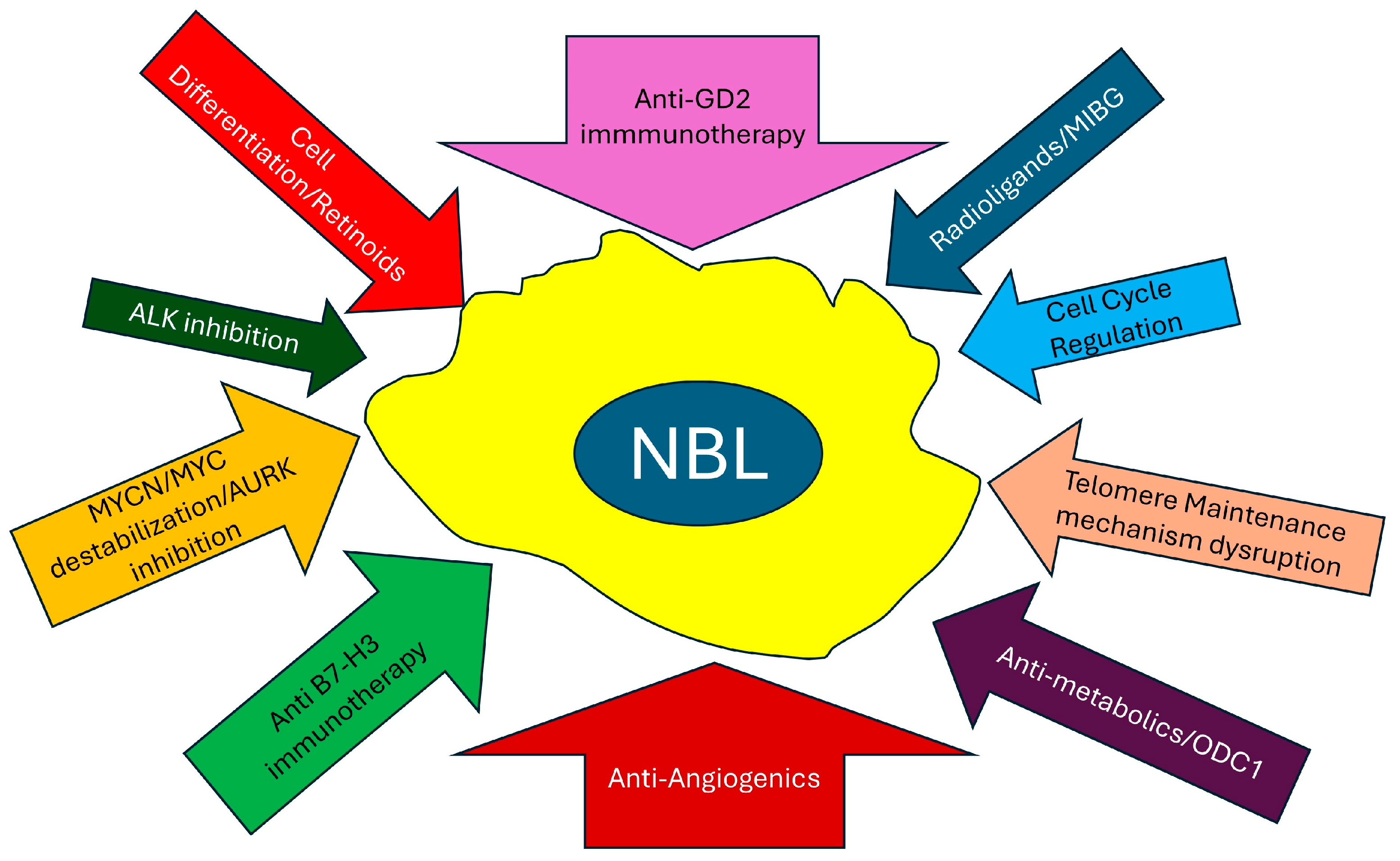
Targeted Therapies in Neuroblastoma: A History and a View to the Future


Simple Summary
Abstract
1. Introduction
2. Cell Differentiation and Retinoids
3. GD2 and Anti-GD2 Immunotherapies
4. Norepinephrine Transporter (NET), Somatostatin Receptors and Radiopharmaceuticals
5. ALK
6. Aurora Kinases, MYCN and MYC
7. Telomere Maintenance Mechanisms, ATR, and ATM
8. Cell Cycle Kinetics and Cyclin Regulation
9. Antiangiogenic Therapies
10. B7-H3
11. ODC1 and Metabolomics
12. Conclusions
Funding
Institutional Review Board Statement
Informed Consent Statement
Data Availability Statement
Conflicts of Interest
References
- Wright, J.H. Neurocytoma or Neuroblastoma, a Kind of Tumor Not Generally Recognized. J. Exp. Med. 1910, 12, 556–561. [Google Scholar] [CrossRef]
- Lehman, E.P. Neuroblastoma: With report of a Case. J. Med. Res. 1917, 36, 309–326.7. [Google Scholar] [PubMed]
- Holmes, G.W.; Dresser, R. Roentgenologic observations in neuroblastoma. J. Am. Med. Assoc. 1928, 91, 1246–1248. [Google Scholar] [CrossRef]
- Phillips, R. Neuroblastoma. Ann. R. Coll. Surg. Engl. 1953, 12, 29–48. [Google Scholar]
- Cohn, S.L.; Pearson, A.D.; London, W.B.; Monclair, T.; Ambros, P.F.; Brodeur, G.M.; Faldum, A.; Hero, B.; Iehara, T.; Machin, D.; et al. The International Neuroblastoma Risk Group (INRG) classification system: An INRG Task Force report. J. Clin. Oncol. 2009, 27, 289–297. [Google Scholar] [CrossRef]
- Irwin, M.S.; Naranjo, A.; Zhang, F.F.; Cohn, S.L.; London, W.B.; Gastier-Foster, J.M.; Ramirez, N.C.; Pfau, R.; Reshmi, S.; Wagner, E.; et al. Revised Neuroblastoma Risk Classification System: A Report From the Children’s Oncology Group. J. Clin. Oncol. 2021, 39, 3229–3241. [Google Scholar] [CrossRef] [PubMed]
- Matthay, K.K.; Villablanca, J.G.; Seeger, R.C.; Stram, D.O.; Harris, R.E.; Ramsay, N.K.; Swift, P.; Shimada, H.; Black, C.T.; Brodeur, G.M.; et al. Treatment of high-risk neuroblastoma with intensive chemotherapy, radiotherapy, autologous bone marrow transplantation, and 13-cis-retinoic acid. N. Engl. J. Med. 1999, 341, 1165–1173. [Google Scholar] [CrossRef]
- Park, J.R.; Kreissman, S.G.; London, W.B.; Naranjo, A.; Cohn, S.L.; Hogarty, M.D.; Tenney, S.C.; Haas-Kogan, D.; Shaw, P.J.; Kraveka, J.M.; et al. Effect of Tandem Autologous Stem Cell Transplant vs Single Transplant on Event-Free Survival in Patients With High-Risk Neuroblastoma: A Randomized Clinical Trial. JAMA 2019, 322, 746–755. [Google Scholar] [CrossRef]
- Ladenstein, R.; Potschger, U.; Pearson, A.D.J.; Brock, P.; Luksch, R.; Castel, V.; Yaniv, I.; Papadakis, V.; Laureys, G.; Malis, J.; et al. Busulfan and melphalan versus carboplatin, etoposide, and melphalan as high-dose chemotherapy for high-risk neuroblastoma (HR-NBL1/SIOPEN): An international, randomised, multi-arm, open-label, phase 3 trial. Lancet Oncol. 2017, 18, 500–514. [Google Scholar] [CrossRef] [PubMed]
- Saari, J.C.; Futterman, S.; Stubbs, G.W.; Heffernan, J.T.; Bredberg, L.; Chan, D.Y.; Albert, D.M. Cellular retinol- and retinoic acid-binding proteins in transformed mammalian cells. Investig. Ophthalmol. Vis. Sci. 1978, 17, 988–992. [Google Scholar]
- Chapman, S.K. Antitumor effects of vitamin A and inhibitors of ornithine decarboxylase in cultured neuroblastoma and glioma cells. Life Sci. 1980, 26, 1359–1366. [Google Scholar] [CrossRef]
- Sidell, N. Retinoic acid-induced growth inhibition and morphologic differentiation of human neuroblastoma cells in vitro. J. Natl. Cancer Inst. 1982, 68, 589–596. [Google Scholar]
- Sidell, N.; Altman, A.; Haussler, M.R.; Seeger, R.C. Effects of retinoic acid (RA) on the growth and phenotypic expression of several human neuroblastoma cell lines. Exp. Cell Res. 1983, 148, 21–30. [Google Scholar] [CrossRef]
- Helson, L.; Helson, C. Human neuroblastoma cells and 13-cis-retinoic acid. J. Neuro-Oncol. 1985, 3, 39–41. [Google Scholar] [CrossRef]
- Sidell, N.; Sarafian, T.; Kelly, M.; Tsuchida, T.; Haussler, M. Retinoic acid-induced differentiation of human neuroblastoma: A cell variant system showing two distinct responses. Exp. Cell Biol. 1986, 54, 287–300. [Google Scholar] [CrossRef]
- Hino, T.; Sugimoto, T.; Matsumura, T.; Horii, Y.; Inazawa, J.; Sawada, T. Diverse responses to retinoid in morphological differentiation, tumorigenesis and N-myc expression in human neuroblastoma sublines. Int. J. Cancer 1989, 44, 286–291. [Google Scholar] [CrossRef] [PubMed]
- Lanciotti, M.; Longone, P.; Cornaglia-Ferraris, P.; Ponzoni, M. Retinoic acid inhibits phosphatidylinositol turnover only in RA-sensitive while not in RA-resistant human neuroblastoma cells. Biochem. Biophys. Res. Commun. 1989, 161, 284–289. [Google Scholar] [CrossRef] [PubMed]
- Finklestein, J.Z.; Krailo, M.D.; Lenarsky, C.; Ladisch, S.; Blair, G.K.; Reynolds, C.P.; Sitarz, A.L.; Hammond, G.D. 13-cis-retinoic acid (NSC 122758) in the treatment of children with metastatic neuroblastoma unresponsive to conventional chemotherapy: Report from the Childrens Cancer Study Group. Med. Pediatr. Oncol. 1992, 20, 307–311. [Google Scholar] [CrossRef]
- Kohler, J.A.; Imeson, J.; Ellershaw, C.; Lie, S.O. A randomized trial of 13-Cis retinoic acid in children with advanced neuroblastoma after high-dose therapy. Br. J. Cancer 2000, 83, 1124–1127. [Google Scholar] [CrossRef]
- Matthay, K.K.; Reynolds, C.P.; Seeger, R.C.; Shimada, H.; Adkins, E.S.; Haas-Kogan, D.; Gerbing, R.B.; London, W.B.; Villablanca, J.G. Long-term results for children with high-risk neuroblastoma treated on a randomized trial of myeloablative therapy followed by 13-cis-retinoic acid: A children’s oncology group study. J. Clin. Oncol. 2009, 27, 1007–1013. [Google Scholar] [CrossRef] [PubMed]
- Mariotti, A.; Marcora, E.; Bunone, G.; Costa, A.; Veronesi, U.; Pierotti, M.A.; Della Valle, G. N-(4-hydroxyphenyl)retinamide: A potent inducer of apoptosis in human neuroblastoma cells. J. Natl. Cancer Inst. 1994, 86, 1245–1247. [Google Scholar] [CrossRef]
- Ponzoni, M.; Bocca, P.; Chiesa, V.; Decensi, A.; Pistoia, V.; Raffaghello, L.; Rozzo, C.; Montaldo, P.G. Differential effects of N-(4-hydroxyphenyl)retinamide and retinoic acid on neuroblastoma cells: Apoptosis versus differentiation. Cancer Res. 1995, 55, 853–861. [Google Scholar]
- Zuccari, G.; Zorzoli, A.; Marimpietri, D.; Alfei, S. Development of Mixed Micelles for Enhancing Fenretinide Apparent Solubility and Anticancer Activity Against Neuroblastoma Cells. Curr. Drug Deliv. 2024, 22, 1017–1029. [Google Scholar] [CrossRef] [PubMed]
- Orienti, I.; Farruggia, G.; Nguyen, F.; Guan, P.; Calonghi, N.; Kolla, V.; Chorny, M.; Brodeur, G.M. Nanomicellar Lenalidomide-Fenretinide Combination Suppresses Tumor Growth in an MYCN Amplified Neuroblastoma Tumor. Int. J. Nanomed. 2020, 15, 6873–6886. [Google Scholar] [CrossRef] [PubMed]
- Orienti, I.; Cripe, T.P.; Currier, M.A.; Cavallari, C.; Teti, G.; Falconi, M. A Cationic Nanomicellar Complex of the Quaternary Amphiphilic Amine RC16+ with Fenretinide as a New Multitasking System for Antitumor Therapy. Curr. Drug Deliv. 2019, 16, 807–817. [Google Scholar] [CrossRef]
- Gu, Y.; Zhong, K.; Peng, L.; Ding, W.; Zeng, X. TRAF4 Silencing Induces Cell Apoptosis and Improves Retinoic Acid Sensitivity in Human Neuroblastoma. Neurochem. Res. 2023, 48, 2116–2128. [Google Scholar] [CrossRef]
- Marayati, R.; Bownes, L.V.; Stafman, L.L.; Williams, A.P.; Quinn, C.H.; Atigadda, V.; Aye, J.M.; Stewart, J.E.; Yoon, K.J.; Beierle, E.A. 9-cis-UAB30, a novel rexinoid agonist, decreases tumorigenicity and cancer cell stemness of human neuroblastoma patient-derived xenografts. Transl. Oncol. 2021, 14, 100893. [Google Scholar] [CrossRef] [PubMed]
- Lampis, S.; Raieli, S.; Montemurro, L.; Bartolucci, D.; Amadesi, C.; Bortolotti, S.; Angelucci, S.; Scardovi, A.L.; Nieddu, G.; Cerisoli, L.; et al. The MYCN inhibitor BGA002 restores the retinoic acid response leading to differentiation or apoptosis by the mTOR block in MYCN-amplified neuroblastoma. J. Exp. Clin. Cancer Res. 2022, 41, 160. [Google Scholar] [CrossRef]
- Issa, R.S.; Kaehler, M.; Pommert, N.S.; Cascorbi, I.; Waetzig, V. Enhancing Retinoic Acid-mediated Effects Through Inhibition of CYP26A1, CYP26B1 and HGF Signaling in Neuroblastoma Cells. Anticancer Res. 2024, 44, 4189–4202. [Google Scholar] [CrossRef]
- Nguyen, L.D.; Sengupta, S.; Cho, K.I.; Floru, A.; George, R.E.; Krichevsky, A.M. A drug that induces the microRNA miR-124 enables differentiation of retinoic acid-resistant neuroblastoma cells. Sci. Signal. 2025, 18, eads2641. [Google Scholar] [CrossRef]
- Cahan, L.D.; Irie, R.F.; Singh, R.; Cassidenti, A.; Paulson, J.C. Identification of a human neuroectodermal tumor antigen (OFA-I-2) as ganglioside GD2. Proc. Natl. Acad. Sci. USA 1982, 79, 7629–7633. [Google Scholar] [CrossRef] [PubMed]
- Hersey, P.; Schibeci, S.; Cheresh, D. Augmentation of lymphocyte responses by monoclonal antibodies to the gangliosides GD3 and GD2: The role of protein kinase C, cyclic nucleotides, and intracellular calcium. Cell. Immunol. 1989, 119, 263–278. [Google Scholar] [CrossRef] [PubMed]
- Saito, M.; Yu, R.K.; Cheung, N.K. Ganglioside GD2 specificity of monoclonal antibodies to human neuroblastoma cell. Biochem. Biophys. Res. Commun. 1985, 127, 1–7. [Google Scholar] [CrossRef]
- Uttenreuther-Fischer, M.M.; Huang, C.S.; Reisfeld, R.A.; Yu, A.L. Pharmacokinetics of anti-ganglioside GD2 mAb 14G2a in a phase I trial in pediatric cancer patients. Cancer Immunol. Immunother. 1995, 41, 29–36. [Google Scholar] [CrossRef] [PubMed]
- Saarinen, U.M.; Coccia, P.F.; Gerson, S.L.; Pelley, R.; Cheung, N.K. Eradication of neuroblastoma cells in vitro by monoclonal antibody and human complement: Method for purging autologous bone marrow. Cancer Res. 1985, 45, 5969–5975. [Google Scholar]
- Mueller, B.M.; Romerdahl, C.A.; Gillies, S.D.; Reisfeld, R.A. Enhancement of antibody-dependent cytotoxicity with a chimeric anti-GD2 antibody. J. Immunol. 1990, 144, 1382–1386. [Google Scholar] [CrossRef]
- Dinutuximab approved for high-risk neuroblastoma. Cancer Discov. 2015, 5, OF5. [CrossRef]
- Pennington, B.; Ren, S.; Barton, S.; Bacelar, M.; Edwards, S.J. Dinutuximab Beta for Treating Neuroblastoma: An Evidence Review Group and Decision Support Unit Perspective of a NICE Single Technology Appraisal. Pharmacoeconomics 2019, 37, 985–993. [Google Scholar] [CrossRef]
- Yu, A.L.; Gilman, A.L.; Ozkaynak, M.F.; London, W.B.; Kreissman, S.G.; Chen, H.X.; Smith, M.; Anderson, B.; Villablanca, J.G.; Matthay, K.K.; et al. Anti-GD2 antibody with GM-CSF, interleukin-2, and isotretinoin for neuroblastoma. N. Engl. J. Med. 2010, 363, 1324–1334. [Google Scholar] [CrossRef]
- Yu, A.L.; Gilman, A.L.; Ozkaynak, M.F.; Naranjo, A.; Diccianni, M.B.; Gan, J.; Hank, J.A.; Batova, A.; London, W.B.; Tenney, S.C.; et al. Long-Term Follow-up of a Phase III Study of ch14.18 (Dinutuximab) + Cytokine Immunotherapy in Children with High-Risk Neuroblastoma: COG Study ANBL0032. Clin. Cancer Res. 2021, 27, 2179–2189. [Google Scholar] [CrossRef]
- Ladenstein, R.; Potschger, U.; Valteau-Couanet, D.; Luksch, R.; Castel, V.; Yaniv, I.; Laureys, G.; Brock, P.; Michon, J.M.; Owens, C.; et al. Interleukin 2 with anti-GD2 antibody ch14.18/CHO (dinutuximab beta) in patients with high-risk neuroblastoma (HR-NBL1/SIOPEN): A multicentre, randomised, phase 3 trial. Lancet Oncol. 2018, 19, 1617–1629. [Google Scholar] [CrossRef] [PubMed]
- Cheung, N.K.; Lazarus, H.; Miraldi, F.D.; Abramowsky, C.R.; Kallick, S.; Saarinen, U.M.; Spitzer, T.; Strandjord, S.E.; Coccia, P.F.; Berger, N.A. Ganglioside GD2 specific monoclonal antibody 3F8: A phase I study in patients with neuroblastoma and malignant melanoma. J. Clin. Oncol. 1987, 5, 1430–1440. [Google Scholar] [CrossRef] [PubMed]
- Navid, F.; Sondel, P.M.; Barfield, R.; Shulkin, B.L.; Kaufman, R.A.; Allay, J.A.; Gan, J.; Hutson, P.; Seo, S.; Kim, K.; et al. Phase I trial of a novel anti-GD2 monoclonal antibody, Hu14.18K322A, designed to decrease toxicity in children with refractory or recurrent neuroblastoma. J. Clin. Oncol. 2014, 32, 1445–1452. [Google Scholar] [CrossRef]
- Mora, J.; Chan, G.C.F.; Morgenstern, D.A.; Amoroso, L.; Nysom, K.; Faber, J.; Wingerter, A.; Bear, M.K.; Rubio-San-Simon, A.; de Las Heras, B.M.; et al. The anti-GD2 monoclonal antibody naxitamab plus GM-CSF for relapsed or refractory high-risk neuroblastoma: A phase 2 clinical trial. Nat. Commun. 2025, 16, 1636. [Google Scholar] [CrossRef]
- Furman, W.L.; McCarville, B.; Shulkin, B.L.; Davidoff, A.; Krasin, M.; Hsu, C.W.; Pan, H.; Wu, J.; Brennan, R.; Bishop, M.W.; et al. Improved Outcome in Children with Newly Diagnosed High-Risk Neuroblastoma Treated with Chemoimmunotherapy: Updated Results of a Phase II Study Using hu14.18K322A. J. Clin. Oncol. 2022, 40, 335–344. [Google Scholar] [CrossRef] [PubMed]
- Chu, Y.; Nayyar, G.; Jiang, S.; Rosenblum, J.M.; Soon-Shiong, P.; Safrit, J.T.; Lee, D.A.; Cairo, M.S. Combinatorial immunotherapy of N-803 (IL-15 superagonist) and dinutuximab with ex vivo expanded natural killer cells significantly enhances in vitro cytotoxicity against GD2(+) pediatric solid tumors and in vivo survival of xenografted immunodeficient NSG mice. J. Immunother. Cancer 2021, 9, e002267. [Google Scholar] [CrossRef]
- Nguyen, R.; Zhang, X.; Sun, M.; Abbas, S.; Seibert, C.; Kelly, M.C.; Shern, J.F.; Thiele, C.J. Anti-GD2 Antibodies Conjugated to IL15 and IL21 Mediate Potent Antitumor Cytotoxicity against Neuroblastoma. Clin. Cancer Res. 2022, 28, 3785–3796. [Google Scholar] [CrossRef]
- Siebert, N.; Leopold, J.; Zumpe, M.; Troschke-Meurer, S.; Biskupski, S.; Zikoridse, A.; Lode, H.N. The Immunocytokine FAP-IL-2v Enhances Anti-Neuroblastoma Efficacy of the Anti-GD(2) Antibody Dinutuximab Beta. Cancers 2022, 14, 4842. [Google Scholar] [CrossRef]
- Song, D.; Han, J.; Dong, C.; Wang, Q.; Zhu, X.; Li, J.; Rao, M.; Liu, H.; Ma, Z.; Teng, Y.; et al. Identification and Pre-clinical Evaluation of a Novel GD2 Antibody-Drug Conjugate for Solid Tumors in Children and Adults. Mol. Cancer Ther. 2026. [Google Scholar] [CrossRef]
- Louis, C.U.; Savoldo, B.; Dotti, G.; Pule, M.; Yvon, E.; Myers, G.D.; Rossig, C.; Russell, H.V.; Diouf, O.; Liu, E.; et al. Antitumor activity and long-term fate of chimeric antigen receptor-positive T cells in patients with neuroblastoma. Blood 2011, 118, 6050–6056. [Google Scholar] [CrossRef]
- Yu, L.; Huang, L.; Lin, D.; Lai, X.; Wu, L.; Liao, X.; Liu, J.; Zeng, Y.; Liang, L.; Zhang, G.; et al. GD2-specific chimeric antigen receptor-modified T cells for the treatment of refractory and/or recurrent neuroblastoma in pediatric patients. J. Cancer Res. Clin. Oncol. 2022, 148, 2643–2652. [Google Scholar] [CrossRef]
- Yankelevich, M.; Thakur, A.; Modak, S.; Chu, R.; Taub, J.; Martin, A.; Schalk, D.; Schienshang, A.; Whitaker, S.; Rea, K.; et al. Targeting refractory/recurrent neuroblastoma and osteosarcoma with anti-CD3xanti-GD2 bispecific antibody armed T cells. J. Immunother. Cancer 2024, 12, e008744. [Google Scholar] [CrossRef]
- Li, C.H.; Sharma, S.; Heczey, A.A.; Woods, M.L.; Steffin, D.H.M.; Louis, C.U.; Grilley, B.J.; Thakkar, S.G.; Wu, M.; Wang, T.; et al. Long-term outcomes of GD2-directed CAR-T cell therapy in patients with neuroblastoma. Nat. Med. 2025, 31, 1125–1129. [Google Scholar] [CrossRef]
- Giudice, A.M.; Roth, S.L.; Matlaga, S.; Cresswell-Clay, E.; Mishra, P.; Schurch, P.M.; Boateng-Antwi, K.A.M.; Samanta, M.; Pascual-Pasto, G.; Zecchino, V.; et al. Reprogramming the neuroblastoma tumor immune microenvironment to enhance GPC2 CAR T cells. Mol. Ther. 2025, 33, 4552–4569. [Google Scholar] [CrossRef]
- Locatelli, F.; Pagliara, D.; De Ioris, M.A.; Becilli, M.; Del Baldo, G.; Serra, A.; Mastronuzzi, A.; Cefalo, M.G.; Li Pira, G.; Leone, G.; et al. GD2-targeting CAR T cells in high-risk neuroblastoma: A phase 1/2 trial. Nat. Med. 2025, 31, 3689–3699. [Google Scholar] [CrossRef] [PubMed]
- Bodden, M.; Hacker, A.; Roder, J.; Kiefer, A.; Zhang, C.; Bhatti, A.; Pfeifer Serrahima, J.; Ullrich, E.; Kuhnel, I.; Wels, W.S. Co-Expression of an IL-15 Superagonist Facilitates Self-Enrichment of GD(2)-Targeted CAR-NK Cells and Mediates Potent Cell Killing in the Absence of IL-2. Cancers 2023, 15, 4310. [Google Scholar] [CrossRef]
- Quamine, A.E.; Olsen, M.R.; Cho, M.M.; Capitini, C.M. Approaches to Enhance Natural Killer Cell-Based Immunotherapy for Pediatric Solid Tumors. Cancers 2021, 13, 2796. [Google Scholar] [CrossRef] [PubMed]
- Singh, N.; Kulikovskaya, I.; Barrett, D.M.; Binder-Scholl, G.; Jakobsen, B.; Martinez, D.; Pawel, B.; June, C.H.; Kalos, M.D.; Grupp, S.A. T cells targeting NY-ESO-1 demonstrate efficacy against disseminated neuroblastoma. Oncoimmunology 2016, 5, e1040216. [Google Scholar] [CrossRef] [PubMed]
- Quan, A.; Huo, M.; Li, D.; Hutchins, L.E.; Rodriguez, C.; Oh, J.; Tsao, H.E.; Spetz, M.; Edmondson, E.; Ashworth, D.; et al. Antibody-gamma/delta T cell receptors targeting GPC2 regress neuroblastoma with low antigen density. Cell Rep. Med. 2025, 6, 102378. [Google Scholar] [CrossRef]
- Santich, B.H.; Cheal, S.M.; Ahmed, M.; McDevitt, M.R.; Ouerfelli, O.; Yang, G.; Veach, D.R.; Fung, E.K.; Patel, M.; Burnes Vargas, D.; et al. A Self-Assembling and Disassembling (SADA) Bispecific Antibody (BsAb) Platform for Curative Two-step Pretargeted Radioimmunotherapy. Clin. Cancer Res. 2021, 27, 532–541. [Google Scholar] [CrossRef]
- Kitidee, K.; Amonyingcharoen, S.; Preedagasamzin, S.; Atjanasuppat, K.; Sawaisorn, P.; Srimorkun, P.; Petvises, S.; Chaicumpa, W.; Borwornpinyo, S.; Anurathapan, U.; et al. Combining CD3/GD2 bispecific T cell engager with human Vgamma9Vdelta2 T cells facilitates neuroblastoma cell targeting and killing in vitro. PLoS ONE 2025, 20, e0325389. [Google Scholar] [CrossRef]
- Theruvath, J.; Menard, M.; Smith, B.A.H.; Linde, M.H.; Coles, G.L.; Dalton, G.N.; Wu, W.; Kiru, L.; Delaidelli, A.; Sotillo, E.; et al. Anti-GD2 synergizes with CD47 blockade to mediate tumor eradication. Nat. Med. 2022, 28, 333–344. [Google Scholar] [CrossRef]
- Martinez-Sanz, P.; Hoogendijk, A.J.; Verkuijlen, P.; Schornagel, K.; van Bruggen, R.; van den Berg, T.K.; Tytgat, G.A.M.; Franke, K.; Kuijpers, T.W.; Matlung, H.L. CD47-SIRPalpha Checkpoint Inhibition Enhances Neutrophil-Mediated Killing of Dinutuximab-Opsonized Neuroblastoma Cells. Cancers 2021, 13, 4261. [Google Scholar] [CrossRef]
- Wu, H.W.; Sheard, M.A.; Malvar, J.; Fernandez, G.E.; DeClerck, Y.A.; Blavier, L.; Shimada, H.; Theuer, C.P.; Sposto, R.; Seeger, R.C. Anti-CD105 Antibody Eliminates Tumor Microenvironment Cells and Enhances Anti-GD2 Antibody Immunotherapy of Neuroblastoma with Activated Natural Killer Cells. Clin. Cancer Res. 2019, 25, 4761–4774. [Google Scholar] [CrossRef] [PubMed]
- Treuner, J.; Feine, U.; Niethammer, D.; Muller-Schaumburg, W.; Meinke, J.; Eibach, E.; Dopfer, R.; Klingebiel, T.; Grumbach, S. Scintigraphic imaging of neuroblastoma with [131-I]iodobenzylguanidine. Lancet 1984, 1, 333–334. [Google Scholar] [CrossRef] [PubMed]
- Horne, T.; Granowska, M.; Dicks-Mireaux, C.; Hawkins, L.A.; Britton, K.E.; Mather, S.; Bomanji, J.; Kemshead, J.T.; Kingston, J.; Malpas, J.S. Neuroblastoma imaged with 123I meta-iodo-benzylguanidine and with 123I-labelled monoclonal antibody, UJ13A, against neural tissue. Br. J. Radiol. 1985, 58, 476–480. [Google Scholar] [CrossRef]
- Feine, U.; Muller-Schauenburg, W.; Treuner, J.; Klingebiel, T. Metaiodobenzylguanidine (MIBG) labeled with 123I/131I in neuroblastoma diagnosis and follow-up treatment with a review of the diagnostic results of the International Workshop of Pediatric Oncology held in Rome, September 1986. Med. Pediatr. Oncol. 1987, 15, 181–187. [Google Scholar] [CrossRef] [PubMed]
- LaFond, C.M.; Yost, A.; Lankin, K.; Kilaru, M.; Cohn, S.L. The Experience of Children With Neuroblastoma and Their Parents During Single-Room Isolation for (131)I-Metaiodobenzylguanidine Therapy: A Qualitative Descriptive Study. J. Pediatr. Hematol. Oncol. Nurs. 2022, 39, 304–316. [Google Scholar] [CrossRef]
- Matthay, K.K.; DeSantes, K.; Hasegawa, B.; Huberty, J.; Hattner, R.S.; Ablin, A.; Reynolds, C.P.; Seeger, R.C.; Weinberg, V.K.; Price, D. Phase I dose escalation of 131I-metaiodobenzylguanidine with autologous bone marrow support in refractory neuroblastoma. J. Clin. Oncol. 1998, 16, 229–236. [Google Scholar] [CrossRef]
- DuBois, S.G.; Messina, J.; Maris, J.M.; Huberty, J.; Glidden, D.V.; Veatch, J.; Charron, M.; Hawkins, R.; Matthay, K.K. Hematologic toxicity of high-dose iodine-131-metaiodobenzylguanidine therapy for advanced neuroblastoma. J. Clin. Oncol. 2004, 22, 2452–2460. [Google Scholar] [CrossRef]
- DuBois, S.G.; Granger, M.M.; Groshen, S.; Tsao-Wei, D.; Ji, L.; Shamirian, A.; Czarnecki, S.; Goodarzian, F.; Berkovich, R.; Shimada, H.; et al. Randomized Phase II Trial of MIBG Versus MIBG, Vincristine, and Irinotecan Versus MIBG and Vorinostat for Patients with Relapsed or Refractory Neuroblastoma: A Report From NANT Consortium. J. Clin. Oncol. 2021, 39, 3506–3514. [Google Scholar] [CrossRef]
- DuBois, S.G.; Allen, S.; Bent, M.; Hilton, J.F.; Hollinger, F.; Hawkins, R.; Courtier, J.; Mosse, Y.P.; Matthay, K.K. Phase I/II study of (131)I-MIBG with vincristine and 5 days of irinotecan for advanced neuroblastoma. Br. J. Cancer 2015, 112, 644–649. [Google Scholar] [CrossRef]
- Matthay, K.K.; Yanik, G.; Messina, J.; Quach, A.; Huberty, J.; Cheng, S.C.; Veatch, J.; Goldsby, R.; Brophy, P.; Kersun, L.S.; et al. Phase II study on the effect of disease sites, age, and prior therapy on response to iodine-131-metaiodobenzylguanidine therapy in refractory neuroblastoma. J. Clin. Oncol. 2007, 25, 1054–1060. [Google Scholar] [CrossRef]
- Lashford, L.S.; Lewis, I.J.; Fielding, S.L.; Flower, M.A.; Meller, S.; Kemshead, J.T.; Ackery, D. Phase I/II study of iodine 131 metaiodobenzylguanidine in chemoresistant neuroblastoma: A United Kingdom Children’s Cancer Study Group investigation. J. Clin. Oncol. 1992, 10, 1889–1896. [Google Scholar] [CrossRef]
- Yanik, G.A.; Villablanca, J.G.; Maris, J.M.; Weiss, B.; Groshen, S.; Marachelian, A.; Park, J.R.; Tsao-Wei, D.; Hawkins, R.; Shulkin, B.L.; et al. 131I-metaiodobenzylguanidine with intensive chemotherapy and autologous stem cell transplantation for high-risk neuroblastoma. A new approaches to neuroblastoma therapy (NANT) phase II study. Biol. Blood Marrow Transplant. 2015, 21, 673–681. [Google Scholar] [CrossRef]
- Kraal, K.C.; Tytgat, G.A.; van Eck-Smit, B.L.; Kam, B.; Caron, H.N.; van Noesel, M. Upfront treatment of high-risk neuroblastoma with a combination of 131I-MIBG and topotecan. Pediatr. Blood Cancer 2015, 62, 1886–1891. [Google Scholar] [CrossRef]
- Cash, T.; Marachelian, A.; DuBois, S.G.; Chi, Y.Y.; Baregamyan, A.; Groshen, S.G.; Jonus, H.C.; Shamirian, A.; Crowley, M.; Goodarzian, F.; et al. Phase I Study of (131)I-Metaiodobenzylguanidine with Dinutuximab +/- Vorinostat for Patients with Relapsed or Refractory Neuroblastoma: A New Approaches to Neuroblastoma Therapy Trial. J. Clin. Oncol. 2025, 43, 2490–2501. [Google Scholar] [CrossRef]
- Sevrin, F.; Kolesnikov-Gauthier, H.; Cougnenc, O.; Bogart, E.; Schleiermacher, G.; Courbon, F.; Gambart, M.; Giraudet, A.L.; Corradini, N.; Badel, J.N.; et al. Phase II study of (131) I-metaiodobenzylguanidine with 5 days of topotecan for refractory or relapsed neuroblastoma: Results of the French study MIITOP. Pediatr. Blood Cancer 2023, 70, e30615. [Google Scholar] [CrossRef]
- Matthay, K.K.; Quach, A.; Huberty, J.; Franc, B.L.; Hawkins, R.A.; Jackson, H.; Groshen, S.; Shusterman, S.; Yanik, G.; Veatch, J.; et al. Iodine-131--metaiodobenzylguanidine double infusion with autologous stem-cell rescue for neuroblastoma: A new approaches to neuroblastoma therapy phase I study. J. Clin. Oncol. 2009, 27, 1020–1025. [Google Scholar] [CrossRef]
- Moertel, C.L.; Reubi, J.C.; Scheithauer, B.S.; Schaid, D.J.; Kvols, L.K. Expression of somatostatin receptors in childhood neuroblastoma. Am. J. Clin. Pathol. 1994, 102, 752–756. [Google Scholar] [CrossRef]
- Gains, J.E.; Moroz, V.; Aldridge, M.D.; Wan, S.; Wheatley, K.; Laidler, J.; Peet, C.; Bomanji, J.B.; Gaze, M.N. A phase IIa trial of molecular radiotherapy with 177-lutetium DOTATATE in children with primary refractory or relapsed high-risk neuroblastoma. Eur. J. Nucl. Med. Mol. Imaging 2020, 47, 2348–2357. [Google Scholar] [CrossRef]
- Makvandi, M.; Lee, H.; Puentes, L.N.; Reilly, S.W.; Rathi, K.S.; Weng, C.C.; Chan, H.S.; Hou, C.; Raman, P.; Martinez, D.; et al. Targeting PARP-1 with Alpha-Particles Is Potently Cytotoxic to Human Neuroblastoma in Preclinical Models. Mol. Cancer Ther. 2019, 18, 1195–1204. [Google Scholar] [CrossRef]
- Sodji, Q.H.; Forsberg, M.H.; Cappabianca, D.; Kerr, C.P.; Sarko, L.; Shea, A.; Adam, D.P.; Eickhoff, J.C.; Ong, I.M.; Hernandez, R.; et al. Comparative Study of the Effect of Radiation Delivered by Lutetium-177 or Actinium-225 on Anti-GD2 Chimeric Antigen Receptor T Cell Viability and Functions. Cancers 2023, 16, 191. [Google Scholar] [CrossRef]
- Makvandi, M.; Samanta, M.; Martorano, P.; Lee, H.; Gitto, S.B.; Patel, K.; Groff, D.; Pogoriler, J.; Martinez, D.; Riad, A.; et al. Pre-clinical investigation of astatine-211-parthanatine for high-risk neuroblastoma. Commun. Biol. 2022, 5, 1260. [Google Scholar] [CrossRef]
- Miederer, M.; McDevitt, M.R.; Borchardt, P.; Bergman, I.; Kramer, K.; Cheung, N.K.; Scheinberg, D.A. Treatment of neuroblastoma meningeal carcinomatosis with intrathecal application of alpha-emitting atomic nanogenerators targeting disialo-ganglioside GD2. Clin. Cancer Res. 2004, 10, 6985–6992. [Google Scholar] [CrossRef]
- Zheng, L.; Yang, X.; Liu, J.; Wang, G.; Zhou, Z.A.; Xu, Y.; Gong, J.; Yang, J. Development of [89Zr]Zr-DFO-hu3F8 and [225Ac]Ac-DOTA-hu3F8 Theranostic Pairs Targeting GD2 in Neuroblastomas. J. Med. Chem. 2025, 68, 25607–25615. [Google Scholar] [CrossRef]
- Berko, E.R.; Naranjo, A.; Daniels, A.A.; McNulty, S.N.; Krytska, K.; Druley, T.; Zelley, K.; Koneru, B.; Chen, L.; Polkosnik, G.; et al. Frequency and Clinical Significance of Clonal and Subclonal Driver Mutations in High-Risk Neuroblastoma at Diagnosis: A Children’s Oncology Group Study. J. Clin. Oncol. 2025, 43, 1673–1684. [Google Scholar] [CrossRef]
- Krasnitz, A.; Katz, J.; Kunofsky, S. Comparative study of the tine and Mantoux tests. Am. Rev. Respir. Dis. 1967, 96, 1028–1032. [Google Scholar]
- Schleiermacher, G.; Javanmardi, N.; Bernard, V.; Leroy, Q.; Cappo, J.; Rio Frio, T.; Pierron, G.; Lapouble, E.; Combaret, V.; Speleman, F.; et al. Emergence of new ALK mutations at relapse of neuroblastoma. J. Clin. Oncol. 2014, 32, 2727–2734. [Google Scholar] [CrossRef]
- Rosswog, C.; Fassunke, J.; Ernst, A.; Schomig-Markiefka, B.; Merkelbach-Bruse, S.; Bartenhagen, C.; Cartolano, M.; Ackermann, S.; Theissen, J.; Blattner-Johnson, M.; et al. Genomic ALK alterations in primary and relapsed neuroblastoma. Br. J. Cancer 2023, 128, 1559–1571. [Google Scholar] [CrossRef]
- Mosse, Y.P.; Laudenslager, M.; Longo, L.; Cole, K.A.; Wood, A.; Attiyeh, E.F.; Laquaglia, M.J.; Sennett, R.; Lynch, J.E.; Perri, P.; et al. Identification of ALK as a major familial neuroblastoma predisposition gene. Nature 2008, 455, 930–935. [Google Scholar] [CrossRef]
- Mosse, Y.P.; Lim, M.S.; Voss, S.D.; Wilner, K.; Ruffner, K.; Laliberte, J.; Rolland, D.; Balis, F.M.; Maris, J.M.; Weigel, B.J.; et al. Safety and activity of crizotinib for paediatric patients with refractory solid tumours or anaplastic large-cell lymphoma: A Children’s Oncology Group phase 1 consortium study. Lancet Oncol. 2013, 14, 472–480. [Google Scholar] [CrossRef]
- Goldsmith, K.C.; Park, J.R.; Kayser, K.; Malvar, J.; Chi, Y.Y.; Groshen, S.G.; Villablanca, J.G.; Krytska, K.; Lai, L.M.; Acharya, P.T.; et al. Lorlatinib with or without chemotherapy in ALK-driven refractory/relapsed neuroblastoma: Phase 1 trial results. Nat. Med. 2023, 29, 1092–1102. [Google Scholar] [CrossRef]
- Huang, H.; Gont, A.; Kee, L.; Dries, R.; Pfeifer, K.; Sharma, B.; Debruyne, D.N.; Harlow, M.; Sengupta, S.; Guan, J.; et al. Extracellular domain shedding of the ALK receptor mediates neuroblastoma cell migration. Cell Rep. 2021, 36, 109363. [Google Scholar] [CrossRef]
- Otto, T.; Horn, S.; Brockmann, M.; Eilers, U.; Schuttrumpf, L.; Popov, N.; Kenney, A.M.; Schulte, J.H.; Beijersbergen, R.; Christiansen, H.; et al. Stabilization of N-Myc is a critical function of Aurora A in human neuroblastoma. Cancer Cell 2009, 15, 67–78. [Google Scholar] [CrossRef]
- Maris, J.M.; Morton, C.L.; Gorlick, R.; Kolb, E.A.; Lock, R.; Carol, H.; Keir, S.T.; Reynolds, C.P.; Kang, M.H.; Wu, J.; et al. Initial testing of the aurora kinase A inhibitor MLN8237 by the Pediatric Preclinical Testing Program (PPTP). Pediatr. Blood Cancer 2010, 55, 26–34. [Google Scholar] [CrossRef]
- Faisal, A.; Vaughan, L.; Bavetsias, V.; Sun, C.; Atrash, B.; Avery, S.; Jamin, Y.; Robinson, S.P.; Workman, P.; Blagg, J.; et al. The aurora kinase inhibitor CCT137690 downregulates MYCN and sensitizes MYCN-amplified neuroblastoma in vivo. Mol. Cancer Ther. 2011, 10, 2115–2123. [Google Scholar] [CrossRef]
- Brockmann, M.; Poon, E.; Berry, T.; Carstensen, A.; Deubzer, H.E.; Rycak, L.; Jamin, Y.; Thway, K.; Robinson, S.P.; Roels, F.; et al. Small molecule inhibitors of aurora-a induce proteasomal degradation of N-myc in childhood neuroblastoma. Cancer Cell 2013, 24, 75–89. [Google Scholar] [CrossRef]
- Mosse, Y.P.; Fox, E.; Teachey, D.T.; Reid, J.M.; Safgren, S.L.; Carol, H.; Lock, R.B.; Houghton, P.J.; Smith, M.A.; Hall, D.; et al. A Phase II Study of Alisertib in Children with Recurrent/Refractory Solid Tumors or Leukemia: Children’s Oncology Group Phase I and Pilot Consortium (ADVL0921). Clin. Cancer Res. 2019, 25, 3229–3238. [Google Scholar] [CrossRef]
- Felgenhauer, J.; Tomino, L.; Selich-Anderson, J.; Bopp, E.; Shah, N. Dual BRD4 and AURKA Inhibition Is Synergistic against MYCN-Amplified and Nonamplified Neuroblastoma. Neoplasia 2018, 20, 965–974. [Google Scholar] [CrossRef]
- Bogen, D.; Wei, J.S.; Azorsa, D.O.; Ormanoglu, P.; Buehler, E.; Guha, R.; Keller, J.M.; Mathews Griner, L.A.; Ferrer, M.; Song, Y.K.; et al. Aurora B kinase is a potent and selective target in MYCN-driven neuroblastoma. Oncotarget 2015, 6, 35247–35262. [Google Scholar] [CrossRef]
- Maddeboina, K.; Pal, D.; Yada, B.; McHale, C.C.; Singh, S.K.; Chhonker, Y.S.; Dryden, H.L.; Delara, R.; Mujumdar, V.; Zhang, Q.; et al. Discovery of a “First-in-Class” Selective Multikinase (CDK4/6/9-AURKA/B) Inhibitor, LCI133, for Neuroblastoma. J. Med. Chem. 2025, 68, 24024–24046. [Google Scholar] [CrossRef]
- Nelson, S.E.; Tucker, J.R.; Prado, M.G.; Tierney, L.C.; Quigley, S.L.; Lumpkin, A.T.; Dodd, C.J.; Hasko, V.; Howie, S.L.; Aastha; et al. Development of Dual Aurora-A and Aurora-B Degrading PROTACs for MCYN-Amplified Neuroblastoma. ChemMedChem 2025, 20, e202400703. [Google Scholar] [CrossRef]
- Poremba, C.; Scheel, C.; Hero, B.; Christiansen, H.; Schaefer, K.L.; Nakayama, J.; Berthold, F.; Juergens, H.; Boecker, W.; Dockhorn-Dworniczak, B. Telomerase activity and telomerase subunits gene expression patterns in neuroblastoma: A molecular and immunohistochemical study establishing prognostic tools for fresh-frozen and paraffin-embedded tissues. J. Clin. Oncol. 2000, 18, 2582–2592. [Google Scholar] [CrossRef]
- Peifer, M.; Hertwig, F.; Roels, F.; Dreidax, D.; Gartlgruber, M.; Menon, R.; Kramer, A.; Roncaioli, J.L.; Sand, F.; Heuckmann, J.M.; et al. Telomerase activation by genomic rearrangements in high-risk neuroblastoma. Nature 2015, 526, 700–704. [Google Scholar] [CrossRef] [PubMed]
- Farooqi, A.S.; Dagg, R.A.; Choi, L.M.; Shay, J.W.; Reynolds, C.P.; Lau, L.M. Alternative lengthening of telomeres in neuroblastoma cell lines is associated with a lack of MYCN genomic amplification and with p53 pathway aberrations. J. Neuro-Oncol. 2014, 119, 17–26. [Google Scholar] [CrossRef]
- Persaud, N.; Gundem, G.; Kushner, B.H.; Ladanyi, M.; Shukla, N.; Modak, S. Clinical Significance of TERT Promoter Mutations in Neuroblastoma. JCO Precis. Oncol. 2025, 9, e2500074. [Google Scholar] [CrossRef]
- Djos, A.; Thombare, K.; Vaid, R.; Gaarder, J.; Umapathy, G.; Reinsbach, S.E.; Georgantzi, K.; Stenman, J.; Caren, H.; Ek, T.; et al. Telomere Maintenance Mechanisms in a Cohort of High-Risk Neuroblastoma Tumors and Its Relation to Genomic Variants in the TERT and ATRX Genes. Cancers 2023, 15, 5732. [Google Scholar] [CrossRef]
- Koneru, B.; Lopez, G.; Farooqi, A.; Conkrite, K.L.; Nguyen, T.H.; Macha, S.J.; Modi, A.; Rokita, J.L.; Urias, E.; Hindle, A.; et al. Telomere Maintenance Mechanisms Define Clinical Outcome in High-Risk Neuroblastoma. Cancer Res. 2020, 80, 2663–2675. [Google Scholar] [CrossRef] [PubMed]
- Roderwieser, A.; Sand, F.; Walter, E.; Fischer, J.; Gecht, J.; Bartenhagen, C.; Ackermann, S.; Otte, F.; Welte, A.; Kahlert, Y.; et al. Telomerase Is a Prognostic Marker of Poor Outcome and a Therapeutic Target in Neuroblastoma. JCO Precis. Oncol. 2019, 3, 1–20. [Google Scholar] [CrossRef] [PubMed]
- Thompson, P.A.; Drissi, R.; Muscal, J.A.; Panditharatna, E.; Fouladi, M.; Ingle, A.M.; Ahern, C.H.; Reid, J.M.; Lin, T.; Weigel, B.J.; et al. A phase I trial of imetelstat in children with refractory or recurrent solid tumors: A Children’s Oncology Group Phase I Consortium Study (ADVL1112). Clin. Cancer Res. 2013, 19, 6578–6584. [Google Scholar] [CrossRef]
- George, S.L.; Parmar, V.; Lorenzi, F.; Marshall, L.V.; Jamin, Y.; Poon, E.; Angelini, P.; Chesler, L. Novel therapeutic strategies targeting telomere maintenance mechanisms in high-risk neuroblastoma. J. Exp. Clin. Cancer Res. 2020, 39, 78. [Google Scholar] [CrossRef]
- Koneru, B.; Farooqi, A.; Nguyen, T.H.; Chen, W.H.; Hindle, A.; Eslinger, C.; Makena, M.R.; Burrow, T.A.; Wilson, J.; Smith, A.; et al. ALT neuroblastoma chemoresistance due to telomere dysfunction-induced ATM activation is reversible with ATM inhibitor AZD0156. Sci. Transl. Med. 2021, 13, eabd5750. [Google Scholar] [CrossRef]
- Szydzik, J.; Lind, D.E.; Arefin, B.; Kurhe, Y.; Umapathy, G.; Siaw, J.T.; Claeys, A.; Gabre, J.L.; Van den Eynden, J.; Hallberg, B.; et al. ATR inhibition enables complete tumour regression in ALK-driven NB mouse models. Nat. Commun. 2021, 12, 6813. [Google Scholar] [CrossRef]
- Ando, K.; Nakagawara, A. Acceleration or Brakes: Which Is Rational for Cell Cycle-Targeting Neuroblastoma Therapy? Biomolecules 2021, 11, 750. [Google Scholar] [CrossRef]
- Rihani, A.; Vandesompele, J.; Speleman, F.; Van Maerken, T. Inhibition of CDK4/6 as a novel therapeutic option for neuroblastoma. Cancer Cell Int. 2015, 15, 76. [Google Scholar] [CrossRef] [PubMed]
- Ferguson, K.M.; Gillen, S.L.; Chaytor, L.; Poon, E.; Marcos, D.; Gomez, R.L.; Woods, L.M.; Mykhaylechko, L.; Elfari, L.; Martins da Costa, B.; et al. Palbociclib releases the latent differentiation capacity of neuroblastoma cells. Dev. Cell 2023, 58, 1967–1982.e8. [Google Scholar] [CrossRef] [PubMed]
- Rader, J.; Russell, M.R.; Hart, L.S.; Nakazawa, M.S.; Belcastro, L.T.; Martinez, D.; Li, Y.; Carpenter, E.L.; Attiyeh, E.F.; Diskin, S.J.; et al. Dual CDK4/CDK6 inhibition induces cell-cycle arrest and senescence in neuroblastoma. Clin. Cancer Res. 2013, 19, 6173–6182. [Google Scholar] [CrossRef]
- Martinez-Monleon, A.; Kryh Oberg, H.; Gaarder, J.; Berbegall, A.P.; Javanmardi, N.; Djos, A.; Ussowicz, M.; Taschner-Mandl, S.; Ambros, I.M.; Ora, I.; et al. Amplification of CDK4 and MDM2: A detailed study of a high-risk neuroblastoma subgroup. Sci. Rep. 2022, 12, 12420. [Google Scholar] [CrossRef]
- Cerci Alkac, B.; Soyoz, M.; Kilicaslan Ayna, T.; Pehlivan, M.; Pirim, I. Antiproliferative and Apoptotic Effects of Mono/Combined Treatment of Abemaciclib and Regulation of Neuroblastoma-Related miRNAs. FASEB J. 2025, 39, e70760. [Google Scholar] [CrossRef] [PubMed]
- Geoerger, B.; Bourdeaut, F.; DuBois, S.G.; Fischer, M.; Geller, J.I.; Gottardo, N.G.; Marabelle, A.; Pearson, A.D.J.; Modak, S.; Cash, T.; et al. A Phase I Study of the CDK4/6 Inhibitor Ribociclib (LEE011) in Pediatric Patients with Malignant Rhabdoid Tumors, Neuroblastoma, and Other Solid Tumors. Clin. Cancer Res. 2017, 23, 2433–2441. [Google Scholar] [CrossRef] [PubMed]
- Macy, M.E.; Mody, R.; Reid, J.M.; Piao, J.; Saguilig, L.; Alonzo, T.A.; Berg, S.L.; Fox, E.; Weigel, B.J.; Hawkins, D.S.; et al. Palbociclib in Solid Tumor Patients With Genomic Alterations in the cyclinD-cdk4/6-INK4a-Rb Pathway: Results From National Cancer Institute-Children’s Oncology Group Pediatric Molecular Analysis for Therapy Choice Trial Arm I (APEC1621I). JCO Precis. Oncol. 2024, 8, e2400418. [Google Scholar] [CrossRef]
- Molenaar, J.J.; Ebus, M.E.; Geerts, D.; Koster, J.; Lamers, F.; Valentijn, L.J.; Westerhout, E.M.; Versteeg, R.; Caron, H.N. Inactivation of CDK2 is synthetically lethal to MYCN over-expressing cancer cells. Proc. Natl. Acad. Sci. USA 2009, 106, 12968–12973. [Google Scholar] [CrossRef]
- Dolman, M.E.; Poon, E.; Ebus, M.E.; den Hartog, I.J.; van Noesel, C.J.; Jamin, Y.; Hallsworth, A.; Robinson, S.P.; Petrie, K.; Sparidans, R.W.; et al. Cyclin-Dependent Kinase Inhibitor AT7519 as a Potential Drug for MYCN-Dependent Neuroblastoma. Clin. Cancer Res. 2015, 21, 5100–5109. [Google Scholar] [CrossRef]
- Gao, Y.; Volegova, M.; Nasholm, N.; Das, S.; Kwiatkowski, N.; Abraham, B.J.; Zhang, T.; Gray, N.S.; Gustafson, C.; Krajewska, M.; et al. Synergistic Anti-Tumor Effect of Combining Selective CDK7 and BRD4 Inhibition in Neuroblastoma. Front. Oncol. 2021, 11, 773186. [Google Scholar] [CrossRef]
- Chipumuro, E.; Marco, E.; Christensen, C.L.; Kwiatkowski, N.; Zhang, T.; Hatheway, C.M.; Abraham, B.J.; Sharma, B.; Yeung, C.; Altabef, A.; et al. CDK7 inhibition suppresses super-enhancer-linked oncogenic transcription in MYCN-driven cancer. Cell 2014, 159, 1126–1139. [Google Scholar] [CrossRef]
- Chen, Z.; Wang, Z.; Pang, J.C.; Yu, Y.; Bieerkehazhi, S.; Lu, J.; Hu, T.; Zhao, Y.; Xu, X.; Zhang, H.; et al. Multiple CDK inhibitor dinaciclib suppresses neuroblastoma growth via inhibiting CDK2 and CDK9 activity. Sci. Rep. 2016, 6, 29090. [Google Scholar] [CrossRef]
- Poon, E.; Liang, T.; Jamin, Y.; Walz, S.; Kwok, C.; Hakkert, A.; Barker, K.; Urban, Z.; Thway, K.; Zeid, R.; et al. Orally bioavailable CDK9/2 inhibitor shows mechanism-based therapeutic potential in MYCN-driven neuroblastoma. J. Clin. Investig. 2020, 130, 5875–5892. [Google Scholar] [CrossRef] [PubMed]
- Russell, M.R.; Levin, K.; Rader, J.; Belcastro, L.; Li, Y.; Martinez, D.; Pawel, B.; Shumway, S.D.; Maris, J.M.; Cole, K.A. Combination therapy targeting the Chk1 and Wee1 kinases shows therapeutic efficacy in neuroblastoma. Cancer Res. 2013, 73, 776–784. [Google Scholar] [CrossRef] [PubMed]
- Nelen, I.H.; Leys, S.; Bekaert, S.L.; De Vloed, F.; Martens, F.; Sanders, E.; Praveena Enton Raj, A.; Jeschke, A.; Ohmura, S.; Grunewald, T.G.P.; et al. Targeting replication stress in neuroblastoma by exploiting the synergistic potential of second generation RRM2 and CHK1 inhibitors. Cell Death Dis. 2026, 17, 263. [Google Scholar] [CrossRef]
- Lowery, C.D.; VanWye, A.B.; Dowless, M.; Blosser, W.; Falcon, B.L.; Stewart, J.; Stephens, J.; Beckmann, R.P.; Bence Lin, A.; Stancato, L.F. The Checkpoint Kinase 1 Inhibitor Prexasertib Induces Regression of Preclinical Models of Human Neuroblastoma. Clin. Cancer Res. 2017, 23, 4354–4363. [Google Scholar] [CrossRef]
- Chen, Z.; Wang, L.; Yao, D.; Yang, T.; Cao, W.M.; Dou, J.; Pang, J.C.; Guan, S.; Zhang, H.; Yu, Y.; et al. Wip1 inhibitor GSK2830371 inhibits neuroblastoma growth by inducing Chk2/p53-mediated apoptosis. Sci. Rep. 2016, 6, 38011. [Google Scholar] [CrossRef]
- Gatz, S.A.; Harttrampf, A.C.; Brard, C.; Bautista, F.; Andre, N.; Abbou, S.; Rubino, J.; Rondof, W.; Deloger, M.; Rubsam, M.; et al. Phase I/II Study of the WEE1 Inhibitor Adavosertib (AZD1775) in Combination with Carboplatin in Children with Advanced Malignancies: Arm C of the AcSe-ESMART Trial. Clin. Cancer Res. 2024, 30, 741–753. [Google Scholar] [CrossRef]
- Cole, K.A.; Ijaz, H.; Surrey, L.F.; Santi, M.; Liu, X.; Minard, C.G.; Maris, J.M.; Voss, S.; Reid, J.M.; Fox, E.; et al. Pediatric phase 2 trial of a WEE1 inhibitor, adavosertib (AZD1775), and irinotecan for relapsed neuroblastoma, medulloblastoma, and rhabdomyosarcoma. Cancer 2023, 129, 2245–2255. [Google Scholar] [CrossRef]
- Meitar, D.; Crawford, S.E.; Rademaker, A.W.; Cohn, S.L. Tumor angiogenesis correlates with metastatic disease, N-myc amplification, and poor outcome in human neuroblastoma. J. Clin. Oncol. 1996, 14, 405–414. [Google Scholar] [CrossRef] [PubMed]
- Ferrer, F.A.; Pantschenko, A.G.; Miller, L.J.; Anderson, K.; Grunnet, M.; McKenna, P.H.; Kreutzer, D. Angiogenesis and neuroblastomas: Interleukin-8 and interleukin-8 receptor expression in human neuroblastoma. J. Urol. 2000, 164, 1016–1020. [Google Scholar] [CrossRef] [PubMed]
- Erdreich-Epstein, A.; Shimada, H.; Groshen, S.; Liu, M.; Metelitsa, L.S.; Kim, K.S.; Stins, M.F.; Seeger, R.C.; Durden, D.L. Integrins alpha(v)beta3 and alpha(v)beta5 are expressed by endothelium of high-risk neuroblastoma and their inhibition is associated with increased endogenous ceramide. Cancer Res. 2000, 60, 712–721. [Google Scholar] [PubMed]
- Lode, H.N.; Moehler, T.; Xiang, R.; Jonczyk, A.; Gillies, S.D.; Cheresh, D.A.; Reisfeld, R.A. Synergy between an antiangiogenic integrin alphav antagonist and an antibody-cytokine fusion protein eradicates spontaneous tumor metastases. Proc. Natl. Acad. Sci. USA 1999, 96, 1591–1596. [Google Scholar] [CrossRef]
- Eggert, A.; Ikegaki, N.; Kwiatkowski, J.; Zhao, H.; Brodeur, G.M.; Himelstein, B.P. High-level expression of angiogenic factors is associated with advanced tumor stage in human neuroblastomas. Clin. Cancer Res. 2000, 6, 1900–1908. [Google Scholar]
- Katzenstein, H.M.; Salwen, H.R.; Nguyen, N.N.; Meitar, D.; Cohn, S.L. Antiangiogenic therapy inhibits human neuroblastoma growth. Med. Pediatr. Oncol. 2001, 36, 190–193. [Google Scholar] [CrossRef]
- Williams, J.I.; Weitman, S.; Gonzalez, C.M.; Jundt, C.H.; Marty, J.; Stringer, S.D.; Holroyd, K.J.; McLane, M.P.; Chen, Q.; Zasloff, M.; et al. Squalamine treatment of human tumors in nu/nu mice enhances platinum-based chemotherapies. Clin. Cancer Res. 2001, 7, 724–733. [Google Scholar] [PubMed]
- Kim, E.S.; Serur, A.; Huang, J.; Manley, C.A.; McCrudden, K.W.; Frischer, J.S.; Soffer, S.Z.; Ring, L.; New, T.; Zabski, S.; et al. Potent VEGF blockade causes regression of coopted vessels in a model of neuroblastoma. Proc. Natl. Acad. Sci. USA 2002, 99, 11399–11404. [Google Scholar] [CrossRef]
- Streck, C.J.; Zhang, Y.; Miyamoto, R.; Zhou, J.; Ng, C.Y.; Nathwani, A.C.; Davidoff, A.M. Restriction of neuroblastoma angiogenesis and growth by interferon-alpha/beta. Surgery 2004, 136, 183–189. [Google Scholar] [CrossRef] [PubMed]
- Yang, Q.; Tian, Y.; Liu, S.; Zeine, R.; Chlenski, A.; Salwen, H.R.; Henkin, J.; Cohn, S.L. Thrombospondin-1 peptide ABT-510 combined with valproic acid is an effective antiangiogenesis strategy in neuroblastoma. Cancer Res. 2007, 67, 1716–1724. [Google Scholar] [CrossRef]
- Chlenski, A.; Guerrero, L.J.; Peddinti, R.; Spitz, J.A.; Leonhardt, P.T.; Yang, Q.; Tian, Y.; Salwen, H.R.; Cohn, S.L. Anti-angiogenic SPARC peptides inhibit progression of neuroblastoma tumors. Mol. Cancer 2010, 9, 138. [Google Scholar] [CrossRef] [PubMed]
- Kim, E.S.; Soffer, S.Z.; Huang, J.; McCrudden, K.W.; Yokoi, A.; Manley, C.A.; Middlesworth, W.; Kandel, J.J.; Yamashiro, D.J. Distinct response of experimental neuroblastoma to combination antiangiogenic strategies. J. Pediatr. Surg. 2002, 37, 518–522. [Google Scholar] [CrossRef]
- Marimpietri, D.; Nico, B.; Vacca, A.; Mangieri, D.; Catarsi, P.; Ponzoni, M.; Ribatti, D. Synergistic inhibition of human neuroblastoma-related angiogenesis by vinblastine and rapamycin. Oncogene 2005, 24, 6785–6795. [Google Scholar] [CrossRef]
- Ribatti, D.; Alessandri, G.; Baronio, M.; Raffaghello, L.; Cosimo, E.; Marimpietri, D.; Montaldo, P.G.; De Falco, G.; Caruso, A.; Vacca, A.; et al. Inhibition of neuroblastoma-induced angiogenesis by fenretinide. Int. J. Cancer 2001, 94, 314–321. [Google Scholar] [CrossRef]
- Segerstrom, L.; Fuchs, D.; Backman, U.; Holmquist, K.; Christofferson, R.; Azarbayjani, F. The anti-VEGF antibody bevacizumab potently reduces the growth rate of high-risk neuroblastoma xenografts. Pediatr. Res. 2006, 60, 576–581. [Google Scholar] [CrossRef][Green Version]
- Dickson, P.V.; Hamner, J.B.; Sims, T.L.; Fraga, C.H.; Ng, C.Y.; Rajasekeran, S.; Hagedorn, N.L.; McCarville, M.B.; Stewart, C.F.; Davidoff, A.M. Bevacizumab-induced transient remodeling of the vasculature in neuroblastoma xenografts results in improved delivery and efficacy of systemically administered chemotherapy. Clin. Cancer Res. 2007, 13, 3942–3950. [Google Scholar] [CrossRef]
- Benesch, M.; Windelberg, M.; Sauseng, W.; Witt, V.; Fleischhack, G.; Lackner, H.; Gadner, H.; Bode, U.; Urban, C. Compassionate use of bevacizumab (Avastin) in children and young adults with refractory or recurrent solid tumors. Ann. Oncol. 2008, 19, 807–813. [Google Scholar] [CrossRef]
- Millan, N.C.; Poveda, M.J.; Cruz, O.; Mora, J. Safety of bevacizumab in patients younger than 4 years of age. Clin. Transl. Oncol. 2016, 18, 464–468. [Google Scholar] [CrossRef]
- Modak, S.; Cheung, N.K.; Abramson, S.J.; Price, A.P. Lack of early bevacizumab-related skeletal radiographic changes in children with neuroblastoma. Pediatr. Blood Cancer 2009, 52, 304–305, author reply 306. [Google Scholar] [CrossRef]
- Moreno, L.; Weston, R.; Owens, C.; Valteau-Couanet, D.; Gambart, M.; Castel, V.; Zwaan, C.M.; Nysom, K.; Gerber, N.; Castellano, A.; et al. Bevacizumab, Irinotecan, or Topotecan Added to Temozolomide for Children with Relapsed and Refractory Neuroblastoma: Results of the ITCC-SIOPEN BEACON-Neuroblastoma Trial. J. Clin. Oncol. 2024, 42, 1135–1145. [Google Scholar] [CrossRef]
- Backman, U.; Christofferson, R. The selective class III/V receptor tyrosine kinase inhibitor SU11657 inhibits tumor growth and angiogenesis in experimental neuroblastomas grown in mice. Pediatr. Res. 2005, 57, 690–695. [Google Scholar] [CrossRef]
- Maris, J.M.; Courtright, J.; Houghton, P.J.; Morton, C.L.; Gorlick, R.; Kolb, E.A.; Lock, R.; Tajbakhsh, M.; Reynolds, C.P.; Keir, S.T.; et al. Initial testing of the VEGFR inhibitor AZD2171 by the pediatric preclinical testing program. Pediatr. Blood Cancer 2008, 50, 581–587. [Google Scholar] [CrossRef]
- Nilsson, M.B.; Zage, P.E.; Zeng, L.; Xu, L.; Cascone, T.; Wu, H.K.; Saigal, B.; Zweidler-McKay, P.A.; Heymach, J.V. Multiple receptor tyrosine kinases regulate HIF-1alpha and HIF-2alpha in normoxia and hypoxia in neuroblastoma: Implications for antiangiogenic mechanisms of multikinase inhibitors. Oncogene 2010, 29, 2938–2949. [Google Scholar] [CrossRef]
- Zhang, L.; Smith, K.M.; Chong, A.L.; Stempak, D.; Yeger, H.; Marrano, P.; Thorner, P.S.; Irwin, M.S.; Kaplan, D.R.; Baruchel, S. In vivo antitumor and antimetastatic activity of sunitinib in preclinical neuroblastoma mouse model. Neoplasia 2009, 11, 426–435. [Google Scholar] [CrossRef]
- Rossler, J.; Monnet, Y.; Farace, F.; Opolon, P.; Daudigeos-Dubus, E.; Bourredjem, A.; Vassal, G.; Geoerger, B. The selective VEGFR1-3 inhibitor axitinib (AG-013736) shows antitumor activity in human neuroblastoma xenografts. Int. J. Cancer 2011, 128, 2748–2758. [Google Scholar] [CrossRef]
- Kumar, S.; Mokhtari, R.B.; Sheikh, R.; Wu, B.; Zhang, L.; Xu, P.; Man, S.; Oliveira, I.D.; Yeger, H.; Kerbel, R.S.; et al. Metronomic oral topotecan with pazopanib is an active antiangiogenic regimen in mouse models of aggressive pediatric solid tumor. Clin. Cancer Res. 2011, 17, 5656–5667. [Google Scholar] [CrossRef]
- Almeida, G.S.; King, P.; Hallsworth, A.; Webber, H.; Popov, S.; Miranda, S.; Yogev, O.; Pearson, A.D.J.; Chesler, L.; Jamin, Y.; et al. Response of GEM models of neuroblastoma to cabozantinib assessed by multiparametric magnetic resonance imaging. Neoplasia 2025, 65, 101170. [Google Scholar] [CrossRef]
- Daudigeos-Dubus, E.; Le Dret, L.; Bawa, O.; Opolon, P.; Vievard, A.; Villa, I.; Bosq, J.; Vassal, G.; Geoerger, B. Dual inhibition using cabozantinib overcomes HGF/MET signaling mediated resistance to pan-VEGFR inhibition in orthotopic and metastatic neuroblastoma tumors. Int. J. Oncol. 2017, 50, 203–211. [Google Scholar] [CrossRef]
- Zhang, L.; Scorsone, K.; Woodfield, S.E.; Zage, P.E. Sensitivity of neuroblastoma to the novel kinase inhibitor cabozantinib is mediated by ERK inhibition. Cancer Chemother. Pharmacol. 2015, 76, 977–987. [Google Scholar] [CrossRef]
- Perisa, M.P.; Storey, M.; Streby, K.A.; Ranalli, M.A.; Skeens, M.; Shah, N. Cabozantinib for relapsed neuroblastoma: Single institution case series. Pediatr. Blood Cancer 2020, 67, e28317. [Google Scholar] [CrossRef]
- Corbacioglu, S.; Lode, H.; Ellinger, S.; Zeman, F.; Suttorp, M.; Escherich, G.; Bochennek, K.; Gruhn, B.; Lang, P.; Rohde, M.; et al. Irinotecan and temozolomide in combination with dasatinib and rapamycin versus irinotecan and temozolomide for patients with relapsed or refractory neuroblastoma (RIST-rNB-2011): A multicentre, open-label, randomised, controlled, phase 2 trial. Lancet Oncol. 2024, 25, 922–932. [Google Scholar] [CrossRef]
- Castelli, S.; Schulze, F.; Thole-Kliesch, T.M.; Astrahantseff, K.; Barone, G.; Beck-Popovic, M.; Berlanga, P.; Corbacioglu, S.; Fischer, M.; Gambart, M.; et al. Current treatment strategies for first relapse of high-risk neuroblastoma. Eur. J. Cancer 2026, 236, 116254. [Google Scholar] [CrossRef]
- Castriconi, R.; Dondero, A.; Augugliaro, R.; Cantoni, C.; Carnemolla, B.; Sementa, A.R.; Negri, F.; Conte, R.; Corrias, M.V.; Moretta, L.; et al. Identification of 4Ig-B7-H3 as a neuroblastoma-associated molecule that exerts a protective role from an NK cell-mediated lysis. Proc. Natl. Acad. Sci. USA 2004, 101, 12640–12645. [Google Scholar] [CrossRef]
- Juhl, H.; Petrella, E.C.; Cheung, N.K.; Bredehorst, R.; Vogel, C.W. Additive cytotoxicity of different monoclonal antibody-cobra venom factor conjugates for human neuroblastoma cells. Immunobiology 1997, 197, 444–459. [Google Scholar] [CrossRef]
- Modak, S.; Kramer, K.; Gultekin, S.H.; Guo, H.F.; Cheung, N.K. Monoclonal antibody 8H9 targets a novel cell surface antigen expressed by a wide spectrum of human solid tumors. Cancer Res. 2001, 61, 4048–4054. [Google Scholar]
- Yerrabelli, R.S.; He, P.; Fung, E.K.; Kramer, K.; Zanzonico, P.B.; Humm, J.L.; Guo, H.; Pandit-Taskar, N.; Larson, S.M.; Cheung, N.V. IntraOmmaya compartmental radioimmunotherapy using (131)I-omburtamab-pharmacokinetic modeling to optimize therapeutic index. Eur. J. Nucl. Med. Mol. Imaging 2021, 48, 1166–1177. [Google Scholar] [CrossRef]
- Kramer, K.; Pandit-Taskar, N.; Kushner, B.H.; Zanzonico, P.; Humm, J.L.; Tomlinson, U.; Donzelli, M.; Wolden, S.L.; Haque, S.; Dunkel, I.; et al. Phase 1 study of intraventricular (131)I-omburtamab targeting B7H3 (CD276)-expressing CNS malignancies. J. Hematol. Oncol. 2022, 15, 165. [Google Scholar] [CrossRef]
- Kramer, K.; Pandit-Taskar, N.; Zanzonico, P.; Wolden, S.L.; Humm, J.L.; DeSelm, C.; Souweidane, M.M.; Lewis, J.S.; Cheung, N.K. Low incidence of radionecrosis in children treated with conventional radiation therapy and intrathecal radioimmunotherapy. J. Neuro-Oncol. 2015, 123, 245–249. [Google Scholar] [CrossRef][Green Version]
- Virgil, H. FDA Decides Not to Approve 131I-Omburtamab for Neuroblastoma with CNS/Leptomeningeal Metastases. Available online: https://www.cancernetwork.com/view/fda-decides-not-to-approve-131i-omburtamab-for-neuroblastoma-with-cns-leptomeningeal-metastases (accessed on 28 February 2026).
- Gorlick, R.; Gill, J.; Zhang, W.; Mosse, Y.; Maris, J.; Groff, D.; Smith, M.; Teicher, B.; Neuhauser, S.; Stearns, T.; et al. Abstract LB402: In vivo efficacy of anti-B7-H3 antibody-drug conjugate (ADC) ifinatamab deruxtecan (I-DXd; DS-7300): An update from the Pediatric Preclinical In Vivo Testing (PIVOT) Program. Cancer Res. 2024, 84, LB402. [Google Scholar] [CrossRef]
- Tian, M.; Cheuk, A.T.; Wei, J.S.; Abdelmaksoud, A.; Chou, H.C.; Milewski, D.; Kelly, M.C.; Song, Y.K.; Dower, C.M.; Li, N.; et al. An optimized bicistronic chimeric antigen receptor against GPC2 or CD276 overcomes heterogeneous expression in neuroblastoma. J. Clin. Investig. 2022, 132, e155621. [Google Scholar] [CrossRef]
- Grote, S.; Urena-Bailen, G.; Chan, K.C.; Baden, C.; Mezger, M.; Handgretinger, R.; Schleicher, S. In Vitro Evaluation of CD276-CAR NK-92 Functionality, Migration and Invasion Potential in the Presence of Immune Inhibitory Factors of the Tumor Microenvironment. Cells 2021, 10, 1020. [Google Scholar] [CrossRef]
- Prakash, N.J.; Schechter, P.J.; Grove, J.; Koch-Weser, J. Effect of alpha-difluoromethylornithine, an enzyme-activated irreversible inhibitor of ornithine decarboxylase, on L1210 leukemia in mice. Cancer Res. 1978, 38, 3059–3062. [Google Scholar]
- Melino, G.; Piacentini, M.; Patel, K.; Annicchiarico-Petruzzelli, M.; Piredda, L.; Kemshead, J.T. Retinoic acid and alpha-difluoromethylornithine induce different expression of neural-specific cell adhesion molecules in differentiating neuroblastoma cells. Prog. Clin. Biol. Res. 1991, 366, 283–291. [Google Scholar]
- Melino, G.; Farrace, M.G.; Ceru, M.P.; Piacentini, M. Correlation between transglutaminase activity and polyamine levels in human neuroblastoma cells. Effect of retinoic acid and alpha-difluoromethylornithine. Exp. Cell Res. 1988, 179, 429–445. [Google Scholar] [CrossRef]
- Wallick, C.J.; Gamper, I.; Thorne, M.; Feith, D.J.; Takasaki, K.Y.; Wilson, S.M.; Seki, J.A.; Pegg, A.E.; Byus, C.V.; Bachmann, A.S. Key role for p27Kip1, retinoblastoma protein Rb, and MYCN in polyamine inhibitor-induced G1 cell cycle arrest in MYCN-amplified human neuroblastoma cells. Oncogene 2005, 24, 5606–5618. [Google Scholar] [CrossRef]
- Hogarty, M.D.; Norris, M.D.; Davis, K.; Liu, X.; Evageliou, N.F.; Hayes, C.S.; Pawel, B.; Guo, R.; Zhao, H.; Sekyere, E.; et al. ODC1 is a critical determinant of MYCN oncogenesis and a therapeutic target in neuroblastoma. Cancer Res. 2008, 68, 9735–9745. [Google Scholar] [CrossRef]
- Koomoa, D.L.; Yco, L.P.; Borsics, T.; Wallick, C.J.; Bachmann, A.S. Ornithine decarboxylase inhibition by alpha-difluoromethylornithine activates opposing signaling pathways via phosphorylation of both Akt/protein kinase B and p27Kip1 in neuroblastoma. Cancer Res. 2008, 68, 9825–9831. [Google Scholar] [CrossRef]
- Oesterheld, J.; Ferguson, W.; Kraveka, J.M.; Bergendahl, G.; Clinch, T.; Lorenzi, E.; Berry, D.; Wada, R.K.; Isakoff, M.S.; Eslin, D.E.; et al. Eflornithine as Postimmunotherapy Maintenance in High-Risk Neuroblastoma: Externally Controlled, Propensity Score-Matched Survival Outcome Comparisons. J. Clin. Oncol. 2024, 42, 90–102. [Google Scholar] [CrossRef]
- Duke, E.S.; Bradford, D.; Sinha, A.K.; Mishra-Kalyani, P.S.; Lerro, C.C.; Rivera, D.; Wearne, E.; Miller, C.P.; Leighton, J.; Sabit, H.; et al. US Food and Drug Administration Approval Summary: Eflornithine for High-Risk Neuroblastoma After Prior Multiagent, Multimodality Therapy. J. Clin. Oncol. 2024, 42, 3047–3057. [Google Scholar] [CrossRef]
- Evageliou, N.F.; Haber, M.; Vu, A.; Laetsch, T.W.; Murray, J.; Gamble, L.D.; Cheng, N.C.; Liu, K.; Reese, M.; Corrigan, K.A.; et al. Polyamine Antagonist Therapies Inhibit Neuroblastoma Initiation and Progression. Clin. Cancer Res. 2016, 22, 4391–4404. [Google Scholar] [CrossRef]
- Bassiri, H.; Benavides, A.; Haber, M.; Gilmour, S.K.; Norris, M.D.; Hogarty, M.D. Translational development of difluoromethylornithine (DFMO) for the treatment of neuroblastoma. Transl. Pediatr. 2015, 4, 226–238. [Google Scholar] [CrossRef]
- Macy, M.E.; Naranjo, A.; Zhang, F.F.; Acord, M.; Cash, T.; DuBois, S.G.; Foster, J.H.; Knight, K.R.; Hogarty, M.D.; Mody, R.; et al. A phase 2 randomized study of chemoimmunotherapy with or without eflornithine (DFMO) in relapsed/refractory neuroblastoma: A Children’s Oncology Group (COG) report. J. Clin. Oncol. 2025, 43, 10001. [Google Scholar] [CrossRef]
- Sholler, G.L.S.; Ferguson, W.; Bergendahl, G.; Clinch, T.; Kraveka, J.M. Survival outcomes in patients with high-risk neuroblastoma (HRNB) in remission after relapsed or refractory treatment receiving eflornithine (DFMO) maintenance. J. Clin. Oncol. 2024, 42, 10060. [Google Scholar] [CrossRef]
- Zhang, X.; Zhou, W.; Yu, J.; Jiang, R.; Han, J.; Li, H.; Liu, Y.; Fang, X.; Zhang, X. Reprogramming Tumor-Associated Macrophage by Ornithine Decarboxylase Inhibitor and Immune Checkpoint for Orthotopic Glioblastoma Photothermal Immunotherapy. ACS Appl. Mater. Interfaces 2025, 17, 35155–35167. [Google Scholar] [CrossRef]
- Miska, J.; Rashidi, A.; Lee-Chang, C.; Gao, P.; Lopez-Rosas, A.; Zhang, P.; Burga, R.; Castro, B.; Xiao, T.; Han, Y.; et al. Polyamines drive myeloid cell survival by buffering intracellular pH to promote immunosuppression in glioblastoma. Sci. Adv. 2021, 7, eabc8929. [Google Scholar] [CrossRef]
- Yam, N.; Levin, J.; Bao, Z.; Qian, W.; Levin, V.A. Effect of eflornithine on mutation frequency in temozolomide-treated U87MG cells. Oncotarget 2020, 11, 3933–3942. [Google Scholar] [CrossRef]
- Durbin, A.D.; Wang, T.; Wimalasena, V.K.; Zimmerman, M.W.; Li, D.; Dharia, N.V.; Mariani, L.; Shendy, N.A.M.; Nance, S.; Patel, A.G.; et al. EP300 Selectively Controls the Enhancer Landscape of MYCN-Amplified Neuroblastoma. Cancer Discov. 2022, 12, 730–751. [Google Scholar] [CrossRef] [PubMed]
- Nijhuis, A.; Sikka, A.; Yogev, O.; Herendi, L.; Balcells, C.; Ma, Y.; Poon, E.; Eckold, C.; Valbuena, G.N.; Xu, Y.; et al. Indisulam targets RNA splicing and metabolism to serve as a therapeutic strategy for high-risk neuroblastoma. Nat. Commun. 2022, 13, 1380. [Google Scholar] [CrossRef] [PubMed]


| Study Publication | Key Study Drug and Relevant Outcome Measures | Number of Study Participants | Results |
|---|---|---|---|
| Matthay et al., 2009 [20] | 13-cis retinoic acid (RA)and myeloablative chemotherapy with autologous stem cell rescue (autoBMT) as consolidation after frontline induction chemotherapy; 5-year overall survival | 397 (two randomizations, 1:1 for autoBMT; 1:1 for RA) | 5-year overall survival: Chemotherapy alone, 36% ± 7%; Chemotherapy with RA, 38% ± 7%; Chemotherapy with autoBMT, 41% ± 8%; Chemotherapy with autoBMT and RA, 59% ± 8% p < 0.01 |
| Yu et al., 2010 [39]; Yu et al., 2021 [40] | RA with or without Dinutuximab with alternating cycles of IL2 or GM-CSF as post-consolidation of frontline therapy; 2-year and 5-year event-free survival and overall survival | 226 (randomized 1:1) | 2 year measures: RA alone: EFS 46% ± 5%; OS 75% ± 5% With dinutuximab: EFS 66.5% ± 5%; OS 86% ± 4% 5-year measures: RA alone: EFS 46.1% ± 5.1%; OS 56.6% ± 5.1% With dinutuximab: EFS 56.6% ± 4.7%; OS 73.2% ± 4.2% |
| Ladenstein et al., 2018 [41] | Dinutuximab beta without or with subcutaneous IL2 as post-consolidation of frontline therapy; 3-year event-free survival | 406 (200 dinutuximab beta alone; 206 with IL2) | 3-year EFS: Dinutuximab beta alone: 56% (95% CI 49–63% With IL2: 60% (95% CI 53–66%) |
| Mora et al., 2025 [44] | Naxitamab with GM-CSF (single arm); overall response rate in relapsed/refractory disease | 74 (50% relapsed, 50% primary refractory) | ORR: 50% (95% CI 36–64%); 58% of responders with primary refractory disease, 42% with relapsed disease; one year overall survival 93% (95% CI 80–98%); one year progression-free survival 35% (95% CI 16–54%) |
| Locatelli et al., 2025 [55] | GD-2 targeted autologous CAR-T cell (single arm); safety, maximally tolerated dose, overall response rate and complete remission rates in patients with relapsed disease | 35 within primary trial | No new safety signals; four children with ICANS requiring cell inactivation; MTD 10 × 106 cells/kg; ORR 66% of patients with disease; CR 40% at 6 months; CAR-T cell persistence at 12 months 64%; 5-year overall survival 42.67% |
| Yanik et al., 2015 [75] | I131-MIBG therapy with high-dose chemotherapy with autologous stem cell rescue (single arm) and external beam radiation; response rate in primary cohort | 50; 27 with primary refractory disease, 15 with progressive disease, 8 in secondary cohort with partial response only to frontline induction therapy | ORR 10% of primary cohort, 38% of secondary cohort; 3-year event-free survival in primary cohort 20% ± 7%; 3-year overall survival in primary cohort 62% ± 8% |
| Goldsmith et al., 2023 [93] | Lorlatinib with or without cyclophosphamide and topotecan (CyTopo); safety, pharmacokinetics and recommended Phase 2 dose (RP2D) in patients with relapsed or refractory disease | 25 ages 1–17 years lorlatinib alone; 15 18-years or older lorlatinib alone; 9 with lorlatinib and CyTopo | RP2D 115 mg/m2/day in children, with or without CyTopo; RP2D 150 mg daily in adults; single-agent ORR 30% < 18 years, 67% ≥ 18 years; lorlatinib with CyTopo ORR 63% |
| Moreno et al., 2024 [154] | Temozolomide with or without irinotecan or topotecan, with or without bevacizumab in patients with relapsed or refractory disease; overall response rate | 160; 3 × 2 factorial design, with 1:1 randomization to with or without bevacizumab | ORR: 18% (95% CI 10–28) without bevacizumab, 26% (95% CI 17–37%) with bevacizumab, p = 0.17; met protocol-defined ORR 1-year PFS bevacizumab-irinotecan-temozolomide 0.67 (95% CI 0.47–0.8) |
| Corbacioglu et al., 2024 [165] | Irinotecan and temozolomide alone or with dasatinib and rapamycin; progression-free survival in patients with relapsed/refractory disease | 123 (66 in control group; 63 in experimental) | Median PFS in control group: 5 months (95% CI 2–8 months); in experimental group: 11 months (95% CI 7–17 months), p = 0.019; patients with MYCN-amplified disease, mPFS 2 month vs. 6 months, p = 0.012; patients with MYCN-nonamplified disease, mPFS 8 months vs. 14 months, p = 0.49 |
| Oesterheld et al., 2024 [183] | Eflornithine after frontline therapy with partial remission or better (single arm), with post hoc external control propensity-score match survival analysis; 4-year event-free and overall survival | 90 in primary analysis cohort (270 matched patients identified in external control, for 3:1 control/experimental ratio) | 4-year EFS: control 72% ± 2%, eflornithine 84% ± 4% 4-year OS: control 84% ± 1%, eflornithine 96% ± 2% |
Disclaimer/Publisher’s Note: The statements, opinions and data contained in all publications are solely those of the individual author(s) and contributor(s) and not of MDPI and/or the editor(s). MDPI and/or the editor(s) disclaim responsibility for any injury to people or property resulting from any ideas, methods, instructions or products referred to in the content. |
© 2026 by the author. Licensee MDPI, Basel, Switzerland. This article is an open access article distributed under the terms and conditions of the Creative Commons Attribution (CC BY) license.
Share and Cite
Shah, N. Targeted Therapies in Neuroblastoma: A History and a View to the Future. Cancers 2026, 18, 1742. https://doi.org/10.3390/cancers18111742
Shah N. Targeted Therapies in Neuroblastoma: A History and a View to the Future. Cancers. 2026; 18(11):1742. https://doi.org/10.3390/cancers18111742
Chicago/Turabian StyleShah, Nilay. 2026. "Targeted Therapies in Neuroblastoma: A History and a View to the Future" Cancers 18, no. 11: 1742. https://doi.org/10.3390/cancers18111742
APA StyleShah, N. (2026). Targeted Therapies in Neuroblastoma: A History and a View to the Future. Cancers, 18(11), 1742. https://doi.org/10.3390/cancers18111742