Clinical Outcomes of Treatment-Naive Transformed vs. De Novo Diffuse Large B-Cell Lymphoma: A Propensity Score-Matched Analysis of 1735 Cases

Simple Summary
Abstract
1. Introduction
2. Patients and Methods
2.1. Patients and Study Design
2.2. Data Collection and Endpoints
2.3. Statistical Analysis
3. Results
3.1. Baseline Clinical Characteristics
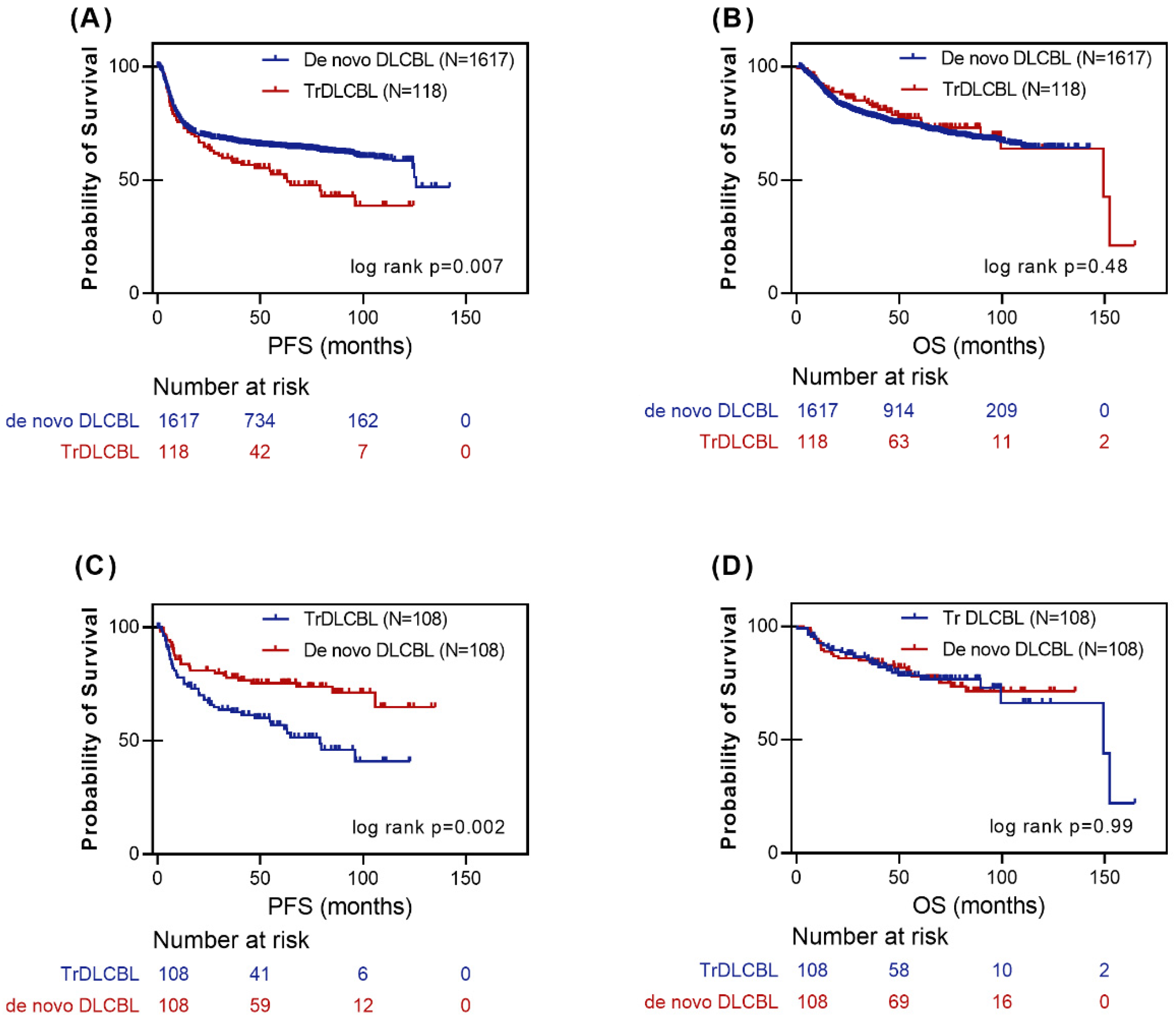
3.2. HT Is an Independent Risk Factor for PFS
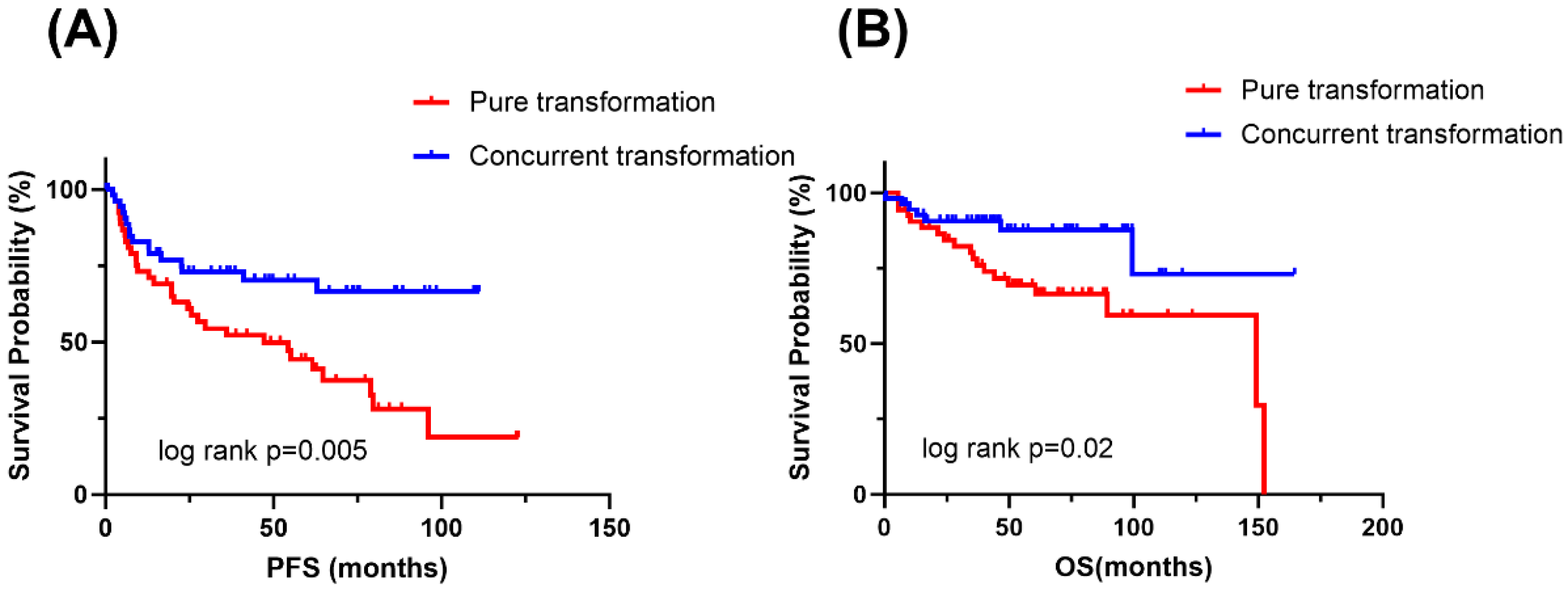
3.3. Impact of Transformation Patterns on Survival Outcomes
3.4. Failure Patterns
4. Discussion
5. Conclusions
Supplementary Materials
Author Contributions
Funding
Institutional Review Board Statement
Informed Consent Statement
Data Availability Statement
Conflicts of Interest
References
- Alizadeh, A.A.; Eisen, M.B.; Davis, R.E.; Ma, C.; Lossos, I.S.; Rosenwald, A.; Boldrick, J.C.; Sabet, H.; Tran, T.; Yu, X.; et al. Distinct types of diffuse large B-cell lymphoma identified by gene expression profiling. Nature 2000, 403, 503–511. [Google Scholar] [CrossRef]
- Wang, S.S. Epidemiology and etiology of diffuse large B-cell lymphoma. Semin. Hematol. 2023, 60, 255–266. [Google Scholar] [CrossRef]
- Berhan, A.; Almaw, A.; Damtie, S.; Solomon, Y. Diffuse large B cell lymphoma (DLBCL): Epidemiology, pathophysiology, risk stratification, advancement in diagnostic approaches and prospects: Narrative review. Discov. Oncol. 2025, 16, 184. [Google Scholar] [CrossRef] [PubMed]
- Kridel, R.; Mottok, A.; Farinha, P.; Ben-Neriah, S.; Ennishi, D.; Zheng, Y.; Chavez, E.A.; Shulha, H.P.; Tan, K.; Chan, F.C.; et al. Cell of origin of transformed follicular lymphoma. Blood 2015, 126, 2118–2127. [Google Scholar] [CrossRef]
- Vaughn, J.L.; Ramdhanny, A.; Munir, M.; Rimmalapudi, S.; Epperla, N. A comparative analysis of transformed indolent lymphomas and de novo diffuse large B-cell lymphoma: A population-based cohort study. Blood Cancer J. 2024, 14, 212. [Google Scholar] [CrossRef] [PubMed]
- Zheng, W.; Peng, B.; Chen, H.; Wang, S.; Guan, L.; Gao, X. Outcomes of the transformation to diffuse large B-cell lymphoma in hodgkin lymphoma and indolent B-cell non-Hodgkin lymphoma: A population-based study. Ann. Hematol. 2025, 104, 2799–2811. [Google Scholar] [CrossRef]
- Wang, Y.; Wang, Y.; Wang, M.; Thanarajasingam, G.; Thompson, C.; Nowakowski, G.; Habermann, T.; Ansell, S.; Witzig, T. Clinical Characteristics and Outcome of Transformed Diffuse Large B-Cell Lymphoma in the Rituximab Era: A SEER Database Analysis. Clin. Lymphoma Myeloma Leuk. 2017, 17, S362. [Google Scholar] [CrossRef]
- Wong, E.; Dickinson, M. Transformation in follicular lymphoma: Biology, prognosis, and therapeutic options. Curr. Oncol. Rep. 2012, 14, 424–432. [Google Scholar] [CrossRef]
- Zheng, W.; Liu, M.; Guan, L.; Wang, S. Outcomes of the transformation of follicular lymphoma to diffuse large B-cell lymphoma in the rituximab era: A population-based study. Cancer Med. 2024, 13, e7120. [Google Scholar] [CrossRef]
- Vaughn, J.L.; Epperla, N. Survival of patients with transformed follicular lymphoma in the United States: A multiple cohort study. Biomark. Res. 2023, 11, 84. [Google Scholar] [CrossRef]
- Desai, S.; Chaturvedi, M.; Hameed, R.; Baez-Sosa, V.; Shenoy, A.G. Single-Center Analysis of Characteristics and Outcomes of De Novo, Concurrent, and Transformed Diffuse Large B-Cell Lymphoma. Oncologist 2021, 26, e1660–e1663. [Google Scholar] [CrossRef] [PubMed]
- Behdad, A.; Boddy, C.; Fought, A.; Taxter, T.; Falkiewicz, M.; Landsburg, D.J.; Winter, J.N.; Pro, B.; Gordon, L.I.; Karmali, R.; et al. Diffuse Large B-Cell Lymphomas Transformed from or with Concurrent Follicular Lymphoma Demonstrate Similar Clinical Outcomes As De-Novo Diffuse Large B-Cell Lymphomas, Except for Cases Harboring Double Hit Rearrangements. Blood 2017, 130, 828. [Google Scholar] [CrossRef]
- Giné, E.; Montoto, S.; Bosch, F.; Arenillas, L.; Mercadal, S.; Villamor, N.; Martínez, A.; Colomo, L.; Campo, E.; Montserrat, E.; et al. The Follicular Lymphoma International Prognostic Index (FLIPI) and the histological subtype are the most important factors to predict histological transformation in follicular lymphoma. Ann. Oncol. 2006, 17, 1539–1545. [Google Scholar] [CrossRef]
- Magnano, L.; Balagué, O.; Dlouhy, I.; Rovira, J.; Karube, K.; Pinyol, M.; Rivas-Delgado, A.; Costa, D.; Martínez-Trillos, A.; González-Farre, B.; et al. Clinicobiological features and prognostic impact of diffuse large B-cell lymphoma component in the outcome of patients with previously untreated follicular lymphoma. Ann. Oncol. 2017, 28, 2799–2805. [Google Scholar] [CrossRef]
- Ghesquières, H.; Berger, F.; Felman, P.; Callet-Bauchu, E.; Bryon, P.A.; Traverse-Glehen, A.; Thieblemont, C.; Baseggio, L.; Michallet, A.S.; Coiffier, B.; et al. Clinicopathologic characteristics and outcome of diffuse large B-cell lymphomas presenting with an associated low-grade component at diagnosis. J. Clin. Oncol. 2006, 24, 5234–5241. [Google Scholar] [CrossRef]
- Zhao, X.; Bian, H.; Hao, F.; Shao, S.; Wu, C.; Zhang, Q.; Wu, M.; Li, Z.; Gao, C. Clinicopathological characteristics and genomic profiling in patients with transformed lymphoma: A monocentric retrospective study. Ann. Med. 2024, 56, 2419556. [Google Scholar] [CrossRef]
- Li, Z.H.; Zhang, M.Y.; Federico, M.; Civallero, M.; Manni, M.; Alonso-Alvarez, S.; Hou, J.; Huang, H.H. Early histological transformation of follicular lymphoma to diffuse large B-cell lymphoma indicating adverse survival: A population-based analysis and validation. Cancer 2024, 130, 3321–3332. [Google Scholar] [CrossRef]
- Montoto, S.; Lister, T.A. Secondary central nervous system lymphoma: Risk factors and prophylaxis. Hematol. Oncol. Clin. N. Am. 2005, 19, 751–763. [Google Scholar] [CrossRef] [PubMed]
- Lossos, I.S.; Alizadeh, A.A.; Diehn, M.; Warnke, R.; Thorstenson, Y.; Oefner, P.J.; Brown, P.O.; Botstein, D.; Levy, R. Transformation of follicular lymphoma to diffuse large-cell lymphoma: Alternative patterns with increased or decreased expression of c-myc and its regulated genes. Proc. Natl. Acad. Sci. USA 2002, 99, 8886–8891. [Google Scholar] [CrossRef] [PubMed]
- Alaggio, R.; Amador, C.; Anagnostopoulos, I.; Attygalle, A.D.; Araujo, I.B.O.; Berti, E.; Bhagat, G.; Borges, A.M.; Boyer, D.; Calaminici, M.; et al. The 5th edition of the World Health Organization Classification of Haematolymphoid Tumours: Lymphoid Neoplasms. Leukemia 2022, 36, 1720–1748. [Google Scholar] [CrossRef]
- Lawrie, C.H.; Chi, J.; Taylor, S.; Tramonti, D.; Ballabio, E.; Palazzo, S.; Saunders, N.J.; Pezzella, F.; Boultwood, J.; Wainscoat, J.S.; et al. Expression of microRNAs in diffuse large B cell lymphoma is associated with immunophenotype, survival and transformation from follicular lymphoma. J. Cell. Mol. Med. 2009, 13, 1248–1260. [Google Scholar] [CrossRef] [PubMed]
- Berglund, M.; Enblad, G.; Thunberg, U.; Amini, R.M.; Sundström, C.; Roos, G.; Erlanson, M.; Rosenquist, R.; Larsson, C.; Lagercrantz, S. Genomic imbalances during transformation from follicular lymphoma to diffuse large B-cell lymphoma. Mod. Pathol. 2007, 20, 63–75. [Google Scholar] [CrossRef] [PubMed]
- Shouse, G.; Herrera, A.F. Advances in Immunotherapy for Diffuse Large B Cell Lymphoma. BioDrugs 2021, 35, 517–528. [Google Scholar] [CrossRef]
- Topp, M.S.; Matasar, M.; Allan, J.N.; Ansell, S.M.; Barnes, J.A.; Arnason, J.E.; Michot, J.M.; Goldschmidt, N.; O’Brien, S.M.; Abadi, U.; et al. Odronextamab monotherapy in R/R DLBCL after progression with CAR T-cell therapy: Primary analysis of the ELM-1 study. Blood 2025, 145, 1498–1509. [Google Scholar] [CrossRef]
- Liebers, N.; Duell, J.; Fitzgerald, D.; Kerkhoff, A.; Noerenberg, D.; Kaebisch, E.; Acker, F.; Fuhrmann, S.; Leng, C.; Welslau, M.; et al. Polatuzumab vedotin as a salvage and bridging treatment in relapsed or refractory large B-cell lymphomas. Blood Adv. 2021, 5, 2707–2716. [Google Scholar] [CrossRef] [PubMed]
- Westin, J.R.; Kersten, M.J.; Salles, G.; Abramson, J.S.; Schuster, S.J.; Locke, F.L.; Andreadis, C. Efficacy and safety of CD19-directed CAR-T cell therapies in patients with relapsed/refractory aggressive B-cell lymphomas: Observations from the JULIET, ZUMA-1, and TRANSCEND trials. Am. J. Hematol. 2021, 96, 1295–1312. [Google Scholar] [CrossRef] [PubMed]
- Maloney, D.G.; Kuruvilla, J.; Liu, F.F.; Kostic, A.; Kim, Y.; Bonner, A.; Zhang, Y.; Fox, C.P.; Cartron, G. Matching-adjusted indirect treatment comparison of liso-cel versus axi-cel in relapsed or refractory large B cell lymphoma. J. Hematol. Oncol. 2021, 14, 140. [Google Scholar] [CrossRef]
- Nastoupil, L.J.; Jain, M.D.; Feng, L.; Spiegel, J.Y.; Ghobadi, A.; Lin, Y.; Dahiya, S.; Lunning, M.; Lekakis, L.; Reagan, P.; et al. Standard-of-Care Axicabtagene Ciloleucel for Relapsed or Refractory Large B-Cell Lymphoma: Results from the US Lymphoma CAR T Consortium. J. Clin. Oncol. 2020, 38, 3119–3128. [Google Scholar] [CrossRef]
- Rosenthal, A.; Munoz, J.; Jun, M.; Wang, T.; Mutebi, A.; Wang, A.; Yang, S.; Osei-Bonsu, K.; Elliott, B.; Navarro, F.R.; et al. Comparisons of treatment outcomes of epcoritamab versus chemoimmunotherapy, polatuzumab-based regimens, tafasitamab-based regimens, or chimeric antigen receptor T-cell therapy, in third-line or later relapsed/refractory large B-cell lymphoma. J. Hematol. Oncol. 2024, 17, 69. [Google Scholar] [CrossRef]
- Tomasik, J.; Bilicki, D.; Basak, G.W. Meta-analysis of response rates to first-line salvage treatment after CAR-T therapy failure in large B-cell lymphoma patients. Expert Opin. Biol. Ther. 2024, 24, 389–397. [Google Scholar] [CrossRef]
- Sun, J.; Yang, Q.; Lu, Z.; He, M.; Gao, L.; Zhu, M.; Sun, L.; Wei, L.; Li, M.; Liu, C.; et al. Distribution of lymphoid neoplasms in China: Analysis of 4,638 cases according to the World Health Organization classification. Am. J. Clin. Pathol. 2012, 138, 429–434. [Google Scholar] [CrossRef] [PubMed]
- Tan, D.; Tan, S.Y.; Lim, S.T.; Kim, S.J.; Kim, W.-S.; Advani, R.; Kwong, Y.-L. Management of B-cell non-Hodgkin lymphoma in Asia: Resource-stratified guidelines. Lancet Oncol. 2013, 14, e548–e561. [Google Scholar] [CrossRef]
- Bennett, R.; Ruskova, A.; Coomarasamy, C.; Theakston, E.; Berkahn, L.; Jackson, S.; Christophers, M.; Wong, S.; Issa, S. Diffuse large B-cell lymphoma at risk of secondary CNS involvement: The inefficacy of intravenous high-dose methotrexate CNS prophylaxis and the importance of baseline cerebrospinal fluid analysis. Am. J. Hematol. 2023, 98, 1070–1079. [Google Scholar] [CrossRef] [PubMed]
- Qualls, D.; Abramson, J.S. Advances in risk assessment and prophylaxis for central nervous system relapse in diffuse large B-cell lymphoma. Haematologica 2019, 104, 25–34. [Google Scholar] [CrossRef] [PubMed]
- Pagani, C.; Re, A.; Maifredi, S.; Passi, A.; Daffini, R.; Anastasia, A.; Motta, M.; Bagnasco, S.; Borlenghi, E.; Pantaleo, A.; et al. Impact of MYC Alterations in De Novo and Transformed Large B-Cell Lymphoma: An Italian Single Center Experience. Blood 2024, 144, 4473. [Google Scholar] [CrossRef]


| Characteristics | All (n = 1735) | Tr DLBCL (n = 118) | De Novo DLBCL (n = 1617) | p |
|---|---|---|---|---|
| Sex, n (%) | 0.13 | |||
| Female | 751 (43.3) | 59 (50.0) | 692 (42.8) | |
| Male | 984 (56.7) | 59 (50.0) | 925 (57.2) | |
| Age (years) | 57.6 (14.4–89.2) | 55.1 (14.6–86.7) | 57.6 (14.4–89.2) | 0.13 |
| >60 years | 728 (42.0) | 41 (34.7) | 687 (42.5) | |
| Ann Arbor stage, n (%) | 0.10 | |||
| I–II | 803 (46.3) | 46 (39.0) | 757 (46.8) | |
| III–IV | 932 (53.7) | 72 (61.0) | 860 (53.2) | |
| B symptoms, n (%) | 504 (29.0) | 32 (27.1) | 472 (29.2) | 0.63 |
| Extra-nodal sites > 1, n (%) | 618 (35.6) | 40 (33.9) | 578 (35.7) | 0.69 |
| Bulky disease, ≥7 cm, n (%) | 375 (21.6) | 16 (13.6) | 359 (22.2) | 0.03 |
| ECOG performance status, n (%) | 0.37 | |||
| 0–1 | 1628 (93.8) | 113 (95.8) | 1515 (93.7) | |
| >1 | 107 (6.2) | 5 (4.2) | 102 (6.3) | |
| LDH > normal, n (%) | 0.43 | |||
| >Normal | 735 (42.4) | 44 (37.3) | 691 (42.7) | |
| Normal | 935 (53.9) | 68 (57.6) | 867 (53.6) | |
| Unknown | 65 (3.7) | 6 (5.1) | 59 (3.6) | |
| β2-microglobulin elevated, n (%) | 0.901 | |||
| >Normal | 388 (22.4) | 25 (21.2) | 363 (22.4) | |
| Normal | 1189 (68.5) | 83 (70.3) | 1106 (68.4) | |
| Unknown | 158 (9.1) | 10 (8.5) | 148 (9.2) | |
| Cell of origin by Hans, n (%) | 0.07 | |||
| GCB | 584 (33.7) | 51 (43.2) | 533 (33.0) | |
| Non-GCB | 1096 (63.2) | 63 (53.4) | 1033 (63.9) | |
| Unknown | 55 (3.2) | 4 (3.4) | 51 (3.2) | |
| Transformation histology, n (%) | <0.01 | |||
| t-MZL | 56 (47.5) | |||
| t-FL | 55 (46.6) | |||
| others | 7(5.9) | |||
| Transformation pattern, n (%) | 0.58 | |||
| Pure transformation | 56 (47.5) | |||
| Concurrent transformation | 62 (52.5) |
| Variables | Univariate Analysis | Multivariate Analysis | ||||
|---|---|---|---|---|---|---|
| HR | 95% CI | p Value | HR | 95% CI | p Value | |
| Sex | 1.136 | 0.969–1.333 | 0.115 | |||
| Age (years), median | 1.374 | 1.173–1.609 | <0.001 | |||
| Ann Arbor stage | 3.057 | 2.559–3.652 | <0.001 | 1.820 | 1.390–2.383 | <0.001 |
| B symptoms | 1.769 | 1.504–2.081 | <0.001 | |||
| Extra-nodal sites > 1 | 2.452 | 2.094–2.872 | <0.001 | 1.503 | 1.188–1.903 | <0.001 |
| Bulky disease, ≥7 cm | 1.878 | 1.578–2.234 | <0.001 | |||
| ECOG performance status | 3.216 | 2.485–4.162 | <0.001 | 2.063 | 1.532–2.779 | <0.001 |
| LDH > normal | 2.762 | 2.331–3.272 | <0.001 | 1.833 | 1.510–2.226 | <0.001 |
| β2-microglobulin elevated | 2.149 | 1.792–2.577 | <0.001 | |||
| Non-GCB | 1.398 | 1.172–1.668 | <0.001 | 1.279 | 1.048–1.561 | 0.015 |
| trDLBCL | 1.447 | 1.101–1.900 | 0.012 | 1.754 | 1.297–2.372 | <0.001 |
| Pathology | ||||||
| Double-hit | 1.511 | 0.853–2.675 | 0.184 | |||
| Double-expressor | 1.422 | 1.172–1.725 | <0.001 | 1.265 | 1.017–1.573 | 0.035 |
| High-grade NOS | 2.140 | 1.108–4.133 | 0.044 | |||
Disclaimer/Publisher’s Note: The statements, opinions and data contained in all publications are solely those of the individual author(s) and contributor(s) and not of MDPI and/or the editor(s). MDPI and/or the editor(s) disclaim responsibility for any injury to people or property resulting from any ideas, methods, instructions or products referred to in the content. |
© 2026 by the authors. Licensee MDPI, Basel, Switzerland. This article is an open access article distributed under the terms and conditions of the Creative Commons Attribution (CC BY) license.
Share and Cite
Chai, J.; Zhang, W.; Wang, Y.; Chen, J.; Song, Y.; Yu, H. Clinical Outcomes of Treatment-Naive Transformed vs. De Novo Diffuse Large B-Cell Lymphoma: A Propensity Score-Matched Analysis of 1735 Cases. Cancers 2026, 18, 1641. https://doi.org/10.3390/cancers18101641
Chai J, Zhang W, Wang Y, Chen J, Song Y, Yu H. Clinical Outcomes of Treatment-Naive Transformed vs. De Novo Diffuse Large B-Cell Lymphoma: A Propensity Score-Matched Analysis of 1735 Cases. Cancers. 2026; 18(10):1641. https://doi.org/10.3390/cancers18101641
Chicago/Turabian StyleChai, Jin, Wenhui Zhang, Yue Wang, Jie Chen, Yuqin Song, and Hui Yu. 2026. "Clinical Outcomes of Treatment-Naive Transformed vs. De Novo Diffuse Large B-Cell Lymphoma: A Propensity Score-Matched Analysis of 1735 Cases" Cancers 18, no. 10: 1641. https://doi.org/10.3390/cancers18101641
APA StyleChai, J., Zhang, W., Wang, Y., Chen, J., Song, Y., & Yu, H. (2026). Clinical Outcomes of Treatment-Naive Transformed vs. De Novo Diffuse Large B-Cell Lymphoma: A Propensity Score-Matched Analysis of 1735 Cases. Cancers, 18(10), 1641. https://doi.org/10.3390/cancers18101641