2. Materials and Methods
This retrospective cohort study was conducted in accordance with the STROBE statement. The study protocol was approved by the Ethics Committee of the Second Affiliated Hospital of Harbin Medical University (Approval No. KY2025-103). The requirement for informed consent was waived due to the retrospective study design. All procedures were conducted in accordance with the Declaration of Helsinki.
2.1. Surgical Procedure
Surgical procedures were performed using the da Vinci Xi robotic surgical system (Intuitive Surgical, Sunnyvale, CA, USA) via a standardized three-arm approach. Anatomical lobectomy or segmentectomy was performed according to standard thoracic surgical principles, with parenchymal, bronchial, and vascular division performed using endoscopic linear staplers. A 28-Fr chest tube was routinely placed at the end of the surgery and removed according to institutional protocols once no air leak was detected and drainage was <100 mL per 24 h.
All procedures were performed under general anesthesia with single-lung ventilation. Intraoperative air leak testing was performed by submerging the resected lobe in saline solution after stapler division to assess parenchymal integrity; however, results were not systematically recorded and could not be incorporated as a model variable. Pleural sealants and stapler buttressing materials were used at the discretion of the operating surgeon and were likewise not systematically documented, representing a limitation of this retrospective analysis. Cases were performed by attending thoracic surgeons credentialed for robotic surgery at the institution, using a consistent procedural framework throughout the study period.
2.2. Study Population
Patients who underwent RATS for primary lung cancer at the Second Affiliated Hospital of Harbin Medical University between January 2020 and December 2024 were retrospectively screened for eligibility. Inclusion criteria were histopathologically confirmed primary lung cancer, clinical stage I–III NSCLC according to the 8th edition AJCC staging system, anatomical lobectomy or segmentectomy, and availability of complete perioperative clinical and pulmonary function measurements. Exclusion criteria included prior pulmonary resection, synchronous malignancy, receipt of neoadjuvant therapy, and missing key clinical or outcome data. A total of 1185 patients met the inclusion criteria and were included in the final analysis.
2.3. Data Collection
Baseline variables included demographic characteristics (age, sex, body mass index [BMI], and smoking history) and comorbidities (hypertension, diabetes, coronary artery disease [CAD], and cerebrovascular disease [CVA]). Preoperative pulmonary function parameters included forced expiratory volume in 1 s (FEV1), FEV1/FVC ratio, maximal voluntary ventilation (MVV), and diffusing capacity for carbon monoxide (DLCO). Comorbidity burden was assessed using a simplified comorbidity score derived from diabetes mellitus and cerebrovascular disease components available in the dataset—hereafter referred to as the modified CCI—which represents only a partial approximation of the full Charlson Comorbidity Index, as other standard CCI domains were not consistently documented in this retrospective dataset [
10]. Perioperative outcomes included operative time, estimated blood loss, duration of chest tube placement, postoperative length of stay, and the occurrence of PAL. Among pulmonary function variables, FEV1 was selected as the primary variable for regression analyses based on its established clinical relevance.
2.4. Outcome Definition
The primary outcome was PAL, defined as a persistent postoperative air leak lasting 5 days or more, in accordance with the definition proposed by the European Society of Thoracic Surgeons (ESTS) [
5]. A sensitivity analysis using a more stringent threshold of 7 days or more was also performed to assess the robustness of findings.
2.5. Statistical Analysis
Continuous variables were summarized as mean ± SD or median (IQR), and categorical variables as frequency and percentage. Comparisons between age-stratified groups were performed using the Kruskal–Wallis test for continuous variables and the chi-square or Fisher’s exact test, as appropriate, for categorical variables.
Independent predictors of PAL were identified using multivariable Firth’s penalized logistic regression. Continuous predictors were initially modeled as linear terms. This approach reduces small-sample bias and improves the stability of parameter estimates. The events-per-variable ratio exceeded 10, supporting model stability. The multivariable model included age, sex, BMI, modified CCI, FEV1, smoking history, and surgical procedure type. Multicollinearity among predictors was assessed using variance inflation factors (VIFs), and all VIF values were <3.
Restricted cubic spline (RCS) modeling was used to evaluate potential nonlinear relationships between continuous predictors and PAL risk. Three knots were placed at the 5th, 50th, and 95th percentiles (Age: 42, 60, 73 years; FEV1: 1.52, 2.38, 3.49 L; BMI: 19.0, 23.8, 29.5 kg/m
2). A 3-knot specification was chosen because it is the recommended default for exploratory nonlinearity assessment with this sample size, consuming only 2 degrees of freedom per predictor and preserving model stability given the available events-per-variable ratio. To confirm that findings were not sensitive to knot number, a 4-knot sensitivity analysis was also performed (
Supplementary Table S1). Nonlinearity was assessed using likelihood ratio tests comparing spline and linear models, and model fit was evaluated using the Akaike information criterion (AIC). Sensitivity analyses included fully adjusted models, an alternative PAL threshold (≥7 days), and a 4-knot RCS specification to assess sensitivity to knot selection.
To further examine the relationship between age and PAL, a stepwise attenuation analysis was performed. Covariates were sequentially added to an age-only model, and changes in the age coefficient were used to quantify attenuation of the association.
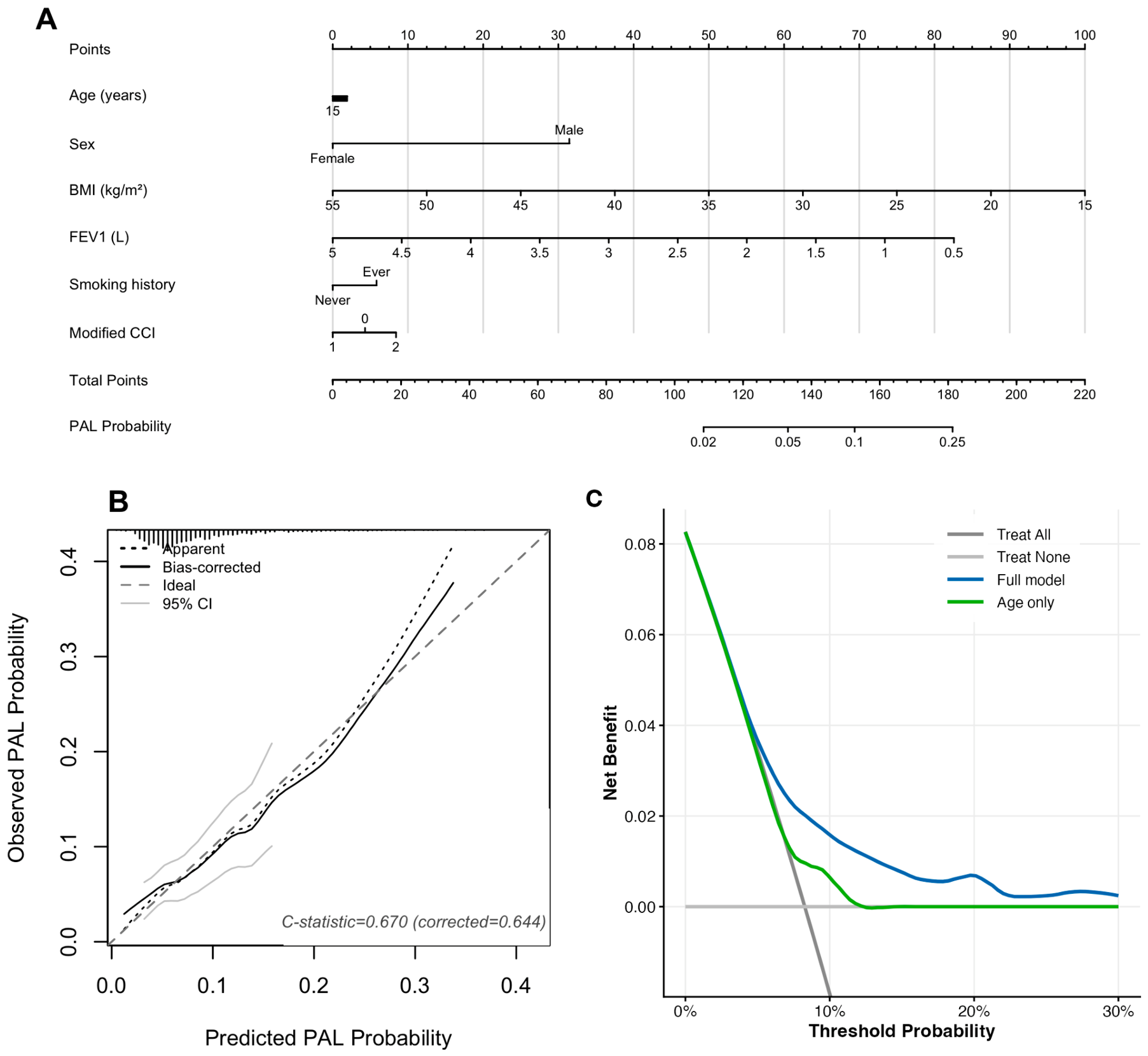
A nomogram was constructed based on the multivariable model to estimate individualized PAL risk. Model discrimination was assessed using the C-statistic with 95% confidence intervals obtained from 1000 bootstrap samples. An optimism-corrected C-statistic was also reported. Model calibration was evaluated using the Hosmer-Lemeshow test and bootstrap-corrected calibration plots.
Decision curve analysis (DCA) was performed to evaluate net benefit across a range of threshold probabilities (0–30%), compared with the treat-all and treat-none strategies. A model including age alone was also evaluated for comparison.
All statistical analyses were performed using R version 4.5.2 (R Foundation for Statistical Computing, Vienna, Austria). For comparison with existing scoring systems, variables from the Pompili ESTS score (male sex, FEV1, and BMI) and the Brunelli score (age, FEV1/FVC ratio, and BMI) were refitted using logistic regression in the study cohort. Discrimination was compared using DeLong’s test for correlated ROC curves. A two-tailed p value < 0.05 was considered statistically significant.
3. Results
3.1. Baseline Characteristics
A total of 1185 patients with primary lung cancer underwent RATS. Patients were categorized into three age groups: <60 years (
n = 549), 60–69 years (
n = 457), and ≥70 years (
n = 179). Baseline characteristics are summarized in
Table 1.
The proportion of male patients increased progressively with age (34.1%, 39.6%, and 46.9% in the <60, 60–69, and ≥70 years groups, respectively; p = 0.006). Similarly, the prevalence of ever smoking increased with age (13.1%, 21.7%, and 22.9%, respectively; p < 0.001). BMI did not differ significantly among age groups (p = 0.70).
Pulmonary function parameters declined with age. Mean FEV1 decreased from 2.7 L in patients < 60 years to 2.1 L in those ≥70 years (p < 0.001), with similar trends observed for FEV1/FVC and DLCO (both p < 0.001). Older patients also had higher rates of hypertension and diabetes (both p < 0.001), whereas coronary artery disease did not differ significantly among age groups (p = 0.168).
Lobectomy was more frequently performed in older patients (44.3%, 57.3%, and 67.0%, respectively; p < 0.001), whereas segmentectomy was more common in younger patients. Tumor size also increased with age (p < 0.001).
3.2. Age and Perioperative Outcomes
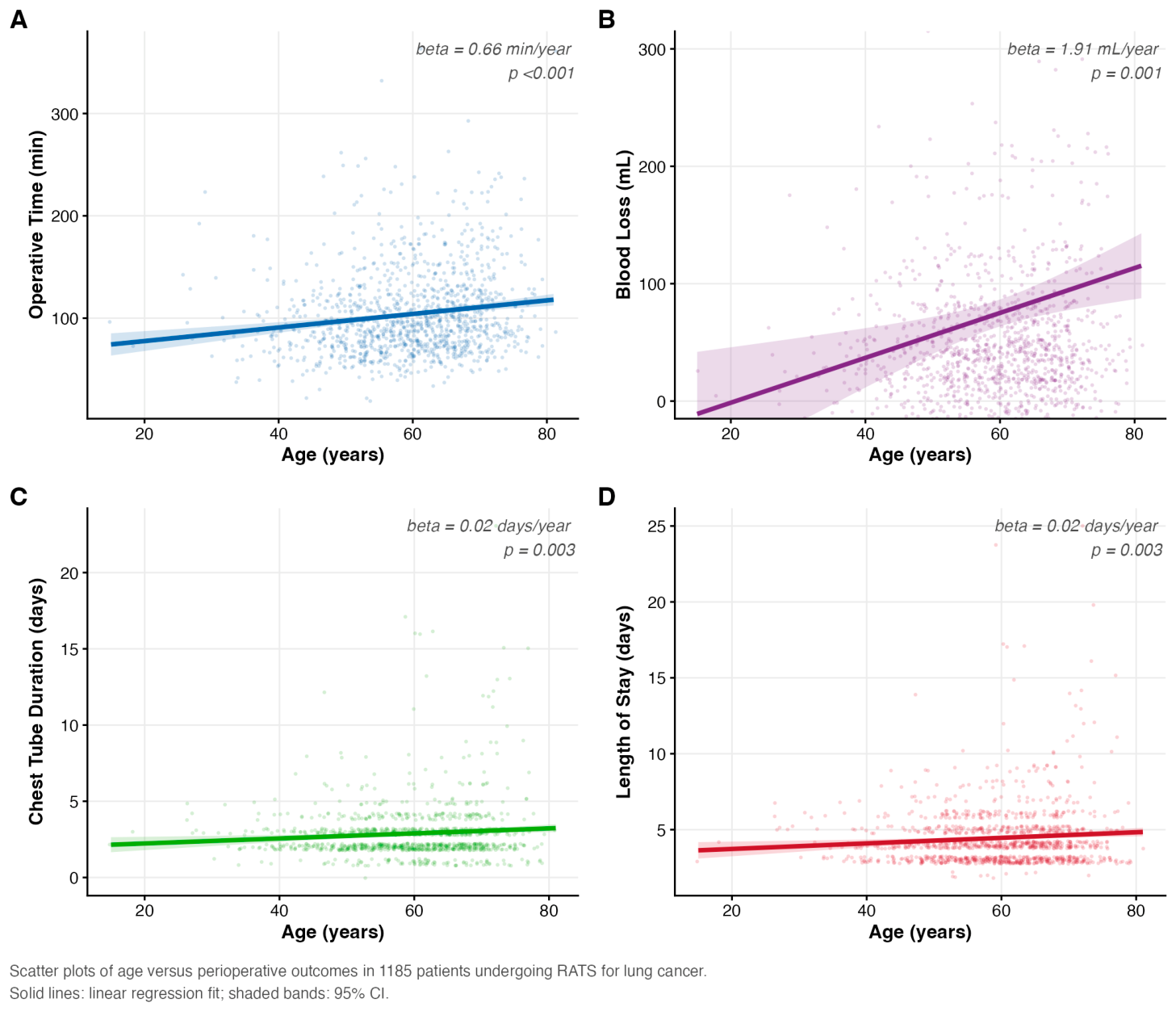
Increasing age was associated with longer chest tube duration and postoperative length of stay (both beta = 0.02 days/year;
p = 0.003). Operative time and intraoperative blood loss also showed modest but statistically significant linear increases with age (beta = 0.66 min/year and beta = 1.91 mL/year, respectively; both
p ≤ 0.001) (
Figure 1).
3.3. Multivariable Analysis of Risk Factors for Prolonged Air Leak
Among the 1185 patients, 98 events of prolonged air leak (PAL ≥ 5 days)occurred. Multivariable Firth’s penalized logistic regression identified independent predictors of PAL (
Table 2).
Male sex was strongly associated with increased PAL risk (OR 3.29, 95% CI 1.96–5.54, p < 0.001). In contrast, higher FEV1 was independently associated with lower odds of PAL (OR 0.50 per 1-L increase, p < 0.01). Higher BMI was also associated with lower PAL risk (OR 0.91, 95% CI 0.85–0.98, p = 0.01). Age was not independently associated with PAL (OR 1.00, 95% CI 0.97–1.02, p = 0.86). Smoking history and modified Charlson Comorbidity Index were likewise not significant predictors. Lobectomy demonstrated borderline significance compared with segmentectomy (OR 1.30, p = 0.24).
3.4. Nonlinear Associations Between Continuous Predictors and Prolonged Air Leak
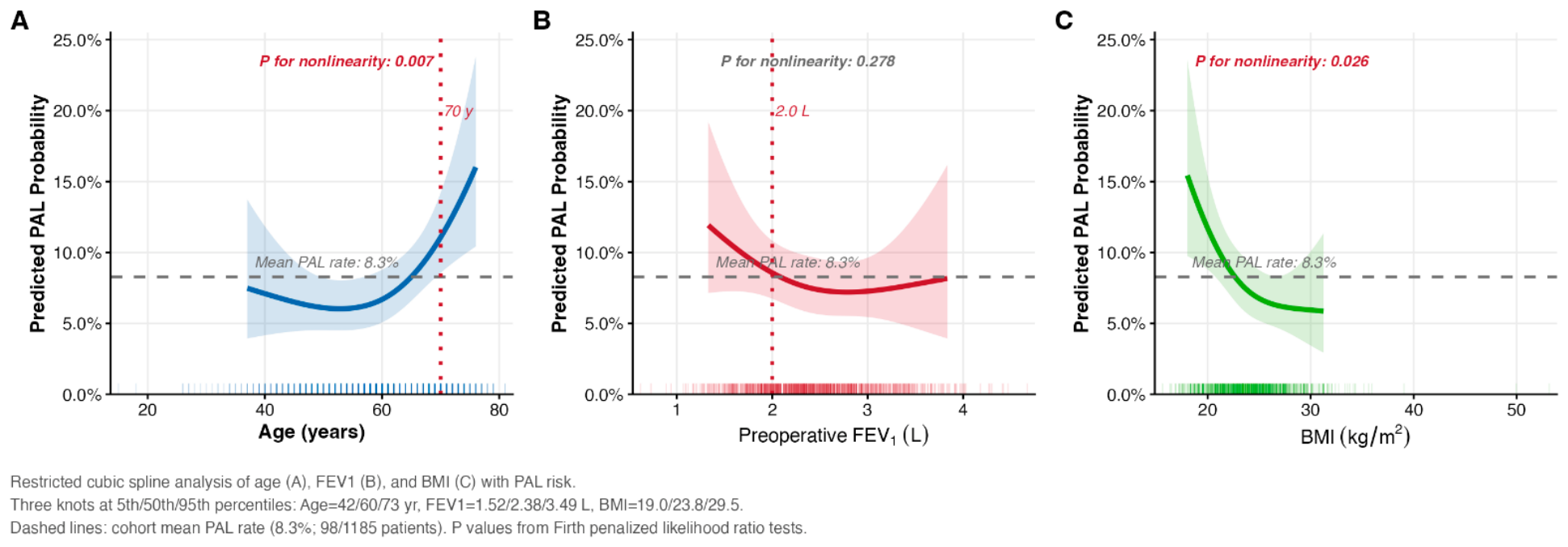
Restricted cubic spline (RCS) analysis was performed to assess potential nonlinear relationships between age, FEV1, BMI, and PAL risk (
Table 3). In the age-adjusted analysis, age demonstrated a significant nonlinear association with PAL (
p for nonlinearity = 0.007). BMI also demonstrated significant nonlinearity (
p = 0.026), whereas FEV1 did not (
p = 0.278). These findings remained consistent after full adjustment, with age and BMI retaining significant nonlinear associations, whereas FEV1 remained linear. Using the more stringent PAL definition (≥7 days) yielded consistent results, with age remaining significantly nonlinear (
p = 0.011), and BMI also showing significant nonlinearity (
p = 0.043). To assess sensitivity to knot selection, a 4-knot RCS analysis was additionally performed; the nonlinear association of age with PAL risk remained statistically significant (
p = 0.009), supporting the robustness of this finding (
Supplementary Table S1). The corresponding spline curves are shown in
Figure 2.
3.5. Stepwise Attenuation Analysis
This analysis was performed specifically to explain the apparent discrepancy between the non-significant linear age effect in the multivariable model (p = 0.86) and the significant nonlinear association identified by RCS (p = 0.007), and is not intended as a standard component of prediction model development.
In the stepwise attenuation analysis, the crude association between age and PAL risk was weak and non-significant (OR 1.011 per year, 95% CI 0.988–1.035, p = 0.374). Sequential adjustment for FEV1 attenuated the age coefficient by 54.2%. Upon further adjustment for sex, the age coefficient crossed the null (OR 0.983), a pattern consistent with sex functioning as a suppressor variable rather than a confounder in this context. In the fully adjusted model, the age coefficient remained non-significant (OR 0.980, 95% CI 0.954–1.007, p = 0.142), consistent with the primary multivariable analysis. These findings indicate that the age-PAL association is substantially mediated by pulmonary function and sex distribution, and that the significant nonlinear threshold effect identified by RCS analysis represents an effect operating primarily beyond approximately 70 years of age.
3.6. Nomogram and Clinical Utility of the Prediction Model
A nomogram was constructed to estimate individualized PAL risk (
Figure 3). Decision curve analysis showed that the model provided greater net benefit than the treat-all and treat-none strategies across clinically relevant threshold probabilities and outperformed an age-only model.
3.7. Subgroup Analysis
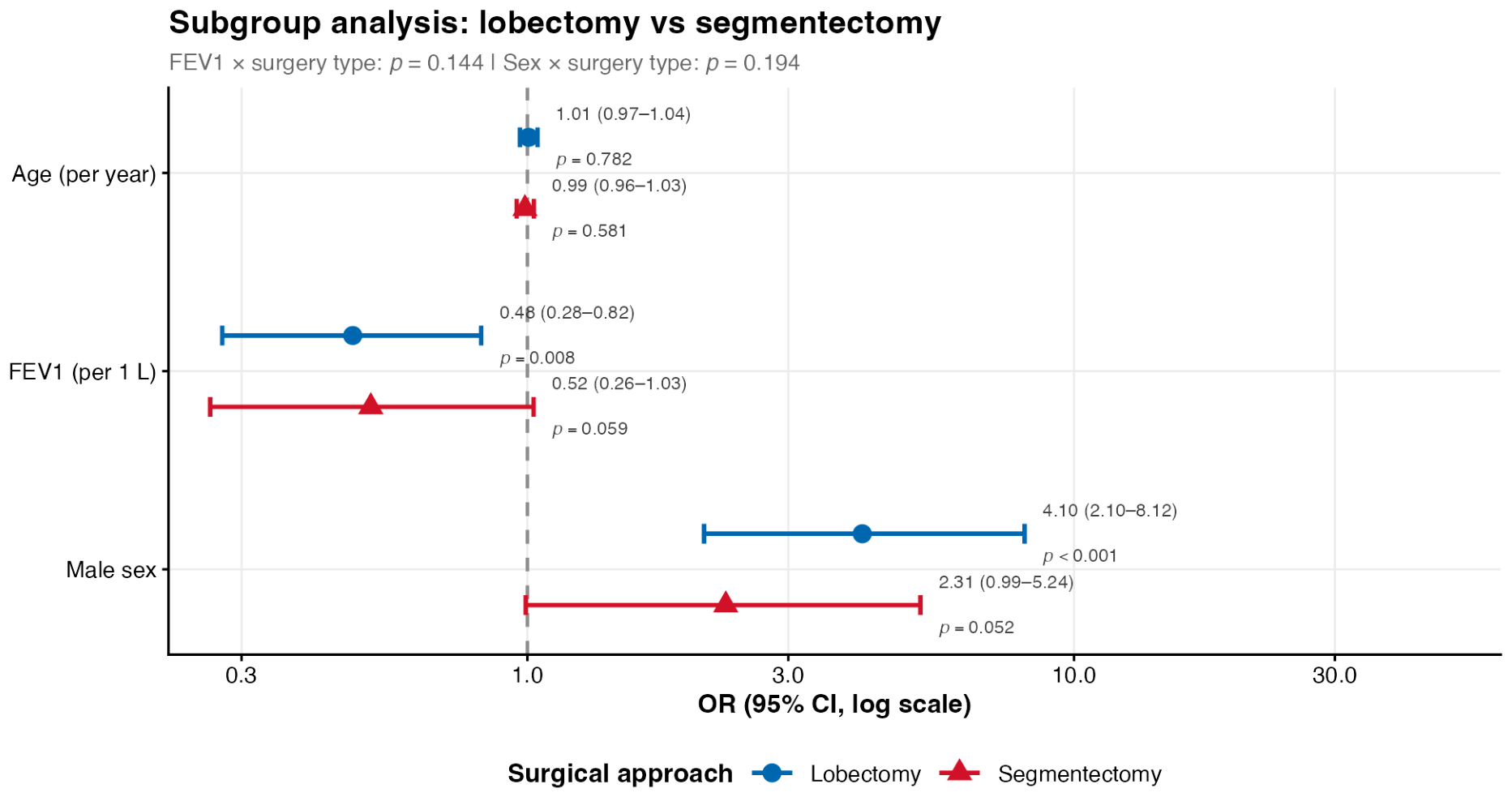
Subgroup analyses were performed separately in patients undergoing lobectomy (
n = 625) and segmentectomy (
n = 560). FEV1 and male sex remained the dominant predictors in both subgroups, with consistent directions of association. In the lobectomy subgroup, FEV1 was associated with lower PAL risk (OR 0.48, 95% CI 0.28–0.82,
p = 0.008) and male sex with higher risk (OR 4.10, 95% CI 2.10–8.12,
p < 0.001). Consistent findings were observed in the segmentectomy subgroup (FEV1: OR 0.52, 95% CI 0.26–1.03,
p = 0.059; male sex: OR 2.31, 95% CI 0.99–5.24,
p = 0.052). Formal interaction testing demonstrated no significant interaction between surgical type and FEV1 (
p = 0.144) or sex (
p = 0.194), indicating that the identified risk factors operated consistently regardless of surgical approach (
Figure 4).
3.8. Risk Stratification
Based on the predicted PAL probabilities from the multivariable model, patients were classified into three risk strata using thresholds of 5% and 10% (
Supplementary Table S2). The low-risk group (predicted probability < 5%) comprised 375 patients (31.6%) with an observed PAL rate of 4.3%. The intermediate-risk group (5–10%) included 495 patients (41.8%) with a PAL rate of 6.5%. The high-risk group (>10%) comprised 315 patients (26.6%) with a PAL rate of 15.9%. PAL rates differed significantly across the three strata (
p < 0.001). The primary utility of this stratification is to identify patients warranting heightened perioperative vigilance and individualized counseling; the absolute PAL rate of 15.9% in the high-risk group indicates that most patients in this stratum will not experience PAL, and this tool should not be used to justify high-risk prophylactic interventions in isolation.
3.9. Comparison with Existing Scoring Systems
To further evaluate the discriminative performance of the model, comparisons were performed with two widely used PAL prediction variable sets, namely the Pompili ESTS score and the Brunelli score, refitted in the study cohort. When variables from the Pompili ESTS score and Brunelli score were refitted, the resulting AUCs were 0.627 and 0.611, respectively. The present model demonstrated significantly superior discrimination (AUC 0.689) compared with both the Pompili variable set (ΔAUC = 0.062, p = 0.006) and the Brunelli variable set (ΔAUC = 0.078, p = 0.019) using DeLong’s test. It should be noted that this comparison does not constitute external validation of the original published scoring systems. The Pompili ESTS and Brunelli variable sets were re-fitted using logistic regression in the present cohort; the resulting AUCs reflect the discriminative capacity of each variable set within this population rather than the performance of the original score algorithms. A true external validation using original published coefficients was not feasible due to differences in variable definitions across studies.
4. Discussion
This study aimed to develop a clinically applicable preoperative risk stratification model for prolonged air leak (PAL) following robot-assisted thoracic surgery (RATS) for lung cancer, with a focus on potential nonlinear relationships assessed using restricted cubic spline (RCS) modeling.
Male sex was strongly associated with an increased risk of PAL, whereas higher preoperative FEV1 was associated with a lower risk. Age was not an independent predictor in the multivariable model. However, RCS analysis revealed a significant nonlinear association between age and PAL risk. This finding suggests that conventional linear models may not fully capture age-related risk patterns. From a clinical perspective, this finding suggests that age-related risk should not be interpreted as a simple linear increase and that patients at older ages may require more individualized perioperative risk assessment.
A nomogram was developed based on these variables to support individualized preoperative risk estimation. Decision curve analysis indicated potential clinical utility. Overall, these results highlight the importance of considering nonlinear relationships when evaluating PAL risk after robotic lung resection.
PAL after pulmonary resection has been widely studied, and many prediction models have been proposed. Early models focused on pulmonary function, BMI, and surgical factors [
11,
12,
13]. Later studies used larger datasets and included more clinical variables [
14,
15,
16,
17,
18,
19,
20]. More recent work has explored machine learning and other flexible modeling approaches [
21,
22,
23,
24]. These studies consistently show that pulmonary function, BMI, and surgical factors are key predictors of PAL [
7,
8].
However, most existing models were developed in mixed surgical populations. They also assume linear relationships between predictors and outcomes. Importantly, the present study focused on a relatively homogeneous cohort of patients undergoing RATS. This reduces variability related to surgical approach and allows a more consistent evaluation of risk patterns.
Among existing approaches, the Pompili ESTS score and Brunelli score are widely used in clinical practice. In comparison, the present model showed improved discrimination in this RATS cohort. This suggests that incorporating nonlinear effects may provide additional predictive value beyond traditional approaches.
A key observation in this study was the behavior of age. Age was not significant in the multivariable model. In contrast, RCS analysis demonstrated a nonlinear association with PAL risk, with a more pronounced increase at older ages. This pattern indicates that the effect of age is not uniform across its range.
Age is closely related to pulmonary function and sex distribution. Both are established risk factors for PAL [
25,
26]. After adjusting for FEV1 and sex, the association between age and PAL was substantially attenuated. This suggests that part of the age effect is explained by these variables.
However, a residual nonlinear pattern remained after adjustment. This finding suggests that additional factors may contribute to PAL risk. These factors may not be fully captured by routinely measured clinical variables. Possible explanations include subclinical emphysema, changes in lung structure, or impaired tissue healing capacity.
The associations of FEV1 and sex with PAL risk are consistent with previous studies. Reduced pulmonary function may reflect impaired lung compliance and diminished parenchymal healing capacity. These factors increase the risk of persistent air leak. The higher risk observed in male patients may be related to a greater burden of smoking-related structural changes in the lung. Differences in lung anatomy and physiology may also play a role.
The nomogram provides a practical tool for clinical use. It uses variables that are available before surgery and allows estimation of individual PAL risk. Decision curve analysis showed that the model provides greater net benefit than treat-all and treat-none strategies across clinically relevant threshold probabilities. This suggests that the model may assist in perioperative decision-making, including surgical planning and postoperative management.
The model showed consistent performance across different surgical approaches. The effects of FEV1 and sex were similar in both lobectomy and segmentectomy. No significant interaction with surgical type was observed. In addition, risk stratification showed a clear gradient, with higher predicted risk corresponding to higher observed PAL rates. This supports the model’s ability to distinguish clinically meaningful risk levels.
This study has several strengths. It included a relatively large cohort of patients undergoing RATS, allowing focused evaluation in a contemporary minimally invasive setting. RCS modeling was used to explore nonlinear relationships that may be overlooked in conventional analyses. The clinical utility of the model was also assessed using decision curve analysis.
The age spline curve (
Figure 2A) shows that predicted PAL probability remains relatively stable near the cohort mean below approximately 60 years of age and rises progressively thereafter, with the most pronounced acceleration beyond 70 years. Clinically, this nonlinear pattern suggests that age-related PAL risk is not a uniform linear phenomenon but rather a threshold effect concentrated in the oldest surgical candidates. For patients aged 70 years or older—who in this cohort had a lobectomy rate of 67.0% and an observed PAL rate of 14.5%—heightened preoperative counseling and consideration of risk-mitigation strategies may be particularly warranted. This pattern likely reflects the cumulative effects of subclinical emphysema, reduced parenchymal compliance, and impaired tissue healing that accumulate disproportionately in advanced age and are not fully captured by FEV1 alone. Importantly, this nonlinear association should be regarded as an exploratory finding: although statistically robust across 3-knot (
p = 0.007) and 4-knot (
p = 0.009) specifications, the wide confidence intervals at older ages reflect substantial uncertainty, and prospective validation is required before this threshold is used to guide clinical decisions.
The preoperative predictors identified in this study likely act as upstream risk modifiers that increase susceptibility to PAL when intraoperative conditions are unfavorable. Male patients with reduced FEV1 may have greater underlying emphysematous parenchymal change, rendering them less tolerant of incomplete fissure development or stapler line tension. In such patients, intraoperative findings of dense pleural adhesions or incomplete fissures may compound the preoperative risk profile, potentially producing a multiplicative rather than additive effect on PAL probability. The modest C-statistic of 0.644 reflects the inherent performance ceiling of preoperative-only prediction: PAL is substantially determined by intraoperative factors—including fissure completeness, pleural adhesion burden, and parenchymal staple line integrity—none of which are measurable before surgery. This limitation is shared by all existing preoperative PAL nomograms and underscores the need for future studies integrating both preoperative and intraoperative data in a unified prediction framework.
For patients classified as high-risk (predicted PAL probability > 10%), several perioperative considerations may be appropriate based on existing evidence and clinical reasoning. These include preoperative counseling regarding the likelihood of extended chest tube duration and hospital stay; discussion of prophylactic use of pleural sealants or stapler buttressing materials, particularly in patients with emphysematous parenchyma or incomplete fissures identified on preoperative CT; consideration of water-seal rather than suction chest tube management protocols; and heightened postoperative physiotherapy surveillance. We emphasize that these recommendations are based on clinical reasoning and existing literature rather than direct evidence from this study, and that prospective evaluation of risk-stratified management protocols is needed to determine whether targeted interventions reduce PAL incidence in predicted high-risk patients.
The present model relied on FEV1 expressed in absolute liters, which does not adjust for age, sex, or body habitus and may reduce generalizability across demographically diverse populations. Future studies should incorporate FEV1% predicted and predicted postoperative FEV1 (ppoFEV1), which provide physiologically normalized measures of pulmonary reserve. Additionally, DLCO was collected in this cohort (
Table 1) but was excluded from the primary model to avoid multicollinearity with FEV1 and to preserve parsimony. DLCO % predicted may capture aspects of parenchymal membrane integrity independent of airflow limitation and could contribute meaningfully to model discrimination in future work. A comprehensive pulmonary function profile combining FEV1% predicted, DLCO % predicted, and ppoFEV1 represents a priority direction for model refinement.
This study has several important limitations. First, as a retrospective single-center analysis, it is subject to selection bias and institutional referral patterns that may not generalize to other settings. Second, several variables known to strongly influence PAL—including CT-based emphysema grading, fissure completeness, intraoperative air leak severity, pleural adhesion burden, and the use of sealants or stapler buttressing—were not systematically recorded and could not be incorporated into the model. Their absence likely accounts for a substantial proportion of the unexplained variance (corrected C-statistic 0.644) and represents the primary performance ceiling for any preoperative-only prediction model. Third, FEV1 was used in absolute liters rather than as % predicted or ppoFEV1, which does not account for age, sex, and body habitus and may reduce generalizability. Fourth, the modified CCI was derived from only two components (diabetes and cerebrovascular disease) due to data availability constraints, representing only a partial approximation the of true comorbidity burden. Fifth, the comorbidity distributions observed in this cohort—including the lower hypertension and diabetes prevalence in the 60–69-year age group—may reflect surgical selection effects rather than the general population distribution. Sixth, the model was internally validated using 1000 bootstrap resamples; external validation in independent, prospectively collected RATS cohorts is required before clinical implementation. The nomogram should therefore be regarded as a preliminary preoperative risk stratification tool pending such validation. Seventh, the comparison with the Pompili ESTS and Brunelli variable sets involved re-fitting in our cohort rather than application of the original published coefficients, and does not constitute true external benchmarking of those scoring systems.