Analysis of the Frequency and Associated Factors of Skin Toxicity in Patients Receiving Ribociclib-Based Therapy for Metastatic Breast Cancer

 , ,
, ,
Simple Summary
Abstract
1. Introduction
2. Materials and Methods
2.1. Study Design and Patients
2.2. Statistical Analysis
3. Results
3.1. Patient Characteristics
3.2. Factors Associated with Skin Toxicity Occurrence
3.3. Clinical Impacts of Skin Toxicities
3.4. Disease Progression and Cutaneous Toxicities
4. Discussion
5. Conclusions
Author Contributions
Funding
Institutional Review Board Statement
Informed Consent Statement
Data Availability Statement
Conflicts of Interest
Abbreviations
References
- Alexiou, S.; Mavrovounis, G.; Christodoulopoulos, G.; Perifanou, S.; Saloustros, E. CDK4/6 Inhibitors Plus Endocrine Therapy in Early-Stage HR+/HER2− Breast Cancer: Updated Meta-Analysis of Phase III Trials. Cancers 2025, 17, 3538. [Google Scholar] [CrossRef]
- Hortobagyi, G.N.; Stemmer, S.M.; Burris, H.A.; Yap, Y.S.; Sonke, G.S.; Paluch-Shimon, S.; Campone, M.; Petrakova, K.; Blackwell, K.L.; Winer, E.P.; et al. Updated results from MONALEESA-2, a phase III trial of first-line ribociclib plus letrozole versus placebo plus letrozole in hormone receptor-positive, HER2-negative advanced breast cancer. Ann. Oncol. 2018, 29, 1541–1547. [Google Scholar] [CrossRef]
- Lu, Y.-S.; Im, S.-A.; Colleoni, M.; Franke, F.; Bardia, A.; Cardoso, F.; Harbeck, N.; Hurvitz, S.; Chow, L.; Sohn, J.; et al. Updated Overall Survival of Ribociclib plus Endocrine Therapy versus Endocrine Therapy Alone in Pre- and Perimenopausal Patients with HR+/HER2− Advanced Breast Cancer in MONALEESA-7: A Phase III Randomized Clinical Trial. Clin. Cancer Res. 2022, 28, 851–859. [Google Scholar] [CrossRef]
- Morrison, L.; Loibl, S.; Turner, N.C. The CDK4/6 inhibitor revolution—A game-changing era for breast cancer treatment. Nat. Rev. Clin. Oncol. 2024, 21, 89–105. [Google Scholar] [CrossRef]
- Slamon, D.J.; Neven, P.; Chia, S.; Jerusalem, G.; De Laurentiis, M.; Im, S.-A.; Petrakova, K.; Bianchi, G.V.; Martín, M.; Nusch, A.; et al. Ribociclib plus fulvestrant for postmenopausal women with hormone receptor-positive, human epidermal growth factor receptor 2-negative advanced breast cancer in the phase III randomized MONALEESA-3 trial: Updated overall survival. Ann. Oncol. 2021, 32, 1015–1024. [Google Scholar] [CrossRef] [PubMed]
- Wekking, D.; Lambertini, M.; Dessì, M.; Denaro, N.; Bardanzellu, F.; Garrone, O.; Scartozzi, M.; Solinas, C. CDK4/6 inhibitors in the treatment of metastatic breast cancer: Focus on toxicity and safety. Semin. Oncol. 2023, 50, 131–139. [Google Scholar] [CrossRef] [PubMed]
- Sollena, P.; Vasiliki, N.; Kotteas, E.; Stratigos, A.J.; Fattore, D.; Orlandi, A.; Mannino, M.; Di Pumpo, M.; Fida, M.; Starace, M.; et al. Cyclin-Dependent Kinase 4/6 Inhibitors and Dermatologic Adverse Events: Results from the EADV Task Force “Dermatology for Cancer Patients” International Study. Cancers 2023, 15, 3658. [Google Scholar] [CrossRef] [PubMed]
- Burris, H.A.; Chan, A.; Bardia, A.; Thaddeus Beck, J.; Sohn, J.; Neven, P.; Tripathy, D.; Im, S.A.; Chia, S.; Esteva, F.J.; et al. Safety and impact of dose reductions on efficacy in the randomised MONALEESA-2, -3 and -7 trials in hormone receptor-positive, HER2-negative advanced breast cancer. Br. J. Cancer 2021, 125, 679–686. [Google Scholar] [CrossRef]
- Cvetanović, A.S.; Jankovic, K.B.; Stojković, A.S.; Živković, N.D.; Kostić, M.S.; Popović, L.S. Real-World Clinical Experience of First-Line Ribociclib Combined with an Aromatase Inhibitor in Metastatic Breast Cancer. Cancers 2026, 18, 242. [Google Scholar] [CrossRef]
- Peng, Y.; Zhou, Y.; Zhou, X.; Jia, X.; Zhong, Y. A disproportionality analysis of CDK4/6 inhibitors in the FDA Adverse Event Reporting System (FAERS). Expert Opin. Drug Saf. 2025, 24, 25–33. [Google Scholar] [CrossRef]
- Bang, A.S.; Fay, C.J.; LeBoeuf, N.R.; Etaee, F.; Leventhal, J.S.; Sibaud, V.; Arbesman, J.; Wang, J.Y.; Kwong, B.Y. Multi-center retrospective review of vitiligo-like lesions in breast cancer patients treated with cyclin-dependent kinase 4 and 6 inhibitors. Breast Cancer Res. Treat. 2024, 204, 643–647. [Google Scholar] [CrossRef] [PubMed]
- Borroni, R.G.; Bartolini, M.; Gaudio, M.; Jacobs, F.; Benvenuti, C.; Gerosa, R.; Tiberio, P.; Manara, S.A.A.M.; Solferino, A.; Santoro, A.; et al. Ribociclib-Induced Cutaneous Adverse Events in Metastatic HR+/HER2− Breast Cancer: Incidence, Multidisciplinary Management, and Prognostic Implication. Oncologist 2024, 29, 484–492. [Google Scholar] [CrossRef]
- Chawla, S.; Hill, A.; Fearfield, L.; Johnston, S.; Parton, M.; Heelan, K. Cutaneous toxicities occurring during palbociclib (CDK4/6 inhibitor) and endocrine therapy in patients with advanced breast cancer: A single-centre experience. Breast Cancer Res. Treat. 2021, 188, 535–545. [Google Scholar] [CrossRef]
- Raschi, E.; Fusaroli, M.; La Placa, M.; Ardizzoni, A.; Zamagni, C.; Poluzzi, E.; De Ponti, F. Skin Toxicities with Cyclin-Dependent Kinase 4/6 Inhibitors in Breast Cancer: Signals from Disproportionality Analysis of the FDA Adverse Event Reporting System. Am. J. Clin. Dermatol. 2022, 23, 247–255. [Google Scholar] [CrossRef]
- Sibaud, V.; Sollena, P. Dermatologic toxicities to inhibitors of cyclin-dependent kinases CDK 4 and 6: An updated review for clinical practice. Ann. Dermatol. Venereol. 2023, 150, 208–212. [Google Scholar] [CrossRef]
- Silvestri, M.; Cristaudo, A.; Morrone, A.; Messina, C.; Bennardo, L.; Nisticò, S.P.; Mariano, M.; Cameli, N. Emerging Skin Toxicities in Patients with Breast Cancer Treated with New Cyclin-Dependent Kinase 4/6 Inhibitors: A Systematic Review. Drug Saf. 2021, 44, 725–732. [Google Scholar] [CrossRef]
- Chan, O.B.; Su, J.C.; Yazdabadi, A.; Chan, A. Drug induced vitiligo-like depigmentation from a CDK 4/6 inhibitor. Asia-Pac. J. Clin. Oncol. 2022, 18, e154–e156. [Google Scholar] [CrossRef] [PubMed]
- Gao, S.; Wei, G.; Hao, Y. Vitiligo-like lesions induced by cyclin-dependent kinase 4/6 inhibitor Palbociclib: A case report and literature review. Pathol. Oncol. Res. 2023, 29, 1611115. [Google Scholar] [CrossRef]
- Karagounis, T.; Vallurupalli, M.; Nathan, N.; Nazarian, R.; Vedak, P.; Spring, L.; Chen, S.T. Stevens-Johnson syndrome-like eruption from palbociclib in a patient with metastatic breast cancer. JAAD Case Rep. 2018, 4, 452–454. [Google Scholar] [CrossRef] [PubMed]
- López-Gómez, V.; Yarza, R.; Muñoz-González, H.; Revilla, E.; Enrech, S.; González-Valle, O.; Tolosa, P.; Ciruelos, E. Ribociclib-Related Stevens-Johnson Syndrome: Oncologic Awareness, Case Report, and Literature Review. J. Breast Cancer 2019, 22, 661–666. [Google Scholar] [CrossRef]
- Mariano, M.; Donati, P.; Cameli, N.; Pigliacelli, F.; Morrone, A.; Cristaudo, A. Ribociclib-Induced Erythema Dyschromicum Perstans (Ashy Dermatosis)-Like Pigmentation in a Metastatic Breast Cancer Patient. J. Breast Cancer 2021, 24, 117–121. [Google Scholar] [CrossRef]
- Ceylan, F.; Mehdiyev, M.; Bilgin, B.; Tenekeci, A.K.; Yalçın, B.; Akıncı, M.B.; Dede, D.; Şendur, M.A.N.; Algın, E.; Yücel, Ş. Palliative Radiotherapy in Metastatic Breast Cancer Patients on CDK4/6 Inhibitors: Safety Analysis. Cancers 2025, 17, 424. [Google Scholar] [CrossRef]
- van Aken, E.S.M.; Beeker, A.; Houtenbos, I.; Pos, F.J.; Linn, S.C.; Elkhuizen, P.H.M.; de Jong, M.C. Unexpected toxicity of CDK4/6 inhibitor palbociclib and radiotherapy. Cancer Rep. 2022, 5, e1470. [Google Scholar] [CrossRef]
- Akbaş, N.; Akbaş, E.M.; Süleyman, Z.; Çiçek, B.; Ağgül, A.G.; Mokhtare, B.; Süleyman, H. Effect of adenosine triphosphate on ribociclib-induced skin toxicity in rats. Cutan. Ocul. Toxicol. 2023, 42, 32–37. [Google Scholar] [CrossRef]
- Pasqualoni, M.; Orlandi, A.; Palazzo, A.; Garufi, G.; Cannizzaro, M.C.; Pontolillo, L.; Pannunzio, S.; Cutigni, C.; Sollena, P.; Federico, F.; et al. Case report: Vitiligo-like toxicity due to ribociclib during first-line treatment of metastatic breast cancer: Two cases of premature interruption of therapy and exceptional response. Front. Oncol. 2023, 13, 1067264. [Google Scholar] [CrossRef] [PubMed]
- Onesti, C.E.; Jerusalem, G. CDK4/6 inhibitors in breast cancer: Differences in toxicity profiles and impact on agent choice. A systematic review and meta-analysis. Expert Rev. Anticancer Ther. 2021, 21, 283–298. [Google Scholar] [CrossRef] [PubMed]
- Deutsch, A.; Leboeuf, N.R.; Lacouture, M.E.; McLellan, B.N. Dermatologic Adverse Events of Systemic Anticancer Therapies: Cytotoxic Chemotherapy, Targeted Therapy, and Immunotherapy. Am. Soc. Clin. Oncol. Educ. Book 2020, 40, 485–500. [Google Scholar] [CrossRef] [PubMed]
- Anjaneyan, G.; Keechilat, P.; Duraisamy, P.; Eapen, M. Ribociclib-induced extensive vitiligo-like lesions: Possible pathomechanisms with clinical, dermoscopic and histological correlation. BMJ Case Rep. 2022, 15, e248782. [Google Scholar] [CrossRef]
- Jhan, J.-Y.; Wang, W.-E.; Chu, S.-C.; Cheng, C.-H.; Chang, C.-H. Case Report: Ribociclib-induced phototoxicity presented as dyschromia with subsequent bullae formation. Front. Oncol. 2023, 13, 1184738. [Google Scholar] [CrossRef]
- Bottai, G.; Mancina, R.; Muratori, M.; Di Gennaro, P.; Lotti, T. 17β-estradiol protects human skin fibroblasts and keratinocytes against oxidative damage. J. Eur. Acad. Dermatol. Venereol. 2013, 27, 1236–1243. [Google Scholar] [CrossRef]
- Mathijssen, R.H.; de Jong, F.A.; Loos, W.J.; van der Bol, J.M.; Verweij, J.; Sparreboom, A. Flat-fixed dosing versus body surface area based dosing of anticancer drugs in adults: Does it make a difference? Oncologist 2007, 12, 913–923. [Google Scholar] [CrossRef] [PubMed]
- Sorf, A.; Hofman, J.; Kucera, R.; Staud, F.; Ceckova, M. Ribociclib shows potential for pharmacokinetic drug-drug interactions being a substrate of ABCB1 and potent inhibitor of ABCB1, ABCG2 and CYP450 isoforms in vitro. Biochem. Pharmacol. 2018, 154, 10–17. [Google Scholar] [CrossRef]
- Sahin, T.K.; Kavgaci, G.; Guven, D.C.; Aksoy, S. Drug-Drug interactions and special considerations in breast cancer patients treated with CDK4/6 inhibitors: A comprehensive review. Cancer Treat. Rev. 2025, 137, 102956. [Google Scholar] [CrossRef] [PubMed]
- Leehy, K.A.; Regan Anderson, T.M.; Daniel, A.R.; Lange, C.A.; Ostrander, J.H. Modifications to glucocorticoid and progesterone receptors alter cell fate in breast cancer. J. Mol. Endocrinol. 2016, 56, R99–R114. [Google Scholar] [CrossRef] [PubMed]


| Number of Patients | ||||
|---|---|---|---|---|
| Missing Value | Analyzed Patients | N (%) | Mean (±S.D) or Median (Range) | |
| Age, years | 0 | 110 | 53.61 (±10.43) | |
| Median (range) | 53.00 (28.00–82.00) | |||
| Sex | 0 | 110 | ||
| Female | 110 (100.0%) | |||
| Male | 0 (0.0%) | |||
| Menopausal status | 0 | 110 | ||
| No | 32 (29.1%) | |||
| Yes | 78 (70.9%) | |||
| ECOG performance status | 0 | 110 | ||
| 0 | 77 (70.0%) | |||
| 1 | 30 (27.3%) | |||
| 2 | 3 (2.7%) | |||
| BSA (m2) | 1.56 (1.29–2.07) | |||
| Tertile 1 (<1.51) | 36 (33.0%) | 1.45 (±0.06) | ||
| Tertile 2 (≥1.51 to <1.64) | 37 (33.9%) | 1.57 (±0.04) | ||
| Tertile 3 (≥1.64) | 36 (33.0%) | 1.74 (±0.10) | ||
| Treatment | 0 | 110 | ||
| Ribociclib + letrozole | 48 (43.6%) | |||
| Ribociclib + fulvestrant | 29 (26.4%) | |||
| Ribociclib + letrozole + GnRHa | 33 (30.0%) | |||
| Disease status | ||||
| De novo metastatic | 0 | 110 | 45 (40.9%) | |
| Recurrent | 65 (59.1%) | |||
| Hypercholesterolemia | 3 | 107 | ||
| No | 68 (63.6%) | |||
| Yes | 39 (36.4%) | |||
| Taking cholesterol-lowering medication | ||||
| No | 0 | 110 | 91 (82.7%) | |
| Yes | 19 (17.3%) | |||
| Cutaneous adverse events | 0 | 110 | ||
| No | 81 (73.6%) | |||
| Yes | 29 (26.4%) | |||
| Toxicity grade (CTCAE) | ||||
| 1 | 0 | 29 | 17 (58.6%) | |
| 2 | 10 (34.5%) | |||
| 3 | 1 (3.5%) | |||
| 4 | 1 (3.5%) | |||
| Patterns of skin toxicity | 0 | 29 | ||
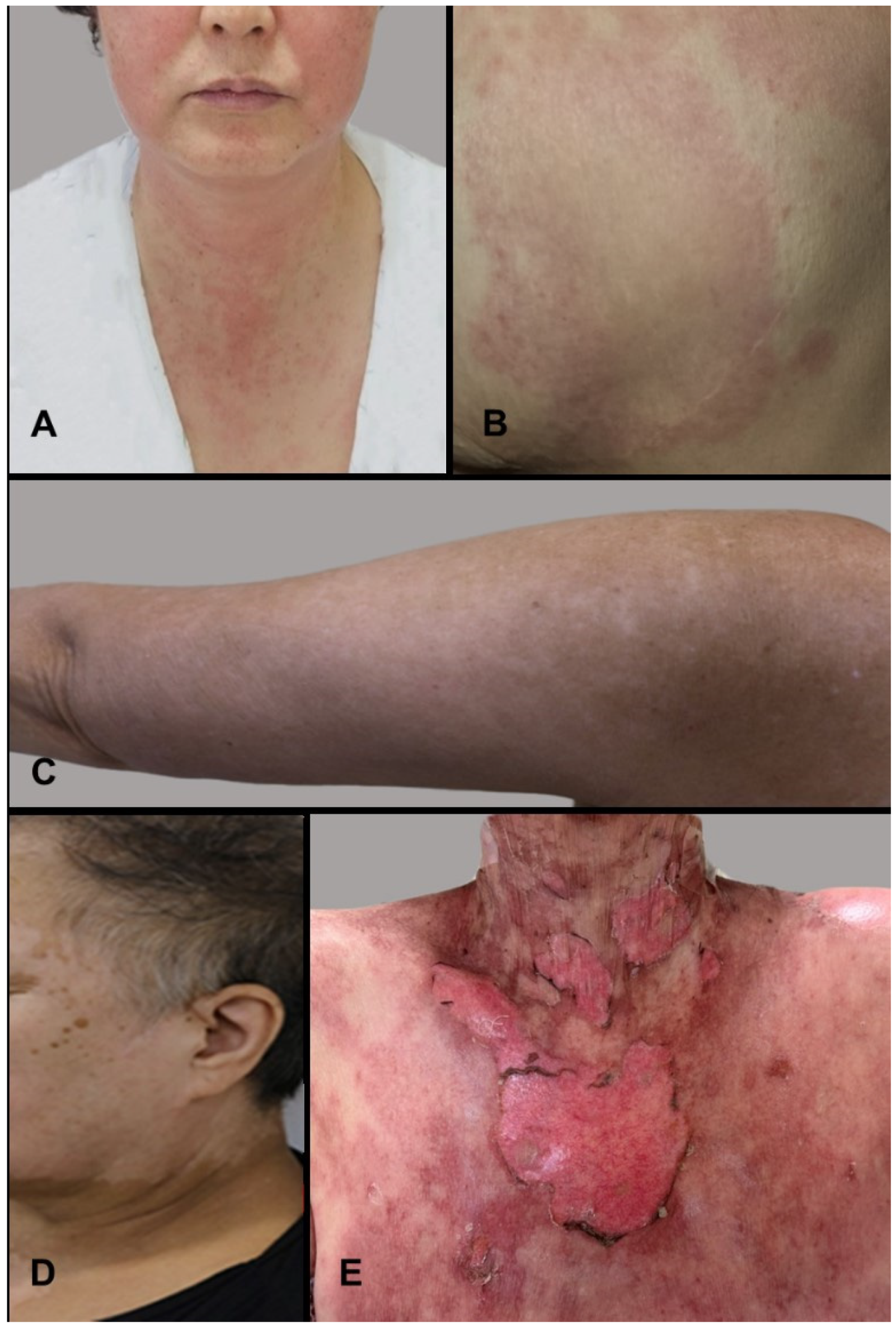
| Pruritus | 17 (58.6%) | |||
| Erythematous macular rash | 8 (27.6%) | |||
| Eczematous rash/contact dermatitis | 4 (13.8%) | |||
| Vitiligo-like lesion | 3 (10.3%) | |||
| Urticarial-type | 3 (10.3%) | |||
| Polymorphous light eruption | 2 (6.9%) | |||
| TEN | 1 (3.4%) | |||
| Desquamation | 1 (3.4%) | |||
| Univariate | Multivariate | |||
|---|---|---|---|---|
| OR (95% CI) | p Value | OR (95% CI) | p Value | |
| Age, years | ||||
| <65 years | Ref | Ref | ||
| ≥65 years | 2.61 (0.73–9.30) | 0.140 | 1.75 (0.43–7.06) | 0.435 |
| Menopausal status | ||||
| No | Ref | |||
| Yes | 1.40 (0.53–3.71) | 0.495 | ||
| ECOG performance status | ||||
| 0 | Ref | |||
| 1 | 0.76 (0.29–2.03) | 0.585 | ||
| 2 | - | - | ||
| BSA (m2) | 11.13 (0.55–226.29) | 0.117 | 5.85 (0.24–140.94) | 0.277 |
| Tertile 1 (<1.51) | Ref | |||
| Tertile 2 (≥1.51 to <1.64) | 1.30 (0.45–3.78) | 0.634 | ||
| Tertile 3 (≥1.64) | 1.54 (0.53–4.44) | 0.424 | ||
| Treatment | ||||
| Ribociclib + letrozole | Ref | Ref | ||
| Ribociclib + fulvestrant | 0.38 (0.12–1.18) | 0.093 | 0.49 (0.14–1.67) | 0.252 |
| Ribociclib + letrozole + GnRHa | 0.49 (0.18–1.37) | 0.173 | 0.62 (0.20–1.90) | 0.398 |
| Disease status | ||||
| De novo metastatic | Ref | Ref | ||
| Recurrent | 0.55 (0.23–1.29) | 0.170 | 0.56 (0.21–1.45) | 0.230 |
| Hypercholesterolemia | ||||
| No | Ref | |||
| Yes | 1.63 (0.68–3.88) | 0.274 | ||
| Taking cholesterol-lowering medication | ||||
| No | Ref | Ref | ||
| Yes | 2.42 (0.86–6.81) | 0.093 | 2.38 (0.79–7.13) | 0.122 |
| Number of Patients | ||||
|---|---|---|---|---|
| Missing Value | Analyzed Patients | N (%) | Mean (±S.D) or Median (Range) | |
| Time until cAEs appear (days) | 1 | 28 | ||
| Median (range) | 84.00 (3.00–498.00) | |||
| Dose reduction due to skin toxicity | 0 | 29 | ||
| No | 26 (89.7%) | |||
| Yes | 3 (10.3%) | |||
| Drug discontinuation due to skin toxicity | 0 | 29 | ||
| No | 26 (89.7%) | |||
| Yes * | 3 (10.3%) | |||
| Medications used for cAEs | 1 | 28 | ||
| Antihistamine | 10 (35.7%) | |||
| Topical ointment | 8 (28.6%) | |||
| Others | 7 (25.0%) | |||
| Systemic steroid | 3 (10.7%) | |||
| Treatment Patterns | ||||
|---|---|---|---|---|
| Ribociclib + Letrozole ± GnRHa | Ribociclib + Fulvestrant | |||
| HR (95% CI) | p Value | HR (95% CI) | p Value | |
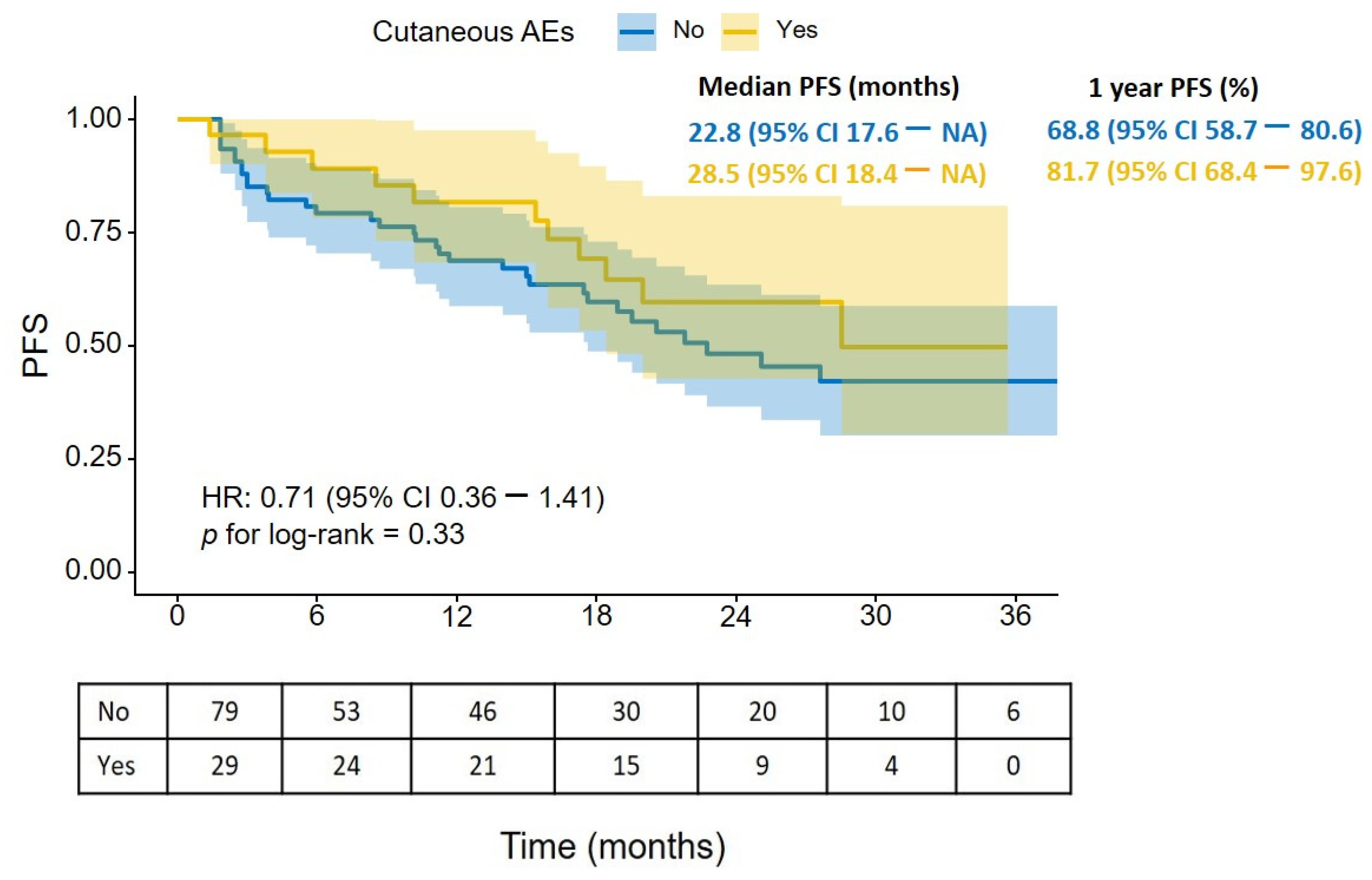
| Cutaneous AEs (yes) | 0.67 (0.27–1.67) | 0.393 | 0.75 (0.22–2.59) | 0.652 |
| Age (≥65 years) | 0.57 (0.13–2.54) | 0.457 | 1.78 (0.36–8.88) | 0.484 |
| BSA (m2) | 4.85 (0.36–66.18) | 0.236 | 9.81 (0.19–504.57) | 0.256 |
| Disease status (recurrent) | 0.97 (0.44–2.15) | 0.944 | 0.85 (0.18–4.04) | 0.841 |
| Taking cholesterol-lowering medication (yes) | 1.03 (0.38–2.76) | 0.955 | 1.32 (0.42–4.20) | 0.637 |
Disclaimer/Publisher’s Note: The statements, opinions and data contained in all publications are solely those of the individual author(s) and contributor(s) and not of MDPI and/or the editor(s). MDPI and/or the editor(s) disclaim responsibility for any injury to people or property resulting from any ideas, methods, instructions or products referred to in the content. |
© 2026 by the authors. Licensee MDPI, Basel, Switzerland. This article is an open access article distributed under the terms and conditions of the Creative Commons Attribution (CC BY) license.
Share and Cite
Kim, E.; Lim, Y.; Ham, A.; Kim, H.G.; Lee, J.W.; Lee, J.H.; Woo, J.; Lim, W.; Moon, B.I.; Ahn, S.H.; et al. Analysis of the Frequency and Associated Factors of Skin Toxicity in Patients Receiving Ribociclib-Based Therapy for Metastatic Breast Cancer. Cancers 2026, 18, 1602. https://doi.org/10.3390/cancers18101602
Kim E, Lim Y, Ham A, Kim HG, Lee JW, Lee JH, Woo J, Lim W, Moon BI, Ahn SH, et al. Analysis of the Frequency and Associated Factors of Skin Toxicity in Patients Receiving Ribociclib-Based Therapy for Metastatic Breast Cancer. Cancers. 2026; 18(10):1602. https://doi.org/10.3390/cancers18101602
Chicago/Turabian StyleKim, Esther, Youra Lim, Ahrong Ham, Hyun Goo Kim, Jun Woo Lee, Jang Hee Lee, Joohyun Woo, Woosung Lim, Byung In Moon, Sei Hyun Ahn, and et al. 2026. "Analysis of the Frequency and Associated Factors of Skin Toxicity in Patients Receiving Ribociclib-Based Therapy for Metastatic Breast Cancer" Cancers 18, no. 10: 1602. https://doi.org/10.3390/cancers18101602
APA StyleKim, E., Lim, Y., Ham, A., Kim, H. G., Lee, J. W., Lee, J. H., Woo, J., Lim, W., Moon, B. I., Ahn, S. H., Lee, H. A., & Lee, K. E. (2026). Analysis of the Frequency and Associated Factors of Skin Toxicity in Patients Receiving Ribociclib-Based Therapy for Metastatic Breast Cancer. Cancers, 18(10), 1602. https://doi.org/10.3390/cancers18101602