1. Introduction
Primary thyroid lymphoma (PTL) is an infrequent malignancy, accounting for roughly 1–5% of thyroid neoplasms and approximately 2% of extranodal lymphomas [
1,
2]. Clinically, PTL is characterized by lymphomatous involvement localized to the thyroid gland, occasionally extending to regional cervical lymph nodes [
1,
2,
3]. The patient demographics typically shift toward older adults in their 60s and 70s, with a pronounced female predominance (ratio of ~4:1) [
4,
5].
The pathogenesis is inextricably linked to chronic inflammatory diseases; patients with Hashimoto’s thyroiditis face a risk nearly sixty times higher than the general population [
6,
7]. This association suggests that persistent immune stimulation triggers lymphoid hyperplasia, eventually facilitating malignant transformation within the thyroid microenvironment. While isolated cases have been documented in patients with Graves’ disease, there is currently no established causal link between PTL and conditions such as colloid goiter, ionizing radiation exposure, or specific chromosomal aberrations [
6,
8,
9,
10,
11,
12].
Treatment of PTL has evolved significantly. Surgical resection, once commonly performed for diagnostic and therapeutic purposes, now has a limited role, largely confined to airway stabilization or cases in which less invasive diagnostic methods are inconclusive [
12,
13,
14,
15,
16].
The present study reports a case series from our institution, detailing the clinical characteristics, diagnostic work-up, histopathologic subtypes, therapeutic approaches and outcomes of patients with PTL managed over a defined period. Our findings may help to inform clinicians’ diagnostic vigilance and to guide selection of appropriate tailored treatment planning for this rare but potentially aggressive thyroid malignancy. This paper focuses exclusively on primary thyroid lymphoma.
2. Materials and Methods
In this retrospective single-center case series, clinical and demographic data from nine patients who underwent fine needle aspiration cytology or surgery (excisional biopsy or thyroidectomy) for primary thyroid lymphoma between 2015 and 2025 were extracted from a computerized endocrine-surgery registry. All procedures were performed at the Veneto Institute of Oncology, a tertiary referral center specialized in endocrine surgery. Each patient had been referred to the surgical unit for an evaluation of a rapidly enlarging cervical mass associated with compressive symptoms, including dysphagia, dysphonia, or dyspnea, or the performance of a fine needle aspiration cytology (FNAC) or surgical biopsy.
The variables collected included sex, age, the presence of pre-existing thyroid disorders (Hashimoto’s thyroiditis, Graves’ disease or multinodular goiter) and a significant family history of thyroid disease. All patients underwent a standardized preoperative evaluation comprising thyroid function tests (TSH, fT4 and fT3) and high-resolution cervical ultrasonography. Additional diagnostic investigations, including further imaging studies (e.g., computed tomography or magnetic resonance imaging) or supplementary laboratory analyses, were performed as clinically indicated on the basis of individual patient characteristics and preoperative findings.
The therapeutic approach adopted for each patient was taken into consideration and reported in our series, and patient outcomes, including survival, were assessed and incorporated in the analysis.
Written informed consent was obtained from every participant following a comprehensive explanation of the study’s purpose, procedures, and data-handling methods.
3. Results
The cohort comprised nine patients (six females and three males) with primary thyroid lymphoma (PTL) in a total of 830 cases of thyroid cancer (0.92%) managed between 2015 and 2025. The median age was 65.2 years with an age distribution ranging from 47 to 83 years.
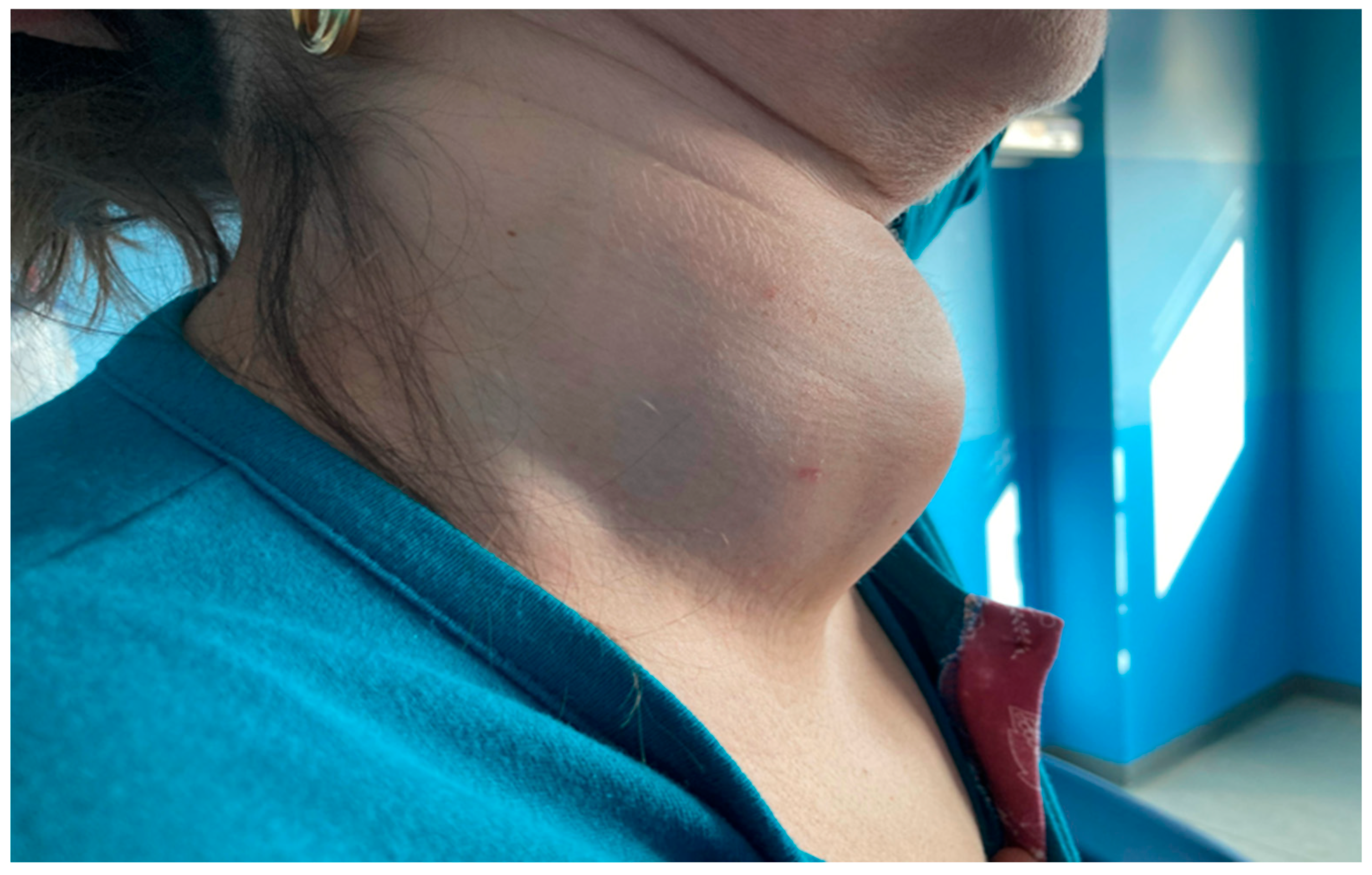
All patients included in the study were euthyroid at the time of evaluation; four patients were receiving levothyroxine to restore normal thyroid hormone levels. With regard to their underlying thyroid conditions, one patient was diagnosed with multinodular goiter alone and one with Hashimoto’s thyroiditis (with a 4-year history), four patients had Hashimoto’s thyroiditis in a multinodular goiter (one with a 7-year history and three with a 3-year history) and two patients had a uninodular goiter (
Figure 1).
Their thyroid functional status was assessed through standard biochemical testing as part of the preoperative workup.
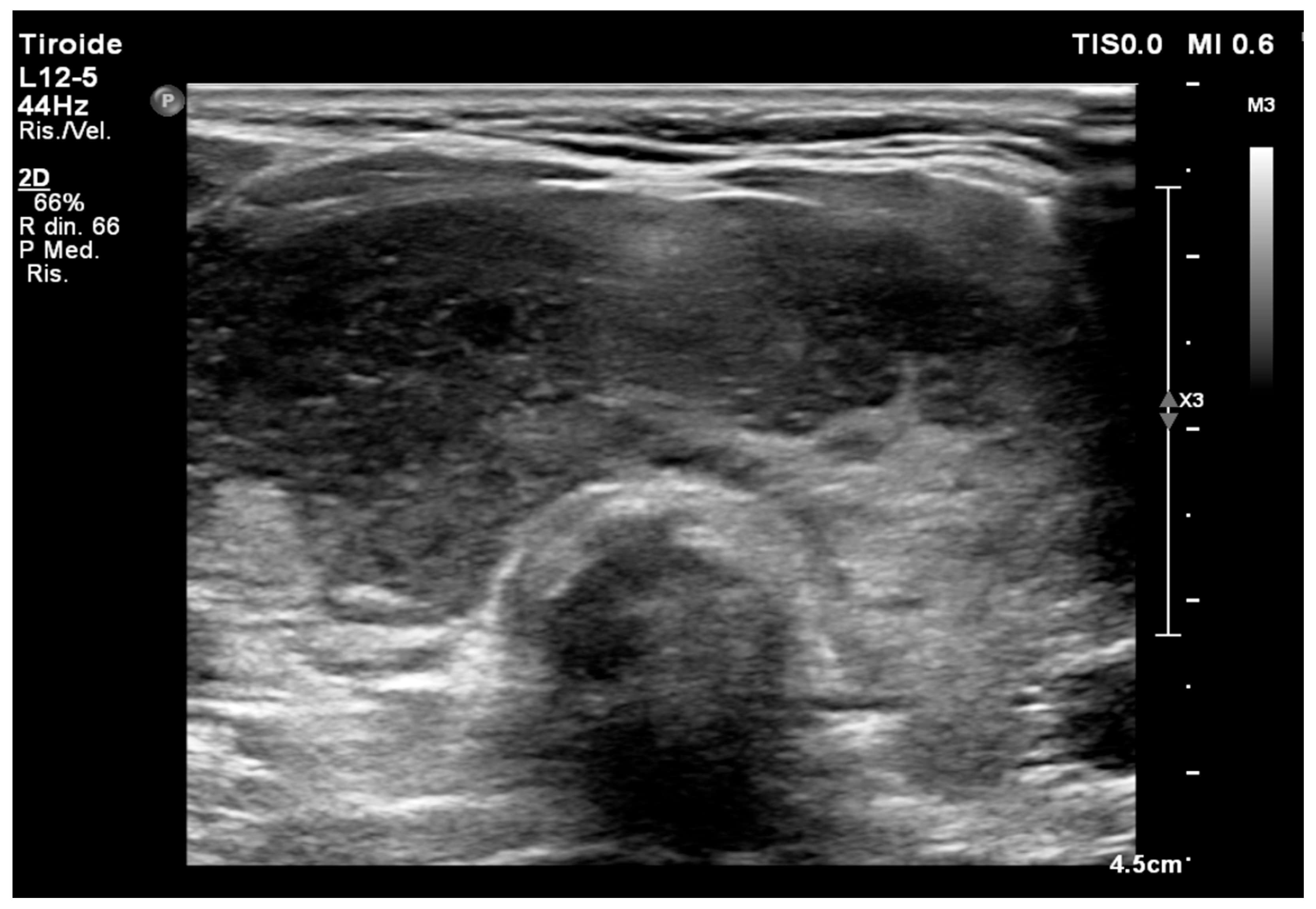
Preoperative ultrasonography was performed in all cases and patients presented a solid lesion having markedly hypoechoic echogenicity with increased intralesional vascularity compared to normal thyroid parenchyma, absence of intranodular calcifications, and variable margin definition (
Figure 2).
Fine-needle aspiration cytology was performed on all patients, and the cytological report was suspicious for lymphoma in three cases. Three samples were non-diagnostic (Bethesda I), anaplastic thyroid cancer was suspected in one specimen, and two patients were diagnosed with a benign nodule (Bethesda II).
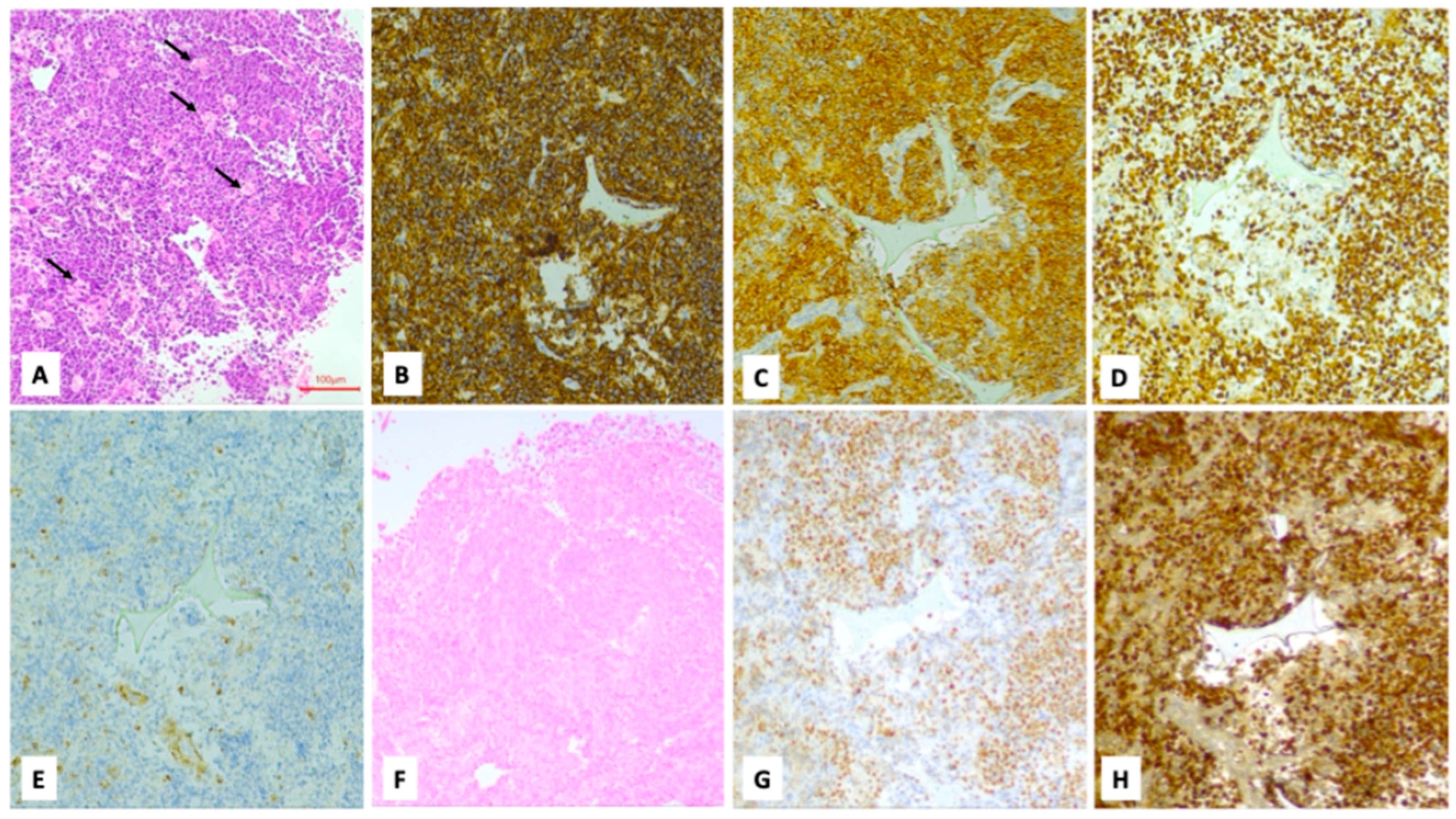
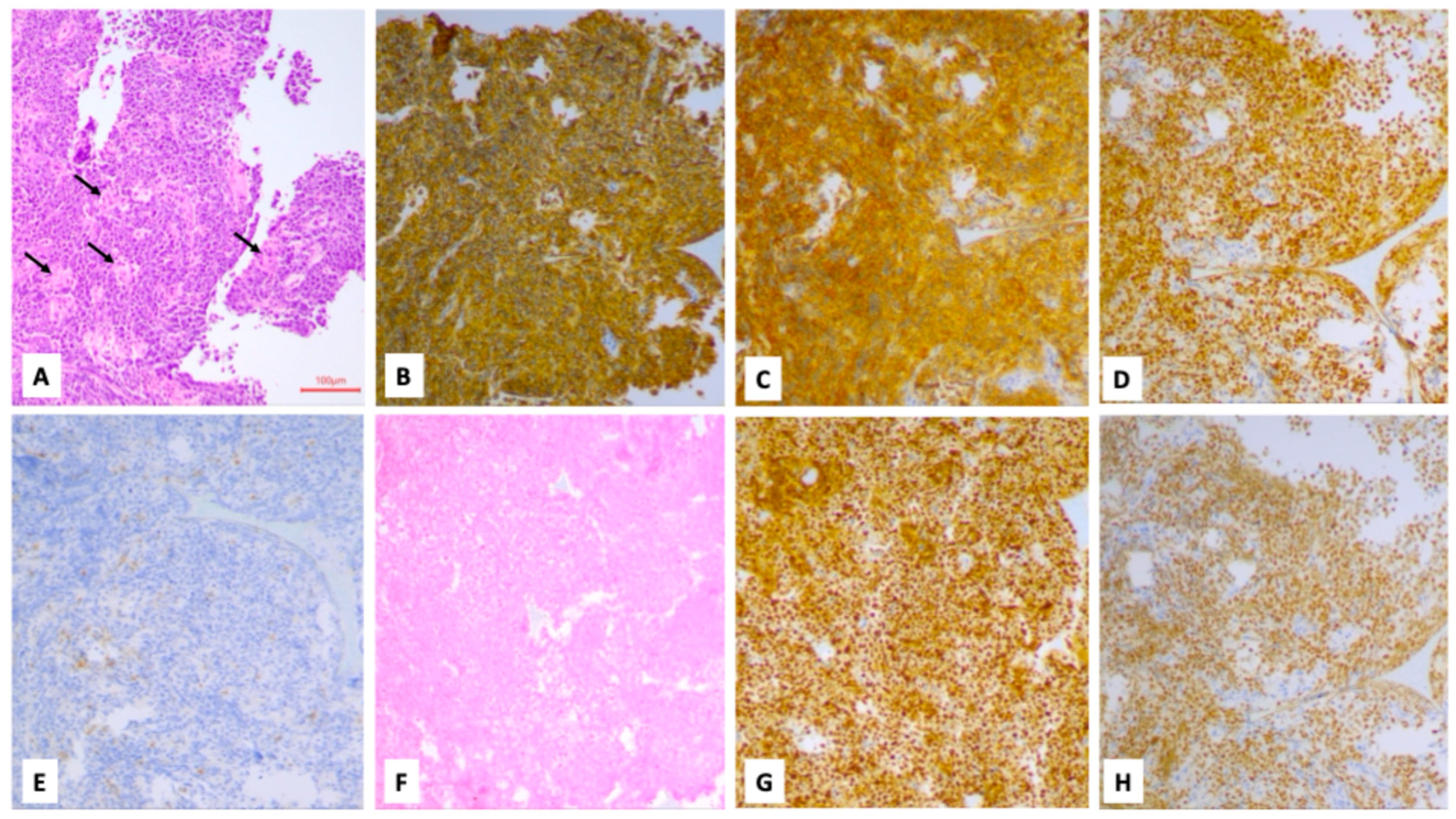
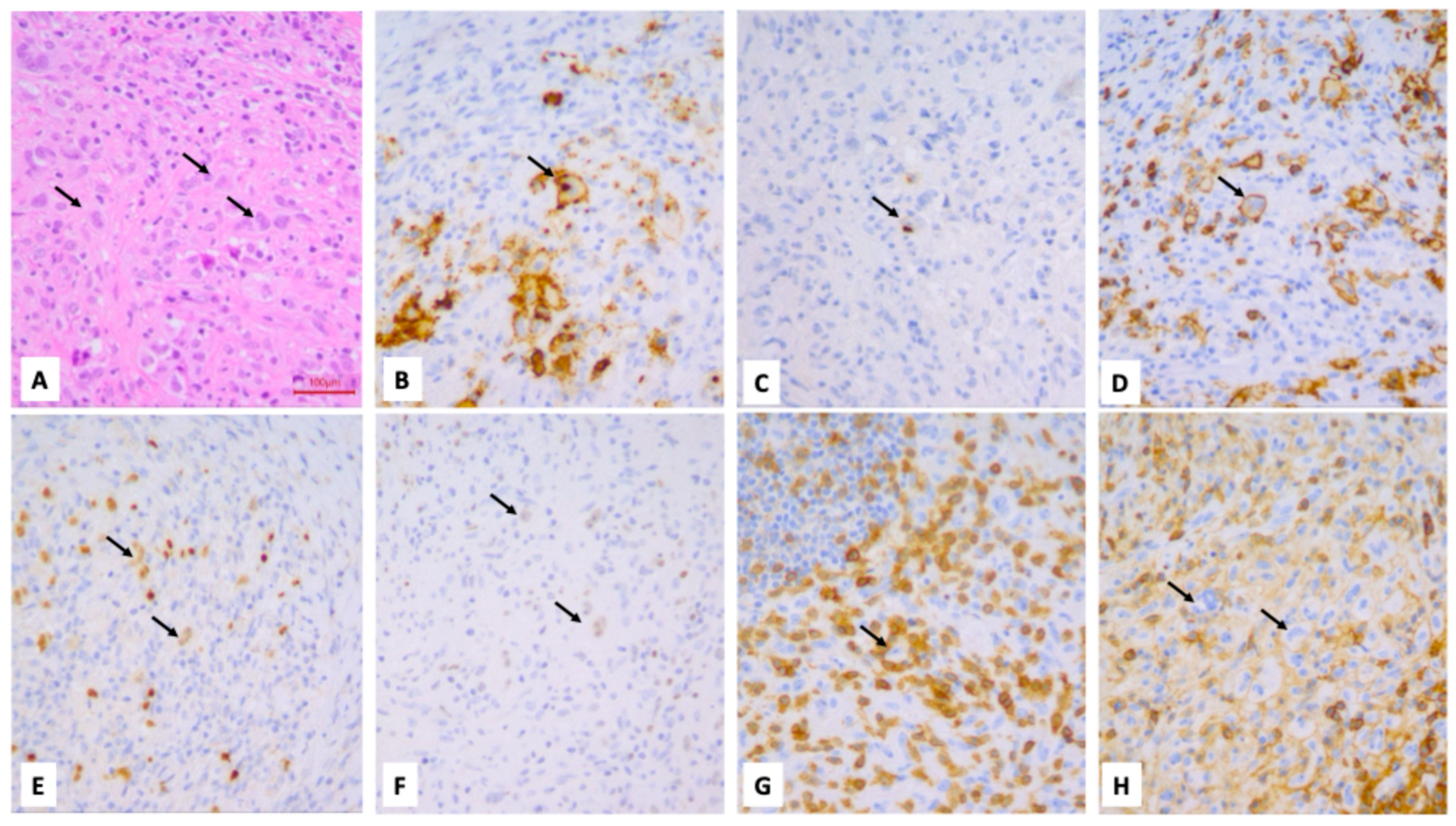
Surgery was performed on eight patients: five patients underwent an incisional biopsy, while the three patients with a cytological report of Bethesda I or II underwent a total thyroidectomy. The histological evaluation showed that two cases had diffuse large B-cell lymphoma (DLBCL), two cases were diagnosed with Burkitt’s lymphoma, one case had high-grade B-cell lymphoma (HGBCL) not otherwise specified (NOS), one case had follicular non-Hodgkin lymphoma, two cases had nodular sclerosis Hodgkin lymphoma and one case had MALT-lymphoma (
Figure 3,
Figure 4 and
Figure 5).
All patients enrolled in the study underwent FDG-PET imaging as part of their diagnostic workup and staging assessment. This modality allowed for the evaluation of metabolically active disease sites and the detection of potential distant involvement.
In patients presenting with advanced-stage disease, FDG-PET findings revealed faint radiotracer uptake at the level of the left adrenal gland in two cases, suggestive of low-grade metabolic involvement. In one additional case, increased FDG uptake was observed in the bilateral laterocervical lymph nodes, consistent with nodal disease extension with a massive uptake of the thyroid gland (SUV 32.25).
One patient was diagnosed with low-grade follicular lymphoma by cytology and flow cytometry and started follow-up because it is considered an indolent, slow-growing disease by the current guidelines [
17]. Indeed, four years later, the presence of periureteral disease was found during an emergency CT scan for anuria. The patient started six cycles of treatment with R–bendamustine (Rituximab–Bendamustine).
Eight patients received chemotherapy and immunotherapy. The patient with MALT lymphoma underwent a total thyroidectomy upfront because it appeared to be a multinodular goiter and then started follow-up.
The chemotherapy included six cycles of R-CHOP (cyclophosphamide, adriamycin, vincristine and prednisolone) with rituximab for patients with DLBCL, while the two patients diagnosed with Burkitt’s lymphoma received six cycles of R-Hyper CVAD-MA (rituximab, cyclophosphamide, vincristine, adriamycin, dexamethasone, and methotrexate). One patient with HGBCL-NOS was treated with six cycles of dose-adjusted EPOCH-R (etoposide, prednisone, vincristine, cyclophosphamide, doxorubicin, and rituximab) and high-dose methotrexate, and the two cases with nodular sclerosis Hodgkin lymphoma received six cycles of Brentuximab–AVD (brentuximab vedotin with doxorubicin, vinblastine, and dacarbazine).
Eight of the patients treated showed a complete therapeutic response. One patient with Burkitt’s lymphoma presented persistent FDG uptake only in the left thyroid lobe. For this reason, she underwent a thyroid lobectomy, and the histological examination only found fibrotic tissue.
Eight patients are still alive with a mean follow-up of 44 months (minimum 6 months, maximum 84 months) without any signs of persistence or recurrence of disease. One patient died of stroke (
Table 1).
4. Discussion
Thyroid cancer is the most common endocrine malignancy, and primary thyroid lymphoma (PTL) accounts for less than 5% of all thyroid malignancies and approximately 3% of all non-Hodgkin lymphomas [
1,
2,
3]. Between 2015 and 2025, we managed a total of 830 cases of thyroid cancer, of which only nine were identified as primary thyroid lymphoma (PTL), corresponding to an incidence of 0.92%. This finding is fully consistent with the rates reported in the literature and confirms the rarity of this type of malignancy [
1,
2,
3].
As a general principle, the thyroid gland normally lacks significant lymphoid tissue. However, when pathological processes arise, lymphocytes can begin to infiltrate the gland, creating an environment that facilitates disease progression [
11]. One of the best-known risk factors in this setting is autoimmune chronic lymphocytic thyroiditis, commonly known as Hashimoto’s thyroiditis. Individuals with this condition exhibit a markedly high risk of developing primary thyroid lymphoma (PTL) estimated to be 40 to 80 times higher than that of the general population [
6,
12,
13].
Several studies report that Hashimoto’s thyroiditis is present in more than 90% of PTL cases, underscoring the strength of this association. The probable explanation for this close link lies in the persistent antigenic stimulation that characterizes chronic autoimmune inflammation, which may drive the lymphoid cells toward malignant transformation over time [
6,
18,
19,
20]. In our series, five patients have HT, representing 55.5% of the sample and confirming HT as a risk factor for primary thyroid lymphoma.
The most common histotype of primary thyroid lymphoma belongs to the category of B-cell non-Hodgkin lymphomas (98%): the most prevalent subtype is diffuse large B-cell lymphoma (DLBCL, 60–80% of cases), followed by mucosa-associated lymphoid tissue (MALT, 10–23% of cases). Other histological types include follicular lymphoma (10% of cases), followed by small lymphocytic lymphoma and chronic lymphocytic lymphoma (~3% of cases), Hodgkin lymphoma (2% of cases), T-cell lymphomas, and lymphoblastic lymphomas. The aggressiveness of the clinical presentation depends on its histology, with DLBCL displaying a more aggressive behavior than indolent lymphomas like MALT lymphoma or follicular lymphomas. In our study, we did not find a significant prevalence of any particular type of PTL [
8,
21,
22].
The duration of symptoms before diagnosis can range widely from a few days to several years. Clinically, PTL often presents dramatically, with many patients experiencing a rapidly enlarging neck mass over weeks to months. This presentation may be accompanied by obstructive symptoms such as dyspnea, stridor, dysphagia, or hoarseness due to compression of the trachea or recurrent laryngeal nerve. Systemic B symptoms (fever, night sweats, weight loss, fatigue or pruritus) are less common but may occur in aggressive subtypes. Since these symptoms overlap with those of more prevalent thyroid diseases including anaplastic thyroid carcinoma, or benign goiters, initial clinical suspicion may be low, potentially delaying diagnosis [
20].
There are no definitive pathognomonic markers in thyroid lymphomas; consequently, thyroid ultrasound is the recommended initial imaging method, although it frequently mimics other inflammatory or neoplastic conditions [
23,
24].
Fine needle aspiration cytology (FNAC) remains the primary diagnostic tool for the initial evaluation of thyroid lesions. However, the lack of pathognomonic features in PTL often complicates the cytological assessment, presenting significant hurdles for achieving a definitive diagnosis. While no large-scale randomized trials evaluating FNAC accuracy specifically for PTL have been conducted, data from several small-scale retrospective series indicate that diagnostic performance has improved. The integration of ancillary techniques—including flow cytometry, immunocytochemistry, and polymerase chain reaction (PCR)—has notably enhanced both the sensitivity and the specificity of the procedure [
23,
24,
25,
26].
We failed to obtain a satisfactory cytological report in six cases (66.6%), making it necessary to proceed with a surgical biopsy or a thyroidectomy [
19]. In our opinion, it is mandatory to proceed with a surgical approach to avoid misdiagnosis and a diagnostic delay that could negatively affect the patient’s overall prognosis and reduce the possibility of starting an appropriate, targeted treatment in time. Such delays may allow the disease to progress unchecked, ultimately limiting therapeutic options and potentially worsening clinical outcomes. The therapeutic value of surgery in primary thyroid lymphoma remains controversial, as evidence from large referral centers does not support a benefit in terms of survival. Surgical management has not been shown to improve overall survival. The largest available series, reported by the Mayo Clinic and including 62 patients with PTL, demonstrated that total thyroidectomy followed by adjuvant radiotherapy did not ensure a higher survival rate than diagnostic biopsy combined with radiotherapy in patients with stage IE or IIE disease [
27,
28]. On this basis, we discouraged routine thyroidectomy, highlighting both the lack of benefit for survival and the potential morbidity associated with surgical procedures. Nevertheless, surgical intervention may still play a limited role in selected cases, such as patients with MALT lymphoma.
Following confirmation of the diagnosis, a multidisciplinary management strategy should be immediately adopted. A coordinated effort involving medical oncologists, radiation oncologists, and endocrinologists ensures that staging workup and therapeutic interventions proceed without delay [
4].
In this case series, three patients underwent total thyroidectomy as there was no definitive preoperative diagnosis due to an unconclusive FNAC or benign cytological report and they presented compressive symptoms that interfered decisively with their quality of life. One patient with a benign cytology was supposed to undergo total thyroidectomy for multinodular goiter but, due to adhesions between the thyroid gland and the prethyroid muscles, and the surrounding anatomical structures, it was only possible to perform a surgical biopsy. Another patient was subjected to a thyroid lobectomy after chemotherapy for the persistence of the disease documented by a FDG PET-CT scan after a multidisciplinary discussion with the hematologist, surgeon, oncologist and radiologist. The histological examination only found fibrotic tissue.
FDG-PET plays a central role in the diagnosis, staging, response assessment, prognostication, and surveillance of high-grade lymphomas, significantly influencing clinical management [
29]. Although imaging techniques such as ultrasound, CT, and [18F]FDG-PET/CT are fundamental for the initial detection and staging assessment of PTL, definitive diagnosis ultimately relies on histopathological evaluation obtained through surgical or core-needle biopsy, coupled with immunohistochemical analysis, underscoring the pivotal role of tissue sampling over imaging alone.
The small sample size represents a major limitation and reflects the rarity of PTL [
30,
31]. Additionally, the heterogeneity of histological subtypes and treatment strategies within such a small cohort further limits the ability to draw subtype-specific conclusions.
Larger, prospective, multi-center studies are therefore needed to validate these findings and to better define optimal diagnostic and therapeutic strategies for primary thyroid lymphoma.
5. Conclusions
Primary thyroid lymphoma is a rare and often underrecognized thyroid malignancy whose diagnosis may be challenging because of its non-specific clinical, laboratory, and imaging features. Our single-center experience confirms the low incidence of PTL among thyroid cancers and highlights its prevalence in older patients, frequent association with autoimmune thyroid disease, and heterogeneous histopathological spectrum. In our series, fine-needle aspiration cytology alone was insufficient to establish a definitive diagnosis in a substantial proportion of cases, reinforcing the limitations of FNAC in this setting and the potential need for surgical biopsy when clinical suspicion is high. Although surgery no longer plays a primary therapeutic role in PTL, our findings support its selective use as a diagnostic and, in carefully chosen cases, symptom-relieving strategy—particularly in patients with rapidly progressing compressive symptoms or inconclusive cytology. Ultimately, the management of primary thyroid lymphoma requires a multidisciplinary approach involving endocrinologists, surgeons, hematologists, oncologists, radiologists, and pathologists. Early recognition, accurate histological classification, and tailored treatment planning are essential to optimize clinical outcomes.
Author Contributions
Conceptualization, A.T. and E.B.; methodology, E.B., L.P. and M.L.S.; software, A.P.; validation, M.L.S. and R.T.; formal analysis, E.B. and L.P.; investigation, E.B. and R.T.; data curation, writing—original draft preparation, E.B. and A.P.; writing—review and editing, E.B., A.T. and I.C.; supervision, A.T. All authors have read and agreed to the published version of the manuscript.
Funding
This research was funded by the Italian Ministry of Health’s Current Research program.
Institutional Review Board Statement
This study was conducted in accordance with the Declaration of Helsinki and approved by the Institutional Ethics Committee of the Veneto Institute of Oncology, IOV-IRCCS, on 26 July 2023 (IOV-ENDCH-01-2023).
Informed Consent Statement
Informed consent was obtained from all subjects involved in the study.
Data Availability Statement
Data can be found in the patients’ medical records.
Conflicts of Interest
The authors have no conflicts of interest to declare.
References
- Ríos, A.; Rodríguez, J.; Febrero, B.; Parrilla, P. Linfoma primario del tiroides Primary thyroid lymphoma. Endocrinol. Nutr. 2014, 61, 497–499. [Google Scholar] [CrossRef]
- Rovira, A.; Carroll, P.; Simo, R. Thyroid lymphoma. Curr. Opin. Otolaryngol. Head Neck Surg. 2023, 31, 83–88. [Google Scholar] [CrossRef]
- Ansell, S.M.; Grant, C.S.; Habermann, T.M. Primary Thyroid Lymphoma. Semin. Oncol. 1999, 26, 316–323. [Google Scholar] [PubMed]
- Graff-Baker, A.; Roman, S.A.; Thomas, D.C.; Udelsman, R.; Sosa, J.A. Prognosis of primary thyroid lymphoma: Demographic, clinical, and pathologic predictors of survival in 1,408 cases. Surgery 2009, 146, 1105–1115. [Google Scholar] [CrossRef]
- Watanabe, N.; Noh, J.Y.; Narimatsu, H.; Takeuchi, K.; Yamaguchi, T.; Kameyama, K.; Kobayashi, K.; Kami, M.; Kubo, A.; Kunii, Y.; et al. Clinicopathological features of 171 cases of primary thyroid lymphoma: A long-term study involving 24 553 patients with Hashimoto’s disease. Br. J. Haematol. 2011, 153, 236–243. [Google Scholar] [CrossRef] [PubMed]
- Suzuki, N.; Watanabe, N.; Noh, J.Y.; Yoshimura, R.; Mikura, K.; Kinoshita, A.; Suzuki, A.; Mitsumatsu, T.; Fukushita, M.; Matsumoto, M.; et al. The Relationship Between Primary Thyroid Lymphoma and Various Types of Thyroid Autoimmunity: A Retrospective Cohort Study of 498 Cases, Including 9 Cases with Graves’ Disease. Thyroid® 2022, 32, 552–559. [Google Scholar] [CrossRef]
- Kuper-Hommel, M.J.; Snijder, S.; Janssen-Heijnen, M.L.; Vreugdenhil, A.; Noordijk, E.M.; Kluin-Nelemans, H.C.; Coebergh, J.W.W.; van Krieken, J.H. Treatment and Survival of Patients with Thyroid Lymphoma: A Population-Based Study with Clinical and Pathologic Reviews. Clin. Lymphoma Myeloma 2005, 6, 240–247. [Google Scholar] [CrossRef]
- Djrolo, F.; Gervaise, N.; Combe, H.; Linassier, C.; Lhuintre, Y.; Lecomte, P. [Malt lymphoma of the thyroid and Graves’disease]. Ann. D’endocrinologie 2001, 62, 442–445. [Google Scholar]
- Doi, Y.; Goto, A.; Murakami, T.; Yamashita, H.; Yamashita, H.; Noguchi, S. Primary thyroid lymphoma associated with Graves’ disease. Thyroid® 2004, 14, 772–776. [Google Scholar] [CrossRef] [PubMed]
- Zeki, K.; Eto, S.; Fujihira, T.; Masuda, M.; Oda, S.; Chiba, S.; Suzuki, H. Primary malignant lymphoma of the thyroid in a patient with long-standing Graves’ disease. Endocrinol. Jpn. 1985, 32, 435–440. [Google Scholar] [CrossRef] [PubMed]
- Lanham, T.; Lanham, E.; Sullivan, A.; Magaji, V. Non-Hodgkin lymphoma of the thyroid in a patient with hyperthyroidism. J. Community Hosp. Intern. Med. Perspect. 2021, 11, 79–80. [Google Scholar] [CrossRef] [PubMed] [PubMed Central]
- Battistella, E.; Pomba, L.; Costantini, A.; Scapinello, A.; Toniato, A. Hashimoto’s Thyroiditis and Papillary Cancer Thyroid Coexistence Exerts a Protective Effect: A Single Centre Experience. Indian J. Surg. Oncol. 2022, 13, 164–168. [Google Scholar] [CrossRef] [PubMed] [PubMed Central]
- Lee, J.S.; Shin, S.-J.; Yun, H.J.; Kim, S.M.; Chang, H.; Lee, Y.S.; Chang, H.-S. Primary thyroid lymphoma: A single-center experience. Front. Endocrinol. 2023, 14, 1064050. [Google Scholar] [CrossRef] [PubMed]
- Albu, E.; Zonszein, J.; Puvvada, N.; Gerst, P.H. Emergency surgery for primary lymphoma of the thyroid. Otolaryngol. Head Neck Surg. 1989, 100, 324–326. [Google Scholar] [CrossRef] [PubMed]
- Tang, Y.; Yan, T.; Qiu, W.; Ding, Z.; Fan, Y.; Jiao, Q.; Yang, Z. Surgery is a Viable Treatment Option for Stage IE Primary Thyroid Lymphoma. Ann. Surg. Oncol. 2024, 31, 1108–1115. [Google Scholar] [CrossRef] [PubMed]
- González-Sánchez, C.; Salvador-Egea, M.P.; Glückmann-Maldonado, E.; Ríos, A.; Martín-Fernández, J.; Pérez-García, J.I.; García-Lorenzo, F.; Flores-Pastor, B.; Gómez-Ramírez, J.; Ortega-Serrano, J.; et al. Diagnosis and treatment of primary thyroid lymphoma from a surgical perspective: A multi-institutional study. Langenbeck’s Arch. Surg. 2023, 408, 206. [Google Scholar] [CrossRef] [PubMed]
- Eyre, T.A.; Cwynarski, K.; d’Amore, F.; De Leval, L.; Dreyling, M.; Eichenauer, D.A.; Ferreri, A.J.M.; Giné, E.; Kersten, M.J.; Ladetto, M.; et al. Lymphomas: ESMO Clinical Practice Guideline for diagnosis, treatment and follow-up. Ann. Oncol. 2025, 36, 1263–1284. [Google Scholar] [CrossRef] [PubMed]
- Antunes, C.M.; Pinheiro, S.L.; Leite, V. Primary thyroid lymphoma: A tertiary-center experience. Endokrynol. Pol. 2025, 76, 659–664. [Google Scholar] [CrossRef]
- Matsuzuka, F.; Miyauchi, A.; Katayama, S.; Narabayashi, I.; Ikeda, H.; Kuma, K.; Sugawara, M. Clinical Aspects of Primary Thyroid Lymphoma: Diagnosis and Treatment Based on Our Experience of 119 Cases. Thyroid® 1993, 3, 93–99. [Google Scholar] [CrossRef]
- Saito, Y.; Watanabe, N.; Inoue, K.; Suzuki, N.; Narimatsu, H.; Yoshioka, K.; Masaki, C.; Akaishi, J.; Hames, K.Y.; Matsumoto, M.; et al. Survival Outcomes and Treatment Strategies in Primary Thyroid Lymphoma: A Population-Based Study of 401 Cases from the Tokyo Cancer Registry. Thyroid® 2025, 35, 1422–1429. [Google Scholar] [CrossRef]
- Wu, F.; Watanabe, N.; Tzioni, M.-M.; Akarca, A.; Zhang, C.; Li, Y.; Chen, Z.; Cucco, F.; Carmell, N.; Noh, J.Y.; et al. Thyroid MALT lymphoma: Self-harm to gain potential T-cell help. Leukemia 2021, 35, 3497–3508. [Google Scholar] [CrossRef] [PubMed]
- Hirokawa, M.; Kudo, T.; Ota, H.; Suzuki, A.; Kobayashi, K.; Miyauchi, A. Preoperative diagnostic algorithm of primary thyroid lymphoma using ultrasound, aspiration cytology, and flow cytometry. Endocr. J. 2017, 64, 859–865. [Google Scholar] [CrossRef]
- Tani, E.; Skoog, L. Fine Needle Aspiration Cytology and Immunocytochemistry in the Diagnosis of Lymphoid Lesions of the Thyroid-Gland. Acta Cytol. 1989, 33, 48–52. [Google Scholar]
- Xue, X.; Wu, L.; Zhang, J.; Sun, W.; Jiang, S.; Chu, X.; Sun, Y. Ultrasound scanning in diagnosing primary thyroid lymphoma. Clin. Hemorheol. Microcirc. 2024, 88, 385–393. [Google Scholar] [CrossRef] [PubMed]
- Matsuda, M.; Sone, H.; Koyama, H.; Ishiguro, S. Fine-needle aspiration cytology of malignant lymphoma of the thyroid. Diagn. Cytopathol. 1987, 3, 244–249. [Google Scholar] [CrossRef]
- Sangalli, G.; Serio, G.; Zampatti, C.; Lomuscio, G.; Colombo, L. Fine needle aspiration cytology of primary lymphoma of the thyroid: A report of 17 cases. Cytopathology 2001, 12, 257–263. [Google Scholar] [CrossRef]
- Pyke, C.M.; Grant, C.S.; Habermann, T.M.; Kurtin, P.J.; van Heerden, J.A.; Bergstralh, E.J.; Kunselman, A.; Hay, I.D. Non-Hodgkin’s lymphoma of the thyroid: Is more than biopsy necessary? World J. Surg. 1992, 16, 604–609. [Google Scholar] [CrossRef] [PubMed]
- Peixoto, R.; Pinto, J.C.; Soares, V.; Koch, P.; Gomes, A.T. Primary thyroid lymphoma: A case report and review of the literature. Ann. Med. Surg. 2017, 13, 29–33. [Google Scholar] [CrossRef]
- Jaafari, A.; Mehaudens, S.; Gheysens, O.; Bailly, S.; Schobbens, N.; Mourad, M.; Jamar, F. Massive Primary Thyroid Lymphoma on [18F]-FDG-PET/CT: A Literature Review of a Rare Case of Rapidly Progressive Goitre. Diagnostics 2025, 15, 2180. [Google Scholar] [CrossRef] [PubMed] [PubMed Central]
- Toniato, A.; Bernardi, C.; Piotto, A.; Rubello, D.; Pelizzo, M.R. Features of Papillary Thyroid Carcinoma in Patients Older than 75 Years. Updates Surg. 2011, 63, 115–118. [Google Scholar] [CrossRef] [PubMed]
- Widder, S.; Pasieka, J.L. Primary thyroid lymphomas. Curr. Treat. Options Oncol. 2004, 5, 307–313. [Google Scholar] [CrossRef] [PubMed]
| Disclaimer/Publisher’s Note: The statements, opinions and data contained in all publications are solely those of the individual author(s) and contributor(s) and not of MDPI and/or the editor(s). MDPI and/or the editor(s) disclaim responsibility for any injury to people or property resulting from any ideas, methods, instructions or products referred to in the content. |



 ,
,