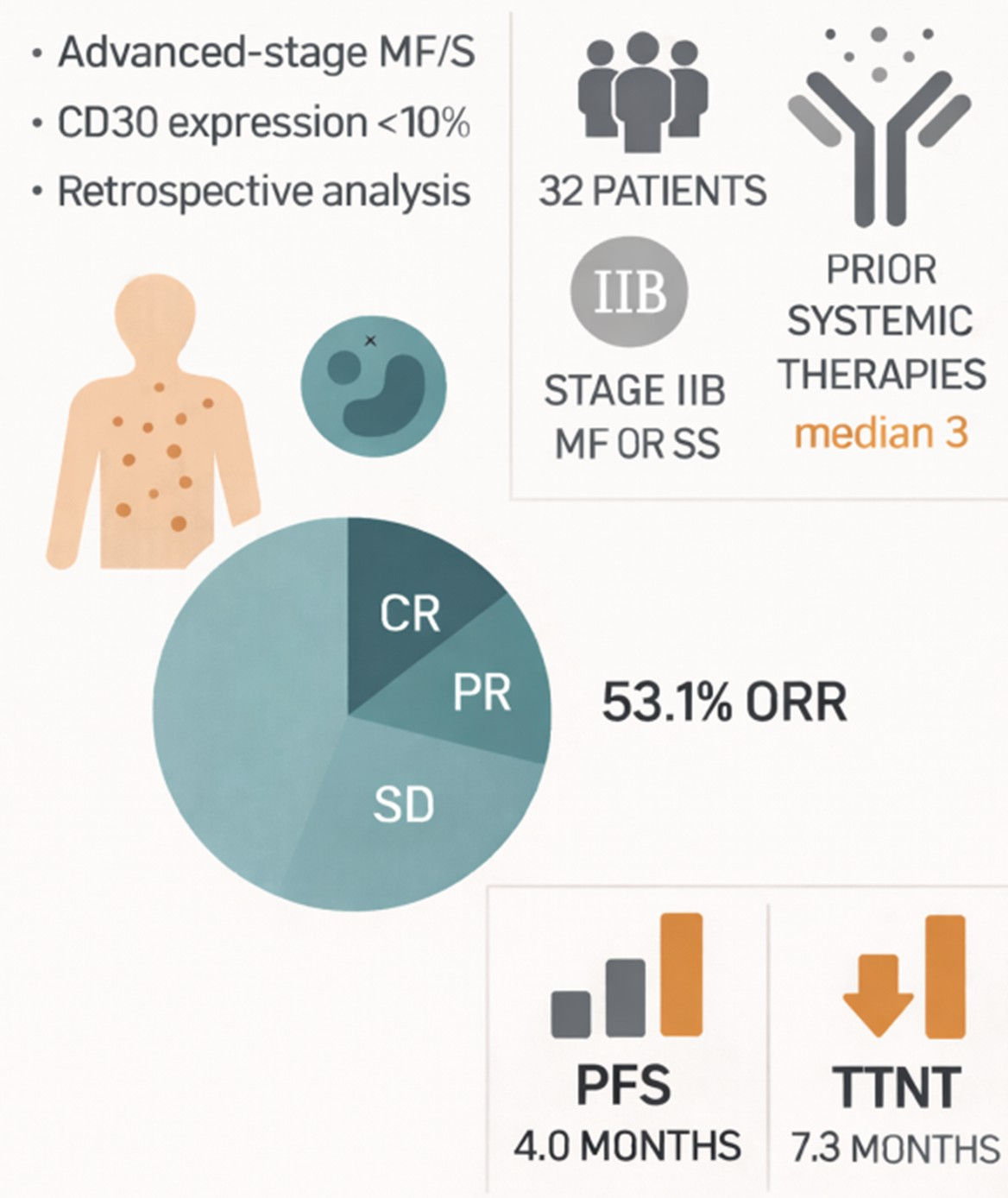
Brentuximab Vedotin in Advanced-Stage Mycosis Fungoides/Sézary Syndrome with Low CD30 Expression: Real-World Data from the German Cutaneous Lymphoma Network

 , ,
, ,  , and
, and 
Simple Summary
Abstract

1. Introduction
2. Materials and Methods
2.1. Patients
2.2. Treatment and Assessments
2.3. Safety
2.4. Statistical Analysis
3. Results
3.1. Patient Characteristics
3.2. Treatment Outcomes
3.3. Adverse Events
4. Discussion
5. Conclusions
Author Contributions
Funding
Institutional Review Board Statement
Informed Consent Statement
Data Availability Statement
Acknowledgments
Conflicts of Interest
References
- Willemze, R.; Cerroni, L.; Kempf, W.; Berti, E.; Facchetti, F.; Swerdlow, S.H.; Jaffe, E.S. The 2018 update of the WHO-EORTC classification for primary cutaneous lymphomas. Blood 2019, 133, 1703–1714. [Google Scholar] [CrossRef] [PubMed]
- Agar, N.S.; Wedgeworth, E.; Crichton, S.; Mitchell, T.J.; Cox, M.; Ferreira, S.; Robson, A.; Calonje, E.; Stefanato, C.M.; Wain, E.M.; et al. Survival Outcomes and Prognostic Factors in Mycosis Fungoides/Sézary Syndrome: Validation of the Revised International Society for Cutaneous Lymphomas/European Organisation for Research and Treatment of Cancer Staging Proposal. J. Clin. Oncol. 2010, 28, 4730–4739. [Google Scholar] [CrossRef] [PubMed]
- Kim, Y.H.; Tavallaee, M.; Sundram, U.; Salva, K.A.; Wood, G.S.; Li, S.; Rozati, S.; Nagpal, S.; Krathen, M.; Reddy, S.; et al. Phase II Investigator-Initiated Study of Brentuximab Vedotin in Mycosis Fungoides and Sézary Syndrome With Variable CD30 Expression Level: A Multi-Institution Collaborative Project. J. Clin. Oncol. 2015, 33, 3750–3758. [Google Scholar] [CrossRef] [PubMed]
- Scarisbrick, J.J.; Quaglino, P.; Whittaker, S.; Bagot, M.; Guenova, E.; Papadavid, E.; Prince, H.M.; Sanches, J.A.; Miyashiro, D.R.; Servitje, O.; et al. A new prognostic index (CLIPI) for advanced cutaneous lymphoma enables precise patient risk stratification. Blood 2025, 146, 1687–1692. [Google Scholar] [CrossRef]
- Dobos, G.; Pohrt, A.; Ram-Wolff, C.; Lebbé, C.; Bouaziz, J.-D.; Battistella, M.; Bagot, M.; de Masson, A. Epidemiology of Cutaneous T-Cell Lymphomas: A Systematic Review and Meta-Analysis of 16,953 Patients. Cancers 2020, 12, 2921. [Google Scholar] [CrossRef]
- Bradford, P.T.; Devesa, S.S.; Anderson, W.F.; Toro, J.R. Cutaneous lymphoma incidence patterns in the United States: A population-based study of 3884 cases. Blood 2009, 113, 5064–5073. [Google Scholar] [CrossRef]
- Cheikh El Najjarine, K.; Kajüter, H.; Wellmann, I.; Stang, A.; Assaf, C. Incidence and Mortality of Cutaneous Lymphomas in Germany. J. Dtsch. Dermatol. Ges. 2025. online ahead of print. [Google Scholar] [CrossRef]
- Latzka, J.; Assaf, C.; Bagot, M.; Cozzio, A.; Dummer, R.; Guenova, E.; Gniadecki, R.; Hodak, E.; Jonak, C.; Klemke, C.-D.; et al. EORTC consensus recommendations for the treatment of mycosis fungoides/Sézary syndrome–Update 2023. Eur. J. Cancer 2023, 195, 113343. [Google Scholar] [CrossRef]
- NCCN. Primary Cutaneous Lymphomas, Version 2025. Available online: https://www.nccn.org (accessed on 26 November 2025).
- Willemze, R.; Hodak, E.; Zinzani, P.; Specht, L.; Ladetto, M. Primary cutaneous lymphomas: ESMO Clinical Practice Guidelines for diagnosis, treatment and follow-up. Ann. Oncol. 2018, 29, iv30–iv40. [Google Scholar] [CrossRef]
- Alberti-Violetti, S.; Ardigò, M.; Massone, C.; Pileri, A.; Sala, R.; Teoli, M.; Grandi, V.; Quaglino, P.; Pimpinelli, N.; Berti, E. Effectiveness and tolerability of chlormethine gel for the management of mycosis fungoides: A multicenter real-life evaluation. Front. Oncol. 2024, 13, 1298296. [Google Scholar] [CrossRef]
- Marchi, E.; Alinari, L.; Tani, M.; Stefoni, V.; Pimpinelli, N.; Berti, E.; Pagano, L.; Bernengo, M.G.; Zaja, F.; Rupoli, S.; et al. Gemcitabine as frontline treatment for cutaneous T-cell lymphoma. Cancer 2005, 104, 2437–2441. [Google Scholar] [CrossRef] [PubMed]
- Wollina, U.; Dummer, R.; Brockmeyer, N.H.; Konrad, H.; Busch, J.; Kaatz, M.; Knopf, B.; Koch, H.; Hauschild, A. Multicenter study of pegylated liposomal doxorubicin in patients with cutaneous T-cell lymphoma. Cancer 2003, 98, 993–1001. [Google Scholar] [CrossRef] [PubMed]
- Hughes, C.F.M.; Khot, A.; McCormack, C.; Lade, S.; Westerman, D.A.; Twigger, R.; Buelens, O.; Newland, K.; Tam, C.; Dickinson, M.; et al. Lack of durable disease control with chemotherapy for mycosis fungoides and Sézary syndrome: A comparative study of systemic therapy. Blood 2015, 125, 71–81. [Google Scholar] [CrossRef] [PubMed]
- Quaglino, P.; Maule, M.; Prince, H.M.; Porcu, P.; Horwitz, S.; Duvic, M.; Talpur, R.; Vermeer, M.; Bagot, M.; Guitart, J.; et al. Global patterns of care in advanced stage mycosis fungoides/Sezary syndrome: A multicenter retrospective follow-up study from the Cutaneous Lymphoma International Consortium. Ann. Oncol. 2017, 28, 2517–2525. [Google Scholar] [CrossRef]
- Assaf, C.; Illidge, T.M.; Waser, N.; He, M.; Li, T.; Zomas, A.; Bent-Ennakhil, N.; Little, M.; Ortiz-Romero, P.L.; Pimpinelli, N.; et al. A Retrospective Chart Review of Treatment Patterns and Overall Survival among a Cohort of Patients with Relapsed/Refractory Mycosis Fungoides in France, Germany, Italy, Spain and the United Kingdom. Cancers 2023, 15, 5669. [Google Scholar] [CrossRef]
- Francisco, J.A.; Cerveny, C.G.; Meyer, D.L.; Mixan, B.J.; Klussman, K.; Chace, D.F.; Rejniak, S.X.; Gordon, K.A.; DeBlanc, R.; Toki, B.E.; et al. cAC10-vcMMAE, an anti-CD30–monomethyl auristatin E conjugate with potent and selective antitumor activity. Blood 2003, 102, 1458–1465. [Google Scholar] [CrossRef]
- Prince, H.M.; Kim, Y.H.; Horwitz, S.M.; Dummer, R.; Scarisbrick, J.; Quaglino, P.; Zinzani, P.L.; Wolter, P.; Sanches, J.A.; Ortiz-Romero, P.L.; et al. Brentuximab vedotin or physician’s choice in CD30-positive cutaneous T-cell lymphoma (ALCANZA): An international, open-label, randomised, phase 3, multicentre trial. Lancet 2017, 390, 555–566. [Google Scholar] [CrossRef]
- Kim, Y.H.; Prince, H.M.; Whittaker, S.; Horwitz, S.M.; Duvic, M.; Bechter, O.; Sanches, J.A.; Stadler, R.; Scarisbrick, J.; Quaglino, P.; et al. Response to brentuximab vedotin versus physician’s choice by CD30 expression and large cell transformation status in patients with mycosis fungoides: An ALCANZA sub-analysis. Eur. J. Cancer 2021, 148, 411–421. [Google Scholar] [CrossRef]
- Horwitz, S.M.; Scarisbrick, J.J.; Dummer, R.; Whittaker, S.; Duvic, M.; Kim, Y.H.; Quaglino, P.; Zinzani, P.L.; Bechter, O.; Eradat, H.; et al. Randomized phase 3 ALCANZA study of brentuximab vedotin vs physician’s choice in cutaneous T-cell lymphoma: Final data. Blood Adv. 2021, 5, 5098–5106. [Google Scholar] [CrossRef]
- Engelina, S.; Saggu, M.; Yoo, J.; Shah, F.; Stevens, A.; Irwin, C.; Chaganti, S.; Scarisbrick, J. Brentuximab a novel antibody therapy: Real-world use confirms efficacy and tolerability for CD30-positive cutaneous lymphoma. Br. J. Dermatol. 2019, 182, 799–800. [Google Scholar] [CrossRef]
- Papadavid, E.; Kapniari, E.; Pappa, V.; Nikolaou, V.; Iliakis, T.; Dalamaga, M.; Jonak, C.; Porkert, S.; Engelina, S.; Quaglino, P.; et al. Multicentric EORTC retrospective study shows efficacy of brentuximab vedotin in patients who have mycosis fungoides and Sézary syndrome with variable CD30 positivity*. Br. J. Dermatol. 2021, 185, 1035–1044. [Google Scholar] [CrossRef] [PubMed]
- Muniesa, C.; Gallardo, F.; García-Doval, I.; Estrach, M.T.; Combalia, A.; Morillo-Andújar, M.; De la Cruz-Vicente, F.; Machan, S.; Moya-Martínez, C.; Rovira, R.; et al. Brentuximab vedotin in the treatment of cutaneous T-cell lymphomas: Data from the Spanish Primary Cutaneous Lymphoma Registry. J. Eur. Acad. Dermatol. Venereol. 2022, 37, 57–64. [Google Scholar] [CrossRef] [PubMed]
- Barta, S.K.; Liu, N.; DerSarkissian, M.; Chang, R.; Ye, M.; Duh, M.S.; Surinach, A.; Fanale, M.; Yu, K.S. Real-World Treatment Patterns and Clinical Outcomes With Brentuximab Vedotin or Other Standard Therapies in Patients With Previously Treated Cutaneous T-Cell Lymphoma in the United States. Clin. Lymphoma Myeloma Leuk. 2023, 24, e21–e32.e4. [Google Scholar] [CrossRef] [PubMed]
- Olsen, E.; Vonderheid, E.; Pimpinelli, N.; Willemze, R.; Kim, Y.; Knobler, R.; Zackheim, H.; Duvic, M.; Estrach, T.; Lamberg, S.; et al. Revisions to the staging and classification of mycosis fungoides and Sézary syndrome: A proposal of the International Society for Cutaneous Lymphomas (ISCL) and the cutaneous lymphoma task force of the European Organization of Research and Treatment of Cancer (EORTC). Blood 2007, 110, 1713–1722. [Google Scholar] [CrossRef]
- Campbell, B.A.; Scarisbrick, J.J.; Kim, Y.H.; Wilcox, R.A.; McCormack, C.; Prince, H.M. Time to Next Treatment as a Meaningful Endpoint for Trials of Primary Cutaneous Lymphoma. Cancers 2020, 12, 2311. [Google Scholar] [CrossRef]
- Schwab, U.; Stein, H.; Gerdes, J.; Lemke, H.; Kirchner, H.; Schaadt, M.; Diehl, V. Production of a monoclonal antibody specific for Hodgkin and Sternberg–Reed cells of Hodgkin’s disease and a subset of normal lymphoid cells. Nature 1982, 299, 65–67. [Google Scholar] [CrossRef]
- Schwarting, R.; Gerdes, J.; Durkop, H.; Falini, B.; Pileri, S.; Stein, H. BER-H2: A new anti-Ki-1 (CD30) monoclonal antibody directed at a formol- resistant epitope. Blood 1989, 74, 1678–1689. [Google Scholar] [CrossRef]
- Sabattini, E.; Pizzi, M.; Tabanelli, V.; Baldin, P.; Sacchetti, C.S.; Agostinelli, C.; Zinzani, P.L.; Pileri, S.A. CD30 expression in peripheral T-cell lymphomas. Haematologica 2013, 98, e81–e82. [Google Scholar] [CrossRef]
- Karube, K.; Kakimoto, Y.; Tonozuka, Y.; Ohshima, K. The expression of CD30 and its clinico-pathologic significance in peripheral T-cell lymphomas. Expert Rev. Hematol. 2021, 14, 777–787. [Google Scholar] [CrossRef]
- Falini, B.; Pileri, S.; Pizzolo, G.; Durkop, H.; Flenghi, L.; Stirpe, F.; Martelli, M.; Stein, H. CD30 (Ki-1) molecule: A new cytokine receptor of the tumor necrosis factor receptor superfamily as a tool for diagnosis and immunotherapy. Blood 1995, 85, 1–14. [Google Scholar] [CrossRef]
- Wehkamp, U.; Mitteldorf, C.; Stendel, S.; Stranzenbach, R.; Nicolay, J.; Wobser, M.; Weichenthal, M.; Schneiderbauer, R.; Klemke, C.; Hillen, U.; et al. Most rare subtypes of cutaneous lymphoma display variable CD30 expression: Analysis of the German Cutaneous Lymphoma Network. Br. J. Dermatol. 2021, 185, 228–230. [Google Scholar] [CrossRef]
- Stein, H.; Falini, B. CD30 as a Target Molecule in the Diagnosis and Therapy of Lymphomas. Am. J. Hematol. 2025, 101, 110–128. [Google Scholar] [CrossRef]
- van de Donk, N.W.C.; Dhimolea, E. Brentuximab vedotin. mAbs 2012, 4, 458–465. [Google Scholar] [CrossRef]
- Jiang, Y.; Dong, S.; Wang, Y. Antibody–Drug Conjugates Targeting CD30 in T-Cell Lymphomas: Clinical Progression and Mechanism. Cancers 2025, 17, 496. [Google Scholar] [CrossRef] [PubMed]
- Debliquis, A.; Baseggio, L.; Bouyer, S.; Guy, J.; Garnache-Ottou, F.; Genevieve, F.; Mayeur-Rousse, C.; Letestu, R.; Chapuis, N.; Harrivel, V.; et al. Multicentric MFI30 study: Standardization of flow cytometry analysis of CD30 expression in non-Hodgkin lymphoma. Cytom. Part B Clin. Cytom. 2020, 100, 488–496. [Google Scholar] [CrossRef] [PubMed]
- Mitteldorf, C.; Kampa, F.; Ströbel, P.; Schön, M.P.; Kempf, W. Intraindividual variability of CD30 expression in mycosis fungoides –implications for diagnostic evaluation and therapy. Histopathology 2022, 81, 55–64. [Google Scholar] [CrossRef] [PubMed]
- Huen, A.; Rahbar, Z.; Talpur, R.; Li, S.; Hong, E.; Tetzlaff, M.; Duvic, M.; Kim, Y. Updated combined analysis of two phase II studies of brentuximab vedotin in patients with mycosis fungoides and Sézary syndrome. Eur. J. Cancer 2018, 101, S37. [Google Scholar] [CrossRef]
- Jagadeesh, D.; Horwitz, S.; Bartlett, N.L.; Kim, Y.; Jacobsen, E.; Duvic, M.; Little, M.; Trepicchio, W.; Fenton, K.; Onsum, M.; et al. Response to Brentuximab Vedotin by CD30 Expression in Non-Hodgkin Lymphoma. Oncol. 2022, 27, 864–873. [Google Scholar] [CrossRef]
- Shi, Y.; Li, X. Challenges of CD30 expression and its impact on targeted treatment responses in non-Hodgkin lymphoma: New perspectives for evaluation and validation. Pathol. Res. Pr. 2025, 272, 156098. [Google Scholar] [CrossRef]
- Furudate, S.; Fujimura, T.; Kakizaki, A.; Kambayashi, Y.; Asano, M.; Watabe, A.; Aiba, S. The possible interaction between periostin expressed by cancer stroma and tumor-associated macrophages in developing mycosis fungoides. Exp. Dermatol. 2016, 25, 107–112. [Google Scholar] [CrossRef]
- Assaf, C.; Hwang, S.T. Mac attack: Macrophages as key drivers of cutaneous T-cell lymphoma pathogenesis. Exp. Dermatol. 2016, 25, 105–106. [Google Scholar] [CrossRef] [PubMed]
- Prince, H.M.; Gautam, A.; Kim, Y.H. Brentuximab vedotin: Targeting CD30 as standard in CTCL. Oncotarget 2018, 9, 11887–11888. [Google Scholar] [CrossRef] [PubMed]
- Li, Z.; Guo, W.; Bai, O. Mechanism of action and therapeutic targeting of CD30 molecule in lymphomas. Front. Oncol. 2023, 13, 1301437. [Google Scholar] [CrossRef] [PubMed]
- Hofer, V.; Maurus, K.; Houben, R.; Schrama, D.; Roth, S.; Goebeler, M.; Geissinger, E.; Rosenwald, A.; Wobser, M. Treatment of mycosis fungoides with brentuximab vedotin: Assessing CD30 expression by immunohistochemistry and quantitative real-time polymerase chain reaction. J. Cutan. Pathol. 2021, 49, 314–317. [Google Scholar] [CrossRef]
- Cieslak, C.M.; Mitteldorf, C.; Krömer-Olbrisch, T.; Kempf, W.; Stadler, R. QuPath Analysis for CD30+ Cutaneous T-Cell Lymphoma. Am. J. Dermatopathol. 2023, 45, 93–98. [Google Scholar] [CrossRef]
- Oymanns, M.; Daum-Marzian, M.; Bellm, A.; Elsayad, K.; Eich, H.T.; Assaf, C. Near complete responses to concurrent brentuximab vedotin and ultra-hypofractionated low-dose total skin electron beam radiation in advanced cutaneous T-cell lymphoma. Br. J. Dermatol. 2022, 188, 145–146. [Google Scholar] [CrossRef]
- Schummer, P.; Glatzel, C.; Schrüfer, P.; Lawrenz, I.; Dobos, G.; Wehkamp, U.; Hüning, S.; Stranzenbach, R.; Nicolay, J.P.; Goebeler, M.; et al. Brentuximab vedotin and radiotherapy for CD30-positive cutaneous T-cell lymphoma—A retrospective multicenter analysis. JDDG J. Dtsch. Dermatol. Ges. 2025. [Google Scholar] [CrossRef]
- Jo, T.; Sakai, T.; Matsuzaka, K.; Shioya, H.; Tominaga, H.; Kaneko, Y.; Hayashi, S.; Matsuo, M.; Taguchi, J.; Abe, K.; et al. Successful Treatment of a Patient with Brentuximab Vedotin-Refractory ALK-Negative Anaplastic Large Cell Lymphoma with Romidepsin. Case Rep. Oncol. 2020, 13, 1402–1409. [Google Scholar] [CrossRef]
- Rozati, S.; Kim, Y.H. Experimental treatment strategies in primary cutaneous T-cell lymphomas. Curr. Opin. Oncol. 2016, 28, 166–171. [Google Scholar] [CrossRef]


| Characteristic | n (%)/Median (Range) |
|---|---|
| Diagnosis | |
| Mycosis fungoides | 30 (93.8) |
| Sézary syndrome | 2 (6.3) |
| Sex | |
| Male | 22 (68.8) |
| Female | 10 (31.3) |
| Age (years) | |
| Mean ± SD | 60.3 ± 14.7 |
| Median (Range) | 63 (27–88) |
| Disease stage | |
| MF IIB | 30 (93.7) |
| SS | 2 (6.3) |
| Prior therapies | |
| Median number of prior systemic therapies | 3 |
| Range | 1–7 |
| Skin-directed therapies * | 32 (100) |
| Systemic therapies † | 32 (100) |
| CD30 expression | |
| <5% | 20 (62.5) |
| 5–9% | 12 (37.5) |
| Outcome | n (%)/Median (Range) |
|---|---|
| Best overall response | |
| Complete response (CR) | 4 (12.5) |
| Partial response (PR) | 13 (40.6) |
| Objective response rate (ORR = CR + PR) | 17 (53.1) |
| Stable disease (SD) | 6 (18.8) |
| Progressive disease (PD) | 9 (28.1) |
| Progression-free survival (PFS) * | |
| Median PFS (months) | 4.0 |
| Range | 0.5–15.5 |
| Time to next treatment (TNT) ** | |
| Median TNT (months) | 7.3 |
| Range | 2.0–15.5 |
| Parameter | CD30 <5% (n = 20) | CD30 5–9% (n = 12) | Total (N = 32) |
|---|---|---|---|
| Best overall response | |||
| Complete response (CR) | 2 (50%) | 2 (50%) | 4 (12.5%) |
| Partial response (PR) | 9 (69.2%) | 4 (30.8%) | 13 (40.6%) |
| Objective response rate (ORR) | 11/20 (64.7%) | 6/12 (50%) | 17 (53.1%) |
| Stable disease (SD) | 3 (60%) | 2 (40%) | 6 (18.8%) |
| Progressive disease (PD) | 6 (66.7%) | 3 (33.3%) | 9 (28.1%) |
| Study | Design/N | Population | CD30 Assessment | Correlation Tested | Key Findings |
|---|---|---|---|---|---|
| Kim et al., 2015 Phase II IIT [3] | Prospective, single-arm; ~32 pts | MF/SS stages IB through IVB at least one systemic therapy failure, broad CD30 range | IHC; multispectral imaging | CD30% vs. ORR (cutoff ~5%) | Higher responses when ≥5% CD30; responses still present <5%; multispectral often found CD30 when IHC “negative.” |
| Kim et al., 2021 ALCANZA Biomarker Sub-analysis [19] | Randomized Phase III; MF ± LCT subset, 131 pts | CD30 + MF (no further information about stages) ± LCT, ≥10% CD30 entry, but lesions variable | Central IHC on ≥2 biopsies | “CD30 min < 10%” vs. “CD30 min ≥ 10%” | BV benefit in both strata; no predictive threshold; inter-lesion variability. |
| Huen et al., 2018 pooled Phase II [38] | Pooled analysis of early trials; ~70 pts | Relapsed/refractory MF/SS, 19% stage IB/IIA, 81% advanced stage (IIB, IV), 53% with LCT | IHC | >5% vs. ≤5% | Trend to higher ORR > 5% (not significant); responses even ≤5%. |
| Jagadeesh et al., 2022 Pooled NHL analysis (CTCL subgroup) [39] | Cross-trial pooled; CTCL subset, 275 pts | CD30+ lymphomas, including CTCL. No further information on disease stage in CTCL is available | IHC | ≥10% vs. <10% | No significant ORR difference; no predictive threshold. |
| Papadavid et al., 2021 EORTC real-world [22] | Retrospective, multicenter; 72 pts | Mostly (71/72 patients) advanced stage MF/SS (Stage IIB to IVB). Patients received at least one systemic therapy. 34/72 patients heavily pretreated (≥3 therapies) | IHC | CD30% as continuous & grouped | Responses across CD30% levels; not powered for cutoffs; supports no strict minimum. |
Disclaimer/Publisher’s Note: The statements, opinions and data contained in all publications are solely those of the individual author(s) and contributor(s) and not of MDPI and/or the editor(s). MDPI and/or the editor(s) disclaim responsibility for any injury to people or property resulting from any ideas, methods, instructions or products referred to in the content. |
© 2025 by the authors. Licensee MDPI, Basel, Switzerland. This article is an open access article distributed under the terms and conditions of the Creative Commons Attribution (CC BY) license.
Share and Cite
Blazejak, C.; Oymanns, M.; Stranzenbach, R.; Hillen, U.; Mitteldorf, C.; Nicolay, J.P.; Wobser, M.; Schrüfer, P.; Gosmann, J.; Wehkamp, U.; et al. Brentuximab Vedotin in Advanced-Stage Mycosis Fungoides/Sézary Syndrome with Low CD30 Expression: Real-World Data from the German Cutaneous Lymphoma Network. Cancers 2026, 18, 97. https://doi.org/10.3390/cancers18010097
Blazejak C, Oymanns M, Stranzenbach R, Hillen U, Mitteldorf C, Nicolay JP, Wobser M, Schrüfer P, Gosmann J, Wehkamp U, et al. Brentuximab Vedotin in Advanced-Stage Mycosis Fungoides/Sézary Syndrome with Low CD30 Expression: Real-World Data from the German Cutaneous Lymphoma Network. Cancers. 2026; 18(1):97. https://doi.org/10.3390/cancers18010097
Chicago/Turabian StyleBlazejak, Christoph, Mathias Oymanns, René Stranzenbach, Uwe Hillen, Christina Mitteldorf, Jan P. Nicolay, Marion Wobser, Philipp Schrüfer, Janika Gosmann, Ulrike Wehkamp, and et al. 2026. "Brentuximab Vedotin in Advanced-Stage Mycosis Fungoides/Sézary Syndrome with Low CD30 Expression: Real-World Data from the German Cutaneous Lymphoma Network" Cancers 18, no. 1: 97. https://doi.org/10.3390/cancers18010097
APA StyleBlazejak, C., Oymanns, M., Stranzenbach, R., Hillen, U., Mitteldorf, C., Nicolay, J. P., Wobser, M., Schrüfer, P., Gosmann, J., Wehkamp, U., Booken, N., Kreuter, A., Dippel, E., Klemke, C.-D., Weyermann, M., Stadler, R., & Assaf, C. (2026). Brentuximab Vedotin in Advanced-Stage Mycosis Fungoides/Sézary Syndrome with Low CD30 Expression: Real-World Data from the German Cutaneous Lymphoma Network. Cancers, 18(1), 97. https://doi.org/10.3390/cancers18010097