Patient Preferences in Breast Cancer: A Scoping Review

 , ,
, ,  and
and
Simple Summary
Abstract
1. Introduction
2. Methods
2.1. Search Strategy
2.2. Study Selection
2.2.1. Inclusion and Exclusion Criteria
2.2.2. Screening Process
2.3. Data Extraction and Analysis
3. Results
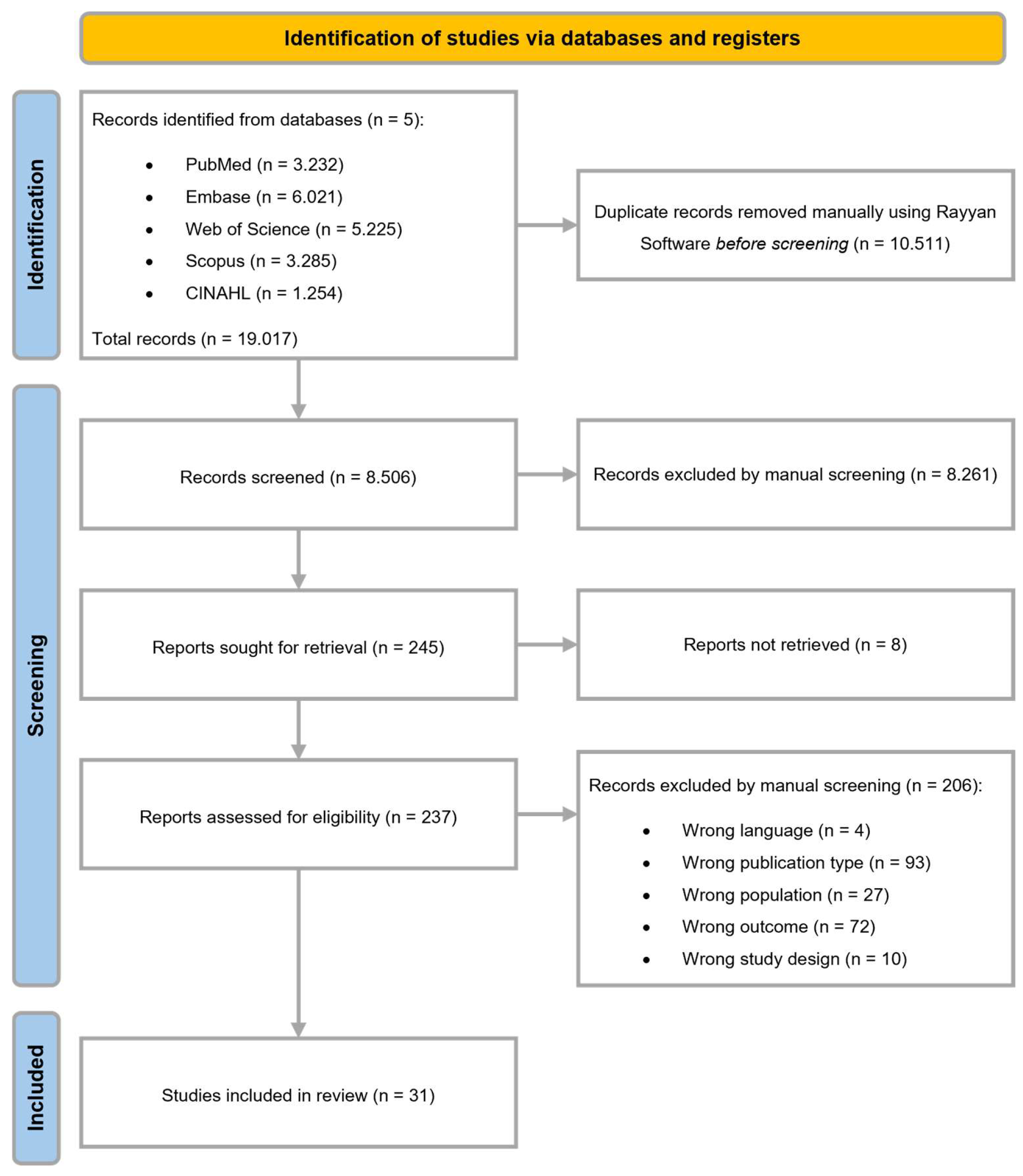
3.1. Study Inclusion
3.2. Study Characteristics
Patient Characteristics
3.3. Patient Preference Studies
3.3.1. Steps Prior to the Patient Preference Studies
3.3.2. Patient Preference Methods
3.3.3. Ranking or Grading Elements
3.4. Preference Outcomes
3.5. Patient Recruitment and Patient Involvement
3.5.1. Patient Recruitment
Recruitment Strategies
3.5.2. Patient Involvement
Involvement in Study Design
- (a)
- Patient providing advice and input
- (b)
- Pretest/pilot test/think-aloud interviews
3.6. Evaluation and Future Preference Research
4. Discussion
4.1. Points to Highlight from the Included Breast Cancer Preference Studies
4.1.1. Various Preference Designs and Outcomes
4.1.2. Selection and Formulation of Attributes
4.1.3. Patient Recruitment Strategies
4.1.4. Opportunities for Future Research
4.2. Suggestions for Patient Preference Studies in Breast Cancer
- (1)
- Standardization of methods and designs making findings comparable
- (2)
- Selection of the attributes to be included
- (3)
- Representative sample: for the chosen target or for the potential population
- (4)
- Preferences from experiences vs. hypothetical preferences.
- (5)
- The concept of preference heterogeneity
- (i)
- In subgroup analyses, subgroups are defined based on patients’ characteristics starting from the sample. Associations between preferences and patients’ characteristics are tested.
- (ii)
- In latent class analyses, patients are segmented based on attribute importance patterns. Patients’ characteristics correlated with the class assignment can be determined (i.e., hidden elements that determine preferences).
- (6)
- Information and communication with the included patients
- (7)
- Patient involvement as co-researchers
4.3. Strengths and Limitations of the Scoping Review
5. Conclusions
Supplementary Materials
Funding
Institutional Review Board Statement
Informed Consent Statement
Data Availability Statement
Acknowledgments
Conflicts of Interest
References
- Kim, J.; Harper, A.; McCormack, V.; Sung, H.; Houssami, N.; Morgan, E.; Mutebi, M.; Garvey, G.; Soerjomataram, I.; Fidler-Benaoudia, M.M. Global Patterns and Trends in Breast Cancer Incidence and Mortality across 185 Countries. Nat. Med. 2025, 31, 1154–1162. [Google Scholar] [CrossRef]
- The PREFER Consortium. Recommendations—Why, When and How to Assess and Use Patient Preferences in Medical Product Decision-Making; Zenodo: Geneva, Switzerland, 2022. [Google Scholar] [CrossRef]
- Soekhai, V.; Whichello, C.; Levitan, B.; Veldwijk, J.; Pinto, C.A.; Donkers, B.; Huys, I.; van Overbeeke, E.; Juhaeri, J.; de Bekker-Grob, E.W. Methods for Exploring and Eliciting Patient Preferences in the Medical Product Lifecycle: A Literature Review. Drug Discov. Today 2019, 24, 1324–1331. [Google Scholar] [CrossRef]
- Cheung, K.L.; Mayer, S.; Simon, J.; de Vries, H.; Evers, S.M.A.A.; Kremer, I.E.H.; Hiligsmann, M. Comparison of Statistical Analysis Methods for Object Case Best–Worst Scaling. J. Med. Econ. 2019, 22, 509–515. [Google Scholar] [CrossRef]
- Vass, C.; Boeri, M.; Karim, S.; Marshall, D.; Craig, B.; Ho, K.A.; Mott, D.; Ngorsuraches, S.; Badawy, S.M.; Mühlbacher, A.; et al. Accounting for Preference Heterogeneity in Discrete-Choice Experiments: An ISPOR Special Interest Group Report. Value Health 2022, 25, 685–694. [Google Scholar] [CrossRef]
- Wang, R.R.; Schweitzer, J.B.; Hernandez, S.; Molina, S.C.; Keegan, T.H.M. Strategies for Recruitment and Retention of Adolescent and Young Adult Cancer Patients in Research Studies. J. Clin. Transl. Sci. 2023, 7, e240. [Google Scholar] [CrossRef]
- Ouzzani, M.; Hammady, H.; Fedorowicz, Z.; Elmagarmid, A. Rayyan—A web and mobile app for systematic reviews. Syst. Rev. 2016, 5, 210. [Google Scholar] [CrossRef]
- Srikanthan, A.; Amir, E.; Gupta, A.; Baxter, N.; Kennedy, E.D. Assisting with Decision-Making: How Standardized Information Impacts Breast Cancer Patient Decisions Regarding Fertility Trade-Offs and Chemotherapy. J. Adolesc. Young Adult Oncol. 2019, 8, 660–667. [Google Scholar] [CrossRef]
- Simes, R.J.; Coates, A.S. Patient Preferences for Adjuvant Chemotherapy of Early Breast Cancer: How Much Benefit Is Needed? J. Natl. Cancer Inst. Monogr. 2001, 2001, 146–152. [Google Scholar] [CrossRef] [PubMed]
- Tan, X.Y.; Aung, M.M.; Ngai, M.I.; Xie, F.; Ko, Y. Assessment of Preference for Hormonal Treatment-Related Health States among Patients with Breast Cancer. Value Health Reg. Issues 2014, 3, 27–32. [Google Scholar] [CrossRef] [PubMed][Green Version]
- Kuchuk, I.; Bouganim, N.; Beusterien, K.; Grinspan, J.; Vandermeer, L.; Gertler, S.; Dent, S.F.; Song, X.; Segal, R.; Mazzarello, S.; et al. Preference Weights for Chemotherapy Side Effects from the Perspective of Women with Breast Cancer. Breast Cancer Res. Treat. 2013, 142, 101–107. [Google Scholar] [CrossRef]
- Williams, C.P.; Gallagher, K.D.; Deehr, K.; Aswani, M.S.; Azuero, A.; Daniel, C.L.; Ford, E.W.; Ingram, S.A.; Balch, A.J.; Rocque, G.B. Quantifying Treatment Preferences and Their Association with Financial Toxicity in Women with Breast Cancer. Cancer 2021, 127, 449–457. [Google Scholar] [CrossRef]
- Stamuli, E.; Corry, S.; Foss, P. Patient Preferences Do Matter: A Discrete Choice Experiment Conducted with Breast Cancer Patients in Six European Countries, with Latent Class Analysis. Int. J. Technol. Assess. Health Care 2023, 39, e21. [Google Scholar] [CrossRef]
- Stamuli, E.; Corry, S.; Ross, D.; Konstantopoulou, T. Patient Preferences for Breast Cancer Treatments: A Discrete Choice Experiment in France, Ireland, Poland and Spain. Future Oncol. 2022, 18, 1115–1132. [Google Scholar] [CrossRef]
- Bullen, A.; Ryan, M.; Ennis, H.; Gray, E.; Loría-Rebolledo, L.E.; McIntyre, M.; Hall, P. Trade-Offs between Overall Survival and Side Effects in the Treatment of Metastatic Breast Cancer: Eliciting Preferences of Patients with Primary and Metastatic Breast Cancer Using a Discrete Choice Experiment. BMJ Open 2024, 14, e076798. [Google Scholar] [CrossRef]
- Beusterien, K.; Grinspan, J.; Kuchuk, I.; Mazzarello, S.; Dent, S.; Gertler, S.; Bouganim, N.; Vandermeer, L.; Clemons, M. Use of Conjoint Analysis to Assess Breast Cancer Patient Preferences for Chemotherapy Side Effects. Oncologist 2014, 19, 127–134. [Google Scholar] [CrossRef]
- Silva, A.S.; França, A.C.W.; Padilla, M.P.; Macedo, L.S.; Magliano, C.A.d.S.; Santos, M.d.S. Brazilian Breast Cancer Patient-Reported Outcomes: What Really Matters for These Women. Front. Med. Technol. 2022, 4, 809222. [Google Scholar] [CrossRef]
- Ngorsuraches, S.; Thongkeaw, K. Patients’ Preferences and Willingness-to-Pay for Postmenopausal Hormone Receptor-Positive, HER2-Negative Advanced Breast Cancer Treatments after Failure of Standard Treatments. Springerplus 2015, 4, 674. [Google Scholar] [CrossRef] [PubMed]
- Chou, T.C.; Chiang, S.C.; Ko, Y. Health State Utilities for Metastatic Breast Cancer in Taiwan. Breast 2020, 51, 57–64. [Google Scholar] [CrossRef] [PubMed]
- Hollin, I.L.; González, J.M.; Buelt, L.; Ciarametaro, M.; Dubois, R.W. Do Patient Preferences Align with Value Frameworks? A Discrete-Choice Experiment of Patients with Breast Cancer. MDM Policy Pract. 2020, 5, 2381468320928012. [Google Scholar] [CrossRef] [PubMed]
- Smith, M.L.; White, C.B.; Railey, E.; Sledge, G.W. Examining and Predicting Drug Preferences of Patients with Metastatic Breast Cancer: Using Conjoint Analysis to Examine Attributes of Paclitaxel and Capecitabine. Breast Cancer Res. Treat. 2014, 145, 83–89. [Google Scholar]
- DiBonaventura, M.D.; Copher, R.; Basurto, E.; Faria, C.; Lorenzo, R. Patient Preferences and Treatment Adherence Among Women Diagnosed with Metastatic Breast Cancer. Am. Health Drug Benefits 2014, 7, 386. [Google Scholar]
- Mansfield, C.; Botha, W.; Vondeling, G.T.; Klein, K.; Wang, K.; Singh, J.; Hackshaw, M.D. Patient Preferences for Features of HER2-Targeted Treatment of Advanced or Metastatic Breast Cancer: A Discrete-Choice Experiment Study. Breast Cancer 2023, 30, 23–35. [Google Scholar] [CrossRef] [PubMed]
- Reinisch, M.; Marschner, N.; Otto, T.; Korfel, A.; Stoffregen, C.; Wöckel, A. Patient Preferences: Results of a German Adaptive Choice-Based Conjoint Analysis (Market Research Study Sponsored by Eli Lilly and Company) in Patients on Palliative Treatment for Advanced Breast Cancer. Breast Care 2021, 16, 491–499. [Google Scholar] [CrossRef]
- Lalla, D.; Carlton, R.; Santos, E.; Bramley, T.; D’Souza, A. Willingness to Pay to Avoid Metastatic Breast Cancer Treatment Side Effects: Results from a Conjoint Analysis. Springerplus 2014, 3, 350. [Google Scholar] [CrossRef]
- Omori, Y.; Enatsu, S.; Cai, Z.; Ishiguro, H. Patients’ Preferences for Postmenopausal Hormone Receptor-Positive, Human Epidermal Growth Factor Receptor 2-Negative Advanced Breast Cancer Treatments in Japan. Breast Cancer 2019, 26, 652–662. [Google Scholar] [CrossRef]
- Nazari, A.; Lopez-Valcarcel, B.G.; Najafi, S. Preferences of Patients With HR+ & HER2- Breast Cancer Regarding Hormonal and Targeted Therapies in the First Line of Their Metastatic Stage: A Discrete Choice Experiment. Value Health Reg. Issues 2021, 25, 7–14. [Google Scholar] [CrossRef]
- Wouters, H.; Maatman, G.A.; Van Dijk, L.; Bouvy, M.L.; Vree, R.; Van Geffen, E.C.G.; Nortier, J.W.; Stiggelbout, A.M. Trade-Offpreferences Regarding Adjuvant Endocrine Therapy among Women with Estrogen Receptor-Positive Breast Cancer. Ann. Oncol. 2013, 24, 2324–2329. [Google Scholar] [CrossRef] [PubMed]
- Ballinger, T.J.; Kassem, N.; Shen, F.; Jiang, G.; Smith, M.L.; Railey, E.; Howell, J.; White, C.B.; Schneider, B.P. Discerning the Clinical Relevance of Biomarkers in Early Stage Breast Cancer. Breast Cancer Res. Treat. 2017, 164, 89–97. [Google Scholar] [CrossRef]
- McQuellon, R.P.; Muss, H.B.; Hoffman, S.L.; Russell, G.; Craven, B.; Yellen, S.B. Patient Preferences for Treatment of Metastatic Breast Cancer: A Study of Women with Early-Stage Breast Cancer. J. Clin. Oncol. 1995, 13, 858–868. [Google Scholar] [CrossRef] [PubMed]
- Spaich, S.; Krickeberg, S.; Hetjens, S.; Wenz, F.; Gerhardt, A.; Sütterlin, M. Patient Preferences Regarding Intraoperative versus External Beam Radiotherapy for Early Breast Cancer and the Impact of Socio-Demographic Factors. Arch. Gynecol. Obstet. 2019, 299, 1121–1130. [Google Scholar] [CrossRef]
- Duric, V.M.; Fallowfield, L.J.; Saunders, C.; Houghton, J.; Coates, A.S.; Stockler, M.R. Patients’ Preferences for Adjuvant Endocrine Therapy in Early Breast Cancer: What Makes It Worthwhile? Br. J. Cancer 2005, 93, 1319–1323. [Google Scholar] [CrossRef][Green Version]
- Duric, V.M.; Stockler, M.R.; Heritier, S.; Boyle, F.; Beith, J.; Sullivan, A.; Wilcken, N.; Coates, A.S.; Simes, R.J. Patients’ Preferences for Adjuvant Chemotherapy in Early Breast Cancer: What Makes AC and CMF Worthwhile Now? Ann. Oncol. 2005, 16, 1786–1794. [Google Scholar] [CrossRef]
- Thill, M.; Pisa, G.; Isbary, G. Targets for Neoadjuvant Therapy–The Preferences of Patients with Early Breast Cancer. Geburtshilfe Frauenheilkd 2016, 76, 551–556. [Google Scholar] [CrossRef]
- Thewes, B.; Meiser, B.; Duric, V.M.; Stockler, M.R.; Taylor, A.; Stuart-Harris, R.; Links, M.; Wilcken, N.; McLachlan, S.A.; Phillips, K.A.; et al. What Survival Benefits Do Premenopausal Patients with Early Breast Cancer Need to Make Endocrine Therapy Worthwhile? Lancet Oncol. 2005, 6, 581–588. [Google Scholar] [CrossRef]
- Wouters, H.; van Geffen, E.C.G.; Baas-Thijssen, M.C.; Krol-Warmerdam, E.M.; Stiggelbout, A.M.; Belitser, S.; Bouvy, M.L.; van Dijk, L. Disentangling Breast Cancer Patients’ Perceptions and Experiences with Regard to Endocrine Therapy: Nature and Relevance for Non-Adherence. Breast 2013, 22, 661–666. [Google Scholar] [CrossRef]
- Galper, S.R.; Lee, S.J.; Tao, M.L.; Troyan, S.; Kaelin, C.M.; Harris, J.R.; Weeks, J.C. Patient Preferences for Axillary Dissection in the Management of Early-Stage Breast Cancer. J. Natl. Cancer Inst. 2000, 92, 1681–1687. [Google Scholar] [CrossRef] [PubMed][Green Version]
- Liu, S.; Xiang, Y.; Gu, Y.; Chen, N.; Fu, P.; Wei, Y.; Zhao, P.; Li, Y.; Du, C.; Mu, W.; et al. Patient Preferences and Willingness to Pay for Central Venous Access Devices in Breast Cancer: A Multicenter Discrete Choice Experiment. Int. J. Nurs. Stud. 2024, 152, 104695. [Google Scholar] [CrossRef] [PubMed]
- Sledge, G.W.; Toi, M.; Neven, P.; Sohn, J.; Inoue, K.; Pivot, X.; Burdaeva, O.; Okera, M.; Masuda, N.; Kaufman, P.A.; et al. MONARCH 2: Abemaciclib in Combination with Fulvestrant in Women with HR+/HER2-Advanced Breast Cancer Who Had Progressed While Receiving Endocrine Therapy. J. Clin. Oncol. 2017, 35, 2875–2884. [Google Scholar] [CrossRef]
- Clark, M.D.; Determann, D.; Petrou, S.; Moro, D.; de Bekker-Grob, E.W. Discrete Choice Experiments in Health Economics: A Review of the Literature. Pharmacoeconomics 2014, 32, 883–902. [Google Scholar] [CrossRef]
- Soekhai, V.; de Bekker-Grob, E.W.; Ellis, A.R.; Vass, C.M. Discrete Choice Experiments in Health Economics: Past, Present and Future. Pharmacoeconomics 2019, 37, 201–226. [Google Scholar] [CrossRef]
- Nouwens, S.P.H.; Marceta, S.M.; Bui, M.; van Dijk, D.M.A.H.; Groothuis-Oudshoorn, C.G.M.; Veldwijk, J.; van Til, J.A.; de Bekker-Grob, E.W. The Evolving Landscape of Discrete Choice Experiments in Health Economics: A Systematic Review. PharmacoEconomics 2025, 43, 879–936. [Google Scholar] [CrossRef] [PubMed]
- Elwyn, G.J.; Edwards, A.; Kinnersley, P.; Grol, R. Shared Decision Making and the Concept of Equipoise: The Competences of Involving Patients in Healthcare Choices. Br. J. General. Pract. 2000, 50, 892. [Google Scholar]
- Mühlbacher, A.C.; Juhnke, C.; Beyer, A.R.; Garner, S. Patient-Focused Benefit-Risk Analysis to Inform Regulatory Decisions: The European Union Perspective. Value Health 2016, 19, 734–740. [Google Scholar] [CrossRef]
- Bland, K.A.; Mustafa, R.; McTaggart-Cowan, H. Patient Preferences in Metastatic Breast Cancer Care: A Scoping Review. Cancers 2023, 15, 4331. [Google Scholar] [CrossRef]
- Tomiwa, T.; Wong, E.; Miller, H.N.; Ogungbe, O.; Byiringiro, S.; Plante, T.; Himmelfarb, C.R. Leveraging Digital Tools to Enhance Diversity and Inclusion in Clinical Trial Recruitment. Front. Public Health 2024, 12, 1483367. [Google Scholar]
- Bridges, J.F.P.; de Bekker-Grob, E.W.; Hauber, B.; Heidenreich, S.; Janssen, E.; Bast, A.; Hanmer, J.; Danyliv, A.; Low, E.; Bouvy, J.C.; et al. A Roadmap for Increasing the Usefulness and Impact of Patient-Preference Studies in Decision Making in Health: A Good Practices Report of an ISPOR Task Force. Value Health 2023, 26, 153–162. [Google Scholar] [CrossRef]
- van Overbeeke, E.; Vanbinst, I.; Jimenez-Moreno, A.C.; Huys, I. Patient Centricity in Patient Preference Studies: The Patient Perspective. Front. Med. 2020, 7, 93. [Google Scholar] [CrossRef]
- Tricco, A.C.; Lillie, E.; Zarin, W.; O’Brien, K.K.; Colquhoun, H.; Levac, D.; Moher, D.; Peters, M.D.; Horsley, T.; Weeks, L.; et al. PRISMA Extension for Scoping Reviews (PRISMAScR): Checklist and Explanation. Ann. Intern. Med. 2018, 169, 467–473. [Google Scholar] [CrossRef]


| Type of Breast Cancer | Studies (n) | References |
|---|---|---|
| Breast cancer survivors | n = 1 | [8] |
| Different disease statuses (disease free, local relapse, distant/relapse) | n = 1 | [9] |
| Varies breast cancer stages (early and metastatic) | n = 9 | [10,11,12,13,14,15,16,17,18] |
| Different stages of breast cancer at diagnosis | n = 1 | [19] |
| Only advanced or metastatic breast cancer | n = 6 | [20,21,22,23,24,25] |
| - Locally advanced or metastatic HR+/HER2− | n = 1 | [24] |
| HR+ patients in different disease stages Estrogen receptor- positive breast cancer | n = 2 n = 1 | [26,27] [28] |
| Early breast cancer patients | n = 8 | [29,30,31,32,33,34,35,36] |
| - Focus on subtype HER2− | n = 1 | [29] |
| - Premenopausal early breast cancer patients | n = 1 | [35] |
| Early breast cancer patients (stage I and II) and patients with a diagnosis of ductal carcinoma in situ | n = 1 | [37] |
| Breast cancer stage or subtypes not specified | n = 1 | [38] |
| Study | Steps Prior to PPS | PPS Method | Type of Treatment Category the Elements are Based On | Ranking/Grading Elements |
|---|---|---|---|---|
| Tan et al., 2014 [10] |
| Face-to-face interviews: assessing health states using the visual analog scale (VAS) and the standard gamble method (SG) | Endocrine therapy |
|
| Srikanthan et al., 2019 [8] |
| Face-to-face interviews: threshold task and post interview debriefing questionnaire | Chemotherapy |
|
| Silva et al., 2022 [17] |
| Observational descriptive study: exploratory interviews and online questionnaire | Not specified |
|
| Ballinger et al., 2017 [29] |
| A choice-based conjoint (CBC) survey | Chemotherapy |
|
| Wouters et al., 2013 [36] |
| Online focus groups and individual interviews with a Q-sorting task | Endocrine therapy |
|
| Hollin et al., 2020 [20] |
| Discrete choice experiment (DCE) | Not specified |
|
| Smith et al., 2014 [21] |
| Online survey containing treatment scenarios for a conjoint analysis | Chemotherapy |
|
| Chou et al., 2020 [19] |
| Cross sectional survey: interview with visual analog scale (VAS) and time trade-off (TTO) to measure health utilities | Not specified |
|
| Dacosta Dibonaventura et al., 2014 [22] |
| Cross sectional internet-based survey with a part ‘stated preferences and choice task’ | Not specified |
|
| Liu et al., 2024 [38] |
| Face to face discrete choice experiment (DCE) | Central venous access device |
|
| Stamuli et al., 2023 [13] |
| Discrete choice experiment (DCE) | Not specified |
|
| Simes et al., 2001 [9] | / | Semi-structured interviews with time trade-off and survival rate questions | Chemotherapy |
|
| Galper et al., 2000 [37] |
| Interviews with hypothetical scenarios | Axillary lymph node dissection (ALND) |
|
| Stamuli et al., 2022 [14] |
| Discrete choice experiment (DCE) | Not specified |
|
| Mansfield et al., 2023 [23] |
| Discrete choice experiment (DCE) | Targeted therapy |
|
| Mcquellon et al., 1995 [30] |
| Interviews with hypothetical treatment scenarios | Chemotherapy and endocrine therapy |
|
| Spaich et al., 2019 [31] | / | Two-part video shown to patients: educational section followed by a preference elicitation section and a questionnaire to identify influencing factors | Radiotherapy |
|
| Reinisch et al., 2021 [24] |
| Survey with an adaptive choice- based conjoint measurement | Not specified |
|
| Ngorsuraches et al., 2015 [18] |
| Discrete choice experiment (DCE) | Not specified |
|
| Duric et al., 2005 [33] |
| Structured, scripted interview using the trade-off method | Chemotherapy |
|
| Duric et al., 2005 [32] |
| Semi structured interview with hypothetical clinical scenarios with questions on ‘survival time trade-off’ and ‘survival rate trade-off’ | Endocrine therapy |
|
| Omori et al., 2019 [26] |
| Discrete choice experiment (DCE) | Targeted agents and endocrine therapy |
|
| Nazari et al., 2021 [27] |
| Discrete choice experiment (DCE) | Endocrine therapy and targeted therapies |
|
| Kuchuk et al., 2013 [11] |
| Survey with standard gamble questions to obtain preference weights for health states | Chemotherapy |
|
| Williams et al., 2021 [12] |
| Choice-based conjoint survey design | Not specified |
|
| Thill et al., 2016 [34] |
| Interviews to determine preferences with analytic hierarchy process methods | Neoadjuvant therapy |
|
| Wouters et al., 2013 [28] |
| Online questionnaire or face- to- face interview: adaptive conjoint analysis choice task | Endocrine therapy |
|
| Bullen et al., 2024 [15] |
| Discrete choice experiment (DCE) | Not specified |
|
| Beusterien et al., 2014 [16] |
| Survey with adaptive conjoint analysis to elicit preferences | Chemotherapy |
|
| Thewes et al., 2005 [35] |
| Face-to-face interview | Endocrine therapy |
|
| Lalla et al., 2014 [25] |
| Self-administered conjoint analysis survey | Not specified |
|
| Study | Patient Recruitment | Patient Involvement | |||
|---|---|---|---|---|---|
| Recruitment Strategy | Compensation | Patients as Participants Information and Communication | Patients as Co-Researchers Involvement in Study Design | ||
| Before the Study | After the Study | ||||
| Tan et al., 2014 [10] |
|
| No | No | No |
| Srikanthan et al., 2019 [8] |
| No | No | No | No |
| Silva et al., 2022 [17] |
| No | No | No | No |
| Ballinger et al., 2017 [29] |
|
| No | No | No |
| Wouters et al., 2013 [36] |
| No | No | No | No |
| Hollin et al., 2020 [20] |
| No | No | No |
|
| Smith et al., 2014 [21] |
| No |
| No |
|
| Chou et al., 2020 [19] |
| No | No | No | No |
| DaCosta DiBonaventura et al., 2014 [22] |
|
| No | No |
|
| Liu et al., 2024 [38] |
| No |
| No |
|
| Stamuli et al., 2023 [13] |
| No | No | No |
|
| Simes et al., 2001 [9] |
| No | No | No | No |
| Galper et al., 2000 [37] |
| No |
| No |
|
| Stamuli et al., 2022 [14] |
|
|
| No |
|
| Mansfield et al., 2023 [23] |
| No | No | No |
|
| McQuellon et al., 1995 [30] |
| No |
| No | / |
| Spaich et al., 2019 [31] | No | No |
| No | No |
| Reinisch et al., 2021 [24] |
| No |
| No |
|
| Ngorsuraches et al., 2015 [18] |
| No |
| No |
|
| Duric et al., 2005 [33] |
| No | No | No |
|
| Duric et al., 2005 [32] |
| No | No | No | No |
| Omori et al., 2019 [26] |
| No | No | No |
|
| Nazari et al., 2021 [27] |
| No | No | No | No |
| Kuchuk et al., 2013 [11] |
| No | No | No |
|
| Williams et al., 2021 [12] |
|
| No | No | No |
| Thill et al., 2016 [34] |
| No | No | No | No |
| Wouters et al., 2013 [28] |
| No | No | No |
|
| Bullen et al., 2024 [15] |
| No | No | No |
|
| Beusterien et al., 2014 [16] |
| No |
| No | No |
| Thewes et al., 2005 [35] |
| No |
| No | No |
| Lalla et al., 2014 [25] |
|
| No | No | No |
Disclaimer/Publisher’s Note: The statements, opinions and data contained in all publications are solely those of the individual author(s) and contributor(s) and not of MDPI and/or the editor(s). MDPI and/or the editor(s) disclaim responsibility for any injury to people or property resulting from any ideas, methods, instructions or products referred to in the content. |
© 2025 by the authors. Licensee MDPI, Basel, Switzerland. This article is an open access article distributed under the terms and conditions of the Creative Commons Attribution (CC BY) license (https://creativecommons.org/licenses/by/4.0/).
Share and Cite
Verbeke, C.; Schuermans, F.; Vanopré, F.; Belmans, A.; Van Houdt, M.; Neven, P.; Huys, I. Patient Preferences in Breast Cancer: A Scoping Review. Cancers 2026, 18, 134. https://doi.org/10.3390/cancers18010134
Verbeke C, Schuermans F, Vanopré F, Belmans A, Van Houdt M, Neven P, Huys I. Patient Preferences in Breast Cancer: A Scoping Review. Cancers. 2026; 18(1):134. https://doi.org/10.3390/cancers18010134
Chicago/Turabian StyleVerbeke, Charlotte, Fiene Schuermans, Fien Vanopré, Aline Belmans, Maxime Van Houdt, Patrick Neven, and Isabelle Huys. 2026. "Patient Preferences in Breast Cancer: A Scoping Review" Cancers 18, no. 1: 134. https://doi.org/10.3390/cancers18010134
APA StyleVerbeke, C., Schuermans, F., Vanopré, F., Belmans, A., Van Houdt, M., Neven, P., & Huys, I. (2026). Patient Preferences in Breast Cancer: A Scoping Review. Cancers, 18(1), 134. https://doi.org/10.3390/cancers18010134