


Simple Summary
This paper describes the incidence of delayed methotrexate elimination and acute kidney injury related to high-dose methotrexate (HDMTX) treatment in various cancers and reports their association with clinical outcomes from 12 treatment centers in 5 European countries. These real-world outcomes outside of the clinical trial setting provide insight into important aspects of HDMTX treatment that should be considered to provide safe and efficacious treatment.
Abstract
Objectives: To determine the incidence of delayed methotrexate elimination (DME) and acute kidney injury (AKI) and their associations with clinical outcomes in patients receiving high-dose methotrexate (HDMTX) for cancer treatment. Methods: The HDMTX European Registry collected medical records data from 12 institutions in 5 European countries to investigate the clinical practice patterns of healthcare providers utilizing HDMTX for cancer treatment. Cancer types included were acute lymphoblastic leukemia (ALL), primary central nervous system lymphoma (PCNSL), non-Hodgkin lymphoma (NHL), osteosarcoma, and other CNS cancers. Primary endpoints were the incidence of DME and AKI; secondary endpoints were clinical outcomes, including hospital length of stay (LOS), delay in the subsequent course of treatment, methotrexate dose reduction, and omission of next course of treatment. Associations between the primary and secondary endpoints were analyzed with Chi-square and Wilcoxon rank-sum tests. Results: Among the 2501 total HDMTX courses analyzed, DME occurred in 302 courses (12.1%), and AKI in 384 courses (15.4%). DME incidence was highest in courses for PCNSL (18.2%) and NHL (17.2%); AKI incidence was highest in ALL courses (21.0%). Incidence of DME and AKI varied by age and methotrexate infusion duration among the different cancer types. Occurrence of DME was associated with longer delays prior to the next course of treatment, longer hospital LOS, and more frequent methotrexate dose reductions and dose omissions. Conclusions: While HDMTX is a very effective and safe treatment, administration of efficacious doses of methotrexate can lead to AKI and DME, and no single or combination of patient or treatment factors was found to reliably predict their occurrence. Thus, diligent monitoring of methotrexate levels is imperative for early detection and prompt management of nephrotoxicity in all settings where HDMTX treatment is administered.
1. Introduction
High-dose methotrexate (HDMTX) is an integral component of treatment for various cancers. The potential for significant nephrotoxicity and delayed renal elimination of methotrexate, however, can lead to severe toxicities in other organ systems and premature treatment cessation [1]. The incidence of HDMTX-associated acute kidney injury (AKI) is reported to range between 2% and 30% depending on patient age, dose of methotrexate, and duration of infusion, but may occur without any identifiable factors [2,3,4,5,6,7]. As AKI is usually asymptomatic (non-oliguric), a high level of awareness is warranted in assessing renal function by monitoring serum creatinine concentration (Scr) prior to, during, and after completion of HDMTX infusion. While an increase in Scr of 50% or greater from baseline is established as an indicator of AKI, the lag in elevation of creatinine levels following the actual onset of AKI renders it a suboptimal marker [8,9,10]. Thus, if available, serial monitoring of plasma methotrexate concentration (MTXc) following the start of HDMTX infusion allows detection of delayed methotrexate elimination (DME) and facilitates early intervention to mitigate its toxicity. The definition of DME varies by study, but MTXc ≥ 1 μM at 42 to 48 h or >0.2 μM at 72 h after the end of a 24 h HDMTX infusion or MTXc ≥ 10 μM at 24 h following a short infusion typically indicates the presence of DME [11,12,13]. To encompass all lengths of HDMTX infusion duration, methotrexate levels that are significantly elevated greater than 2 standard deviations of the measured methotrexate excretion curve can be used as a criterion for DME [14].
It is imperative that supportive measures (e.g., hyperhydration, urine alkalinization, leucovorin rescue) are carried out in conjunction with HDMTX treatment to prevent precipitation of methotrexate crystals in the renal tubules and minimize methotrexate cytotoxicity in non-cancer cells [11,12,15]. In cases of DME, prompt administration of glucarpidase within 48–60 h of the start of infusion can prevent the development of irreversible toxicities and increase the odds of renal recovery [3,16,17]. Glucarpidase plays an important role in the management of DME caused by renal impairment as it rapidly metabolizes over 95% of plasma methotrexate within 15 min of intravenous administration and maintains its effect for 48 h [18,19,20].
The High-Dose Methotrexate European Registry (hereafter referred to as “Registry”) was established in 2022 to systematically investigate the clinical practice patterns of healthcare providers utilizing HDMTX to treat various cancers (ClinicalTrials.gov identifier: NCT05899751). Data were collected from 12 institutions in 5 European countries in which HDMTX treatment was provided to cancer patients diagnosed between January 2010 and June 2021. The Registry aimed to investigate characteristics of HDMTX treatment (dose, infusion duration, number of courses) by cancer type, determine the incidence of HDMTX-associated AKI and DME and their impact on treatment outcomes, and document supportive care measures including hyperhydration, urine alkalinization, leucovorin rescue, and glucarpidase administration. This paper reports pertinent findings from the Registry to provide real-world data on all aspects of HDMTX treatment and outcomes during a recent 12-year period. Specifically, the objectives of this study were to (1) quantify the incidence of HDMTX-associated AKI and DME among children and adults diagnosed with acute lymphoblastic leukemia (ALL), primary central nervous system lymphoma (PCNSL), non-Hodgkin lymphomas (NHL), osteosarcoma, and other CNS cancers, and (2) determine the association between occurrence of AKI and DME with treatment characteristics (e.g., methotrexate dose and infusion duration, concomitant medications) and outcomes (e.g., hospital length of stay, methotrexate dose reduction, treatment cessation, adverse events, long-term survival).
2. Methods
This was an international multicenter retrospective cohort study to analyze real-world registry data collected from investigational sites selected to achieve a balance between pediatric and adult populations.
2.1. Setting
Data were extracted from medical records at 12 sites in 5 European countries: 3 from Spain, 3 from Germany, 2 from Italy, 2 from France, and 2 from the United Kingdom. Data were entered for consecutively diagnosed patients starting with the most recent patients (those diagnosed in 2021) and working backward by year to avoid any bias in patient accrual by assuring that all patients treated during a given year were included without bias.
2.2. Participants
Patients were enrolled in the Registry if (1) a cancer was diagnosed from 1 January 2010 to 30 June 2021; (2) HDMTX chemotherapy (methotrexate dose ≥ 500 mg/m2 of body surface area [BSA] infused over 1–36 h) was administered; and (3) they had at least one course containing MTXc and Scr measurements following HDMTX infusion. For this analysis, a sub-sample of patients from the Registry was included if data were available for (1) patient age, sex, and BSA at the time of HDMTX administration; (2) methotrexate dose and infusion length; (3) baseline Scr; and (4) at least one post-infusion Scr and MTXc measurement in all their courses.
2.3. Endpoints
Primary endpoints were AKI, DME, and DME with concomitant AKI (DME + AKI). AKI was defined as an increase in Scr of greater than 50% of baseline or a nominal increase of 0.3 mg/dL or greater following HDMTX infusion according to the Acute Kidney Injury Network (AKIN) criteria [21]. The AKIN criteria stratifies severity of AKI as follows: Grade 1, an increase in Scr by at least 0.3 mg/dL within 48 h or an increase of 1.5–1.9 times baseline within seven days; Grade 2, Scr increase of 2.0–2.9 times baseline; and Grade 3, Scr increase ≥ 3 times baseline, Scr ≥ 4.0 mg/dL, or the initiation of renal replacement therapy. For this study, severe AKI was defined as meeting the AKIN criteria for Grade 2 or 3 during a course of HDMTX treatment. DME was determined to have occurred if MTXc was greater than 2 standard deviations of the population mean, as simulated by MTXPK.org at 36, 42, or 48 h from the start of HDMTX infusion [22]. Briefly, MTXPK.org is a validated pharmacokinetic modeling tool that simulates MTXc based on available data points that did not meet the criteria for early levels and allows for a standardized and clinically relevant metric for assessing DME [23,24]. Primary endpoints were classified as binary based on whether the event occurred or not during the HDMTX course under consideration.
Secondary endpoints were clinical outcomes including hospital length of stay (LOS), delay to the start of the subsequent block of HDMTX (i.e., 7-days or longer difference between patient-specific protocol prescribed treatment start time and actual start time), methotrexate dose reduction (a decrease of 25% or more from the prior course), methotrexate dose omission in the subsequent course, estimated event-free survival (EFS), and overall survival (OS) from the start of the first course of HDMTX administration.
2.4. Covariables
Other variables collected include baseline demographic characteristics, HDMTX administration details (dose, infusion duration), and supportive therapy (e.g., leucovorin rescue, glucarpidase administration). Administration of concomitant medications (e.g., loop diuretics, proton-pump inhibitors) was analyzed to determine their association with the primary endpoints. Abnormal laboratory values (e.g., elevated alanine transaminase [ALT] and bilirubin levels, neutropenia, thrombocytopenia) were recorded and analyzed to determine associations with the primary endpoints.
2.5. Statistical Methods
Statistical analyses were performed using R version 4.4.1 (R Foundation for Statistical Computing, Vienna, Austria). A two-sided p-value of <0.05 was considered statistically significant for all analyses. Descriptive statistics were used to summarize the demographic characteristics of the patients and relevant clinical information. Continuous variables were presented as median and interquartile range (IQR). Categorical variables were summarized using absolute frequencies and percentages.
Primary endpoint analyses included frequency tables and incidences with 95% exact Clopper–Pearson confidence intervals (95% CIs) for AKI, DME, and DME + AKI. For continuous secondary endpoints (e.g., hospital LOS), median and interquartile range were used to describe their distribution. For nominal dichotomous secondary outcomes (hospital readmission for toxicity management, delay to the start of the subsequent block of HDMTX, and methotrexate dose reduction/omission), incidences with 95% CI were used. For time-to-event secondary endpoints, the Kaplan–Meier estimator was used to assess EFS and OS from 1 to 5 years and compared by the occurrence of AKI, DME, and cancer type using the log-rank test. Chi-square and Wilcoxon rank-sum tests were used to determine associations of the categorical and continuous secondary endpoints, respectively, by the presence of the primary endpoints.
3. Results
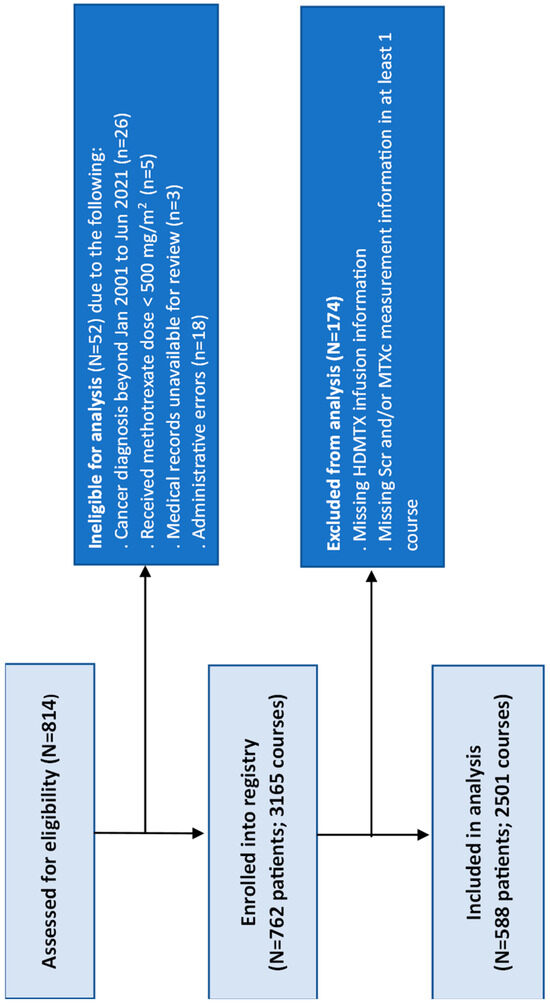
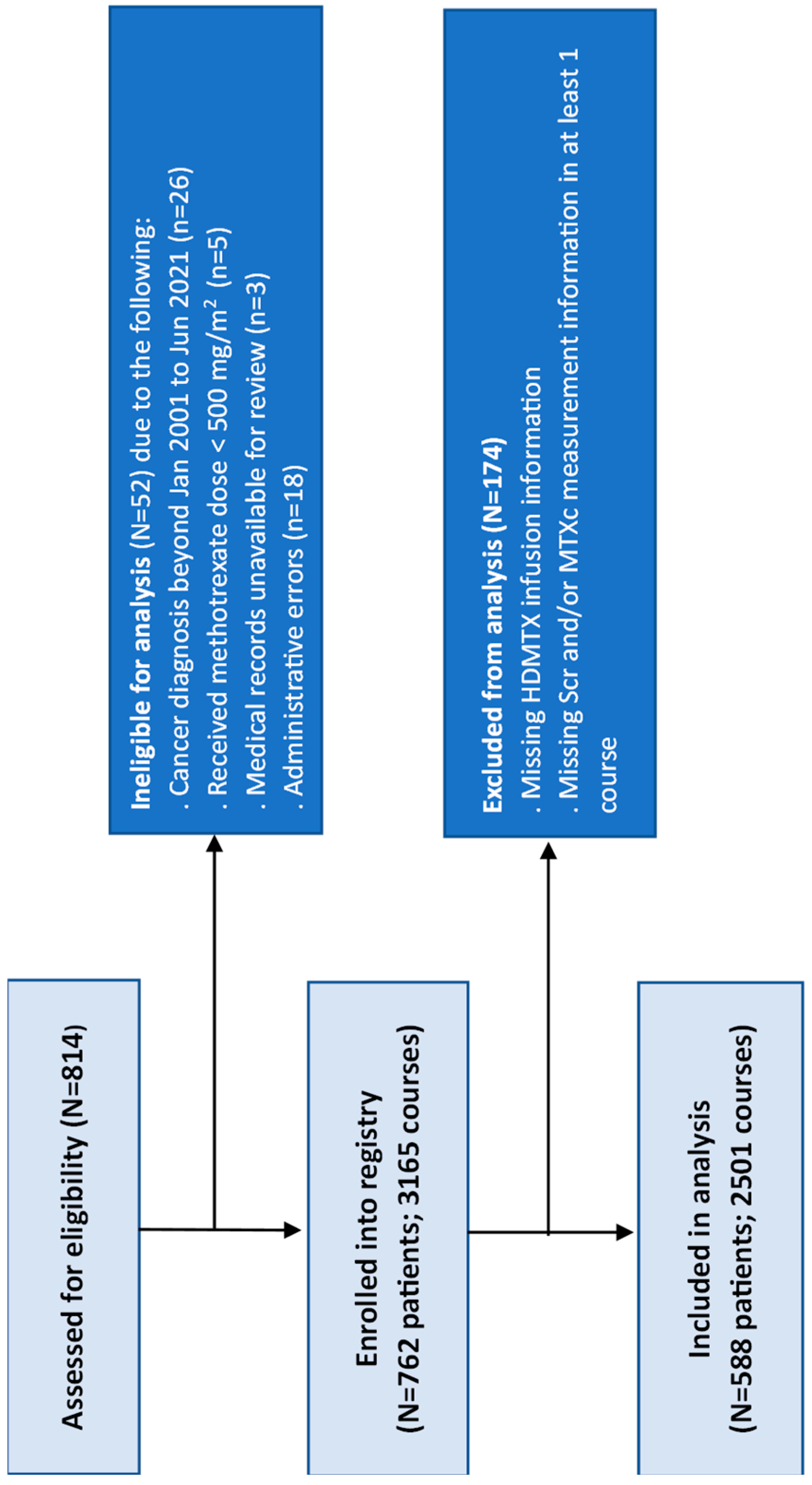
Among a total of 814 patients assessed for eligibility, 762 patients who received 3165 HDMTX courses were included in the Registry, of which 588 patients with 2501 courses had data that met the criteria for inclusion in analysis (Figure 1).
Figure 1.
Analysis population.
The distribution of the primary cancers among the 588 patients were 283 with ALL (48.1%), 158 with PCNSL (26.9%), 108 NHL (18.4%), 29 osteosarcoma (4.9%), and 10 (1.7%) with other CNS cancers (medulloblastoma [n = 5], ependymoma [n = 2], pineoblastoma [n = 1], histology unavailable [n = 2]). The median age of patients was 16.4 years (IQR, 5.6–62.2), with 279 (47.4%) adults and 309 (52.6%) children under the age of 18 (Table 1). Methotrexate administration characteristics collected from the 2501 HDMTX courses revealed the median methotrexate dose standard for all courses was 3.4 g/m2 (IQR, 2.7–5.0), with doses varying by cancer type (Table 2); patients with osteosarcoma received the highest median dose of 11.8 g/m2 (IQR 11.2–12.0), followed by ALL patients with a median dose of 5.0 g/m2 (IQR 4.8–5.0). Infusion duration was longest in ALL patients who received a median of 24.0 h and shortest in both NHL and osteosarcoma patient groups, with a median of 4.0 h. Leucovorin rescue was administered in 95.4% of the courses; 99.6% of courses for ALL received leucovorin, while only 87.4% of courses for NHL and 93.7% of PCNSL courses received leucovorin. Glucarpidase was administered in only eight courses, of which three were ALL courses, and five were PCNSL courses. No patients were reported to have died or received extracorporeal treatment (e.g., dialysis) due to methotrexate-related toxicities.
Table 1.
Demographic characteristics of patients by cancer type.
Table 2.
Characteristics of high-dose methotrexate administration by cancer type.
3.1. Primary Endpoints
Among the 2501 courses included for analysis, DME occurred in 302 courses (12.1%), AKI in 384 courses (15.4%), severe AKI in 78 courses (3.1%), and DME + AKI in 106 courses (4.2%) (Table 3). Occurrence of DME was highest in courses for PCNSL at 18.2% followed by courses for NHL (17.2%); courses for osteosarcoma were found to have the lowest occurrence of DME. Occurrences of AKI and severe AKI were found to be highest in courses for ALL patients at 21.0% and 5.4%, respectively, followed by courses in NHL patients at 18.9% and 2.6%, respectively. Occurrence of DME was higher in HDMTX courses administered to adults 18 years of age and older in all cancer types compared to courses in children, with the highest rates found in adults with PCNSL at 18.2% (Supplementary Table S1). Adults receiving courses for ALL had a higher occurrence of AKI compared to children with ALL (35.8% vs. 19.2%); however, rates of AKI were similar for adults and children in NHL and osteosarcoma. Occurrences of DME with concomitant AKI were also more frequent for adults compared to children in courses for ALL (11.3% vs. 3.5%) and NHL (8.8% vs. 3.8%).
Table 3.
Primary endpoints by age group and cancer type (N = 2501).
Courses that administered methotrexate dose ≥ 2.5 to <4 g/m2 had the highest occurrence of DME at 20.2%, followed by doses < 2.5 g/m2 (15.2%), while AKI was most frequent in courses given doses of ≥4 to <6 g/m2 (20.5%), followed by ≥6 to <10 g/m2 (14.9%) and ≥2.5 to <4 g/m2 (14.2%). Courses given doses greater than 10 g/m2 had the least occurrence of both DME and AKI (Table 4). Courses with infusion duration < 5 h had the highest occurrence of DME (21.3%), while AKI was most frequent in courses with infusion duration > 24 h.
Table 4.
Occurrence of primary endpoints by methotrexate dose and infusion duration.
3.2. Secondary Endpoints (Clinical Outcomes)
The median hospital LOS for a course of HDMTX therapy was 4.4 days (IQR 3.8–6.3) (Supplementary Table S2). Courses for ALL reported the shortest median LOS with 3.8 days (IQR 3.0–5.3), while courses for NHL had the longest median LOS (6.8 days, IQR 5.0–15.0). Delay in the subsequent treatment cycle was required in 12.0% of the courses; among the cancers, PCNSL courses were delayed most frequently at 15.6% while only 6% of osteosarcoma courses required a delay. Methotrexate dose reduction in the subsequent course occurred in 18.6% of all courses and was most frequent in PCNSL at 36.6% of the courses, followed by NHL courses at 10.6%. Methotrexate dose omission in the next course occurred in 3% of the total courses, with courses in NHL (6.9%) and PCNSL (3.5%) reporting the highest frequencies. Rehospitalization for toxicity management within 14 days of the start of HDMTX infusion occurred in 5.9% of the courses, and the median LOS for toxicity management was 4.9 days (IQR 2.1–9.5). While higher rates of rehospitalization were found in courses for NHL (11.7%) and osteosarcoma (8.2%) compared to courses for PCNSL (2.8%), median rehospitalization LOS was shortest for osteosarcoma (3.2 days) and longest for PCNSL (15.1 days) and NHL (7.5 days).
3.3. Impact of Primary Endpoint Occurrence on Clinical Outcomes and Adverse Events
Courses in which DME occurred required significantly longer delays prior to the next course of treatment compared to courses without DME occurrence (Table 5). Hospital LOS for chemotherapy was significantly longer in courses in which DME occurred (5.3 days, IQR 4.2–9.1) compared to those with no DME (4.2 days, IQR 3.7–6.1). Similarly, courses with AKI and DME + AKI required longer hospital LOS compared to courses without AKI and DME + AKI, respectively. The proportion of courses that required rehospitalization for toxicity was smaller in courses with DME (4.0%) compared to those without DME (6.1%); however, the median LOS of rehospitalization for toxicity management was 1.4 days longer in courses with DME. In contrast, courses with AKI occurrence were observed to have a higher incidence (7.8% vs. 5.5%) of rehospitalization but shorter LOS (3.5 days vs. 5.1 days) than those without AKI. However, these differences in rehospitalization were not significant. Methotrexate dose omission in the subsequent course occurred more frequently in courses that experienced DME, AKI, and DME + AKI compared to those that did not: 9.6% vs. 2.1%, 4.9% vs. 2.7%, and 7.5% vs. 2.8%, respectively. Methotrexate dose reduction in the subsequent course was required more frequently in courses with DME (27.8%) than those without DME (17.3%), whereas it was required less frequently in courses with AKI occurrence (12.5%) compared to those without AKI (19.7%).
Table 5.
Cross-tabulations for clinical outcomes by the occurrence of primary endpoints.
Estimated survival rates from the start of HDMTX administration compared by the occurrence of the primary endpoints (Supplementary Table S4) revealed that patients who developed DME had lower 3- and 5-year EFS than those that did not have DME (61.6% vs. 75.3% and 55.9% vs. 71.3%, respectively; log rank p < 0.001) as well as lower 3- and 5-year OS (77.4% vs. 88.9% and 76.0% vs. 82.5%, respectively; log rank p = 0.003). Patients who experienced DME + AKI also had lower 3- and 5-year EFS compared to those who did not, but this difference was not significant (log rank p = 0.095). On the other hand, 3- and 5-year EFS and OS did not differ between patients who had experienced AKI and those who did not.
Courses in which DME occurred reported having higher incidences of Grade 4 neutropenia and thrombocytopenia (28.0% and 29.3%, respectively), compared to courses that did not have DME (7.7% and 9.6%, respectively). Courses with AKI had more frequent incidences of Grades 1 and 2 thrombocytopenia than those without AKI, and courses that experienced DME + AKI reported higher incidences of thrombocytopenia compared to those that did not (Table 6).
Table 6.
Cross-tabulations for adverse events by the occurrence of primary endpoints.
3.4. Association of Select Concomitant Medications with the Occurrence of Primary Endpoints
Among the 2501 HDMTX courses analyzed, furosemide was administered in 751 (30.0%) courses and proton-pump inhibitors (PPI) in 248 (9.9%) (Table 7). No observable difference in occurrence of primary endpoints was found between courses with and without exposure to PPI. However, among the 384 courses with AKI occurrence, 152 (39.6%) had received furosemide, whereas 28.3% of the 2117 courses without AKI had any exposure to furosemide. While administration of furosemide up to day 3 following the start of HDMTX administration was associated only with AKI, exposure to furosemide on day 4 or later in the course was found to be associated with DME, AKI, and DME + AKI.
Table 7.
Cross-tabulations for medications by the occurrence of primary endpoints.
4. Discussion
High-dose methotrexate is an essential component of treatment for many types of cancers that is safe and effective when administered with meticulous supportive care measures. This study evaluated real-world HDMTX administration practices and outcomes in centers located in Europe to quantify the incidence of DME and AKI. The Registry included a diverse population of both pediatric and adult patients, with the earliest data point collected from a patient diagnosed in 2010 and the last in 2021. Thus, this analysis provides an overview of HDMTX treatment patterns and outcomes of a recent 12-year period in Europe.
The overall incidences of DME and AKI among all treatment courses in this study were 12.1% and 15.4%, respectively, and varied by age and cancer treatment. Occurrence of DME was more frequent in the adult population (≥18 years), whereas AKI occurrence was higher among the pediatric population (Table 3 and Table S1). The higher incidence of AKI in the younger patients may be explained by the AKIN criteria used to define AKI, which includes an increase in Scr of or a greater increase from baseline [21]; this may have resulted in an overestimation of AKI in courses where Scr increased from 0.2 mg/dL at baseline to 0.3 mg/dL at follow-up. A sensitivity analysis comparing AKI incidence according to the ≥50% increase criterion vs. an absolute Scr increase of 0.3 mg/dL criterion in courses would possibly result in a lower incidence of AKI in the pediatric population. Among the cancer types, AKI was most frequent in courses for ALL (21.0%), but despite pediatric patients comprising 89% ALL, a higher proportion of ALL courses in adults (35.8%) were reported to have AKI compared to courses in children (19.2%), indicating age as a potential risk factor for AKI in ALL. In osteosarcoma and NHL, however, AKI incidences were comparable between children and adults despite differences in age distribution within the cancer. Also, while differences in DME and AKI incidence were observed among different doses and infusion durations (Table 4), no definite correlation was elucidated between methotrexate dose and infusion duration with the primary endpoints. The lack of observable associations is likely due to the different HDMTX treatment protocols administered to patients of the different cancers, in which the age distribution of patients also varied. These findings suggest that neither age nor treatment-related factors can predict the occurrence of DME or AKI a priori with sufficient sensitivity and specificity to be clinically useful and underscore the importance of vigilant monitoring of MTXc for early detection with validated tools such as MTXPK.org [18,23].
Occurrence of DME was associated with longer hospital LOS, longer delays before starting the next cycle of treatment, and higher rates of Grade 4 neutropenia and thrombocytopenia (Table 6), both of which may have contributed to the higher rates of methotrexate dose reduction and dose omission in subsequent courses. Further, patients in whom DME occurred at any point during their treatment were found to have 13.7% lower 3-year EFS and 15.4% lower 5-year EFS, as well as lower OS compared to those who did not experience DME (Supplementary Table S4). These findings demonstrate the negative impact of DME on HDMTX treatment outcomes and highlight the importance of supportive care measures for its prevention and prompt management. While leucovorin rescue was administered in 99.6% of ALL and 95.1% of osteosarcoma courses, it was provided in only 88% of CNS cancer and 93.3% of NHL courses, both of which were composed of predominantly adult patients. The reason for the lack of leucovorin rescue in these courses could not be determined as no clinical notes were reported in the Registry, but this does serve as a reminder to provide sufficient leucovorin rescue, especially in older patients who may be more susceptible to toxicities [4,25]. It is noteworthy that although DME was found in 302 courses, glucarpidase was administered in only 8 courses in 8 different individuals. The missed opportunities for glucarpidase administration likely reflect the timing of the European Medicines Agency (EMA) authorization for glucarpidase approval in January 2022 [26], a considerable amount of time after the period of data collection for the Registry, and the eight cases of glucarpidase administration were most likely from the compassionate-use named patient program or available institutional funding. Nonetheless, the very small proportion of DME cases that received glucarpidase reflects the opportunities that could have resulted in potentially improved clinical outcomes had glucarpidase been provided per the prescription guidelines. A follow-up analysis is currently underway describing the glucarpidase cases and missed opportunities from the Registry.
The Registry collected data on concomitant medications; two non-chemotherapeutic agents, the loop diuretic furosemide and PPIs, were reported in this study based on their potentially negative impact on renal function [27,28,29,30]. Reported use of PPI and furosemide was 10% and 30% of all courses (Table 7), respectively, with both administered most frequently in ALL, at 12.4% and 38.9%, respectively, compared to the other cancers. Although PPI was not associated with either AKI or DME in this population, furosemide use at any time point was associated with AKI, and furosemide use on day 4 or later after start of HDMTX administration was found to be associated with DME. It was a bit alarming that furosemide was administered in 30% of all HDMTX courses and close to 40% of courses for ALL, and this finding serves as a reminder that clinicians should be aware of medications and drug interactions that can worsen the nephrotoxicity associated with HDMTX. It is noted that the other agents administered as a component of multiagent chemotherapy for these cancers carried the risk of adverse events, which may have led to poor clinical outcomes, but it was beyond the scope of this study to parse out their individual impact.
There are several limitations in this study. The various treatment regimens for the different cancers and varying age distribution of patients within the cancer types rendered elucidation of specific factors (e.g., methotrexate dose, infusion duration) to predict the development of DME and AKI very difficult. Further, the relatively smaller number of osteosarcoma patients included in this Registry may have under-represented the outcomes of the real-world setting and resulted in lower incidences of DME and AKI than those reported in the literature [15,31,32]. More granular analyses by age group and treatment factors within each cancer type would allow for more focused information to determine potential predictors of HDMTX nephrotoxicity. It must be noted that this study was intended as a descriptive study rather than providing a causal analysis between independent variables and DME and AKI; a causal pathway was not set up a priori, and thus, analyses such as multivariate regression modeling were beyond the scope of this paper. This study, however, was able to provide a broad overview of HDMTX treatment and its association with clinical outcomes in four cancer categories that can serve as a foundation for more detailed investigations. Supportive therapy reported in this study was limited to leucovorin rescue and glucarpidase administration, and measures including hyperhydration and urine alkalinization (with pH monitoring), which are essential for preventing nephrotoxicity, were not presented in this study. While these data were collected in the Registry, data recording errors and the large number of missing data precluded them from being included in this analysis. A separate analysis examining the data collected on all supportive care measures and outcomes by a cancer type will be conducted to fill this gap. Similarly, the large number of missing data for laboratory findings, particularly for neutropenia and thrombocytopenia (Table 6), precludes making definite associations with DME or AKI. Also, although the focus of this study was on the clinical impact of HDMTX, the majority of the treatment protocols employed polychemotherapy that incorporates other potentially nephrotoxic agents, which may have contributed to the development of DME and AKI. Lastly, while this study provides real-world data on HDMTX treatment and outcomes in patients receiving treatment in European countries under ideal conditions and well-funded healthcare systems, it does not reflect treatment conditions in lower and middle-income countries (LMICs), where patients often receive less-than-ideal treatment doses due to limited access to supportive care, such as obtaining methotrexate levels in a timely manner or access to glucarpidase [33,34,35,36]. The findings of this study are still valuable as they demonstrate the importance of vigilant monitoring of MTXc to prevent nephrotoxicity even in high-income countries, such that measures to provide better access to supportive care can be promoted to governing bodies in LMICs.
5. Conclusions
High-dose methotrexate is a very effective and safe treatment when provided with meticulous supportive therapy. Despite supportive measures, administration of efficacious doses of HDMTX can lead to AKI and DME, and no single or combination of patient or treatment factors was found to reliably predict their occurrence. Thus, diligent monitoring of methotrexate concentration with sensitive tools such as MTXPK.org is paramount for early detection and prompt management of nephrotoxicity in all settings where HDMTX treatment is administered.
Supplementary Materials
The following supporting information can be downloaded at: https://www.mdpi.com/article/10.3390/cancers18010124/s1. Table S1. Primary endpoints by cancer type and age group (N=2501); Table S2. Incidence and characteristics of secondary endpoints by cancer type; Table S3. Three- and 5-year event-free survival and overall survival estimates by cancer type; Table S4. Event-free and overall survival estimates by occurrence of the primary endpoints; Table S5. Total number of courses included in the Registry by investigational site (N = 3165); Figure S1. Kaplan-Meier estimates for EFS by cancer type from start of HDMTX administration; Figure S2. Kaplan-Meier estimates for OS by cancer type from start of HDMTX administration
Author Contributions
Conceptualization and methodology, S.C.H., J.L., N.T. and R.C.; investigation and data acquisition, M.D.A., P.B., E.C., M.D., A.J.M.F., K.M.I., C.K., S.L., E.M., T.M.-C., B.P., T.A.R., E.S., S.S., M.S. and C.R.; statistical analysis, R.C., N.T., G.V., C.S. and M.H.; writing—original draft and editing, M.H.; writing—review and editing, M.D.A., P.B., E.C., M.D., A.J.M.F., K.M.I., C.K., S.L., E.M., T.M.-C., B.P., T.A.R., E.S., S.S., M.S., N.T., G.V. and C.R.; visualization, R.C. and M.H.; supervision, S.C.H. and C.R.; project administration, J.L. All authors have read and agreed to the published version of the manuscript.
Funding
BTG Pharmaceuticals provided financial support but had no role in the analysis or writing of this manuscript.
Institutional Review Board Statement
Ethical review and approval were not required for this study, which analyzed de-identified data from the Registry. However, ethical approval was obtained by eight of the investigational sites to participate in the Registry; the investigational sites in France (2) and the United Kingdom (2) did not require ethical approval to participate in the Registry but had national-level approval. The IRBs of the following institutions provided ethical approval.
| Site Name | Country | Institutional Review Board Name |
| Hospital Vall d’Hebron (2 sites: VHIR, VHIO) | Spain | Comité de Ética de la Investigación con medicamentos del Hospital Universitari Vall d’Hebron |
| Hospital Universitario Reina Sofia | Spain | Comité de Ética de la Investigación provincial de Córdoba. Junta de Andalucía—Consejería de Salud y Familias |
| University of Milano-Bicocca | Italy | Comitato Etico Brianza |
| IRCCS San Raffaele Scientific Institute | Italy | Il Comitato etico dell’Ospedale San Ra aele—Milano Instituto di Ricovero e Cura e Carattere Scientifico |
| Charité Universitatsmedizin Berlin | Germany | Ethikkommission Charité—Universitätsmedizin Berlin. Ethikausschuss CBF |
| University of Hannover | Germany | Ethics Committee of Hannover Medical School (MHH) |
| University of Freiburg | Germany | Ethics Commission—Albert Ludwigs-Universität Freiburg |
| UK | Health Research Authority & Health and Care Research Wales | |
| France | Commission Nationale Informatique & Libertes |
Informed Consent Statement
Informed consent was not obtained for this study, which analyzed de-identified data from the Registry. The requirement for informed consent for the Registry varied by investigational site, with ethics committee approval obtained at all eight sites noted above. Informed consent was either waived or deemed unnecessary except at the University of Milano-Bicocca, where it was required for living patients to provide consent for data usage, but granted a waiver of consent for deceased patients or those lost to follow-up. Investigational sites in France and the UK did not require institutional review board or ethics committee approval, but obtained national-level approval for participation in the Registry.
Data Availability Statement
Restrictions apply to the availability of the datasets, as the Registry data were obtained from BTG and are available from the authors with the permission of BTG.
Conflicts of Interest
P. Barba—consultant and advisory board member for Allogene, Amgen, Autolus, AstraZeneca, BMS/Celgene, Kite/Gilea, Incyte, Miltenyi Biomedicine, Novartis, Pfizer, and Pierre Fabre. E. Chatelut—honorarium from BTG; consultant for SERB. M. Dandapani—speaker honorarium from SERB. A.J.M. Ferreri—advisory board member for AbbVie, AstraZeneca, Bristol Myers Squibb (BMS), Genmab, Gilead, Incyte, Juno, Novartis, PlexitaPharm, and Roche; investigator for ADC Therapeutics, Amgen, BeiGene, BMS, Genmab, Gilead, Hutchison Medipharma, Incyte, Janssen, Novartis, Pfizer, Pharmacyclics, and Takeda; institutional research grants from BTG; institutional funding from Roche. S. Howard—speaker and consultant for Jazz Pharmaceuticals, SERB, Servier, Adium, and Amgen. S. Liebig—speaker honoraria from SERB, AbbVie; travel reimbursement from SERB, AbbVie, Roche, Kite. E. Morris—speaker honorarium from Novartis; symposium sponsorship from Celltrion, Lily, and Jazz Pharmaceuticals. T. Murciano-Carrillo—speaker honoraria from SERB, Amgen, Novartis; advisory board member for Amgen, BTG, Novartis, and Sobi. E. Schorb—consultant for SERB and Bristol Myers Squibb. S. Schwartz—research grant from Prostherics Medicines Development, Ltd.; consultant for Amgen, Pfizer, and SERB SAS; speaker honoraria from Akademie für Infektionsmedizin e.V., Amgen, CSi Hamburg GmbH, Pfizer, and SERB SAS; travel grants from Amgen, Pfizer, and SERB SAS. M. Stanulla—no current conflicts; past consultant and advisory board member for Jazz (until 2023). C. Rizzari—investigator for clinical studies sponsored by Amgen; speaker and consultant/advisory board member for Amgen, Clinigen, SERB, Jazz, and Servier. Resonance (R. Combs, N. Tentoni, G. Villanueva, J. Lowe, C. Sampor, M. Hwang)—received research funding for the Registry from BTG. M. D. Aumente, K. Ingley, and C. Koenecke—no conflicts to declare.
References
- Widemann, B.C.; Adamson, P.C. Understanding and managing methotrexate nephrotoxicity. Oncologist 2006, 11, 694–703. [Google Scholar] [CrossRef] [Scilit]
- Widemann, B.C.; Balis, F.M.; Kim, A.; Boron, M.; Jayaprakash, N.; Shalabi, A.; O’Brien, M.; Eby, M.; Cole, D.E.; Murphy, R.F.; et al. Glucarpidase, leucovorin, and thymidine for high-dose methotrexate-induced renal dysfunction: Clinical and pharmacologic factors affecting outcome. J. Clin. Oncol. 2010, 28, 3979–3986. [Google Scholar] [CrossRef] [Scilit]
- Ramsey, L.B.; Balis, F.M.; O’Brien, M.M.; Schmiegelow, K.; Pauley, J.L.; Bleyer, A.; Widemann, B.C.; Askenazi, D.; Bergeron, S.; Shirali, A.; et al. Consensus Guideline for Use of Glucarpidase in Patients with High-Dose Methotrexate Induced Acute Kidney Injury and Delayed Methotrexate Clearance. Oncologist 2018, 23, 52–61. [Google Scholar] [CrossRef] [Scilit]
- Barreto, J.N.; Peterson, K.T.; Barreto, E.F.; Mara, K.C.; Dierkhising, R.A.; Leung, N.; Witzig, T.E.; Thompson, C.A. Early, empiric high-dose leucovorin rescue in lymphoma patients treated with sequential doses of high-dose methotrexate. Support. Care Cancer 2021, 29, 5293–5301. [Google Scholar] [CrossRef] [Scilit]
- Bleyer, W.A. The clinical pharmacology of methotrexate: New applications of an old drug. Cancer 1978, 41, 36–51. [Google Scholar] [CrossRef] [Scilit]
- Wippel, B.; Gundle, K.R.; Dang, T.; Paxton, J.; Bubalo, J.; Stork, L.; Fu, R.; Ryan, C.W.; Davis, L.E. Safety and efficacy of high-dose methotrexate for osteosarcoma in adolescents compared with young adults. Cancer Med. 2019, 8, 111–116. [Google Scholar] [CrossRef] [Scilit]
- Amitai, I.; Rozovski, U.; El-Saleh, R.; Shimony, S.; Shepshelovich, D.; Rozen-Zvi, B.; Raanani, P.; Gafter-Gvili, A.; Gurion, R. Risk factors for high-dose methotrexate associated acute kidney injury in patients with hematological malignancies. Hematol. Oncol. 2020, 38, 584–588. [Google Scholar] [CrossRef] [Scilit]
- Coca, S.G.; Yalavarthy, R.; Concato, J.; Parikh, C.R. Biomarkers for the diagnosis and risk stratification of acute kidney injury: A systematic review. Kidney Int. 2008, 73, 1008–1016. [Google Scholar] [CrossRef] [Scilit]
- Barreto, J.N.; Kashani, K.B.; Mara, K.C.; Rule, A.D.; Lieske, J.C.; Giesen, C.D.; Thompson, C.A.; Leung, N.; Witzig, T.E.; Barreto, E.F. A Prospective Evaluation of Novel Renal Biomarkers in Patients with Lymphoma Receiving High-Dose Methotrexate. Kidney Int. Rep. 2022, 7, 1690–1693. [Google Scholar] [CrossRef] [Scilit]
- Ylinen, E.; Jahnukainen, K.; Saarinen-Pihkala, U.M.; Jahnukainen, T. Assessment of renal function during high-dose methotrexate treatment in children with acute lymphoblastic leukemia. Pediatr. Blood Cancer 2014, 61, 2199–2202. [Google Scholar] [CrossRef] [Scilit]
- Bielack, S.S.; Soussain, C.; Fox, C.P.; Houillier, C.; Murciano, T.; Osborne, W.; Zinzani, P.L.; Rizzari, C.; Schwartz, S. A European consensus recommendation on the management of delayed methotrexate elimination: Supportive measures, leucovorin rescue and glucarpidase treatment. J. Cancer Res. Clin. Oncol. 2024, 150, 441. [Google Scholar] [CrossRef] [Scilit]
- Alsdorf, W.H.; Karagiannis, P.; Langebrake, C.; Bokemeyer, C.; Frenzel, C. Standardized Supportive Care Documentation Improves Safety of High-Dose Methotrexate Treatment. Oncologist 2021, 26, e327–e332. [Google Scholar] [CrossRef] [Scilit]
- Miyazaki, K.; Asano, N.; Yamada, T.; Miyawaki, K.; Sakai, R.; Igarashi, T.; Nishikori, M.; Ohata, K.; Sunami, K.; Yoshida, I.; et al. DA-EPOCH-R combined with high-dose methotrexate in patients with newly diagnosed stage II-IV CD5-positive diffuse large B-cell lymphoma: A single-arm, open-label, phase II study. Haematologica 2020, 105, 2308–2315. [Google Scholar] [CrossRef] [Scilit]
- Tentoni, N.; Hwang, M.; Villanueva, G.; Combs, R.; Lowe, J.; Ramsey, L.B.; Taylor, Z.L.; Carrillo, T.M.; Aumente, M.D.; Lopez-Vinau Lopez, T.; et al. Early therapeutic drug monitoring of methotrexate and its association with acute kidney injury: A retrospective cohort study. Cancer Med. 2024, 13, e70176. [Google Scholar] [CrossRef] [Scilit]
- Bacci, G.; Ferrari, S.; Longhi, A.; Forni, C.; Loro, L.; Beghelli, C.; Tremosini, M.; Versari, M. Delayed methotrexate clearance in osteosarcoma patients treated with multiagent regimens of neoadjuvant chemotherapy. Oncol. Rep. 2003, 10, 851–857. [Google Scholar] [CrossRef] [Scilit]
- Widemann, B.C. Practical considerations for the administration of glucarpidase in high-dose methotrexate (HDMTX) induced renal dysfunction. Pediatr. Blood Cancer 2015, 62, 1512–1513. [Google Scholar] [CrossRef] [Scilit]
- Gupta, S.; Kaunfer, S.A.; Chen, K.L.; Dias, J.A.; Vijayan, A.; Rajasekaran, A.; Prosek, J.M.; Truong, H.L.; Wood, A.; Bassil, C.; et al. Glucarpidase for treatment of high-dose methotrexate toxicity. Blood 2025, 145, 1858–1869. [Google Scholar] [CrossRef] [Scilit]
- Howard, S.C.; McCormick, J.; Pui, C.H.; Buddington, R.K.; Harvey, R.D. Preventing and Managing Toxicities of High-Dose Methotrexate. Oncologist 2016, 21, 1471–1482. [Google Scholar] [CrossRef] [Scilit]
- Widemann, B.C.; Schwartz, S.; Jayaprakash, N.; Christensen, R.; Pui, C.H.; Chauhan, N.; Daugherty, C.; King, T.R.; Rush, J.E.; Howard, S.C. Efficacy of glucarpidase (carboxypeptidase g2) in patients with acute kidney injury after high-dose methotrexate therapy. Pharmacotherapy 2014, 34, 427–439. [Google Scholar] [CrossRef] [Scilit]
- Medrano, C.; Oberic, L.; Puisset, F.; Recher, C.; Larrieu-Ciron, D.; Ysebaert, L.; Protin, C.; Picard, M.; Perriat, S.; Chatelut, E.; et al. Life-threatening complications after high-dose methotrexate and the benefits of glucarpidase as salvage therapy: A cohort study of 468 patients. Leuk. Lymphoma 2021, 62, 846–853. [Google Scholar] [CrossRef] [Scilit]
- Mehta, R.L.; Kellum, J.A.; Shah, S.V.; Molitoris, B.A.; Ronco, C.; Warnock, D.G.; Levin, A.; Acute Kidney Injury Network. Acute Kidney Injury Network: Report of an initiative to improve outcomes in acute kidney injury. Crit. Care 2007, 11, R31. [Google Scholar] [CrossRef] [Scilit] [PubMed]
- Voraxaze. Available online: https://www.accessdata.fda.gov/drugsatfda_docs/label/2012/125327lbl.pdf (accessed on 5 September 2024).
- Taylor, Z.L.; Mizuno, T.; Punt, N.C.; Baskaran, B.; Navarro Sainz, A.; Shuman, W.; Felicelli, N.; Vinks, A.A.; Heldrup, J.; Ramsey, L.B. MTXPK.org: A Clinical Decision Support Tool Evaluating High-Dose Methotrexate Pharmacokinetics to Inform Post-Infusion Care and Use of Glucarpidase. Clin. Pharmacol. Ther. 2020, 108, 635–643. [Google Scholar] [CrossRef] [Scilit]
- Taylor, Z.L.; Miller, T.P.; Poweleit, E.A.; DeGroote, N.P.; Pommert, L.; Awoniyi, O.; Board, S.G.; Ugboh, N.; Joshi, V.; Ambrosino, N.; et al. Clinical covariates that improve the description of high dose methotrexate pharmacokinetics in a diverse population to inform MTXPK.org. Clin. Transl. Sci. 2023, 16, 2130–2143. [Google Scholar] [CrossRef] [Scilit]
- Jahnke, K.; Korfel, A.; Martus, P.; Weller, M.; Herrlinger, U.; Schmittel, A.; Fischer, L.; Thiel, E.; German Primary Central Nervous System Lymphoma Study Group. High-dose methotrexate toxicity in elderly patients with primary central nervous system lymphoma. Ann. Oncol. 2005, 16, 445–449. [Google Scholar] [CrossRef] [Scilit]
- Voraxaze. European Medicines Agency. Available online: https://www.ema.europa.eu/en/medicines/human/EPAR/voraxaze (accessed on 12 October 2025).
- Wang, X.; Song, Y.; Wang, J.; He, J.; Liu, R.; Li, X.; Huang, H.; Zhang, J. Effect of proton pump inhibitors on high-dose methotrexate elimination: A systematic review and meta-analysis. Int. J. Clin. Pharm. 2020, 42, 23–30. [Google Scholar] [CrossRef] [Scilit]
- Suzuki, K.; Doki, K.; Homma, M.; Tamaki, H.; Hori, S.; Ohtani, H.; Sawada, Y.; Kohda, Y. Co-administration of proton pump inhibitors delays elimination of plasma methotrexate in high-dose methotrexate therapy. Br. J. Clin. Pharmacol. 2009, 67, 44–49. [Google Scholar] [CrossRef] [Scilit]
- Wiczer, T.; Dotson, E.; Tuten, A.; Phillips, G.; Maddocks, K. Evaluation of incidence and risk factors for high-dose methotrexate-induced nephrotoxicity. J. Oncol. Pharm. Pract. 2016, 22, 430–436. [Google Scholar] [CrossRef] [Scilit] [PubMed]
- Ranchon, F.; Vantard, N.; Gouraud, A.; Schwiertz, V.; Franchon, E.; Pham, B.N.; Vial, T.; You, B.; Bouafia, F.; Salles, G.; et al. Suspicion of drug-drug interaction between high-dose methotrexate and proton pump inhibitors: A case report—Should the practice be changed? Chemotherapy 2011, 57, 225–229. [Google Scholar] [CrossRef] [Scilit] [PubMed]
- Widemann, B.C.; Balis, F.M.; Kempf-Bielack, B.; Bielack, S.; Pratt, C.B.; Ferrari, S.; Bacci, G.; Craft, A.W.; Adamson, P.C. High-dose methotrexate-induced nephrotoxicity in patients with osteosarcoma. Cancer 2004, 100, 2222–2232. [Google Scholar] [CrossRef] [Scilit]
- Zhang, W.; Zhang, Q.; Zheng, T.T.; Zhen, J.C.; Niu, X.H. Delayed High-dose Methotrexate Excretion and Influencing Factors in Osteosarcoma Patients. Chin. Med. J. (Engl.) 2016, 129, 2530–2534. [Google Scholar] [CrossRef] [Scilit]
- Villanueva, G.; Lowe, J.; Tentoni, N.; Taluja, A.; Villarroel, M.; Narvaez, C.E.; Leon, S.A.; Valencia Libreros, D.L.; Gonzalez Suarez, N.; Mikkelsen, T.S.; et al. Access to Methotrexate Monitoring in Latin America: A Multicountry Survey of Supportive Care Capacity. Pediatr. Hematol. Oncol. 2024, 41, 135–149. [Google Scholar] [CrossRef] [Scilit]
- Gennarini, L.; Cole, P.D. Safety of limited therapeutic monitoring after high-dose methotrexate in developing countries. Pediatr. Blood Cancer 2020, 67, e28540. [Google Scholar] [CrossRef] [Scilit] [PubMed]
- Totadri, S.; Srinivasan, H.N.; Joseph, L.L.; Boddu, D.; Mathew, L.G.; John, R. A single assessment of methotrexate levels at 42 h permits safe administration and early discharge in children with lymphoblastic lymphoma and leukemia receiving high-dose methotrexate. Pediatr. Hematol. Oncol. 2021, 38, 434–443. [Google Scholar] [CrossRef] [Scilit]
- Vaishnavi, K.; Bansal, D.; Trehan, A.; Jain, R.; Attri, S.V. Improving the safety of high-dose methotrexate for children with hematologic cancers in settings without access to MTX levels using extended hydration and additional leucovorin. Pediatr. Blood Cancer 2018, 65, e27241. [Google Scholar] [CrossRef] [Scilit] [PubMed]

Disclaimer/Publisher’s Note: The statements, opinions and data contained in all publications are solely those of the individual author(s) and contributor(s) and not of MDPI and/or the editor(s). MDPI and/or the editor(s) disclaim responsibility for any injury to people or property resulting from any ideas, methods, instructions or products referred to in the content. |
© 2025 by the authors. Licensee MDPI, Basel, Switzerland. This article is an open access article distributed under the terms and conditions of the Creative Commons Attribution (CC BY) license.