Single Nucleotide Polymorphisms as Biomarkers of Response to Neoadjuvant Chemoradiotherapy in Rectal Cancer: A Systematic Review

 , , , ,
Simple Summary
Abstract
1. Introduction
2. Materials and Methods
2.1. Search Strategy
2.2. Evidence Acquisition
2.3. PICO Framework: Inclusion and Exclusion Criteria
2.4. Evidence Synthesis and Risk of Bias Assessment
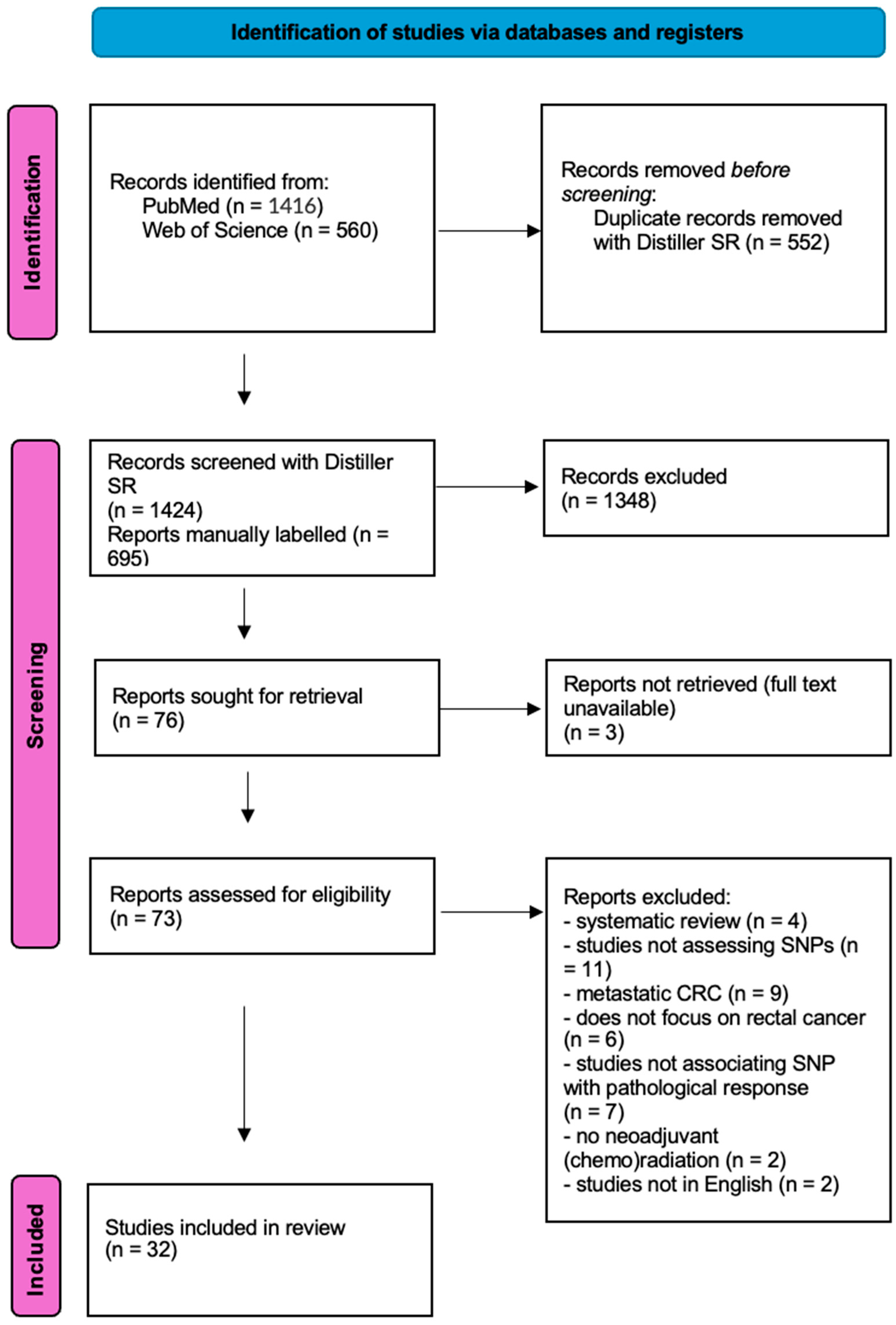
3. Results
3.1. rs25487 (XRCC1)
3.2. rs1801133 (MTHFR)
3.3. Risk of Bias
4. Discussion
5. Conclusions
Supplementary Materials
Author Contributions
Funding
Conflicts of Interest
References
- Benson, A.B.; Venook, A.P.; Adam, M.; Chang, G.; Chen, Y.-J.; Ciombor, K.K.; Cohen, S.A.; Cooper, H.S.; Deming, D.; Garrido-Laguna, I.; et al. NCCN Guidelines® Insights: Rectal Cancer, Version 3.2024: Featured Updates to the NCCN Guidelines. J. Natl. Compr. Cancer Netw. 2024, 22, 366–375. [Google Scholar] [CrossRef] [PubMed]
- Conroy, T.; Bosset, J.F.; Etienne, P.L.; Rio, E.; François, E.; Mesgouez-Nebout, N.; Vendrely, V.; Artignan, X.; Bouché, O.; Gargot, D.; et al. Neoadjuvant chemotherapy with FOLFIRINOX and preoperative chemoradiotherapy for patients with locally advanced rectal cancer (UNICANCER-PRODIGE 23): A multicentre, randomised, open-label, phase 3 trial. Lancet Oncol. 2021, 22, 702–715. [Google Scholar] [CrossRef] [PubMed]
- Bahadoer, R.R.; Dijkstra, E.A.; van Etten, B.; Marijnen, C.A.M.; Putter, H.; Kranenbarg, E.M.-K.; Roodvoets, A.G.H.; Nagtegaal, I.D.; Beets-Tan, R.G.H.; Blomqvist, L.K.; et al. Short-course radiotherapy followed by chemotherapy before total mesorectal excision (TME) versus preoperative chemoradiotherapy, TME, and optional adjuvant chemotherapy in locally advanced rectal cancer (RAPIDO): A randomised, open-label, phase 3 trial. Lancet Oncol. 2021, 22, 29–42. [Google Scholar] [CrossRef]
- Clancy, C.; Burke, J.P.; Coffey, J.C. KRAS mutation does not predict the efficacy of neo-adjuvant chemoradiotherapy in rectal cancer: A systematic review and meta-analysis. Surg. Oncol. 2013, 22, 105–111. [Google Scholar] [CrossRef]
- Zhao, Y.; Li, X.; Kong, X. MTHFR C677T Polymorphism is Associated with Tumor Response to Preoperative Chemoradiotherapy: A Result Based on Previous Reports. Med. Sci. Monit. 2015, 21, 3068. [Google Scholar] [CrossRef][Green Version]
- De Mattia, E.; Roncato, R.; Palazzari, E.; Toffoli, G.; Cecchin, E. Germline and Somatic Pharmacogenomics to Refine Rectal Cancer Patients Selection for Neo-Adjuvant Chemoradiotherapy. Front. Pharmacol. 2020, 11, 897. [Google Scholar] [CrossRef]
- Spolverato, G.; Pucciarelli, S.; Bertorelle, R.; de Rossi, A.; Nitti, D. Predictive factors of the response of rectal cancer to neoadjuvant radiochemotherapy. Cancers 2011, 3, 2176–2194. [Google Scholar] [CrossRef]
- Pezzolo, E.; Modena, Y.; Corso, B.; Giusti, P.; Gusella, M. Germ line polymorphisms as predictive markers for pre-surgical radiochemotherapy in locally advanced rectal cancer: A 5-year literature update and critical review. Eur. J. Clin. Pharmacol. 2015, 71, 529–539. [Google Scholar] [CrossRef]
- Page, M.J.; McKenzie, J.E.; Bossuyt, P.M.; Boutron, I.; Hoffmann, T.C.; Mulrow, C.D.; Shamseer, L.; Tetzlaff, J.M.; Akl, E.A.; Brennan, S.E.; et al. The PRISMA 2020 statement: An updated guideline for reporting systematic reviews. BMJ 2021, 372, 71. [Google Scholar] [CrossRef]
- Hamel, C.; Kelly, S.E.; Thavorn, K.; Rice, D.B.; Wells, G.A.; Hutton, B. An evaluation of DistillerSR’s machine learning-based prioritization tool for title/abstract screening–impact on reviewer-relevant outcomes. BMC Med. Res. Methodol. 2020, 20, 256. [Google Scholar] [CrossRef] [PubMed]
- DistillerSR|Systematic Review Software|Literature Review Software. Available online: https://www.distillersr.com/products/distillersr-systematic-review-software (accessed on 7 March 2025).
- Van Dijk, S.H.B.; Brusse-Keizer, M.G.J.; Bucsán, C.C.; Van Der Palen, J.; Doggen, C.J.M.; Lenferink, A. Artificial intelligence in systematic reviews: Promising when appropriately used. BMJ Open 2023, 13, e072254. [Google Scholar] [CrossRef] [PubMed]
- Sohani, Z.N.; Sarma, S.; Alyass, A.; de Souza, R.J.; Robiou-Du-Pont, S.; Li, A.; Mayhew, A.; Yazdi, F.; Reddon, H.; Lamri, A.; et al. Empirical evaluation of the Q-Genie tool: A protocol for assessment of effectiveness. BMJ Open 2016, 6, e010403. [Google Scholar] [CrossRef] [PubMed]
- Kim, J.C.; Ha, Y.J.; Roh, S.A.; Cho, D.H.; Choi, E.Y.; Kim, T.W.; Kim, J.H.; Kang, T.W.; Kim, S.Y.; Kim, Y.S. Novel single-nucleotide polymorphism markers predictive of pathologic response to preoperative chemoradiation therapy in rectal cancer patients. Int. J. Radiat. Oncol. Biol. Phys. 2013, 86, 350–357. [Google Scholar] [CrossRef]
- Balboa, E.; Duran, G.; Lamas, M.J.; Gomez-Caamaño, A.; Celeiro-Muñoz, C.; Lopez, R.; Carracedo, A.; Barros, F. Pharmacogenetic analysis in neoadjuvant chemoradiation for rectal cancer: High incidence of somatic mutations and their relation with response. Pharmacogenomics 2010, 11, 747–761. [Google Scholar] [CrossRef]
- Boige, V.; Mollevi, C.; Gourgou, S.; Azria, D.; Seitz, J.; Vincent, M.; Bigot, L.; Juzyna, B.; Miran, I.; Gerard, J.; et al. Impact of single-nucleotide polymorphisms in DNA repair pathway genes on response to chemoradiotherapy in rectal cancer patients: Results from ACCORD-12/PRODIGE-2 phase III trial. Int. J. Cancer 2019, 145, 3163–3172. [Google Scholar] [CrossRef]
- Cecchin, E.; Agostini, M.; Pucciarelli, S.; De Paoli, A.; Canzonieri, V.; Sigon, R.; De Mattia, E.; Friso, M.L.; Biason, P.; Visentin, M.; et al. Tumor response is predicted by patient genetic profile in rectal cancer patients treated with neo-adjuvant chemo-radiotherapy. Pharmacogenomics J. 2011, 11, 214–226. [Google Scholar] [CrossRef]
- Chiang, S.F.; Huang, K.C.Y.; Chen, W.T.L.; Chen, T.W.; Ke, T.W.; Chao, K.S.C. Polymorphism of formyl peptide receptor 1 (FPR1) reduces the therapeutic efficiency and antitumor immunity after neoadjuvant chemoradiotherapy (CCRT) treatment in locally advanced rectal cancer. Cancer Immunol. Immunother. 2021, 70, 2937–2950. [Google Scholar] [CrossRef] [PubMed]
- Dreussi, E.; Cecchin, E.; Polesel, J.; Canzonieri, V.; Agostini, M.; Boso, C.; Belluco, C.; Buonadonna, A.; Lonardi, S.; Bergamo, F.; et al. Pharmacogenetics biomarkers and their specific role in neoadjuvant chemoradiotherapy treatments: An exploratory study on rectal cancer patients. Int. J. Mol. Sci. 2016, 17, 1482. [Google Scholar] [CrossRef]
- Dreussi, E.; Pucciarelli, S.; De Paoli, A.; Polesel, J.; Canzonieri, V.; Agostini, M.; Friso, M.L.; Belluco, C.; Buonadonna, A.; Lonardi, S.; et al. Predictive role of microRNA-related genetic polymorphisms in the pathological complete response to neoadjuvant chemoradiotherapy in locally advanced rectal cancer patients. Oncotarget 2016, 7, 19781–19793. [Google Scholar] [CrossRef]
- Dzhugashvili, M.; Luengo-Gil, G.; García, T.; González-Conejero, R.; Conesa-Zamora, P.; Escolar, P.P.; Calvo, F.; Vicente, V.; de la Peña, F.A. Role of genetic polymorphisms in NFKB-mediated inflammatory pathways in response to primary chemoradiation therapy for rectal cancer. Int. J. Radiat. Oncol. Biol. Phys. 2014, 90, 595–602. [Google Scholar] [CrossRef]
- Formica, V.; Benassi, M.; Del Vecchio Blanco, G.; Doldo, E.; Martano, L.; Portarena, I.; Nardecchia, A.; Lucchetti, J.; Morelli, C.; Giudice, E.; et al. Hemoglobin level and XRCC1 polymorphisms to select patients with locally advanced rectal cancer candidate for neoadjuvant chemoradiotherapy with concurrent capecitabine and a platinum salt. Med. Oncol. 2018, 35, 83. [Google Scholar] [CrossRef] [PubMed]
- Garcia-Aguilar, J.; Chen, Z.; Smith, D.D.; Li, W.B.; Madoff, R.D.; Cataldo, P.; Marcet, J.; Pastor, C. Identification of a biomarker profile associated with resistance to neoadjuvant chemoradiation therapy in rectal cancer. Ann. Surg. 2011, 254, 486–493. [Google Scholar] [CrossRef] [PubMed]
- Grimminger, P.P.; Brabender, J.; Warnecke-Eberz, U.; Narumiya, K.; Wandhöfer, C.; Drebber, U.; Bollschweiler, E.; Hölscher, A.H.; Metzger, R.; Vallböhmer, D. XRCC1 gene polymorphism for prediction of response and prognosis in the multimodality therapy of patients with locally advanced rectal cancer. J. Surg. Res. 2010, 164, e61–e66. [Google Scholar] [CrossRef] [PubMed]
- Havelund, B.M.; Spindler, K.L.G.; Ploen, J.; Andersen, R.F.; Jakobsen, A. Single nucleotide polymorphisms in the HIF-1α gene and chemoradiotherapy of locally advanced rectal cancer. Oncol. Lett. 2012, 4, 1056–1060. [Google Scholar] [CrossRef]
- Ho-Pun-Cheung, A.; Assenat, E.; Bascoul-Mollevi, C.; Bibeau, F.; Boissière-Michot, F.; Thezenas, S.; Cellier, D.; Azria, D.; Rouanet, P.; Senesse, P.; et al. A large-scale candidate gene approach identifies SNPs in SOD2 and IL13 as predictive markers of response to preoperative chemoradiation in rectal cancer. Pharmacogenomics J. 2011, 11, 437–443. [Google Scholar] [CrossRef]
- Ho-Pun-Cheung, A.; Assenat, E.; Thezenas, S.; Bibeau, F.; Rouanet, P.; Azria, D.; Cellier, D.; Grenier, J.; Ychou, M.; Senesse, P.; et al. Cyclin D1 Gene G870A Polymorphism Predicts Response to Neoadjuvant Radiotherapy and Prognosis in Rectal Cancer. Int. J. Radiat. Oncol. Biol. Phys. 2007, 68, 1094–1101. [Google Scholar] [CrossRef]
- Hu-Lieskovan, S.; Vallbohmer, D.; Zhang, W.; Yang, D.; Pohl, A.; Labonte, M.J.; Grimminger, P.P.; Hölscher, A.H.; Semrau, R.; Arnold, D.; et al. EGF61 polymorphism predicts complete pathologic response to cetuximab-based chemoradiation independent of KRAS status in locally advanced rectal cancer patients. Clin. Cancer Res. 2011, 17, 5161–5169. [Google Scholar] [CrossRef]
- Hur, H.; Kang, J.; Kim, N.K.; Min, B.S.; Lee, K.Y.; Shin, S.J.; Keum, K.C.; Choi, J.; Kim, H.; Choi, S.H.; et al. Thymidylate synthase gene polymorphism affects the response to preoperative 5-fluorouracil chemoradiation therapy in patients with rectal cancer. Int. J. Radiat. Oncol. Biol. Phys. 2011, 81, 669–676. [Google Scholar] [CrossRef]
- Kim, S.Y.; Baek, J.Y.; Oh, J.H.; Park, S.C.; Sohn, D.K.; Kim, M.J.; Chang, H.J.; Kim, D.Y. A phase II study of preoperative chemoradiation with tegafur-uracil plus leucovorin for locally advanced rectal cancer with pharmacogenetic analysis. Radiat. Oncol. 2017, 12, 62. [Google Scholar] [CrossRef]
- Lamas, M.J.; Duran, G.; Gomez, A.; Balboa, E.; Anido, U.; Bernardez, B.; Rana-Diez, P.; Lopez, R.; Carracedo, A.; Barros, F. X-ray cross-complementing group 1 and thymidylate synthase polymorphisms might predict response to chemoradiotherapy in rectal cancer patients. Int. J. Radiat. Oncol. Biol. Phys. 2012, 82, 138–144. [Google Scholar] [CrossRef]
- Leu, M.; Riebeling, T.; Dröge, L.H.; Hubert, L.; Guhlich, M.; Wolff, H.A.; Brockmöller, J.; Gaedcke, J.; Rieken, S.; Schirmer, M.A. 8-oxoguanine dna glycosylase (Ogg1) cys326 variant: Increased risk for worse outcome of patients with locally advanced rectal cancer after multimodal therapy. Cancers 2021, 13, 2805. [Google Scholar] [CrossRef]
- Nicosia, L.; Gentile, G.; Reverberi, C.; Minniti, G.; Valeriani, M.; de Sanctis, V.; Marinelli, L.; Cipolla, F.; de Luca, O.; Simmaco, M.; et al. Single nucleotide polymorphism of gstp1 and pathological complete response in locally advanced rectal cancer patients treated with neoadjuvant concomitant radiochemotherapy. Radiat. Oncol. J. 2018, 36, 218–226. [Google Scholar] [CrossRef]
- Nikas, J.B.; Lee, J.T.; Maring, E.D.; Washechek-Aletto, J.; Felmlee-Devine, D.; A Johnson, R.; Smyrk, T.C.; Tawadros, P.S.; A Boardman, L.; Steer, C.J. A common variant in MTHFR influences response to chemoradiotherapy and recurrence of rectal cancer. Am. J. Cancer Res. 2015, 5, 3231–3240. Available online: https://pmc.ncbi.nlm.nih.gov/articles/PMC4656744/ (accessed on 28 July 2025).
- Páez, D.; Salazar, J.; Paré, L.; Pertriz, L.; Targarona, E.; del Rio, E.; Barnadas, A.; Marcuello, E.; Baiget, M. Pharmacogenetic study in rectal cancer patients treated with preoperative chemoradiotherapy: Polymorphisms in thymidylate synthase, epidermal growth factor receptor, GSTP1, and DNA repair genes. Int. J. Radiat. Oncol. Biol. Phys. 2011, 81, 1319–1327. [Google Scholar] [CrossRef]
- Peng, J.; Ma, W.; Zhou, Z.; Gu, Y.; Lu, Z.; Zhang, R.; Pan, Z. Genetic variations in the PI3K/PTEN/AKT/mTOR pathway predict tumor response and disease-free survival in locally advanced rectal cancer patients receiving preoperative chemoradiotherapy and radical surgery. J. Cancer 2018, 9, 1067–1077. [Google Scholar] [CrossRef]
- Rampazzo, E.; Cecchin, E.; Del Bianco, P.; Menin, C.; Spolverato, G.; Giunco, S.; Lonardi, S.; Malacrida, S.; De Paoli, A.; Toffoli, G.; et al. Genetic variants of the TERT gene, telomere length, and circulating TERT as prognostic markers in rectal cancer patients. Cancers 2020, 12, 3115. [Google Scholar] [CrossRef]
- Sclafani, F.; Chau, I.; Cunningham, D.; Peckitt, C.; Lampis, A.; Hahne, J.; Braconi, C.; Tabernero, J.; Glimelius, B.; Cervantes, A.; et al. Prognostic role of the LCS6 KRAS variant in locally advanced rectal cancer: Results of the EXPERT-C trial. Ann. Oncol. 2015, 26, 1936–1941. [Google Scholar] [CrossRef]
- Sclafani, F.; Chau, I.; Cunningham, D.; Lampis, A.; Hahne, J.C.; Ghidini, M.; Lote, H.; Zito, D.; Tabernero, J.; Glimelius, B.; et al. Sequence variation in mature microRNA-608 and benefit from neo-adjuvant treatment in locally advanced rectal cancer patients. Carcinogenesis 2016, 37, 852–857. [Google Scholar] [CrossRef]
- Sebio, A.; Salazar, J.; Páez, D.; Berenguer-Llergo, A.; del Río, E.; Tobeña, M.; Martín-Richard, M.; Sullivan, I.; Targarona, E.; Balart, J.; et al. EGFR ligands and DNA repair genes: Genomic predictors of complete response after capecitabine-based chemoradiotherapy in locally advanced rectal cancer. Pharmacogenomics J. 2015, 15, 77–83. [Google Scholar] [CrossRef]
- Spindler, K.L.G.; Nielsen, J.N.; Lindebjerg, J.; Brandslund, I.; Jakobsen, A. Prediction of response to chemoradiation in rectal cancer by a gene polymorphism in the epidermal growth factor receptor promoter region. Int. J. Radiat. Oncol. Biol. Phys. 2006, 66, 500–504. [Google Scholar] [CrossRef]
- Stanojevic, A.; Spasic, J.; Marinkovic, M.; Stojanovic-Rundic, S.; Jankovic, R.; Djuric, A.; Zoidakis, J.; Fijneman, R.J.A.; Castellvi-Bel, S.; Cavic, M. Methylenetetrahydrofolate reductase polymorphic variants C677T and A1298C in rectal cancer in Slavic population: Significance for cancer risk and response to chemoradiotherapy. Front. Genet. 2024, 14, 1299599. [Google Scholar] [CrossRef]
- Stoehlmacher, J.; Goekkurt, E.; Mogck, U.; Aust, D.E.; Kramer, M.; Baretton, G.B.; Liersch, T.; Ehninger, G.; Jakob, C. Thymidylate synthase genotypes and tumor regression in stage II/III rectal cancer patients after neoadjuvant fluorouracil-based chemoradiation. Cancer Lett. 2008, 272, 221–225. [Google Scholar] [CrossRef]
- Terrazzino, S.; Agostini, M.; Pucciarelli, S.; Pasetto, L.M.; Friso, M.L.; Ambrosi, A.; Lisi, V.; Leon, A.; Lise, M.; Nitti, D. A haplotype of the methylenetetrahydrofolate reductase gene predicts poor tumor response in rectal cancer patients receiving preoperative chemoradiation. Pharmacogenet. Genom. 2006, 16, 817–824. [Google Scholar] [CrossRef]
- Xiao, L.; Yu, X.; Zhang, R.; Chang, H.; Xi, S.; Xiao, W.; Zeng, Z.; Zhang, H.; Xu, R.; Gao, Y. Can an IL13-1112 C/T (rs1800925) polymorphism predict responsiveness to neoadjuvant chemoradiotherapy and survival of Chinese Han patients with locally advanced rectal cancer? Oncotarget 2016, 7, 34149–34157. [Google Scholar] [CrossRef][Green Version]
- Guo, C.X.; Yang, G.P.; Pei, Q.; Yin, J.Y.; Tan, H.Y.; Yuan, H. DNA repair gene polymorphisms do not predict response to radiotherapy-based multimodality treatment of patients with rectal cancer: A meta-analysis. Asian Pac. J. Cancer Prev. 2015, 16, 713–718. [Google Scholar] [CrossRef][Green Version]
- Systematic Review of Candidate Single-Nucleotide Polymorphisms as Biomarkers for Responsiveness to Neoadjuvant Chemoradiation for Rectal Cancer-PubMed. Available online: https://pubmed.ncbi.nlm.nih.gov/26124319/ (accessed on 10 November 2025).
- Chow, O.S.; Kuk, D.; Keskin, M.; Smith, J.J.; Camacho, N.; Pelossof, R.; Chen, C.T.; Chen, Z.; Avila, K.; Weiser, M.R.; et al. KRAS and Combined KRAS/TP53 Mutations in Locally Advanced Rectal Cancer Are Independently Associated with Decreased Response to Neoadjuvant Therapy. Ann. Surg. Oncol. 2016, 23, 2548–2555. [Google Scholar] [CrossRef] [PubMed]
- Aboelmaaty, S.; Gomaa, I.A.; Sileo, A.; Sassun, R.; Ng, J.C.; Keshk, N.O.; McKenna, N.P.; Perry, W.R.; Larson, D.W. The Impact of RAS/BRAF Mutation on Pathological Complete Response After Total Neoadjuvant Therapy in Rectal Cancer. Ann. Surg. Oncol. 2025, 32, 7326–7332. [Google Scholar] [CrossRef] [PubMed]
- Hasan, S.; Renz, P.; Wegner, R.E.; Finley, G.; Raj, M.; Monga, D.; McCormick, J.; Kirichenko, A. Microsatellite Instability (MSI) as an Independent Predictor of Pathologic Complete Response (PCR) in Locally Advanced Rectal Cancer: A National Cancer Database (NCDB) Analysis. Ann. Surg. 2020, 271, 716–723. [Google Scholar] [CrossRef] [PubMed]


| Description | |
|---|---|
| P—Population | Adult patients (≥18 years) diagnosed with locally advanced non-metastatic rectal cancer who underwent neoadjuvant (chemo)radiotherapy (nCRT). |
| E—Exposure | Presence of specific single nucleotide polymorphisms (SNPs). |
| C—Comparator | Patients with alternative SNP variants or wild-type genotypes. |
| O—Outcomes | Pathological complete response (pCR) or Tumor regression grade (TRG) |
| Author | Year | Study Design | Country | Number of Patients | Years of Recruitment | Initial Staging | Neoadjuvant Protocol | Median Age | Sample Examined | Number of SNPs Analyzed | Genes Investigated | Genotyping Method | Primary Outcome | Responder/pCR Definition and Rate | Positive Predictors of Tumor Response |
|---|---|---|---|---|---|---|---|---|---|---|---|---|---|---|---|
| Balboa [15] | 2010 | Retrospective cohort | Spain | 65 | NR | stage II (31%), stage III (69%) | RT + Uracil/Capecitabine | 64 | peripheral blood sample, pre-treatment tumor material | 7 | XRCC1, ERCC1, ERCC2 (XPD), MTHFR, DPYD, TYMS, EGFR | SNaPshot | Mandard TRG | responders (TRG 1–2) 48% non-responders (TRG 3–5) 53% | XRCC1 - rs25487 AA |
| Boige [16] | 2019 | Prospective cohort (RCT subgroup) | France | 316 | 2005–2008 | T3–4 M0 (100%) | RT + Capecitabine (49%) or dose-intensified RT + Capecitabine + Oxaliplatin (51%) | 61 | peripheral blood sample | 66 | ERCC1, ERCC2 (XPD), ERCC4, XRCC1, XRCC3, XPA, GSTP1, MTHFR, TYMS, SOD2 | Illumina Infinium iSelect custom SNP genotyping | Dworak TRG (modified) | responders (TRG 2–3) 37.6% non-responders (TRG 0–1) 62.4% | ERCC2 - rs1799787 C>T ERCC1 - rs10412761 A>G |
| Cecchin [17] | 2011 | Retrospective cohort | Italy | 238 | 1993–2006 | staging not specified | RT 45–50.4 Gy + 5-FU ± others | 61 | peripheral blood sample | 21 | MTHFR, ABCB1, ABCC2, GSTA1*B, RAD51, MLH1, MSH2, OGG1, XRCC3, XRCC1, ERCC2 (XPD), ERCC1, GSTP1 | Pyrosequencing, TaqMan, Gel electrophoresis | Mandard TRG | good responders (TRG 1–2) 51% intermediate responders (TRG 3) 21% non-responders (TRG 4–5) 27% | hOGG1 - rs1052133 CC MTHFR - rs1801133 TT |
| Chiang [18] | 2021 | Retrospective cohort + animal model | Taiwan | 130 | 2006–2014 | cT3–4 or cN+ (100%) | RT 50.4 Gy + 5-FU/UFT/Capecitabine | 59.7 | non-tumor surgical material | 4 | FPR1, TIM3, P2RX7, TLR1 | MassARRAY | Dworak TRG | responders (TRG 3–4) 65% non-responders (TRG 1–2) 35% | FPR1 - rs867228 AC/AA |
| Dreussi [19] | 2016 | Retrospective cohort | Italy | 280 | 1993–2011 | T3–T4 and N0–2 M0 (100%) | RT 50.4 Gy/55.0 Gy + 5-FU/Capecitabine ± Oxaliplatin | 61 | peripheral blood sample | 30 | MTHFR, MSH6, XRCC1, OGG1, MDM2, MLH1, MGMT, GSTP1, SOD2, XRCC3, TP53, ATM, EGFR, PARP-1, EXO1, ERCC1, ERCC2 (XPD), EGF, VEGF, APEX1 | TaqMan PCR, Pyrosequencing, Gel electrophoresis | pCR | pCR (Mandard TRG 1) 28% | none |
| Dreussi [20] | 2016 | Prospective cohort | Italy | 265 | 1993–2011 | T3–T4 N0–2 M0 (100%) | RT 50.4/55.0 Gy + 5-FU/Capecitabine ± Oxaliplatin | NR | peripheral blood sample | 114 | SMAD3, TRBP, DROSHA, CNOT4, CNOT6, DDX20, DGCR8, DICER1, SMAD2, SMAD5, TNRC6A, TNRC6B, miR-196a-2, miR-371A (authors do not report all analyzed SNPs) | BeadXpress platform | pCR | pCR (Mandard TRG 1) 28% | SMAD3 - rs744910 AG/GG - rs745103 GG - rs17228212 TT TRBP - rs6088619 AG/GG DROSHA - rs10719 CC |
| Dzhugashvili [21] | 2014 | Retrospective cohort | Spain | 159 | 2004–2010 | cT0–2 (5.7%) cT3–4 (94.3%) cN+ (72.9%) | RT 50.4 Gy (1.8 Gy per fraction) + Capecitabine | 64 | peripheral blood sample | 6 | IL1B, PTGS1, PTGS2 | TaqMan | pCR | pCR (ypT0N0) 18.2% | none |
| Formica [22] | 2018 | Prospective cohort | Italy | 51 | NR | stage II (35%), stage III (65%) | RT 45 Gy (1.8 Gy per fraction) + 5.4 Gy boost + Cisplatin + Capecitabine | 63 | surgical tumor material | 5 | GSTP1, XRCC1, ERCC1, MTHFR, ABCB1 | Pyrosequencing | AJCC TRG | responders (AJCC TRG 0–1) 34% non-responders (AJCC TRG 2–3) 66% | XRCC1 - rs25487 GG |
| Garcia-Aguilar [23] | 2011 | Prospective cohort (Secondary analysis of phase II trial) | USA, Spain | 132 | 2004–2012 | stage II (28%), stage III (69%), unknown (3%) | RT 50.4 Gy, + 5-FU ± mFOLFOX-6 | 57 | pre-treatment tumor material | 2 | CCND1, MTHFR | Sanger sequencing | pCR | pCR (AJCC TRG 0) 25% | CCND1 - rs603965 AG/GG MTHFR - rs1801133 TC/CC |
| Grimminger [24] | 2010 | Prospective cohort | Germany | 81 | 1997–2008 | T3/4 Nx (100%) | RT 50.4 Gy + 5-FU | 59 | pre-treatment tumor material | 3 | XRCC1 | TaqMan | Viable residual tumor cells | major response (VRTC 3–4) 32% minor response (VRTC 1–2) 68% | XRCC1 - rs25487 AG |
| Havelund [25] | 2012 | Prospective cohort | Denmark | 198 | 2005–2009 | cT3 (83%), cT4 (17%); N+ (89%) | RT 50.4 Gy with or ± 10 Gy brachytherapy + UFT + Leucovorin | 63 | peripheral blood sample | 3 | HIF-1α | KASPar, Sanger sequencing, TaqMan | Mandard TRG | responders (TRG 1) 19% non-responders (TRG 2–4) 81% | none |
| Ho-Pun-Cheung [26] | 2011 | Prospective study | France | 71 | 2005–2008 | stage II (20%), stage III (72%), stage IV (9%) | RT 45/50 Gy (1.8–2 Gy per fraction) + Capecitabine ± Oxaliplatin | 61 | peripheral blood sample | 128 | ADPRT, CHEK1, CHEK2, ATM, BRCA1, BRCA2, ERCC1, ERCC2 (XPD), ERCC4, ERCC5, LIG3, LIG4, MBD4, MGMT, XPA, XRCC1, XRCC3, BAX, CASP3, CASP8, CASP10, CASP9, BCL2, CCND1, CDKN1A, MDM2, TP53, TP73, EGF, EGFR, ERBB2, IGF1, FGF2, FGFR4, IGF2R, TGFB1, VEGF, FCGR2A, FCGR3A, IL8, IL10, IL1B, IL4, IL6, IL13, LTA, NFKB1, TNFA, PTGS2, PPARG, NFE2L2, PARP-1, MPO, GPX1, SOD2, NOS2A, NOS3, HIF-1A, CYP1A1, GSTP1, GSTT1, MT-ND3, MTHFR, ICAM5, GSK3B, CTNNB1, APEX1, NBN, RECQL, ZNF350, RAD52, XRCC5 | SNPlex Genotyping System, TaqMan, PCR-RFLP | Dworak TRG | responders (TRG 3–4) 45% non-responders (TRG 0–2) 55% | SOD2 - rs4880 CC IL13 - rs1800925 CC |
| Ho-Pun-Cheung [27] | 2007 | Prospective cohort | France | 70 | 1996–2001 | stage I (16%), stage II (31%), stage III (36%), stage IV (17%) | RT (45/60 Gy) | 64 | peripheral blood sample | 1 | CCND1 | PCR-RFLP | Dworak TRG | responders (TRG 2–4) 50% non-responders (TRG 0–1) 43% NR 7% | CCND1 - positive G870A AA |
| Hu-Lieskovan [28] | 2011 | Prospective cohort from Phase I/II trials | Germany, Slovenia, Belgium | 130 | NR | stage II (3%), stage III (84%), stage IV (12%) | RT + Cetuximab + Capecitabine/Oxaliplatin/5-FU | 61 | surgical tumor material | 13 | EGFR, KRAS, IL8, MTHFR, FCGR2A, FCGR3A, XRCC3, VEGF, EGF, CCND1, PTGS2, RAD51 | PCR-RFLP | pCR | pCR (Dworak TRG 4) 15% | EGF - rs4444903 AG/GG |
| Hur [29] | 2011 | Prospective cohort | South Korea | 44 | 2007–2008 | T2(2.3%), T3 (40.9%), T4 (56.8%) | RT 45 Gy (1.8 Gy per fraction) + 5.4 Gy boost + 5-FU | 58 | pre-treatment tumor material | 1 | TYMS | Sanger sequencing | pCR, Mandard TRG | pCR (Mandard TRG 1) 14% responders (Mandard TRG 1–2) 41% non-responders (Mandard TRG 3–4) 59% | none |
| Kim [14] | 2013 | Prospective cohort | South Korea | 113 (genome-wide screening of 691,162 SNPs) | NR | stage II (9%), stage III (89%), stage IV (2%) | RT 45 Gy + 5.4 Gy boost + 5-FU + Leucovorin (80%)/Capecitabine (20%) | 59 | peripheral blood sample | 9 | FAM101A, CORO2A, USP20, ZNF281, OR2T4, SLC10A7, ASZ1, MED4, CDC42BPA | Genome-Wide Human SNP Array, Pyrosequencing | Mandard TRG | responders (Mandard TRG 1–3) 84% non-responders (Mandard TRG 4) 16% | CORO2A - rs1985859 CC (wild type) |
| Kim [30] | 2017 | Prospective cohort | South Korea | 91 | 2009–2012 | T3 (97%), T4 (3%), N+ (87%) | RT 50.4 Gy (1.8 Gy per fraction) + Tegafur + Uracil + Leucovorin | 59 | peripheral blood sample | 7 | UMPS, CYP2A6, ABCB1 | PCR-RFLP | pCR | pCR (not defined) 11% | none |
| Lamas [31] | 2012 | Prospective cohort | Spain | 93 | 2007–2008 | stage II (28%), stage III (72%) | RT 50.4 Gy + 5-FU | 67 | peripheral blood sample | 5 | XRCC1, TYMS, MTHFR, ERCC1 | SNaPshot | Mandard TRG | responders (TRG 1–2) 47% non-responders (TRG 3–4) 53% | XRCC1 - rs25487 GG/AA TYMS - 5′UTR VNTR 2R/3G, 3C/3G, 3G/3G |
| Leu [32] | 2021 | Prospective cohort | Germany | 287 | 1998–2016 | stage II (21%), stage III (79%) | RT 50.4 Gy (1.8 Gy per fraction) + 5-FU ± Oxaliplatin | 64.4 | peripheral blood sample | 8 | SOD2, SOD3, CAT, CYBA, GPX1, MPO, OGG1 | SNaPshot | pCR | pCR (not defined) 17% | none |
| Nicosia [33] | 2018 | Retrospective cohort | Italy | 80 | 2008–2015 | T2 (11%) T3 (84%) T4 (5%), N+ (54%) M0 (100%) | RT 45 Gy + 10 Gy boost + Capecitabine (60%)/5-FU (40%) | 64 | peripheral blood sample | 2 | GSTP1, XRCC1 | Pyrosequencing | pCR | pCR (Dworak TRG 4) 19% | GSTP1 - rs1695 AA (wild type) |
| Nikas [34] | 2015 | Prospective cohort | USA | 108 | NR | staging not specified | RT 50.4 Gy + 5-FU | NR | peripheral blood sample | 1 | MTHFR | High-resolution Melting Analysis | pCR | pCR (College of American Pathologists TRG 0) 33% non-responders (College of American Pathologists TRG 3–4) 67% | MTHFR - rs1801133 CC (wild type) |
| Paez [35] | 2011 | Prospective cohort | Spain | 128 | 1998–2009 | T2 (6%), T3 (81%), T4 13%, N+ (60%) | RT 45 Gy+ 5-FU/Capecitabine/Capecitabine + Oxaliplatin/5-FU + Oxaliplatin | 65 | peripheral blood sample | 10 | XRCC1, ERCC1, EGFR, GSTP1, ERCC2 (XPD), TYMS | TaqMan | pCR | responders (pCR Mandard TRG 1 plus residual microfoci) 43% non-responders 57% | none |
| Peng [36] | 2018 | Retrospective cohort | China | 97 | 2008–2011 | stage II (36.3%), stage III (63.7%) | RT 50 Gy (2 Gy per fraction) + XELOX | 58 | peripheral blood sample | 12 | PTEN, PIK3CA, AKT1, AKT2, FRAP1 | PCR-RFLP | pCR, Dworak TRG | pCR (Dworak TRG 4) 14.4% responders (TRG 2–4) 69.1% non-responders (TRG 1) 30.9% | none |
| Rampazzo [37] | 2020 | Prospective cohort | Italy | 194 | NR | stage I (3.2%), stage II (11.1%), stage III (84.1%), stage IV (1.6%) | RT + Fluoropyrimidine ± other drug | 65 | peripheral blood sample | 8 | TERT | TaqMan | Mandard TRG | responders (TRG 1–2) 46% non-responders (TRG 3–5) 54% | TERT - rs2736108 CC - rs2853690 GG/AA |
| Sclafani [38] | 2015 | Retrospective cohort | UK, Spain, Sweden, and others | 155 | 2005–2008 | staging not specified | CAPOX (±Cetuximab) + Capecitabine-RT 45 Gy + 5.4 Gy | 60 | surgical tumor material, pre-treatment tumor material | 1 | KRAS | TaqMan | pCR | pCR (pCR or, in patients who did not undergo surgery, radiologic CR) 14% | KRAS - rs61764370 TG |
| Sclafani [39] | 2016 | Retrospective cohort | UK, Spain, Sweden, and others | 155 | 2005–2008 | staging not specified | CAPOX (±Cetuximab) + Capecitabine-RT 45 Gy + 5.4 Gy | 60 | surgical tumor material, pre-treatment tumor material | 1 | miR-608 | TaqMan | pCR | pCR (pCR or, in patients who did not undergo surgery, radiologic CR) 14% | none |
| Sebio [40] | 2015 | Retrospective cohort | Spain | 84 | NR | stage II (27.4%), stage III (72.6%) | RT 45 Gy (1.8 Gy per fraction) + Capecitabine | 68 | peripheral blood sample | 28 | TYMS, XRCC1, ERCC1, AREG, EGF, EREG, EGFR, ERCC2 (XPD) | TaqMan | pCR | complete response (Mandard TRG 1) 20.2% | ERCC1 - rs11615 CT/TT AREG - rs11942466 CC (wild type) |
| Spindler [41] | 2006 | Prospective cohort | Denmark | 77 | 2003–2005 | T3N0M0 (22%) T3N1M0 (62%) T3N2M0 (16%) | RT 65 Gy + UFT + Leucovorin | 64 | peripheral blood sample | 1 | EGFR | TaqMan | Mandard TRG | responders (TRG 1–2) 49% non-responders (TRG 3–4) 51% | EGFR - rs712829 GT/TT |
| Stanojevic [42] | 2024 | Prospective cohort | Serbia | 97 | 2018–2019 | stage II (8%), stage III (92%) | RT 50.4 Gy (1.8 Gy per fraction) + 5-FU + Leucovorin | 61 | pre-treatment tumor material | 2 | MTHFR | PCR-RFLP | Mandard TRG | responders (TRG 1–2) 31% non-responders (TRG 3–5) 67% NR 2% | none |
| Stoehlmacher [43] | 2008 | Retrospective cohort | Germany | 40 | 1998–2001 | stage II or III (100%) | RT 50.4 Gy (1.8 Gy per fraction) + 5-FU | 60 | pre-treatment tumor material | 1 | TYMS | PCR-RFLP | TRG * | responders 84% non-responders 16% | none |
| Terrazzino [44] | 2006 | Retrospective cohort | Italy | 125 | 1994–2002 | T2 (8%), T3 (66%), T4 (24%); N1 (67%); M0 (100%) | RT 48.4 Gy (median) + 5-FU (35%)/5-FU + Oxaliplatin (22%)/Leucovorin (29%)/Carboplatin (14%) | 60 | peripheral blood sample | 2 | MTHFR | PCR-RFLP | Mandard TRG | responders (TRG 1–2) 39% non-responders (TRG 3–4) 61% | MTHFR - rs1801133 CC |
| Xiao [45] | 2016 | Prospective cohort | China | 58 | 2007–2012 | stage II (22%), stage III (78%) | RT 46 Gy (2 Gy per fraction) + XELOX (86%) or mFOLFOX6 (10%) | NR | pre-treatment tumor material | 1 | IL13 | Sanger sequencing | pCR, Dworak TRG | pCR (Dworak TRG 4) 28% good response (TRG 3–4) 48% non-responders (TRG 0–2) 52% | none |
| Gene Function | Name | Studies | Number of Studies | SNP ID | Number of Different SNPs Analyzed |
|---|---|---|---|---|---|
| Folate metabolism | DPYD | Balboa [15] | 1 | rs3918290 | 1 |
| MTHFR | Balboa [15], Boige [16], Cecchin [17], Dreussi [19], Formica [22], Garcia-Aguilar [23], Ho-Pun-Cheung [26], Hu-Lieskovan [28], Lamas [31], Nikas [34], Stanojevic [42], Terrazzino [44] | 12 | rs3737967, rs3818762, rs3737964, rs7553194, rs17367504, rs9651118, rs4846052, rs1572151, rs1801133, rs1801131, rs17375901 | 11 | |
| UMPS | Kim [30] | 1 | rs1801019 | 1 | |
| TYMS | Balboa [15], Boige [16], Hur [29], Lamas [31], Páez [35], Sebio [40], Stoehlmacher [43] | 7 | rs2853542, rs2847153, rs2298582, rs2612101, rs10502290, rs2260821, rs3744962, rs1001761, rs2853741, VNTR/5′UTR | 11 | |
| DNA repair | ERCC5 | Ho-Pun-Cheung [26] | 1 | rs17655 | 1 |
| MSH6 | Dreussi [19] | 1 | rs3136228 | 1 | |
| CHEK2 | Ho-Pun-Cheung [26] | 1 | rs2267130 | 1 | |
| RAD51 | Cecchin [17], Hu-Lieskovan [28] | 2 | rs1801320, rs5030783, rs1801321 | 3 | |
| ERCC1 | Balboa [15], Boige [16], Cecchin [17], Dreussi [19], Formica [22], Ho-Pun-Cheung [26], Lamas [31], Páez [35], Sebio [40] | 9 | rs11615, rs10412761, rs2336219, rs3212986, rs2298881, rs4803823, rs3212948 | 7 | |
| MGMT | Dreussi [19], Ho-Pun-Cheung [26] | 2 | rs12917 | 1 | |
| EXO1 | Dreussi [19] | 1 | rs4149963 | 1 | |
| MLH1 | Cecchin [17], Dreussi [19] | 2 | rs1799977, rs1800734 | 2 | |
| MSH2 | Cecchin [17] | 1 | rs2303428 | 1 | |
| XRCC1 | Balboa [15], Boige [16], Cecchin [17], Dreussi [19], Formica [22], Grimminger [24], Ho-Pun-Cheung [26], Lamas [31], Nicosia [33], Páez [35], Sebio [40] | 11 | rs25487, rs2293036, rs3213334, rs2023614, rs1001581, rs2854496, rs3213266, rs3213255, rs304729, rs1799782, rs3213239, rs25489, rs861539, rs3213245 | 14 | |
| BAX | Ho-Pun-Cheung [26] | 1 | rs36017265, rs4645878 | 2 | |
| XPA | Boige [16], Ho-Pun-Cheung [26] | 2 | rs2773354, rs3176757, rs2808667, rs2805835, rs3176689, rs3176683, rs3176658, rs3176639, rs1800975 | 9 | |
| XRCC3 | Boige [16], Cecchin [17], Dreussi [19], Ho-Pun-Cheung [26], Hu-Lieskovan [28] | 5 | rs3212102, rs12432907, rs3212090, rs3212079, rs861531, rs861530, rs861528, rs1799794, rs861539, rs1799796 | 10 | |
| PARP-1 | Dreussi [19], Ho-Pun-Cheung [26] | 2 | rs11136410 | 1 | |
| ADPRT | Ho-Pun-Cheung [26] | 1 | rs1136410 | 1 | |
| ERCC4 | Boige [16], Ho-Pun-Cheung [26] | 2 | rs1364362, rs1800067, rs11075223, rs1799802, rs744154, rs1799801, rs1799800 | 7 | |
| LIG4 | Ho-Pun-Cheung [26] | 1 | rs1805388, rs1805386 | 2 | |
| CHEK1 | Ho-Pun-Cheung [26] | 1 | rs521102 | 1 | |
| LIG3 | Ho-Pun-Cheung [26] | 1 | rs1052536, rs3135967 | 2 | |
| ERCC2 (XPD) | Balboa [15], Boige [16], Cecchin [17], Dreussi [19], Ho-Pun-Cheung [26], Páez [35], Sebio [40] | 7 | rs13181, rs238415, rs50872, rs50871, rs1799793, rs11878644, rs28365048, rs1799787 | 9 | |
| MBD4 | Ho-Pun-Cheung [26] | 1 | rs10342, rs140693 | 2 | |
| APEX1 | Dreussi [19], Ho-Pun-Cheung [26] | 2 | rs1130409, rs1760944 | 2 | |
| NBN | Ho-Pun-Cheung [26] | 1 | rs1805794 | 1 | |
| RECQL | Ho-Pun-Cheung [26] | 1 | rs13035 | 1 | |
| ZNF350 | Ho-Pun-Cheung [26] | 1 | rs2278415, rs2278420 | 2 | |
| RAD52 | Ho-Pun-Cheung [26] | 1 | rs11226 | 1 | |
| XRCC5 | Ho-Pun-Cheung [26] | 1 | rs1051677, rs1051685, rs6941, rs2440 | 4 | |
| PTEN | Peng [36] | 1 | rs2299939, rs12569998 | 2 | |
| Immune regulation | TNFA | Ho-Pun-Cheung [26] | 1 | rs1800629 | 1 |
| LTA | Ho-Pun-Cheung [26] | 1 | rs2229094 | 1 | |
| IL8 | Ho-Pun-Cheung [26], Hu-Lieskovan [28] | 2 | rs4073 | 1 | |
| IL4 | Ho-Pun-Cheung [26] | 1 | rs2243250 | 1 | |
| FPR1 | Chiang [18] | 1 | rs867228 | 1 | |
| IL13 | Ho-Pun-Cheung [26], Xiao [45] | 2 | rs20541, rs1800925 | 2 | |
| IL10 | Ho-Pun-Cheung [26] | 1 | rs1800896 | 1 | |
| FAM101A | Kim [14] | 1 | rs7955740 | 1 | |
| TLR1 | Chiang [18] | 1 | rs5743618 | 1 | |
| IL6 | Ho-Pun-Cheung [26] | 1 | rs1800795 | 1 | |
| P2RX7 | Chiang [18] | 1 | rs3751143 | 1 | |
| NFKB1 | Ho-Pun-Cheung [26] | 1 | rs3774932, rs3774934, rs3774936, rs3774937 | 4 | |
| FCGR2A | Ho-Pun-Cheung [26], Hu-Lieskovan [28] | 2 | rs1801274 | 1 | |
| FCGR3A | Ho-Pun-Cheung [26], Hu-Lieskovan [28] | 2 | rs396991 | 1 | |
| IL1B | Dzhugashvili [21], Ho-Pun-Cheung [26] | 2 | rs16944, rs1143627, rs1143634 | 3 | |
| TIM3 | Chiang [18] | 1 | rs1036199 | 1 | |
| CORO2A | Kim [14] | 1 | rs1985859 | 1 | |
| Angiogenesis | HIF-1A | Havelund [25], Ho-Pun-Cheung [26] | 2 | rs11549465, rs11549467, rs2057482, rs2246350 | 4 |
| VEGF | Dreussi [19], Ho-Pun-Cheung [26], Hu-Lieskovan [28] | 3 | rs2010963, rs1570360, rs3025039, rs699947 | 4 | |
| Growth factor receptor | IGF2R | Ho-Pun-Cheung [26] | 1 | rs629849 | 1 |
| ERBB2 | Ho-Pun-Cheung [26] | 1 | rs1801200 | 1 | |
| EGFR | Balboa [15], Dreussi [19], Ho-Pun-Cheung [26], Hu-Lieskovan [28], Páez [35], Sebio [40], Spindler [41] | 7 | rs11568315, rs2227983, rs17290169, rs17335738, rs712830, rs712829, rs11543848 | 7 | |
| EGF | Dreussi [19], Ho-Pun-Cheung [26], Hu-Lieskovan [28], Sebio [40] | 4 | rs4444903, rs6533485, rs11568993, rs4698803, rs11568972, rs929446, rs2074390, rs6850557 | 8 | |
| EREG | Sebio [40] | 1 | rs7687621, rs1017733 | 2 | |
| TGFB1 | Ho-Pun-Cheung [26] | 1 | rs1982073, rs1800471, rs1800469 | 3 | |
| IGF1 | Ho-Pun-Cheung [26] | 1 | rs2229765 | 1 | |
| FGFR4 | Ho-Pun-Cheung [26] | 1 | rs351855 | 1 | |
| FGF2 | Ho-Pun-Cheung [26] | 1 | rs308447 | 1 | |
| AREG | Sebio [40] | 1 | rs11942466, rs28635876, rs13104811, rs1353295, rs3913032, rs6447003, rs10034692, rs11725706, rs2132065 | 9 | |
| Oncogene | BRCA2 | Ho-Pun-Cheung [26] | 1 | rs1799943, rs206143, rs144848 | 3 |
| BRCA1 | Ho-Pun-Cheung [26] | 1 | rs1799966, rs16941, rs16942, rs799917 | 4 | |
| KRAS | Hu-Lieskovan [28], Sclafani [38] | 2 | rs61764370 | 1 | |
| PIK3CA | Peng [36] | 1 | rs2699887, rs6443624, rs7621329, rs7651265 | 4 | |
| miRNA | miR-371a | Dreussi [20] | 1 | rs28461391 | 1 |
| SMAD5 | Dreussi [20] | 1 | rs1057898, rs6871224 | 2 | |
| DDX20 | Dreussi [20] | 1 | rs197412 | 1 | |
| TNRC6B | Dreussi [20] | 1 | rs139911 | 1 | |
| miR-608 | Sclafani [39] | 1 | rs4919510 | 1 | |
| DGCR8 | Dreussi [20] | 1 | rs417309 | 1 | |
| CNOT4 | Dreussi [20] | 1 | rs11772832 | 1 | |
| TNRC6A | Dreussi [20] | 1 | rs6497759 | 1 | |
| TRBP | Dreussi [20] | 1 | rs6088619 | 1 | |
| miR-196a-2 | Dreussi [20] | 1 | rs11614913 | 1 | |
| SMAD2 | Dreussi [20] | 1 | rs1792671 | 1 | |
| CNOT6 | Dreussi [20] | 1 | rs6877400 | 1 | |
| DICER1 | Dreussi [20] | 1 | rs1057035 | 1 | |
| DROSHA | Dreussi [20] | 1 | rs10719 | 1 | |
| Transporter | SLC10A7 | Kim [14] | 1 | rs41398848 | 1 |
| Tumor suppressor | TP53 | Dreussi [19], Ho-Pun-Cheung [26] | 2 | rs1642785, rs1042522, rs2602141, rs560191 | 4 |
| Drug transporters | ABCB1 | Cecchin [17], Formica [22], Kim [30] | 3 | rs1045642, rs1128503, rs2032582 | 3 |
| CYP2A6 | Kim [30] | 1 | rs5031016, rs28399433, rs28399468 | 4 | |
| ABCC2 | Cecchin [17] | 1 | rs2273697, rs717620 | 2 | |
| Detoxication | GSTA1*B | Cecchin [17] | 1 | rs3957357 | 1 |
| GSTP1 | Boige [16], Cecchin [17], Dreussi [19], Formica [22], Ho-Pun-Cheung [26], Nicosia [33], Páez [35] | 7 | rs7927381, rs6591256, rs1138272, rs947894, rs1695 | 6 | |
| CYP1A1 | Ho-Pun-Cheung [26] | 1 | rs1048943 | 1 | |
| GSTT1 | Ho-Pun-Cheung [26] | 1 | rs4630 | 1 | |
| Reactive oxygen species | SOD2 | Boige [16], Dreussi [19], Ho-Pun-Cheung [26], Leu [32] | 4 | rs5746136, rs5746141, rs2842980, rs2758329, rs4342445, rs4880 | 7 |
| MPO | Ho-Pun-Cheung [26], Leu [32] | 2 | rs7208693, rs2333227 | 2 | |
| SOD3 | Leu [32] | 1 | rs699473 | 1 | |
| NOS2A | Ho-Pun-Cheung [26] | 1 | rs2297518 | 1 | |
| CAT | Leu [32] | 1 | rs1001179, rs769214 | 2 | |
| MT-ND3 | Ho-Pun-Cheung [26] | 1 | rs2853826 | 1 | |
| NOS3 | Ho-Pun-Cheung [26] | 1 | rs179998 | 1 | |
| GPX1 | Ho-Pun-Cheung [26], Leu [32] | 2 | rs1050450 | 1 | |
| OGG1 | Cecchin [17], Dreussi [19], Leu [32] | 3 | rs1052133 | 1 | |
| CYBA | Leu [32] | 1 | rs1049255 | 1 | |
| Cell cycle regulator | AKT1 | Peng [36] | 1 | rs1130214, rs2494738, rs2498804 | 3 |
| TP73 | Ho-Pun-Cheung [26] | 1 | rs2273953, rs1801173 | 2 | |
| CDKN1A | Ho-Pun-Cheung [26] | 1 | rs1801270 | 1 | |
| CCND1 | Garcia-Aguilar [23], Ho-Pun-Cheung [26], Ho-Pun-Cheung [27], Hu-Lieskovan [28] | 4 | rs603965, rs9344 | 2 | |
| ATM | Dreussi [19], Ho-Pun-Cheung [26] | 2 | rs1801516, rs189037, rs1800057 | 3 | |
| MDM2 | Dreussi [19], Ho-Pun-Cheung [26] | 2 | rs2279744, rs1470383 | 2 | |
| AKT2 | Peng [36] | 1 | rs8100018 | 1 | |
| FRAP1 | Peng [36] | 1 | rs2295080, rs11121704 | 2 | |
| TERT | Rampazzo [37] | 1 | rs2736108, rs2735940, rs2736098, rs2736100, rs35241335, rs11742908, rs2736122, rs2853690 | 8 | |
| Other | CDC42BPA | Kim [14] | 1 | rs192986 | 1 |
| ASZ1 | Kim [14] | 1 | rs7808424 | 1 | |
| SMAD3 | Dreussi [20] | 1 | rs17228212, rs2289791, rs744910, rs745103, rs8025774, rs8028147 | 6 | |
| OR2T4 | Kim [14] | 1 | rs1538704 | 1 | |
| USP20 | Kim [14] | 1 | rs2274507 | 1 | |
| ICAM5 | Ho-Pun-Cheung [26] | 1 | rs1056538, rs2228615 | 2 | |
| Apoptosis | BCL2 | Ho-Pun-Cheung [26] | 1 | rs2279115 | 1 |
| CASP9 | Ho-Pun-Cheung [26] | 1 | rs1052576 | 1 | |
| CASP8 | Ho-Pun-Cheung [26] | 1 | rs1045485, rs13113 | 2 | |
| CASP10 | Ho-Pun-Cheung [26] | 1 | rs13010627 | 1 | |
| CASP3 | Ho-Pun-Cheung [26] | 1 | rs6948, rs1049216 | 2 | |
| Transcription factors | ZNF281 | Kim [14] | 1 | rs4244146 | 1 |
| PPARG | Ho-Pun-Cheung [26] | 1 | rs1801282 | 1 | |
| MED4 | Kim [14] | 1 | rs1571256 | 1 | |
| NFE2L2 | Ho-Pun-Cheung [26] | 1 | rs5031039, rs35652124 | 3 | |
| β-catenin pathway | GSK3B | Ho-Pun-Cheung [26] | 1 | rs334558, rs3755557, rs6721961 | 2 |
| CTNNB1 | Ho-Pun-Cheung [26] | 1 | rs4135385, rs13072632 | 2 | |
| Cyclooxygenase | PTGS2 | Dzhugashvili [21], Ho-Pun-Cheung [26], Hu-Lieskovan [28] | 3 | rs5275, rs20417 | 2 |
| PTGS1 | Dzhugashvili [21] | 1 | rs1213266, rs5789 | 2 |
| Name | Genes | Number of Studies with Effect/All Studies | Studies Showing Significance | Studies Not Showing Significance | Number of Patients in Studies Showing Significance/Total Number of Patients | Positive Predictors of Pathological Response | Allele Frequency | Effect Size * |
|---|---|---|---|---|---|---|---|---|
| Folate metabolism pathways | ||||||||
| rs2853542 G>C | TYMS | 1/6 | Lamas [31] | Balboa [15], Hur [29], Páez [35], Sebio [40], Stoehlmacher [43] | 93/454 | rs2853542 2R/3G, 3C/3G, 3G/3G | 39% | OR: 2.65; 95% CI: 1.10–6.39, p = 0.02 |
| rs1801133 C>T | MTHFR | 3/10 | (1) Cecchin [17], (2) Nikas [34], (3) Terrazzino [44] | Boige [16], Dreussi [19], Garcia-Aguilar [23], Ho-Pun-Cheung [26], Hu-Lieskovan [28], Lamas [31], Stanojevic [42] | 471/1590 | (1,2,3) rs1801133 CC | (1) 64% (2) 54% (3) 33% | (1) OR: 2.00; 95% CI: 1.03–4.00; p < 0.05 (2) OR: 2.91; 95% CI: 1.23–6.89; p = 0.0150 (3) OR: 3.13; 95% CI: 1.39–7.14; p = 0.002 |
| DNA repair pathway | ||||||||
| rs25487 A>G | XRCC1 | 4/10 | (1) Balboa [15], (2) Formica [22], (3) Grimminger [24], (4) Lamas [31] | Cecchin [17], Dreussi [19], Ho-Pun-Cheung [26], Nicosia [33], Páez [35], Sebio [40] | 239/1120 | (1) rs25487 AA, (2) rs25487 GG, (3) rs25487 AG, (4) rs25487 GG | (1) 10% (2) NR (3) 40% (4) 47% | (1) OR: 7.93 95% CI: 1.03–60.83; p = 0.006 (2) OR: 25.8; 95% CI: 1.02–653.85; p = 0.049 (3) OR: NR, 95% CI: NR; p = 0.039 (4) GG vs. GA: OR: 4.18; 95% CI: 1.62–10.74; p = 0.003 |
| rs11615 T>C | ERCC1 | 1/8 | Sebio [40] | Balboa [15], Cecchin [17], Dreussi [19], Formica [22], Ho-Pun-Cheung [26], Lamas [31], Páez [35] | 84/959 | rs11615 TT | 20% | TT vs. CT OR: 2.27; 95% CI: 0.76–7.69; p = 0.0235 |
| rs10412761 A>G | ERCC1 | 1/1 | Boige [16] | 316/361 | rs10412761 AG/GG | 44% | OR: 1.75, 95% CI: 1.02–2.94, p = 0.042 | |
| rs1799787 C>T | ERCC2 (XPD) | 1/1 | Boige [16] | 316/361 | rs1799787 CT/TT | 44% | OR: 1.82, 95% CI: 1.08–3.13, p = 0.027 | |
| Reactive oxygen species pathways | ||||||||
| rs1695 A>G | GSTP1 | 1/5 | Nicosia [33] | Dreussi [19], Formica [22], Ho-Pun-Cheung [26], Páez [35] | 80/559 | rs1695 AA | NR | OR: NR, 95% CI: NR; p = 0.04 |
| rs4880 C>T | SOD2 | 1/3 | Ho-Pun-Cheung [26] | Dreussi [19], Leu [32] | 71/638 | rs4880 CC | 32% | OR: 5.26; 95% CI: 1.56–16.67; p = 0.005 |
| rs1052133 C>G | OGG1 | 1/4 | Cecchin [17] | Dreussi [19], Ho-Pun-Cheung [26], Leu [32] | 238/876 | rs1052133 CC | 69% | OR: 2.13; 95% CI: 1.06–4.17; p < 0.05 |
| Growth factor receptor pathways | ||||||||
| rs4444903 A>G | EGF | 1/4 | Hu-Lieskovan [28] | Dreussi [19], Ho-Pun-Cheung [26], Sebio [40] | 130/565 | rs4444903 AG/GG | 54% | OR: 16.68; 95% CI: 2.1–130.8; p = 0.007 |
| rs712829 | EGFR | 1/3 | Spindler [41] | Ho-Pun-Cheung [26], Sebio [40] | 77/232 | rs712829 GT/TT | 54% | OR: NR, 95% CI: NR; p = 0.023 |
| rs11942466 C>A | AREG | 1/1 | Sebio [40] | 84/84 | rs11942466 CC | 20% | CC vs. CA OR: 2.33; 95% CI: 0.75–7.14; p = 0.0018 | |
| Cell cycle regulator pathways | ||||||||
| rs603965 G>A | CCND1 | 1/3 | Ho-Pun-Cheung [27] | Garcia-Aguilar [23], Ho-Pun-Cheung [26] | 70/273 | rs603965 AA | 14% | OR: 10.0; 95% CI: 1.2–84.7; p = 0.034 |
| Immune regulation pathways | ||||||||
| rs1985859 C>T | CORO2A | 1/1 | Kim [14] | 113/113 | rs1985859 CC | 34% | OR: 4.88; 95% CI: 1.06–22.73; p = 0.03 | |
| rs867228 T>C | FPR1 | 1/1 | Chiang [18] | 130/130 | rs867228 AC/AA | 42% | OR: 2.521; 95% CI: 1.162–5.473; p = 0.017 | |
| rs1800925 C>T | IL13 | 1/2 | Ho-Pun-Cheung [26] | Xiao [45] | 71/129 | rs1800925 CC | 63% | OR: 7.14; 95% CI: 2.04–25.00; p = 0.0008 |
| Oncogenic pathways | ||||||||
| rs61764370 T>G | KRAS | 1/2 | Sclafani [38] | Hu-Lieskovan [28] | 155/285 | rs61764370 TG | 21% | OR: NR, 95% CI: NR; p = 0.02 |
| Telomere length pathways | ||||||||
| rs2736108 C>T | TERT | 1/1 | Rampazzo [37] | 194/194 | rs2736108 CC | NR | CC vs. TT OR: 4.6; 95% CI: 1.1–19.1; p = 0.034 | |
| rs2853690 G>A | TERT | 1/1 | Rampazzo [37] | 194/194 | rs2853690 GG/AA | NR | AA/GG vs. AG OR: 3.0; 95% CI: 1.3–6.9; p = 0.008 | |
| Other pathways | ||||||||
| rs17228212 C>T | SMAD3 | 1/1 | Dreussi [20] | 265/265 | rs17228212 TT | NR | OR: 2.01; 95% CI: 1.22–3.31; p = 0.0064 | |
| rs744910 A>G | SMAD3 | 1/1 | Dreussi [20] | 265/265 | rs744910 AG/GG | NR | OR: 2.22; 95% CI: 1.18–4.17; p = 0.0135 | |
| rs745103 T>C | SMAD3 | 1/1 | Dreussi [20] | 265/265 | rs745103 GG | NR | OR 2.08; 95% CI: 1.06–4.00; p = 0.0316 | |
| rs6088619 C>T | TRBP | 1/1 | Dreussi [20] | 265/265 | rs6088619 AG/GG | NR | OR: 2.56; 95% CI: 1.27–5.26; p = 0.0089 | |
| rs10719 T>C | DROSHA | 1/1 | Dreussi [20] | 265/265 | rs10719 CC | NR | OR: 3.0; 95% CI: 1.3–6.9; p = 0.008 | |
| Author | Year | Rationale for Study | Selection and Definition of Outcome of Interest | Selection and Comparability of Comparison Groups (If Applicable) | Technical Classification of the Exposure | Non-Technical Classification of the Exposure | Other Sources of Bias | Sample Size and Power | A Priori Planning of Analyses | Statistical Methods and Control for Confounding | Testing of Assumptions and Inferences for Genetic Analyses | Appropriateness of Inferences Drawn from Results | Overall |
|---|---|---|---|---|---|---|---|---|---|---|---|---|---|
| Balboa [15] | 2010 | 6 | 6 | 4 | 6 | 5 | 5 | 3 | 5 | 6 | 5 | 6 | 57/77 |
| Boige [16] | 2019 | 6 | 6 | 5 | 6 | 6 | 5 | 4 | 6 | 6 | 4 | 4 | 58/77 |
| Cecchin [17] | 2011 | 6 | 6 | 4 | 6 | 5 | 5 | 5 | 5 | 5 | 5 | 6 | 58/77 |
| Chiang [18] | 2021 | 6 | 6 | 5 | 6 | 4 | 6 | 4 | 5 | 5 | 3 | 6 | 56/77 |
| Dreussi [20] | 2016 | 6 | 6 | 5 | 6 | 5 | 4 | 5 | 5 | 5 | 5 | 6 | 58/77 |
| Dreussi [19] | 2016 | 6 | 6 | 5 | 5 | 4 | 4 | 5 | 5 | 6 | 3 | 6 | 55/77 |
| Dzhugashvili [21] | 2014 | 6 | 6 | 4 | 6 | 4 | 5 | 5 | 5 | 6 | 4 | 6 | 57/77 |
| Formica [22] | 2018 | 5 | 6 | 4 | 3 | 2 | 4 | 2 | 5 | 6 | 3 | 6 | 46/77 |
| Garcia-Aguilar [23] | 2011 | 6 | 6 | 5 | 6 | 5 | 5 | 5 | 5 | 6 | 3 | 6 | 58/77 |
| Grimminger [24] | 2010 | 6 | 6 | 4 | 6 | 5 | 4 | 3 | 5 | 6 | 3 | 6 | 54/77 |
| Havelund [25] | 2012 | 6 | 6 | 6 | 6 | 5 | 3 | 4 | 5 | 5 | 4 | 6 | 56/77 |
| Ho-Pun-Cheung [27] | 2011 | 6 | 6 | 5 | 5 | 4 | 3 | 3 | 5 | 6 | 3 | 6 | 52/77 |
| Ho-Pun-Cheung [26] | 2007 | 5 | 6 | 4 | 5 | 5 | 3 | 2 | 5 | 6 | 3 | 5 | 49/77 |
| Hu-Lieskovan [28] | 2011 | 6 | 6 | 3 | 4 | 5 | 4 | 4 | 5 | 6 | 3 | 5 | 51/77 |
| Hur [29] | 2011 | 6 | 6 | 5 | 4 | 6 | 2 | 2 | 5 | 6 | 3 | 4 | 49/77 |
| Kim [14] | 2013 | 6 | 6 | 4 | 5 | 3 | 3 | 4 | 4 | 6 | 4 | 6 | 51/77 |
| Kim [30] | 2017 | 5 | 5 | 5 | 3 | 3 | 6 | 4 | 5 | 5 | 5 | 5 | 51/77 |
| Lamas [31] | 2012 | 6 | 6 | 5 | 4 | 3 | 3 | 4 | 5 | 6 | 4 | 6 | 52/77 |
| Leu [32] | 2021 | 7 | 6 | 5 | 4 | 3 | 5 | 6 | 5 | 7 | 4 | 7 | 59/77 |
| Nicosia [33] | 2018 | 5 | 6 | 5 | 6 | 3 | 2 | 3 | 5 | 5 | 4 | 5 | 49/77 |
| Nikas [34] | 2015 | 7 | 7 | 4 | 4 | 5 | 1 | 5 | 6 | 5 | 2 | 6 | 52/77 |
| Páez [35] | 2011 | 5 | 6 | 4 | 5 | 5 | 3 | 3 | 4 | 4 | 4 | 5 | 48/77 |
| Peng [36] | 2018 | 6 | 5 | 4 | 4 | 3 | 4 | 3 | 5 | 5 | 3 | 6 | 48/77 |
| Rampazzo [37] | 2020 | 6 | 4 | 3 | 5 | 3 | 2 | 3 | 5 | 4 | 4 | 4 | 43/77 |
| Sclafani [38] | 2015 | 5 | 3 | 4 | 5 | 5 | 3 | 3 | 4 | 4 | 5 | 6 | 47/77 |
| Sclafani [39] | 2016 | 7 | 6 | 6 | 6 | 7 | 4 | 3 | 6 | 5 | 6 | 6 | 62/77 |
| Sebio [40] | 2015 | 6 | 4 | 4 | 6 | 2 | 2 | 3 | 6 | 5 | 5 | 4 | 47/77 |
| Spindler [41] | 2006 | 6 | 3 | 4 | 3 | 2 | 3 | 2 | 2 | 3 | 2 | 4 | 34/77 |
| Stanojevic [42] | 2024 | 6 | 7 | 7 | 7 | 5 | 5 | 3 | 6 | 5 | 7 | 7 | 65/77 |
| Stoehlmacher [43] | 2008 | 6 | 3 | 3 | 4 | 2 | 4 | 1 | 4 | 3 | 2 | 6 | 38/77 |
| Terrazzino [44] | 2006 | 6 | 6 | 4 | 6 | 5 | 2 | 3 | 6 | 5 | 6 | 5 | 54/77 |
| Xiao [45] | 2016 | 5 | 3 | 2 | 3 | 2 | 5 | 2 | 6 | 3 | 4 | 6 | 41/77 |
| Criterium average | 5.88 | 5.50 | 4.41 | 5.00 | 4.09 | 3.72 | 3.47 | 5.00 | 5.19 | 3.91 | 5.56 |
Disclaimer/Publisher’s Note: The statements, opinions and data contained in all publications are solely those of the individual author(s) and contributor(s) and not of MDPI and/or the editor(s). MDPI and/or the editor(s) disclaim responsibility for any injury to people or property resulting from any ideas, methods, instructions or products referred to in the content. |
© 2025 by the authors. Licensee MDPI, Basel, Switzerland. This article is an open access article distributed under the terms and conditions of the Creative Commons Attribution (CC BY) license (https://creativecommons.org/licenses/by/4.0/).
Share and Cite
Połomska, K.; Rybicka, M.; Jażdżewska, A.; Prud, M.; Jackowska, S.; Kobiela, J.; Spychalski, P. Single Nucleotide Polymorphisms as Biomarkers of Response to Neoadjuvant Chemoradiotherapy in Rectal Cancer: A Systematic Review. Cancers 2025, 17, 3995. https://doi.org/10.3390/cancers17243995
Połomska K, Rybicka M, Jażdżewska A, Prud M, Jackowska S, Kobiela J, Spychalski P. Single Nucleotide Polymorphisms as Biomarkers of Response to Neoadjuvant Chemoradiotherapy in Rectal Cancer: A Systematic Review. Cancers. 2025; 17(24):3995. https://doi.org/10.3390/cancers17243995
Chicago/Turabian StylePołomska, Katarzyna, Magda Rybicka, Adrianna Jażdżewska, Magdalena Prud, Stefania Jackowska, Jaroslaw Kobiela, and Piotr Spychalski. 2025. "Single Nucleotide Polymorphisms as Biomarkers of Response to Neoadjuvant Chemoradiotherapy in Rectal Cancer: A Systematic Review" Cancers 17, no. 24: 3995. https://doi.org/10.3390/cancers17243995
APA StylePołomska, K., Rybicka, M., Jażdżewska, A., Prud, M., Jackowska, S., Kobiela, J., & Spychalski, P. (2025). Single Nucleotide Polymorphisms as Biomarkers of Response to Neoadjuvant Chemoradiotherapy in Rectal Cancer: A Systematic Review. Cancers, 17(24), 3995. https://doi.org/10.3390/cancers17243995