
Liquid Biopsy and Circulating Biomarkers in Head and Neck Cancer: Advancing Non-Invasive Detection and Tailored Management
 , and
, and
Simple Summary
Abstract
1. Introduction
1.1. The Unmet Need for Biomarkers in Head and Neck Oncology
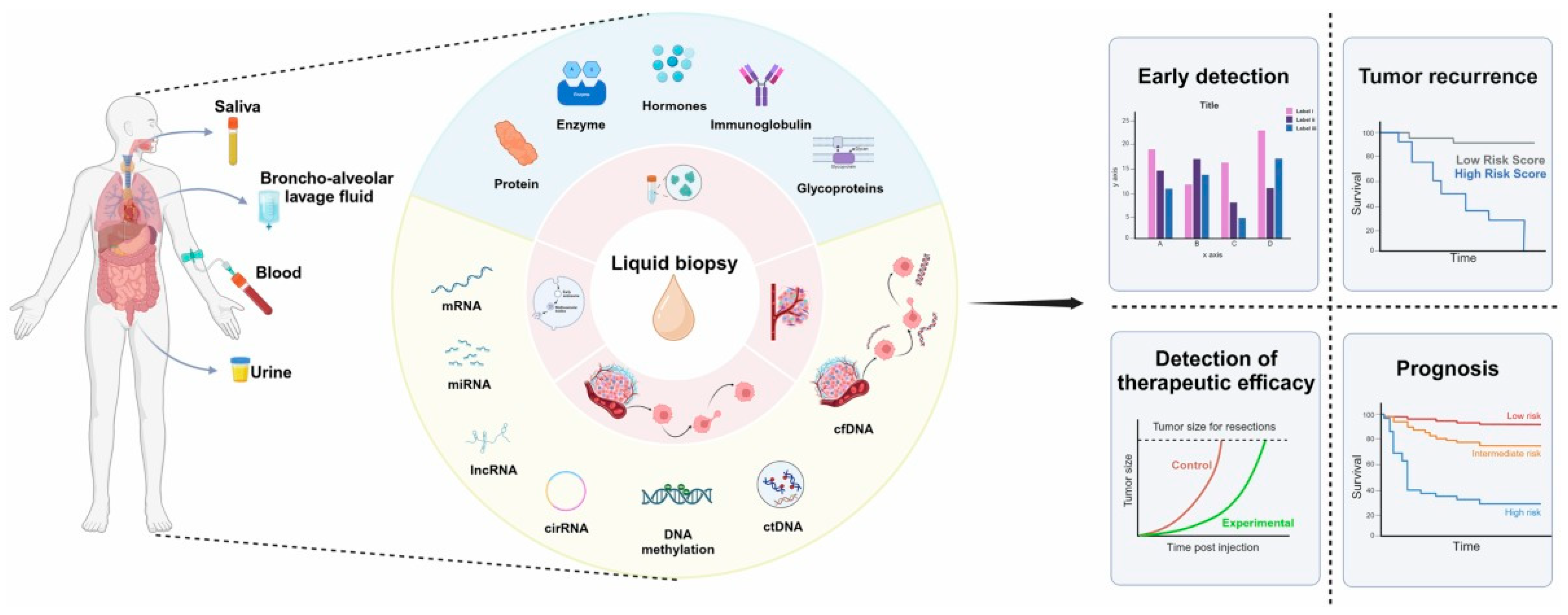
1.2. Liquid Biopsy and Biomarkers in Head and Neck Cancer: An Overview
- Circulating tumor DNA (ctDNA): it consists of short fragments of tumor-derived DNA released into the bloodstream as cancer cells die or actively secrete genetic material. These fragments reflect the molecular characteristics of the tumor and can be analyzed using advanced sequencing technologies from a simple blood sample. ctDNA testing enables real-time assessment of tumor dynamics, detection of MRD and identification of emerging resistance mutations. While tissue biopsy remains essential for definitive diagnosis, ctDNA complements it by offering a non-invasive means of monitoring disease progression and guiding personalized therapy [15,16]
- Circulating tumor cells (CTCs): CTCs are malignant cells shed from the primary tumor or metastatic sites into the bloodstream, representing key intermediates in the metastatic process. Although most CTCs are rapidly destroyed, a small subset can survive and form distant metastases. Their detection in peripheral blood provides valuable prognostic and predictive information, as CTC counts correlate with disease progression, therapeutic response, and overall survival. Molecular characterization of CTCs allows exploration of tumor heterogeneity and resistance mechanisms. Despite technical challenges due to their rarity and biological variability, recent advances in enrichment and single-cell analysis technologies are improving their clinical utility [17,18,19].
- Cell-free RNA (cfRNA): cfRNA refers to extracellular RNA molecules found in various biological fluids, including plasma, serum, urine, cerebrospinal fluid, saliva, and pleural fluid [20]. Unlike intracellular RNA, cfRNA is released through active secretion or cell death processes such as apoptosis and necrosis [21]. As a non-invasive biomarker, cfRNA holds significant potential for liquid biopsy applications, supporting early diagnosis, disease monitoring, and prognosis in cancer and other pathological conditions [22,23,24,25].
- MicroRNAs (miRNAs): miRNAs are small, non-coding RNA molecules (19–25 nucleotides) that regulate gene expression at the post-transcriptional level. They are transcribed as primary miRNAs (pri-miRNAs), processed into precursor forms (pre-miRNAs), and finally matured to guide the RNA-induced silencing complex (RISC), which modulates target mRNA stability and translation. Dysregulated miRNA expression is frequently associated with cancer development and progression. Measuring circulating miRNA levels through liquid biopsy enables their use as sensitive and specific biomarkers for cancer diagnosis, prognosis, and treatment monitoring [26,27,28,29].
- Extracellular vesicles (EVs):EVs are nano-sized, membrane-bound particles secreted by cells under both physiological and pathological conditions. Present in all biological fluids, they contain DNA, RNA, proteins and lipids, reflecting the status of their cell of origin. Tumor-derived EVs play important roles in cancer progression by promoting metastasis, immune evasion, and chemoresistance. Moreover, EVs can be engineered as natural delivery systems for therapeutic molecules, offering promising applications in targeted cancer treatment [30,31,32,33].
- Viral nucleic acids: Detection of viral DNA or RNA in liquid biopsy samples—such as blood, urine or saliva—can indicate virus-associated malignancies. In particular, the identification of circulating HPV DNA (ctHPV) is highly relevant for HPV-related head and neck cancers. Measuring ctHPV levels allows for non-invasive monitoring of treatment response, detection of recurrence, and stratification of patients for therapy. With the application of next-generation sequencing (NGS), it is now possible to identify multiple HPV types and quantify viral load with high precision. Moreover, analyzing viral nucleic acids within extracellular vesicles may enhance detection sensitivity and stability [34,35,36,37].
| Application | Preferred Approach |
| MRD tracking | ddPCR |
| Broad biomarker discovery and resistance mechanisms | Hybrid-capture NGS |
| Targeted mutation verification | Amplicon-based NGS or ddPCR |
2. Clinical Applications of Biomarkers in Head and Neck Cancer
2.1. Early Detection of Head and Neck Cancers Using Circulating Biomarkers
2.1.1. Choosing the Right Fluids for ctDNA Detection
2.1.2. Use of ctDNA in HPV-Positive Disease (Table 2)

| First Author, Year | Setting | Biomarker and Assay Type | N. Patients | Main Findings | Clinical Implications |
|---|---|---|---|---|---|
| Mijares K., 2024 [47] | Clinical surveillance and diagnostic evaluation of HPV + HNSCC | Circulating tumor HPV DNA (ctHPVDNA) using ddPCR | 167 total (141 HPV+) | Detectable ctHPVDNA in 94.3% of HPV+ tumors; sensitivity 91.7%, specificity 100%, PPV 100%, NPV 63.6%. Rare non-HPV16 genotypes explain most false negatives. | Strong diagnostic and surveillance performance; highly reliable for confirming HPV+ disease; negative result requires caution due to limited NPV, especially for non-HPV16 tumors |
| Rettig EM, 2022 [51] | Case–control study using archived plasma from biobank | ctHPV16DNA detection via digital droplet PCR (TTMV assay) | 12 cases + 100 controls | ctHPV16DNA detectable in 30% of HPV16 + HNSCC patients (43% in HPV16+ OPSCC) up to 19–43 months before diagnosis; not detected in controls | Supports ctHPV16DNA as a potential biomarker for preclinical detection of HPV-positive HNSCC |
| Sastre-Garau X., 2021 [50] | Prospective, multicenter (France & Senegal) | ctHPV DNA via NGS-based CaptHPV assay (broad genotype capture) | 135 total (80 HPV-positive tumors; multiple primary sites including 25 OPSCC) | Sensitivity 95% and specificity 98.1% for detecting HPV-positive carcinomas from plasma; 15 different HPV genotypes detected | Blood-based diagnostic capable of detecting any HPV genotype, enabling personalized tumor markers and expanding ctDNA testing to non-HPV16 cancers |
| Siravegna G., 2021 [48] | Prospective observational study comparing noninvasive vs. standard diagnostic workup for HPV + HNSCC | Plasma ctHPVDNA measured with custom ddPCR targeting HPV genotypes 16/18/33/35/45 | 140 (70 cases, 70 controls) | ctHPVDNA alone: sensitivity 98.4%, specificity 98.6%; Combined ctHPVDNA + imaging: higher diagnostic accuracy vs. standard care, 36–38% lower cost, diagnosis 26 days faster | ctHPVDNA-based noninvasive diagnosis improves accuracy, reduces costs and accelerates diagnosis, serving as a promising alternative to tissue biopsy-based diagnostic pathways |
| Damerla RR, 2019 [43] | Prospective plasma-based diagnostic cohort in early-stage HPV-associated cancers | Plasma HPV16/33 ctDNA by droplet digital PCR (ddPCR) | 105 (97 OPSCC, 8 anal SCC) + 27 controls | Overall sensitivity 95.6% and specificity 100%. Detectable ctDNA in all low-volume HPV + OPSCC cases | ddPCR ctHPV-DNA is highly accurate for early detection and treatment monitoring in HPV-associated cancers; supports potential use in screening |
| Wang Y., 2015 [40] | Prospective sample collection (plasma + saliva) in HNSCC | Tumor-specific DNA detection (somatic mutations & HPV DNA), qPCR/sequencing-based assays | 93 | Detectable tumor DNA in 96% of patients when combining saliva + plasma; early-stage detection 100%; saliva highly sensitive for oral cavity tumors, plasma for non-oral cavity sites; postsurgical detection of recurrence before clinical diagnosis in 3 cases | Combined saliva + plasma sampling enhances detection across sites and may enable early recurrence detection and screening in HNSCC |
2.1.3. EBV-Associated ctDNA (Table 3)
| First Author, Year | Setting | Biomarker and Assay Type | N. Patients | Main Findings | Clinical Implications |
|---|---|---|---|---|---|
| Chen WJ, 2021 [54] | EBV-seropositive population in NPC high-risk region | Plasma EBV DNA (real-time qPCR) | 1363 followed, 30 NPC cases | Higher plasma EBV DNA strongly predicted NPC development; HR up to 39.79 for ≥1000 copies/mL; predictive value dropped when excluding cases within 3–4 years | EBV DNA improves NPC early detection, enhances serology-based screening; best predictive value within 3-year window, useful for surveillance of high-risk individuals |
| Wei ZG, 2021 [62] | Single-center cohort (NPC patients) | Plasma EBV DNA, quantitative assay | 480 NPC patients | Patients with consistently negative EBV DNA had earlier T and N stage; significantly better 3-year DFS (95.0% vs. 84.4%), DMFS (98.3% vs. 89.4%), and OS (100% vs. 97.6%) compared with EBV-positive patients | Consistently negative EBV DNA identifies NPC patients with earlier clinical stage and superior survival outcomes; may help in prognostication and risk stratification |
| Tay JK, 2020 [60] | Prospective cohort of individuals with first-degree family history of NPC | EBV-EA IgA & VCA IgA serology + serum cf-EBV DNA | 524 high-risk individuals (5 NPC cases) | Screening detected NPC in 0.96% (199/100,000 person-years), 80% T1 stage at diagnosis; EBV-EA IgA showed 94.6% specificity & 15.2% PPV, outperforming VCA IgA and cf-EBV DNA; rising EA IgA titers preceded diagnosis | Screening in familial-risk groups can detect early, asymptomatic NPC; EBV-EA IgA adds diagnostic value for biopsy triage and surveillance |
| Chan KCA, 2017 [53] | Prospective population-based screening | Plasma EBV DNA, real-time PCR | 20,174 asymptomatic participants | EBV DNA detectable in 5.5% of participants; 34 NPC cases detected among 309 persistently positive individuals; sensitivity 97.1%, specificity 98.6%; 71% of detected NPC were stage I/II vs. 20% in historical cohort; superior 3-year progression-free survival (97% vs. 70%) | Plasma EBV DNA is effective for early detection of asymptomatic NPC, enabling diagnosis at earlier stages and improving patient outcomes |
| Ji MF, 2014 [56] | Population-based NPC screening | Plasma EBV DNA, real-time PCR; previously identified high-risk participants via VCA/IgA and EBNA1/IgA | 825 high-risk participants | Using 0 copies/mL as cutoff: sensitivity 86.8% for NPC detected within 1 year; PPV 30%, NPV 99.3%; lower sensitivity for early stage NPC (81.5%) vs. advanced NPC (100%); for NPC detected after 1 year, baseline positivity 50% | Plasma EBV DNA improves diagnostic accuracy in high-risk individuals, but limited value for early-stage NPC detection and prediction of NPC development |
2.1.4. Genomic Alterations Detected by ctDNA in HNSCC
2.1.5. Limitation of ctDNA Adoption in Early Diagnosis
2.2. Risk Assessment and Prognostic Insights from Liquid Biopsy Biomarkers (Table 4)
2.2.1. Risk Stratification in HPV-Positive Cohort
| First Author, Year | Setting | Biomarker and Assay Type | N. Patients | Main Findings | Clinical Implications |
|---|---|---|---|---|---|
| Rodriguez-Ces AM, 2025 [81] | Multicentre, prospective study in patients with HNSCC across all stages | ccfDNA quantified by fluorometry (Qubit) and qPCR | 85 HNSCC patients, 28 healthy controls | Baseline plasma ccfDNA significantly higher in HNSCC vs. controls (AUC = 0.705); elevated levels even in early-stage disease; lower post-treatment ccfDNA associated with longer PFS (16.37 vs. 9.63 months, p < 0.05); high inter-patient variability in ccfDNA kinetics | Fluorometric ccfDNA quantification shows promise as a minimally invasive biomarker for prognosis in HNSCC, warranting validation in larger studies |
| Cooke PV, 2025 [86] | Single tertiary-center cohort study of patients with HPV-positive OPSCC | (TTMV) HPV DNA quantified by fragment count (fragments/mL) | 203 HPV+ OPSCC patients | Higher pretreatment TTMV-HPV DNA levels associated with advanced clinical T and N stage (aOR for cT3/4 = 2.51; aOR for cN1 = 4.26; cN2/3 = 3.64) and greater total tumor plus nodal volume on PET-CT (aOR = 1.04); no significant association with histopathologic risk factors or survival outcomes | Pretreatment TTMV-HPV DNA load reflects overall tumor and nodal burden, supporting its potential use as a noninvasive indicator of disease extent and a tool for refining treatment intensity in HPV+ OPSCC |
| Agarwal A., 2024 [87] | Cohort study in patients with HPV-driven OPSCC undergoing posttreatment surveillance | ctHPV-DNA quantified from plasma | 34 HPV-positive OPSCC patients with ≥3 sequential imaging and ctDNA assessments | Strong positive correlation between ctHPV-DNA levels and imaging findings in recurrent cases; ctHPV-DNA test showed 100% negative predictive value for ruling out recurrence | ctHPV-DNA assay provides a highly sensitive and specific, noninvasive tool for posttreatment surveillance in HPV-driven OPSCC, enabling earlier detection of recurrence and supporting integration into routine multidisciplinary management |
| Mazurek AM, 2024 [85] | Prospective cohort study of patients with HPV16-positive OPSCC treated with CRT | ctHPV16 quantified by qPCR | 91 ctHPV16-positive OPSCC patients | Higher pre-treatment ctHPV16 viral load significantly associated with increased risk of distant metastasis (VL 4.09 vs. 3.25; p = 0.009); HR for MFS = 2.22 (p = 0.015); optimal cutoff VL = 3.556; 5-year LRFS, MFS, and OS were 88%, 90%, and 81%, respectively | Elevated baseline ctHPV16 viral load identifies patients at higher risk of metastatic progression and poorer outcomes; supports use of ctHPV16 VL for pre-treatment risk stratification in HPV-driven OPSCC |
| Lin LH, 2023 [82] | Comprehensive genomic profiling study in OSCC | cfDNA analyzed by WES with multiple variant calling pipelines and IGV validation | 50 paired plasma and whole blood samples | Plasma cfDNA mutation burden significantly correlated with clinical stage and distant metastasis; recurrently mutated genes included TTN, PLEC, SYNE1, USH2A, and known drivers (KMT2D, LRP1B, TRRAP, FLNA) | cfDNA WES reveals key genomic alterations associated with OSCC progression and metastasis, supporting its use for prognostic stratification and identification of actionable therapeutic targets |
| Silvoniemi A., 2023 [84] | Prospective study correlating ctDNA with FDG-PET/CT metabolic parameters in HNSCC | ctDNA analyzed by NGS; VAF correlated with FDG-PET/CT metrics | 26 HNSCC patients | Maximum VAF in ctDNA correlated positively with metabolic tumor volume (r = 0.510, p = 0.008) and total lesion glycolysis (r = 0.584, p = 0.002); ctDNA positivity associated with high WB-TLG; concordant ctDNA/tissue variants also linked to metabolic burden | ctDNA levels and metabolic imaging provide complementary prognostic information; integrating genomic and metabolic markers may enhance pre-treatment risk stratification and therapeutic planning in HNSCC |
| Schirmer AM, 2018 [83] | Single-center, non interventional observational study in HNSCC patients | Cell-free tumor DNA CNAs assessed by low-coverage NGS; genome-wide CNI score derived | 116 HNSCC patients (103 presurgery samples) and 142 tumor-free controls | High CNI values strongly associated with lymph node involvement and poorer overall survival (HR 4.89, p = 0.01); AUC for tumor detection 87.2%; CNI outperformed conventional staging features as prognostic predictor | CNI score represents a robust, minimally invasive biomarker for predicting lymph node involvement and survival in HNSCC, supporting its potential integration into pre-treatment risk stratification and treatment planning |
2.2.2. Prognostic Significance of Specific Genetic Alterations Detected in ctDNA
2.2.3. Prognostic Insights in HPV- and EBV-Related Head and Neck Cancers
2.3. Monitoring Tumor Dynamics and Therapeutic Response Through Circulating Biomarkers
2.3.1. MRD and ctDNA in HNSCC (Table 6)
| First Author, Year | Setting | Biomarker and Assay Type | N. Patients | Main Findings | Clinical Implications |
|---|---|---|---|---|---|
| Honorè N., 2025 [114] | Post-treatment monitoring of LA HNSCC | Personalized, tumor-informed 16-plex PCR-NGS ctDNA assay | 43 (50 enrolled) | Post-treatment ctDNA positivity (9.5%) predicted significantly worse RFS and OS | Post-treatment ctDNA positivity identifies patients at high risk of recurrence |
| Marret G., 2025 [117] | Post-surgical and longitudinal surveillance in non-metastatic resectable HNSCC | Targeted NGS ctDNA sequencing on serial plasma samples (tumor and blood compared) | 41 | ctDNA detected in 51% at surgery and 68% at recurrence; MRD positivity within 14 weeks correlated with recurrence (HR = 3.0, p = 0.03); median lead-time to clinical relapse = 9.9 months. | ctDNA enables detection of MRD and ITH, offering a predictive tool for relapse and insights into tumor evolution beyond tissue sequencing. |
| Ferrier ST, 2023 [119] | Post-treatment monitoring of HPV-positive HNC | ddPCR detection of HPV16/18/31/33/35/45 ctDNA in blood and saliva | 60 HPV+ (17 HPV-controls) | ctDNA detection significantly higher pre-treatment (91%) vs. post-treatment (8%); strong blood–saliva concordance (93%). Persistent ctDNA associated with residual disease and recurrence. | Combined blood and saliva ctDNA testing is a non-invasive, sensitive biomarker for treatment response and early recurrence detection in HPV+ HNC |
| Honorè N., 2023 [115] | Post-treatment MRD detection in LA SCCHN | Tumor-agnostic 26-gene NGS plasma ctDNA assay (includes 2 HPV-16 genes) | 53 | MRD detected in 41% of patients after treatment. 2-year PFS: 23.5% (MRD+) vs. 86.6% (MRD–); median survival: 28.4 months (MRD+) vs. not reached (MRD–). | Tumor-agnostic ctDNA assay predicts progression and survival without tumor sequencing, enabling broad clinical implementation for MRD monitoring in LA SCCHN |
| Flach S., 2022 [116] | Post-surgical surveillance in p16-negative HNSCC | Personalized RaDaR™ deep-sequencing ctDNA assay (tumour-specific variants from WES) | 17 | ctDNA detected in 100% of baseline samples and at very low VAF (0.0006%) post-surgery; ctDNA positivity preceded all clinical recurrences by 108–253 days | Personalized ctDNA assays are feasible and highly sensitive for MRD detection and early relapse prediction in surgically treated p16– HNSCC. |
| Jonas H., 2022 [118] | Post-treatment and immunotherapy monitoring in localized HNSCC (IMSTAR-HN trial) | Tumor-specific digital droplet PCR (ddPCR) liquid biopsy based on NGS-identified mutations | 19 | Personalized ddPCR assays feasible in 17/18 patients; persistent or emerging ctDNA in ≥2 consecutive samples predicted relapse in most cases. Lead time to clinical recurrence up to 18 weeks. Patients achieving full ctDNA clearance had no relapse. | ddPCR-based ctDNA monitoring is a feasible and sensitive approach for identifying minimal residual disease and relapse risk in localized HNSCC |
| Routman DM, 2022 [120] | Postoperative monitoring in HPV-positive OPSCC | Multianalyte PCR assay detecting ctHPVDNA | 159 postop samples (32 paired pre/post) | Detectable postop ctHPVDNA strongly associated with worse RFS (p < 0.001) and correlated with adverse features (LVI, ENE) | Detectable postoperative ctHPVDNA before adjuvant therapy is a potential biomarker of residual disease and predictor of recurrence risk in HPV+ OPSCC. |
| O’Boyle CJ, 2022 [121] | Post-surgical kinetics of HPV ctDNA in HPV-positive OPSCC | Custom ddPCR assay for HPV16/18/33/35/45 ctHPVDNA | 33 | ctHPVDNA levels cleared to <1 copy/mL by POD 1 in patients without residual disease; remained high (>350 copies/mL) in macroscopic residual disease; intermediate levels (1.2–58.4 copies/mL) corresponded to microscopic residual disease. | Postoperative day 1 ctHPVDNA levels reflect residual disease burden and may guide adjuvant therapy decisions in HPV+ OPSCC. |
| Leung E., 2021 [58] | Retrospective analysis of prospective cohorts (cervical cancer + OPSCC) | HPV ctDNA analyzed by next-generation sequencing (HPV-seq) vs. dPCR | Multicenter cohorts (sample size not fully stated for OPSCC alone) | HPV-seq detects ctDNA at much lower levels than dPCR (<0.03 copies/mL); excellent correlation with dPCR (R2 = 0.95); 100% sensitivity for detecting recurrence post-treatment (specificity 67%); reliable genotyping in 100% of baseline samples; distinct fragmentomic signatures of ctDNA | Superior performance for low tumor burden and minimal residual disease (MRD) detection → strong potential for early relapse prediction and improved treatment response monitoring |
2.3.2. HPV-Positive OPSCC (Table 7)
| First Author, Year | Setting | Biomarker and Assay Type | N. Patients | Main Findings | Clinical Implications |
|---|---|---|---|---|---|
| Oldaeus Almeren A., 2025 [125] | Multicenter, prospective cohort of HPV+ OPSCC/HNCUP undergoing definitive (chemo)radiotherapy | HPV genotype-specific ddPCR ctHPV-DNA in plasma | 51 | Baseline ctDNA correlated with total tumour and nodal volume. Undetectable ctHPV-DNA at follow-up corresponded to favorable radiologic response. | ctHPV-DNA is a promising biomarker for treatment evaluation, correlates with tumor burden and could complement radiologic assessment in HPV+ OPSCC/HNCUP. |
| Roof SA, 2024 [126] | Retrospective multicenter cohort, HPV-associated OPSCC, post-treatment surveillance | Plasma TTMV-HPV DNA assay | 543 | 210/543 patients had clinically indeterminate findings (CIFs). TTMV-HPV DNA testing accurately resolved 97.5% (77/79) of indeterminate cases; minimal discordance with clinical outcomes (0.6%). | TTMV-HPV DNA is a highly accurate tool for resolving indeterminate findings during HPV+ OPSCC surveillance, improving clinical decision-making and potentially reducing overtreatment. |
| Ferrandino RM, 2023 [44] | Retrospective observational cohort, HPV-associated OPSCC | Plasma TTMV-HPV DNA | 399 (163 diagnostic, 290 surveillance) | Diagnostic sensitivity 91.5%, specificity 100%; surveillance sensitivity 88.4%, specificity 100%; median lead time to pathologic confirmation = 47 days. | TTMV-HPV DNA is a highly specific and sensitive biomarker for both diagnosis and surveillance of HPV-associated OPSCC. |
| Jakobsen KK, 2023 [46] | Prospective cohort, HPV+/p16+ OPSCC, serial follow-up | Droplet digital PCR (ddPCR) targeting 8 HPV genotypes in plasma cfHPV-DNA | 72 (54 with serial follow-up) | Baseline cfHPV-DNA sensitivity 97.2%, copy number correlated with tumor stage, 100% genotype concordance with tumor. cfHPV-DNA detected 97–166 days before recurrence. Patients with undetectable cfHPV-DNA did not recur. | Serial plasma cfHPV-DNA measurement is a highly sensitive, clinically applicable surveillance tool for early detection of recurrence in HPV+/p16+ OPSCC. |
| Cao Y.,2022 [127] | Randomized trial, AJCC8 stage III p16+ OPSCC, during chemoradiation | Serial plasma HPV ctDNA, correlated with MRI (DCE, DWI) and FDG-PET imaging biomarkers | 34 | Low pretreatment ctDNA and early increase at week 2 associated with superior FFP. ctDNA at weeks 4–7 not predictive. ctDNA correlated with tumor subvolumes on MRI and PET | Early ctDNA kinetics during chemoradiation can serve as a predictive biomarker of therapy response, potentially complementing imaging in stage III p16+ OPSCC. |
| Akashi K, 2021 [124] | p16-positive HPV-associated oropharyngeal cancer, multiple timepoints during treatment | Digital PCR targeting HPV-derived ctDNA in plasma | 25 | HPV ctDNA detected in 14/25 patients (56%); all became ctDNA-negative after initial treatment. ctDNA detected at time of recurrence in 2 patients. | HPV-derived ctDNA is a minimally invasive biomarker for monitoring treatment response and predicting recurrence in p16-positive OPSCC. |
| Chera BS,2020 [128] | Multi-institutional prospective biomarker trial, p16+ HPV-associated OPSCC, definitive chemoradiotherapy | Serial plasma HPV ctDNA (types 16/18/31/33/35) measured by optimized multianalyte ddPCR | 103 | Defined a favorable clearance profile (>200 copies/mL baseline and >95% clearance by day 28) associated with 0% recurrence; unfavorable profile + adverse clinical factors had 35% recurrence. | Rapid ctHPVDNA clearance predicts disease control after CRT; may guide de-intensified therapy selection in HPV+ OPSCC. |
| Reder H., 2020 [100] | Observational study, OPSCC patients | Plasma cfHPV-DNA targeting E6/E7 oncogenes, quantified by real-time qPCR | 50 | cfHPV-DNA correlated with tumor size. Post-treatment decline in patients without recurrence; persistent/increased cfHPV-DNA associated with residual disease or relapse. | Plasma cfHPV-DNA can monitor therapy response and detect minimal residual disease |
2.3.3. Non-Oropharyngeal HNSCC
2.3.4. Induction Therapy and Recurrent/Metastatic (R/M) Settings
2.4. Guiding Precision Medicine Using Circulating Biomarkers in Head and Neck Cancer
3. Current Challenges and Future Directions
Limitations
4. Conclusions
Author Contributions
Funding
Data Availability Statement
Conflicts of Interest
References
- Kamangar, F.; Dores, G.M.; Anderson, W.F. Patterns of Cancer Incidence, Mortality, and Prevalence Across Five Continents: Defining Priorities to Reduce Cancer Disparities in Different Geographic Regions of the World. J. Clin. Oncol. 2006, 24, 2137–2150. [Google Scholar] [CrossRef]
- Abogunrin, S.; Di Tanna, G.L.; Keeping, S.; Carroll, S.; Iheanacho, I. Prevalence of human papillomavirus in head and neck cancers in European populations: A meta-analysis. BMC Cancer 2014, 14, 968. [Google Scholar] [CrossRef]
- Strojan, P.; Ferlito, A.; Medina, J.E.; Woolgar, J.A.; Rinaldo, A.; Robbins, K.T.; Fagan, J.J.; Mendenhall, W.M.; Paleri, V.; Silver, C.E.; et al. Contemporary management of lymph node metastases from an unknown primary to the neck: I. A review of diagnostic approaches. Head Neck 2013, 35, 123–132. [Google Scholar] [CrossRef]
- Waltonen, J.D.; Ozer, E.; Hall, N.C.; Schuller, D.E.; Agrawal, A. Metastatic Carcinoma of the Neck of Unknown Primary Origin: Evolution and Efficacy of the Modern Workup. Arch. Otolaryngol. Neck Surg. 2009, 135, 1024–1029. [Google Scholar] [CrossRef]
- Hoffman, H.T.; Karnell, L.H.; Funk, G.F.; Robinson, R.A.; Menck, H.R. The National Cancer Data Base Report on Cancer of the Head and Neck. Arch. Otolaryngol. Neck Surg. 1998, 124, 951–962. [Google Scholar] [CrossRef]
- Connal, S.; Cameron, J.M.; Sala, A.; Brennan, P.M.; Palmer, D.S.; Palmer, J.D.; Perlow, H.; Baker, M.J. Liquid biopsies: The future of cancer early detection. J. Transl. Med. 2023, 21, 118. [Google Scholar] [CrossRef]
- De Rubis, G.; Krishnan, S.R.; Bebawy, M. Liquid Biopsies in Cancer Diagnosis, Monitoring, and Prognosis. Trends Pharmacol. Sci. 2019, 40, 172–186. [Google Scholar] [CrossRef]
- Arneth, B. Update on the types and usage of liquid biopsies in the clinical setting: A systematic review. BMC Cancer 2018, 18, 527. [Google Scholar] [CrossRef]
- Alix-Panabières, C. The future of liquid biopsy. Nature 2020, 579, S9. [Google Scholar] [CrossRef]
- Adashek, J.J.; Janku, F.; Kurzrock, R. Signed in Blood: Circulating Tumor DNA in Cancer Diagnosis, Treatment and Screening. Cancers 2021, 13, 3600. [Google Scholar] [CrossRef]
- Lone, S.N.; Nisar, S.; Masoodi, T.; Singh, M.; Rizwan, A.; Hashem, S.; El-Rifai, W.; Bedognetti, D.; Batra, S.K.; Haris, M.; et al. Liquid biopsy: A step closer to transform diagnosis, prognosis and future of cancer treatments. Mol. Cancer 2022, 21, 79. [Google Scholar] [CrossRef] [PubMed]
- Martins, I.; Ribeiro, I.P.; Jorge, J.; Gonçalves, A.C.; Sarmento-Ribeiro, A.B.; Melo, J.B.; Carreira, I.M. Liquid Biopsies: Applications for Cancer Diagnosis and Monitoring. Genes 2021, 12, 349. [Google Scholar] [CrossRef]
- Klein, E.; Richards, D.; Cohn, A.; Tummala, M.; Lapham, R.; Cosgrove, D.; Chung, G.; Clement, J.; Gao, J.; Hunkapiller, N.; et al. Clinical validation of a targeted methylation-based multi-cancer early detection test using an independent validation set. Ann. Oncol. 2021, 32, 1167–1177. [Google Scholar] [CrossRef]
- Cohen, J.D.; Li, L.; Wang, Y.; Thoburn, C.; Afsari, B.; Danilova, L.; Douville, C.; Javed, A.A.; Wong, F.; Mattox, A.; et al. Detection and localization of surgically resectable cancers with a multi-analyte blood test. Science 2018, 359, 926–930. [Google Scholar] [CrossRef]
- Donaldson, J.; Park, B.H. Circulating Tumor DNA: Measurement and Clinical Utility. Annu. Rev. Med. 2018, 69, 223–234. [Google Scholar] [CrossRef]
- Cheng, F.; Su, L.; Qian, C. Circulating tumor DNA: A promising biomarker in the liquid biopsy of cancer. Oncotarget 2016, 7, 48832–48841. [Google Scholar] [CrossRef]
- Dai, C.S.; Mishra, A.; Edd, J.; Toner, M.; Maheswaran, S.; Haber, D.A. Circulating tumor cells: Blood-based detection, molecular biology, and clinical applications. Cancer Cell 2025, 43, 1399–1422. [Google Scholar] [CrossRef]
- Yang, C.; Xia, B.-R.; Jin, W.-L.; Lou, G. Circulating tumor cells in precision oncology: Clinical applications in liquid biopsy and 3D organoid model. Cancer Cell Int. 2019, 19, 341. [Google Scholar] [CrossRef]
- Ju, S.; Chen, C.; Zhang, J.; Xu, L.; Zhang, X.; Li, Z.; Chen, Y.; Zhou, J.; Ji, F.; Wang, L. Detection of circulating tumor cells: Opportunities and challenges. Biomark. Res. 2022, 10, 58. [Google Scholar] [CrossRef]
- Pegler, S.S.; Ferguson, D.J. Rapid heat discharge during deep-sea eruptions generates megaplumes and disperses tephra. Nat. Commun. 2021, 12, 2292. [Google Scholar] [CrossRef]
- Heitzer, E.; Haque, I.S.; Roberts, C.E.S.; Speicher, M.R. Current and future perspectives of liquid biopsies in genomics-driven oncology. Nat. Rev. Genet. 2019, 20, 71–88. [Google Scholar] [CrossRef] [PubMed]
- Zhong, P.; Bai, L.; Hong, M.; Ouyang, J.; Wang, R.; Zhang, X.; Chen, P. A Comprehensive Review on Circulating cfRNA in Plasma: Implications for Disease Diagnosis and Beyond. Diagnostics 2024, 14, 1045. [Google Scholar] [CrossRef] [PubMed]
- Liu, Y.; Liang, Y.; Li, Q.; Li, Q. Comprehensive analysis of circulating cell-free RNAs in blood for diagnosing non-small cell lung cancer. Comput. Struct. Biotechnol. J. 2023, 21, 4238–4251. [Google Scholar] [CrossRef] [PubMed]
- Raez, L.E.; Danenberg, K.; Sumarriva, D.; Usher, J.; Sands, J.; Castrellon, A.; Ferraro, P.; Milillo, A.; Huang, E.; Soon-Shiong, P.; et al. Using cfRNA as a tool to evaluate clinical treatment outcomes in patients with metastatic lung cancers and other tumors. Cancer Drug Resist. 2021, 4, 1060–1070. [Google Scholar] [CrossRef]
- Ning, C.; Cai, P.; Liu, X.; Li, G.; Bao, P.; Yan, L.; Ning, M.; Tang, K.; Luo, Y.; Guo, H.; et al. A comprehensive evaluation of full-spectrum cell-free RNAs highlights cell-free RNA fragments for early-stage hepatocellular carcinoma detection. EBioMedicine 2023, 93, 104645. [Google Scholar] [CrossRef]
- Naranbat, D.; Herdes, E.; Tapinos, N.; Tripathi, A. Review of microRNA detection workflows from liquid biopsy for disease diagnostics. Expert Rev. Mol. Med. 2025, 27, e11. [Google Scholar] [CrossRef]
- Cicatiello, A.G.; Musone, M.; Imperatore, S.; Giulioni, C.; La Rocca, R.; Cafarelli, A.; Del Giudice, F.; Dentice, M.; Crocetto, F. Circulating miRNAs in genitourinary cancer: Pioneering advances in early detection and diagnosis. J. Liq. Biopsy 2025, 8, 100296. [Google Scholar] [CrossRef]
- Di Martino, M.T.; Tagliaferri, P.; Tassone, P. MicroRNA in cancer therapy: Breakthroughs and challenges in early clinical applications. J. Exp. Clin. Cancer Res. 2025, 44, 126. [Google Scholar] [CrossRef]
- Cui, M.; Wang, H.; Yao, X.; Zhang, D.; Xie, Y.; Cui, R.; Zhang, X. Circulating MicroRNAs in Cancer: Potential and Challenge. Front. Genet. 2019, 10, 626. [Google Scholar] [CrossRef]
- Kumar, M.A.; Baba, S.K.; Sadida, H.Q.; Marzooqi, S.A.; Jerobin, J.; Altemani, F.H.; Algehainy, N.; Alanazi, M.A.; Abou-Samra, A.-B.; Kumar, R.; et al. Extracellular vesicles as tools and targets in therapy for diseases. Signal Transduct. Target. Ther. 2024, 9, 27. [Google Scholar] [CrossRef]
- Seay, T.W.; Suo, Z. Roles of Extracellular Vesicles on the Progression and Metastasis of Hepatocellular Carcinoma. Cells 2023, 12, 1879. [Google Scholar] [CrossRef]
- Semeradtova, A.; Liegertova, M.; Herma, R.; Capkova, M.; Brignole, C.; Del Zotto, G. Extracellular vesicles in cancer’s communication: Messages we can read and how to answer. Mol. Cancer 2025, 24, 86. [Google Scholar] [CrossRef]
- Han, T.; Hao, Q.; Chao, T.; Sun, Q.; Chen, Y.; Gao, B.; Guan, L.; Ren, W.; Zhou, X. Extracellular vesicles in cancer: Golden goose or Trojan horse. J. Mol. Cell Biol. 2024, 16, mjae025. [Google Scholar] [CrossRef] [PubMed]
- Scholte, L.L.; Bethony, J.M.; Xian, R.R. Diagnosis and monitoring of virus-associated cancer using cell-free DNA. Curr. Opin. Virol. 2023, 60, 101331. [Google Scholar] [CrossRef]
- Bhamidipati, D.; Johnson, J.R.; Lin, K.; Pelicano, H.; Eng, C.; Huey, R.; Wolff, R.A.; Halperin, D.M.; Frumovitz, M.F.; Wistuba, I.I.; et al. The Clinical Utility of a Next-Generation Sequencing-Based Approach to Detecting Circulating HPV DNA in Patients with Advanced Anal Cancer. Cancers 2025, 17, 308. [Google Scholar] [CrossRef]
- Mazurek, A.M.; Małusecka, E.; Jabłońska, I.; Vydra, N.; Rutkowski, T.W.; Giglok, M.; Suwiński, R. Circulating HPV16 DNA in Blood Plasma as Prognosticator and Early Indicator of Cancer Recurrence in Radio-Chemotherapy for Anal Cancer. Cancers 2023, 15, 867. [Google Scholar] [CrossRef]
- Elasifer, H.; Amukwaya, M.M.N.; Bhatia, R.; Cuschieri, K.; Gregory, J.M. The role of circulating viral and tumour DNA in the diagnosis and management of HPV associated anogenital cancers, a systematic review and meta-analysis. J. Clin. Virol. 2023, 164, 105469. [Google Scholar] [CrossRef]
- Ma, L.; Guo, H.; Zhao, Y.; Liu, Z.; Wang, C.; Bu, J.; Sun, T.; Wei, J. Liquid biopsy in cancer current: Status, challenges and future prospects. Signal Transduct Target Ther. 2024, 9, 336. [Google Scholar] [CrossRef] [PubMed] [PubMed Central]
- Kaczor-Urbanowicz, K.E. Salivary Diagnostics. In Salivary Glands—New Approaches in Diagnostics and Treatment; Güvenç, I.A., Ed.; IntechOpen: London, UK, 2019. [Google Scholar] [CrossRef]
- Wang, Y.; Springer, S.; Mulvey, C.L.; Silliman, N.; Schaefer, J.; Sausen, M.; James, N.; Rettig, E.M.; Guo, T.; Pickering, C.R.; et al. Detection of somatic mutations and HPV in the saliva and plasma of patients with head and neck squamous cell carcinomas. Sci. Transl. Med. 2015, 7, 293ra104. [Google Scholar] [CrossRef] [PubMed]
- Ahn, S.M.; Chan, J.Y.K.; Zhang, Z.; Wang, H.; Khan, Z.; Bishop, J.A.; Westra, W.; Koch, W.M.; Califano, J.A. Saliva and Plasma Quantitative Polymerase Chain Reaction–Based Detection and Surveillance of Human Papillomavirus–Related Head and Neck Cancer. Arch. Otolaryngol. Neck Surg. 2014, 140, 846–854. [Google Scholar] [CrossRef]
- Bu, J.; Lee, T.H.; Poellmann, M.J.; Rawding, P.A.; Jeong, W.; Hong, R.S.; Hyun, S.H.; Eun, H.S.; Hong, S. Tri-modal liquid biopsy: Combinational analysis of circulating tumor cells, exosomes, and cell-free DNA using machine learning algorithm. Clin. Transl. Med. 2021, 11, e499. [Google Scholar] [CrossRef]
- Damerla, R.R.; Lee, N.Y.; You, D.; Soni, R.; Shah, R.; Reyngold, M.; Katabi, N.; Wu, V.; McBride, S.M.; Tsai, C.J.; et al. Detection of Early Human Papillomavirus–Associated Cancers by Liquid Biopsy. JCO Precis. Oncol. 2019, 3, 1–17. [Google Scholar] [CrossRef]
- Ferrandino, R.M.; Chen, S.; Kappauf, C.; Barlow, J.; Gold, B.S.; Berger, M.H.; Westra, W.H.; Teng, M.S.; Khan, M.N.; Posner, M.R.; et al. Performance of Liquid Biopsy for Diagnosis and Surveillance of Human Papillomavirus–Associated Oropharyngeal Cancer. Arch. Otolaryngol. Neck Surg. 2023, 149, 971–977. [Google Scholar] [CrossRef]
- Tewari, S.R.; D’sOuza, G.; Troy, T.; Wright, H.; Struijk, L.; Waterboer, T.; Fakhry, C. Association of Plasma Circulating Tumor HPV DNA With HPV-Related Oropharynx Cancer. Arch. Otolaryngol. Neck Surg. 2022, 148, 488–489. [Google Scholar] [CrossRef]
- Jakobsen, K.K.; Bendtsen, S.K.; Pallisgaard, N.; Friborg, J.; Lelkaitis, G.; Grønhøj, C.; von Buchwald, C. Liquid Biopsies with Circulating Plasma HPV–DNA Measurements—A Clinically Applicable Surveillance Tool for Patients with HPV-Positive Oropharyngeal Cancer. Clin. Cancer Res. 2023, 29, 3914–3923. [Google Scholar] [CrossRef]
- Mijares, K.; Ferrandino, R.; Chai, R.; Roof, S.; Bhardwaj, S.M.; Posner, M.; Westra, W.H. Circulating Tumor HPV DNA in Patients With Head and Neck Carcinoma. Am. J. Surg. Pathol. 2023, 48, 80–87. [Google Scholar] [CrossRef]
- Siravegna, G.; O’Boyle, C.J.; Varmeh, S.; Queenan, N.; Michel, A.; Stein, J.; Thierauf, J.; Sadow, P.M.; Faquin, W.C.; Perry, S.K.; et al. Cell-Free HPV DNA Provides an Accurate and Rapid Diagnosis of HPV-Associated Head and Neck Cancer. Clin. Cancer Res. 2021, 28, 719–727. [Google Scholar] [CrossRef]
- Ferrier, S.T.; Zeitouni, A.; Sadeghi, N.; Tsering, T.; Burnier, J.V. Abstract 3405: Characterizing treatment response in head and neck cancer through viral ctDNA quantification and fragment length. Cancer Res. 2022, 82. [Google Scholar] [CrossRef]
- Sastre-Garau, X.; Diop, M.; Martin, F.; Dolivet, G.; Marchal, F.; Charra-Brunaud, C.; Peiffert, D.; Leufflen, L.; Dembélé, B.; Demange, J.; et al. A NGS-based Blood Test For the Diagnosis of Invasive HPV-associated Carcinomas with Extensive Viral Genomic Characterization. Clin. Cancer Res. 2021, 27, 5307–5316. [Google Scholar] [CrossRef]
- Rettig, E.M.; Faden, D.L.; Sandhu, S.; Wong, K.; Faquin, W.C.; Warinner, C.; Stephens, P.; Kumar, S.; Kuperwasser, C.; Richmon, J.D.; et al. Detection of circulating tumor human papillomavirus DNA before diagnosis of HPV-positive head and neck cancer. Int. J. Cancer 2022, 151, 1081–1085. [Google Scholar] [CrossRef]
- Jeannot, E.; Latouche, A.; Bonneau, C.; Calméjane, M.-A.; Beaufort, C.; Ruigrok-Ritstier, K.; Bataillon, G.; Chérif, L.L.; Dupain, C.; Lecerf, C.; et al. Circulating HPV DNA as a Marker for Early Detection of Relapse in Patients with Cervical Cancer. Clin. Cancer Res. 2021, 27, 5869–5877. [Google Scholar] [CrossRef]
- Chan, K.C.A.; Woo, J.K.S.; King, A.; Zee, B.C.-Y.; Lam, W.K.J.; Chan, S.L.; Chu, S.W.I.; Mak, C.; Tse, I.O.L.; Leung, S.Y.M.; et al. Analysis of Plasma Epstein–Barr Virus DNA to Screen for Nasopharyngeal Cancer. N. Engl. J. Med. 2017, 377, 513–522. [Google Scholar] [CrossRef]
- Chen, W.-J.; Xu, W.-N.; Wang, H.-Y.; Chen, X.-X.; Li, X.-Q.; Xie, S.-H.; Lin, D.-F.; Cao, S.-M. Plasma Epstein-Barr virus DNA and risk of nasopharyngeal carcinoma in a prospective seropositive population. BMC Cancer 2021, 21, 651. [Google Scholar] [CrossRef]
- Lo, Y.M.; Chan, L.Y.; Lo, K.W.; Leung, S.F.; Zhang, J.; Chan, A.T.; Lee, J.C.; Hjelm, N.M.; Johnson, P.J.; Huang, D.P. Quantitative analysis of cell-free Epstein-Barr virus DNA in plasma of patients with nasopharyngeal carcinoma. Cancer Res. 1999, 59, 1188–1191. [Google Scholar]
- Ji, M.; Huang, Q.; Yu, X.; Liu, Z.; Li, X.; Zhang, L.; Wang, P.; Xie, S.; Rao, H.; Fang, F.; et al. Evaluation of plasma Epstein-Barr virus DNA load to distinguish nasopharyngeal carcinoma patients from healthy high-risk populations in Southern China. Cancer 2014, 120, 1353–1360. [Google Scholar] [CrossRef] [PubMed]
- Krishna, S.M.; James, S.; Kattoor, J.; Balaram, P. Serum EBV DNA as a Biomarker in Primary Nasopharyngeal Carcinoma of Indian Origin. Ultrasound Med. Biol. 2004, 34, 307–311. [Google Scholar] [CrossRef]
- Leung, S.-F.; Tam, J.S.; Chan, A.T.; Zee, B.; Chan, L.Y.; Huang, D.P.; Van Hasselt, A.; Johnson, P.J.; Lo, Y.D. Improved Accuracy of Detection of Nasopharyngeal Carcinoma by Combined Application of Circulating Epstein–Barr Virus DNA and Anti-Epstein–Barr Viral Capsid Antigen IgA Antibody. Clin. Chem. 2004, 50, 339–345. [Google Scholar] [CrossRef]
- Shao, J.; Li, Y.; Gao, H.; Wu, Q.; Cui, N.; Zhang, L.; Cheng, G.; Hu, L.; Ernberg, I.; Zeng, Y. Comparison of plasma Epstein–Barr virus (EBV) DNA levels and serum EBV immunoglobulin A/virus capsid antigen antibody titers in patients with nasopharyngeal carcinoma. Cancer 2004, 100, 1162–1170. [Google Scholar] [CrossRef]
- Tay, J.K.; Siow, C.H.; Goh, H.L.; Lim, C.M.; Hsu, P.P.; Chan, S.H.; Loh, K.S. A comparison of EBV serology and serum cell-free DNA as screening tools for nasopharyngeal cancer: Results of the Singapore NPC screening cohort. Int. J. Cancer 2019, 146, 2923–2931. [Google Scholar] [CrossRef]
- Miller, J.A.; Le, Q.-T.; Pinsky, B.A.; Wang, H. Cost-Effectiveness of Nasopharyngeal Carcinoma Screening With Epstein-Barr Virus Polymerase Chain Reaction or Serology in High-Incidence Populations Worldwide. J. Natl. Cancer Inst. 2020, 113, 852–862. [Google Scholar] [CrossRef] [PubMed]
- Wei, Z.; Hu, X.; He, Y.; Guan, H.; Wang, J.; He, L.; Mu, X.; Liu, Z.; Li, R.; Peng, X. Clinical and survival analysis of nasopharyngeal carcinoma with consistently negative Epstein–Barr virus DNA. Head Neck 2021, 43, 1465–1475. [Google Scholar] [CrossRef]
- Mishra, V.; Singh, A.; Chen, X.; Rosenberg, A.J.; Pearson, A.T.; Zhavoronkov, A.; Savage, P.A.; Lingen, M.W.; Agrawal, N.; Izumchenko, E. Application of liquid biopsy as multi-functional biomarkers in head and neck cancer. Br. J. Cancer 2021, 126, 361–370. [Google Scholar] [CrossRef]
- Hudečková, M.; Koucký, V.; Rottenberg, J.; Gál, B. Gene Mutations in Circulating Tumour DNA as a Diagnostic and Prognostic Marker in Head and Neck Cancer—A Systematic Review. Biomedicines 2021, 9, 1548. [Google Scholar] [CrossRef]
- Agrawal, N.; Frederick, M.J.; Pickering, C.R.; Bettegowda, C.; Chang, K.; Li, R.J.; Fakhry, C.; Xie, T.-X.; Zhang, J.; Wang, J.; et al. Exome Sequencing of Head and Neck Squamous Cell Carcinoma Reveals Inactivating Mutations in NOTCH1. Science 2011, 333, 1154–1157. [Google Scholar] [CrossRef]
- Porter, A.; Natsuhara, M.; Daniels, G.A.; Patel, S.P.; Sacco, A.G.; Bykowski, J.; Banks, K.C.; Cohen, E.E.W. Next generation sequencing of cell free circulating tumor DNA in blood samples of recurrent and metastatic head and neck cancer patients. Transl. Cancer Res. 2020, 9, 203–209. [Google Scholar] [CrossRef]
- Wilson, H.L.; D’AGostino, R.B.; Meegalla, N.; Petro, R.; Commander, S.; Topaloglu, U.; Zhang, W.; Porosnicu, M. The Prognostic and Therapeutic Value of the Mutational Profile of Blood and Tumor Tissue in Head and Neck Squamous Cell Carcinoma. Oncologist 2020, 26, e279–e289. [Google Scholar] [CrossRef] [PubMed]
- Zhou, C.; Ye, M.; Ni, S.; Li, Q.; Ye, D.; Li, J.; Shen, Z.; Deng, H. DNA methylation biomarkers for head and neck squamous cell carcinoma. Epigenetics 2018, 13, 398–409. [Google Scholar] [CrossRef] [PubMed]
- Nishiyama, A.; Nakanishi, M. Navigating the DNA methylation landscape of cancer. Trends Genet. 2021, 37, 1012–1027. [Google Scholar] [CrossRef]
- Chen, X.; Gole, J.; Gore, A.; He, Q.; Lu, M.; Min, J.; Yuan, Z.; Yang, X.; Jiang, Y.; Zhang, T.; et al. Non-invasive early detection of cancer four years before conventional diagnosis using a blood test. Nat. Commun. 2020, 11, 3475. [Google Scholar] [CrossRef]
- Misawa, K.; Imai, A.; Matsui, H.; Kanai, A.; Misawa, Y.; Mochizuki, D.; Mima, M.; Yamada, S.; Kurokawa, T.; Nakagawa, T.; et al. Identification of novel methylation markers in HPV-associated oropharyngeal cancer: Genome-wide discovery, tissue verification and validation testing in ctDNA. Oncogene 2020, 39, 4741–4755. [Google Scholar] [CrossRef]
- Mydlarz, W.K.; Hennessey, P.T.; Wang, H.; Carvalho, A.L.; Califano, J.A. Serum biomarkers for detection of head and neck squamous cell carcinoma. Head Neck 2014, 38, 9–14. [Google Scholar] [CrossRef]
- Lim, Y.; Wan, Y.; Vagenas, D.; Ovchinnikov, D.A.; Perry, C.F.L.; Davis, M.J.; Punyadeera, C. Salivary DNA methylation panel to diagnose HPV-positive and HPV-negative head and neck cancers. BMC Cancer 2016, 16, 749. [Google Scholar] [CrossRef]
- Flach, S.; Kumbrink, J.; Walz, C.; Hess, J.; Drexler, G.; Belka, C.; Canis, M.; Jung, A.; Baumeister, P. Analysis of genetic variants of frequently mutated genes in human papillomavirus-negative primary head and neck squamous cell carcinoma, resection margins, local recurrences and corresponding circulating cell-free DNA. J. Oral Pathol. Med. 2022, 51, 738–746. [Google Scholar] [CrossRef]
- Payne, K.F.B.; Brotherwood, P.; Suriyanarayanan, H.; Brooks, J.M.; Batis, N.; Beggs, A.D.; Gendoo, D.M.A.; Mehanna, H.; Nankivell, P. Circulating tumour DNA detects somatic variants contributing to spatial and temporal intra-tumoural heterogeneity in head and neck squamous cell carcinoma. Front. Oncol. 2024, 14, 1374816. [Google Scholar] [CrossRef]
- Kreimer, A.R.; Shiels, M.S.; Fakhry, C.; Johansson, M.; Pawlita, M.; Brennan, P.; Hildesheim, A.; Waterboer, T. Screening for human papillomavirus-driven oropharyngeal cancer: Considerations for feasibility and strategies for research. Cancer 2018, 124, 1859–1866. [Google Scholar] [CrossRef] [PubMed]
- Batool, S.; Sethi, R.K.; Wang, A.; Dabekaussen, K.; Egloff, A.M.; Fitz, C.D.V.; Kuperwasser, C.; Uppaluri, R.; Shin, J.; Rettig, E.M. Circulating tumor-tissue modified HPV DNA testing in the clinical evaluation of patients at risk for HPV-positive oropharynx cancer: The IDEA-HPV study. Oral Oncol. 2023, 147, 106584. [Google Scholar] [CrossRef] [PubMed]
- Naegele, S.; Efthymiou, V.; Das, D.; Richmon, J.; Iafrate, J.; Faden, D. O2.3 Detection and monitoring of circulating tumor HPV DNA in HPV-associated sinonasal and nasopharyngeal cancers. Oral Oncol. 2022, 134, 106174. [Google Scholar] [CrossRef]
- Garda, A.; Jethwa, K.; Routman, D.; Kumar, S.; Chera, B.; Viehman, J.; Sandhyavenu, H.; Liu, M.; Laack, N.; Hallemeier, C.; et al. Pre-Treatment Circulating Tumor Human Papillomavirus (HPV) DNA and Recurrence Risk in HPV Associated Malignancy: Oropharyngeal, Anal Canal, and Cervical Cancer. Int. J. Radiat. Oncol. 2020, 108, S6–S7. [Google Scholar] [CrossRef]
- Zhang, S.Y.; Qin, S.; Li, G.H.; Yi, Y.Q.; Fu, H.J.; Gao, Y.J.; Sun, M.L. Detection of peripheral blood circulating tumor cells in oral squamous cell carcinoma and its clinical significance. Hua Xi Kou Qiang Yi Xue Za Zhi 2021, 39, 591–597, (In English, Chinese). [Google Scholar] [CrossRef] [PubMed] [PubMed Central]
- Rodríguez-Ces, A.M.; Rapado-González, Ó.; Aguín-Losada, S.; Formoso-García, I.; López-Cedrún, J.L.; Triana-Martínez, G.; López-López, R.; Suárez-Cunqueiro, M.M. Circulating Cell-Free DNA Concentration as a Biomarker in Head and Neck Cancer. Oral Diseases 2025, 1–12. [Google Scholar] [CrossRef]
- Lin, L.-H.; Chang, K.-W.; Cheng, H.-W.; Liu, C.-J. Identification of Somatic Mutations in Plasma Cell-Free DNA from Patients with Metastatic Oral Squamous Cell Carcinoma. Int. J. Mol. Sci. 2023, 24, 10408. [Google Scholar] [CrossRef]
- Schirmer, M.A.; Beck, J.; Leu, M.; Oellerich, M.; Rave-Fränk, M.; Walson, P.D.; Schütz, E.; Canis, M. Cell-Free Plasma DNA for Disease Stratification and Prognosis in Head and Neck Cancer. Clin. Chem. 2018, 64, 959–970. [Google Scholar] [CrossRef]
- Silvoniemi, A.; Laine, J.; Aro, K.; Nissi, L.; Bäck, L.; Schildt, J.; Hirvonen, J.; Hagström, J.; Irjala, H.; Aaltonen, L.-M.; et al. Circulating Tumor DNA in Head and Neck Squamous Cell Carcinoma: Association with Metabolic Tumor Burden Determined with FDG-PET/CT. Cancers 2023, 15, 3970. [Google Scholar] [CrossRef]
- Mazurek, A.M.; Jabłońska, I.; Kentnowski, M.; Kacorzyk, U.; Śnietura, M.; Rutkowski, T.W. Pretreatment Circulating HPV16 DNA Viral Load Predicts Risk of Distant Metastasis in Patients with HPV16-Positive Oropharyngeal Cancer. Cancers 2024, 16, 1163. [Google Scholar] [CrossRef]
- Cooke, P.V.; Chennareddy, S.; Kraft, D.O.; Kappauf, C.; Lam, A.S.; Chen, S.; Sindhu, K.K.; Berger, M.H.; Ferrandino, R.M.; Kulkarni, R.; et al. Pretreatment Liquid Biopsy and Clinicopathologic Features in HPV−Associated Oropharyngeal Squamous Cell Carcinoma. Arch. Otolaryngol. Neck Surg. 2025, 151, 433. [Google Scholar] [CrossRef] [PubMed]
- Agarwal, A.; Bhatt, A.A.; Patel, S.; Bathla, G.; Murray, J.; Rhyner, P. Preliminary Results from Retrospective Correlation of Circulating Tumor DNA (ct-DNA) with Imaging for HPV-Positive Oropharyngeal Squamous Cell Carcinoma. Am. J. Neuroradiol. 2024, 45, 1135–1140. [Google Scholar] [CrossRef] [PubMed]
- Kaorey, N.; Dickinson, K.; Agnihotram, V.R.; Zeitouni, A.; Sadeghi, N.; Burnier, J.V. The role of ctDNA from liquid biopsy in predicting survival outcomes in HPV-negative head and neck cancer: A meta-analysis. Oral Oncol. 2024, 161, 107148. [Google Scholar] [CrossRef]
- Yang, R.; Li, T.; Zhang, S.; Shui, C.; Ma, H.; Li, C. The effect of circulating tumor DNA on the prognosis of patients with head and neck squamous cell carcinoma: A systematic review and meta-analysis. BMC Cancer 2024, 24, 1434. [Google Scholar] [CrossRef]
- Economopoulou, P.; Spathis, A.; Kotsantis, I.; Maratou, E.; Anastasiou, M.; Moutafi, M.K.; Kirkasiadou, M.; Pantazopoulos, A.; Giannakakou, M.; Edelstein, D.L.; et al. Next-generation sequencing (NGS) profiling of matched tumor and circulating tumor DNA (ctDNA) in head and neck squamous cell carcinoma (HNSCC). Oral Oncol. 2023, 139, 106358. [Google Scholar] [CrossRef] [PubMed]
- Kampel, L.; Feldstein, S.; Tsuriel, S.; Hannes, V.; Neiderman, N.N.C.; Horowitz, G.; Warshavsky, A.; Leider-Trejo, L.; Hershkovitz, D.; Muhanna, N. Mutated TP53 in Circulating Tumor DNA as a Risk Level Biomarker in Head and Neck Squamous Cell Carcinoma Patients. Biomolecules 2023, 13, 1418. [Google Scholar] [CrossRef]
- Khandelwal, A.R.; Greer, A.H.; Hamiter, M.; Fermin, J.M.; McMullen, T.; Moore-Medlin, T.; Mills, G.; Flores, J.M.; Yin, H.; Nathan, C.O. Comparing cell-free circulating tumorDNAmutational profiles of disease-free and nonresponders patients with oropharyngeal squamous cell carcinoma. Laryngoscope Investig. Otolaryngol. 2020, 5, 868–878. [Google Scholar] [CrossRef] [PubMed]
- Koukourakis, M.I.; Xanthopoulou, E.; Koukourakis, I.M.; Fortis, S.P.; Kesesidis, N.; Kakouratos, C.; Karakasiliotis, I.; Baxevanis, C.N. Next-Generation Sequencing Analysis of Mutations in Circulating Tumor DNA from the Plasma of Patients with Head–Neck Cancer Undergoing Chemo-Radiotherapy Using a Pan-Cancer Cell-Free Assay. Curr. Oncol. 2023, 30, 8902–8915. [Google Scholar] [CrossRef] [PubMed]
- Zhang, X.; Weeramange, C.E.; Hughes, B.G.M.; Vasani, S.; Liu, Z.Y.; Warkiani, M.; Hartel, G.; Ladwa, R.; Thiery, J.P.; Kenny, L.; et al. Circulating tumour cells predict recurrences and survival in head and neck squamous cell carcinoma patients. Cell. Mol. Life Sci. 2024, 81, 233. [Google Scholar] [CrossRef] [PubMed]
- de Oliveira, T.B.; Braun, A.C.; Nicolau, U.R.; Abdallah, E.A.; Alves, V.d.S.; de Jesus, V.H.F.; Calsavara, V.F.; Kowaslki, L.P.; Chinen, L.T.D. Prognostic impact and potential predictive role of baseline circulating tumor cells in locally advanced head and neck squamous cell carcinoma. Oral Oncol. 2021, 121, 105480. [Google Scholar] [CrossRef] [PubMed]
- Strati, A.; Koutsodontis, G.; Papaxoinis, G.; Angelidis, I.; Zavridou, M.; Economopoulou, P.; Kotsantis, I.; Avgeris, M.; Mazel, M.; Perisanidis, C.; et al. Prognostic significance of PD-L1 expression on circulating tumor cells in patients with head and neck squamous cell carcinoma. Ann. Oncol. 2017, 28, 1923–1933. [Google Scholar] [CrossRef]
- Ruiz-Torres, D.A.; Merkin, R.D.; Bryan, M.E.; Mendel, J.; Efthymiou, V.; Roberts, T.; Patel, M.J.; Park, J.C.; Chevalier, A.; Murray, C.; et al. Personalized circulating tumor DNA dynamics inform survival and response to immune checkpoint blockade in recurrent/metastatic head and neck cancer. npj Precis. Oncol. 2025, 9, 298. [Google Scholar] [CrossRef] [PubMed]
- Adrian, G.; Forslund, O.; Pedersen, L.; Sjövall, J.; Gebre-Medhin, M. Circulating tumour HPV16 DNA quantification—A prognostic tool for progression-free survival in patients with HPV-related oropharyngeal carcinoma receiving curative chemoradiotherapy. Radiother. Oncol. 2023, 186, 109773. [Google Scholar] [CrossRef]
- Chang, P.-H.; Wang, H.-M.; Kuo, Y.-C.; Lee, L.-Y.; Liao, C.-J.; Kuo, H.-C.; Hsu, C.-L.; Liao, C.-T.; Lin, S.H.-C.; Huang, P.-W.; et al. Circulating p16-Positive and p16-Negative Tumor Cells Serve as Independent Prognostic Indicators of Survival in Patients with Head and Neck Squamous Cell Carcinomas. J. Pers. Med. 2021, 11, 1156. [Google Scholar] [CrossRef]
- Reder, H.; Taferner, V.F.; Wittekindt, C.; Bräuninger, A.; Speel, E.-J.M.; Gattenlöhner, S.; Wolf, G.; Klussmann, J.P.; Wuerdemann, N.; Wagner, S. Plasma Cell-Free Human Papillomavirus Oncogene E6 and E7 DNA Predicts Outcome in Oropharyngeal Squamous Cell Carcinoma. J. Mol. Diagn. 2020, 22, 1333–1343. [Google Scholar] [CrossRef]
- Chikuie, N.; Urabe, Y.; Ueda, T.; Hamamoto, T.; Taruya, T.; Kono, T.; Yumii, K.; Takeno, S. Utility of plasma circulating tumor DNA and tumor DNA profiles in head and neck squamous cell carcinoma. Sci. Rep. 2022, 12, 9316. [Google Scholar] [CrossRef]
- Hilke, F.J.; Muyas, F.; Admard, J.; Kootz, B.; Nann, D.; Welz, S.; Rieß, O.; Zips, D.; Ossowski, S.; Schroeder, C.; et al. Dynamics of cell-free tumour DNA correlate with treatment response of head and neck cancer patients receiving radiochemotherapy. Radiother. Oncol. 2020, 151, 182–189. [Google Scholar] [CrossRef]
- Zhang, X.; Weeramange, C.E.; Hughes, B.G.M.; Vasani, S.; Liu, Z.Y.; Warkiani, M.E.; Hartel, G.; Ladwa, R.; Thiery, J.P.; Kenny, L.; et al. Application of circulating tumour cells to predict response to treatment in head and neck cancer. Cell. Oncol. 2022, 45, 543–555. [Google Scholar] [CrossRef]
- Kogo, R.; Manako, T.; Iwaya, T.; Nishizuka, S.; Hiraki, H.; Sasaki, Y.; Idogawa, M.; Tokino, T.; Koide, A.; Komune, N.; et al. Individualized circulating tumor DNA monitoring in head and neck squamous cell carcinoma. Cancer Med. 2022, 11, 3960–3968. [Google Scholar] [CrossRef] [PubMed]
- Husain, N.; Verma, T.; Kumari, S.; Mishra, S.; Rastogi, M.; Tiwari, V.; Agarwal, G.R.; Anand, N. Circulating free DNA as a marker of response to chemoradiation in locally advanced head and neck squamous cell carcinoma. Indian J. Pathol. Microbiol. 2020, 63, 521–526. [Google Scholar] [CrossRef] [PubMed]
- Bai, J.; Zhang, S.; Li, X.; Zhang, Y.; Liu, X. Next-Generation Sequencing of Plasma Cell-Free DNA for Treatment Monitoring in Advanced Head and Neck Cancer Patients. Clin. Lab. 2020, 66, 1331–1340. [Google Scholar] [CrossRef]
- Hanna, G.J.; Dennis, M.J.; Scarfo, N.; Mullin, M.S.; Sethi, R.K.; Sehgal, K.; Annino, D.J.; Goguen, L.A.; Haddad, R.I.; Tishler, R.B.; et al. Personalized ctDNA for Monitoring Disease Status in Head and Neck Squamous Cell Carcinoma. Clin. Cancer Res. 2024, 30, 3329–3336. [Google Scholar] [CrossRef]
- Egyud, M.; Sridhar, P.; Devaiah, A.; Yamada, E.; Saunders, S.; Ståhlberg, A.; Filges, S.; Krzyzanowski, P.M.; Kalatskaya, I.; Jiao, W.; et al. Plasma circulating tumor DNA as a potential tool for disease monitoring in head and neck cancer. Head Neck 2018, 41, 1351–1358. [Google Scholar] [CrossRef]
- Lele, S.J.; Adilbay, D.; Lewis, E.; Pang, J.; Asarkar, A.A.; Nathan, C.O. ctDNA as an Adjunct to Posttreatment PET for Head and Neck Cancer Recurrence Risk Assessment. Otolaryngol. Neck Surg. 2024, 171, 439–444. [Google Scholar] [CrossRef] [PubMed]
- Tanaka, H.; Takemoto, N.; Horie, M.; Takai, E.; Fukusumi, T.; Suzuki, M.; Eguchi, H.; Komukai, S.; Tatsumi, M.; Isohashi, F.; et al. Circulating tumor HPV DNA complements PET-CT in guiding management after radiotherapy in HPV-related squamous cell carcinoma of the head and neck. Int. J. Cancer 2020, 148, 995–1005. [Google Scholar] [CrossRef]
- Post, C.M.; Ohaegbulam, K.C.; Mitin, T. From planned neck dissection to PET response to circulating tumour DNA: Changes in post-treatment assessment of HPV-driven oropharyngeal cancer. J. Med. Radiat. Sci. 2023, 71, 21–25. [Google Scholar] [CrossRef]
- Pantel, K.; Alix-Panabières, C. Liquid biopsy and minimal residual disease—Latest advances and implications for cure. Nat. Rev. Clin. Oncol. 2019, 16, 409–424. [Google Scholar] [CrossRef]
- Martínez-Castedo, B.; Camblor, D.; Martín-Arana, J.; Carbonell-Asins, J.; García-Micó, B.; Gambardella, V.; Huerta, M.; Roselló, S.; Roda, D.; Gimeno-Valiente, F.; et al. Minimal residual disease in colorectal cancer. Tumor-informed versus tumor-agnostic approaches: Unraveling the optimal strategy. Ann. Oncol. 2024, 36, 263–276. [Google Scholar] [CrossRef]
- Honoré, N.; Laliotis, G.; Aushev, V.; Velichko, S.; Palsuledesai, C.; Dahou, H.; van Marcke, C.; Galot, R.; Liu, M.; Machiels, J.-P. Tumor-informed ctDNA assay to predict recurrence in locally advanced squamous-cell carcinoma of the head and neck (SCCHN). ESMO Open 2025, 10, 104534. [Google Scholar] [CrossRef]
- Honoré, N.; van Marcke, C.; Galot, R.; Helaers, R.; Ambroise, J.; van Maanen, A.; Mendola, A.; Dahou, H.; Marbaix, E.; Van Eeckhout, P.; et al. Tumor-agnostic plasma assay for circulating tumor DNA detects minimal residual disease and predicts outcome in locally advanced squamous cell carcinoma of the head and neck. Ann. Oncol. 2023, 34, 1175–1186. [Google Scholar] [CrossRef]
- Flach, S.; Howarth, K.; Hackinger, S.; Pipinikas, C.; Ellis, P.; McLay, K.; Marsico, G.; Forshew, T.; Walz, C.; Reichel, C.A.; et al. Liquid BIOpsy for MiNimal RESidual DiSease Detection in Head and Neck Squamous Cell Carcinoma (LIONESS)—A personalised circulating tumour DNA analysis in head and neck squamous cell carcinoma. Br. J. Cancer 2022, 126, 1186–1195. [Google Scholar] [CrossRef]
- Marret, G.; Lamy, C.; Vacher, S.; Cabel, L.; Séné, M.; Ahmanache, L.; Courtois, L.; El Beaino, Z.; Klijanienko, J.; Martinat, C.; et al. Deciphering molecular relapse and intra-tumor heterogeneity in non-metastatic resectable head and neck squamous cell carcinoma using circulating tumor DNA. Oral Oncol. 2024, 160, 107111. [Google Scholar] [CrossRef]
- Jonas, H.; Simnica, D.; Bußmann, L.; Zech, H.; Doescher, J.; Laban, S.; Busch, C.-J.; Binder, M. Early relapse detection by monitoring of circulating cell-free DNA in patients with localized head and neck squamous cell carcinoma: A subgroup analysis of the multicenter randomized clinical trial IMSTAR-HN. Oral Oncol. 2022, 126, 105733. [Google Scholar] [CrossRef]
- Ferrier, S.T.; Tsering, T.; Sadeghi, N.; Zeitouni, A.; Burnier, J.V. Blood and saliva-derived ctDNA is a marker of residual disease after treatment and correlates with recurrence in human papillomavirus-associated head and neck cancer. Cancer Med. 2023, 12, 15777–15787. [Google Scholar] [CrossRef]
- Routman, D.M.; Kumar, S.; Chera, B.S.; Jethwa, K.R.; Van Abel, K.M.; Frechette, K.; DeWees, T.; Golafshar, M.; Garcia, J.J.; Price, D.L.; et al. Detectable Postoperative Circulating Tumor Human Papillomavirus DNA and Association with Recurrence in Patients With HPV-Associated Oropharyngeal Squamous Cell Carcinoma. Int. J. Radiat. Oncol. 2022, 113, 530–538. [Google Scholar] [CrossRef]
- O’Boyle, C.J.; Siravegna, G.; Varmeh, S.; Queenan, N.; Michel, A.; Pang, K.C.S.; Stein, J.; Thierauf, J.C.; Sadow, P.M.; Faquin, W.C.; et al. Cell-free human papillomavirus DNA kinetics after surgery for human papillomavirus–associated oropharyngeal cancer. Cancer 2022, 128, 2193–2204. [Google Scholar] [CrossRef]
- Ginzac, A.; Ferreira, M.-C.; Cayre, A.; Bouvet, C.; Biau, J.; Molnar, I.; Saroul, N.; Pham-Dang, N.; Durando, X.; Bernadach, M. Prediction of residual disease using circulating DNA detection after potentiated radiotherapy for locally advanced head and neck cancer (NeckTAR): A study protocol for a prospective, multicentre trial. BMC Cancer 2023, 23, 621. [Google Scholar] [CrossRef]
- Karimi, A.; Jafari-Koshki, T.; Zehtabi, M.; Kargar, F.; Gheit, T. Predictive impact of human papillomavirus circulating tumorDNAin treatment response monitoring ofHPV-associated cancers; a meta-analysis on recurrent event endpoints. Cancer Med. 2023, 12, 17592–17602. [Google Scholar] [CrossRef]
- Akashi, K.; Sakai, T.; Fukuoka, O.; Saito, Y.; Yoshida, M.; Ando, M.; Ito, T.; Murakami, Y.; Yamasoba, T. Usefulness of circulating tumor DNA by targeting human papilloma virus-derived sequences as a biomarker in p16-positive oropharyngeal cancer. Sci. Rep. 2022, 12, 572. [Google Scholar] [CrossRef]
- Almerén, A.O.; Waenerlund, M.; Landström, F.; von Beckerath, M.; Qvick, A.; Carlsson, J.; Helenius, G. Circulating Tumour DNA as a Complementary Tool for Treatment Evaluation in HPV-Associated Head and Neck Squamous Cell Carcinoma: An Observational Cohort Study. Clin. Otolaryngol. 2025, 50, 831–839. [Google Scholar] [CrossRef]
- Roof, S.A.; Jabalee, J.; Rettig, E.M.; Chennareddy, S.; Ferrandino, R.M.; Chen, S.; Posner, M.R.; Genden, E.M.; Chai, R.L.; Sims, J.; et al. Utility of TTMV-HPV DNA in resolving indeterminate findings during oropharyngeal cancer surveillance. Oral Oncol. 2024, 155, 106874. [Google Scholar] [CrossRef] [PubMed]
- Cao, Y.; Haring, C.T.; Brummel, C.; Bhambhani, C.; Aryal, M.; Lee, C.; Neal, M.H.; Bhangale, A.; Gu, W.; Casper, K.; et al. Early HPV ctDNA Kinetics and Imaging Biomarkers Predict Therapeutic Response in p16+ Oropharyngeal Squamous Cell Carcinoma. Clin. Cancer Res. 2021, 28, 350–359. [Google Scholar] [CrossRef]
- Chera, B.S.; Kumar, S.; Beaty, B.T.; Marron, D.; Jefferys, S.; Green, R.; Goldman, E.C.; Amdur, R.; Sheets, N.; Dagan, R.; et al. Rapid Clearance Profile of Plasma Circulating Tumor HPV Type 16 DNA during Chemoradiotherapy Correlates with Disease Control in HPV-Associated Oropharyngeal Cancer. Clin. Cancer Res. 2019, 25, 4682–4690. [Google Scholar] [CrossRef]
- Uchibori, M.; Hosomichi, K.; Hoshimoto, Y.; Sasaki, M.; Aoki, T.; Tajima, A.; Ota, Y.; Kimura, M. The Efficacy of Liquid Biopsy of Total cfDNA for Predicting Systemic Metastasis in Japanese Patients With Oral Squamous Cell Carcinoma. Head Neck 2024, 47, 1411–1420. [Google Scholar] [CrossRef]
- Romani, C.; Assoni, C.; Mattavelli, D.; Rampinelli, V.; Piazza, C. The prognostic role of salivary miRNAs in oral squamous cell carcinoma: Technical challenges and clinical perspectives. Acta Otorhinolaryngol. Ital. 2024, 44, 279–284. [Google Scholar] [CrossRef] [PubMed]
- Wu, C.-F.; Lin, L.; Mao, Y.-P.; Deng, B.; Lv, J.-W.; Zheng, W.-H.; Wen, D.-W.; Kou, J.; Chen, F.-P.; Yang, X.-L.; et al. Liquid biopsy posttreatment surveillance in endemic nasopharyngeal carcinoma: A cost-effective strategy to integrate circulating cell-free Epstein-Barr virus DNA. BMC Med. 2021, 19, 193. [Google Scholar] [CrossRef] [PubMed]
- Chen, F.; Huang, X.; Lv, J.; Wen, D.; Zhou, G.; Lin, L.; Kou, J.; Wu, C.; Chen, Y.; Zheng, Z.; et al. Prognostic potential of liquid biopsy tracking in the posttreatment surveillance of patients with nonmetastatic nasopharyngeal carcinoma. Cancer 2020, 126, 2163–2173. [Google Scholar] [CrossRef]
- Yang, Z.-C.; Nie, Z.-Q.; Chen, Q.-Y.; Du, C.-C.; Luo, D.-H.; Liu, L.-T.; Guo, S.-S.; Li, J.-B.; Sun, R.; Liu, S.-L.; et al. Cost-Effectiveness analysis of combining plasma Epstein-Barr virus DNA testing and different surveillance imaging modalities for nasopharyngeal carcinoma patients in first remission. Oral Oncol. 2022, 128, 105851. [Google Scholar] [CrossRef]
- Liu, L.-T.; Yang, Z.-C.; He, J.-R.; Long, H.-X.; Hu, Y.-Y.; Shen, J.-Y.; Luo, M.-J.; Li, Y.-C.; Zhang, X.; Li, S.-C.; et al. [18F] Fluorodeoxyglucose positron emission tomography/computed tomography scan and liquid biopsy at 12 weeks posttreatment for surveillance of locoregionally advanced nasopharyngeal carcinoma. Eur. J. Nucl. Med. 2025, 53, 277–287. [Google Scholar] [CrossRef] [PubMed]
- Huang, C.-L.; Sun, Z.-Q.; Guo, R.; Liu, X.; Mao, Y.-P.; Peng, H.; Tian, L.; Lin, A.-H.; Li, L.; Shao, J.-Y.; et al. Plasma Epstein-Barr Virus DNA Load After Induction Chemotherapy Predicts Outcome in Locoregionally Advanced Nasopharyngeal Carcinoma. Int. J. Radiat. Oncol. 2019, 104, 355–361. [Google Scholar] [CrossRef] [PubMed]
- Zhao, F.-P.; Liu, X.; Chen, X.-M.; Lu, J.; Yu, B.-L.; Tian, W.-D.; Wang, L.; Xu, X.; Huang, H.-R.; Zhang, M.-W.; et al. Levels of plasma Epstein-Barr virus DNA prior and subsequent to treatment predicts the prognosis of nasopharyngeal carcinoma. Oncol. Lett. 2015, 10, 2888–2894. [Google Scholar] [CrossRef] [PubMed]
- Liu, L.; Liang, Y.; Guo, S.; Xie, Y.; Jia, G.; Wen, D.; Tang, L.; Chen, Q.; Mai, H. Identifying distinct risks of treatment failure in nasopharyngeal carcinoma: Study based on the dynamic changes in peripheral blood lymphocytes, monocytes, N classification, and plasma Epstein-Barr virus DNA. Head Neck 2021, 44, 34–45. [Google Scholar] [CrossRef] [PubMed]
- Lee, V.H.-F.; Kwong, D.L.-W.; Leung, T.-W.; Choi, C.-W.; Lai, V.; Ng, L.; Lam, K.-O.; Ng, S.C.-Y.; Sze, C.-K.; Tong, C.-C.; et al. Prognostication of serial post-intensity-modulated radiation therapy undetectable plasma EBV DNA for nasopharyngeal carcinoma. Oncotarget 2016, 8, 5292–5308. [Google Scholar] [CrossRef]
- Huttinger, Z.M.; Gogineni, E.; Baliga, S.; Blakaj, D.M.; Bhateja, P.; Bonomi, M.; Kang, S.Y.; Old, M.O.; Seim, N.B.; VanKoevering, K.K.; et al. Circulating tumor DNA determines induction chemotherapy response in HPV associated oropharyngeal squamous cell carcinoma: A pilot study. Oral Oncol. 2025, 161, 107179. [Google Scholar] [CrossRef]
- Zhu, J.; Ning, Y. Molecular markers for the efficacy of neoadjuvant immunotherapy for head and neck squamous cell carcinoma. Front. Oncol. 2025, 15, 1586130. [Google Scholar] [CrossRef]
- Zhang, H.; Wu, W.; Wang, M.; Zhang, J.; Guo, C.; Han, G.; Wang, L. Integrated peripheral blood multi-omics profiling identifies immune signatures predictive of neoadjuvant PD-1 blockade efficacy in head and neck squamous cell carcinoma. J. Transl. Med. 2025, 23, 693. [Google Scholar] [CrossRef]
- Baa, A.K.; Sharma, A.; Bhaskar, S.; Biswas, A.; Thakar, A.; Kumar, R.; Jayant, S.; Aland, G.; D’souza, A.; Jadhav, V.; et al. Role of circulating tumour cells (CTCs) in recurrent/metastatic head and neck squamous cell carcinoma (HNSCC). ecancer 2023, 17, 1578. [Google Scholar] [CrossRef]
- Haring, C.T.; Bhambhani, C.; Brummel, C.; Jewell, B.; Bellile, E.; Neal, M.E.H.; Sandford, E.; Spengler, R.M.; Bhangale, A.; Spector, M.E.; et al. Human papilloma virus circulating tumor DNA assay predicts treatment response in recurrent/metastatic head and neck squamous cell carcinoma. Oncotarget 2021, 12, 1214–1229. [Google Scholar] [CrossRef]
- Ahlborn, L.B.; Rohrberg, K.S.; Gabrielaite, M.; Tuxen, I.V.; Yde, C.W.; Spanggaard, I.; Santoni-Rugiu, E.; Nielsen, F.C.; Lassen, U.; Mau-Sorensen, M.; et al. Application of cell-free DNA for genomic tumor profiling: A feasibility study. Oncotarget 2019, 10, 1388–1398. [Google Scholar] [CrossRef]
- Shi, S.; Yu, Z.-L.; Jia, J. The Roles of Exosomes in the Diagnose, Development and Therapeutic Resistance of Oral Squamous Cell Carcinoma. Int. J. Mol. Sci. 2023, 24, 1968. [Google Scholar] [CrossRef]
- Li, L.Q.; Adamowicz, M.; Wescott, R.A.; Warlow, S.J.; Thomson, J.P.; Robert, C.; Carey, L.M.; Thain, H.; Cuschieri, K.; Conn, B.; et al. The role of liquid biopsy in management of the neck with indeterminate response on post-treatment imaging following non-surgical management of oropharyngeal cancer. Eur. J. Surg. Oncol. 2022, 49, 55–59. [Google Scholar] [CrossRef]
- Souza, S.S.; Stephens, E.M.; Bourdillon, A.T.; Bhethanabotla, R.; Farzal, Z.; Plonowska-Hirschfeld, K.; Qualliotine, J.R.; Heaton, C.M.; Ha, P.K.; Ryan, W.R. Circulating tumor HPV DNA assessments after surgery for human papilloma virus-associated oropharynx carcinoma. Am. J. Otolaryngol. 2023, 45, 104184. [Google Scholar] [CrossRef] [PubMed]
- Routman, D.M.; Van Abel, K.M.; Price, K.A.; Moore, E.J.; Patel, S.H.; Hinni, M.L.; Fruth, B.; Foster, N.R.; Yin, L.X.; Neben-Wittich, M.; et al. ctDNA and Recurrence Risk for Adjuvant De-Escalation in HPV-Positive Oropharyngeal Carcinoma. Arch. Otolaryngol. Neck Surg. 2025, 151, 665. [Google Scholar] [CrossRef]
- Sharma, R.; Malviya, R. Modifying the electrical, optical, and magnetic properties of cancer cells: A comprehensive approach for cancer management. iLABMED 2024, 2, 3–19. [Google Scholar] [CrossRef]
- Keppens, C.; Palma, J.F.; Das, P.M.; Scudder, S.; Wen, W.; Normanno, N.; van Krieken, J.H.; Sacco, A.; Fenizia, F.; de Castro, D.G.; et al. Detection of EGFR Variants in Plasma. J. Mol. Diagn. 2018, 20, 483–494. [Google Scholar] [CrossRef]
- van Dessel, L.F.; Beije, N.; Helmijr, J.C.; Vitale, S.R.; Kraan, J.; Look, M.P.; de Wit, R.; Sleijfer, S.; Jansen, M.P.; Martens, J.W.; et al. Application of circulating tumor DNA in prospective clinical oncology trials—Standardization of preanalytical conditions. Mol. Oncol. 2017, 11, 295–304. [Google Scholar] [CrossRef] [PubMed]
- Parpart-Li, S.; Bartlett, B.; Popoli, M.; Adleff, V.; Tucker, L.; Steinberg, R.; Georgiadis, A.; Phallen, J.; Brahmer, J.; Azad, N.; et al. The Effect of Preservative and Temperature on the Analysis of Circulating Tumor DNA. Clin. Cancer Res. 2017, 23, 2471–2477. [Google Scholar] [CrossRef]
- Elazezy, M.; Joosse, S.A. Techniques of using circulating tumor DNA as a liquid biopsy component in cancer management. Comput. Struct. Biotechnol. J. 2018, 16, 370–378. [Google Scholar] [CrossRef]
- Newman, A.M.; Bratman, S.V.; To, J.; Wynne, J.F.; Eclov, N.C.W.; Modlin, L.A.; Liu, C.L.; Neal, J.W.; Wakelee, H.A.; Merritt, R.E.; et al. An ultrasensitive method for quantitating circulating tumor DNA with broad patient coverage. Nat. Med. 2014, 20, 548–554. [Google Scholar] [CrossRef]
- Zhou, R.; Wang, C.; Huang, Y.; Huang, K.; Wang, Y.; Xu, W.; Xie, L.; Ying, Y. Label-free terahertz microfluidic biosensor for sensitive DNA detection using graphene-metasurface hybrid structures. Biosens. Bioelectron. 2021, 188, 113336. [Google Scholar] [CrossRef]
- Warton, K.; Yuwono, N.L.; Cowley, M.J.; McCabe, M.J.; So, A.; Ford, C.E. Evaluation of Streck BCT and PAXgene Stabilised Blood Collection Tubes for Cell-Free Circulating DNA Studies in Plasma. Mol. Diagn. Ther. 2017, 21, 563–570. [Google Scholar] [CrossRef]
- Torga, G.; Pienta, K.J. Patient-Paired Sample Congruence Between 2 Commercial Liquid Biopsy Tests. JAMA Oncol. 2018, 4, 868–870. [Google Scholar] [CrossRef] [PubMed]
- Nikolaev, S.; Lemmens, L.; Koessler, T.; Blouin, J.-L.; Nouspikel, T. Circulating tumoral DNA: Preanalytical validation and quality control in a diagnostic laboratory. Anal. Biochem. 2018, 542, 34–39. [Google Scholar] [CrossRef]
- Whale, A.S.; Devonshire, A.S.; Karlin-Neumann, G.; Regan, J.; Javier, L.; Cowen, S.; Fernandez-Gonzalez, A.; Jones, G.M.; Redshaw, N.; Beck, J.; et al. International Interlaboratory Digital PCR Study Demonstrating High Reproducibility for the Measurement of a Rare Sequence Variant. Anal. Chem. 2017, 89, 1724–1733. [Google Scholar] [CrossRef] [PubMed]
- Stetson, D.; Ahmed, A.; Xu, X.; Nuttall, B.R.; Lubinski, T.J.; Johnson, J.H.; Barrett, J.C.; Dougherty, B.A. Orthogonal Comparison of Four Plasma NGS Tests With Tumor Suggests Technical Factors are a Major Source of Assay Discordance. JCO Precis. Oncol. 2019, 3, 1–9. [Google Scholar] [CrossRef]
- Pennell, N.A.; Mutebi, A.; Zhou, Z.-Y.; Ricculli, M.L.; Tang, W.; Wang, H.; Guerin, A.; Arnhart, T.; Dalal, A.; Sasane, M.; et al. Economic Impact of Next-Generation Sequencing Versus Single-Gene Testing to Detect Genomic Alterations in Metastatic Non–Small-Cell Lung Cancer Using a Decision Analytic Model. JCO Precis. Oncol. 2019, 3, 1–9. [Google Scholar] [CrossRef] [PubMed]
- Mannelli, C. Tissue vs Liquid Biopsies for Cancer Detection: Ethical Issues. J. Bioethical Inq. 2019, 16, 551–557. [Google Scholar] [CrossRef] [PubMed]
- Lim, M.; Kim, C.-J.; Sunkara, V.; Kim, M.-H.; Cho, Y.-K. Liquid Biopsy in Lung Cancer: Clinical Applications of Circulating Biomarkers (CTCs and ctDNA). Micromachines 2018, 9, 100. [Google Scholar] [CrossRef]
- Leiman, L.C.; Baden, J.; D’aUria, K.; Lin, C.J.; Meier, K. Creating standards for liquid biopsies: The BLOODPAC experience. Expert Rev. Mol. Diagn. 2022, 22, 677–679. [Google Scholar] [CrossRef]
- Fusco, N.; Jantus-Lewintre, E.; Serrano, M.J.; Gandara, D.; Malapelle, U.; Rolfo, C. Role of the International Society of Liquid Biopsy (ISLB) in establishing quality control frameworks for clinical integration. Crit. Rev. Oncol. 2025, 209, 104619. [Google Scholar] [CrossRef]
- Royo, F.; Théry, C.; Falcón-Pérez, J.M.; Nieuwland, R.; Witwer, K.W. Methods for Separation and Characterization of Extracellular Vesicles: Results of a Worldwide Survey Performed by the ISEV Rigor and Standardization Subcommittee. Cells 2020, 9, 1955. [Google Scholar] [CrossRef] [PubMed]
- Zhang, Y.; Peng, Y.; Lin, B.; Yang, S.; Deng, F.; Yang, X.; Li, A.; Xia, W.; Gao, C.; Lei, S.; et al. Non-coding RNA and drug resistance in head and neck cancer. Cancer Drug Resist. 2024, 7, 34. [Google Scholar] [CrossRef] [PubMed]
- Li, J.; Gu, A.; Tang, N.; Zengin, G.; Li, M.; Liu, Y. Patient-derived xenograft models in pan-cancer: From bench to clinic. Interdiscip. Med. 2025, 3, e20250016. [Google Scholar] [CrossRef]

| Method | Sensitivity | Specificity | Cost | Turnaround Time | Clinical Use | Economic Feasibility |
|---|---|---|---|---|---|---|
| qPCR | 75–85% | >90% | Low | 24–48 h | Targeted testing, initial screening | High |
| ddPCR | >95% | >98% | Medium | 24–72 h | Real-time disease monitoring and MRD detection | Cost-effective for routine use |
| NGS (hybrid-capture) | >99% | ~97% | Very high | 7–10 days | Comprehensive genomic profiling | Expensive; requires specialized support |
| NGS (amplicon-based) | ~95% | ~96% | High | 5–7 days | Detection of actionable mutations and resistance | Feasible in specialized centers |
| First Author, Year | Setting | Biomarker and Assay Type | N. Patients | Main Findings | Clinical Implications |
|---|---|---|---|---|---|
| Glenn JH, 2024 [107] | Predominantly newly diagnosed HPV-negative locally advanced HNSCC | ctDNA, tumor-informed 16-plex PCR (Signatera, Natera) | 100 | Posttreatment ctDNA positivity strongly correlated with worse progression-free survival (HR 7.33) | Tumor-informed ctDNA is feasible in HPV-negative HNSCC; posttreatment ctDNA positivity identifies patients at high risk of progression and could guide therapy decisions |
| Chikuie N., 2022 [101] | Post-treatment follow-up of HNSCC after radical therapy | ctDNA from serial plasma samples using NGS | 20 | ctDNA detected in 5/7 patients with recurrence but not in 13 recurrence-free cases. Post-treatment ctDNA positivity associated with shorter RFS (9.6 ± 9.1 vs. 20.6 ± 7.7 months, p < 0.01). | ctDNA monitoring after radical treatment can identify early recurrence and predict poor prognosis earlier than radiologic methods |
| Zhang X., 2022 [103] | Treatment-naïve head and neck cancer | CTCs isolated using a spiral microfluidic device and characterized by immunofluorescence staining | 119 | Higher CTC counts correlated with advanced stage and incomplete treatment response | Baseline CTC count serve as independent predictors of treatment response and prognosis |
| Kogo R., 2022 [104] | HNSCC patients post-curative treatment | Individualized ctDNA analysis using tumor-informed SCC panel and monitored longitudinally via dPCR | 26 | Longitudinal ctDNA positivity after treatment predicted relapse in all 7 patients; ctDNA negativity predicted no recurrence in 11 patients. Significant difference in prognosis between positive vs. negative ctDNA (p < 0.0001). | Individualized ctDNA monitoring via dPCR can serve as a sensitive biomarker for early detection of relapse and treatment response |
| Post CM, 2021 [111] | Post-treatment in HPV-positive OPSCC | ctHPVDNA, commercially available blood test | 25 | ctHPVDNA higher specificity (96%) and lower false positive rate (4%) than PET/CT (56% specificity, 44% false positives) at 3–6 months after treatment. | ctHPVDNA is a more reliable biomarker than PET/CT for post-treatment monitoring in HPV+ OPSCC |
| Hilke FJ, 2020 [102] | Locally advanced HNSCC treated with definitive radiochemotherapy | ctDNA assessed via deep sequencing with UMI-based error suppression | 20 | ctDNA levels correlated with gross tumor volume (p = 0.032) and decreased progressively with treatment. Persistent ctDNA at first follow-up predicted later recurrence. Circulating HPV DNA showed similar kinetics, disappearing after therapy. | ctDNA serves as dynamic, minimally invasive biomarkers for real-time monitoring of treatment response during RCT |
| Verma T, 2020 [105] | Locally advanced HNSCC monitored during chemoradiation | cfDNA quantified by β-globin real-time PCR | 24 HNSCC patients, 16 healthy controls | cfDNA significantly elevated in HNSCC vs. controls. In responders, cfDNA decreased; in non-responders, cfDNA increased during 3-month follow-up. | cfDNA may serve as a non-invasive biomarker for monitoring response to chemoradiotherapy and potentially predicting early treatment outcomes in HNSCC |
| Egyud M, 2019 [108] | Post-curative therapy follow-up | ctDNA, patient-specific mutations identified via tumor sequencing and tracked in plasma | 8 | Baseline ctDNA detected in 6/8 patients; recurrence occurred in 4 patients, 2 of whom had ctDNA detected prior to clinical recurrence | ctDNA may allow early detection of recurrence, improved prognostication, and guide modification of treatment strategies after curative therapy |
Disclaimer/Publisher’s Note: The statements, opinions and data contained in all publications are solely those of the individual author(s) and contributor(s) and not of MDPI and/or the editor(s). MDPI and/or the editor(s) disclaim responsibility for any injury to people or property resulting from any ideas, methods, instructions or products referred to in the content. |
© 2025 by the authors. Licensee MDPI, Basel, Switzerland. This article is an open access article distributed under the terms and conditions of the Creative Commons Attribution (CC BY) license (https://creativecommons.org/licenses/by/4.0/).
Share and Cite
Morelli, I.; Ghirardini, C.; Faccani, L.; Casanova, C.; Fernandez, I.J.; Tamberi, S. Liquid Biopsy and Circulating Biomarkers in Head and Neck Cancer: Advancing Non-Invasive Detection and Tailored Management. Cancers 2025, 17, 3974. https://doi.org/10.3390/cancers17243974
Morelli I, Ghirardini C, Faccani L, Casanova C, Fernandez IJ, Tamberi S. Liquid Biopsy and Circulating Biomarkers in Head and Neck Cancer: Advancing Non-Invasive Detection and Tailored Management. Cancers. 2025; 17(24):3974. https://doi.org/10.3390/cancers17243974
Chicago/Turabian StyleMorelli, Ilaria, Chiara Ghirardini, Laura Faccani, Claudia Casanova, Ignacio Javier Fernandez, and Stefano Tamberi. 2025. "Liquid Biopsy and Circulating Biomarkers in Head and Neck Cancer: Advancing Non-Invasive Detection and Tailored Management" Cancers 17, no. 24: 3974. https://doi.org/10.3390/cancers17243974
APA StyleMorelli, I., Ghirardini, C., Faccani, L., Casanova, C., Fernandez, I. J., & Tamberi, S. (2025). Liquid Biopsy and Circulating Biomarkers in Head and Neck Cancer: Advancing Non-Invasive Detection and Tailored Management. Cancers, 17(24), 3974. https://doi.org/10.3390/cancers17243974