Article

High-Dose Transarterial Radioembolization of Hepatic Metastases Using Yttrium-90 Resin Microspheres


by
Charlotte C. I. Schneider
1,2,
Belinda J. de Wit-van der Veen
3,
Sanne M. A. Jansen
3,
Kenneth F. M. Hergaarden
1,
Margot E. T. Tesselaar
4,
Niels F. M. Kok
5,
Larissa W. van Golen
3,
Arthur J. A. T. Braat
3,6,
Regina G. H. Beets-Tan
1,2,
Tarik R. Baetens
1 and
Elisabeth G. Klompenhouwer
1,*
1
Department of Radiology, The Netherlands Cancer Institute, 1066 CX Amsterdam, The Netherlands
2
GROW School for Oncology and Reproduction, Maastricht University, 6229 ER Maastricht, The Netherlands
3
Department of Nuclear Medicine, The Netherlands Cancer Institute, 1066 CX Amsterdam, The Netherlands
4
Department of Gastro-Intestinal Oncology, The Netherlands Cancer Institute, 1066 CX Amsterdam, The Netherlands
5
Department of Surgical Oncology, The Netherlands Cancer Institute, 1066 CX Amsterdam, The Netherlands
6
Department of Radiology and Nuclear Medicine, University Medical Center Utrecht, 3584 CX Utrecht, The Netherlands
*
Author to whom correspondence should be addressed.
Cancers 2025, 17(24), 3889; https://doi.org/10.3390/cancers17243889
Submission received: 7 November 2025 / Revised: 28 November 2025 / Accepted: 3 December 2025 / Published: 5 December 2025
(This article belongs to the Special Issue Image-Guided Treatment of Liver Tumors)

Simple Summary

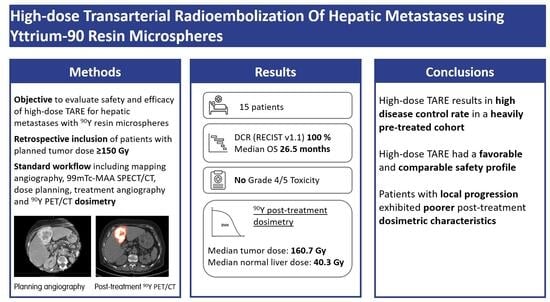
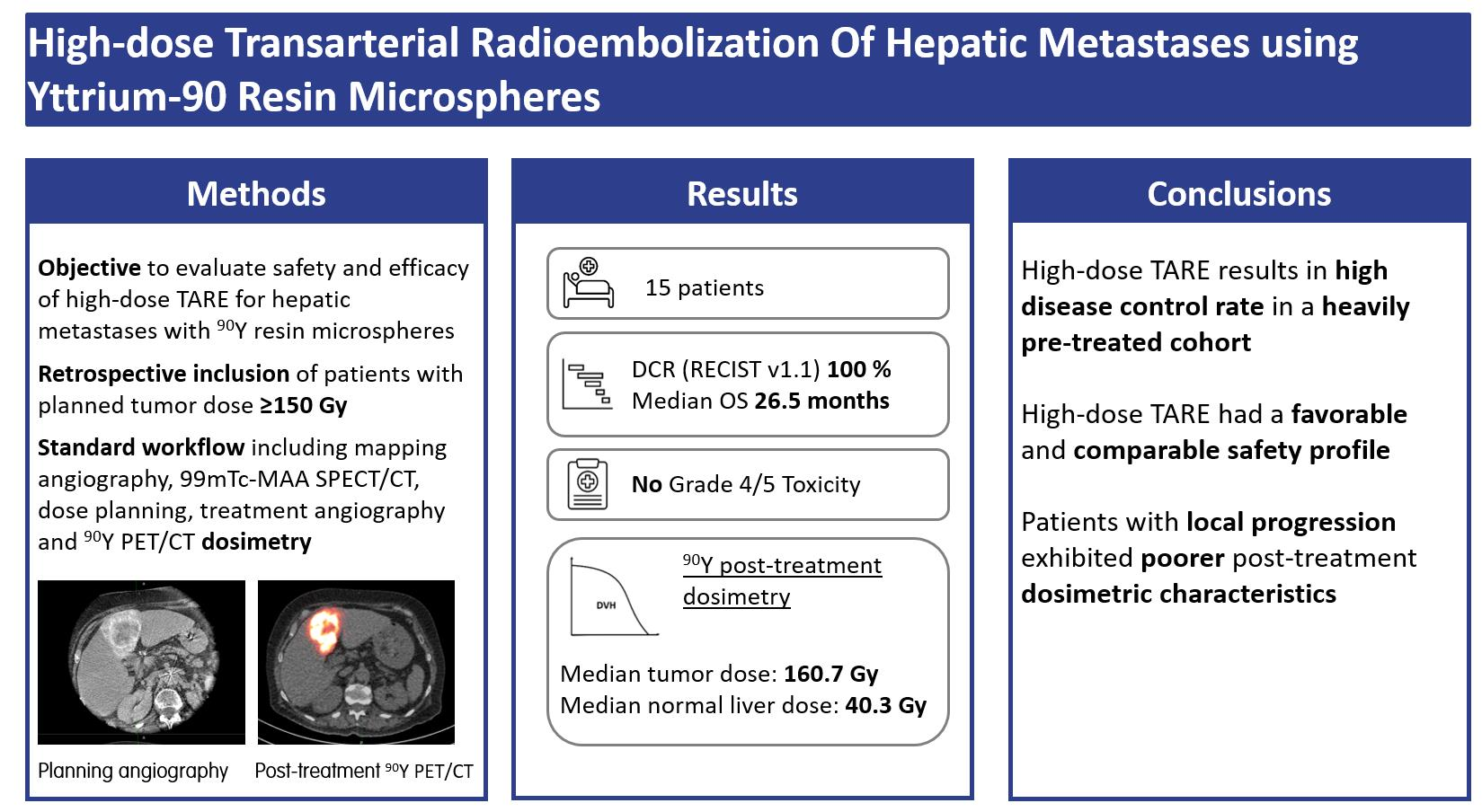
High-dose radioembolization with Yttrium-90 resin microspheres is increasingly used for primary liver cancer, however its role in the treatment of hepatic metastases is unknown. This retrospective study included 15 patients with hepatic metastases and evaluated the safety and efficacy of high-dose radioembolization. The treatment was well tolerated in all patients and disease control after 3 months was achieved in all patients. These findings suggest that high-dose radioembolization is safe and effective for selected patients with hepatic metastases.

Abstract

Background/Objectives: Over the past few years, high-dose radioembolization (≥150 Gy) has become widely adopted for the treatment of primary liver cancer, while evidence for its application in hepatic metastases is still limited. The aim of this study was to evaluate the safety and efficacy of high-dose transarterial radioembolization (TARE) in patients with hepatic metastases using resin Yttrium-90 (90Y) microspheres. Methods: In this retrospective analysis, patients who were treated with high-dose TARE for hepatic metastases with 90Y resin microspheres between May 2019 and April 2025 were included. The primary outcomes were treatment efficacy and toxicity assessed according to the National Cancer Institute Common Terminology Criteria for Adverse Events v5.0. Treatment efficacy was evaluated based on radiological response according to Response Evaluation Criteria in Solid Tumors version 1.1, time to progression and overall survival (OS). Secondary outcomes included 90Y PET/CT post-treatment voxel-based local deposition model dosimetry and its relations to response. Results: A total of 15 patients were included, with hepatic metastases originating from colorectal cancer (n = 11, 73.3%), neuroendocrine tumor (n = 3, 20%) and breast cancer (n = 1, 6.7%). Seven patients (47.7%) had undergone one or multiple prior loco(regional) liver treatments and 13 (86.7%) patients had prior systemic therapy. The median mean tumor absorbed dose was 160.7 Gy (IQR 127.6–245.0 Gy), and the median normal liver parenchyma dose was 40.3 Gy (IQR 21.7–52.3 Gy). Disease control was achieved in all patients, with partial response in 10 patients (66.7%) and stable disease in 5 patients (33.3%) after 3 months. The median OS was 26.5 months (95% CI 24.5 months to no estimate). Two patients (13.3%) experienced grade 3 laboratory toxicity. No grade 4 or 5 toxicities were observed. Conclusions: High-dose TARE with 90Y resin microspheres resulted in a high disease control rate and demonstrated a favorable safety profile, even in this heavily pretreated cohort.

Graphical Abstract

1. Introduction

Hepatic metastases are a common manifestation of advanced malignancies, particularly those originating from colorectal, breast, and other gastrointestinal tumors [1]. Despite advances in systemic therapies, achieving effective locoregional control remains a major therapeutic challenge and key determinant of survival [2].
Transarterial radioembolization (TARE) has emerged as an effective locoregional treatment by delivering targeted β-emitting radiation via yttrium-90 (90Y)-labeled microspheres to tumor tissue. The procedure is a multi-step process that involves angiographic mapping, imaging and dosimetry [3]. Pre-treatment simulation with 99mTc-labeled macroaggregated albumin (99mTc-MAA) infusion at predefined catheter positions predicts microsphere distribution over the hepatic metastases and normal parenchyma. Historically, dose planning (e.g., the calculation of radioactivity to be administered) is executed based on empirical models, which are easy to use but often result in suboptimal tumor dosing. The advent of personalized dosimetry and selective infusion techniques has evolved TARE from a salvage therapy with primarily palliative intent into a potentially curative modality for selected patients [3]. These developments enable high-dose TARE, where tumor doses exceed conventional thresholds to maximize the tumoricidal effect while minimizing toxicity.
In hepatocellular carcinoma (HCC), high-dose TARE has demonstrated durable and, in some cases, complete responses [4]. The LEGACY study [5] reported a 88.3% objective response rate (ORR) in patients with solitary unresectable HCC undergoing high-dose TARE, with 27.8% of the patients subsequently undergoing resection or transplantation. The RASER trial [6] showed 90% sustained complete response after radiation segmentectomy (e.g., high-dose radiation to a liver segment). Also, the DOORwaY90 trial [7] confirmed the high efficacy of high-dose TARE in patients with unresectable or unablatable HCC (ORR 98.5%). Based on this evidence, high-dose TARE has been adopted as locoregional treatment in HCC, especially in a curative setting or as down-staging to meet liver transplant criteria [4,8].
In metastatic liver disease, guidelines support the use of TARE for unresectable patients in the salvage setting [2,9]. High-dose TARE has been explored in a limited number of retrospective studies [10,11,12,13,14,15] and is considered a promising treatment option [16]. Here unique challenges are presented due to the infiltrative growth and dispersed tumor distribution, often necessitating treatment of larger perfusion volumes compared to HCC. Clear dose–response thresholds remain undefined, mainly due to the heterogenic microsphere accumulation in metastatic lesions and limited published data on voxel-level post-treatment dosimetry. Furthermore, most high-dose data involve glass microspheres (TheraSphere, Boston Scientific, Malborough, MA, USA) which are due to their higher specific activity more frequently used in this setting; evidence for resin microspheres (SIR-Spheres, Sirtex Medical Europe, Bonn, Germany) remains limited. This study aims to assess the safety, toxicity and clinical outcomes of high-dose TARE using resin microspheres in patients with liver-dominant metastatic disease. Advanced voxel-level post-treatment dosimetry is included to better understand the therapeutic potential in metastatic liver disease.

2. Materials and Methods

2.1. Participants and Design

This was a single center retrospective study performed under Institutional Review Board approval (IRBd24-003) between May 2019 to April 2025. Patients with liver metastatic disease treated using 90Y resin microspheres on clinical indication were eligible for inclusion if they had a planned mean tumor dose ≥ 150 Gy. Exclusion criteria were less than three months follow-up and inability to score response using the Response Evaluation Criteria for Tumor Response (RECIST) version 1.1.

2.2. Procedure and Dosimetry Planning

TARE was performed in two phases: planning and treatment phase. During the planning phase, 3D-mapping angiographies (Cone-beam Computed Tomography (CT) or Angio-CT) were performed to identify suitable injection positions and ensure complete tumor coverage. This was followed by intra-arterial injection of 99mTc-MAA and subsequent single-photon emission computed tomography (SPECT/CT). Diagnostic contrast enhanced (CE) CT, 3D-angiographies and 99mTc-MAA SPECT/CT were all used to validate suitability of the patient for TARE according to guidelines.
Individualized dose planning was performed using the partition model. Total liver volume was segmented, as were the treated liver volume and tumor volume per injection position. For uni-or bilobar treatments, the planned mean tumor dose (planTDmean) was maximized (≥150 Gy) while taking into account a <40 Gy threshold to the normal liver in treated volume (<30 Gy for heavily pretreated patients). For segmental treatments, the planTDmean was set at >250 Gy–300 Gy, not taking into account the dose to normal liver in treated volume.
The treatment phase was performed within two weeks after the initial planning. Patients underwent high-dose TARE with 90Y resin microspheres (SIRspheres, Sirtex Medical Europe, Bonn, Germany) administered at planned injection sites, followed by a 90Y Positron Emission Tomography (PET)/CT for treatment verification. Figure 1 demonstrates this workflow of planning, treatment and response assessment.

2.3. Post-Treatment Dosimetry Analysis

MIM Sureplan® LiverY90 software (version 7.3.6) was used for post-treatment dosimetry. Lung and total liver volume were segmented on the 90Y-PET/CT using AI-based contouring. Again, treated liver volume and tumor volume were segmented per injection position on pre- and/or periprocedural CE-CT. The necrotic areas were not removed from the tumor segmentations. Normal liver parenchyma segmentation comprised the treated liver volume excluding the tumor segmentations. Image sets were co-registered with rigid alignment. Tumor volumes < 8mL were excluded from analysis because of partial volume effect [17].
Dose-volume histograms (DVH) and dose statistics of all segmented areas were calculated. The following indices were calculated: (1) the mean absorbed dose (Dmean); (2) the D70 and D90, to provide the minimum absorbed doses at consecutive percentages within the tumor volume; (3) the V%<100Gy, indicating the tumor volume receiving less than 100 Gy; and (4) the AUCD30–D90, the area under the curve (AUC) from D30 to D90 calculated using a trapezoidal fit.
A weighted absorbed tumor dose (wTD) was calculated per patient, based on a method described by Dimopoulos et al. [18], by summing the product of each tumor’s volume (V) and its corresponding dose (D), then dividing by the total tumor volume of the patient:
W e i g h t e d   T u m o r   D o s e   ( w T D ) =   V 1 × D 1 + V 2 × D 2 + V 3 × D 3 + V 1 + V 2 + V 3 +

2.4. Response and Toxicity Assessment

All available follow-up CE-CTs were reviewed to identify time to progression (TTP) and local response in accordance with RECIST v1.1. On clinical indication 18F-FDG PET/CT could be performed; these were not included for response assessment. For colorectal patients carcinoembryonic antigen (CEA) was assessed up to three months after radioembolization, and a change in CEA from baseline was calculated.
Response and progression were assessed in four categories: (1) local response, defined as the targeted lesions within the treated volume; (2) hepatic response, defined as non-targeted hepatic lesions outside the treated volume; (3) extra-hepatic response; and (4) overall response. ORR was assessed at 3 months after TARE for targeted lesions; best response was defined as the optimal radiologic response during the entire follow-up. Disease control rate (DCR) was defined as the proportion of patients achieving complete response (CR), partial response (PR) and stable disease (SD) after TARE. Overall survival (OS) was calculated from moment of TARE to either death or censored at the last recorded follow-up. Biochemical and clinical toxicity were assessed up to 3 months after radioembolization using the Common Terminology Criteria for Adverse Events (CTCAE) version 5.0.

2.5. Statistical Analysis

OS and TTP were estimated using the Kaplan–Meier method. Patients were censored at the date of the last hospital visit, in absence of death or progression. All statistical analyses were performed in R v4.4.1 (R Foundation for Statistical Computing, Vienna, Austria). Patient characteristics and dosimetry parameters are provided as median ± interquartile range (IQR) or percentages, when appropriate.

3. Results

3.1. Demographics and Treatment Planning

A total of 18 patients were eligible for participation in the study; 3 patients had to be excluded due to limited follow-up time or inability to score liver lesions in accordance with RECIST v1.1. Detailed patient characteristics of the 15 included patients are shown in Table 1.
The median planTDmean of the 15 patients was 200 Gy (IQR 187.5–473.0 Gy) based on 99mTc-MAA SPECT/CT. The median treated volume was 1304.7 mL (IQR 646.9–2396.0 mL), with a median tumor volume of 196.0 mL (IQR 87.2–293.0 mL). This resulted in a median administered activity of 2.2 GBq (IQR 1.0–2.9 GBq) 90Y microspheres. Administrations were performed as segmental (6 cases), unilobar (5 cases) or bilobar (4 cases) treatments. The total range of pre-calibration days for 90Y activity was zero to four days with a median of three (IQR 2–3).

3.2. Post-Treatment Dosimetry

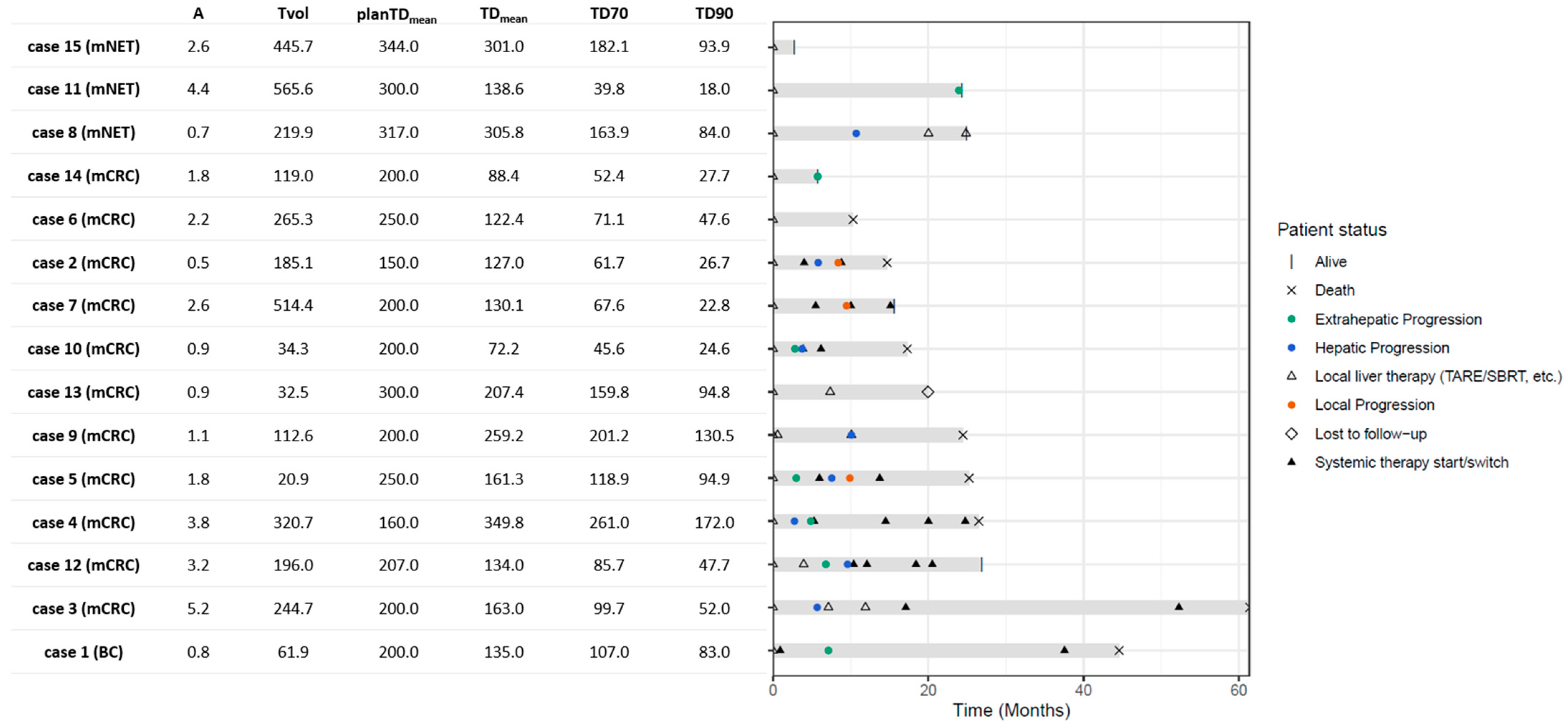
Based on post-treatment 90Y PET/CT, the median TDmean was 160.7 Gy (IQR 127.6–245.0 Gy). The median TD70 was 99.7 Gy (IQR 64.6–161.9 Gy), and the median TD90 was 52 Gy (IQR 27.2–94.3 Gy). The median V%<100Gy was 32.87% (IQR 18.37–53.42%). In Figure 2 and Table S1, the post-treatment dosimetry and course per patient are displayed.
The normal liver parenchyma in the treated volume received 40.3 Gy (IQR 21.7–52.3 Gy); in cases with a uni- or bilobar approach, the median dose was 50.4 Gy (IQR 40.3–87.4 Gy).

3.3. Response Assessment

Tumor response at 3 months after treatment is displayed in Table 2. No patients showed progression of treated lesions at 3 months, resulting in a disease control rate of 100%. The best response for local lesions was partial response in 12 patients (80%) and stable disease in 3 patients (20%), with a median time to best response of 7.3 months (IQR 4.9–17.9 months). Complete metabolic response was observed in one patient at 3 months on 18F-FDG PET/CT, and in two additional patients during subsequent follow-up scans.
CEA laboratory values were available for eight colorectal patients. All but one patient showed a decrease in CEA within three months after radioembolization (median CEA change: −0.77%, IQR −0.88 to −0.50%).
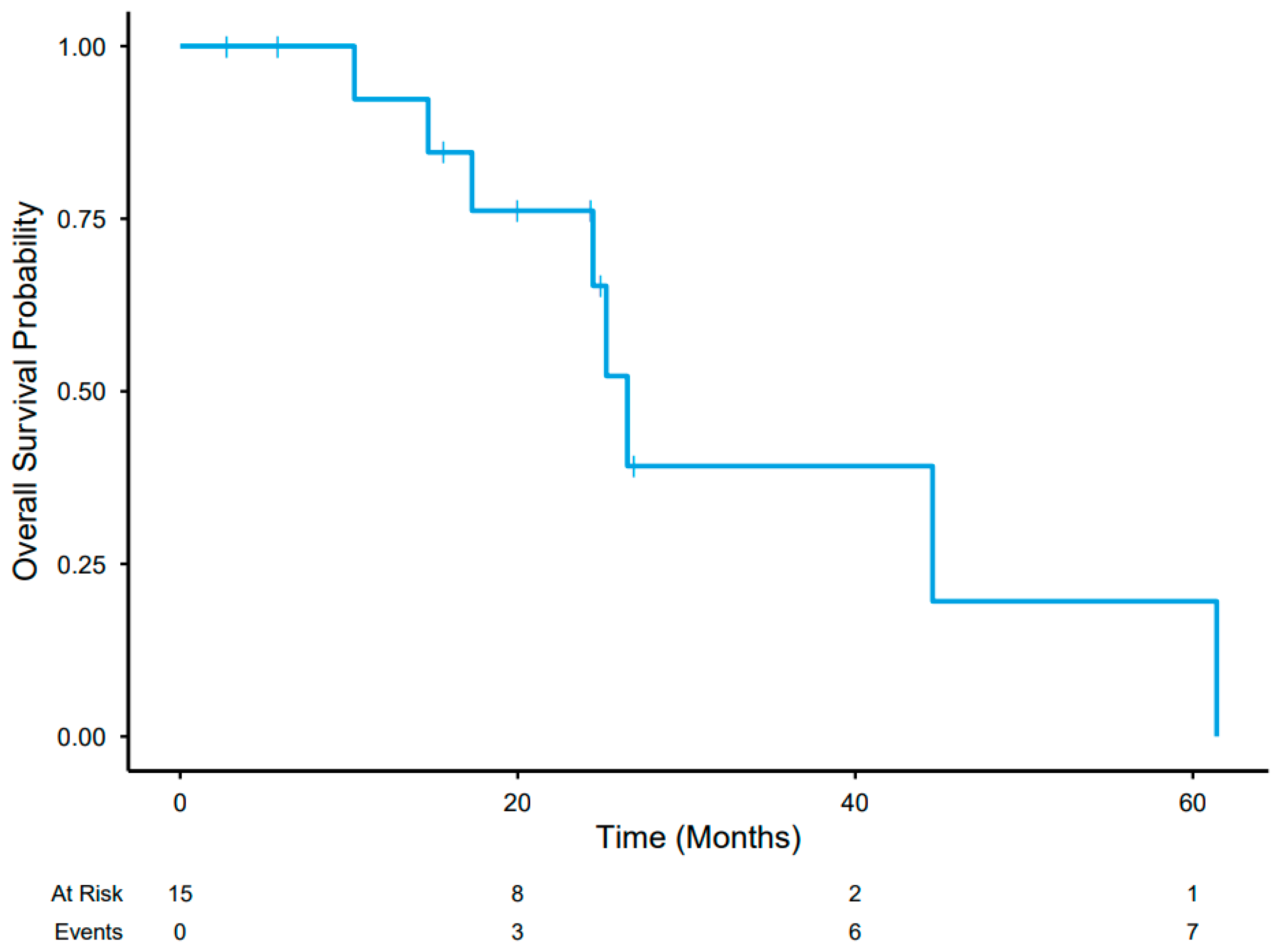
The OS was 26.5 months (95% CI 24.5 months to no estimate) for all patients, as shown in Figure 3; OS for the colorectal metastases group alone was 25.2 months (95% CI 17.3 months to no estimate) (Figure S1).
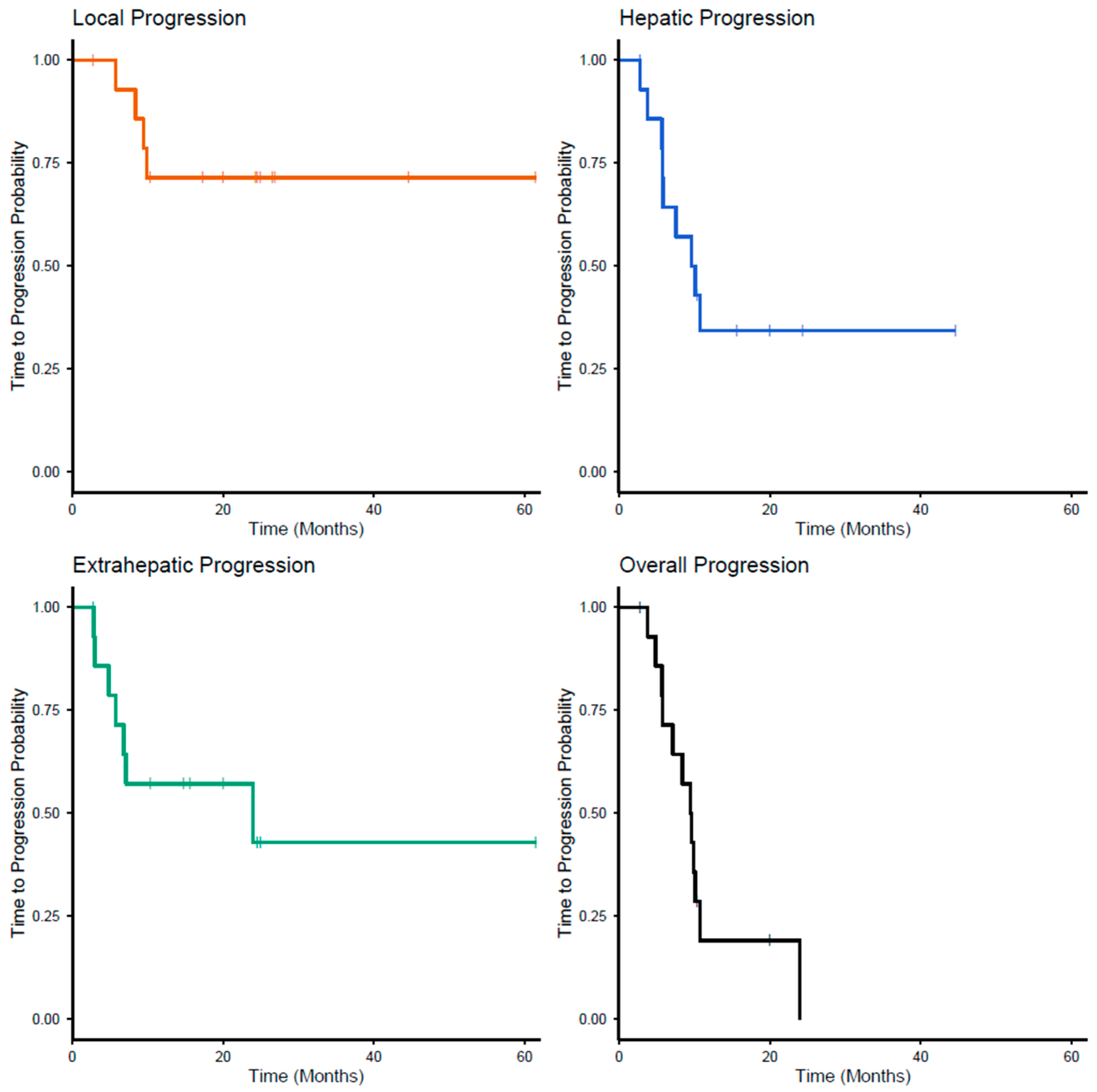
The median TTP as assessed by RECIST v1.1 was 9.53 months (95% CI 7.13 months to no estimate), as displayed in Figure 4. Four (26.7%) patients had progression of the local lesions (median TTP was not reached). Nine (60%) patients developed hepatic tumors outside the treated volume, with a median TTP of 9.85 months (95% CI 5.82 months to no estimate). Extra-hepatic progression occurred in seven (46.7%) patients with a median TTP of 23.9 months (95% CI 6.81 months to no estimate).
Patients with local progression had a TDmean of 128.0 Gy (IQR 126.5–161.3 Gy), TD70 of 78.6 Gy (IQR 62.4–98.0 Gy), TD90 of 28.0 Gy (IQR 23.8–46.3 Gy) and V%<100Gy of 46.3% (IQR 31.5–46.6%).

3.4. Toxicity

Table 3 displays the toxicity up to three months after TARE. The most frequent grade 1–2 toxicities were elevated aspartate aminotransferase (66.7%), decreased platelet count (40%), anemia (40%), increased alanine aminotransferase (40%) and fatigue (40%). Two patients (14%) experienced a biochemical grade 3 toxicity: elevated GGT in one case and decreased lymphocyte count in the other. No grade 4 or 5 toxicities were observed.

3.5. Post-Treatment Course

Most patients experienced extra-hepatic progression before hepatic or local progression, as shown in Figure 2. Eight patients (53.3%) received systemic therapy after radioembolization. Six (40%) patients received one or multiple local liver therapies, consisting of microwave ablation, (repeat) radioembolization, stereotactic radiotherapy and hemihepatectomy. Time after TARE to start a new treatment varied from 1 month to 20 months.

4. Discussion

This single-center series demonstrates that high-dose TARE using 90Y resin microspheres is feasible, safe and effective for patients with hepatic metastases. Only two patients (13.3%) developed a laboratory grade 3 toxicity. No grade 4–5 events occurred. At the first follow-up, DCR was 100%, and the median OS was 25.2 months. These findings support the use of resin microspheres for high-dose TARE in selected metastatic population, serving as either a bridge to further local therapy or as a break from systemic therapy.
Historically, most high-dose data involve glass microspheres (TheraSphere) due to its higher specific activity (e.g., radiation per microspheres), meaning fewer spheres are needed to deliver a dose. This allows for a higher local tumoricidal doses and more precise dose delivery [3]. The introduction of Sirtex’s FlexDose™ regimen has expanded the capabilities of resin microspheres, allowing physicians to deliver more individualized and higher activity levels [19,20]. It is hypothesized that fewer spheres could prevent vascular embolization, thus reducing the risk of severe complications such as post-embolization syndrome [7,21]. According to the most recent EANM guideline [3], tumor-absorbed doses > 100 Gy have been associated with higher rates of metabolic complete response. In patients with hepatic lesions limited to ≤2 liver segments, higher absorbed doses to the perfused target volume can be administered. For radiation segmentectomies, a tumor-absorbed dose of ≥150 Gy is recommended with 90Y resin microspheres in colorectal metastases [3,22]. In the absence of defined thresholds for other tumor types, a planTDmean ≥ 150 Gy has been applied in the current study as the definition for high-dose TARE.
Post-treatment Y90 PET/CT imaging revealed a lower tumor-absorbed dose than planned in all but two cases (#4 and #9); although, the current study was not designed to directly compare planning and post-treatment dosimetry. This finding is consistent with prior reports of dose underestimation, even when using voxel-based planning and post-treatment dosimetry [23,24,25,26]. These discrepancies in dose outcomes can be attributed to some fundamental factors: (1) 99mTc-MAA distribution serves as a reasonably good surrogate, but in some patients, hepatic distribution patterns prove to be less predictive; (2) variability in perfusion, flow and catheter positioning between the interventions may cause variations in hepatic distribution patterns; and (3) inherent physical differences between quantification of 99mTc-SPECT versus 90Y-PET modalities, which are more pronounced in small lesions [23,24,25]. The unpredictable nature of these factors on microspheres distribution and quantification are not easily accounted for in the clinical setting. Consequently, partition-based planning is still preferred in many institutions over voxel-based planning dosimetry.
Though there is a growing awareness that individualized dosimetry is key in order to optimize treatment efficacy, planning dosimetry is still predominantly reported in clinical studies. As a consequence, there is limited data on the role of post-treatment DVHs and dose statistics for defining dose–response relations. A recent large retrospective study [18] reported improved survival in patients with colorectal metastases for a wTD70 ≥ 60 Gy and wTDmean ≥ 120 Gy. These indices were also calculated using voxel-based dosimetry (MIM SurePlan) based on 90Y SPECT/CT or PET/CT scans. To compare, the wTD70 and wTDmean found in this study were higher than these thresholds in all but three cases included in our study (Table S1). Patients with local progression had lower median TDmean, TD70 and TD90 compared to the median of the overall population. Additionally, the local progression group had a higher V%<100Gy compared to the whole population, indicating a higher proportion of tumor volume receiving insufficient dosage [27]. Further research into post-treatment dosimetry across different microspheres and tumor types is essential to establish dose thresholds.
The results of the presented high-dose cohort show favorable results compared to larger registry data on conventional TARE. The CIRT registry [28] reported grade 3–5 toxicity in 11.8% of the colorectal liver metastases (CRLM) patients compared to 13.3% in our cohort. The grade 3–5 toxicity rates of the current series are comparable to prior series describing high-dose TARE ranging from 2.7% to 22% [10,11,12,13,14,15].
In the CIRT registry [29], CRLM patients treated with resin microspheres using the partition model to plan the tumor dose achieved a median OS of 13.0 months (95% CI 8.8–23.8 months). The median OS of 25.2 months in our series exceeds this, though cross-study comparisons should be interpreted with caution because of differences in prescribed activity and treatment strategy.
When compared to high dose studies using 90Y glass microspheres [10,11,12,13,14,15], two studies reported an even higher OS of 41.5 months [12] and 60.9 months [11], likely reflecting stricter inclusion criteria. Both studies only included patients with limited hepatic and minimal extra-hepatic disease. The lower overall survival observed in this study may be explained by the high incidence of extra-hepatic disease at baseline. As shown in Figure 4, extra-hepatic progression tended to occur earlier than local and hepatic progression. In patients with neuroendocrine liver metastases, OS exceeding 60 months has been observed [10]. All neuroendocrine patients in our cohort were still alive at the time of data analysis.
Limitations of the current study include its retrospective design, small sample size and heterogeneous study population with multiple primary tumor origins and treatment histories. The small sample size resulted in the inability to perform stratified analyses of the different primary tumor origins. Also, no complete responders were observed in our study based on assessment using CE-CT, whereas others studies have reported complete response following high-dose TARE [10,11,12,13,14,15]. This discrepancy is attributed to the sole use of RECIST v1.1 for response assessment. It is well established that 18F-FDG PET/CT provides a more accurate evaluation of treatment response in radioembolization [30], as lesions can remain visible on CT while not having any metabolic tumor activity (Figure 1). As 18F-FDG PET/CT was not routinely performed in our institution, it could not be used for standardized response assessment. Despite these limitations, our findings add to growing evidence that high-dose TARE is feasible with resin microspheres and can achieve meaningful disease control and prolonged survival.

5. Conclusions

High-dose TARE using 90Y resin microspheres is a safe and effective treatment for hepatic metastases from various primary malignancies, even in pretreated patients. Despite variations in clinical characteristics and prior treatments, TARE could provide meaningful clinical outcomes. Future prospective multicenter studies should validate these findings and establish dose–response thresholds for specific cancer types.

Supplementary Materials

The following supporting information can be downloaded at https://www.mdpi.com/article/10.3390/cancers17243889/s1, Figure S1: Overall survival in months as estimated by the Kaplan–Meier Method for the colorectal metastases population; Table S1: Post-treatment voxel-based local deposition dosimetry per patient.

Author Contributions

Conceptualization, C.C.I.S., B.J.d.W.-v.d.V., L.W.v.G. and E.G.K.; formal analysis, C.C.I.S.; writing—original draft preparation, C.C.I.S., B.J.d.W.-v.d.V. and E.G.K.; writing—review and editing, C.C.I.S., B.J.d.W.-v.d.V., T.R.B., S.M.A.J., K.F.M.H., M.E.T.T., N.F.M.K., L.W.v.G., A.J.A.T.B., R.G.H.B.-T. and E.G.K.; supervision, B.J.d.W.-v.d.V. and E.G.K. All authors have read and agreed to the published version of the manuscript.

Funding

This research received no external funding.

Institutional Review Board Statement

The study was conducted in accordance with the Declaration of Helsinki and approved by the Institutional Review Board of The Netherlands Cancer Institute (IRBd24-003, 22 December 2023).

Informed Consent Statement

Patient consent was waived due to the retrospective nature of the study and the Institutional Review Board approval.

Data Availability Statement

The used dataset is not available.

Conflicts of Interest

The authors declare no conflicts of interest.

Abbreviations

The following abbreviations are used in this manuscript:
90YYttrium-90
99mTc-MAA99mTc-labeled Macroaggregated Albumin
AUCArea Under the Curve
AUCD30–D90The Area Under Curve Calculated from D30 to D90
CEContrast Enhanced
CEACarcinoembryonic Antigen
CRComplete Response
CRLMColorectal Liver Metastasis
CTComputed Tomography
CTCAECommon Terminology Criteria for Adverse Events
DDose
D70The Mean Absorbed Dose in 70% of the Volume
D90The Mean Absorbed Dose in 90% of the Volume
DCRDisease Control Rate
DmeanMean Absorbed Dose
DVHDose–Volume Histogram
ECOGEastern Cooperative Oncology Group
HCCHepatocellular Carcinoma
IQRInterquartile Range
MWAMicrowave Ablation
ORRObjective Response Rate
OSOverall Survival
PDProgressive Disease
PETPositron Emission Tomography
planTDmeanPlanned Mean Tumor Dose
PRPartial Response
RECISTResponse Evaluation Criteria for Tumor Response
RFARadiofrequency Ablation
RTRadiotherapy
SBRTStereotactic Radiotherapy
SDStable Disease
SPECTSingle-Photon Emission
TARETrans-Arterial Radioembolization
TTPTime to Progression
VVolume
V%<100Gy The Percentage of Volume That Receives Less Than 100 Gy
wTDWeighted Absorbed Tumor Dose

References

  1. Horn, S.R.; Stoltzfus, K.C.; Lehrer, E.J.; Dawson, L.A.; Tchelebi, L.; Gusani, N.J.; Sharma, N.K.; Chen, H.; Trifiletti, D.M.; Zaorsky, N.G. Epidemiology of Liver Metastases. Cancer Epidemiol. 2020, 67, 101760. [Google Scholar] [CrossRef]
  2. Van Cutsem, E.; Cervantes, A.; Adam, R.; Sobrero, A.; Van Krieken, J.H.; Aderka, D.; Aranda Aguilar, E.; Bardelli, A.; Benson, A.; Bodoky, G.; et al. ESMO Consensus Guidelines for the Management of Patients with Metastatic Colorectal Cancer. Ann. Oncol. 2016, 27, 1386–1422. [Google Scholar] [CrossRef] [PubMed]
  3. Weber, M.; Lam, M.; Chiesa, C.; Konijnenberg, M.; Cremonesi, M.; Flamen, P.; Gnesin, S.; Bodei, L.; Kracmerova, T.; Luster, M.; et al. EANM Procedure Guideline for the Treatment of Liver Cancer and Liver Metastases with Intra-Arterial Radioactive Compounds. Eur. J. Nucl. Med. Mol. Imaging 2022, 49, 1682–1699. [Google Scholar] [CrossRef] [PubMed]
  4. European Association for the Study of the Liver. EASL Clinical Practice Guidelines on the Management of Hepatocellular Carcinoma. J. Hepatol. 2025, 82, 315–374. [Google Scholar] [CrossRef]
  5. Salem, R.; Johnson, G.E.; Kim, E.; Riaz, A.; Bishay, V.; Boucher, E.; Fowers, K.; Lewandowski, R.; Padia, S.A. Yttrium-90 Radioembolization for the Treatment of Solitary, Unresectable HCC: The LEGACY Study. Hepatology 2021, 74, 2342–2352. [Google Scholar] [CrossRef]
  6. Kim, E.; Sher, A.; Abboud, G.; Schwartz, M.; Facciuto, M.; Tabrizian, P.; Knešaurek, K.; Fischman, A.; Patel, R.; Nowakowski, S.; et al. Radiation Segmentectomy for Curative Intent of Unresectable Very Early to Early Stage Hepatocellular Carcinoma (RASER): A Single-Centre, Single-Arm Study. Lancet Gastroenterol. Hepatol. 2022, 7, 843–850. [Google Scholar] [CrossRef] [PubMed]
  7. Sirtex—DOORwaY90 Study Interim Results. Available online: https://www.sirtex.com/us/products/sir-spheres/clinical-trials/doorway90-study/doorway90-study-interim-results/ (accessed on 3 November 2025).
  8. Vogel, A.; Chan, S.L.; Dawson, L.A.; Kelley, R.K.; Llovet, J.M.; Meyer, T.; Ricke, J.; Rimassa, L.; Sapisochin, G.; Vilgrain, V.; et al. Hepatocellular Carcinoma: ESMO Clinical Practice Guideline for Diagnosis, Treatment and Follow-Up. Ann. Oncol. 2025, 36, 491–506. [Google Scholar] [CrossRef]
  9. Lamarca, A.; Bartsch, D.K.; Caplin, M.; Kos-Kudla, B.; Kjaer, A.; Partelli, S.; Rinke, A.; Janson, E.T.; Thirlwell, C.; van Velthuysen, M.-L.F.; et al. European Neuroendocrine Tumor Society (ENETS) 2024 Guidance Paper for the Management of Well-Differentiated Small Intestine Neuroendocrine Tumours. J. Neuroendocrinol. 2024, 36, e13423. [Google Scholar] [CrossRef]
  10. Gordon, A.C.; Savoor, R.; Kircher, S.M.; Kalyan, A.; Benson, A.B.; Hohlastos, E.; Desai, K.R.; Sato, K.; Salem, R.; Lewandowski, R.J. Yttrium-90 Radiation Segmentectomy for Treatment of Neuroendocrine Liver Metastases. J. Vasc. Interv. Radiol. 2025, 36, 293–300. [Google Scholar] [CrossRef]
  11. Chiu, A.M.; Savoor, R.; Gordon, A.C.; Riaz, A.; Sato, K.T.; Hohlastos, E.; Salem, R.; Lewandowski, R.J. Yttrium-90 Radiation Segmentectomy in Oligometastatic Secondary Hepatic Malignancies. J. Vasc. Interv. Radiol. 2023, 34, 362–368. [Google Scholar] [CrossRef]
  12. Kurilova, I.; Bendet, A.; Fung, E.K.; Petre, E.N.; Humm, J.L.; Boas, F.E.; Crane, C.H.; Kemeny, N.; Kingham, T.P.; Cercek, A.; et al. Radiation Segmentectomy of Hepatic Metastases with Y-90 Glass Microspheres. Abdom. Radiol. 2021, 46, 3428–3436. [Google Scholar] [CrossRef]
  13. Padia, S.A.; Johnson, G.E.; Agopian, V.G.; Di Norcia, J.; Srinivasa, R.N.; Sayre, J.; Shin, D.S. Yttrium-90 Radiation Segmentectomy for Hepatic Metastases: A Multi-Institutional Study of Safety and Efficacy. J. Surg. Oncol. 2021, 123, 172–178. [Google Scholar] [CrossRef]
  14. Meiers, C.; Taylor, A.; Geller, B.; Toskich, B. Safety and Initial Efficacy of Radiation Segmentectomy for the Treatment of Hepatic Metastases. J. Gastrointest. Oncol. 2018, 9, 311–315. [Google Scholar] [CrossRef]
  15. Dimopoulos, P.M.; Sotirchos, V.S.; Dunne-Jaffe, C.; Petre, E.N.; Gonen, M.; Zhao, K.; Kirov, A.S.; Crane, C.; D’Angelica, M.; Connell, L.C.; et al. Voxel-Based Dosimetry Predicts Local Tumor Progression Post 90 Y Radiation Segmentectomy of Colorectal Liver Metastases. Clin. Nucl. Med. 2025, 50, 133–142. [Google Scholar] [CrossRef]
  16. Entezari, P.; Gabr, A.; Salem, R.; Lewandowski, R.J. Yttrium-90 for Colorectal Liver Metastasis—The Promising Role of Radiation Segmentectomy as an Alternative Local Cure. Int. J. Hyperth. 2022, 39, 620–626. [Google Scholar] [CrossRef]
  17. Soret, M.; Bacharach, S.L.; Buvat, I. Partial-Volume Effect in PET Tumor Imaging. J. Nucl. Med. 2007, 48, 932–945. [Google Scholar] [CrossRef] [PubMed]
  18. Dimopoulos, M.-P.; Sotirchos, V.S.; Dunne-Jaffe, C.; Mitchell, A.; Petre, E.N.; Alexander, E.S.; Gonen, M.; Rao, D.; Connell, L.C.; Soares, K.; et al. Tumor Absorbed Dose Predicts Survival and Local Tumor Control in Colorectal Liver Metastases Treated with 90Y Radioembolization. Cardiovasc. Interv. Radiol. 2025; ahead of print. [Google Scholar] [CrossRef] [PubMed]
  19. Paladini, A.; Spinetta, M.; Matheoud, R.; D’Alessio, A.; Sassone, M.; Di Fiore, R.; Coda, C.; Carriero, S.; Biondetti, P.; Laganà, D.; et al. Role of Flex-Dose Delivery Program in Patients Affected by HCC: Advantages in Management of Tare in Our Experience. J. Clin. Med. 2024, 13, 2188. [Google Scholar] [CrossRef]
  20. Maxwell, A.W.P.; Mendoza, H.G.; Sellitti, M.J.; Camacho, J.C.; Deipolyi, A.R.; Ziv, E.; Sofocleous, C.T.; Yarmohammadi, H.; Maybody, M.; Humm, J.L.; et al. Optimizing 90Y Particle Density Improves Outcomes After Radioembolization. Cardiovasc. Interv. Radiol. 2022, 45, 958–969. [Google Scholar] [CrossRef] [PubMed]
  21. Villalobos, A.; Arndt, L.; Cheng, B.; Dabbous, H.; Loya, M.; Majdalany, B.; Bercu, Z.; Kokabi, N. Yttrium-90 Radiation Segmentectomy of Hepatocellular Carcinoma: A Comparative Study of the Effectiveness, Safety, and Dosimetry of Glass-Based versus Resin-Based Microspheres. J. Vasc. Interv. Radiol. 2023, 34, 1226–1234. [Google Scholar] [CrossRef]
  22. van den Hoven, A.F.; Rosenbaum, C.E.N.M.; Elias, S.G.; de Jong, H.W.A.M.; Koopman, M.; Verkooijen, H.M.; Alavi, A.; van den Bosch, M.A.A.J.; Lam, M.G.E.H. Insights into the Dose-Response Relationship of Radioembolization with Resin 90Y-Microspheres: A Prospective Cohort Study in Patients with Colorectal Cancer Liver Metastases. J. Nucl. Med. 2016, 57, 1014–1019. [Google Scholar] [CrossRef]
  23. Jadoul, A.; Bernard, C.; Lovinfosse, P.; Gérard, L.; Lilet, H.; Cornet, O.; Hustinx, R. Comparative Dosimetry between 99mTc-MAA SPECT/CT and 90Y PET/CT in Primary and Metastatic Liver Tumors. Eur. J. Nucl. Med. Mol. Imaging 2020, 47, 828–837. [Google Scholar] [CrossRef]
  24. Cheng, Y.; Wei, F.; Yu, H.; Ling, X.; Guo, B.; Shang, J.; Cai, Q.; Li, Y.; Yang, X.; Ran, B.; et al. 99mTc-MAA SPECT/CT Imaging before 90Y-SIRT for Reflecting the Distribution of 90Y Resin Microspheres in Tumors and the Liver: A Comparison with 90Y PET/CT Verification Imaging. Quant. Imaging Med. Surg. 2025, 15, 6272–6286. [Google Scholar] [CrossRef]
  25. Riveira-Martin, M.; Akhavanallaf, A.; Mansouri, Z.; Bianchetto Wolf, N.; Salimi, Y.; Ricoeur, A.; Mainta, I.; Garibotto, V.; López Medina, A.; Zaidi, H. Predictive Value of 99mTc-MAA-Based Dosimetry in Personalized 90Y-SIRT Planning for Liver Malignancies. EJNMMI Res. 2023, 13, 63. [Google Scholar] [CrossRef]
  26. Lam, M.; Garin, E.; Haste, P.; Denys, A.; Geller, B.; Kappadath, S.C.; Turkmen, C.; Sze, D.Y.; Alsuhaibani, H.S.; Herrmann, K.; et al. Utility of Pre-Procedural [99mTc]TcMAA SPECT/CT Multicompartment Dosimetry for Treatment Planning of 90Y Glass Microspheres in Patients with Hepatocellular Carcinoma: Comparison of Anatomic versus [99mTc]TcMAA-Based Segmentation. Eur. J. Nucl. Med. Mol. Imaging 2024, 52, 744–755. [Google Scholar] [CrossRef]
  27. Sarwar, A.; Nasser, I.; Weinstein, J.L.; Odeh, M.; Babar, H.; Dinh, D.; Curry, M.; Bullock, A.; Eckhoff, D.; Dib, M.; et al. Histopathologic Outcomes of Hepatocellular Carcinoma Treated with Transarterial Radioembolization with Yttrium-90 Resin Microspheres. Eur. J. Nucl. Med. Mol. Imaging, 2025; ahead of print. [Google Scholar] [CrossRef]
  28. Maleux, G.; Albrecht, T.; Arnold, D.; Bargellini, I.; Cianni, R.; Helmberger, T.; Kolligs, F.; Munneke, G.; Peynircioglu, B.; Sangro, B.; et al. Predictive Factors for Adverse Event Outcomes After Transarterial Radioembolization with Yttrium-90 Resin Microspheres in Europe: Results from the Prospective Observational CIRT Study. Cardiovasc. Interv. Radiol. 2023, 46, 852–867. [Google Scholar] [CrossRef] [PubMed]
  29. Schaefer, N.; Grözinger, G.; Pech, M.; Pfammatter, T.; Soydal, C.; Arnold, D.; Kolligs, F.; Maleux, G.; Munneke, G.; Peynircioglu, B.; et al. Prognostic Factors for Effectiveness Outcomes After Transarterial Radioembolization in Metastatic Colorectal Cancer: Results from the Multicentre Observational Study CIRT. Clin. Color. Cancer 2022, 21, 285–296. [Google Scholar] [CrossRef] [PubMed]
  30. Zerizer, I.; Al-Nahhas, A.; Towey, D.; Tait, P.; Ariff, B.; Wasan, H.; Hatice, G.; Habib, N.; Barwick, T. The Role of Early 18F-FDG PET/CT in Prediction of Progression-Free Survival after 90Y Radioembolization: Comparison with RECIST and Tumour Density Criteria. Eur. J. Nucl. Med. Mol. Imaging 2012, 39, 1391–1399. [Google Scholar] [CrossRef] [PubMed]
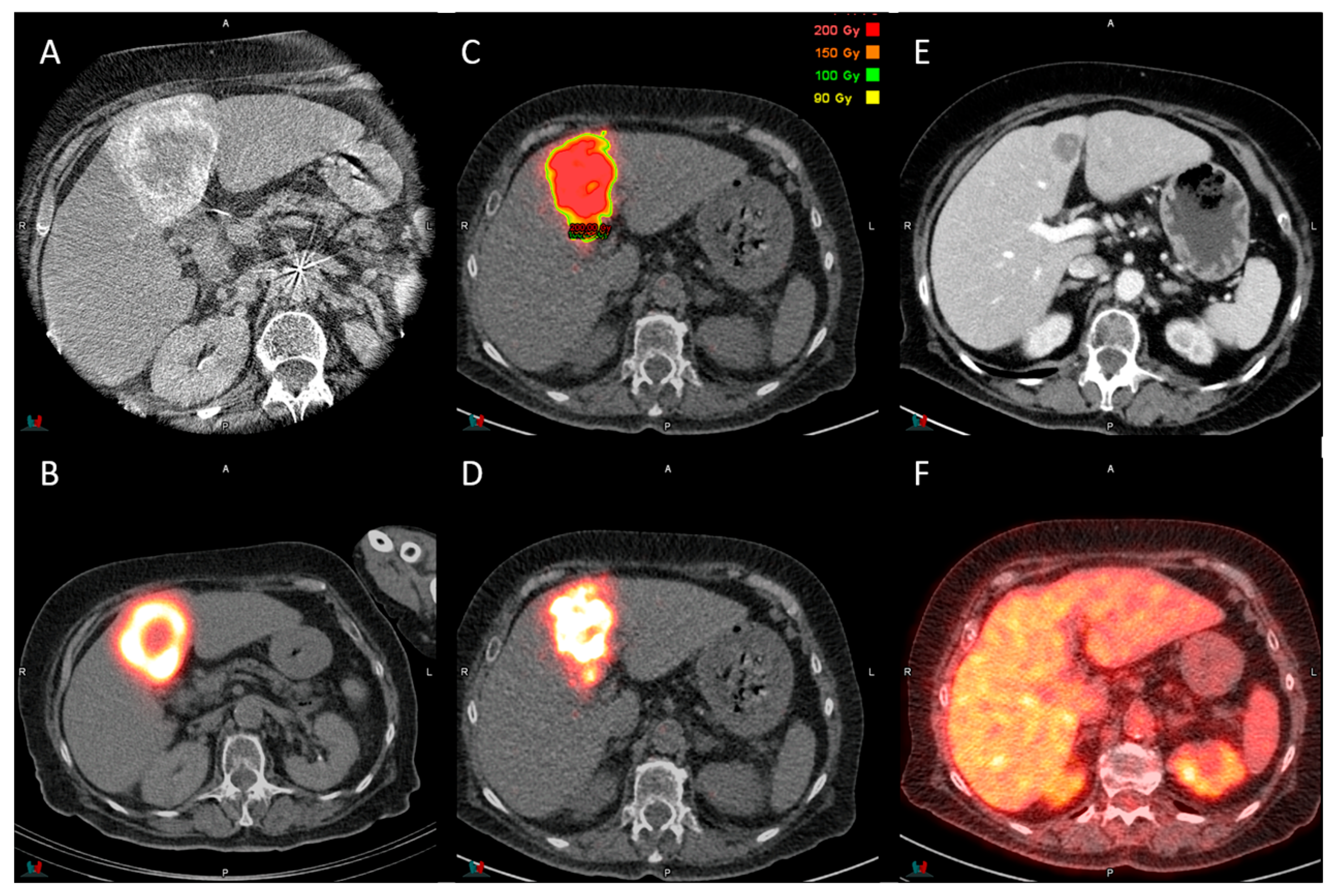
Figure 1. (A) Contrast-enhanced cone-beam CT of the treatment volume (segment 4) with one large colorectal metastasis before TARE; (B) 99mTc-MAA SPECT/CT used for planning dosimetry showing good 99mTc-MAA uptake in segment 4; (C) 90Y PET/CT dose maps showing a uniform dose distribution of 200 Gy in the center and a lower dose in the border of the treated volume; (D) 90Y PET/CT showing good tumor uptake in segment 4 (activity 1.1 GBq; planTDmean 200 Gy; TDmean 259.2 Gy); (E) post-treatment contrast-enhanced CT at 3 months showing a remaining lesion (partial response); (F) 18F-FDG PET/CT at 3 months showing no 18FDG uptake in the treated lesion in segment 4.
Cancers 17 03889 g001
Figure 2. Swimmer’s plot of post-treatment course after high-dose TARE (month = 0) and dosimetry overview per case. A administered activity in GBq; Tvol tumor volume in mL; PlanTDmean mean planned tumor dose in Gy; TDmean mean tumor dose; Dx dose delivered to x% of the volume in Gy.
Cancers 17 03889 g002
Figure 3. Overall survival in months as estimated by the Kaplan–Meier Method.
Cancers 17 03889 g003
Figure 4. Time to progression (RECIST v1.1 based) as estimated by the Kaplan–Meier Method for local progression, hepatic progression, extra-hepatic progression and overall progression.
Cancers 17 03889 g004
Table 1. Baseline patient characteristics (n = 15).
Variable Value
GenderMale8 (53.3%)
Female7 (46.6%)
Age 66 (54.5–71.5)
Primary Tumor TypeColorectal11 (73.3%)
Neuroendocrine3 (20%)
Breast1 (6.7%)
ECOG status09 (60%)
16 (40%)
Prior Systemic Therapy 13 (86.7%)
Prior Local Liver Therapy 7 (47.7%)
Of which n patients hadBland embolization1 (6.7%)
Radioembolization2 (13.3%)
Surgical resection3 (20%)
Chip and burn3 (20%)
Ablation (RFA/MWA)3 (20%)
Stereotactic Body RT (SBRT)2 (13.3%)
Intra-arterial pump chemotherapy1 (6.7%)
Extra-hepatic disease at baseline 7 (46.7%)
Of which n patients hadLung6 (40%)
Lymph node4 (26.7%)
Bone1 (6.67%)
Soft tissue1 (6.67%)
Tumor burden (%) 1 10.0 (4.7–14.2)
Treatment strategySegmental6 (40%)
Unilobar5 (33.3%)
Bilobar4 (26.7%)
Baseline labBilirubin, total serum (µmol/L)6 (6–9)
Aspartate transaminase (U/L)28 (24–34)
Alanine transaminase (U/L22 (19–28.5)
Alkaline Phosphatase (U/L)128 (86.5–201)
Gamma-glutamyl Transferase (U/L)98 (48.5–144.5)
Median follow-up time 25.2 (17.3–26.9)
1 Tumor burden was calculated by dividing tumor volume (segmented on contrast-enhanced CT) with total liver volume. Data are median (IQR) or n(%). Eastern Cooperative Oncology Group (ECOG); Radiofrequency ablation (RFA); Microwave ablation (MWA); Radiotherapy (RT); Stereotactic radiotherapy (SBRT).
Table 2. Local radiological response.
Radiological Response3 Months Post TAREBest Response
Complete Response00
Partial Response10 (66.7%)12 (80%)
Stable Disease5 (33.3%)3 (20%)
Progressive Disease00
Disease Control Rate15 (100%)15 (100%)
Table 3. Toxicity up to three months after radioembolization assessed according to CTCAE v5.0.
CTCAE Grade
Terminology123
Abdominal Pain210
Anemia510
Fatigue420
Fever100
Nausea330
↑ Alanine Aminotransferase 510
↑ Alkaline Phosphatase 410
↑ Aspartate Aminotransferase 910
↑ Blood Bilirubin 110
↑ Blood Lactate Dehydrogenase 400
↑ GGT 151
Hypophosphatemia100
↓ Lymphocyte Count 201
↓ Platelet Count 600
↓ White Blood Cell Count 100
Total49162
↑ indicates increased or hyper-; ↓ indicates decreased or hypo-.
Disclaimer/Publisher’s Note: The statements, opinions and data contained in all publications are solely those of the individual author(s) and contributor(s) and not of MDPI and/or the editor(s). MDPI and/or the editor(s) disclaim responsibility for any injury to people or property resulting from any ideas, methods, instructions or products referred to in the content.