Article

Neighborhood Disadvantage and Cardiovascular Mortality Among Colorectal Cancer Survivors

1
Department of Nutrition and Health Science, Ball State University, Muncie, IN 47306, USA
2
Department of Surgery, University of Florida College of Medicine, Gainesville, FL 32610, USA
3
Department of Radiation Oncology, University of Florida, Gainesville, FL 32610, USA
4
University of Florida Health Cancer Center, Gainesville, FL 32608, USA
*
Author to whom correspondence should be addressed.
Cancers 2025, 17(23), 3782; https://doi.org/10.3390/cancers17233782
Submission received: 30 October 2025 / Revised: 19 November 2025 / Accepted: 25 November 2025 / Published: 26 November 2025

Simple Summary

This study examined whether where a person lives influences their risk of dying from heart disease (CVD) when they also have colon or rectal cancer (CRC). Using data from 316,549 CRC patients, we found that over a median follow-up of 39 months, 146,206 patients died. Although cancer was the leading cause of death (62.1%), heart disease accounted for a substantial portion (9.6%) of deaths. Patients living in the poorest neighborhoods had a 39% higher risk of dying specifically from heart disease compared to those in the affluent neighborhoods. This increased risk was evident even after accounting for the patient’s age, tumor stage, and other individual health factors. The link between neighborhood poverty and heart disease death was stronger for older patients and men. This suggests that factors related to living environment, such as access to quality healthcare, comorbidities, and lifestyle habits, may play a role in contributing to differences in survival outcomes.

Abstract

Background: Cardiovascular disease (CVD) is a common cause of death among colorectal cancer (CRC) patients. We examined whether neighborhood disadvantage is associated with CVD mortality in CRC patients. Methods: Data were obtained from the Surveillance, Epidemiology, and End Results (SEER) program for primary CRC patients diagnosed between 2006 and 2017. Neighborhood disadvantage was measured using the quintiles of the Yost Index, a socioeconomic composite measure. Cause-specific mortality (CVD-specific and CRC-specific mortality) was evaluated using a competing risk cause-specific hazard model, controlling for demographic and clinical covariates. Cumulative incidence function (CIF) and restricted mean survival time (RMST) analyses were performed to provide complementary estimates of absolute risk and survival differences. Results: The study included 316,549 patients with CRC. Cancer-specific mortality was the leading cause of death (62.1%), while CVD accounted for 9.6% of deaths. Multivariable competing risk Cox regression showed that the lowest-SES neighborhoods (Group 1) had a higher CVD-specific mortality (HR, 1.39; 95% CI, 1.30–1.48; p < 0.001) compared to the highest-SES neighborhoods (Group 5). RMST and CIF analyses revealed a similar dose–response pattern, with progressively higher CVD mortality associated with increasing levels of neighborhood disadvantage. Effect modification analyses indicated stronger associations in older patients and men, but no modifications by race. Conclusions: Among CRC patients, residing in disadvantaged neighborhoods was independently associated with higher CVD mortality, suggesting the importance of addressing cardiovascular risk in disadvantaged populations.

1. Introduction

Colorectal cancer (CRC) is the fourth most common cancer and the second leading cause of cancer-related death in the United States, with an estimated 154,270 new cases and 52,900 deaths projected in 2025 [1,2,3]. Advances in cancer treatment have markedly improved cancer-specific survival, but cardiovascular disease (CVD) has become a leading cause of non-cancer mortality among CRC survivors [4,5,6,7,8]. This heightened risk is due in part to the cardiotoxic effects of certain cancer therapies and shared risk factors such as obesity, hypertension, diabetes, smoking, diet, physical activity, and social determinants of health [9,10,11,12]. CRC survivors are two to four times more likely to develop CVD compared to the general population [7]. Population-based studies have consistently shown that CVD is the leading cause of non-cancer death in CRC survivors [7,9]. In a multi-registry study, 42% of non-cancer deaths among CRC survivors were attributable to CVD [9]. Another study reported that 13.7% of CRC survivors died from CVD, compared with an average of 11.3% across all cancer types [13]. This places CRC among the top five cancer types with the highest proportion of CVD-related deaths [13]. Findings from these studies underscore the significance of survivorship research and subsequent interventions aimed at reducing CVD risk in CRC patients.
Neighborhood disadvantage, characterized by higher poverty, unemployment, and lower educational attainment [14], has been linked to a greater incidence of CVD in the general population [15,16,17]. Adverse neighborhood environments may lead to chronic exposure to stressors such as housing instability, limited access to health care resources, and social disorder [16]. Among CRC survivors, these stressors may compound with treatment-related cardiovascular toxicities and a high chronic disease burden, but their influence on cardiovascular outcomes in this population is not well understood [18,19].
This represents a critical gap in CRC survivorship research, as failure to consider neighborhood disadvantage may exacerbate existing disparities and limit the effectiveness of proposed interventions. CRC survivors may be particularly vulnerable due to cumulative treatment exposures and pre-existing comorbidities [10]. Understanding the relationship between neighborhood context and CVD mortality is essential for reducing disparities and optimizing survivorship care [20]. This study addresses this gap by examining the associations of neighborhood disadvantage, as measured by the Yost Index [21,22,23], with CVD-specific mortality after adjustment for factors historically associated with worse outcomes (e.g., Black race, later stage at diagnosis, and lack of treatment) [24,25,26]. Our objective was to determine whether increasing levels of neighborhood disadvantage are independently associated with higher CVD-specific mortality among CRC survivors. We hypothesized that CRC survivors residing in disadvantaged areas would be independently associated with higher CVD-specific mortality, even after accounting for these factors. We also explored whether this association varied by age, sex, and race.

2. Materials and Methods

2.1. Population and Data

Data for this study was drawn from the publicly available Surveillance, Epidemiology, and End Results (SEER) database of the National Cancer Institute [27]. SEER*Stat software version 8.4.5 (https://seer.cancer.gov/seerstat/, accessed on 10 February 2024) was used to access the SEER Research Plus Data (Specialized with Census Tract SES/Rurality), which encompasses 18 cancer registries (excluding Alaska) from the November 2020 submission, covering the years 2006–2018 [27]. This dataset includes approximately 28% of the U.S. population aged 20 years or older who were diagnosed with a primary colorectal malignancy (ICD codes C18–C20) between 2006 and 2017. Cases diagnosed in 2018 were excluded to ensure at least one year of follow-up for survival analyses. This study adhered to the Strengthening the Reporting of Observational Studies in Epidemiology (STROBE) reporting guidelines [28]. This study was exempt from review by the Institutional Review Board of the University of Florida because the analysis was based on publicly available data.

2.2. Primary Exposure

Neighborhood disadvantage was assessed using the census tract–level Yost Index, as defined by Yost et al. [21]. Prior studies have demonstrated the validity of the Yost Index in cancer outcomes [23,29,30]. Higher scores correspond to higher socioeconomic status (SES), with lower scores indicating greater neighborhood disadvantage [21]. The Yost Index is based on geocoded patient-level, location-based, and census-tract level data that incorporates seven measures: education index, median household income, percent unemployed, percent below 150% of the poverty line, percent working class, median house value, and median rent [21]. Census tract-level data is preferable to county-level SES measurements because the smaller tracts offer greater resolution and specificity in characterizing socioeconomic status [31]. Index scores were categorized into quintiles, with group 1 representing the most disadvantaged neighborhoods (lowest SES) and group 5 representing the least disadvantaged (highest SES), each containing approximately equal proportions of the population [21]. Neighborhood disadvantage classification was assigned to all cancer cases based on the census tract of residence at the time of diagnosis.

2.3. Outcome

SEER determines mortality through state and national vital records, with causes of death assigned using death certificates and ICD codes [27]. The primary outcome of this study was CVD-specific mortality, defined as the time from the date of CRC diagnosis to death from CVD. The CVD-specific deaths as recorded in the SEER database included deaths due to six specific causes: diseases of the heart, hypertension without heart disease, cerebrovascular disease, atherosclerosis, aortic aneurysm and dissection, and other diseases of the arteries, arterioles, and capillaries. The patients with the following CVD mortality were identified using ICD-10 codes I00-99. Secondary outcomes included all-cause mortality and CRC–specific mortality. Patients who were alive at the end of the study or lost to follow-up were considered censored.

2.4. Covariates

Covariates were selected based on existing literature and subject-matter expertise to assess the association between neighborhood disadvantage and survival [7,9,24]. Included covariates were: age at diagnosis (categorized as 20–49, 50–64, 65–74, and 75+ years); race and ethnicity (non-Hispanic [NH] White, NH-Black, NH-Asian/Pacific Islander [Asian/PI], and Hispanic [all races]); marital status (married/partnered vs. never married/divorced/separated/widowed/unknown); and year of diagnosis (2006–2008, 2009–2011, 2012–2014, 2015–2017). SEER summary stage was classified as localized, regional (including regional by direct extension, regional lymph nodes, both direct extension and lymph node involvement, or not otherwise specified), distant (distant site[s]/node[s] involved), and unstaged/unknown. Tumor location was defined as colon (right, left), rectum, or unspecified. Tumor grade was categorized as well-differentiated, moderately differentiated, poorly differentiated, undifferentiated, anaplastic, or unknown. Treatment receipt was defined as surgery (yes/no), radiation (yes/no), and chemotherapy (yes/no).

2.5. Statistical Analysis

Frequencies were calculated for categorical variables, and the median with interquartile range (IQR) was reported for continuous variables. Missing data for categorical variables were replaced with the level of “unknown,” whereas no missing data were observed for continuous variables. Overall survival was analyzed using Kaplan–Meier curves and the log-rank test. Cumulative incidence function (CIF) curves [32] using the Fine-Gray subdistribution hazard model, were generated to describe the incidence of CVD-specific mortality, accounting for competing risks from CRC-specific and other causes of death. The analysis was stratified by Yost Index groups, allowing for visual comparison of the cumulative incidence of CVD mortality across the socioeconomic gradient throughout the follow-up period. Adjusted hazard ratios (aHRs) and corresponding 95% confidence intervals (CIs) were estimated using Cox proportional hazards regression to assess overall mortality. Proportional hazards assumptions were formally evaluated for all covariates using cumulative martingale residuals and the supremum test (ASSESS statement, SAS), and no violations were detected [33,34]. To account for competing risks, we used the cause-specific Cox proportional hazards model [33] to estimate aHRs (95% CIs) for CVD-specific and CRC-specific mortality [9]. This approach allows deaths from other causes to be treated as censored at their time of occurrence, enabling us to assess the association between covariates and the instantaneous risk of each cause-specific death. In the cause-specific models, deaths due to other causes were censored at their time of occurrence. For the CVD-specific model, cancer-specific deaths were considered a competing event [33]. Covariates included in the model were age, sex, race/ethnicity, marital status, year of diagnosis, stage, grade, tumor location, surgery, chemotherapy, and radiotherapy. Effect modification was assessed using the likelihood ratio test; the interaction between effect modification and age, sex, and race/ethnicity was explored with the Yost Index groups. An interaction was considered significant if the p-value for the interaction term was <0.05, and assessment for final inclusion in the model was based on between-model comparisons using the likelihood ratio test: only models that offer significantly better goodness of fit than the original model were selected. To complement hazard ratio estimates, we report the differences in the restricted mean survival time (RMST) between Yost Index quintiles at 60 months, providing an interpretable measure of average survival time across socioeconomic strata [35]. Statistical significance was determined using two-sided tests with p < 0.05. All analyses were performed using SAS version 9.4 (Cary, NC, USA).

3. Results

3.1. Population Characteristics

Overall, 316,549 patients with colorectal cancer met the study criteria (Figure S1). Patients were classified according to Yost index quintiles: 25.0% (n = 79,082) resided in the most advantaged neighborhoods (group 5, highest SES), while 17.2% (n = 54,593) lived in the most disadvantaged neighborhoods (group 1, lowest SES). In the most advantaged neighborhood, the highest proportion of non-Hispanic (NH) White patients was observed (58,999 patients [74.6%]), whereas the most disadvantaged neighborhoods had the highest proportion of NH-Black individuals (16,935 patients [31.0%]). Individuals living in the most disadvantaged neighborhoods (group 1) had the highest proportion of younger patients (<65 years), divorced, separated, or single status, and a lower median survival time of 36 months, with an IQR of 13–74 months (Table 1).

3.2. Survival Analysis

There were 146,206 deaths during the study period (2006–2017), including 90,801 (62.1%) CRC-specific deaths, 13,983 (9.6%) CVD-specific deaths, and 41,422 (28.3%) from other causes (Supplementary Figure S1). On Kaplan–Meier analysis, overall survival differed significantly across Yost Index groups (p < 0.0001; Figure 1).
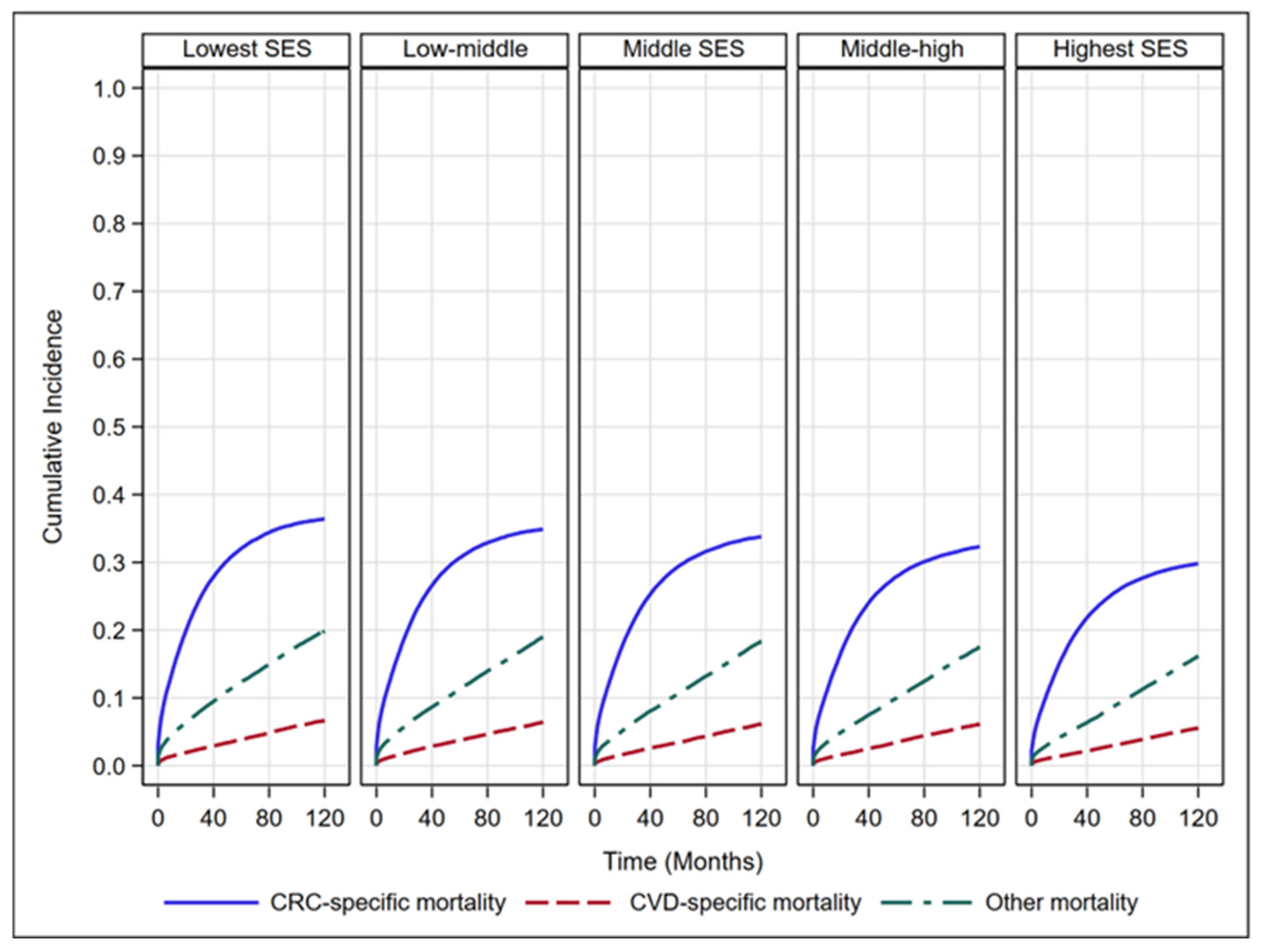
The 10-year cumulative incidence of CVD-specific mortality across all Yost Index groups (Gray’s test, p < 0.001), accounting for competing risks from CRC-specific and other causes of death (Figure 2). The unadjusted CIFs revealed a consistent SES gradient for CVD-specific, CRC-specific mortality, and death due to other causes. Individuals in the lowest SES group experienced the highest cumulative incidence of all three outcomes. In contrast, the highest SES group exhibited the lowest incidence of all three outcomes. The curves demonstrated a clear “dose–response” relationship, with cumulative incidence decreasing progressively from the lowest to the highest SES category over the follow-up period.
Note: Each panel represents a distinct cause of death: cardiovascular disease (CVD), colorectal cancer (CRC), or other causes by Yost Index quintiles. Curves depict the probability of death from the specified cause over time, accounting for competing risks. Data is drawn from SEER for the years 2006–2018. Higher Yost index quintiles indicate greater neighborhood advantage.
Compared with the highest SES quintile group, lower SES quintile groups were associated with progressively higher mortality risks after adjustment for potential confounders (Table 2). For overall mortality, adjusted hazard ratios increased across SES quintile groups: 1.10 (95% CI, 1.06–1.14) in Group 4, 1.18 (95% CI, 1.14–1.21) in Group 3, 1.23 (95% CI, 1.20–1.26) in Group 2, and 1.31 (95% CI, 1.28–1.33) in Group 1 (lowest SES) (p-trend < 0.001). In the cause-specific analysis for CVD mortality, the aHRs also increased with lower SES groups, ranging from 1.07 (95% CI, 0.94–1.22) in Group 4 to 1.39 (95% CI, 1.30–1.48) in Group 1 (p-trend < 0.001), indicating the strongest relative impact of neighborhood disadvantage on CVD outcomes. For cancer-specific mortality, a clear gradient was also observed, with aHRs ranging from 1.09 (95% CI, 1.06–1.11) in Group 4 to 1.24 (95% CI, 1.18–1.30) in Group 1 (p-trend < 0.001). These results demonstrate a graded inverse association between neighborhood SES and mortality, with the most disadvantaged neighborhoods exhibiting the highest risk across all outcomes, particularly for all-cause and CVD mortality.
The RMSTs were calculated over a 60-month horizon and demonstrated progressively shorter survival with increasing neighborhood disadvantage across SES quintiles (Table 3). Group 5 (highest SES) had the longest RMST of 45.5 months (95% CI, 45.3–45.6). Compared to this reference, RMST decreased incrementally in more disadvantaged neighborhoods, with Group 1 showing the most significant reduction of 5.0 months (95% CI, −5.2–4.7; p < 0.0001). All pairwise differences between groups were statistically significant (p < 0.0001), indicating a clear socioeconomic gradient in survival.

3.3. Effect Modification

Significant effect modification by neighborhood SES was observed across demographic subgroups (Supplementary Tables S1–S3). CVD mortality increased sharply with age and was consistently higher among men, with the steepest gradients in the most disadvantaged neighborhoods (all p for interaction < 0.0001). In contrast, racial and ethnic differences in CVD mortality were less pronounced (p interaction = 0.62); however, Asian/Pacific Islander and Hispanic individuals had a lower risk of CVD mortality than White individuals across all SES quintiles. Males consistently experienced higher CVD-specific mortality than females across all SES quintiles, indicating sex-based differences in the relationship between neighborhood disadvantage and cardiovascular risk. For all-cause and CRC mortality, SES-related differences in mortality were also evident, with stronger gradients among older adults and men.

4. Discussion

In this large, population-based study, we found that greater neighborhood disadvantage was associated with a higher mortality rate. We used the Yost Index, a detailed census tract–level measure focused on economic aspects of neighborhood socioeconomic status (SES) [21], to assess disparities with greater precision. Individuals residing in the most disadvantaged group (lowest SES group) experienced higher overall, CVD-specific, and CRC–specific mortality compared with those in the highest SES group. Although disparities in all-cause and cause-specific mortality by SES are well established [36,37], our study is among the first to demonstrate differences in CVD-specific mortality among CRC survivors by neighborhood disadvantage [19]. Leveraging a large, population-based cohort and a multidimensional measure of neighborhood SES, this study captures the spectrum of socioeconomic disadvantage across the U.S. By accounting for competing risks and evaluating multiple mortality outcomes, our findings provide novel insights into the association of neighborhood disadvantage and survivorship outcomes among CRC patients.

4.1. Treatment-Related Factors

Chemotherapy for CRC often includes agents such as platinum-based drugs, fluorouracil, and anti-vascular endothelial growth factor (VEGF) inhibitors. While very effective, these drugs are associated with cardiotoxicity [38,39], especially during the early post-treatment periods. Individuals residing in disadvantaged neighborhoods may lack access to specialty care, such as cardio-oncology services, which are often concentrated in academic or high-volume cancer centers located in more affluent areas [40,41]. A prior study linked the SEER data to the American Community Survey and found that poverty, unemployment, and lower income correlated with poor survival outcomes for CRC across different ethnic and racial groups [42]. Conversely, higher levels of education and having commercial insurance were linked to better survival. Lack of specialty care in disadvantaged neighborhoods further contributes to CVD and mortality [40,42]. This limited access may result in delayed identification or inadequate management of treatment-related cardiotoxicities, to preventive services, timely management of treatment-related toxicities, and specialty care [43,44]. Patients from disadvantaged neighborhoods are more likely to receive non-guideline-concordant therapies that elevate CVD risk [45]. Barriers to care, ranging from transportation and financial hardship to fewer local specialists, may further prevent timely treatment or follow-up care [46].

4.2. Psychological and Biological Pathways

Our findings suggest that neighborhood disadvantage has an independent impact on CRC survival, which is not fully accounted for by clinical and treatment factors. We observed a clear socioeconomic gradient in the hazard of death of CVD mortality, with individuals in the more disadvantaged neighborhoods associated with a higher risk, even after accounting for competing risks [16].
Chronic exposure to stressors [47,48], such as crime, violence, and limited social cohesion, can activate stress-related biological pathways. These include increased sympathetic system upregulation of proinflammatory signaling via conserved transcriptional gene adversity (CTRA) in leukocytes [49,50,51]. Research in animal and human studies suggests that such changes may promote tumor progression and contribute to excess mortality [52,53]. Integrating social determinants of health into cancer biology research could provide new avenues for intervention, especially when paired with upstream policy efforts to address structural inequities [54].

4.3. Physical Environment and Health Behaviors

Neighborhood-level SES also captures features of the built and physical environment that influence health behaviors and exposures. Disadvantaged neighborhoods may lack access to healthy food, safe spaces for physical activity, and adequate healthcare services, factors that extend beyond individual-level characteristics [16]. Such environments contribute to a higher prevalence of obesity, diabetes, tobacco use, unhealthy diet, alcohol consumption, and other shared risk factors for both CRC and CVD [20]. Low CRC screening rates leading to delayed diagnosis are consistently observed in these communities, often resulting in later-stage disease and poorer prognosis [55]. In parallel, persistent inequities in cardiovascular risk factor management and access to timely care for CVD events may contribute to CVD mortality [16]. These findings align with prior research showing that CVD is the leading non-cancer cause of death among CRC survivors [7,20]. Addressing area-level social and structural determinants of health is essential when designing interventions to reduce CVD-specific mortality in this population [56].

4.4. Strengths and Limitations

The strengths of this study include the use of a large sample size from a population-based cohort, enabling the examination of differences by neighborhood SES groups across the U.S. population. However, our study has certain limitations. First, while census tract–level SES is a validated proxy, it does not fully capture individual-level socioeconomic variation, which may result in exposure misclassification. Second, neighborhood socioeconomic status (SES) was measured only at diagnosis and may have changed during follow-up. This introduces the possibility of non-differential exposure misclassification, which could bias the results toward the null. Third, the SEER lacks important variables such as insurance status, detailed treatment characteristics, treatment rationale, treatment intensity, prior comorbidities, tobacco use, and alcohol consumption, which may confound the observed associations. Finally, our findings are based on U.S. SEER data and may not be generalizable to populations outside the United States, which have different healthcare systems and demographic characteristics. Despite these limitations, our findings contribute to a better understanding of how neighborhood disadvantage is associated with long-term, cause-specific mortality outcomes in CRC survivors.

5. Conclusions

In summary, residence in disadvantaged neighborhoods is independently associated with higher mortality among CRC, with CVD having a significant role in these deaths. Differences in outcomes are influenced not only by individual factors but also by neighborhood-level contextual factors, highlighting the importance of looking beyond the individual level [57]. Future studies that incorporate neighborhood disadvantage into risk stratification could offer a holistic approach essential for advancing precision oncology and guiding effective cancer control interventions. These findings may also inform clinical and public health interventions aimed at reducing cardiovascular risk and improving long-term survival among adults with CRC.

Supplementary Materials

The following supporting information can be downloaded at: https://www.mdpi.com/article/10.3390/cancers17233782/s1, Figure S1: Flow chart of adults 20 years and older with primary colorectal cancer using the Surveillance, Epidemiology, and End Results database (SEER), 2006–2017; Table S1: Joint association between race/ethnicity and neighborhood disadvantage (Yost Index) with mortality; Table S2: Joint association between age and neighborhood disadvantage (Yost Index) with mortality; Table S3: Joint association between gender and neighborhood disadvantage (Yost Index) with mortality.

Author Contributions

Conceptualization, N.V. and S.D.K.; methodology, N.V. and S.D.K.; formal analysis, N.V.; writing—original draft preparation, N.V., H.V., and S.D.K.; supervision, S.D.K. and D.B.; funding acquisition, S.D.K.; writing—review & editing, M.G., K.T., P.S. and K.E.H. All authors have read and agreed to the published version of the manuscript.

Funding

The study was supported by the UF Health Cancer Institute.

Institutional Review Board Statement

This study was exempted by the Institutional Review Board of the University of Florida because the analysis was based on publicly available data.

Informed Consent Statement

As no patients were enrolled directly in the study, no informed consent was collected.

Data Availability Statement

The data analyzed in this study are available from the SEER database, which can be accessed through the NCI (https://seer.cancer.gov/data-software, accessed on 30 September 2024).

Conflicts of Interest

The authors declare no conflicts of interest.

References

  1. Siegel, R.L.; Kratzer, T.B.; Giaquinto, A.N.; Sung, H.; Jemal, A. Cancer statistics, 2025. CA A Cancer J. Clin. 2025, 75, 10–45. [Google Scholar] [CrossRef] [PubMed]
  2. National Cancer Institute. Cancer Stat Facts: Colorectal Cancer. Available online: https://seer.cancer.gov/statfacts/html/colorect.html (accessed on 28 April 2025).
  3. American Cancer Society: Key Statistics for Colorectal Cancer. Available online: https://www.cancer.org/cancer/types/colon-rectal-cancer/about/key-statistics.html (accessed on 25 April 2025).
  4. Weaver, K.E.; Foraker, R.E.; Alfano, C.M.; Rowland, J.H.; Arora, N.K.; Bellizzi, K.M.; Hamilton, A.S.; Oakley-Girvan, I.; Keel, G.; Aziz, N.M. Cardiovascular risk factors among long-term survivors of breast, prostate, colorectal, and gynecologic cancers: A gap in survivorship care? J. Cancer Surviv. 2013, 7, 253–261. [Google Scholar] [CrossRef] [PubMed]
  5. Florido, R.; Daya, N.R.; Ndumele, C.E.; Koton, S.; Russell, S.D.; Prizment, A.; Blumenthal, R.S.; Matsushita, K.; Mok, Y.; Felix, A.S.; et al. Cardiovascular Disease Risk Among Cancer Survivors. J. Am. Coll. Cardiol. 2022, 80, 22–32. [Google Scholar] [CrossRef] [PubMed]
  6. Zullig, L.L.; Smith, V.A.; Lindquist, J.H.; Williams, C.D.; Weinberger, M.; Provenzale, D.; Jackson, G.L.; Kelley, M.J.; Danus, S.; Bosworth, H.B. Cardiovascular disease-related chronic conditions among Veterans Affairs nonmetastatic colorectal cancer survivors: A matched case-control analysis. Cancer Manag. Res. 2019, 11, 6793–6802. [Google Scholar] [CrossRef]
  7. Zhang, T.; Zhu, H.; Hu, H.; Hu, H.; Zhan, W.; Jiang, L.; Tang, M.; Escobar, D.; Huang, W.; Feng, Y.; et al. Cardiovascular-specific mortality and risk factors in colorectal Cancer patients: A cohort study based on registry data of over 500,000 individuals in the US. Prev. Med. 2024, 179, 107796. [Google Scholar] [CrossRef]
  8. Koene, R.J.; Prizment, A.E.; Blaes, A.; Konety, S.H. Shared risk factors in cardiovascular disease and cancer. Circulation 2016, 133, 1104–1114. [Google Scholar] [CrossRef]
  9. Zhang, S.; Wang, Y.; Zhang, P.; Ai, L.; Liu, T. Cardiovascular Outcomes in the Patients With Colorectal Cancer: A Multi-Registry-Based Cohort Study of 197,699 Cases in the Real World. Front. Cardiovasc. Med. 2022, 9, 851833. [Google Scholar] [CrossRef]
  10. Muhandiramge, J.; Zalcberg, J.R.; van Londen, G.J.; Warner, E.T.; Carr, P.R.; Haydon, A.; Orchard, S.G. Cardiovascular Disease in Adult Cancer Survivors: A Review of Current Evidence, Strategies for Prevention and Management, and Future Directions for Cardio-oncology. Curr. Oncol. Rep. 2022, 24, 1579–1592. [Google Scholar] [CrossRef]
  11. Aleman, B.M.; Moser, E.C.; Nuver, J.; Suter, T.M.; Maraldo, M.V.; Specht, L.; Vrieling, C.; Darby, S.C. Cardiovascular disease after cancer therapy. Eur. J. Cancer Suppl. 2014, 12, 18–28. [Google Scholar] [CrossRef]
  12. Wilcox, N.S.; Amit, U.; Reibel, J.B.; Berlin, E.; Howell, K.; Ky, B. Cardiovascular disease and cancer: Shared risk factors and mechanisms. Nat. Rev. Cardiol. 2024, 21, 617–631. [Google Scholar] [CrossRef]
  13. Sturgeon, K.M.; Deng, L.; Bluethmann, S.M.; Zhou, S.; Trifiletti, D.M.; Jiang, C.; Kelly, S.P.; Zaorsky, N.G. A population-based study of cardiovascular disease mortality risk in US cancer patients. Eur. Heart J. 2019, 40, 3889–3897. [Google Scholar] [CrossRef]
  14. Ksinan, A.J.; Vazsonyi, A.T. Understanding neighborhood disadvantage: A behavior genetic analysis. J. Crim. Justice 2021, 73, 101782. [Google Scholar] [CrossRef]
  15. Malla, G.; Long, D.L.; Cherrington, A.; Goyal, P.; Guo, B.; Safford, M.M.; Khodneva, Y.; Cummings, D.M.; McAlexander, T.P.; DeSilva, S. Neighborhood disadvantage and risk of heart failure: The Reasons for Geographic and Racial Differences in Stroke (REGARDS) study. Circ. Cardiovasc. Qual. Outcomes 2024, 17, e009867. [Google Scholar] [CrossRef] [PubMed]
  16. Kershaw, K.N.; Magnani, J.W.; Diez Roux, A.V.; Camacho-Rivera, M.; Jackson, E.A.; Johnson, A.E.; Magwood, G.S.; Morgenstern, L.B.; Salinas, J.J.; Sims, M.; et al. Neighborhoods and Cardiovascular Health: A Scientific Statement From the American Heart Association. Circ. Cardiovasc. Qual. Outcomes 2024, 17, e000124. [Google Scholar] [CrossRef] [PubMed]
  17. Xiao, Y.Y.; Graham, G. Where we live: The impact of neighborhoods and community factors on cardiovascular health in the United States. Clin. Cardiol. 2019, 42, 184–189. [Google Scholar] [CrossRef] [PubMed]
  18. Kashyap, M.K.; Mangrulkar, S.V.; Kushwaha, S.; Ved, A.; Kale, M.B.; Wankhede, N.L.; Taksande, B.G.; Upaganlawar, A.B.; Umekar, M.J.; Koppula, S.; et al. Recent Perspectives on Cardiovascular Toxicity Associated with Colorectal Cancer Drug Therapy. Pharmaceuticals 2023, 16, 1441. [Google Scholar] [CrossRef]
  19. Danos, D.M.; Ferguson, T.F.; Simonsen, N.R.; Leonardi, C.; Yu, Q.; Wu, X.C.; Scribner, R.A. Neighborhood disadvantage and racial disparities in colorectal cancer incidence: A population-based study in Louisiana. Ann. Epidemiol. 2018, 28, 316–321.e312. [Google Scholar] [CrossRef]
  20. Gaitanidis, A.; Spathakis, M.; Tsalikidis, C.; Alevizakos, M.; Tsaroucha, A.; Pitiakoudis, M. Risk factors for cardiovascular mortality in patients with colorectal cancer: A population-based study. Int. J. Clin. Oncol. 2019, 24, 501–507. [Google Scholar] [CrossRef]
  21. Yost, K.; Perkins, C.; Cohen, R.; Morris, C.; Wright, W. Socioeconomic status and breast cancer incidence in California for different race/ethnic groups. Cancer Causes Control 2001, 12, 703–711. [Google Scholar] [CrossRef]
  22. Boscoe, F.P.; Liu, B.; Lee, F. A comparison of two neighborhood-level socioeconomic indexes in the United States. Spat. Spatiotemporal Epidemiol. 2021, 37, 100412. [Google Scholar] [CrossRef]
  23. Loomans-Kropp, H.A.; Elsaid, M.I.; Kweon, Y.; Noonan, A.M.; Stanich, P.P.; Plascak, J.; Kalady, M.F.; Doubeni, C.A.; Paskett, E.D. Neighborhood level socioeconomic disparities are associated with reduced colorectal cancer survival. Sci. Rep. 2025, 15, 32795. [Google Scholar] [CrossRef] [PubMed]
  24. Ng, H.S.; Meng, R.; Marin, T.S.; Damarell, R.A.; Buckley, E.; Selvanayagam, J.B.; Koczwara, B. Cardiovascular mortality in people with cancer compared to the general population: A systematic review and meta-analysis. Cancer Med. 2024, 13, e70057. [Google Scholar] [CrossRef] [PubMed]
  25. Arun, A.S.; Sawano, M.; Lu, Y.; Warner, F.; Caraballo, C.; Khera, R.; Echols, M.R.; Yancy, C.W.; Krumholz, H.M. Excess Cardiovascular Mortality Among Black Americans 2000–2022. JACC 2024, 84, 581–588. [Google Scholar] [CrossRef] [PubMed]
  26. Guan, T.; Monteiro, O.; Chen, D.; Luo, Z.; Chi, K.; Li, Z.; Liang, Y.; Lu, Z.; Jiang, Y.; Yang, J. Long-term and short-term cardiovascular disease mortality among patients of 21 non-metastatic cancers. J. Adv. Res. 2025, 69, 215–224. [Google Scholar] [CrossRef]
  27. Surveillance, Epidemiology, and End Results (SEER) Program. SEER*Stat Database: Incidence—SEER Research Data, 18 Registries (2000–2018), National Cancer Institute, DCCPS, Surveillance Research Program, Released April 2021, Based on the November 2020 Submission. Available online: https://seer.cancer.gov/data-software/documentation/seerstat/nov2020/ (accessed on 1 April 2025).
  28. Cuschieri, S. The STROBE guidelines. Saudi J. Anaesth. 2019, 13, S31–S34. [Google Scholar] [CrossRef]
  29. Goel, N.; Hernandez, A.E.; Mazul, A. Neighborhood Disadvantage and Breast Cancer–Specific Survival in the US. JAMA Netw. Open 2024, 7, e247336. [Google Scholar] [CrossRef]
  30. Moss, J.L.; Stinchcomb, D.G.; Yu, M. Providing Higher Resolution Indicators of Rurality in the Surveillance, Epidemiology, and End Results (SEER) Database: Implications for Patient Privacy and Research. Cancer Epidemiol. Biomark. Prev. 2019, 28, 1409–1416. [Google Scholar] [CrossRef]
  31. Sharma, R.K.; Irace, A.L.; Overdevest, J.B.; Turner, J.H.; Patel, Z.M.; Gudis, D.A. Association of Race, Ethnicity, and Socioeconomic Status With Esthesioneuroblastoma Presentation, Treatment, and Survival. OTO Open 2022, 6, 2473974x221075210. [Google Scholar] [CrossRef]
  32. Zhang, M.J.; Zhang, X.; Scheike, T.H. Modeling cumulative incidence function for competing risks data. Expert Rev. Clin. Pharmacol. 2008, 1, 391–400. [Google Scholar] [CrossRef]
  33. Cox, D.R. Regression models and life-tables. J. R. Stat. Soc. Ser. B (Methodol.) 1972, 34, 187–202. [Google Scholar] [CrossRef]
  34. Lin, D.Y.; Wei, L.J.; Ying, Z. Checking the Cox model with cumulative sums of martingale-based residuals. Biometrika 1993, 80, 557–572. [Google Scholar] [CrossRef]
  35. Uno, H.; Claggett, B.; Tian, L.; Inoue, E.; Gallo, P.; Miyata, T.; Schrag, D.; Takeuchi, M.; Uyama, Y.; Zhao, L.; et al. Moving beyond the hazard ratio in quantifying the between-group difference in survival analysis. J. Clin. Oncol. 2014, 32, 2380–2385. [Google Scholar] [CrossRef] [PubMed]
  36. Liu, L.; Wen, W.; Shrubsole, M.J.; Lipworth, L.E.; Mumma, M.T.; Ackerly, B.A.; Shu, X.O.; Blot, W.J.; Zheng, W. Impacts of Poverty and Lifestyles on Mortality: A Cohort Study in Predominantly Low-Income Americans. Am. J. Prev. Med. 2024, 67, 15–23. [Google Scholar] [CrossRef]
  37. Stringhini, S.; Carmeli, C.; Jokela, M.; Avendaño, M.; Muennig, P.; Guida, F.; Ricceri, F.; d’Errico, A.; Barros, H.; Bochud, M.; et al. Socioeconomic status and the 25 × 25 risk factors as determinants of premature mortality: A multicohort study and meta-analysis of 1.7 million men and women. Lancet 2017, 389, 1229–1237. [Google Scholar] [CrossRef]
  38. Morelli, M.B.; Bongiovanni, C.; Da Pra, S.; Miano, C.; Sacchi, F.; Lauriola, M.; D’Uva, G. Cardiotoxicity of Anticancer Drugs: Molecular Mechanisms and Strategies for Cardioprotection. Front. Cardiovasc. Med. 2022, 9, 847012. [Google Scholar] [CrossRef]
  39. Yeh, E.T.; Bickford, C.L. Cardiovascular complications of cancer therapy: Incidence, pathogenesis, diagnosis, and management. J. Am. Coll. Cardiol. 2009, 53, 2231–2247. [Google Scholar] [CrossRef]
  40. Barac, A.; Murtagh, G.; Carver, J.R.; Chen, M.H.; Freeman, A.M.; Herrmann, J.; Iliescu, C.; Ky, B.; Mayer, E.L.; Okwuosa, T.M.; et al. Cardiovascular Health of Patients With Cancer and Cancer Survivors: A Roadmap to the Next Level. J. Am. Coll. Cardiol. 2015, 65, 2739–2746. [Google Scholar] [CrossRef]
  41. Wolfson, J.A.; Sun, C.L.; Wyatt, L.P.; Hurria, A.; Bhatia, S. Impact of care at comprehensive cancer centers on outcome: Results from a population-based study. Cancer 2015, 121, 3885–3893. [Google Scholar] [CrossRef]
  42. Aloysius, M.M.; Goyal, H.; Shah, N.J.; Pallav, K.; John, N.; Gajendran, M.; Perisetti, A.; Tharian, B. Impact of Race and Socioeconomics Disparities on Survival in Young-Onset Colorectal Adenocarcinoma-A SEER Registry Analysis. Cancers 2021, 13, 3262. [Google Scholar] [CrossRef]
  43. Carethers, J.M.; Doubeni, C.A. Causes of Socioeconomic Disparities in Colorectal Cancer and Intervention Framework and Strategies. Gastroenterology 2020, 158, 354–367. [Google Scholar] [CrossRef] [PubMed]
  44. Robinson, J.R.M.; Phipps, A.I.; Barrington, W.E.; Hurvitz, P.M.; Sheppard, L.; Malen, R.C.; Newcomb, P.A. Associations of Household Income with Health-Related Quality of Life Following a Colorectal Cancer Diagnosis Varies With Neighborhood Socioeconomic Status. Cancer Epidemiol. Biomark. Prev. 2021, 30, 1366–1374. [Google Scholar] [CrossRef] [PubMed]
  45. Yu, K.X.; Yuan, W.J.; Huang, C.H.; Xiao, L.; Xiao, R.S.; Zeng, P.W.; Chen, L.; Chen, Z.H. Socioeconomic deprivation and survival outcomes in patients with colorectal cancer. Am. J. Cancer Res. 2022, 12, 829–838. [Google Scholar] [PubMed]
  46. Planey, A.M.; Spees, L.P.; Biddell, C.B.; Waters, A.; Jones, E.P.; Hecht, H.K.; Rosenstein, D.; Wheeler, S.B. The intersection of travel burdens and financial hardship in cancer care: A scoping review. JNCI Cancer Spectr. 2024, 8, pkae093. [Google Scholar] [CrossRef]
  47. Costanzo, E.S.; Sood, A.K.; Lutgendorf, S.K. Biobehavioral influences on cancer progression. Immunol. Allergy Clin. N. Am. 2011, 31, 109–132. [Google Scholar] [CrossRef]
  48. Smith, J.A.; Zhao, W.; Wang, X.; Ratliff, S.M.; Mukherjee, B.; Kardia, S.L.R.; Liu, Y.; Roux, A.V.D.; Needham, B.L. Neighborhood characteristics influence DNA methylation of genes involved in stress response and inflammation: The Multi-Ethnic Study of Atherosclerosis. Epigenetics 2017, 12, 662–673. [Google Scholar] [CrossRef]
  49. Antoni, M.H.; Dhabhar, F.S. The impact of psychosocial stress and stress management on immune responses in patients with cancer. Cancer 2019, 125, 1417–1431. [Google Scholar] [CrossRef]
  50. Cole, S.W. The Conserved Transcriptional Response to Adversity. Curr. Opin. Behav. Sci. 2019, 28, 31–37. [Google Scholar] [CrossRef]
  51. McEwen, B.S. Sex, stress and the hippocampus: Allostasis, allostatic load and the aging process. Neurobiol. Aging 2002, 23, 921–939. [Google Scholar] [CrossRef]
  52. Iyer, H.S.; Gomez, S.L.; Cheng, I.; Rebbeck, T.R. Relative impact of genetic ancestry and neighborhood socioeconomic status on all-cause mortality in self-identified African Americans. PLoS ONE 2022, 17, e0273735. [Google Scholar] [CrossRef]
  53. Cole, S.W.; Nagaraja, A.S.; Lutgendorf, S.K.; Green, P.A.; Sood, A.K. Sympathetic nervous system regulation of the tumour microenvironment. Nat. Rev. Cancer 2015, 15, 563–572. [Google Scholar] [CrossRef]
  54. Abdullah, A.; Liu, Z.; Molinari, M. From Diagnosis to Survivorship: The Role of Social Determinants in Cancer Care. Cancers 2025, 17, 1067. [Google Scholar] [CrossRef]
  55. Warren Andersen, S.; Blot, W.J.; Lipworth, L.; Steinwandel, M.; Murff, H.J.; Zheng, W. Association of Race and Socioeconomic Status With Colorectal Cancer Screening, Colorectal Cancer Risk, and Mortality in Southern US Adults. JAMA Netw. Open 2019, 2, e1917995. [Google Scholar] [CrossRef]
  56. Bazoukis, G.; Loscalzo, J.; Hall, J.L.; Bollepalli, S.C.; Singh, J.P.; Armoundas, A.A. Impact of Social Determinants of Health on Cardiovascular Disease. J. Am. Heart Assoc. 2025, 14, e039031. [Google Scholar] [CrossRef]
  57. Barber, S.; Hickson, D.A.; Kawachi, I.; Subramanian, S.V.; Earls, F. Neighborhood Disadvantage and Cumulative Biological Risk Among a Socioeconomically Diverse Sample of African American Adults: An Examination in the Jackson Heart Study. J. Racial Ethn. Health Disparities 2016, 3, 444–456. [Google Scholar] [CrossRef]
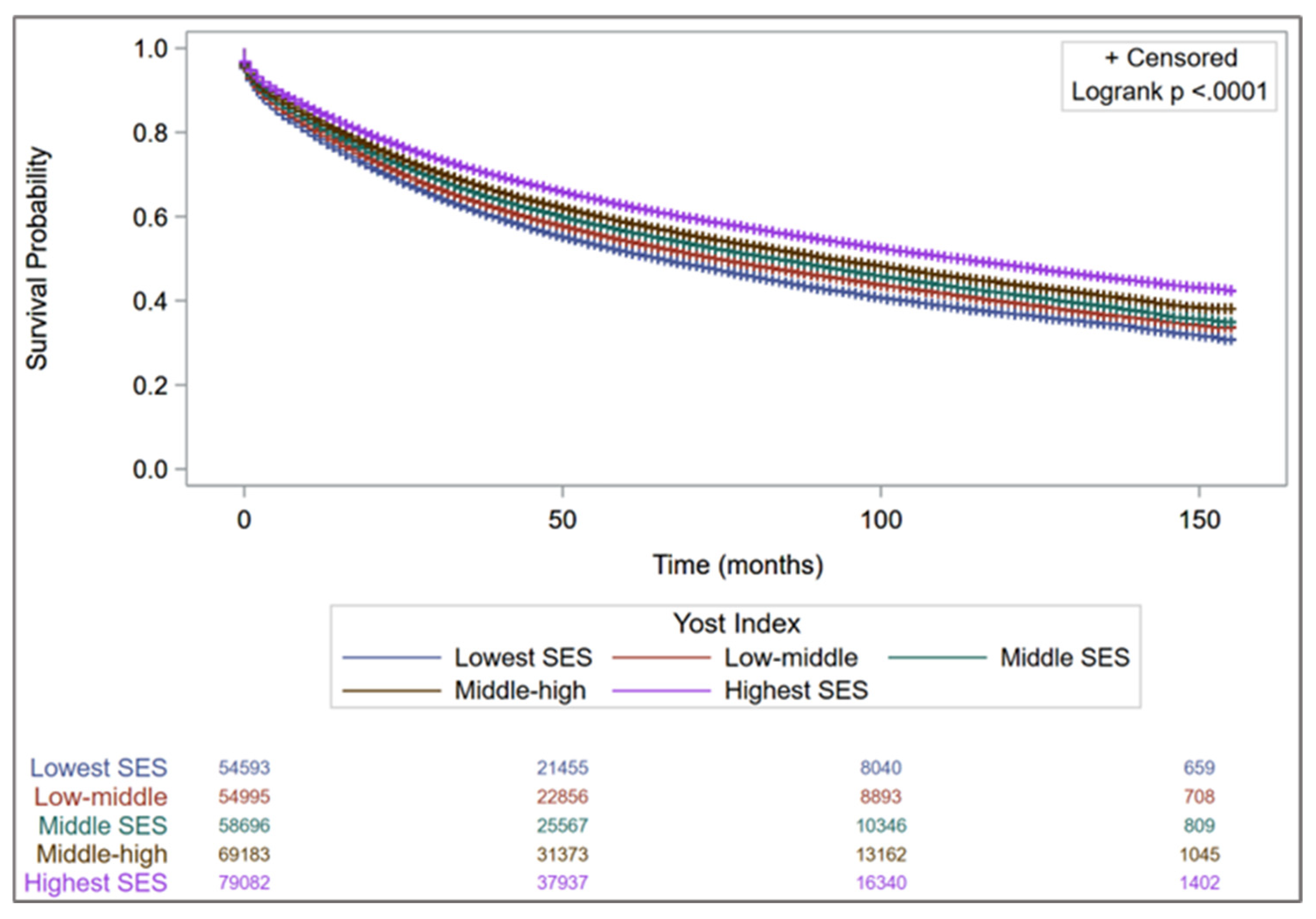
Figure 1. Kaplan–Meier Curves for Overall Survival by Yost Index Quintiles.
Cancers 17 03782 g001
Figure 2. Cumulative Incidence of Mortality by Yost Index Quintiles.
Cancers 17 03782 g002
Table 1. Characteristics of Colorectal Cancer Patients by Neighborhood Disadvantage (Yost Index Quintiles), SEER 2006–2017 (N + 316,549).
Characteristics
n (%)
Group 1
(n = 54,593)
Group 2
(n = 54,995)
Group 3
(n = 58,696)
Group 4
(n = 69,183)
Group 5
(n = 79,082)
Age group, y      
 20–496572 (12.0)6438 (11.7)7095 (12.1)8415 (12.2)10,339 (13.1)
 50–6420,264 (37.1)19,266 (35.0)20,246 (34.5)23,664 (34.2)26,808 (33.9)
 65–7413,937 (25.5)14,019 (25.5)14,319 (24.4)16,568 (23.9)18,290 (23.1)
 ≥7513,820 (25.3)15,272 (27.8)17,036 (29.0)20,536 (29.7)23,645 (29.9)
Sex     
 Female26,067 (47.7)26,371 (47.9)28,130 (47.9)33,222 (48.0)37,737 (47.7)
 Male28,526 (52.3)28,624 (52.1)30,566 (52.1)35,961 (52.0)41,345 (52.3)
Race/ethnicity     
 NH-White26,250 (48.0)34,846 (63.4)39,906 (68.0)49,380 (71.4)58,999 (74.6)
 NH-Black16,935 (31.0)8072 (14.7)5896 (10.0)5031 (7.3)3361 (4.2)
 Hispanic8641 (15.8)8232 (15.0)7636 (13.0)6769 (9.8)5412 (6.8)
 NH-Asian/PI2322 (4.2)3295 (6.0)4691 (8.0)7333 (10.6)10,383 (13.1)
 NH-AI/AN276 (0.5)310 (0.6)271 (0.5)248 (0.4)217 (0.3)
 Unknown169 (0.3)240 (0.4)296 (0.5)422 (0.6)710 (0.9)
Marital status     
 Married/Partnered23,268 (42.6)27,051 (49.2)30,759 (52.4)37,967 (54.9)47,991 (61.0)
 Other31,325 (57.4)27,944 (50.8)27,937 (47.6)31,216 (45.1)31,091 (39.0)
Year of diagnosis     
 2006–200813,074 (23.9)13,488 (24.5)14,989 (25.5)18,357 (26.5)21,321 (27.0)
 2009–201113,485 (24.7)13,865 (25.2)14,693 (25.0)17,379 (25.1)19,743 (24.5)
 2012–201414,123 (25.9)13,906 (25.3)14,555 (24.8)16,840 (24.3)18,959 (24.0)
 2015–201713,911 (25.5)13,736 (25.0)14,459 (24.6)16,607 (24.0)19,059 (24.1)
Stage     
 Localized21,119 (38.7)21,669 (39.4)23,328 (39.7)28,023 (40.5)33,817 (42.0)
 Regional20,240 (37.1)20,611 (37.5)22,343 (38.1)26,217 (37.9)29,788 (37.7)
 Distant13,234 (24.2)12,715 (23.1)13,025 (22.2)14,943 (21.6)16,107 (20.4)
Tumor location     
 Right colon20,925 (38.3)21,321 (38.8)22,923 (39.0)26,980 (38.9)30,559 (38.6)
 Left colon15,040 (27.5)14,813 (26.9)15,942 (27.2)18,780 (27.1)21,226 (26.8)
 Rectum16,747 (30.7)17,099 (31.1)18,090 (30.8)21,521 (31.1)25,262 (31.9)
 Unspecified1881 (3.4)1762 (3.2)1741 (3.0)1992 (2.9)2035 (2.6)
Tumor grade     
 Well-differentiated4918 (9.0)4912 (8.9)5229 (8.9)6136 (8.9)7563 (9.6)
 Moderately differentiated33,051 (60.5)33,214 (60.4)35,562 (60.6)41,902 (60.6)46,918 (59.3)
 Poorly differentiated6867 (12.6)7431 (13.5)8220 (14.0)10,046 (14.5)12,093 (15.3)
 Undifferentiated or anaplastic1333 (2.4)1327 (2.4)1427 (2.4)1512 (2.2)1622 (2.0)
 Unknown8424 (15.4)8111 (14.7)8258 (14.1)9587 (13.9)10,886 (13.8)
Surgery Receipt     
 Yes44,882 (82.2)45,973 (83.6)49,786 (84.8)59,132 (85.5)68,166 (86.2)
 No9711 (17.8)9022 (16.4)8910 (15.2)10,051 (14.5)10,916 (13.8)
Chemotherapy     
 Yes21,428 (39.2)21,635 (39.3)23,273 (39.7)27,510 (39.8)31,934 (40.4)
 No33,165 (60.8)33,360 (60.7)35,423 (60.3)41,673 (60.2)47,148 (59.6)
Radiation     
 Yes7927 (14.5)8085 (14.7)8597 (14.6)9884 (14.3)11,195 (14.2)
 No46,666 (85.5)46,910 (85.3)50,099 (85.4)59,299 (85.7)67,887 (85.8)
Months of follow-up, Median (IQR)36 (13–74)38 (38–79)41 (16–82)43 (17–86)47 (19–90)
Abbreviations: NH—Non-Hispanic; PI—Pacific Islander; AI/AN—American Indian/Alaska Native; IQR—Inter-quartile range. Yost Index Quintiles: Neighborhood socioeconomic status measured using the Yost Index, categorized into quintiles. Group 1 represents the lowest SES, and Group 5 represents the highest SES, with intermediate groups (2–4) representing increasing SES levels.
Table 2. All-cause mortality, cause-specific cardiovascular-related mortality, and cancer-specific mortality among US adults 20 years and older, SEER 2006–2017 (N = 316,549).
Overall MortalityCVD-Specific MortalityCancer-Specific Mortality
VariableHazard Ratio
(95% CI)
p-ValueHazard Ratio (95% CI)p-ValueHazard Ratio
(95% CI)
p-Value
Yost Index
Group 5 (highest SES) Ref  Ref Ref 
Group 41.10 (1.06–1.14)<0.0011.07 (0.94–1.22)<0.0011.09 (1.06–1.11)<0.001
Group 31.18 (1.14–1.21)<0.0011.12 (1.01–1.25)<0.0011.15 (1.12–1.19)<0.001
Group 21.23 (1.20–1.26)<0.0011.24 (1.14–1.35)<0.0011.19 (1.15–1.24)<0.001
Group 1 (lowest SES)1.31 (1.28–1.33)<0.0011.39 (1.30–1.48)<0.0011.24 (1.18–1.30)<0.001
p-trend<0.001<0.001<0.001
Abbreviations: CVD—cardiovascular disease; CRC—colorectal cancer. Models were adjusted for age, sex, race/ethnicity, marital status, year of diagnosis, stage, grade, tumor location, surgery, chemotherapy, and radiotherapy. Yost Index Quintiles: Neighborhood socioeconomic status measured using the Yost Index, categorized into quintiles. Group 1 represents the lowest SES, and Group 5 represents the highest SES, with intermediate groups (2–4) representing increasing SES levels.
Table 3. Restricted Mean Survival Time (RMST) by Neighborhood Disadvantage (Yost Index Quintiles).
Yost Index QuintileRMST (LCL to UCL)Change in RMST (LCL to UCL)p Value
Group 5 (highest SES)45.5 (45.3 to 45.6)Ref 
Group 443.7 (43.6 to 43.9)−1.8 (−1.9 to −1.5)<0.0001
Group 342.8 (42.6 to 43.9)−2.7 (−2.9 to −2.4)<0.0001
Group 241.7 (41.5 to 41.9)−3.8 (−4.0 to −3.5)<0.0001
Group 1 (lowest SES)40.5 (40.3 to 40.7)−5.0 (−5.2 to −4.7)<0.0001
Abbreviations: LCL—Lower Confidence Limit; UCL—Upper Confidence Limit. Yost Index Quintiles: Neighborhood socioeconomic status measured using the Yost Index, categorized into quintiles. Group 1 represents the lowest SES, and Group 5 represents the highest SES, with intermediate groups (2–4) representing increasing SES levels.
Disclaimer/Publisher’s Note: The statements, opinions and data contained in all publications are solely those of the individual author(s) and contributor(s) and not of MDPI and/or the editor(s). MDPI and/or the editor(s) disclaim responsibility for any injury to people or property resulting from any ideas, methods, instructions or products referred to in the content.