The In Vitro Cytotoxic Effect of Elesclomol on Breast Adenocarcinoma Cells Is Enhanced by Concurrent Treatment with Glycolytic Inhibitors
by
Josephine S. Modica-Napolitano
*,
Morgan Murray
,
Jacob Thibault
,
John-Paul Haley-Read
,
Lauren Nixdorf
,
Bridget Shanahan
,
Nicholas Iacovella
and
Carlos Reyes
Department of Biology, Merrimack College, North Andover, MA 01845, USA
*
Author to whom correspondence should be addressed.
Cancers 2024, 16(23), 4054; https://doi.org/10.3390/cancers16234054
Submission received: 29 August 2024
/
Revised: 18 November 2024
/
Accepted: 28 November 2024
/
Published: 3 December 2024
(This article belongs to the Special Issue The Warburg Effect in Cancers)
Simple Summary
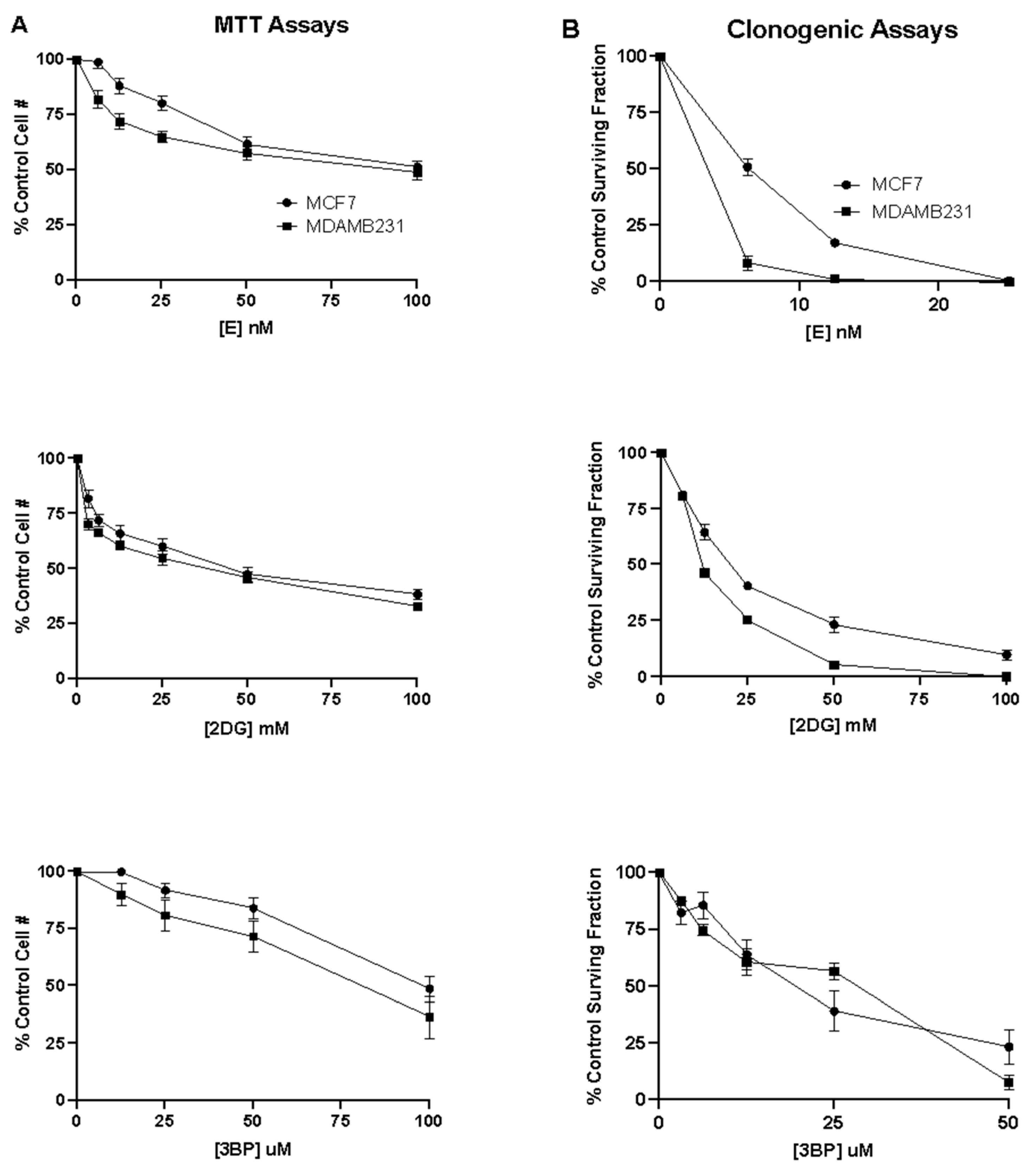
Breast cancer cells exhibit a high degree of metabolic plasticity, allowing them to shift between glycolytic and mitochondrial ATP-producing pathways as a means of adapting to and surviving in a variety of growth conditions. Consequently, breast cancer cells exposed to a single chemotherapeutic agent that inhibits only one of these major cellular ATP-producing pathways can meet their energy demands by using the alternative pathway. This study explored a novel drug combination aimed simultaneously at both means of energy production in MCF7 and MDA-MB-231 breast adenocarcinoma cells. Our data show that dual treatment of these cells with the mitochondria-targeting anticancer agent, elesclomol, and either glycolytic inhibitor, 2-deoxy-D-glucose or 3-bromopyruvate resulted in greater cytotoxic and antiproliferative effects than those induced by any of the compounds used as a single agent. These results suggest the possibility of a novel and effective combination treatment for the enhanced cytotoxicity of breast cancer cells.
Abstract
Background/Objectives: Glycolysis and mitochondrial oxidative phosphorylation are the two major metabolic pathways for cellular ATP production. The metabolic plasticity displayed by cancer cells allows them to effectively shift between each of these pathways as a means of adapting to various growth conditions, thus ensuring their survival, proliferation and disease progression. Metabolic plasticity also provides cancer cells with the ability to circumvent many traditional monotherapies aimed at only one or the other of the major ATP-producing pathways. The purpose of this study was to determine the effectiveness of a dual treatment strategy aimed simultaneously at both pathways of ATP production in human breast cancer cells. It was hypothesized that concurrent exposure of these cells to the mitochondria-targeting chemotherapeutic agent, elesclomol, in combination with either of two glycolytic inhibitors, 2-deoxy-D-glucose or 3-bromopyruvate, would yield greater in vitro anticancer effects than those observed for any of the compounds used as a single agent. Methods: Cytotoxicity and clonogenic assays were employed to assess the survival and proliferation of MCF7 and MDA-MB-231 human breast adenocarcinoma cells exposed to the compounds alone and in combination. Results: The data obtained show that the cancer-cell-killing and antiproliferative effects of the dual treatment were significantly enhanced compared to those observed for any of the compounds alone. Conclusions: The results of this study are important in that they suggest the possibility of a novel and effective chemotherapeutic strategy for breast cancer cell killing.