Improving the Clinical Utility of Platelet Count for Cancer Detection in Primary Care: A Cohort Study in England, Canada, and Australia
by
 , ,
, ,
Luke T. A. Mounce
1 ,
,
Raff Calitri
1,
Willie Hamilton
1,
Meena Rafiq
2,3,
Jon D. Emery
2,
Vasily Giannakeas
4,5,
Joanne Kotsopoulos
4,6 and 
Sarah E. R. Bailey
1,* 1
University of Exeter Medical School, University of Exeter, Exeter EX1 3DB, UK
2
Department of General Practice and Primary Care, Centre for Cancer Research, University of Melbourne, Grattan Street, Parkville, VIC 3010, Australia
3
Epidemiology of Cancer Healthcare & Outcomes (ECHO) Group, Department of Behavioural Science, Institute of Epidemiology and Health Care (IEHC), UCL, London WC1E 7HB, UK
4
Research and Innovation Institute, Women’s College Hospital, Toronto, ON M5S 1B2, Canada
5
ICES, Toronto, ON M5T 3M6, Canada
6
Department of Epidemiology, Dalla Lana School of Public Health, University of Toronto, Toronto, ON M5T 3M7, Canada
*
Author to whom correspondence should be addressed.
Cancers 2024, 16(17), 3074; https://doi.org/10.3390/cancers16173074
Submission received: 8 April 2024
/
Revised: 27 August 2024
/
Accepted: 29 August 2024
/
Published: 4 September 2024
(This article belongs to the Section Cancer Survivorship and Quality of Life)
Simple Summary
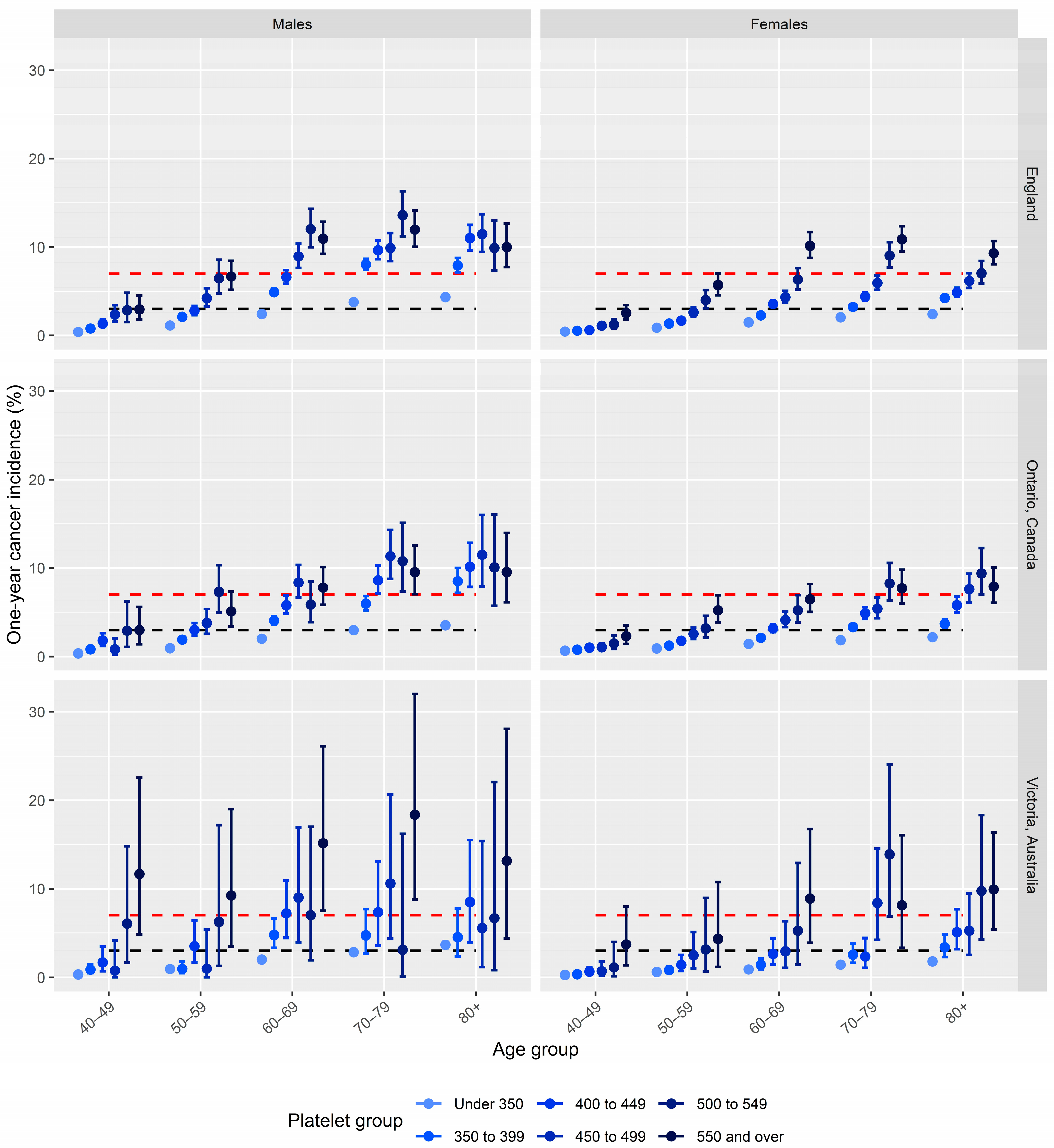
The platelet count is an established marker of cancer. In healthy populations, platelet count varies by age and sex; despite that variation, a single reference range is used. This study aimed to identify age- and sex-specific upper thresholds for platelet count at which cancer should be considered in primary care, using audits of primary care-based clinical data in England, Canada, and Australia. Across all three cohorts, there was a clear upwards trend in cancer incidence with increasing platelet count for both sexes and at all age groups. The appropriate threshold will vary by country and will depend on local healthcare needs and priorities. As colorectal and lung cancers predominate, initial investigation may target these sites. Further investigation, depending on the patient’s symptoms, could be CT imaging, endoscopy, or CA125.
Abstract
The platelet count, a component of the full blood count, has been identified as a useful diagnostic marker for cancer in primary care. The reference range for the platelet count is 150 to 400 or 450 × 109/L; this range does not account for natural variation in platelet count by age and sex. This study used three primary care cohorts from England, Canada, and Australia. Patients aged 40 years and over with a full blood count were included and stratified by age (in 10-year bands), sex, (male/female), and platelet count group. Cancer incidence within one year of the test date was estimated from linked registry data. In all three countries, there was a clear upwards trend in cancer incidence with increasing platelet count for both sexes and at all age groups. Lung and colorectal were the most common sites. These results have important implications for the international application of this work; analysis of local health datasets will be crucial to determining appropriate thresholds. Appropriate upper thresholds will depend on local populations, healthcare needs, and priorities. Further research is needed to assess the likely impact of new recommendations on the healthcare system, on cancer outcomes, and patient benefit.
Keywords:
cancer; diagnosis; primary care; family medicine; full blood count; platelet count