Characteristics and Components of Self-Management Interventions for Improving Quality of Life in Cancer Survivors: A Systematic Review

 , , , , ,
Abstract
Simple Summary
Abstract
1. Introduction
2. Methods
2.1. Search Strategy
2.2. Eligibility Criteria
2.3. Paper Selection
2.4. Data Extraction
2.4.1. Study Characteristics
2.4.2. Intervention Description
2.4.3. Risk of Bias Quality Appraisal
2.4.4. Outcomes
2.5. Data Synthesis
3. Results
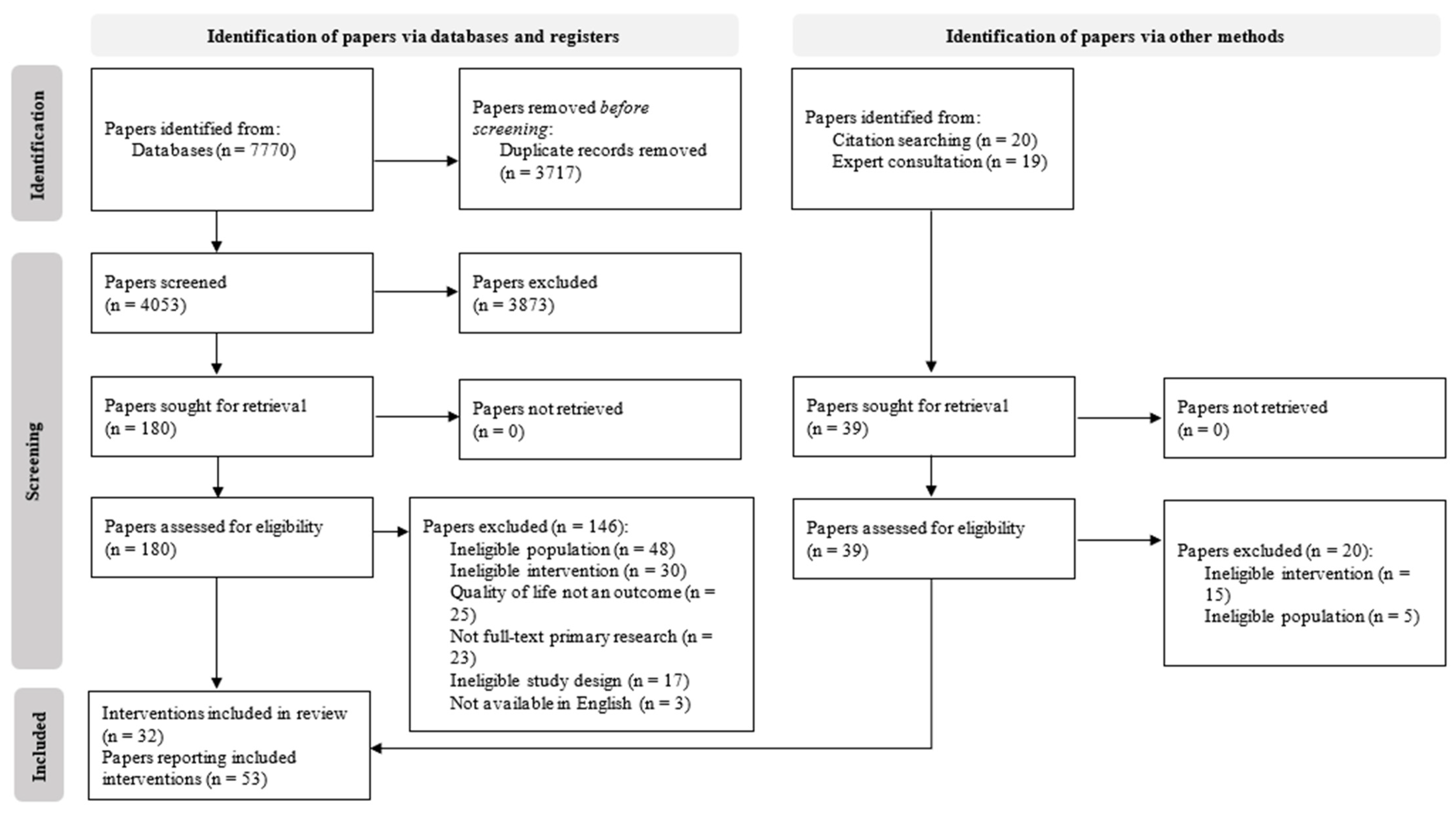
3.1. Search Results
3.2. Population Characteristics
3.3. Study Design
3.4. Intervention Description
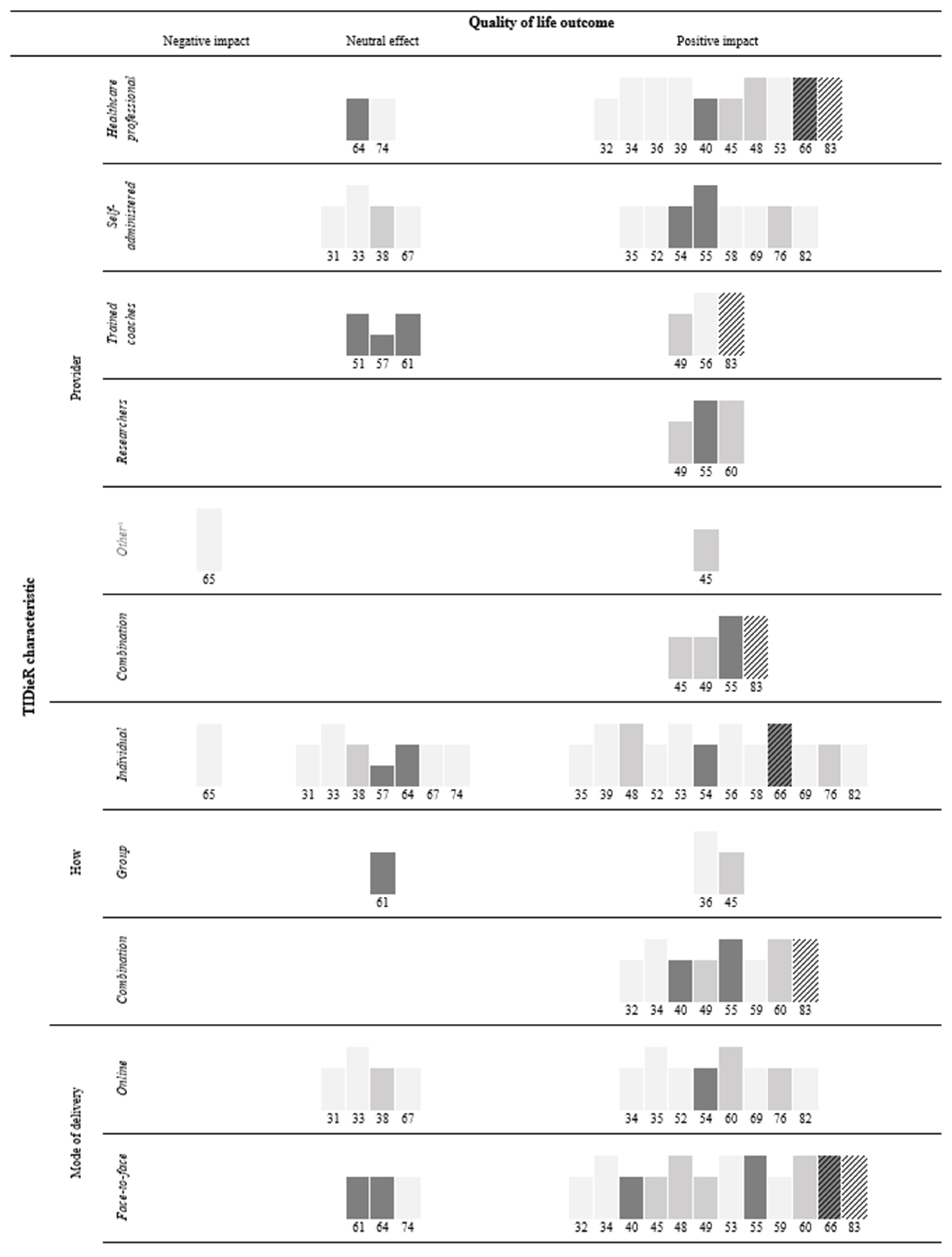
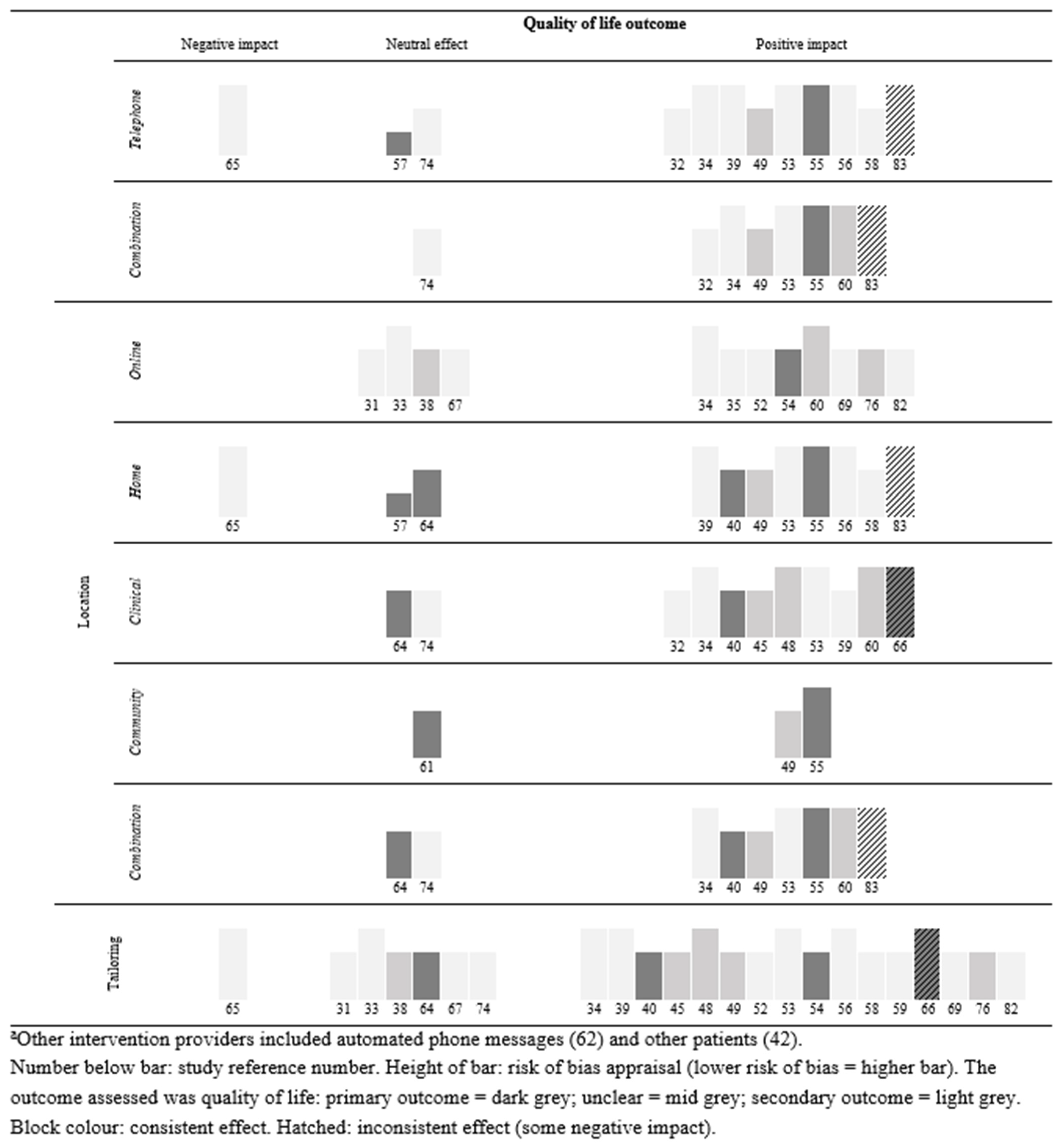
3.4.1. Intervention Characteristics (TIDieR)
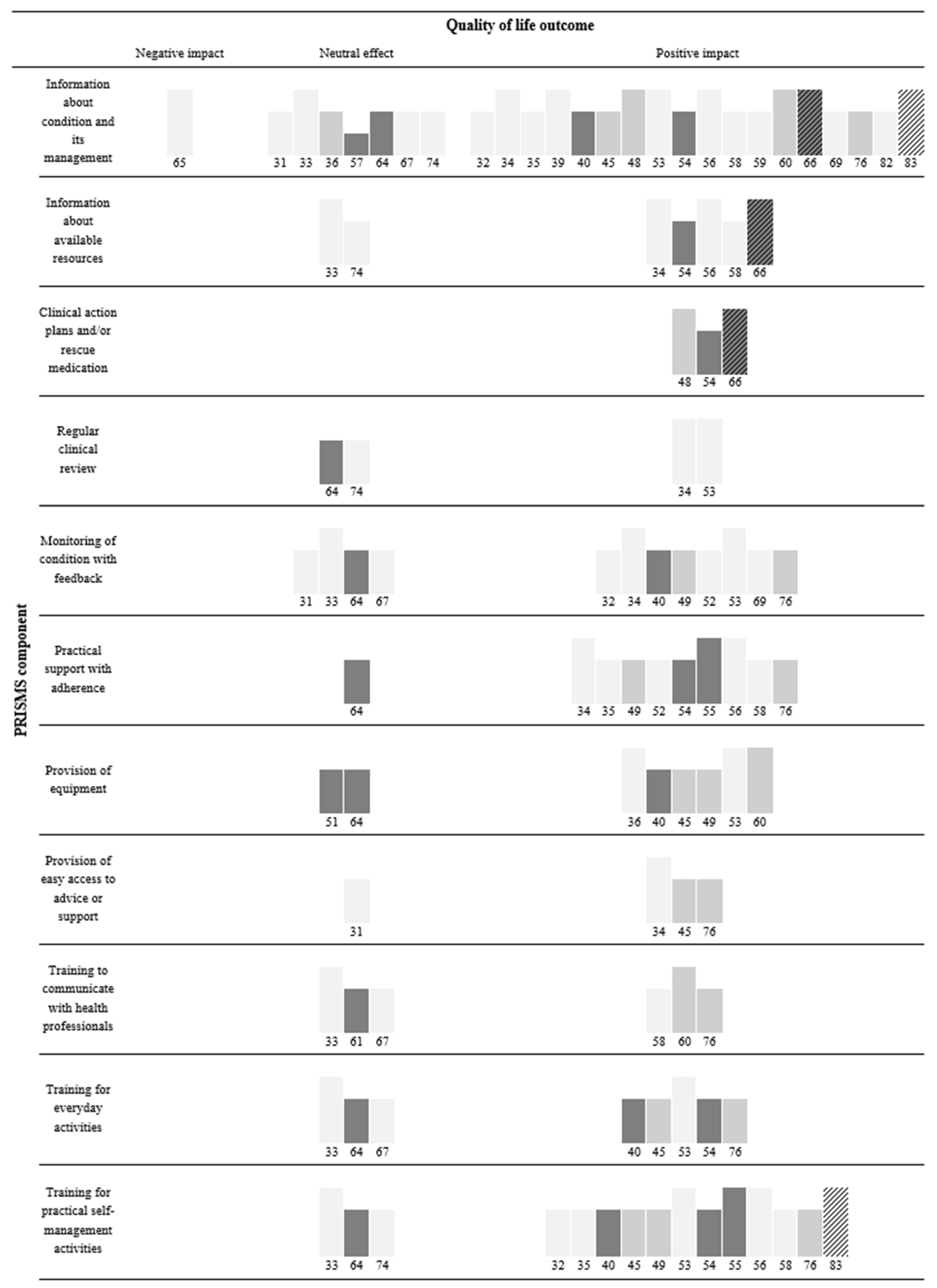
3.4.2. Intervention Components (PRISMS)
3.4.3. Self-Management Tasks
3.4.4. Implementation Issues
3.5. Risk of Bias Quality Appraisal
4. Outcomes
4.1. Quality of Life
4.2. Self-Efficacy and Additional Outcomes
4.3. Economic Factors
4.4. Associations with QoL
5. Discussion
5.1. Summary of Findings
5.2. Critical Appraisal of Evidence
5.3. Implications
5.4. Strengths and Limitations
6. Conclusions
Supplementary Materials
Author Contributions
Funding
Data Availability Statement
Conflicts of Interest
References
- Allemani, C.; Matsuda, T.; Di Carlo, V.; Harewood, R.; Matz, M.; Nikšić, M.; Bonaventure, A.; Valkov, M.; Johnson, C.J.; Estève, J.; et al. Global surveillance of trends in cancer survival 2000–14 (CONCORD-3): Analysis of individual records for 37 513 025 patients diagnosed with one of 18 cancers from 322 population-based registries in 71 countries. Lancet 2018, 391, 1023–1075. [Google Scholar] [CrossRef] [PubMed]
- Arnold, M.; Rutherford, M.; Bardot, A.; Ferlay, J.; Andersson, T.M.-L.; Myklebust, T.Å.; Tervonen, H.; Thursfield, V.; Ransom, D.; Shack, L.; et al. Progress in cancer survival, mortality, and incidence in seven high-income countries 1995–2014 (ICBP SURVMARK-2): A population-based study. Lancet Oncol. 2019, 20, 1493–1505. [Google Scholar] [CrossRef] [PubMed]
- Agbejule, O.A.; Hart, N.H.; Ekberg, S.; Crichton, M.; Chan, R.J. Self-management support for cancer-related fatigue: A systematic review. Int. J. Nurs. Stud. 2022, 129, 104206. [Google Scholar] [CrossRef] [PubMed]
- Cook, S.A.; Salmon, P.; Hayes, G.; Byrne, A.; Fisher, P.L. Predictors of emotional distress a year or more after diagnosis of cancer: A systematic review of the literature. Psycho-Oncology 2018, 27, 791–801. [Google Scholar] [CrossRef]
- Schmidt, M.E.; Goldschmidt, S.; Hermann, S.; Steindorf, K. Late effects, long-term problems and unmet needs of cancer survivors. Int. J. Cancer 2021, 151, 1280–1290. [Google Scholar] [CrossRef] [PubMed]
- Nekhlyudov, L.; Campbell, G.B.; Schmitz, K.H.; Brooks, G.A.; Kumar, A.J.; Ganz, P.A.; Von Ah, D. Cancer-related impairments and functional limitations among long-term cancer survivors: Gaps and opportunities for clinical practice. Cancer 2022, 128, 222–229. [Google Scholar] [CrossRef] [PubMed]
- Foster, C.; Brown, J.; Killen, M.; Brearley, S. The NCRI Cancer Experiences Collaborative: Defining self management. Eur. J. Oncol. Nurs. 2007, 11, 295–297. [Google Scholar] [CrossRef] [PubMed]
- McCorkle, R.; Ercolano, E.; Lazenby, M.; Schulman-Green, D.; Schilling, L.S.; Lorig, K.; Wagner, E.H. Self-management: Enabling and empowering patients living with cancer as a chronic illness. CA Cancer J. Clin. 2011, 61, 50–62. [Google Scholar] [CrossRef]
- Dwarswaard, J.; Bakker, E.J.; van Staa, A.; Boeije, H.R. Self-management support from the perspective of patients with a chronic condition: A thematic synthesis of qualitative studies. Health Expect. 2016, 19, 194–208. [Google Scholar] [CrossRef]
- Howell, D.; Harth, T.; Brown, J.; Bennett, C.; Boyko, S. Self-management education interventions for patients with cancer: A systematic review. Support. Care Cancer 2017, 25, 1323–1355. [Google Scholar] [CrossRef]
- Kim, S.H.; Kim, K.; Mayer, D.K. Self-Management Intervention for Adult Cancer Survivors After Treatment: A Systematic Review and Meta-Analysis. Oncol. Nurs. Forum 2017, 44, 719–728. [Google Scholar] [CrossRef] [PubMed]
- Kim, A.R.; Park, H.-A. Web-based Self-management Support Interventions for Cancer Survivors: A Systematic Review and Meta-analyses. MedInfo 2015, 216, 142–147. [Google Scholar]
- Boland, L.; Bennett, K.; Connolly, D. Self-management interventions for cancer survivors: A systematic review. Support. Care Cancer 2018, 26, 1585–1595. [Google Scholar] [CrossRef] [PubMed]
- Cuthbert, C.A.; Farragher, J.F.; Hemmelgarn, B.R.; Ding, Q.; McKinnon, G.P.; Cheung, W.Y. Self-management interventions for cancer survivors: A systematic review and evaluation of intervention content and theories. Psycho-Oncology 2019, 28, 2119–2140. [Google Scholar] [CrossRef]
- Panagioti, M.; Richardson, G.; Small, N.; Murray, E.; Rogers, A.; Kennedy, A.; Newman, S.; Bower, P. Self-management support interventions to reduce health care utilisation without compromising outcomes: A systematic review and meta-analysis. BMC Health Serv. Res. 2014, 14, 356. [Google Scholar] [CrossRef] [PubMed]
- Bandura, A. Social Foundations of Thought and Action: A Social Cognitive; Prentice-Hall: Englewoods Cliffs, NJ, USA, 1986. [Google Scholar]
- Pearce, G.; Parke, H.L.; Pinnock, H.; Epiphaniou, E.; LA Bourne, C.; Sheikh, A.; Taylor, S.J. The PRISMS taxonomy of self-management support: Derivation of a novel taxonomy and initial testing of its utility. J. Health Serv. Res. Policy 2016, 21, 73–82. [Google Scholar] [CrossRef] [PubMed]
- Taylor SJ, C.; Pinnock, H.; Epiphaniou, E.; Pearce, G.; Parke, H.L.; Schwappach, A.; Purushotham, N.; Jacob, S.; Griffiths, C.J.; Greenhalgh, T. A rapid synthesis of the evidence on interventions supporting self-management for people with long-term conditions: PRISMS—Practical systematic Review of Self-Management Support for long-term conditions. Health Serv. Deliv. Res. 2014, 2, 53. [Google Scholar] [CrossRef] [PubMed]
- Coffey, L.; Mooney, O.; Dunne, S.; Sharp, L.; Timmons, A.; Desmond, D.; O’Sullivan, E.; Timon, C.; Gooberman-Hill, R.; Gallagher, P. Cancer survivors’ perspectives on adjustment-focused self-management interventions: A qualitative meta-synthesis. J. Cancer Surviv. 2016, 10, 1012–1034. [Google Scholar] [CrossRef]
- Evans, R.E.; Craig, P.; Hoddinott, P.; Littlecott, H.; Moore, L.; Murphy, S.; O’Cathain, A.; Pfadenhauer, L.; Rehfuess, E.; Segrott, J. When and how do ‘effective’interventions need to be adapted and/or re-evaluated in new contexts? The need for guidance. J. Epidemiol. Community Health 2019, 73, 481–482. [Google Scholar] [CrossRef]
- Campbell, M.; Moore, G.; Evans, R.E.; Khodyakov, D.; Craig, P. ADAPT study: Adaptation of evidence-informed complex population health interventions for implementation and/or re-evaluation in new contexts: Protocol for a Delphi consensus exercise to develop guidance. BMJ Open 2020, 10, e038965. [Google Scholar] [CrossRef]
- Howell, D.; Mayer, D.K.; Fielding, R.; Eicher, M.; Leeuw, I.M.V.-D.; Johansen, C.; Soto-Perez-De-Celis, E.; Foster, C.; Chan, R.; Alfano, C.M.; et al. Management of cancer and health after the clinic visit: A call to action for self-management in cancer care. J. Natl. Cancer Inst. 2021, 113, 523–531. [Google Scholar] [CrossRef] [PubMed]
- Rimmer, B.; Sharp, L. Implementation. of Self-Management Interventions in Cancer Survivors: Why Are We Not There Yet? J. Cancer Educ. 2021, 36, 1355–1358. [Google Scholar] [CrossRef] [PubMed]
- Page, M.J.; McKenzie, J.E.; Bossuyt, P.M.; Boutron, I.; Hoffmann, T.C.; Mulrow, C.D.; Shamseer, L.; Tetzlaff, J.M.; Akl, E.A.; Brennan, S.E.; et al. The PRISMA 2020 statement: An updated guideline for reporting systematic reviews. BMJ 2021, 372, n71. [Google Scholar] [CrossRef] [PubMed]
- EORTC Quality of Life. Available online: https://qol.eortc.org/ (accessed on 2 November 2022).
- Hoffmann, T.C.; Glasziou, P.P.; Boutron, I.; Milne, R.; Perera, R.; Moher, D.; Altman, D.G.; Barbour, V.; Macdonald, H.; Johnston, M. Better reporting of interventions: Template for intervention description and replication (TIDieR) checklist and guide. BMJ 2014, 348, g1687. [Google Scholar] [CrossRef] [PubMed]
- Lorig, K.R.; Holman, H.R. Self-management education: History, definition, outcomes, and mechanisms. Ann. Behav. Med. 2003, 26, 1–7. [Google Scholar] [CrossRef]
- Critical Appraisal Skills Programme. CASP Randomised Controlled Trial Checklist. 2018. Available online: https://casp-uk.net/casp-tools-checklists/ (accessed on 3 September 2020).
- Tufanaru, C.; Munn, Z.; Aromataris, E.; Campbell, J.M.; Hopp, L.J. Chapter 3: Systematic Reviews of Effectiveness. In JBI Manual for Evidence Synthesis; Joanna Briggs Institute: Adelaide, SA, Australia, 2020; Available online: https://synthesismanual.jbi.global (accessed on 3 September 2020).
- Popay, J.; Arai, L.; Rodgers, M.; Britten, N. Guidance on the Conduct of Narrative Synthesis in Systematic Reviews: A Product from the ESRC Methods Programme Communities in Control-Big Local Evaluation View Project VOICES (ViOlence: Impact on Children Evidence Synthesis) View Project. 2006. Available online: https://doi.org/10.13140/2.1.1018.4643 (accessed on 12 October 2021).
- Chambers, S.K.; Ritterband, L.M.; Thorndike, F.; Nielsen, L.; Aitken, J.F.; Clutton, S.; Scuffham, P.A.; Youl, P.; Morris, B.; Baade, P.D.; et al. Web-delivered cognitive behavioral therapy for distressed cancer patients: Randomized controlled trial. J. Med. Internet Res. 2018, 20, e42. [Google Scholar] [CrossRef]
- Faithfull, S.; Cockle-Hearne, J.; Khoo, V. Self-management after prostate cancer treatment: Evaluating the feasibility of providing a cognitive and behavioural programme for lower urinary tract symptoms. BJU Int. 2011, 107, 783–790. [Google Scholar] [CrossRef]
- Foster, C.; Grimmett, C.; May, C.M.; Ewings, S.; Myall, M.; Hulme, C.; Smith, P.W.; Powers, C.; Calman, L.; Armes, J.; et al. A web-based intervention (RESTORE) to support self-management of cancer-related fatigue following primary cancer treatment: A multi-centre proof of concept randomised controlled trial. Support. Care Cancer 2016, 24, 2445–2453. [Google Scholar] [CrossRef]
- Frankland, J.; Brodie, H.; Cooke, D.; Foster, C.; Foster, R.; Gage, H.; Jordan, J.; Mesa-Eguiagaray, I.; Pickering, R.; Richardson, A. Follow-up care after treatment for prostate cancer: Evaluation of a supported self-management and remote surveillance programme. BMC Cancer 2019, 19, 368. [Google Scholar] [CrossRef]
- Fu, M.R.; Axelrod, D.; Guth, A.A.; Rampertaap, K.; El-Shammaa, N.; Hiotis, K.; Scagliola, J.; Yu, G.; Wang, Y. mHealth self-care interventions: Managing symptoms following breast cancer treatment. mHealth 2016, 2, 28. [Google Scholar] [CrossRef]
- Grégoire, C.; Faymonville, M.E.; Vanhaudenhuyse, A.; Charland-Verville, V.; Jerusalem, G.; Willems, S.; Bragard, I. Effects of an intervention combining self-care and self-hypnosis on fatigue and associated symptoms in post-treatment cancer patients: A randomized-controlled trial. Psycho-Oncology 2020, 29, 1165–1173. [Google Scholar] [CrossRef] [PubMed]
- Grégoire, C.; Faymonville, M.E.; Vanhaudenhuyse, A.; Jerusalem, G.; Willems, S.; Bragard, I. Randomized controlled trial of a group intervention combining self-hypnosis and self-care: Secondary results on self-esteem, emotional distress and regulation, and mindfulness in post-treatment cancer patients. Qual. Life Res. 2021, 30, 425–436. [Google Scholar] [CrossRef] [PubMed]
- Kazer, M.W.; Bailey, D.E.; Sanda, M.; Colberg, J.; Kelly, W.K. An internet intervention for management of uncertainty during active surveillance for prostate cancer. Oncol. Nurs. Forum 2011, 38, 560–568. [Google Scholar] [CrossRef] [PubMed]
- Kim, S.H.; Choe, Y.H.; Cho, Y.U.; Park, S.; Lee, M.H. Effects of a partnership-based, needs-tailored self-management support intervention for post-treatment breast cancer survivors: A randomized controlled trial. Psycho-Oncology 2021, 31, 460–469. [Google Scholar] [CrossRef] [PubMed]
- Korstjens, I.; May, A.M.; van Weert, E.; Mesters, I.; Tan, F.; Ros WJ, G.; Hoekstra-Weebers JE, H.M.; van der Schans, C.P.; van den Borne, B. Quality of life after self-management cancer rehabilitation: A randomized controlled trial comparing physical and cognitive-behavioral training versus physical training. Psychosom. Med. 2008, 70, 422–429. [Google Scholar] [CrossRef] [PubMed]
- Korstjens, I.; Mesters, I.; May, A.M.; van Weert, E.; van den Hout, J.H.; Ros, W.; Hoekstra-Weebers JE, H.M.; van der Schans, C.P.; van den Borne, B. Effects of cancer rehabilitation on problem-solving, anxiety and depression: A RCT comparing physical and cognitive-behavioural training versus physical training. Psychol. Health 2011, 26 (Suppl. S1), 63–82. [Google Scholar] [CrossRef] [PubMed]
- May, A.M.; van Weert, E.; Korstjens, I.; Hoekstra-Weebers, J.E.H.M.; van der Schans, C.P.; Zonderland, M.L.; Mesters, I.; van den Borne, B.; Ros, W.J.G. Improved physical fitness of cancer survivors: A randomised controlled trial comparing physical training with physical and cognitive-behavioural training. Acta Oncol. 2008, 47, 825–834. [Google Scholar] [CrossRef] [PubMed]
- May, A.M.; Korstjens, I.; van Weert, E.; van den Borne, B.; Hoekstra-Weebers, J.E.H.M.; van der Schans, C.P.; Mesters, I.; Passchier, J.; Grobbee, D.E.; Ros, W.J.G. Long-term effects on cancer survivors’ quality of life of physical training versus physical training combined with cognitive-behavioral therapy: Results from a randomized trial. Support. Care Cancer 2009, 17, 653–663. [Google Scholar] [CrossRef]
- van Weert, E.; May, A.M.; Korstjens, I.; Post, W.J.; van der Schans, C.P.; van den Borne, B.; Mesters, I.; Ros, W.J.G.; Hoekstra-Weebers, J.E.H.M. Cancer-Related Fatigue and Rehabilitation: A Randomized Controlled Multicenter Trial Comparing Physical Training Combined with Cognitive-Behavioral Therapy with Physical Training Only and With No Intervention. Phys. Ther. 2010, 90, 1413–1425. [Google Scholar] [CrossRef]
- Krouse, R.S.; Grant, M.; McCorkle, R.; Wendel, C.S.; Cobb, M.D.; Tallman, N.J.; Ercolano, E.; Sun, V.; Hibbard, J.H.; Hornbrook, M.C. A chronic care ostomy self-management program for cancer survivors. Psycho-Oncology 2016, 25, 574–581. [Google Scholar] [CrossRef]
- Hornbrook, M.C.; Cobb, M.D.; Tallman, N.J.; Colwell, J.; McCorkle, R.; Ercolano, E.; Grant, M.; Sun, V.; Wendel, C.S.; Hibbard, J.H. Costs of an ostomy self-management training program for cancer survivors. Psycho-Oncology 2018, 27, 879–885. [Google Scholar] [CrossRef] [PubMed]
- Cidav, Z.; Marcus, S.; Mandell, D.; Hornbrook, M.C.; Mo, J.J.; Sun, V.; Ercolano, E.; Wendel, C.S.; Weinstein, R.S.; Holcomb, M.J.; et al. Programmatic Costs of the Telehealth Ostomy Self-Management Training: An Application of Time-Driven Activity-Based Costing. Value Health 2021, 24, 1245–1253. [Google Scholar] [CrossRef]
- Kvale, E.A.; Huang, C.S.; Meneses, K.M.; Demark-Wahnefried, W.; Bae, S.; Azuero, C.B.; Rocque, G.B.; Bevis, K.S.; Ritchie, C.S. Patient-centered support in the survivorship care transition: Outcomes from the Patient-Owned Survivorship Care Plan Intervention. Cancer 2016, 122, 3232–3242. [Google Scholar] [CrossRef]
- Lawn, S.; Zrim, S.; Leggett, S.; Miller, M.; Woodman, R.; Jones, L.; Kichenadasse, G.; Sukumaran, S.; Karapetis, C.; Koczwara, B. Is self-management feasible and acceptable for addressing nutrition and physical activity needs of cancer survivors? Health Expect. 2015, 18, 3358–3373. [Google Scholar] [CrossRef] [PubMed]
- Miller, M.; Zrim, S.; Lawn, S.; Woodman, R.; Leggett, S.; Jones, L.; Karapetis, C.; Kichenadasse, G.; Sukumaran, S.; Roy, A.C.; et al. A Pilot Study of Self-Management-based Nutrition and Physical Activity Intervention in Cancer Survivors. Nutr. Cancer 2016, 68, 762–771. [Google Scholar] [CrossRef] [PubMed]
- Lee, E.O.; Chae, Y.R.; Song, R.; Eom, A.; Lam, P.; Heitkemper, M. Feasibility and effects of a Tai Chi self-help education program for Korean gastric cancer survivors. Oncol. Nurs. Forum 2010, 37, E1–E6. [Google Scholar] [CrossRef] [PubMed][Green Version]
- Lee, M.K.; Yun, Y.H.; Park, H.A.; Lee, E.S.; Jung, K.H.; Noh, D.Y. A Web-based self-management exercise and diet intervention for breast cancer survivors: Pilot randomized controlled trial. Int. J. Nurs. Stud. 2014, 51, 1557–1567. [Google Scholar] [CrossRef]
- Loubani, K.; Kizony, R.; Milman, U.; Schreuer, N. Hybrid tele and in-clinic occupation based intervention to improve women’s daily participation after breast cancer: A pilot randomized controlled trial. Int. J. Environ. Res. Public Health 2021, 18, 5966. [Google Scholar] [CrossRef]
- Manne, S.; Hudson, S.; Frederick, S.; Mitarotondo, A.; Baredes, S.; Kalyoussef, E.; Ohman-Strickland, P.; Kashy, D.A. e-Health self-management intervention for oral and oropharyngeal cancer survivors: Design and single-arm pilot study of empowered survivor. Head Neck 2020, 42, 3375–3388. [Google Scholar] [CrossRef]
- Mardani, A.; Pedram Razi, S.; Mazaheri, R.; Haghani, S.; Vaismoradi, M. Effect of the exercise programme on the quality of life of prostate cancer survivors: A randomized controlled trial. Int. J. Nurs. Pract. 2021, 27, e12883. [Google Scholar] [CrossRef]
- McCusker, J.; Jones, J.M.; Li, M.; Faria, R.; Yaffe, M.J.; Lambert, S.D.; Ciampi, A.; Belzile, E.; de Raad, M. CanDirect: Effectiveness of a Telephone-Supported Depression Self-Care Intervention for Cancer Survivors. J. Clin. Oncol. 2021, 39, 1150–1161. [Google Scholar] [CrossRef] [PubMed]
- Meneses, K.; Gisiger-Camata, S.; Benz, R.; Raju, D.; Bail, J.R.; Benitez, T.J.; Pekmezi, D.; McNees, P. Telehealth intervention for Latina breast cancer survivors: A pilot. Womens Health 2018, 14. [Google Scholar] [CrossRef] [PubMed]
- Moon, Z.; Moss-Morris, R.; Hunter, M.S.; Goodliffe, S.; Hughes, L.D. Acceptability and feasibility of a self-management intervention for women prescribed tamoxifen. Health Educ. J. 2019, 78, 901–915. [Google Scholar] [CrossRef]
- Newman, R.; Lyons, K.D.; Coster, W.J.; Wong, J.; Festa, K.; Ko, N.Y. Feasibility, acceptability and potential effectiveness of an occupation-focused cognitive self-management program for breast cancer survivors. Br. J. Occup. Ther. 2019, 82, 604–611. [Google Scholar] [CrossRef]
- Omidi, Z.; Kheirkhah, M.; Abolghasemi, J.; Haghighat, S. Effect of lymphedema self-management group-based education compared with social network-based education on quality of life and fear of cancer recurrence in women with breast cancer: A randomized controlled clinical trial. Qual. Life Res. 2020, 29, 1789–1800. [Google Scholar] [CrossRef]
- Salvatore, A.L.; Ahn, S.N.; Jiang, L.; Lorig, K.; Ory, M.G. National study of chronic disease self-management: 6-month and 12-month findings among cancer survivors and non-cancer survivors. Psycho-Oncology 2015, 24, 1714–1722. [Google Scholar] [CrossRef]
- Ahn, S.; Basu, R.; Smith, M.L.; Jiang, L.; Lorig, K.; Whitelaw, N.; Ory, M.G. The impact of chronic disease self-management programs: Healthcare savings through a community-based intervention. BMC Public Health 2013, 13, 1141. [Google Scholar] [CrossRef]
- Ory, M.G.; Ahn, S.; Jiang, L.; Lorig, K.; Ritter, P.; Laurent, D.D.; Whitelaw, N.; Smith, M.L. National study of chronic disease self-management: Six-month outcome findings. J. Aging Health 2013, 25, 1258–1274. [Google Scholar] [CrossRef]
- Schmidt, H.; Boese, S.; Bauer, A.; Landenberger, M.; Lau, A.; Stoll, O.; Schmoll, H.-J.; Mauz-Koerholz, C.; Kuss, O.; Jahn, P. Interdisciplinary care programme to improve self-management for cancer patients undergoing stem cell transplantation: A prospective non-randomised intervention study. Eur. J. Cancer Care 2017, 26, e12458. [Google Scholar] [CrossRef]
- Skolarus, T.A.; Metreger, T.; Wittmann, D.; Hwang, S.; Kim, H.M.; Grubb, R.L.; Gingrich, J.R.; Zhu, H.; Piette, J.D.; Hawley, S.T. Self-Management in Long-Term Prostate Cancer Survivors: A Randomized, Controlled Trial. J. Clin. Oncol. 2019, 37, 1326–1335. [Google Scholar] [CrossRef]
- Turner, J.; Yates, P.; Kenny, L.; Gordon, L.G.; Burmeister, B.; Hughes, B.G.M.; McCarthy, A.L.; Perry, C.; Chan, R.J.; Paviour, A.; et al. The ENHANCES study: A randomised controlled trial of a nurse-led survivorship intervention for patients treated for head and neck cancer. Support. Care Cancer 2019, 27, 4627–4637. [Google Scholar] [CrossRef] [PubMed]
- van den Berg, S.W.; Gielissen, M.F.M.; Custers, J.A.E.; van der Graaf, W.T.A.; Ottevanger, P.B.; Prins, J.B. BREATH: Web-based self-management for psychological adjustment after primary breast cancer-results of a multicenter randomized controlled trial. J. Clin. Oncol. 2015, 33, 2763–2771. [Google Scholar] [CrossRef] [PubMed]
- van den Berg, S.W.; Peters, E.J.; Kraaijeveld, J.F.; Gielissen, M.F.M.; Prins, J.B. Usage of a generic web-based self-management intervention for breast cancer survivors: Substudy analysis of the BREATH trial. J. Med. Internet Res. 2013, 15, e170. [Google Scholar] [CrossRef] [PubMed]
- van der Hout, A.; van Uden-Kraan, C.F.; Holtmaat, K.; Jansen, F.; Lissenberg-Witte, B.I.; Nieuwenhuijzen, G.A.P.; Hardillo, J.A.; Baatenburg de Jong, R.J.; Tiren-Verbeet, N.L.; Sommeijer, D.W.; et al. Role of eHealth application Oncokompas in supporting self-management of symptoms and health-related quality of life in cancer survivors: A randomised, controlled trial. Lancet Oncol. 2020, 21, 80–94. [Google Scholar] [CrossRef] [PubMed]
- Van der Hout, A.; Jansen, F.; van Uden-Kraan, C.F.; Coupé, V.M.; Holtmaat, K.; Nieuwenhuijzen, G.A.; Hardillo, J.A.; de Jong, R.J.B.; Tiren-Verbeet, N.L.; Sommeijer, D.W.; et al. Cost-utility of an eHealth application ‘Oncokompas’ that supports cancer survivors in self-management: Results of a randomised controlled trial. J. Cancer Surviv. 2021, 15, 77–86. [Google Scholar] [CrossRef] [PubMed]
- van der Hout, A.; Holtmaat, K.; Jansen, F.; Lissenberg-Witte, B.I.; van Uden-Kraan, C.F.; Nieuwenhuijzen, G.A.P.; Hardillo, J.A.; Baatenburg de Jong, R.J.; Tiren-Verbeet, N.L.; Sommeijer, D.W.; et al. The eHealth self-management application ‘Oncokompas’ that supports cancer survivors to improve health-related quality of life and reduce symptoms: Which groups benefit most? Acta Oncol. 2021, 60, 403–411. [Google Scholar] [CrossRef] [PubMed]
- van der Hout, A.; van Uden-Kraan, C.F.; Holtmaat, K.; Jansen, F.; Lissenberg-Witte, B.I.; Nieuwenhuijzen, G.A.P.; Hardillo, J.A.; Baatenburg de Jong, R.J.; Tiren-Verbeet, N.L.; Sommeijer, D.W.; et al. Reasons for not reaching or using web-based self-management applications, and the use and evaluation of Oncokompas among cancer survivors, in the context of a randomised controlled trial. Internet Interv. 2021, 25, 100429. [Google Scholar] [CrossRef] [PubMed]
- Duman-Lubberding, S.; van Uden-Kraan, C.F.; Jansen, F.; Witte, B.I.; van der Velden, L.A.; Lacko, M.; Cuijpers, P.; Leemans, C.R.; Verdonck-de Leeuw, I.M. Feasibility of an eHealth application “OncoKompas” to improve personalized survivorship cancer care. Support. Care Cancer 2016, 24, 2163–2171. [Google Scholar] [CrossRef]
- Watson, E.K.; Shinkins, B.; Matheson, L.; Burns, R.M.; Frith, E.; Neal, D.; Hamdy, F.; Walter, F.M.; Weller, D.; Wilkinson, C.; et al. Supporting prostate cancer survivors in primary care: Findings from a pilot trial of a nurse-led psycho-educational intervention (PROSPECTIV). Eur. J. Oncol. Nurs. 2018, 32, 73–81. [Google Scholar] [CrossRef]
- Burns, R.M.; Wolstenholme, J.; Shinkins, B.; Frith, E.; Matheson, L.; Rose, P.W.; Watson, E. Including Health Economic Analysis in Pilot Studies: Lessons Learned from a Cost-Utility Analysis within the PROSPECTIV Pilot Study. Glob. Reg. Health Technol. Assess. Ital. North. Eur. Span. 2017, 4, grhta-5000269. [Google Scholar] [CrossRef]
- Willems, R.A.; Bolman, C.A.W.; Mesters, I.; Kanera, I.M.; Beaulen, A.A.J.M.; Lechner, L. Short-term effectiveness of a web-based tailored intervention for cancer survivors on quality of life, anxiety, depression, and fatigue: Randomized controlled trial. Psycho-Oncology 2017, 26, 222–230. [Google Scholar] [CrossRef] [PubMed]
- Willems, R.A.; Lechner, L.; Verboon, P.; Mesters, I.; Kanera, I.M.; Bolman, C.A.W. Working mechanisms of a web-based self-management intervention for cancer survivors: A randomised controlled trial. Psychol. Health 2017, 32, 605–625. [Google Scholar] [CrossRef] [PubMed]
- Willems, R.A.; Mesters, I.; Lechner, L.; Kanera, I.M.; Bolman, C.A.W. Long-term effectiveness and moderators of a web-based tailored intervention for cancer survivors on social and emotional functioning, depression, and fatigue: Randomized controlled trial. J. Cancer Surviv. 2017, 11, 691–703. [Google Scholar] [CrossRef] [PubMed]
- Kanera, I.M.; Bolman, C.A.W.; Willems, R.A.; Mesters, I.; Lechner, L. Lifestyle-related effects of the web-based Kanker Nazorg Wijzer (Cancer Aftercare Guide) intervention for cancer survivors: A randomized controlled trial. J. Cancer Surviv. 2016, 10, 883–897. [Google Scholar] [CrossRef] [PubMed]
- Kanera, I.M.; A Willems, R.; Bolman, C.A.W.; Mesters, I.; Zambon, V.; Gijsen, B.C.M.; Lechner, L. Use and appreciation of a tailored self-management ehealth intervention for early cancer survivors: Process evaluation of a randomized controlled trial. J. Med. Internet Res. 2016, 18, e229. [Google Scholar] [CrossRef]
- Kanera, I.M.; Willems, R.A.; Bolman, C.A.W.; Mesters, I.; Verboon, P.; Lechner, L. Long-term effects of a web-based cancer aftercare intervention on moderate physical activity and vegetable consumption among early cancer survivors: A randomized controlled trial. Int. J. Behav. Nutr. Phys. Act. 2017, 14, 19. [Google Scholar] [CrossRef]
- Yun, Y.H.; Lee, K.S.; Park, S.Y.; Lee, E.S.; Noh, D.-Y.; Kim, S.; Oh, J.H.; Jung, S.Y.; Chung, K.-W.; Lee, Y.J.; et al. Web-based tailored education program for disease-free cancer survivors with cancer-related fatigue: A randomized controlled trial. J. Clin. Oncol. 2012, 30, 1296–1303. [Google Scholar] [CrossRef]
- Zhang, A.Y.; Bodner, D.R.; Fu, A.Z.; Gunzler, D.D.; Klein, E.; Kresevic, D.; Moore, S.; Ponsky, L.; Purdum, M.; Strauss, G.; et al. Effects of patient centered interventions on persistent urinary incontinence after prostate cancer treatment: A randomized, controlled trial. J. Urol. 2015, 194, 1675–1681. [Google Scholar] [CrossRef]
- Osoba, D.; Rodrigues, G.; Myles, J.; Zee, B.; Pater, J. Interpreting the significance of changes in health-related quality-of-life scores. J. Clin. Oncol. Off. J. Am. Soc. Clin. Oncol. 1998, 16, 139–144. [Google Scholar] [CrossRef]
- Frankland, J.; Brodie, H.; Cooke, D.; Foster, C.; Foster, R.; Gage, H.; Jordan, J.; Mesa-Eguiagaray, I.; Pickering, R.; Richardson, A. Follow-up care after treatment for prostate cancer: Protocol for an evaluation of a nurse-led supported self-management and remote surveillance programme. BMC Cancer 2017, 17, 656. [Google Scholar] [CrossRef]
- Davies, N.J.; Batehup, L. Self-Management Support for Cancer Survivors: Guidance for Developing Interventions. An Update of the Evidence. NCSI/Macmillan Cancer Support/NHS. National Cancers Survivorship Initiative Supported Self-Management Workstream. 2010. Available online: http://trustedwriter.com/documents/Guidance-for-Developing-Cancer-Specific-Self-Management-Programmes.pdf (accessed on 1 April 2022).
- Rimmer, B.; Bolnykh, I.; Dutton, L.; Lewis, J.; Burns, R.; Gallagher, P.; Williams, S.; Araújo-Soares, V.; Menger, F.; Sharp, L. Health-related quality of life in adults with low-grade gliomas: A systematic review. Qual. Life Res. 2023, 32, 625–651. [Google Scholar] [CrossRef] [PubMed]
- Cheng, L.; Kotronoulas, G. How effective are self-management interventions in promoting health-related quality of life in people after primary treatment for breast cancer? A critical evidence synthesis. Eur. J. Oncol. Nurs. 2020, 47, 101776. [Google Scholar] [CrossRef] [PubMed]
- Huang, J.; Han, Y.; Wei, J.; Liu, X.; Du, Y.; Yang, L.; Li, Y.; Yao, W.; Wang, R. The effectiveness of the Internet-based self-management program for cancer-related fatigue patients: A systematic review and meta-analysis. Clin. Rehabil. 2020, 34, 287–298. [Google Scholar] [CrossRef]
- Hernandez Silva, E.; Lawler, S.; Langbecker, D. The effectiveness of mHealth for self-management in improving pain, psychological distress, fatigue, and sleep in cancer survivors: A systematic review. J. Cancer Surviv. 2019, 13, 97–107. [Google Scholar] [CrossRef] [PubMed]
- Currie, C.C.; Walburn, J.; Hackett, K.L.; Sniehotta, F.F. Intervention Development for Health Behavior Change: Integrating Evidence and the Perspectives of Users and Stakeholders. Compr. Clin. Psychol. 2021, 8, 118–148. [Google Scholar] [CrossRef]
- Sainsbury, K.; Walburn, J.; Foster, L.; Morgan, M.; Sarkany, R.; Weinman, J.; Araujo-Soares, V. Improving photoprotection in adults with xeroderma pigmentosum: Personalisation and tailoring in the “XPAND” intervention. Health Psychol. Behav. Med. 2020, 8, 543–572. [Google Scholar] [CrossRef] [PubMed]
- Noar, S.M.; Grant Harrington, N.; van Stee, S.K.; Shemanski Aldrich, R. Tailored Health Communication to Change Lifestyle Behaviors. Am. J. Lifestyle Med. 2010, 5, 112–122. [Google Scholar] [CrossRef]
- Lustria, M.L.A.; Noar, S.M.; Cortese, J.; van Stee, S.K.; Glueckauf, R.L.; Lee, J. A Meta-Analysis of Web-Delivered Tailored Health Behavior Change Interventions. J. Health Commun. 2013, 18, 1039–1069. [Google Scholar] [CrossRef]
- Noar, S.M.; Benac, C.N.; Harris, M.S. Does Tailoring Matter? Meta-Analytic Review of Tailored Print Health Behavior Change Interventions. Psychol. Bull. 2007, 133, 673–693. [Google Scholar] [CrossRef] [PubMed]
- Bohlen, L.C.; Michie, S.; de Bruin, M.; Rothman, A.J.; Kelly, M.P.; Groarke, H.N.K.; Carey, R.N.; Hale, J.; Johnston, M. Do Combinations of Behavior Change Techniques That Occur Frequently in Interventions Reflect Underlying Theory? Ann. Behav. Med. 2020, 54, 827. [Google Scholar] [CrossRef] [PubMed]
- Foster, C.; Calman, L.; Richardson, A.; Pimperton, H.; Nash, R. Improving the lives of people living with and beyond cancer: Generating the evidence needed to inform policy and practice. J. Cancer Policy 2018, 15, 92–95. [Google Scholar] [CrossRef]



| Study (Country) | Study Design | Comparator | Sample Size | Mean Age (SD) a | % Female | Cancer Site(s) | Time Since Diagnosis/ Treatment |
|---|---|---|---|---|---|---|---|
| Chambers, 2018 (Australia) [31] b | RCT | Usual care plus static patient education website | I: 79; C: 84 | I: 57.3; C: NR | I: 68%; C: NR | I: Colorectal (37%), breast (26%), melanoma (18%), other (19%); C: NR | I: Diagnosis: 0–3 months (n = 48), 4–6 months (n = 58), 6–12 months (n = 38), >12 months (n = 19), median 139 days; C: NR |
| Faithfull, 2010 (UK) [32] | Pre–post | No | 22 (baseline), 15 (follow-up) | NR | 0% | Prostate (100%) | Treatment: median 4 months |
| Foster, 2016 (UK) [33] | RCT | Usual care plus coping with fatigue leaflet | I: 83; C: 76 | I: 58.1 (10.7); C: 57.5 (9.1) | I: 73.5%; C: 80.3% | I: Breast (55.4%), GI (16.9%), head and neck (12%), gynaecological (6%), prostate (9.6%); C: Breast (63.2%), GI (14.5%), prostate (7.9%), head and neck (6.6%), gynaecological (3.9%), lung (2.6%), bladder/kidney (1.3%) | I: Diagnosis: mean 768 days/Treatment: mean 578 days; C: Diagnosis: mean 773 days/Treatment: mean 485 days |
| Frankland, 2019 (UK) [34] | Historically controlled trial | Usual care | I: 293; C: 334 | I: 70 (7); C: 71 (7) | I: 0%; C: 0% | I: Prostate (100%); C: Prostate (100%) | I: Diagnosis: mean 2 years, range 0–14 years/Treatment: 0–1 years (n = 160), 1–2 years (n = 69), 2–3 years (n = 56); C: Diagnosis: mean 2 years, range 0–14 years/Treatment: 0–1 years (n = 154), 1–2 years (n = 116), 2–3 years (n = 58) |
| Fu, 2016 (USA) [35] | Pre–post | No | 20 | 55.9 (11.7) | 100% | Breast (100%) | Treatment: median 4 years, mean 4.3 years, range 2–10.5 years |
| Gregoire, 2020, Gregoire, 2021 (Belgium) [36,37] | RCT | Waiting list | I: 48; C: 47 | I: 51.7 (12.5); C: 56.1 (10.9) | I: 100%; C: 100% | I: Breast (79.2%), haematological (6.3%), gynaecological (6.3%), digestive (6.3%), lung (2.1%); C: Breast (78.7%), haematological (2.1%), gynaecological (2.1%), skin (4.3%), ear/nose/throat (2.1%), digestive (4.3%), thyroid (4.3%), brain (2.1%) | I: Diagnosis: mean 9.9 (5.1) months, range 2–24 months; C: Diagnosis: mean 11.4 (11.3) months, range 1–72 months |
| Kazer, 2011 (USA) [38] | Pre–post | No | 9 (baseline), 6 (follow-up) | 72 (66–79) | 0% | Prostate (100%) | Diagnosis: mean 3 years, range 0.5–10 years |
| Kim, 2021 (Republic of Korea) [39] | RCT | Usual care plus education booklet (excluded SM skill training) | I: 47; C: 47 | I: 50.3 (9.1); C: 49.6 (10) | I: 100%; C: 100% | I: Breast (100%); C: Breast (100%) | I: Diagnosis: mean 8.9 (3.5) months; C: Diagnosis: mean 7.9 (3.8) months |
| Korstjens, 2008, Korstjens, 2011, May 2008, May 2009, van Weert, 2010 (The Netherlands) [40,41,42,43,44] | RCT | Waiting list | I: PT + CBT: 76; I: PT: 71; C: 62 | I: PT + CBT: 47.8 (10.5); I: PT: 49.9 (11.3); C: 51.3 (8.8) | I: PT + CBT: 86.8%; I: PT: 80.3%; C: 90.3% | I: PT + CBT: Breast (63.2%), haematological (19.7%), gynaecological (7.9%), urologic (3.9%), lung (2.6%), colon (1.3%), other (1.3%); I: PT: Breast (47.9%), haematological (11.3%), gynaecological (15.5%), urologic (8.5%), lung (2.8%), colon (2.8%), other (11.3%); C: Breast (61.3%), haematological (16.1%), gynaecological (11.3%), lung (6.5%), colon (3.2%), other (1.6%) | I: PT + CBT: Treatment: mean 1.2 years; I: PT: Treatment: mean 1.4 years; C: Treatment: mean 1.9 years |
| Krouse, 2016, Hornbrook, 2018, Cidav, 2021 (USA) [45,46,47] | Pre–post | No | 25 (pre-sessions), 23 (post-sessions and follow-up) | 71.3 (7.4) | 26.3% | rectal (60.5%), bladder (28.9%), ovarian (2.6%), unknown (7.8%) | Treatment: mean 201 days, range 22–1626 days |
| Kvale, 2016 (USA) [48] | RCT | Usual care | I: 38; C: 38 | I: 57.2 (9.2); C: 59.5 (12) | I: 100%; C: 100% | I: Breast (100%); C: Breast (100%) | I: Treatment: median 113.5 days; C: Treatment: median 116 days |
| Lawn, 2015, Miller, 2016 (Australia) [49,50] c | Pre–post | No | 14 | 47.4 (10.4) | 93% | Breast (71%), ovarian (14%), colorectal (7%), brain (7%) | Treatment: <8 weeks |
| Lee, 2010 (Republic of Korea) [51] | Pre–post | No | 21 | 57.9 (1.9) | 33% | Gastric (100%) | Treatment (surgery): <2 years |
| Lee, 2014 (Republic of Korea) [52] | RCT | Usual care plus 50-page educational booklet on exercise and diet | I: 30; C: 29 | I: 41.5 (6.3); C: 43.2 (5.1) | I: 100%; C: 100% | I: Breast (100%): C: Breast (100%) | I: Treatment: mean 161.6 days: C: Treatment: mean 156.6 days |
| Loubani, 2021 (Israel) [53] | RCT | Usual care | I: 18; C: 17 | I: 48 (11.1); C: 52.1 (12.8) | I: 100%; C: 100% | I: Breast (100%); C: Breast (100%) | I: Diagnosis: mean 14.6 (5.5) months, range 5–25 months; C: Diagnosis: mean 11.2 (3.2) months, range 6–17 months |
| Manne, 2020 (USA) [54] | Pre–post | No | 66 (baseline), 57 (2 month), 59 (6 month) | 63.2 (9.5) | 40.9% | Tonsil (33.3%), lip (3%), tongue (37.9%), oropharynx (1.5%), gum and other mouth (13.6%), missing data (10.6%) | NR |
| Mardani, 2020 (Iran) [55] | RCT | Usual care | I: 35; C: 36 | I: 69.4 (5.8); C: 70.4 (5.5) | I: 0%; C: 0% | I: Prostate (100%); C: Prostate (100%) | I: Diagnosis: <1 year (2.9%), 1–3 years (57.1%), >3 years (40%); C: Diagnosis: <1 year (16.7%), 1–3 years (44.4%), >3 years (38.9%) |
| McCusker, 2021 (Canada) [56] | RCT | Usual care | I: 121; C: 124 | I: 58.3 (11.3); C: 56.9 (13) | I: 75.2%; C: 82.3% | I: Breast (57%), hematologic and lymphatic (14.1%), genitourinary (9.9%), gynaecological (3.3%), other (15.7%); C: Breast (58.1%), haematological and lymphatic (13.7%), genitourinary (7.3%), gynaecological (5.7%), other (15.3%) | I: Treatment: <6 months (24.2%), 6 months—<3 years (52.5%), 3–10 years (23.3%); C: Treatment: <6 months (25%), 6 months—<3 years (44.4%), 3–10 years (30.7%) |
| Meneses, 2017 (USA) [57] b | RCT | Waiting list | I: 21; C: 19 | I: 56.6 (10.3); C: NR | I: 100%; C: NR | I: Breast (100%); C: NR | I: Treatment: mean 2.2 years; C: NR |
| Moon 2019, (UK) [58] | Pre–post | No | 33 | 51 (6.1) | 100% | Breast (100%) | Treatment: <1 year (n = 3), 1–2 years (n = 9), 2–3 years (n = 10), 3–4 years (n = 6), 4–5 years (n = 3), >5 years (n = 2) |
| Newman, 2019 (USA) [59] | Pre–post | No | 15 | 60.1 (12.3) | 100% | Breast (100%) | Treatment: 6–12 months (n = 4), 12–18 months (n = 3), 18–24 months (n = 8) |
| Omidi, 2020 (Iran) [60] | RCT | Usual care plus brochure on care and prevention of lymphedema | I: GE: 32; I: SNE: 34; C: 31 | I: GE: 52.5 (10.6); I: SNE: 50.4 (8.8); C: 50.2 (8.9) | I: GE: 100%; I: SNE: 100%; C: 100% | I: GE: Breast (100%); I: SNE: Breast (100%); C: Breast (100%) | I: GE: NR; I: SNE: NR; C: NR |
| Salvatore, 2015, Ahn, 2013, Ory, 2013 (USA) [61,62,63] c | Pre–post | No | 116 | 72.2 (10) | 75% | NR | NR |
| Schmidt, 2016 (Germany) [64] | Prospective non-randomised trial | Usual care | I: 37; C: 42 | I: 51.8 (11.3); C: 53.2 (14) | I: 35.1%; C: 26.2% | I: Multiple myeloma (35.1%), lymphoma (35.1%), acute lymphoblastic leukaemia (13.5%), chronic lymphocytic leukaemia (5.4%), solid cancer (10.8%); C: Multiple myeloma (40.5%), lymphoma (26.2%), acute lymphoblastic leukaemia (16.7%), solid cancer (16.7%) | NR |
| Skolarus, 2019 (USA) [65] | RCT | Usual care plus non-tailored newsletter | I: 278; C: 278 | I: 67.2 (5.7); C: 66.2 (7.1) | I: 0%; C: 0% | I: Prostate (100%); C: Prostate (100%) | I: Diagnosis: mean 4.1 years, range 1.1–8 years; C: Diagnosis: mean 4.1 years, range 1.1–8 years/Treatment: median 116 days |
| Turner, 2019 (Australia) [66] | RCT | Usual care or usual care plus information only | I: 36; C: UC: 37; C: IO: 35 | I: <60 (38.9%), ≥60 (61.1%); C: UC: <60 (54.1%), ≥60 (45.9%); C: IO: <60 (38.9%), ≥60 (61.1%) | I: 19.4%; C: UC: 24.3%; C: IO: 11.4% | I: Head and neck (74.3%), Skin cancer of head and neck (25.7%); C: UC: Head and neck (67.6%), skin cancer of head and neck (32.4%); C: IO: Head and neck (74.3%), skin cancer of head and neck (25.7%) | I: Diagnosis: 1–4 months (n = 23), 5–156 months (n = 5)/Treatment: <1 month; C: UC: Diagnosis: 1–4 months (n = 21), 5–156 months (n = 14)/Treatment: <1 month; C: IO: Diagnosis: 1–4 months (n = 22), 5–156 months (n = 9)/Treatment: <1 month |
| Van den Berg, 2015, Van den Berg, 2013 (The Netherlands) [67,68] | RCT | Usual care | I: 70; C: 80 | I: 51.4 (8.3); C: 50.2 (9.2) | I: 100%; C: 100% | I: Breast (100%); C: Breast (100%) | I: Treatment: 2–4 months; C: Treatment: 2–4 months |
| Van der Hout, 2020, Van der Hout, 2020, Van der Hout, 2021, Van der Hout, 2021, Duman-Lubberding, 2016 (The Netherlands) [69,70,71,72,73] | RCT | Waiting list | I: 320; C: 305 | I: 65; C: 65 | I: 49%; C: 52% | I: Breast (21%), colorectal (25%), head and neck (31%), lymphoma (23%); C: Breast (24%), colorectal (24%), head and neck (28%), lymphoma (25%) | I: Diagnosis: mean 25 months, range 16–41 months; C: Diagnosis: mean 29 months, range 16.5–41 months |
| Watson, 2018, Burns, 2017 (UK) [74,75] | RCT | Usual care | I: 42; C: 41 | I: 68.4 (7.4); C: 68.7 (7.2) | I: 0%; C: 0% | I: Prostate (100%); C: Prostate (100%) | I: Diagnosis: mean 23.2 months, range 13–34 months; C: Diagnosis: mean 24 months, range 13–34 months |
| Willems, 2016, Willems, 2017, Willems, 2017, Kanera, 2016, Kanera, 2016, Kanera, 2017 (The Netherlands) [76,77,78,79,80,81] | RCT | Waiting list | I: 231; C: 231 | I: 55.6 (11.5); C: 56.2 (11.3) | I: 79.2%; C: 80.5% | I: Breast (70.1%), Other (29.9%); C: Breast (71%), Other (29%); | I: Treatment: mean 25.1 weeks; C: Treatment: mean 23.4 weeks |
| Yun, 2012 (Republic of Korea) [82] | RCT | Waiting list | I: 136; C: 137 | I: ≥45 (52.2%); C: ≥45 (54.7%) | I: 73.5%; C: 72.3% | I: Breast (38.2%), stomach (21.3%), colon (12.5%), uterine (8.8%), lung (7.4%), thyroid (11.8%); c: breast (39.4%), stomach (19%), colon (13.9%), uterine (13.9%), lung (7.3%), thyroid (6.6%) | I: Treatment: <24 months; C: Treatment: <24 months |
| Zhang, 2015 (USA) [83] | RCT | Usual care | I: 81; I: TS: 81; C: 82 | I: 66.8 (7.2); I: TS: 64.3 (7.3); C: 64.9 (8.2) | I: 0%; I: TS: 0%; C: 0% | I: Prostate (100%); I: TS: Prostate (100%); C: Prostate (100%) | I: Treatment: >6 months; I: TS: Treatment: >6 months; C: Treatment: >6 months |
| Study | Brief Name | Why | What (Materials) | What (Procedures) | Who Provided | How | Where | When and How Much | Tailoring |
|---|---|---|---|---|---|---|---|---|---|
| Chambers, 2018 [31] | CancerCope is an individualised web-delivered cognitive behavioural intervention | To lower psychological and cancer-specific distress, lower unmet psychological supportive care needs, increase positive adjustment and improve QoL in cancer patients who have, or are at risk of having elevated psychological distress. | Access to an online support programme, which included 6 core areas and additional cancer-related components could be selected if relevant; was interactive and included quizzes, online diaries and games, educational information, expert videos from psychologists, stories/videos about fictional characters on their cancer journey. | Participants received access to online program, which consisted of 6 core components (1. The Cancer Journey; 2. Understanding Stress; 3. Managing Worry; 4. Tackling Problems; 5. Taking Care; 6 Moving Forward). Core components completed weekly. Additional components could be chosen if relevant (e.g., fatigue, sleep disturbance, pain). Included personalised email reminders, follow-up and feedback. Counsellors alerted if user is/or is at high risk of distress, triggers need for contact. Feedback on distress scores and concerns. Assigned behavioural homework. Content tailored to user’s needs based on input. | NA, self-administered | Online, individual | Online | Core components released weekly over 6-week period; ongoing access to programme for 12 months (length NR and number of sessions unclear). | Users received tailored feedback based on distress scores and concerns. Users were also able to set personal goals and received recommended goals. These were then tracked and could be modified by the user as needed. |
| Faithfull, 2010 [32] | A cognitive and behavioural self-management intervention | To help men cope with lower urinary tract symptoms as a result of radiotherapy for prostate cancer. | NR | The programme consisted of two components: (i) cognitive component involving problem-solving, skill building, coping strategies for symptom management, recognising urinary problems, information provision and emotional support; (ii) a behavioural component involving self-monitoring of symptoms and bladder retraining techniques, including pelvic floor exercises and biofeedback. Afterwards, users received follow-up calls that covered desired goals, learning and progress of behavioural techniques, assessment of change and review for future. | Specialist prostate cancer nurse trained in cognitive-behavioural techniques | Face-to-face (follow-ups by telephone), individual (3 sessions, 3 follow-ups) and group (1 session) | Cancer centre | A total of 4 sessions (3 telephone follow-ups), 60 min for individual, 90 min for group sessions. Sessions every 2 weeks for 2 months; follow-ups at 1, 2 and 4 months. | NR |
| Foster, 2016 [33] | RESTORE: a web-based resource to support self-management. | To increase people’s self-efficacy to manage CRF following primary cancer treatment. | Access of a web-based intervention; consisting of 5 sessions. Participants were encouraged to download and complete a fatigue diary. Links to video clips and written text of patient narratives. Links to several trusted sources (e.g., Macmillan Cancer Support pages, Department of Work and Pensions, NHS guide for talking therapies). Link to online forum for people affected by cancer. | RESTORE group received automated weekly emails announcing availability of their session and reminders if session not accessed within 7 days. Five sessions: (1) Introduction to CRF- what it is, causes and effects; (2) Goal setting—self-monitoring, goal setting and planning; (3) Work and home life—how CRF can impact on everyday life and how effective goal setting can manage this; (4) Managing thoughts and feelings—psychological aspects of CRF and how these can be managed; (5) Talking to others—describes difficulties of talking to others and strategies to manage this. Sessions 1 and 2 were mandatory. Each time participant logged in they completed a single-item measure of fatigue. Structured activities available throughout included goal setting, automated tailored feedback on goals and fatigue levels. | NA, self-administered | Online, individual | Online | A total of 5 sessions, approximately 30 min each, made available weekly across 6 weeks. | Sessions 1 and 2 were mandatory but participants were able to visit sessions 3–5 depending on what was deemed relevant to them. They could choose whether to complete all sessions or spend time on areas most important to them. Received tailored feedback on achievement of goals, planning and fatigue levels. “Take a break” button allowed participants to rest during session if required. |
| Frankland, 2019 [34] | The TrueNTH Supported Self-Management and Follow-up Care Programme (shortened to the Programme). Delivering survivorship care through remote monitoring and supported self-management | To provide post-treatment follow-up care, which is better tailored to men’s needs, which supports them to achieve their personal goals in relation to those needs and is cost-effective and scalable. | Users attended supported self-management workshop (and completed a holistic needs assessment); a care plan is drawn up if appropriate (during telephone consultation); access to a bespoke Patient Online Service where users can access personal information such as treatment summaries, care plans and validated sources of information to support self-management. | Eligible men are introduced to the programme by the support workers at their final clinic session. Users attend a workshop to prepare them for self-management and remote monitoring of their prostate cancer follow-up care, with a focus on living well, promoting healthy lifestyles and setting personal health and well-being goals. Men complete a holistic needs assessment during session. Support worker then initiates a follow-up telephone consultation to check understanding of information given in workshop and answer questions. A bespoke Patient Online Service enables men to access personal information and validated sources of information. Users can submit their holistic needs assessment for a 2-way conversation with a member of their clinical team. System prompts men when blood test is due. Allows men to see PSA results promptly. Healthcare team run virtual clinics through an electronic PSA tracking system—can review PSA results and holistic needs assessments and recall any users who have indicators for concern. | Workshops facilitated by a uro-oncology clinical nurse specialist and support worker who have been trained in workshop delivery skills and follow a facilitator manual; support worker initiates follow-up telephone consultation (also first point of contact for any problems and manages the programme on day-to-day basis and co-ordinator of patient’s follow-up-care); clinical team involved in reviewing PSA results and holding “virtual clinics”. | Workshop face-to-face, telephone consultation, follow-up facilitated via Patient Online System; workshops in groups of 8–10, rest individual | Workshop at hospital; telephone and online | 1 four-hour workshop, 1 initial telephone consultation (schedule and frequency of access to online system NR). | A bespoke online service that contained access to users personal information; contact with users is negotiated individually with expectation that some men will need more contact and support for self-management than others; clinical team can recall to clinic any man who has indicators for concern; ability to have two-way conversation with member of clinical team. |
| Fu, 2016 [35] | TOLF; The-Optimal-Lymph-Flow health IT system. A patient-centred, web-and-mobile-based educational and behavioural mHealth intervention. | To enhance self-care for lymphedema symptom management. To manage chronic pain and symptoms of lymphedema. | Access to a web- and mobile-based The-Optimal-Lymph-Flow platform (http://optimallymph.org, accessed on 29 October 2023). Website contents include information about lymphedema, self-care, daily exercises and ask experts. Included 8 avatar videos that provide instructions for daily exercises to promote lymph flow/mobility. Participants can use web-based programme or app for daily exercises. | First in-person research visit to access and learn about program; participants then encouraged to access programme and follow daily exercises; monthly online self-report of pain and symptoms. Three main self-care strategies of promoting lymph flow, improving limb functional status and keeping a healthy weight. Each presents patient education and actions, e.g., exercises, getting up to walk at least every 4 h, eating balanced meals). Daily exercises can be accessed via web or mobile-based platform. | NA, self-administered | Online, individual | Online | Encouraged to perform exercises at least twice a day across 12 weeks; estimated 45–60 min to learn programme and 15 min to learn exercises. | NR |
| Gregoire, 2020, Gregoire, 2021 [36,37] | Intervention combining self-care and hypnosis | To improve fatigue and associated symptoms (sleep difficulties, emotional distress, cognitive functioning and physical activity) of post-treatment cancer patients. | Participants provided with a CD to encourage home practice of hypnosis. Provided with actigraph (Garmin Vivoactive) to monitor physical activity and sleep. Provided with work-related diary to report how they managed tasks in their daily life. | Intervention included eight weekly 2 h sessions. Participants to complete a variety of assigned tasks (e.g., revising self-narrative, adaption of social roles, adjusting self-expectation) at home between sessions; asked to keep work-related diary to report how they managed it in their daily life. Patients encouraged to observe their thoughts and acts, and the different tasks proposed during and between sessions help them to detect and react to difficult situations. Patients are asked to be actively involved in the process since the aim is to introduce change in their daily routines. Participants introduced to hypnosis in first session and at the end of each session, a 15 min supervised hypnosis exercise is conducted. Participants receive a CD for each exercise to encourage at home practice. Intended that self-hypnosis will facilitate the completion of assigned tasks. During study, participants benefit from usual care, which includes medical care, oncological revalidation and individual psychological help if needed. Therapist can also propose a meeting to discuss participant difficulties, and if necessary, suggest a meeting with psychologist or other health professional. | Sessions led by a therapist who is an international expert in hypnosis; has extensive experience of leading self-hypnosis and self-care groups for chronic pain and cancer patients. | NR, groups of 8–10 | NR | A total of 8 two hour sessions, attended weekly | NR |
| Kazer, 2011 [38] | Alive and Well: a functional Internet-based uncertainty management intervention | To help older men undergoing active surveillance self-manage disease-related issues (e.g., uncertainty, health behaviours) and improve QoL. | Access to web-based intervention. | Participants received instructions on how to access the intervention website. Asked to complete the study questionnaires on the Internet on two additional occasions and to access the Web site at least 5 times over a 5-week period. | NA, self-administered | Online, individual | Online | Asked to access the website at least 5 times across 5 weeks (length NR). | Tailored e-mail-based interventions specific to the needs of each participant to probe for problems, issues and concerns. |
| Kim, 2021 [39] | EMPOWER: partnership based, needs-tailored self-management support programme for women with breast cancer. A partnership-based, needs-tailored, self-management support intervention. | To empower post-treatment breast cancer survivors and ultimately improve their health outcomes. | Intervention delivered by nurses using a 96-page evidence-and theory-based workbook covering problem identification, goal setting, action planning, resource identification, and action monitoring. A telephone counselling manual that used motivational interviewing principles (i.e., open questions, affirmation, reflective listening, and summary reflections) facilitated the participant-provider partnerships. | Intervention group received telephone counselling consisting of 3 weeks (5 sessions) of self-management education; followed by 4 weeks (5 sessions) of self-management skill training in a topic of their choice (pain, fatigue, insomnia, exercise, diet, distress). EMPOWER content structured by 5 self-management tasks (medical, symptom, lifestyle, emotional and role management) and 21 specific topics. During education sessions, providers exploit Bandura’s four sources of self-efficacy—verbal persuasion, vicarious experience, mastery and physiological states. Skill training modules (e.g., pain) are structured—each week has a specific goal. Motivational interviewing principles (i.e., open questions, affirmation, reflective listening, and summary reflections) used in sessions. | Trained nurse (masters-level) | Telephone, individual | Home | A total of 10 sessions, 15–20 min each, across 7 weeks; 3 weeks of self-management education and 4 weeks of self-management skill training. | Participants chose self-management skill training in one of six topics that EMPOWER had evidence-based modules for (pain, fatigue, insomnia, exercise, diet, and distress), tailoring self-management skill training to individual needs. |
| Korstjens, 2008, Korstjens, 2011, May 2008, May 2009, van Weert, 2010 [40,41,42,43,44] | Self-management rehabilitation programme combining physical training and cognitive behavioural training. | To solve cancer-related problems that limit patients to be physically active in everyday life. To also test the effects of a PT programme compared to a PT and CBT programme. | PT and CBT intervention arm: participants given a workbook containing extensive summary of the training, self-management worksheets and assignments, and information on additional relevant topics for cancer patients. PT only intervention arm: unclear; patients received an illustrative model of fatigue and information on benefits of exercise, exercise physiology, illness perceptions and self-management but not clear what format information took (e.g., written, verbal). All therapists received a manual and were trained to ensure that the standardised intervention was delivered as intended. | PT only intervention arm: sessions involved individual training (e.g., cycle training, 30 min; muscle strength training, 30 min) followed by group training (e.g., sport such as swimming, badminton and soccer for 60 min). During first 4 weeks, participants followed a tailor-made basic training programme based on individual baseline testing. Then, in cooperation with the therapists, participants determined their personal goals for training from week 5 onward. From week 6 onwards: home-based walking programme to provide additional training stimulus. Participants wore heart rate recorder or counted their pulse rate during walking. Patients also received information on exercise physiology, illness perceptions, and self-management to support them in regulating their PT. PT and CBT intervention arm: PT sessions as above. CBT sessions involved: first 3 weeks—exchanging experiences, with cancer, psychoeducation about stress, relaxation, fatigue, exercise physiology, illness perceptions, promoting optimism and self-efficacy for self-management. Week 4 onwards trained in applying self-management skills by following problem-solving process of (1) problem orientation; (2) problem definition and formulation, and goal setting; (3) generation of alternative solutions (brainstorming);(4) decision-making; and (5) solution implementation and verification. Every session was structured in: (1) recapitulation of the previous week’s session and exchanging daily life experiences; (2) discussing home assignments; (3) introducing new topics or self-management skills; (4) practicing self-management skills; (5) introducing the next homework assignments; and (6) relaxation exercises. Generalisation to daily life during and after rehabilitation was promoted by practicing activities during sessions and by homework assignments. | PT only intervention arm: PT was supervised by two physical therapists. PT and CBT intervention arm: PT was supervised by two physical therapists. CBT supervised by psychologist and social worker. All therapists were experienced professionals and in the field of cancer rehabilitation. All therapists received group training to apply the standardised protocols. | Face-to-face, PT only intervention arm: individual PT sessions and group PT sessions (sports/games). PT and CBT intervention arm: as above, and CBT sessions in groups. All groups were of 8–12 cancer survivors. | Four centres (each centre delivered one group at a time). Centres were 2 university medical centres; 1 general hospital, 1 rehabilitation centre; participants also completed homework (as part of PT and CBT arm) and home-based walking programme (as part of PT only; PT and CBT arm). | PT only intervention arm: 24 individual 1 h PT and group 1 h PT sessions, twice weekly for 12 weeks. PT and CBT intervention arm: As above, with 12 two-hour CBT sessions once a week for 12 weeks, with a maximum of 30 min homework per week. | Participants chose, in cooperation with the therapists, their individual goals during the first four weeks, to be trained from week five onwards, i.e., (a) improving exercise capacity, (b) improving muscle strength, (c) coping with fatigue or (d) handling physical role limitations. This was based on individual baseline testing. PT and CBT were tailor-made to individual participants through personalised exercises. |
| Krouse, 2016, Hornbrook, 2018, Cidav, 2021 [45,46,47] | OSMT: Ostomy Self-Management Training program. | To improve HRQoL and self-management for cancer survivors with ostomies. | Assignments given to participants to complete before next session—only mentions use of log to monitor nutrition and output from ostomy. No mention of materials used in sessions. | Content of sessions is standardised to ensure consistency across groups; focus is on identifying problems, barriers and finding solutions. Interaction is expected with hands on laboratory sessions, and rehearsing embarrassing communication challenges that may occur in social settings; group discussion used to explore what to say, how to say it and what to do when communicating with others. Patients expected to discuss barriers, coping strategies, adjustment timing, equipment problems, eating problems and sexuality. Assignment to be carried out between each session and discussed at the next session. Peer ostomate introduced to participant at session 1. | Experienced ostomy nurses. Training included an understanding of their role with the group, review of the curriculum and post session review to identify problems, barriers, and find solutions. Also, a network of peer ostomates who have had their stomas for at least 2 years are employed in programme. Trained prior to intervention. | Face-to-face, group | Academic medical centre | A total of 4 two hour sessions, sessions 1 and 2 on one day, the others approximately 1 month apart, over 12 weeks. | Content for each of the sessions is standardised to ensure consistency across groups. All sessions include discussions amongst participants. Interventionists addressed all concerns raised by ostomy patients and their family caregivers during and between group sessions. Session 5: The group’s demands and needs drive the content for this session. |
| Kvale, 2016 [48] | POSTCARE: Patient-owned Survivorship Transition Care for Activated, Empowered survivors. A single coaching encounter. | Theory-based SCP intervention, designed to promote survivor activation and self-management of survivorship health issues as patients transition from active treatment to follow-up care. Engages patients in the development of a patient-owned SCP that incorporates health goals and strategies related to cancer follow-up, surveillance, symptom management and health behaviour. | Survivors received a survivorship care plan that included individualised treatment summary. | Single coaching encounter using MI techniques to engage patient in the development of patient-owned SCP; SCP incorporates health goals, and strategies related to cancer follow-up, surveillance, symptom management and health behaviour. Session begins with coach engaging patient in sharing her cancer treatment narrative. Coach actively listens for change talk, clues to health goals and examples of self-management. Session then moves to identification of health goals. Review of patient’s health care team, with explicit inclusion of a primary care physician. “Red flags” for seeking help are reviewed. Appropriate contacts for “red flags” discussed. Strategise potential barriers to goal accomplishment, and ways to address these. | Masters-level mental health professionals who completed MI training. | Face-to-face, individual | Hospital | Single session, 75 min (range 31–126 min) in duration. | Each session tailored, survivor engaged and focused on their narrative. |
| Lawn, 2015, Miller, 2016 [49,50] | The Flinders Living Well Self-Management Program. A self-management-based exercise and nutrition intervention for cancer survivors. | NR: hypothesise that intervention would improve nutrition and exercise behaviours and QoL. | Received a nutrition DVD and a physical activity diary to record daily physical activity. Provided with copy of Living Well Care Plan which outlined agreed issues to be addressed, desired outcomes/aims, strategies to get there, who is responsible, date for review of progress, and patient-led physical activity and nutrition specific, measurable, achievable, realistic, and timely (SMART) goals. Format of diary and care plan not stated (e.g., booklet or electronic). | The research officer worked with participants to develop tailored nutrition and physical activity goals, with interventions of their choice to support goal attainment, delivered over a 12-week period. Sessions led to the development of an individualised care plan. Participants could choose from a range of nutrition and physical activity supports in addition to personalised actions outlined on their care plan. Nutrition and physical activity services included home exercise programmes, supervised exercise classes supermarket tours and 1-on-1 dietary counselling. These were delivered by the various health-care providers; settings, formats and number of sessions varied. Participants asked to keep a daily record of physical activity. Participants were telephoned fortnightly to review care plans and progress towards goals. | A research officer (a qualified dietician) who had received training in the use of the tools from a Flinders Programme accredited trainer. The nutrition and physical activity services were delivered by the various health-care providers (e.g., yoga facilitated by qualified yoga instructor, exercise sessions facilitated by qualified exercise scientist with additional cancer-specific training). Telephone reviews conducted by the project’s dietetics honours student. | Telephone for progress review, face-to-face for other intervention aspects, individual and group | Home or gym | Carried out over 12 weeks (schedule, number and length of sessions NR; suggested to vary for participants). | The research officer worked with participants to develop tailored nutrition and physical activity goals, with interventions of their choice to support goal attainment. |
| Lee, 2010 [51] | Tai Chi self-help education program. | NR | Each participant received a CD demonstrating the Tai Chi programme to practice at home. | Intervention included biweekly self-help education class and weekly Tai Chi exercise. Education sessions provided information to patients including principles of self-help management and humour therapy, activity of daily life management, nutrition management, alcohol consumption, smoking, emotional and social management and beneficial effects of physical exercise. Tai Chi class consisted of a 10 min warm-up exercise to loosen/stretch the body/joints, a 30 to 40 min period of Tai Chi and Chi Kung exercise (for healing of the gastric region and enhancing immune function), and a 10 min cooling down and Chi Kung exercise. Improving mental strength, reducing stress and enhancing immune function were emphasised. The level of Tai Chi exercise was gradually increased, reaching full potential on the ninth week. | The provider for the self-help education classes was NR. The Tai Chi exercise classes were led by trained Tai Chi practitioners. | Unclear | Unclear | Six self-help education classes, ran every 2 weeks for 12 weeks (length NR); 24 Tai Chi exercise classes approximately 50–60 min long, ran weekly for 24 weeks. | NR |
| Lee, 2014 [52] | WSEDI: Web-based self-management exercise and diet intervention program. | To primarily promote exercise, dietary behaviours and diet quality. To secondly improve HRQoL, anxiety, depression, fatigue, motivational readiness and self-efficacy. | Access to web-based intervention. | Web-based resource contained 4 portions including assessment, education (tailored information provision), action planning (goal setting, scheduling, keeping a diary), and automatic feedback. Educational content was enhancing exercise and dietary change; importance of weight management; barriers to exercise and diet behaviour; considerations when planning; benefits of regular exercise and balanced diet; exercise and dietary guidelines for survivors. In the planning portion, participants were encouraged to plan exercise and diet. The educational content was arranged into modules based on the 5 stages of the TTM. | NA, self-administered | Online, individual | Online | Encouraged to use regularly (at least twice a week) for 5–10 min each day across 12 weeks. | Education, action planning and automatic feedback tailored to participant through assessment. Educational portion included 5 modules based on each of the stages of change—patient could access the one appropriate for them. Participants could adjust the planning of exercise to their preferences, level of tiredness, etc. Participants could adjust dietary planning by their BMI, normal body weight and level of activity. |
| Loubani, 2021 [53] | MaP-BC: Managing participation with breast cancer. A hybrid occupation-based intervention. | To improve daily participation in meaningful daily activities in the subacute phase of breast cancer. | CogniMotion tele-system (3D video capture camera-based system) to capture upper extremity movements while interacting with virtual games and tasks (e.g., preparing a pizza). | Hybrid intervention of alternative weekly in-clinic occupational therapy sessions and tele-rehabilitation sessions. First meeting at clinic included setting functional goals, planning timeline, training women to use CogniMotion. Following meetings include strategies to manage symptoms and minimise barriers to participating in selected meaningful activities (e.g., self-knowledge, reorganising priorities, utilising potential environmental and social resources). Tele-health sessions included training motor/cognitive performance capacities. | Occupational therapist | Hybrid, face-to-face and tele-rehabilitation, individual | Hybrid, in-clinic occupational therapy sessions and home tele-rehabilitation | Twelve sessions, twice a week for 6 weeks (length NR). | Tailored to the occupational needs and goals that each woman defined as important, considering her habits, roles, abilities, limitations, and environmental and life contexts. |
| Manne, 2020 [54] | Empowered survivor. A web-based self-management tool. | NR: implied that aim was to improve engagement in self-management behaviour. | Intervention accessed via URL website, which included four modules in which contact was informed by previous research. Modules contained activities, e.g., videotaped introductions by oral surgeons audiotaped survivor stories, videotaped explanation/demonstration of exercises by speech pathologies and occupational therapist, visual diagrams of neck/shoulder exercises, quizzes. Provided with link to survivorship care plan website and link to Drinkers Check-up and “BecomeAnEx” website for smoking cessation. | Intervention included four modules: (1) introduction; (2) oral care, (3) swallowing and muscle strength; (4) long-term follow-up care and detecting lesions. Included interactive activities to engage participants and foster skill acquisition (e.g., confidence and importance of managing symptoms). | NA, self-administered | Online, individual | Online | Access to website allowed for 6 months (number and length of sessions NR). | Participants selected a goal, rated the importance of the goal, chose from a menu of strategies, rated benefits and barriers to achieving the goal, confidence in achieving the goal, and needed goal support. Recommendations for follow-up care were personalised to the time off-treatment. |
| Mardani, 2020 [55] | Exercise programme based on the self-management approach. | To improve QoL of prostate cancer survivors. | Booklet that was informed by review of the literature and based on exercise guidelines for cancer survivors. Compilation of booklet informed by social cognition theory and the SMA. Contained pictorial information on how to perform the exercise programme and how to replicate exercises. | A 2 h education session was given to each group regarding the exercise program. Exercise programme including aerobic, resistant, flexible and pelvic floor muscle exercises. Patients taught to perform pelvic floor exercise in a daily manner. Participants taught how to use Borg pressure scale during exercise. Programme consisted of one group exercise session a week and three individual sessions of exercise. | Researcher and self-administered | Face-to-face, telephone, and home exercises, group (1 session per week), individual (3 sessions per week) | Urban park and home | A total of 48 sessions, 4 each week (1 group, 3 individual) for 12 weeks. Two hour educational session (length of exercise sessions unclear); 60 min of aerobic walking per week in first 2 weeks, adding 20 min every 2 weeks, reaching 150 min per week in last 4 weeks. Weekly telephone calls to provide indirect supervision also given. | NR |
| McCusker, 2021 [56] | CanDirect: The cancer depression intervention via referral, education and collaborative treatment. A telephone-supported depression self-care intervention for cancer survivors. | To reduce the severity of depressive symptoms in cancer survivors. | Participants received the Depression Self-Care Toolkit for Cancer Survivors, which was accessible in paper format or on a secure website. Toolkits include links to audio/video files for relaxation skills. A DVD “Finding a way out of depression” including testimonials from medical professionals/individuals who have experienced clinical depression. | Received Depression Self-Care Toolkit for Cancer Survivors. Were also offered lay telephone coaching guided by a structured manual to activate and guide participants through materials, help with selecting tools, setting SMART (specific, measurable, attainable, relevant and time-bound) goals and provide reinforcement. | Trained lay coaches who were female non-professionals (students with bachelor-level nursing or psychology degrees, or retired nurse) and were trained and supervised by a clinical psychologist. | Telephone, individual | Home | Maximum of 15 telephone calls, on average 14.5 min long across 6 months (number and length of sessions for paper/web toolkit NR). | Follow-up on all participants with suicidal thoughts. |
| Meneses, 2017 [57] | LBCSI: Latina Breast Cancer Survivorship Intervention. A survivorship self-management intervention. | To improve QoL among Latina breast cancer survivors and their support partners. | Telephone education sessions were supplemented by written education and self-management materials, which were designed for reinforcement of learning from sessions. Materials were a 168-page LBCSI Education binder; 37 tip sheets. | Consisted of 3 education sessions via telephone which addressed common concerns and emphasised self-management techniques. Session 1: covered physical side effect management (pain, fatigue, lymphedema). Session 2: covered physical changes, cancer and health surveillance, financial impact. Session 3: covered psychological late effects in survivorship, social and family impact. Six telephone support sessions for clarification of survivorship care and self-management and reinforcement of cancer surveillance, health and wellness activities, and symptom management. | Interventionists were bilingual, native Spanish speakers who received training in breast cancer survivorship, principles of survivorship self-management, and understanding of core Latino values. | Telephone, individual | Home | A total of 3 weekly education sessions, 45–60 min long; 6 telephone support sessions, 30 min long (schedule unclear). | NR |
| Moon, 2019 [58] | A self-directed psychoeducational intervention to support medication taking for women prescribed tamoxifen. | To improve tamoxifen self-adherence in survivors of breast cancer. | A 4-part psychoeducational manual covering: (1) What is tamoxifen (included diagrams and videos explaining what tamoxifen is, why it has been prescribed); (2) How to take tamoxifen (included tips on how to take it). (3) Side effects of tamoxifen (included information and tips on managing side effects, symptom monitoring, goal setting); (4) Support (including sources of social support, communicating with healthcare professionals). An accompanying activity booklet with series of CBT-based activities and behaviour change techniques. Full details available in first author’s PhD thesis. | Participants completed the 4-part self-directed psychoeducational manual and also completed the activity booklet. Participants directed to completed SMART (specific, measurable, attainable, relevant and time-bound) goals in relation to their medication taking and symptom management. Intervention materials were accompanied by an explanatory telephone call from the researcher. An additional telephone call around 2 weeks later discussed progress and provided assistance with activities. | NA, self-administered | Telephone, individual | Home | Self-directed completion of manual, average 6-week (range 2–12 week) completion; 2 telephone calls, approximately 10 min long, first call after manual sent, second call 2–3 weeks into intervention. | Second telephone session gave additional support with the activities and discussed goal-setting. Women had their own activity booklet. |
| Newman, 2019 [59] | The Take Action Program. An occupation-focused cognitive self-management programme for breast cancer survivors with CRCI. | To address the self-care, work, leisure and social participation needs of survivors living with CRCI. | Each participant received a workbook that contained a space to record programme goals, self-management strategies and potential solutions related to daily life challenges discussed in the group. | Each session had a specific topic/task. Session 1 included individual administration of study measures and personalised goal setting. Session 2 included group introductions and education on CRCI and its impact on occupational performance. Session 3–5 included group sessions focusing on application of brainstorming, problem solving, action planning for self-care (session 3), work and productive activities (session 4) and leisure and social participation (session 5). Session 6 included individual administration of study measures, goal attainment for personalised goals and goal setting for next 3 months. Participants asked to return 3 months after end of intervention for follow-up session of study measures and goals. | NR | Face-to-face, two individual sessions, four group sessions | Outpatient hospital setting | Six 90 min sessions (schedule NR). | Personalised goal setting for up to five areas of occupational performance challenges; goal attainment for personalised goals set for the programme and goal setting for 3 months. |
| Omidi, 2020 [60] | Lymphedema self-management education. Comparing group-based education to social network-based education for lymphedema in breast cancer patients. | To compare the effect of lymphedema group-based and social network-based education on improving QoL and fear of cancer recurrence in breast cancer patients. | All participants received a brochure on the care and prevention of lymphedema and a CD for rehabilitation exercises. The educational groups received the educational content via a CD (group education) or via a “Lymphedema Self-Management Education” messenger channel (social network-based education), which posted 20 audio and photo messages. CD was only given to control group after the study. | Group education: Attended five group sessions of group discussions/Q and As, which were moderated by researcher. After sessions, a CD of the educational content was provided to participants. Social network-based education: A “Lymphedema Self-Management Education” messenger channel was created. Educational content uploaded twice a week for three weeks. For both groups educational content included sessions on lymphedema self-management (problem solving and decision making; using resources; applying personalised cares; cooperating with the treatment team; sharing skills with caregivers). One session on stress management strategies. | Researcher | Group education: face-to-face, groups of 5 Social network-based education: online, individual | Group education: rehabilitation centre Social network-based education: online | Group education: Five 60–90 min sessions, twice a week for 3 weeks Social network-based education: presented content 6 times, twice a week for 3 weeks. | NR |
| Salvatore, 2015, Ahn, 2013, Ory, 2013 [61,62,63] | Stanford Chronic Disease Self-management Programme (CDSMP). A chronic disease self-management intervention. | To assist people with an array of health issues and self-management behaviours common to different chronic diseases. To empower participants to develop skills necessary for medical, social role, and emotional management of chronic conditions. The CDSMP was not specifically designed for cancer survivors. | NR | Programme composed to community-based, peer-led and small group workshops. Over course of workshops, peer leaders guide participants through goal setting, problem solving and action planning across a range of topics such as: cognitive symptom management techniques, physical activity, use of medications, communication with health professionals and others, and nutrition and other related topics. | Facilitated by two trained leaders, one or both of whom were non health professionals and had at least one chronic disease. | Face-to-face, groups of 8–16 | Workshops held at various community-based locations throughout 17 U.S states. | Six weekly sessions, each 2.5 h long | NR |
| Schmidt, 2016 [64] | SCION-HSCT intervention: Self-Care Intervention in Oncology Nursing for patients undergoing Hematopoietic Stem Cell Transplantation. | To increase patients’ participation and improve self-management abilities with respect to activation and relaxation, prevention of oral mucositis and malnutrition. | Given an activity log with individualised exercise descriptions/instructions. Patients given a mouth-care protocol describing their tasks in the mouth-care regime. To counsel patients, nurses used printed handouts covering frequent nutritional problems during HSCT. | Intervention comprised of 3 modules: (1) activation and relaxation—involved maximal endurance training to increase patients’ physical activity in order to prevent loss of muscular strength, reduction of physical functioning and development of cancer-related fatigue; (2) prevention of oral mucositis—involved education by nurses on oral hygiene/management; (3) nutritional support—involved monitoring and counselling to counteract appetite loss and malnutrition. | On each ward, one nurse received special training to implement the SCION-HSCT intervention. Sports therapists were employed especially for the study to execute the module activation/relaxation and were trained accordingly. | Patients encouraged to carry out daily training activities at home. At least twice a week, patients had supervised training, individual | Supervised sessions at University Hospital. Daily training activities at home. | NR: Patients encouraged to undertake daily training schedule and daily self-assessment for oral mucositis and appetite/nutrition, but how many supervised sessions were delivered is not stated. | Patients given individualised exercise descriptions/instructions. Training plan was adjusted in response to patients’ physical performance. |
| Skolarus, 2019 [65] | Building Your New Normal. An automated telephone symptom management intervention to improve self-management among veterans who are long-term survivors of prostate cancer. | Designed to improve confidence in symptom self-management, reduce symptom burden, and have subsequent positive impacts on subjective health (QoL) and cancer outlook. | Received self-management guidance through a series of tailored newsletters. | Intervention includes two components: (1) IVR telephone calls to assess symptoms (including questions about symptoms, allowing them to identify a goal to work on and help the participant to take steps towards reaching that goal/managing their symptoms) and to offer participants the chance to choose a symptom to focus on (i.e., priority symptom); and (2) tailored newsletter, which is sent following the IVR that includes more detail about the symptom area chosen, as well as CBT-based approaches for coping with symptoms. Participants could switch their symptom focus area each month. If they did not switch symptoms they continued to receive information on that symptom and associated self-management information, but newsletters were different and more detailed. Priority symptom could be urinary, sexual, bowel or general. | NA, automated phone call and mailed newsletter. | Automated phone calls followed by personalised mail newsletter, individual | Home | Four automated phone calls, approximately 15–25 min long, over a 3 month period. Followed by 4 newsletters, 4–8 pages long. | Automated phone calls include questions about symptoms, allow the veteran to identify a goal to work on, and help the veteran take steps towards reaching their goal and managing their symptoms. Newsletters personalised based on IVR responses. |
| Turner, 2019 [66] | ENHANCES: Enhancing Head and Neck Cancer Patients’ Experiences of Survivorship. A tailored Head and Neck Cancer Survivor Self-Management Care Plan (HNCP) intervention. | To improve QoL of patients treated for head and neck cancer. | Intervention arm: Received a written individualised HNCP (which will also be sent to patients’ general practitioner) and a 61-page written resource “Facing the Future: Living with Confidence after Treatment for Head and Neck Cancer”, based on evidence about issues concerning patients treated for head and neck cancer. These issues included physical changes, work, day-to-day tasks, interpersonal relationships and social functioning. Recruited nurses completed a self-directed training manual that described the common physical and emotional consequences of diagnosis and treatment of HNC, communication techniques to elicit patient concerns, principles of chronic disease self-management, and evidence about lifestyle. Information arm: Received the “Facing the Future: Living with Confidence after Treatment for Head and Neck Cancer” resource. | Intervention arm: The HNCP will be developed during a face-to-face supportive and educational session. Patient and nurse will collaborate to define problems of concern to the patient and develop strategies targeted to address these concerns through practical goal setting and planning. Information will be provided about symptom management, and strategies to promote behaviour change will also be discussed (e.g., smoking). Nurses worked on promotion of self-efficacy in devising the HNCP by (i) helping the patient to define realistic achievable goals, (ii) giving explicit encouragement about the person’s ability to achieve tasks, and (iii) giving patients insights into the success of others in similar circumstances. The HNCP defined follow-up and engagement with health-care systems and sources of community and social support. | Oncology nurses trained to deliver the HNCP. | Face-to-face, individual | Tertiary referral centre | Single session, 60 min in duration. | HNCP tailored and individualised to patient. Individual session allows exploration of patient’s own concerns and unmet needs, identification of health beliefs and misperceptions. |
| Van den Berg, 2015, Van den Berg, 2013 [67,68] | BREATH: BREAst cancer e-healTH. A non-guided web-based self-management website for breast cancer survivors. | To provide survivors with self-management skills to enable them to take control of, and adjust to, post-treatment survivorship; to decrease psychological stress and improve psychological empowerment. | Web-based resource that uses CBT techniques and guides participants chronologically through the transition from being “cancer patient” to “survivor”. Functionality included a library with background information, a personal notebook and a mailbox for technical assistance. | Fully automated and non-guided intervention. Structure covers 4 months representing 4 different phases of recovery: (1) looking back, (2) emotional processing, (3) strengthening, (4) looking ahead. Covers psychoeducation, problems in everyday life, social environment and empowerment. New content is unlocked/released every week. Working ingredients of each topic included—self-help contract; information; assignments (e.g., written tasks); assessments (e.g., tests on post-treatment fatigue); video clips (e.g., peer modelling videos with patients who have completed treatment). Participants receive weekly standardised email reminders to access intervention. | NA, self-administered | Online, individual | Online | Information released weekly over 16 weeks, encouraged to use intervention for 1 h per week. | Intervention has fixed structure, but participants are free to select the intervention ingredients that they find useful or that apply to their personal situation. |
| Van der Hout, 2020, Van der Hout, 2020, Van der Hout, 2021, Van der Hout, 2021, Duman-Lubberding, 2016 [69,70,71,72,73] | OncoKompas. An e-Health self-management application that supports cancer survivors in finding and obtaining optimal supportive care. | To support cancer survivors to monitor their HRQoL and cancer-generic and tumour-specific symptoms in order to improve HRQoL and reduce symptoms. | Web-based eHealth application that can be considered both a screening and monitoring tool and consists of three components: survivors can monitor their QoL by means of PROs (“Measure”), which is followed by automatically generated tailored feedback (“Learn”) and personalised advice on supportive care services (“Act”). | Consists of 3 components: Measure, Learn and Act. In the “Measure” component, cancer survivors independently complete PROs targeting the QoL domains of psychological, physical social, healthy lifestyle and existential issues (and a tumour specific measure if relevant, e.g., for head and neck cancer patients). Data are processed in real time and linked to tailored feedback to cancer survivors in the “learn” component, which concludes with comprehensive and tailored self-care advice, tips and tools. In the “Act component” survivors are provided with personalised supportive care options based on their PRO scores and their preferences. | NA, self-administered | Online, individual | Online | NR | Completion of questionnaires in Measure component results in tailored feedback in the Learn and Act components. |
| Watson, 2018, Burns, 2017 [74,75] | PROSPECTIV. A nurse-led psychoeducational intervention (NLPI) delivered in primary care offering tailored support to men with prostate cancer. | To promote self-management and improve HRQoL, self-efficacy, psychological well-being and to reduce unmet needs in men with prostate cancer in post-treatment care pathway. | Nurses followed intervention manual developed for the study. Nurses given patient information leaflets to give to participants as they saw appropriate. Nurses given participant’s phase 1 questionnaire to prompt assessment and discussion at initial appointment. Patients provided with written materials from Prostate Cancer UK and Macmillan Cancer Support, as nurses saw appropriate. | An initial face-to-face appointment where a nurse provided tailored information, advice and support to help participants self-manage to either improve symptoms or cope with symptoms that could not be improved. Components of intervention covered 4 domains: (1) understanding the context of prostate cancer treatment; (2) eliciting needs; (3) self-management and behavioural activation; (4) cognitive restructuring. Onward referral to GP, secondary care, or support services if required. Further nurse contact was individually tailored according to need. All participants received a final follow-up telephone call at 6 months. | Nurse (primary care practice nurses or research nurses) who had received intensive 2-day training and assessment in delivering intervention. Received intervention manual. | Face-to-face and telephone, individual | Initial face-to-face appointment in general practice. Follow-up appointments were either face-to-face (location not specified) or via telephone. | Initial appointment approximately 60 min long, follow-up ranged 0–3 appointments, with all participants receiving final follow-up telephone call at 6 months (no regular schedule between first and last contact). Telephone follow-ups were approximately 12 min long. | Initial face-to-face appointment tailored to specific problems of participant based on the questionnaire they had completed in phase 1 of study. Further nurse contact was individually tailored according to the man and his needs. |
| Willems, 2016, Willems, 2017, Willems, 2017, Kanera, 2016, Kanera, 2016, Kanera, 2017 [76,77,78,79,80,81] | KNW: Kanker Nazorg Wijzer (Cancer Aftercare Guide). A fully automated, web-based computer-tailored self-management intervention for cancer survivors. | To enhance QoL among early cancer survivors by promoting positive lifestyle changes in 7 areas (i.e., CRF; difficulties in return to work; anxiety and depression; social relationships and intimacy; lack of physical activity; lack of healthy diet; smoking cessation). | Web-based resource, which was fully automated and operates without human involvement. Contained extensive pre-programmed message library. Consisted of 8 modules. Included Module Referral Advice system where participants were screened and then advised on which modules would be most relevant to them. Text, photos and videos of fellow survivors and specialists, and hyperlinks to other sources were used to target attitudes, social support, self-efficacy and barriers and intensions towards behaviour change. Detailed examples of action and coping plans provided to help prepare for behaviour change. KNW forum was suggested for interaction with peer cancer survivors and social support. Additional information was provided by launching monthly news items. CBT-based assignments, which are mainly implemented in modules discussing issues with large psychosocial and cognitive components (i.e., return to work). | Participants fill in a baseline questionnaire that enables tailoring. Participants receive personalised advice on which modules are most relevant to them (via a traffic light system where red indicates they should follow the module). Intervention consisted of 8 modules (7 of self-management training and 1 of general information on residual symptoms). Module topics were return to work, fatigue, anxiety and depression, social relationship and intimacy issues, physical activity, diet and smoking cessation. Participant also free to use any module. Behaviour change techniques used included consciousness-raising, identifying pros and cons, identifying barriers and providing solutions, persuasive communication, self-monitoring, social modelling, goal setting, action, coping planning. Each module had 2 sessions: the first focused on problem identification, goal setting and action planning. Thirty days later participant invited to session 2 to evaluate their progress and make a new goal if necessary. | NA, self-administered | Online, individual | Online | For each module screening was followed by 1 session (problem identification, goal setting, action planning) and a second session (evaluation of behaviour) 30 days after session 1. No restrictions to intervention access across 6-month period. | Participants directed towards modules that could be most meaningful for them based on their baseline assessment; information also tailored to personal characteristics, cancer-related issues, motivational determinants and current lifestyle behaviour. |
| Yun, 2012 [82] | Health Navigation: A web-based tailored education programme for cancer survivors with CRF. | To improve CRF. | Web-based resource (Health Navigation) which consisted of 5 components: self-assessment and graphic reports, health advice and online education, enhanced and short message services, caregiver monitoring and support and health professional monitoring. Booklet provided to participants that explained how to use Health Navigation. | The user’s web page covers 7 education areas: a general introduction to CRF (which allowed participants to evaluate their CRF status), energy conservation, physical activity, nutrition, sleep hygiene, pain control and distress management. Areas contained personally tailored sections based on the TTM model (physical activity, sleep hygiene, and pain control) and education sections based on the CBT model (general introduction, energy conservation, nutrition, and distress management). Each area offers different number of sessions (e.g., 2 sessions on energy conservation, 4 on nutrition) | NA, self-administered | Online, individual | Online | Encouraged to participate in health navigation regularly over 12-week period with 39 or 44 sessions in total (number of sessions varied: general introductory session, 2 sessions on energy conservation, 4 on nutrition, 10 on physical activity, 7 on sleep hygiene, 7 or 12 on pain control according to pain severity, and 8 on distress management). | Personally tailored sessions based on the TTM model. Number of sessions on pain control was either 7 or 12 depending on pain severity. |
| Zhang, 2015 [83] | Stay Dry program. An intervention combining pelvic floor muscle exercises and symptom self -management for urinary incontinence in patients with prostate cancer. | To improve urinary incontinence and QoL in patients with prostate cancer. | NR | For both intervention arms, intervention consisted of 2 components: (1) a 60 min biofeedback. to learn about PFME using a computerised biofeedback machine. (2) Adapted problem-solving therapy to teach self-management skills was delivered through 6 biweekly sessions during 3 months after biofeedback session. For the biofeedback plus support arm, this problem-solving therapy was delivered via a peer support group, and for the biofeedback plus telephone arm this was delivered through individual telephone contact with therapist. All participants asked to practice PFME 3 times daily and meet a secondary goal (as prioritised by them). | Biofeedback sessions were performed by a trained technician experienced in teaching PFME. Two health psychologists and a nurse specialist were trained to deliver the problem solving therapy via support groups and telephone. | Biofeedback plus support arm: face-to-face, biofeedback was individual, problem-solving therapy was groups of 3–5. Biofeedback plus telephone arm: Biofeedback session was face-to-face; problem solving therapy sessions were via telephone, individual | Biofeedback plus support arm: unclear Biofeedback plus telephone arm: home | A total of 1 biofeedback session to learn PFME, 60 min long, followed by 6 biweekly PST sessions across 3 months, either 60–75 min group sessions or approximately 45 min telephone calls. | NR |
| Study | Information about Condition and Its Management | Information about Available Resources | Clinical Action Plans and/or Rescue Medication | Regular Clinical Review | Monitoring of Condition with Feedback | Practical Support with Adherence | Provision of Equipment | Provision of Easy Access to Advice or Support | Training to Communicate with Health Professionals | Training for Everyday Activities | Training for Practical Self- Management Activities | Training for Psychological Strategies | Social Support | Lifestyle Advice and Support |
|---|---|---|---|---|---|---|---|---|---|---|---|---|---|---|
| Chambers, 2018 [31] | Yes | No | No | No | Yes | Unclear | No | Yes | No | No | No | Yes | No | Yes |
| Faithfull, 2010 [32] | Yes | No | No | No | Yes | No | No | No | No | No | Yes | Yes | Yes | No |
| Foster, 2016 [33] | Yes | Yes | No | No | Yes | No | No | No | Yes | Yes | Yes | Yes | Yes | Yes |
| Frankland, 2019 [34] | Yes | Yes | Unclear | Yes | Yes | Yes | No | Yes | No | Unclear | No | Yes | No | Yes |
| Fu, 2016 [35] | Yes | No | No | No | No | Yes | No | No | No | No | Yes | No | No | Yes |
| Gregoire, 2020, Gregoire, 2021 [36,37] | No | No | No | No | No | No | Yes | No | No | No | No | Yes | No | Yes |
| Kazer, 2011 [38] | Yes | No | No | No | No | No | No | No | No | No | Unclear | Yes | No | Yes |
| Kim, 2021 [39] | Yes | No | No | No | No | No | No | No | No | No | No | Yes | No | Yes |
| Korstjens, 2008, Korstjens, 2011, May 2008, May 2009, van Weert, 2010 [40,41,42,43,44] | Yes | No | No | No | Yes | No | Yes | No | No | Yes | Yes | Yes | Yes | Yes |
| Krouse, 2016, Hornbrook, 2018, Cidav, 2021 [45,46,47] | Yes | Unclear | No | No | No | No | Yes | Yes | Unclear | Yes | Yes | Yes | Yes | Yes |
| Kvale, 2016 [48] | Yes | No | Yes | No | No | No | No | No | No | No | No | No | No | Unclear |
| Lawn, 2015, Miller, 2016 [49,50] | Unclear | No | Unclear | No | Yes | Yes | Yes | No | No | No | Yes | Yes | Unclear | Yes |
| Lee, 2010 [51] | No | No | No | No | No | No | Yes | No | No | No | No | Unclear | No | Yes |
| Lee, 2014 [52] | No | No | No | No | Yes | Yes | No | No | No | No | No | Yes | No | Yes |
| Loubani, 2021 [53] | Yes | No | No | Yes | Yes | No | Yes | No | No | Yes | Yes | Yes | No | No |
| Manne, 2020 [54] | Yes | Yes | Yes | No | No | Yes | No | No | No | Yes | Yes | Yes | No | Yes |
| Mardani, 2020 [55] | No | No | No | No | No | Yes | No | No | No | No | Yes | Yes | No | Yes |
| McCusker, 2021 [56] | Yes | Yes | No | No | Unclear | Yes | No | No | No | No | Yes | Yes | No | Yes |
| Meneses, 2017 [57] | Yes | Unclear | Unclear | No | Unclear | No | No | No | No | No | Unclear | Unclear | No | Yes |
| Moon, 2019 [58] | Yes | Yes | No | No | Unclear | Yes | No | No | Yes | No | Yes | Yes | No | No |
| Newman, 2019 [59] | Yes | No | No | No | No | No | No | No | No | Unclear | Unclear | Yes | Yes | No |
| Omidi, 2020 [60] | Yes | No | No | No | No | No | Yes | Unclear | Yes | Unclear | Unclear | Yes | Yes | No |
| Salvatore, 2015, Ahn, 2013, Ory, 2013 [61,62,63] | Unclear | No | No | No | No | No | No | No | Yes | No | Unclear | Yes | Yes | Yes |
| Schmidt, 2016 [64] | Yes | No | Unclear | Yes | Yes | Yes | Yes | No | No | Yes | Yes | Yes | No | Yes |
| Skolarus, 2019 [65] | Yes | No | No | No | No | No | No | No | No | No | Unclear | Unclear | No | No |
| Turner, 2019 [66] | Yes | Yes | Yes | No | No | No | No | No | No | Unclear | Unclear | Yes | No | Yes |
| Van den Berg, 2015, Van den Berg, 2013 [67,68] | Yes | Unclear | No | No | Yes | No | No | No | Yes | Yes | No | Yes | Yes | Yes |
| Van der Hout, 2020, Van der Hout, 2020, Van der Hout, 2021, Van der Hout, 2021, Duman-Lubberding, 2016 [69,70,71,72,73] | Yes | No | No | No | Yes | No | No | No | Unclear | Unclear | Unclear | Unclear | No | Yes |
| Watson, 2018, Burns, 2017 [74,75] | Yes | Yes | No | Yes | Unclear | No | No | Unclear | No | No | Yes | Yes | No | Yes |
| Willems, 2016, Willems, 2017, Willems, 2017, Kanera, 2016, Kanera, 2016, Kanera, 2017 [76,77,78,79,80,81] | Yes | Unclear | No | No | Yes | Yes | No | Yes | Yes | Yes | Yes | Yes | Yes | Yes |
| Yun, 2012 [82] | Yes | No | No | No | No | No | No | No | No | Unclear | Unclear | Unclear | No | Yes |
| Zhang, 2015 [83] | Yes | No | No | Unclear | Unclear | No | No | No | No | Unclear | Yes | Unclear | Yes | Yes |
| Study | Primary Outcome? | Instrument(s) Used | Timepoint(s) Measured | Any Significant Differences Reported? b |
|---|---|---|---|---|
| Chambers, 2018 [31] | No | AQoL-8D | Baseline, 2 months | No |
| Faithfull, 2010 [32] | No | EORTC QLQ-C30, EORTC QLQ-PR25 | Baseline, 6 months | From baseline to follow-up, there were significant improvements to emotional functioning (p = 0.018) and reduced urinary symptoms (p = 0.005). |
| Foster, 2016 [33] | No | FACT-G | Baseline, 6 weeks, 12 weeks | No |
| Frankland, 2019 [34] | No | FACT-G, EPIC-26 | Baseline, 4 months, 8 months | Significant improvements for the EPIC-26 bowel subscale for men in the programme group compared to the comparator group at 4-month (mean difference = 2.7, 95% CI 0.5–4.9, p = 0.016) and 8-month (mean difference 3.6, 95% CI 1.2–6.1, p = 0.003) follow-up. |
| Fu, 2016 [35] | No | BCLE-SEI | Baseline, 12 weeks | At 12 weeks post-intervention, pain had less interference with their enjoyment of life (95% CI, 0.00–0.69; p = 0.015); less interference on normal work (95% CI, 0.00–0.69; p = 0.016); less difficulty in completing simple task (95% CI, 0.00–0.69; p = 0.015); and less experiences of being fed up and frustrated by pain (95% CI, 0.00–0.51; p = 0.004). In addition, pain had lower negative affect on cleaning house (95% CI, 0.00–0.85; p = 0.031). Pain had less negative impact on emotion of frustration (95% CI, 0.00–0.85; p = 0.031) and being angry (95% CI, 0.00–0.69; p = 0.016). |
| Gregoire, 2020, Gregoire, 2021 [36,37] | No | FACT-Cog | Baseline, 8 weeks | From baseline to post-intervention, the intervention group showed significant improvements in perceived cognitive impairments (p = 0.02), impact of perceived cognitive impairments on QoL (p = 0.004), and perceived cognitive abilities (p = 0.004). |
| Kazer, 2011 [38] | Unclear | PCI | Baseline, 5 weeks, 10 weeks | No |
| Kim, 2021 [39] | No | SF-36 | Baseline, 8 weeks, 20 weeks | From baseline to 8 weeks, the intervention group showed significant improvements to social functioning (p = 0.02), pain (p = 0.018) and general health perception (p = 0.022). From baseline to 20 weeks, the intervention group showed significant improvements in general health perception (p = 0.029). The intervention group showed significantly greater improvements to general health perception at 8 and 20 weeks than the control group (mean difference = 3.68, 95% CI = 0.67 to 6.72, p = 0.037). |
| Korstjens, 2008, Korstjens, 2011, May 2008, May 2009, van Weert, 2010 [40,41,42,43,44] a | Yes | EORTC QLQ-C30, SF-36 | Baseline, post-intervention, 3 months, 9 months | From baseline to post-intervention, 3 months, and 9 months follow-up, both intervention groups significantly improved in global quality of life, physical, role, emotional, cognitive, and social functioning, and fatigue (all p < 0.001). From baseline to post-intervention, the combined rehabilitation groups showed significantly greater improvements than the waiting list control in role physical (mean difference = 20.8, 95% CI = 8.9 to 32.7, p = 0.001), physical functioning (mean difference = 9.4, 95% CI = 5.1 to 13.6, p < 0.001), vitality (mean difference = 9.8, 95% CI = 5.3 to 14.3, p < 0.001), and health change (mean difference = 25.7, 95% CI = 16.8 to 34.5, p < 0.001). A total of 40 to 73% of both intervention groups had clinically meaningful improvements across all EORTC-QLQ-C30 functioning domains. |
| Krouse, 2016, Hornbrook, 2018, Cidav, 2021 [45,46,47] | Unclear | COH-QOL-O | Baseline, post-intervention, 6 months | Significantly improved total QoL (p = 0.03), physical well-being (p = 0.01), and social well-being (p = 0.005) from baseline to 6-month follow-up. |
| Kvale, 2016 [48] | Unclear | SF-36 | Baseline, 3 months | Significantly greater improvements in the intervention group than the control group from baseline to 3-month follow-up for role—physical (mean difference 6.36 vs. −1.82, p = 0.019), role—emotional (mean difference 7.06 vs. −0.03, p = 0.041), and mental component scores (mean difference 4.27 vs. 1.08, p = 0.047). A total of 40 to 60% of the intervention group had clinically meaningful improvements across the eight SF-36 domains and two component scores. |
| Lawn, 2015, Miller, 2016 [49,50] | Unclear | EORTC-QLQ-C30 | Baseline, 6 weeks, 12 weeks | Significantly improved global health status (p = 0.023), physical functioning (p = 0.05) and social functioning (p = 0.037) in the intervention group from baseline to 12 weeks follow-up. |
| Lee, 2010 [51] | Yes | FACT-G | Baseline, 24 weeks | No |
| Lee, 2014 [52] | No | EORTC QLQ-C30 | Baseline, 12 weeks | Significantly greater improvements to physical functioning (p = 0.023) and reduced appetite loss (p = 0.034) from baseline to 12 weeks in the intervention group, than the control group. |
| Loubani, 2021 [53] | No | FACT-B | Baseline, 6 weeks, 12 weeks | From baseline to 6 weeks, the intervention group showed significant improvements to total FACT-B scores (p = 0.001). |
| Manne, 2020 [54] | Yes | EORTC QLQ-HN35 | Baseline, 2 months, 6 months | From baseline to 2 and 6 months, there were significant improvements to health-related quality of life (p < 0.01), trouble with social eating (p < 0.001) and sticky saliva (p = 0.007). From baseline to 6 months, there were significant improvements to dry mouth (p < 0.001), opening mouth (p = 0.034), pain (p = 0.032), trouble with social contact (p = 0.019), senses problems (p = 0.012) and speech problems (p = 0.019). |
| Mardani, 2020 [55] | Yes | EORTC QLQ-C30, EORTC QLQ-PR25 | Baseline, 12 weeks | At baseline, the control group had significantly better cognitive function (p = 0.04), and less pain (p = 0.002) and diarrhoea (p = 0.002) than the intervention group. At post-intervention, the intervention group had significantly better physical (p < 0.001) and role function (p = 0.002), and sexual activity (p = 0.001), and less fatigue (p = 0.001) than the control group. From baseline to post-intervention, the intervention group significantly improved in physical (p < 0.001), role (p < 0.001), emotional (p < 0.001), social (p < 0.001), and sexual function (p = 0.01), and reduced levels of fatigue (p < 0.001), insomnia (p < 0.001), constipation (p = 0.03), diarrhoea (p = 0.005), urinary (p < 0.001), bowel (p < 0.001), and hormonal treatment-related symptoms (p = 0.001). |
| McCusker, 2021 [56] | No | SF-12 | Baseline, 3 months, 6 months | At 6 months follow-up, the intervention group had significantly better mental (p < 0.001) and physical component scores (p = 0.047) than the control group. |
| Meneses, 2017 [57] | Yes | SF-36 | Baseline, 3 months, 6 months | No |
| Moon, 2019 [58] | No | FACT-ES | Baseline, post-intervention | Significantly improved total QoL (p = 0.003) and FACT-ES symptom score (p < 0.001) from baseline to post-intervention. |
| Newman, 2019 [59] | No | FACT-G, FACT-Cog | Baseline, post-treatment, 3 months | Significantly improved physical well-being (p = 0.022), functional well-being (p = 0.039), and perceived cognitive impairment (p = 0.027) from baseline to post-treatment. Significantly improved functional well-being (p = 0.039), perceived cognitive impairment (p = 0.023), and perceived cognitive abilities (p = 0.002) from baseline to 3 months. |
| Omidi, 2020 [60] | Unclear | LLIS | Baseline, post-intervention, 3 months | The group education intervention group showed significant improvement over time in total (p = 0.007), psychosocial (p = 0.038), and functional scores (p = 0.024). The group education intervention group showed significantly greater improvements to functional scores (p = 0.017) over time, than the social network education and control groups. |
| Salvatore, 2015, Ahn, 2013, Ory, 2013 [61,62,63] | Yes | Visual analogue scale | Baseline, 6 months, 12 months | No |
| Schmidt, 2016 [64] | Yes | EORTC QLQ-C30 | Day before HSCT, Day before discharge | No |
| Skolarus, 2019 [65] | No | SF-12, EPIC-26 | Baseline, 5 months, 12 months | Significantly greater deterioration to SF-12 physical health (mean difference −0.2, 95% CI (−0.3 to 0.0), p = 0.007) at 12 months post-intervention in the intervention group than the control group. |
| Turner, 2019 [66] | Yes | FACT-G, FACT-H&N | Baseline, 3 months, 6 months | From baseline to 3 months, physical well-being significantly worsened in the intervention (mean difference = −6.7, 95% CI −8.9 to −4.4, p < 0.01) and information groups (mean difference = −8.8, 95% CI −10.9 to −6.7, p < 0.01), emotional well-being (mean difference = 1.7, 95% CI 0.2 to 3.2, p < 0.05) and FACT-G total (mean difference = 19.4, 95% CI 13.7 to 25.1, p < 0.01) significantly improved in the information group. From baseline to 6 months, the intervention group significantly improved in social well-being (mean difference = 3.3, 95% CI 1.3 to 5.2, p < 0.01). From baseline to 3 and 6 months the intervention and information groups showed significant improvements to functional well-being (intervention mean difference 3 months = 3.9, 95% CI 1.5 to 6.3; 6 months = 4.1, 95% CI 1.6 to 6.6; information mean difference 3 months = 7.2, 95% CI 4.7 to 9.6; 6 months = 6.5, 95% CI 4.1 to 8.8), HNCS scores (intervention mean difference 3 months = 6.5, 95% CI 3.6 to 9.3; 6 months = 6.4, 95% CI 3.5 to 9.3; information mean difference 3 months = 11.2, 95% CI 8.4 to 14.1; 6 months = 9.6, 95% CI 6.9 to 12.4), FHNSI scores (intervention mean difference 3 months = 6.4, 95% CI 3.8 to 9.0; 6 months = 7.5, 95% CI 4.8 to 10.2; information mean difference 3 months = 11.0, 95% CI 8.4 to 13.6; 6 months = 9.5, 95% CI 6.9 to 12.0), FACT-H&N total (intervention mean difference 3 months = 18.3, 95% CI 10.8 to 25.8; 6 months = 22.0, 95% CI 14.1 to 29.8; information mean difference 3 months = 30.7, 95% CI 23.1 to 38.3; 6 months = 27.1, 95% CI 19.7 to 34.4), and FACT-ToI (intervention mean difference 3 months = 15.8, 95% CI 9.9 to 21.7; 6 months = 16.9, 95% CI 10.8 to 23.1; information mean difference 3 months = 27.7, 95% CI 21.7 to 33.7; 6 months = 24.9, 95% CI 19.1 to 30.7) (all p < 0.01). Compared with the usual care group, the information group showed significantly greater improvements to FACT-G, FACT-ToI and FHNSI scores at 3 months (all p < 0.01). |
| Van den Berg, 2015, Van den Berg, 2013 [67,68] | No | EORTC QLQ-C30 | Baseline, 4 months, 6 months, 10 months | No |
| Van der Hout, 2020, Van der Hout, 2020, Van der Hout, 2021, Van der Hout, 2021, Duman-Lubberding, 2016 [69,70,71,72,73] | No | EORTC QLQ-C30, EORTC QLQ-HN43, EORTC QLQ-CR29, EORTC QLQ-NHL-HG29, EORTC QLQ-BR23 | Baseline, 1 week, 3 months, 6 months | Over time, the intervention group showed significantly greater improvements than the control group in global health-related quality of life (mean difference = 1.7, 95% CI −0.8 to 4.2, p = 0.048), pain in the mouth (mean difference = −8.6, 95% CI −14.2 to 3.1, p = 0.01), social eating (mean difference = −9.6, 95% CI −18.2 to 1.0, p = 0.038), swallowing (mean difference = −6.2, 95% CI −12.5 to 0.2, p = 0.045), coughing (mean difference = −7.2, 95% CI −14.2 to 0.2, p = 0.017), trismus (mean difference = −11.9, 95% CI −21.5 to −2.4, p = 0.046), weight (mean difference = −10.7, 95% CI −18.1 to −3.3, p = 0.028), and emotional impacts (mean difference = −3.2, 95% CI −12.4 to 6.0, p = 0.049). |
| Watson, 2018, Burns, 2017 [74,75] | No | EPIC-26 | Baseline, 7 months | No |
| Willems, 2016, Willems, 2017, Willems, 2017, Kanera, 2016, Kanera, 2016, Kanera, 2017 [76,77,78,79,80,81] | Unclear | EORTC QLQ-C30 | Baseline, 6 months, 12 months | From baseline to 6 months, the intervention group showed significant improvements to emotional (p = 0.022) and social functioning (p = 0.011). Improvements maintained from 6- to 12-month follow-up. |
| Yun, 2012 [82] | No | EORTC QLQ-C30 | Baseline, 3 months | Intervention group had significantly greater improvements at 3 months than the control group for global QoL (mean difference = 5.22, 95% CI 0.93–9.50, p = 0.017), emotional (mean difference = 4.69, 95% CI 0.69–8.69, p = 0.022), cognitive (mean difference = 6.09, 95% CI 2.23–9.94, p = 0.002), and social functioning (mean difference = 4.73, 95% CI 0.53–8.93, p = 0.027). |
| Zhang, 2015 [83] | No | Visual analogue scale | Baseline, 3 months, 6 months | Significantly greater improvement to incontinence symptom severity (95% CI −3.20 to −1.40, p = 0.001) from baseline to 3 months in the support intervention group than the usual care control group. Significantly greater improvements from baseline to 6 months for the support intervention group and telephone group than the usual care control group in incontinence symptom severity (95% CI −3.84 to −1.37, p = 0.001; 95% CI −3.92 to −1.18, p = 0.001), VAS rating last 7 days (95% CI −1.27 to −0.13, p = 0.014; 95% CI −1.27 to −0.13, p = 0.015), and VAS rating last 4 weeks (95% CI −0.84 to 0.32, p < 0.001; 95% CI −1.48 to −0.32, p < 0.001). Significant deterioration from baseline to 6 months for the telephone intervention group compared to the usual care control group in urinary function (95% CI 0.04 to 9.64, p = 0.049) and urinary function bother (95% CI 1.95 to 13.83, p = 0.009). |
Disclaimer/Publisher’s Note: The statements, opinions and data contained in all publications are solely those of the individual author(s) and contributor(s) and not of MDPI and/or the editor(s). MDPI and/or the editor(s) disclaim responsibility for any injury to people or property resulting from any ideas, methods, instructions or products referred to in the content. |
© 2023 by the authors. Licensee MDPI, Basel, Switzerland. This article is an open access article distributed under the terms and conditions of the Creative Commons Attribution (CC BY) license (https://creativecommons.org/licenses/by/4.0/).
Share and Cite
Rimmer, B.; Brown, M.C.; Sotire, T.; Beyer, F.; Bolnykh, I.; Balla, M.; Richmond, C.; Dutton, L.; Williams, S.; Araújo-Soares, V.; et al. Characteristics and Components of Self-Management Interventions for Improving Quality of Life in Cancer Survivors: A Systematic Review. Cancers 2024, 16, 14. https://doi.org/10.3390/cancers16010014
Rimmer B, Brown MC, Sotire T, Beyer F, Bolnykh I, Balla M, Richmond C, Dutton L, Williams S, Araújo-Soares V, et al. Characteristics and Components of Self-Management Interventions for Improving Quality of Life in Cancer Survivors: A Systematic Review. Cancers. 2024; 16(1):14. https://doi.org/10.3390/cancers16010014
Chicago/Turabian StyleRimmer, Ben, Morven C. Brown, Tumi Sotire, Fiona Beyer, Iakov Bolnykh, Michelle Balla, Catherine Richmond, Lizzie Dutton, Sophie Williams, Vera Araújo-Soares, and et al. 2024. "Characteristics and Components of Self-Management Interventions for Improving Quality of Life in Cancer Survivors: A Systematic Review" Cancers 16, no. 1: 14. https://doi.org/10.3390/cancers16010014
APA StyleRimmer, B., Brown, M. C., Sotire, T., Beyer, F., Bolnykh, I., Balla, M., Richmond, C., Dutton, L., Williams, S., Araújo-Soares, V., Finch, T., Gallagher, P., Lewis, J., Burns, R., & Sharp, L. (2024). Characteristics and Components of Self-Management Interventions for Improving Quality of Life in Cancer Survivors: A Systematic Review. Cancers, 16(1), 14. https://doi.org/10.3390/cancers16010014