Cardiovascular Immunotoxicity Associated with Immune Checkpoint Inhibitors in Metastatic Melanoma
by
Jean-Matthieu L’Orphelin
1,*,
Charles Dollalille
2,
Julia Akroun
1,
Joachim Alexandre
2 and
Anne Dompmartin
1 1
Department of Dermatology, Caen-Normandie University Hospital, 14033 Caen CEDEX, France
2
Department of Cardiology, Caen-Normandie University Hospital, 14033 Caen CEDEX, France
*
Author to whom correspondence should be addressed.
Cancers 2023, 15(7), 2170; https://doi.org/10.3390/cancers15072170
Submission received: 27 February 2023
/
Revised: 27 March 2023
/
Accepted: 31 March 2023
/
Published: 6 April 2023
(This article belongs to the Special Issue Role of Immune Checkpoint Inhibitors or Targeted Therapy in the Treatment of Patients with Melanoma Volume II)
Simple Summary
PD-1 inhibitors (nivolumab, pembrolizumab) and anti-CTLA-4 (CD152) (ipilimumab) are widely used in metastatic melanoma, and most immune-related adverse events are known. Recently, several cardiovascular AEs (CVAEs, i.e., myocardial infarction, heart failure, stroke, Takotsubo syndrome, and arrhythmia) have been associated with immune checkpoint inhibitor exposure in post-marketing surveillance studies and represent major issues for patients with melanoma during and after cancer treatment. The aim of this study was to estimate the risk of CVAES associated with immune checkpoint inhibitor exposure for melanoma. Among the cancer population of our systematic review, we performed a safety meta-analysis in a subgroup of melanoma patients.
Abstract
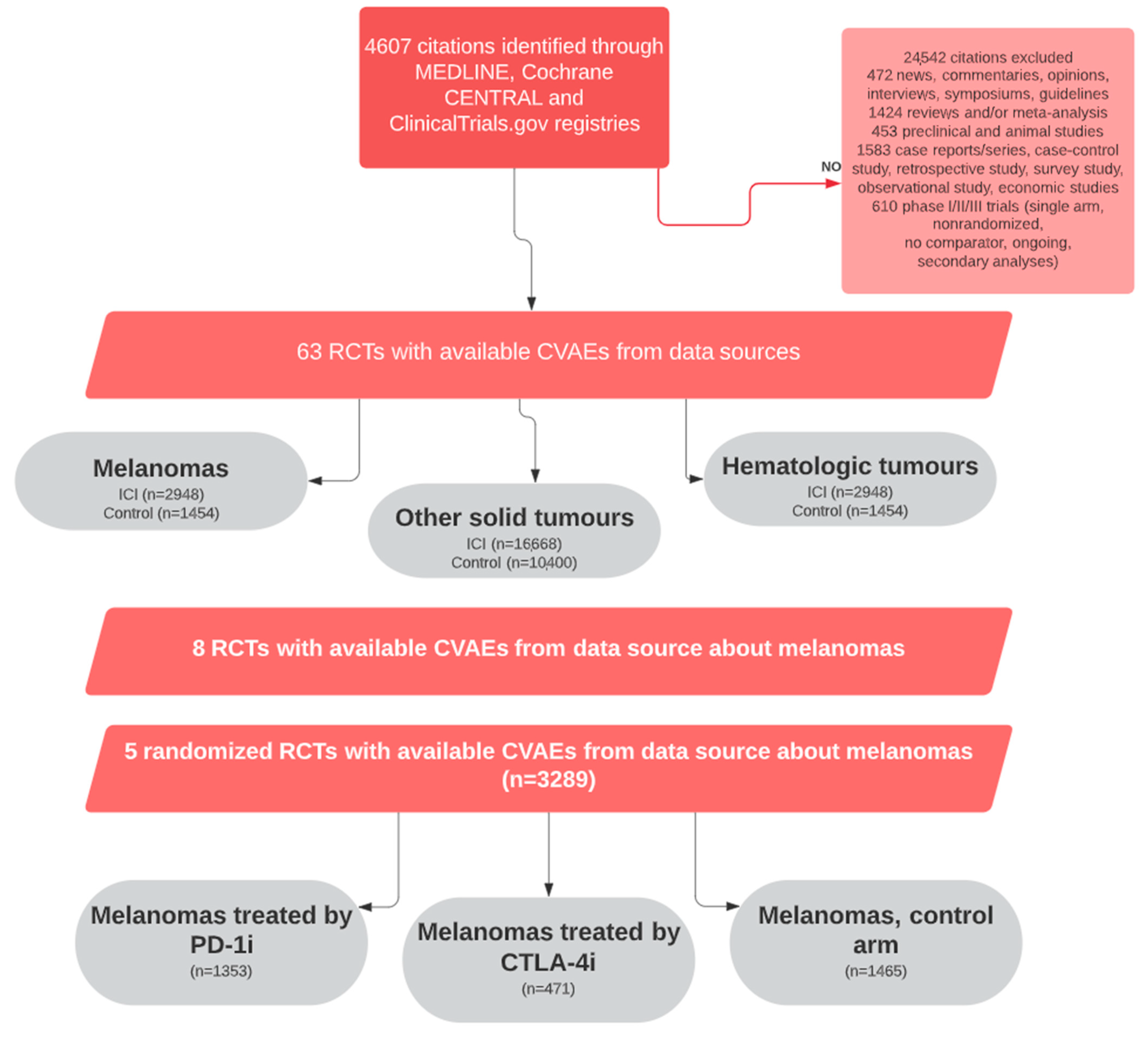
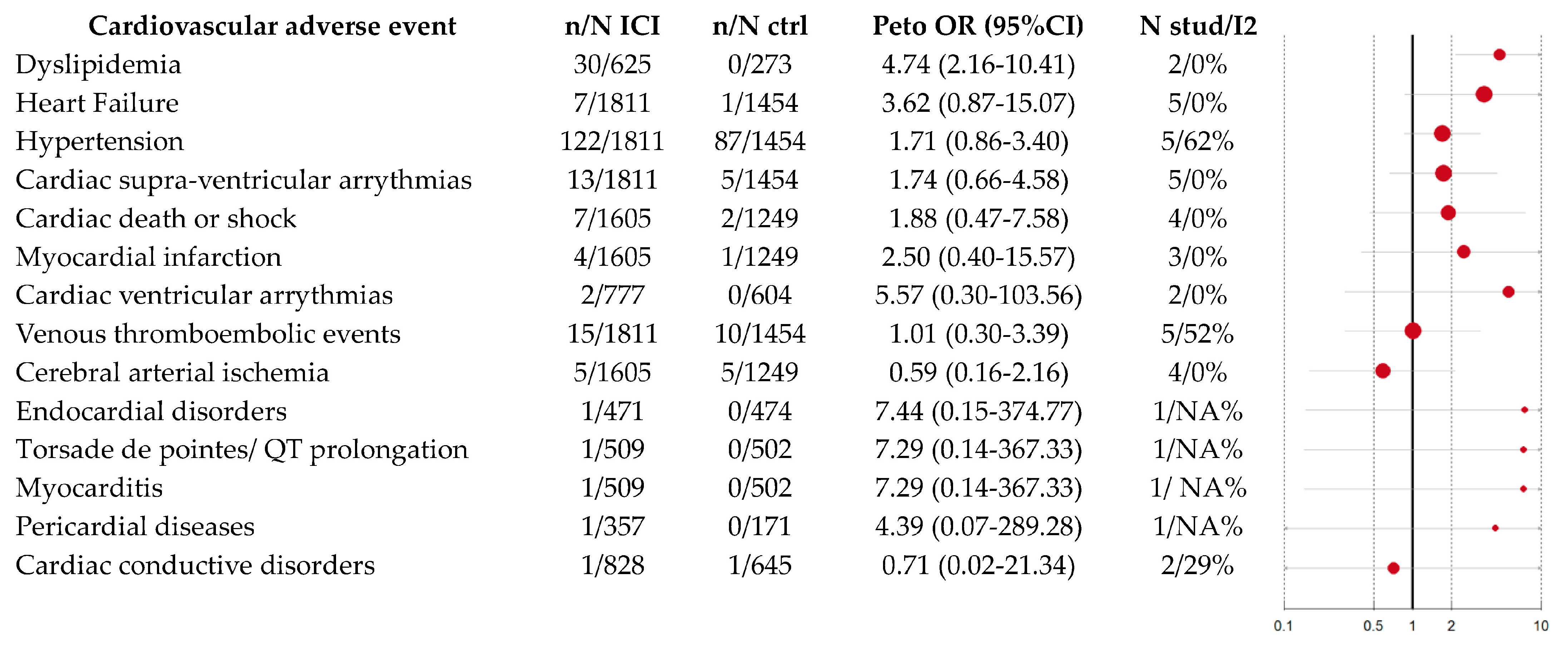
Background: Checkpoint inhibitors, such as PD-1 inhibitors (nivolumab, pembrolizumab) and anti-CTLA-4 (CD152) (ipilimumab), are widely used in metastatic melanoma, and most immune-related adverse events are known. Several cardiovascular AEs (CVAEs) associated with immune checkpoint inhibitor exposure have been reported in post-marketing surveillance studies and represent major issues for patients with melanoma during and after cancer treatment. Data on CVAES induced by immune checkpoint inhibitors in melanoma, especially incidence and risk factors, are lacking. Methods: A systematic review of the literature up to 31 August 2020 was performed in Medline, the Cochrane Central Register of Controlled Trials (CENTRAL), and the ClinicalTrials.gov register according to prespecified selection criteria from inception to 7 April 2020. Statistics were performed on 3289 patients from five randomized clinical trials on melanoma. Results: Patients with melanoma treated with immune checkpoint inhibitors had a significant risk of presenting dyslipidemia (Peto OR: 4.74, 95% CI: 2.16–10.41, p < 0.01, I2 = 0%, p = 0.94). The Peto OR was numerically significant for pericarditis, myocarditis, heart failure, myocardial infarction, cerebral ischemia, high pulmonary pressure, blood high pressure, arrhythmias, endocarditis, and conduction disturbances, but the confidence interval was not significant. The risk of CVAEs was not statistically different between melanoma treated with immune checkpoint inhibitors and other tumors treated with immune checkpoint inhibitors (range of p-value from 0.13 to 0.95). No interaction between follow-up length and CVAE reporting was found. Conclusions: Our study underlines that checkpoint inhibitors used for melanoma increase CVAEs, especially dyslipidemia, which could pave the way to chronic inflammatory processes, atherosclerosis, and, finally, ischemic cardiopathy. These cardiovascular adverse events could be acute or delayed, justifying the monitoring of lipidic biology and a baseline cardiology consultation.
Keywords:
melanoma; adverse events; immunotherapy; cardiology; CVAE