

Prognostic Significance of Esophagogastric Junction Invasion in Patients with Adenocarcinoma of the Cardia or Subcardia
by
Sung Eun Oh
1,†, 
Sujin Park
2,†,
Soomin Ahn
2,
Ji Yeong An
1,
Jun Ho Lee
1,
Tae Sung Sohn
1,
Jae Moon Bae
1 and
Min-Gew Choi
1,* 1
Department of Surgery, Samsung Medical Center, Sungkyunkwan University School of Medicine, Seoul 06351, Republic of Korea
2
Department of Pathology, Samsung Medical Center, Sungkyunkwan University School of Medicine, Seoul 06351, Republic of Korea
*
Author to whom correspondence should be addressed.
†
These authors contributed equally to this work.
Cancers 2023, 15(6), 1656; https://doi.org/10.3390/cancers15061656
Submission received: 18 October 2022
/
Revised: 3 February 2023
/
Accepted: 3 March 2023
/
Published: 8 March 2023
Simple Summary
We compared the prognosis of patients with cardia or subcardia cancer using a gastric cancer staging system and identified a significant difference in overall survival according to invasion of the esophagogastric junction. In addition, esophagogastric junction invasion was a significant independent factor reflecting a poor prognosis. Esophagogastric junction invasion should be considered for staging, and additional research is needed to apply it to gastric and esophageal cancer classification.
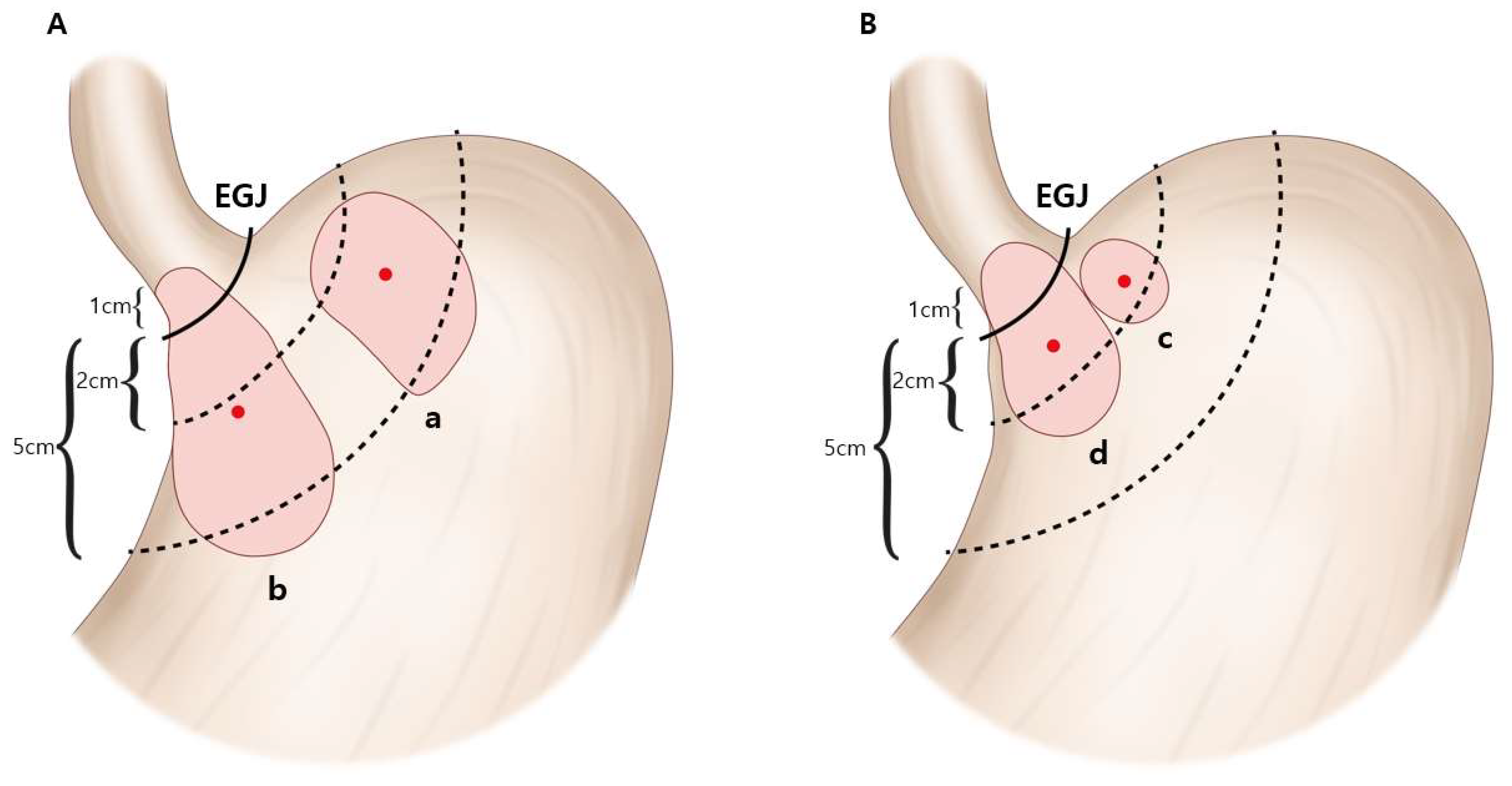
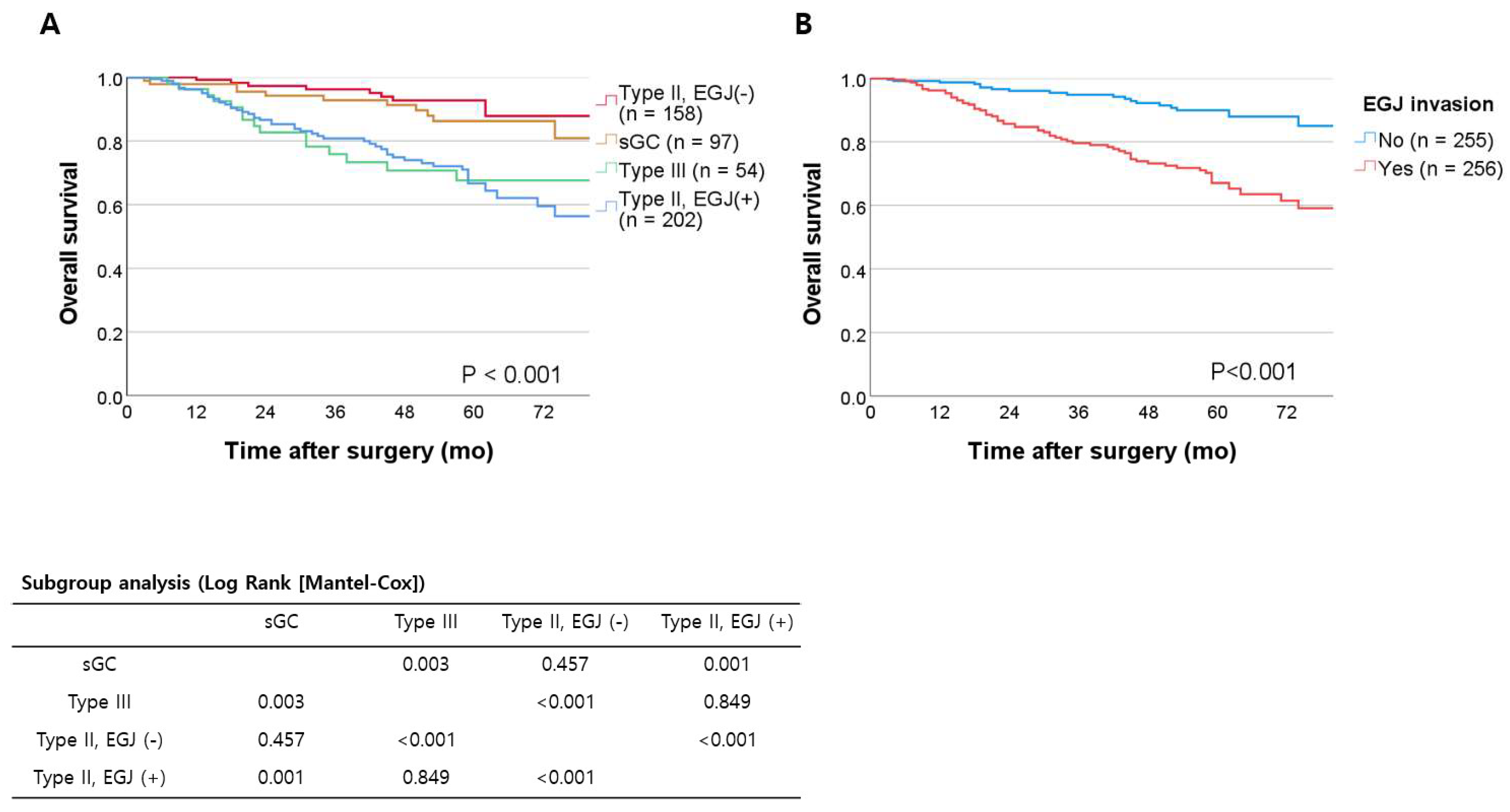
Abstract
Background: There has been no comparison of the prognoses of Korean patients who underwent curative surgery for cancer located at the cardia or subcardia of the stomach. We performed this comparison and further investigated the prognostic significance of esophagogastric junction (EGJ) invasion in patients. Methods: The medical records of patients (n = 511) who were diagnosed with cardia or subcardia cancer and underwent surgery between January 2010 and May 2019 were retrospectively reviewed. Patients were further categorized into four groups for analysis: subcardia gastric cancer (sGC; subcardia cancer without EGJ invasion; n = 97), AEG (adenocarcinoma of the esophagogastric junction) type III (subcardia cancer with EGJ invasion, n = 54), AEG type II without EGJ invasion (n = 158), and AEG type II with EGJ invasion (n = 202). We compared the overall survival of the four groups using a gastric cancer staging system and evaluated the prognostic significance of EGJ invasion with multivariate analysis. Results: The median follow-up of patients was 46.0 months (range: 0–124 months). There was significant difference in overall survival curves among the four groups (p < 0.001). Subgroup analysis showed a significant difference in overall survival between the groups with and without EGJ invasion (p < 0.001). Cancers with EGJ invasion were more frequently in the cardia (p < 0.001), had a larger size (p < 0.001), and showed a more advanced pathologic stage (stages II and III; 67.6% versus 33.7%, p < 0.001) than those without EGJ invasion. EGJ invasion and the pathologic stage were significant independent prognostic factors of overall survival in cardia and subcardia cancer patients (hazard ratio 2.24, 95% confidence interval 1.32–3.81, p = 0.003). Conclusion: The overall survival between patients with cardia or subcardia cancer was significantly different according to EGJ invasion. EGJ invasion was an independent prognostic factor and should be considered for staging. Additional research is needed to apply this feature to gastric and esophageal cancer classification.