



R1 Vascular or Parenchymal Margins: What Is the Impact after Resection of Intrahepatic Cholangiocarcinoma?

 ,
,  ,
,
Abstract
Simple Summary
Abstract
1. Introduction
2. Materials and Methods
- R1vasc when the iCCA has been surgically detached from a hepatic vein (or a first or second order branch) or Glisson’s capsule (surrounding the branches of portal triad in its connective tissues), these structures having not been resected in a parenchymal-sparing strategy. R1vasc resection may potentially leave a microscopic tumoral residue in contact with the vascular structure.
- R1par when the parenchymal margin (distance between tumor and parenchymal section) was described as ≤1 mm.
Statistical Analysis
3. Results
3.1. Preoperative Data
3.2. Peri-and Post-Operative Data
3.3. Oncological Outcomes and Survival Results
4. Discussion
4.1. Statement of Principal Findings
4.2. Interpretation with Reference to Other Studies
4.3. Study Limitations
5. Conclusions
Author Contributions
Funding
Institutional Review Board Statement
Informed Consent Statement
Data Availability Statement
Conflicts of Interest
References
- Bertuccio, P.; Malvezzi, M.; Carioli, G.; Hashim, D.; Boffetta, P.; El-Serag, H.B.; La Vecchia, C.; Negri, E. Global trends in mortality from intrahepatic and extrahepatic cholangiocarcinoma. J. Hepatol. 2019, 71, 104–114. [Google Scholar] [CrossRef] [PubMed]
- Khan, S.A.; Toledano, M.B.; Taylor-Robinson, S.D. Epidemiology, risk factors, and pathogenesis of cholangiocarcinoma. HPB 2008, 10, 77–82. [Google Scholar] [CrossRef] [PubMed]
- Shahid, A.; Khan, S.E.; Nimzing, G.L.; Thomas, H.C.; Elliott, P.; Taylor-Robinson, S.D.; Toledano, M.B. Rising trends in cholangiocarcinoma: Is the ICD classification system misleading us? J. Hepatol. 2012, 56, 848–854. [Google Scholar]
- Khan, S.A.; Thomas, H.C.; Davidson, B.R.; Taylor-Robinson, S.D. Cholangiocarcinoma. Lancet 2005, 366, 1303–1314. [Google Scholar] [CrossRef]
- Ebata, T.; Ercolani, G.; Alvaro, D.; Ribero, D.; Di Tommaso, L.; Valle, J.W. Current status on cholangiocarcinoma and gallbladder cancer. Liver Cancer 2016, 6, 59–65. [Google Scholar] [CrossRef]
- Banales, J.M.; Cardinale, V.; Carpino, G.; Marzioni, M.; Andersen, J.B.; Invernizzi, P.; Lind, G.E.; Folseraas, T.; Forbes, S.J.; Fouassier, L.; et al. Expert consensus document: Cholangiocarcinoma: Current knowledge and future perspectives consensus statement from the European Network for the Study of Cholangiocarcinoma (ENS-CCA). Nat. Rev. Gastroenterol. Hepatol. 2016, 13, 261–280. [Google Scholar] [CrossRef]
- Nagino, M.; Hirano, S.; Yoshitomi, H.; Aoki, T.; Uesaka, K.; Unno, M.; Ebata, T.; Konishi, M.; Sano, K.; Shimada, K.; et al. Clinical practice guidelines for management of biliary tract cancers 2019. The 3rd English edition. J. Hepatobiliary Pancreat. Sci. 2021, 28, 28–54. [Google Scholar] [CrossRef]
- De Jong, M.C.; Nathan, H.; Sotiropoulos, G.C.; Paul, A.; Alexandrescu, S.; Marques, H.; Pulitano, C.; Barroso, E.; Clary, B.M.; Aldrighetti, L.; et al. Intrahepatic cholangiocarcinoma: An international multi-institutional analysis of prognostic factors and lymph node assessment. J. Clin. Oncol. 2011, 29, 3140–3145. [Google Scholar] [CrossRef]
- Kim, Y.; Moris, D.P.; Zhang, X.F.; Bagante, F.; Spolverato, G.; Schmidt, C.; Dilhoff, M.; Pawlik, T.M. Evaluation of the 8th edition American Joint Commission on Cancer (AJCC) staging system for patients with intrahepatic cholangiocarcinoma: A surveillance, epidemiology, and end results (SEER) analysis. J. Surg. Oncol. 2017, 116, 643–650. [Google Scholar] [CrossRef]
- Si, A.; Li, J.; Xiang, H.; Zhang, S.; Bai, S.; Yang, P.; Zhang, X.; Xia, Y.; Wang, K.; Yan, Z.; et al. Actual over 10- year survival after liver resection for patients with intrahepatic cholangiocarcinoma. Oncotarget 2017, 8, 44521–44532. [Google Scholar] [CrossRef]
- Farges, O.; Fuks, D.; Boleslawski, E.; Le Treut, Y.P.; Castaing, D.; Laurent, A.; Ducerf, C.; Rivoire, M.; Bachellier, P.; Chiche, L.; et al. Influence of surgical margins on outcome in patients with intrahepatic cholangiocarcinoma: A multicenter study by the AFCIHCC-2009 study group. Ann. Surg. 2011, 254, 824–829. [Google Scholar] [CrossRef]
- Ribero, D.; Pinna, A.D.; Guglielmi, A.; Ponti, A.; Nuzzo, G.; Giulini, S.M.; Aldrighetti, L.; Calise, F.; Gerunda, G.E.; Tomatis, M.; et al. Surgical approach for long-term survival of patients with intrahepatic cholangiocarcinoma: A multi-institutional analysis of 434 patients. Arch. Surg. 2012, 147, 1107–1113. [Google Scholar] [CrossRef]
- Tamandl, D.; Herberger, B.; Gruenberger, B.; Puhalla, H.; Klinger, M.; Gruenberger, T. Influence of hepatic resection margin on recurrence and survival in intrahepatic cholangiocarcinoma. Ann. Surg. Oncol. 2008, 15, 2787–2794. [Google Scholar] [CrossRef]
- Tang, H.; Lu, W.; Li, B.; Meng, X.; Dong, J. Influence of surgical margins on overall survival after resection of intrahepatic cholangiocarcinoma: A meta-analysis. Medicine 2016, 95, e4621. [Google Scholar] [CrossRef]
- Guglielmi, A.; Ruzzenente, A.; Campagnaro, T.; Pachera, S.; Valdegamberi, A.; Nicoli, P.; Cappellani, A.; Malfermoni, G.; Iacono, C. Intrahepatic cholangiocarcinoma: Prognostic factors after surgical resection. World J. Surg. 2009, 33, 1247–1254. [Google Scholar] [CrossRef]
- Shimada, K.; Sano, T.; Sakamoto, Y.; Esaki, M.; Kosuge, T.; Ojima, H. Clinical impact of the surgical margin status in hepatectomy for solitary mass-forming type intrahepatic cholangiocarcinoma without lymph node metastases. J. Surg. Oncol. 2007, 96, 160–165. [Google Scholar] [CrossRef]
- Li, M.X.; Bi, X.Y.; Li, Z.Y.; Huang, Z.; Han, Y.; Zhao, J.; Zhao, H.; Cai, J. Impaction of surgical margin status on the survival outcome after surgical resection of intrahepatic cholangiocarcinoma: A systematic review and metaanalysis. J. Surg. Res. 2016, 203, 163–173. [Google Scholar] [CrossRef]
- Spolverato, G.; Yakoob, M.Y.; Kim, Y.; Alexandrescu, S.; Marques, H.P.; Lamelas, J.; Aldrighetti, L.; Gamblin, T.C.; Maithel, S.K.; Pulitano, C.; et al. The impact of surgical margin status on longterm outcome after resection for intrahepatic cholangiocarcinoma. Ann. Surg. Oncol. 2015, 22, 4020–4028. [Google Scholar] [CrossRef]
- Torzilli, G.; Montorsi, M.; Donadon, M.; Palmisano, A.; Del Fabbro, D.; Gambetti, A.; Olivari, N.; Makuuchi, M. Radical but conservative" is the main goal for ultrasonography-guided liver resection: Prospective validation of this approach. J. Am. Coll. Surg. 2005, 201, 517–528. [Google Scholar] [CrossRef]
- Torzilli, G.; Donadon, M.; Palmisano, A.; Marconi, M.; Procopio, F.; Botea, F.; Del Fabbro, D.; Cappellani, A.; Montorsi, M. Ultrasound guided liver resection: Does this approach limit the need for portal vein embolization? Hepato-Gastroenterology 2009, 56, 1483–1490. [Google Scholar] [CrossRef]
- Torzilli, G. Adjuncts to hepatic resection—Ultrasound and emerging guidance systems. In Blumgart’s Surgery of the Liver, Pancreas, and Biliary Tract, 2nd ed.; Elsevier: Amsterdam, The Netherlands, 2012; pp. 1601–1649. [Google Scholar]
- Torzilli, G. Ultrasound-guided liver surgery. In Atlas; Springer: Berlin/Heidelberg, Germany, 2014. [Google Scholar]
- Torzilli, G.; Procopio, F.; Viganò, L.; Costa, G.; Fontana, A.; Cimino, M.; Donadon, M.; Del Fabbro, D. The liver tunnel: Intention-to-treat validation of a new type of hepatectomy. Ann. Surg. 2019, 269, 331–336. [Google Scholar] [CrossRef] [PubMed]
- Viganò, L.; Procopio, F.; Cimino, M.; Donadon, M.; Gatti, A.; Costa, G.; Del Fabbro, D.; Torzilli, G. Is tumor detachment from vascular structures equivalent to R0 resection in surgery for colorectal liver metastases? An observational cohort. Ann. Surg. Oncol. 2016, 23, 1352–1360. [Google Scholar] [CrossRef] [PubMed]
- Torzilli, G.; Procopio, F.; Viganò, L.; Cimino, M.; Costa, G.; Del Fabbro, D.; Donadon, M. Hepatic vein management in a parenchyma-sparing policy for resecting colorectal liver metastases at the caval confluence. Surgery 2018, 163, 277–284. [Google Scholar] [CrossRef] [PubMed]
- Shindoh, J.; Makuuchi, M.; Matsuyama, Y.; Mise, Y.; Arita, J.; Sakamoto, Y.; Hasegawa, K.; Kokudo, N. Complete removal of the tumor-bearing portal territory decreases local tumor recurrence and improves disease-specific survival of patients with hepatocellular carcinoma. J. Hepatol. 2016, 64, 594–600. [Google Scholar] [CrossRef] [PubMed]
- Shi, M.; Guo, R.P.; Lin, X.J.; Zhang, Y.Q.; Chen, M.S.; Zhang, C.Q.; Lau, W.Y.; Li, J.Q. Partial hepatectomy with wide versus narrow resection margin for solitary hepatocellular carcinoma: A prospective randomized trial. Ann. Surg. 2007, 245, 36–43. [Google Scholar] [CrossRef]
- Donadon, M.; Terrone, A.; Procopio, F.; Cimino, M.; Palmisano, A.; Viganò, L.; Del Fabbro, D.; Di Tommaso, L.; Torzilli, G. Is R1 vascular hepatectomy for hepatocellular carcinoma oncologically adequate? Analysis of 327 consecutive patients. Surgery 2019, 165, 897–904. [Google Scholar] [CrossRef]
- Torzilli, G.; Viganò, L.; Fontana, A.; Procopio, F.; Terrone, A.; Cimino, M.; Donadon, M.; Del Fabbro, D. Oncological outcome of R1 vascular margin for mass-forming cholangiocarcinoma. A single center observational cohort analysis. HPB 2020, 22, 570–577. [Google Scholar] [CrossRef]
- Torzilli, G.; Procopio, F.; Botea, F.; Marconi, M.; Del Fabbro, D.; Donadon, M.; Palmisano, A.; Spinelli, A.; Montorsi, M. One-stage ultrasonographically guided hepatectomy for multiple bilobar colorectal metastases: A feasible and effective alternative to the 2-stage approach. Surgery 2009, 146, 60–71. [Google Scholar] [CrossRef]
- Torzilli, G.; Montorsi, M.; Del Fabbro, D.; Palmisano, A.; Donadon, M.; Makuuchi, M. Ultrasonographically guided surgical approach to liver tumours involving the hepatic veins close to the caval confluence. Br. J. Surg. 2006, 93, 1238–1246. [Google Scholar] [CrossRef]
- Lamarca, A.; Edeline, J.; McNamara, M.G.; Hubner, R.A.; Nagino, M.; Bridgewater, J.; Primrose, J.; Valle, J.W. Current standards and future perspectives in adjuvant treatment for biliary tract cancers. Cancer Treat. Rev. 2020, 84, 101936. [Google Scholar] [CrossRef]
- Primrose, J.N.; Fox, R.P.; Palmer, D.H.; Malik, H.Z.; Prasad, R.; Mirza, D.; Anthony, A.; Corrie, P.; Falk, S.; Finch-Jones, M.; et al. Capecitabine compared with observation in resected biliary tract cancer (BILCAP): A randomised, controlled, multicentre, phase 3 study. Lancet Oncol. 2019, 20, 663–6730. [Google Scholar] [CrossRef]
- Dindo, D.; Demartines, N.; Clavien, P.A. Classification of surgical complications: A new proposal with evaluation in a cohort of 6336 patients and results of a survey. Ann. Surg. 2004, 240, 205–213. [Google Scholar] [CrossRef]
- Nickkholgh, A.; Ghamarnejad, O.; Khajeh, E.; Tinoush, P.; Bruckner, T.; Kulu, Y.; Mieth, M.; Goeppert, B.; Roessler, S.; Weiss, K.H.; et al. Outcome after liver resection for primary and recurrent intrahepatic cholangiocarcinoma. BJS Open 2019, 10, 793–801. [Google Scholar] [CrossRef]
- Khatib, A.M.; Stepan, A.E.; Margaritescu, C.; Simionescu, C.; Ciurea, R.N. E-cadherin and Snail Immunoexpression in Colorectal Adenocarcinomas. Curr. Health Sci. J. 2019, 45, 204–209. [Google Scholar]
- Labib, P.L.; Goodchild, G.; Pereira, S.P. Molecular Pathogenesis of Cholangiocarcinoma. BMC Cancer 2019, 19, 185. [Google Scholar] [CrossRef]
- Jia, A.Y.; JWu, J.X.; Zhao, Y.T.; Li, Y.X.; Wang, Z.; Rong, W.Q.; Wang, L.M.; Jin, J.; Wang, S.L.; Song, Y.W.; et al. Intensity-modulated radiotherapy following null-margin resection is associated with improved survival in the treatment of intrahepatic cholangiocarcinoma. J. Gastrointest. Onco. 2015, 6, 126–133. [Google Scholar]
- Le Roy, B.; Gelli, M.; Pittau, G.; Allard, M.A.; Pereira, B.; Serji, B.; Vibert, E.; Castaing, D.; Adam, R.; Cherqui, D.; et al. Neoadjuvant chemotherapy for initially unresectable intrahepatic cholangiocarcinoma. Br. J. Surg. 2018, 105, 839–847. [Google Scholar] [CrossRef]
- Riby, D.; Mazzotta, A.D.; Bergeat, D.; Verdure, L.; Sulpice, L.; Bourien, H.; Lièvre, A.; Rolland, Y.; Garin, E.; Boudjema, K. Downstaging with Radioembolization or Chemotherapy for Initially Unresectable Intrahepatic Cholangiocarcinoma. Ann. Surg. Oncol. 2020, 27, 3729–3737. [Google Scholar] [CrossRef]
- Rayar, M.; Sulpice, L.; Edeline, J.; Garin, E.; Sandri, G.B.L.; Meunier, B.; Boucher, E.; Boudjema, K. Intra-arterial yttrium-90 radioembolization combined with systemic chemotherapy is a promising method for downstaging unresectable huge intrahepatic cholangiocarcinoma to surgical treatment. Ann. Surg. Oncol. 2015, 22, 3102–3108. [Google Scholar] [CrossRef]
- Edeline, J.; Touchefeu, Y.; Guiu, B.; Farge, O.; Tougeron, D.; Baumgaertner, I.; Ayav, A.; Campillo-Gimenez, B.; Beuzit, L.; Pracht, M.; et al. Radioembolization Plus Chemotherapy for First-line Treatment of Locally Advanced Intrahepatic Cholangiocarcinoma: A Phase 2 Clinical Trial. JAMA Oncol. 2020, 1, 51–59. [Google Scholar] [CrossRef]
- Lee, Y.; Yoo, I.R.; Boo, S.H.; Kim, H.; Park, H.L.; Hyun, O.J. The Role of F-18 FDG PET/CT in Intrahepatic Cholangiocarcinoma. Nucl. Med. Mol. Imaging 2017, 51, 69–78. [Google Scholar] [CrossRef]
- Bridgewater, J.; Galle, P.R.; Khan, S.A.; Llovet, J.M.; Park, J.W.; Patel, T.; Pawlik, T.M.; Gores, G.J. Guidelines for the diagnosis and management of intrahepatic cholangiocarcinoma. J. Hepatol. 2014, 60, 1268–1289. [Google Scholar] [CrossRef]
- Zheng, X.; Chen, B.; Wu, J.-X.; Jia, A.Y.; Rong, W.-Q.; Wang, L.-M.; Wu, F.; Zhao, Y.-T.; Li, Y.-X.; Wang, W.H. Benefit of adjuvant radiotherapy following narrow-margin hepatectomy in patients with intrahepatic cholangiocarcinoma that adhere to major vessels. Cancer Manag. Res. 2018, 10, 3973. [Google Scholar] [CrossRef]
- Golse, N.; Nunez, J.; Mazzotta, A.D.; Cano, L.; Bergeat, D.; Sulpice, L.; Jeddou, H.; Abdelrafee, A.; Sa Cunha, A.; Cherqui, D.; et al. Personalized Preoperative Nomograms Predicting Postoperative Risks after Resection of Perihilar Cholangiocarcinoma. World J. Surg. 2020, 44, 3449–3460. [Google Scholar] [CrossRef]
- Li, H.; Liu, R.; Li, J.; Li, J.; Wu, H.; Wang, G.; Li, D. Tumor location influences perioperative and oncologic outcomes in solitary intrahepatic cholangiocarcinoma following curative resection: A multi-center analysis. HPB 2022, 24, 1543–1550. [Google Scholar] [CrossRef]
- Hobeika, C.; Cauchy, F.; Fuks, D.; Barbier, L.; Fabre, J.M.; Boleslawski, E.; Regimbeau, J.M.; Farges, O.; Pruvot, F.R.; Pessaux, P.; et al. Laparoscopic versus open resection of intrahepatic cholangiocarcinoma: Nationwide analysis. Br. J. Surg. 2021, 108, 419–426. [Google Scholar] [CrossRef]
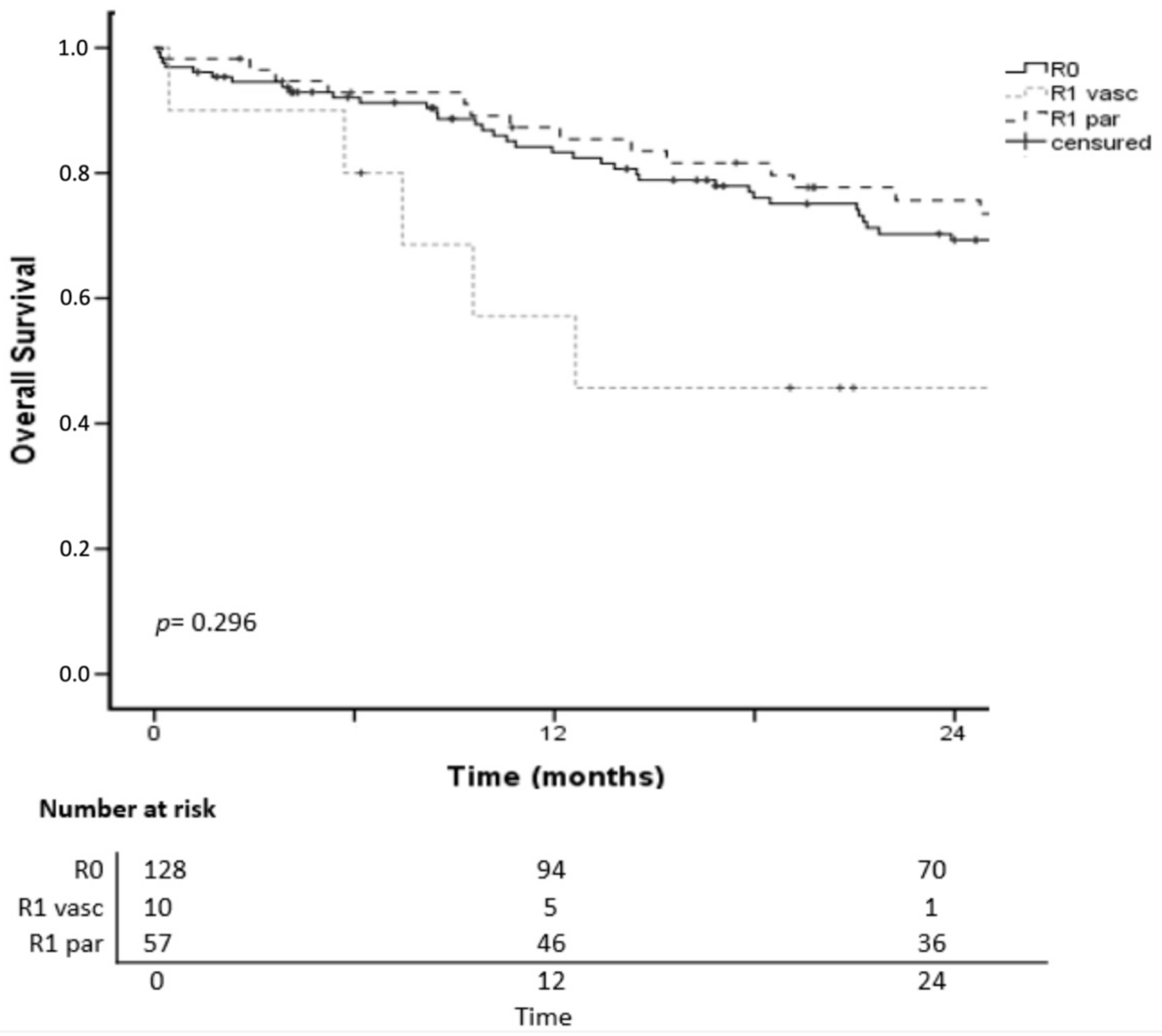
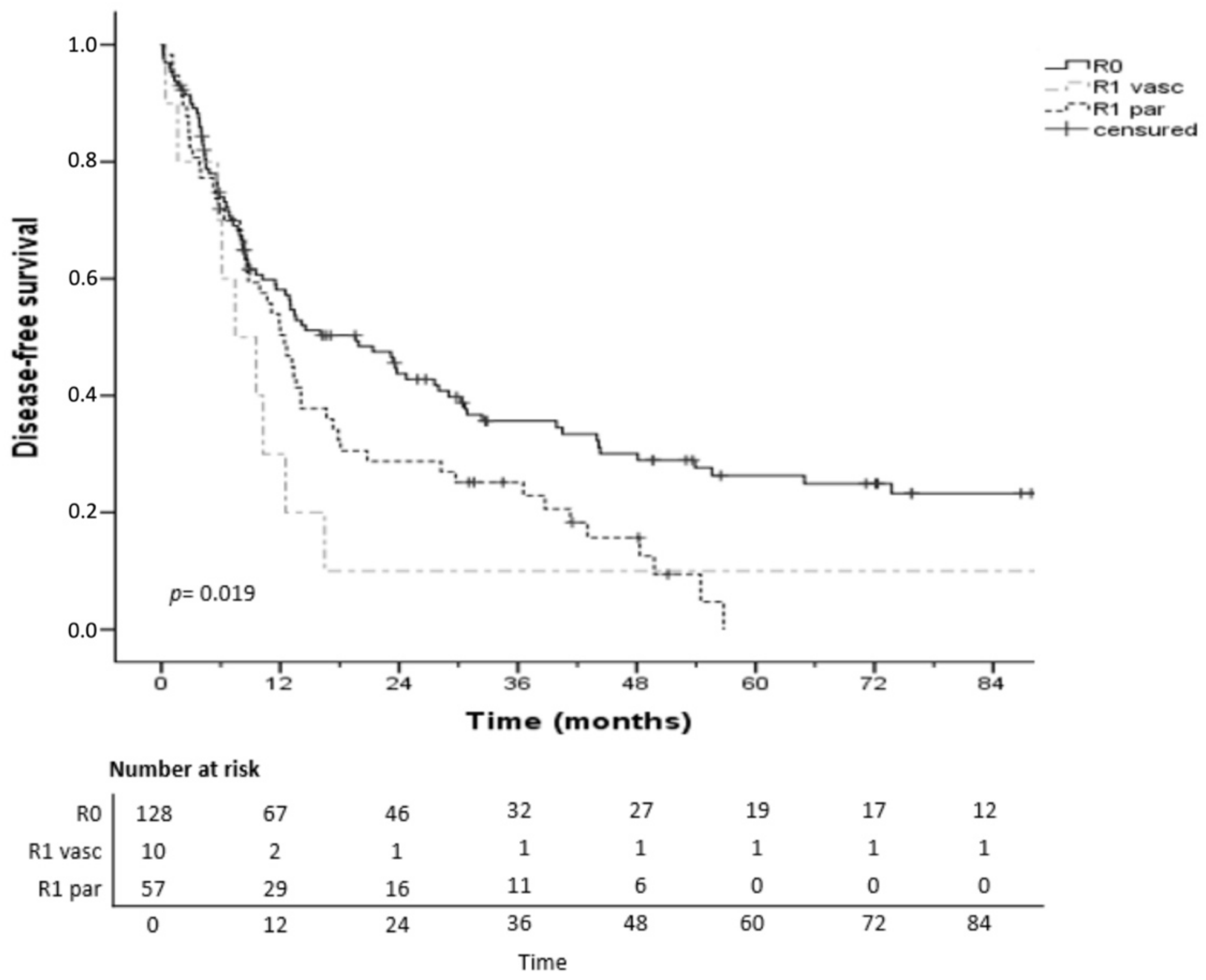
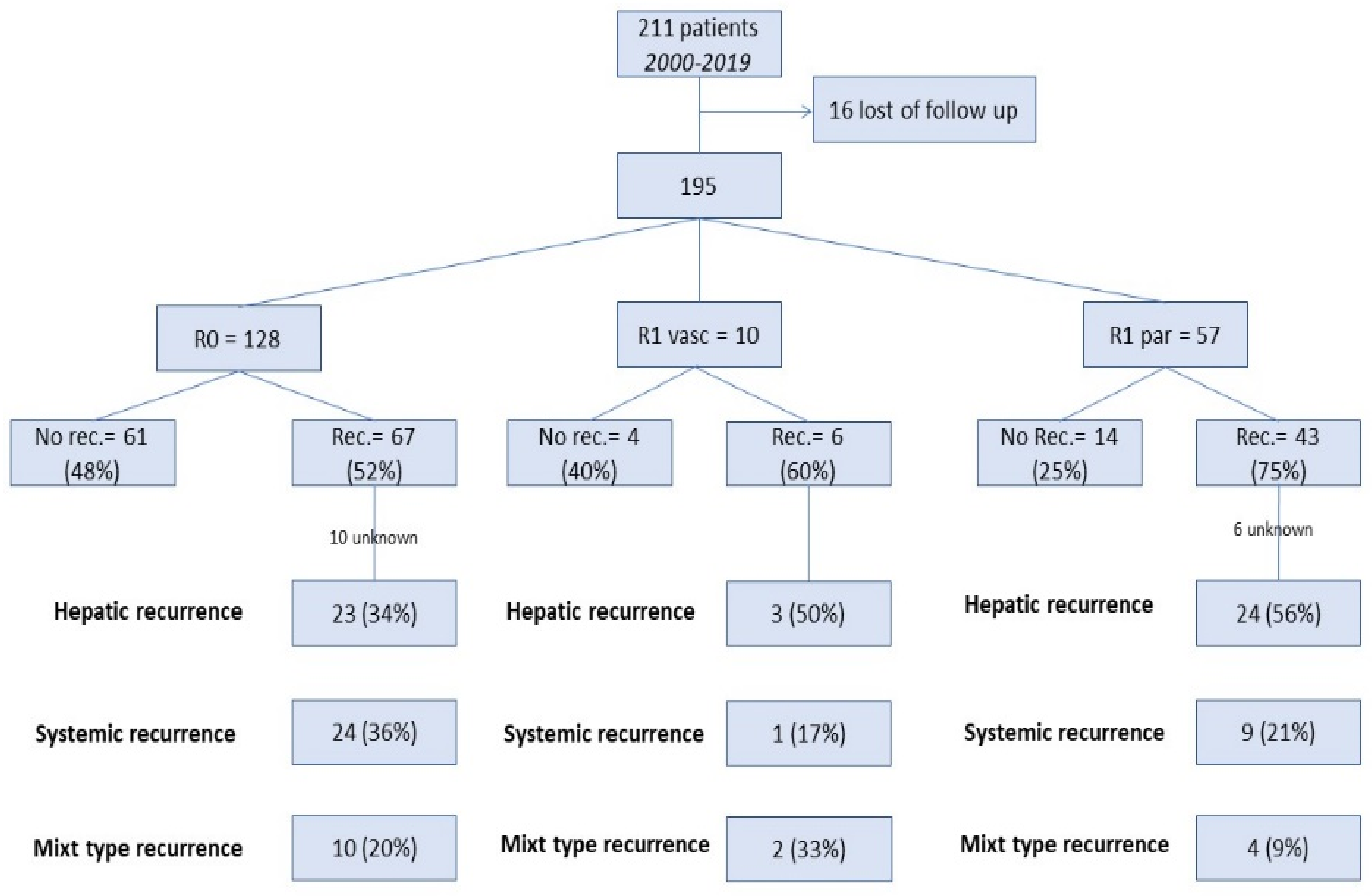

| R0 (n = 128) | R1 Vasc. (n = 10) | R1 Par. (n = 57) | p Value | |
|---|---|---|---|---|
| Age (years) | 67 [60–72] | 71 [69.2–75.0] | 64 [58–73] | 0.16 |
| BMI (Kg/m2) | 25.5 [22.5–28.5] | 25.2 [21.3–27.2] | 25.8 [22.8–28.5] | 0.89 |
| Tumor size (cm) | 6 [4.5–8.7] | 7 [3.5–10] | 7 [5–9.2] | 0.16 |
| Male gender | 33 (25.6) | 5 (50) | 24 (42.1) | 0.04 |
| Peritumoral secondary biliary cirrhosis | 26 (20.2) | 2 (20) | 4 (7) | 0.07 |
| Preop. biliary drainage | 7 (5.5) | 2 (20) | 3 (5.4) | 0.18 |
| Portal vein embolization | 16 (12.4) | 1 (7) | 4 (10.7) | 0.54 |
| Neoadjuvant radiotherapy | 3 (2.4) | 2 (20) | 0 (0) | 0.001 |
| Neoadjuvant chemotherapy | 22 (17.2) | 2 (20) | 6 (10.5) | 0.50 |
| R0 (n = 128) | R1vasc. (n = 10) | R1par. (n = 57) | p Value | R0 vs. R1vasc | R1vasc vs. R1par | |
|---|---|---|---|---|---|---|
| Operative time (min) | 215 [158–316] | 345 [150–554.2] | 299 [180–390.5] | 0.01 | 0.12 | 0.47 |
| Liver pedicle clamping | 28 [15–45] | 30 [0–59] | 40 [7–60] | 0.12 | 0.77 | 0.84 |
| Major liver resection | 102 (81) | 9 (90) | 46 (82.1) | 0.77 | 0.50 | 0.53 |
| Biliary resection | 19 (14.7) | 5 (50) | 12 (21.1) | 0.02 | 0.04 | 0.05 |
| Arterial resection | 3 (2.3) | 0 (0) | 2 (3.5) | 0.78 | 0.62 | 0.54 |
| Portal vein resection | 11 (8.5) | 3 (30) | 2 (3.5) | 0.02 | 0.03 | 0.003 |
| Lymph nodes analyzed | 3 [1–5] | 8 [4–15.2] | 4 [2–6] | 0.003 | 0.01 | 0.057 |
| Patients N+ | 21 (16.3) | 4 (40) | 11 (19.3) | 0.25 | 0.06 | 0.012 |
| Patients Nx | 58 (45) | 4 (40) | 20 (35.1) | 0.25 | 0.14 | 0.22 |
| Numbers of tumors | 1 [1,1] | 1 [1–4.2] | 1 [1,1] | 0.16 | 0.23 | 0.40 |
| Max tumor size (cm) | 6 [4.50–8.75] | 7 [3.50–10.00] | 7 [5.00–9.25] | 0.16 | 0.73 | 0.73 |
| Perineural invasion | 27 (21.1) | 5 (50) | 15 (26.3) | 0.10 | 0.03 | 0.13 |
| Microvascular invasion | 53 (41.4) | 6 (66.7) | 30 (52.6) | 0.16 | 0.13 | 0.43 |
| Clavien Dindo ≥ 3 | 29 (25) | 5 (50) | 12 (21) | 0.13 | 0.06 | 0.06 |
| R1vasc (Age, Sex) | R1 location (Vascular Contact) | Type Hep | Biliary Resec | Portal Resec | Relapse | Death at Follow-Up | OS (Mounths) | DFS (Mounths) | N (+/tot) |
|---|---|---|---|---|---|---|---|---|---|
| A 71 y, F | Hepatic vein | Left Hep | Yes | No | Yes | Yes | 12.6 | 1.6 | 1/16 |
| B 71y, F | Hepatic vein | Right Hep | Yes | Yes | Yes | No | 6.2 | 6.1 | 2/6 |
| C 71 y, M | Portal Vein | Left Hep | Yes | No | Yes | No | 19.0 | 16.5 | 4/15 |
| D 72 y, M | Portal Vein | Right Hep | Yes | Yes | No | Yes | 7.4 | 7.4 | 0/10 |
| E 64 y, F | Portal Vein | Left Hep | No | No | Yes | No | 20.9 | 10.2 | 2/5 |
| F 58 y, F | Hepatic vein | Minor Hep | No | No | Yes | No | 20.6 | 12.5 | - |
| G 75 y, M | Portal Vein | Right Hep | No | No | No | Yes | 9.6 | 9.6 | - |
| H 75 y, M | Hepatic vein | Left Hep | No | No | No | Yes | 0.4 | 0.4 | 0/1 |
| I 74 y, M | Portal Vein | Right Hep | Yes | Yes | No | Yes | 5.7 | 5.7 | - |
| L 76 y, F | Portal Vein | Right Hep | No | No | Yes | Yes | 127.1 | 113.9 | - |
| Variable | Univariate Analysis | Multivariate Analysis | ||||
|---|---|---|---|---|---|---|
| HR | CI | p Val. | HR | CI | p Val. | |
| Gender (female) | 1.07 | 0.76–1.50 | 0.69 | |||
| Age | 1.02 | 1.00–1.03 | 0.03 | 1.02 | 1.00–1.05 | 0.024 |
| BMI | 0.98 | 0.95–1.02 | 0.39 | |||
| Peritumoral secondary biliary cirrhosis | 1.10 | 0.74–1.65 | 0.62 | |||
| Major liver resection | 1.22 | 0.79–1.86 | 0.35 | |||
| Preop. biliary drainage | 1.54 | 0.85–2.79 | 0.17 | |||
| Portal vein embolization | 1.47 | 0.93–2.31 | 0.09 | 2.4 | 1.10–5.28 | 0.028 |
| Neoadjuvant chemotherapy | 1.32 | 0.87–2.02 | 0.19 | |||
| Neoadjuvant radiotherapy | 1.00 | 0.36–2.70 | 1.00 | |||
| Tumor size | 1.07 | 1.03–1.13 | 0.002 | 1.09 | 1.00–1.19 | 0.037 |
| R0, R1vasc, R1par | 1.24 | 1.05–1.47 | 0.01 | 1.56 | 1.16–2.09 | 0.003 |
| Numbers of lymph nodes invaded | 1.30 | 1.09–1.55 | 0.003 | 1.31 | 1.05–1.65 | 0.014 |
| Numbers of lymph nodes resected | 1.05 | 0.99–1.10 | 0.056 | 1.004 | 0.93–1.09 | 0.92 |
| Perineural invasion | 1.45 | 1.02–2.07 | 0.04 | 1.16 | 0.59–2.27 | 0.66 |
| Microvascular invasion | 1.47 | 1.06–2.03 | 0.02 | 0.75 | 0.39–1.40 | 0.35 |
| Number of iCCA nodules | 1.33 | 1.16–1.51 | <0.001 | 1.47 | 1.18–1.83 | 0.001 |
| Biliary resection | 0.94 | 0.62–1.43 | 0.76 | |||
| Arterial resection | 0.78 | 0.25–2.46 | 0.6 | |||
| Portal vein resection | 0.96 | 0.53–1.73 | 0.96 |
| Variable | Univariate Analysis | Multivariate Analysis | ||||
|---|---|---|---|---|---|---|
| HR | CI | p Val. | HR | CI | p Val. | |
| Gender (female) | 1.22 | 0.81–1.83 | 0.32 | |||
| Age | 1.01 | 1.00–1.03 | 0.05 | 1.00 | 0.98–1.03 | 0.64 |
| BMI | 1.00 | 0.96–1.07 | 0.86 | |||
| Peritumoral secondary biliary cirrhosis | 1.57 | 0.98–2.5 | 0.06 | 1.92 | 0.67–5.48 | 0.21 |
| Major liver resection | 0.89 | 0.59–1.57 | 0.89 | |||
| Preop. biliary drainage | 1.04 | 0.44–2.37 | 0.92 | |||
| Portal vein embolization | 1.68 | 0.97–2.91 | 0.06 | 4.09 | 1.52–10.98 | 0.005 |
| Neoadjuvant chemotherapy | 1.28 | 0.76–2.15 | 0.36 | |||
| Neoadjuvant radiotherapy | 0.86 | 0.21–3.52 | 0.83 | |||
| Tumor size | 1.05 | 1.00–1.11 | 0.06 | 1.03 | 0.92–1.15 | 0.59 |
| R0, R1vasc, R1par | 1.03 | 1.00–1.12 | 0.05 | 1.16 | 0.79–1.71 | 0.44 |
| Numbers of lymph nodes invaded | 1.30 | 1.05–1.61 | 0.01 | 1.55 | 1.19–2.02 | 0.001 |
| Numbers of lymph nodes resected | 1.00 | 0.94–1.07 | 0.80 | |||
| Perineural invasion | 1.18 | 0.77–1.82 | 0.44 | |||
| Microvascular invasion | 1.03 | 0.70–1.52 | 0.85 | |||
| Number of iCCA nodules | 1.30 | 1.10–1.15 | 0.002 | 1.33 | 0.93–1.91 | 0.11 |
| Biliary resection | 0.65 | 0.37–1.14 | 0.19 | 0.85 | 0.37–1.95 | 0.71 |
| Arterial resection | 0.77 | 0.26–2.66 | 0.76 | |||
| Portal vein resection | 1.20 | 0.60–2.38 | 0.60 |
Publisher’s Note: MDPI stays neutral with regard to jurisdictional claims in published maps and institutional affiliations. |
© 2022 by the authors. Licensee MDPI, Basel, Switzerland. This article is an open access article distributed under the terms and conditions of the Creative Commons Attribution (CC BY) license (https://creativecommons.org/licenses/by/4.0/).
Share and Cite
Mabilia, A.; Mazzotta, A.D.; Robin, F.; Ghallab, M.; Vibert, E.; Adam, R.; Cherqui, D.; Cunha, A.S.; Azoulay, D.; Salloum, C.; et al. R1 Vascular or Parenchymal Margins: What Is the Impact after Resection of Intrahepatic Cholangiocarcinoma? Cancers 2022, 14, 5151. https://doi.org/10.3390/cancers14205151
Mabilia A, Mazzotta AD, Robin F, Ghallab M, Vibert E, Adam R, Cherqui D, Cunha AS, Azoulay D, Salloum C, et al. R1 Vascular or Parenchymal Margins: What Is the Impact after Resection of Intrahepatic Cholangiocarcinoma? Cancers. 2022; 14(20):5151. https://doi.org/10.3390/cancers14205151
Chicago/Turabian StyleMabilia, Andrea, Alessandro D. Mazzotta, Fabien Robin, Mohammed Ghallab, Eric Vibert, René Adam, Daniel Cherqui, Antonio Sa Cunha, Daniel Azoulay, Chady Salloum, and et al. 2022. "R1 Vascular or Parenchymal Margins: What Is the Impact after Resection of Intrahepatic Cholangiocarcinoma?" Cancers 14, no. 20: 5151. https://doi.org/10.3390/cancers14205151
APA StyleMabilia, A., Mazzotta, A. D., Robin, F., Ghallab, M., Vibert, E., Adam, R., Cherqui, D., Cunha, A. S., Azoulay, D., Salloum, C., Pittau, G., Ciacio, O., Allard, M. A., Boudjema, K., Sulpice, L., & Golse, N. (2022). R1 Vascular or Parenchymal Margins: What Is the Impact after Resection of Intrahepatic Cholangiocarcinoma? Cancers, 14(20), 5151. https://doi.org/10.3390/cancers14205151

