Exercise Counteracts the Deleterious Effects of Cancer Cachexia

1
Cachexia Research Laboratory, Exercise Science Research Center, Department of Health, Human Performance and Recreation, University of Arkansas, Fayetteville, AR 72701, USA
2
Molecular Muscle Mass Regulation Laboratory, Exercise Science Research Center, Department of Health, Human Performance and Recreation, University of Arkansas, Fayetteville, AR 72701, USA
3
Exercise Muscle Biology Laboratory, Exercise Science Research Center, Department of Health, Human Performance and Recreation, University of Arkansas, Fayetteville, AR 72701, USA
*
Author to whom correspondence should be addressed.
Cancers 2022, 14(10), 2512; https://doi.org/10.3390/cancers14102512
Submission received: 17 April 2022
/
Revised: 12 May 2022
/
Accepted: 17 May 2022
/
Published: 19 May 2022
(This article belongs to the Special Issue Cancer Cachexia: Molecular Insights and Clinical Implications)
Simple Summary
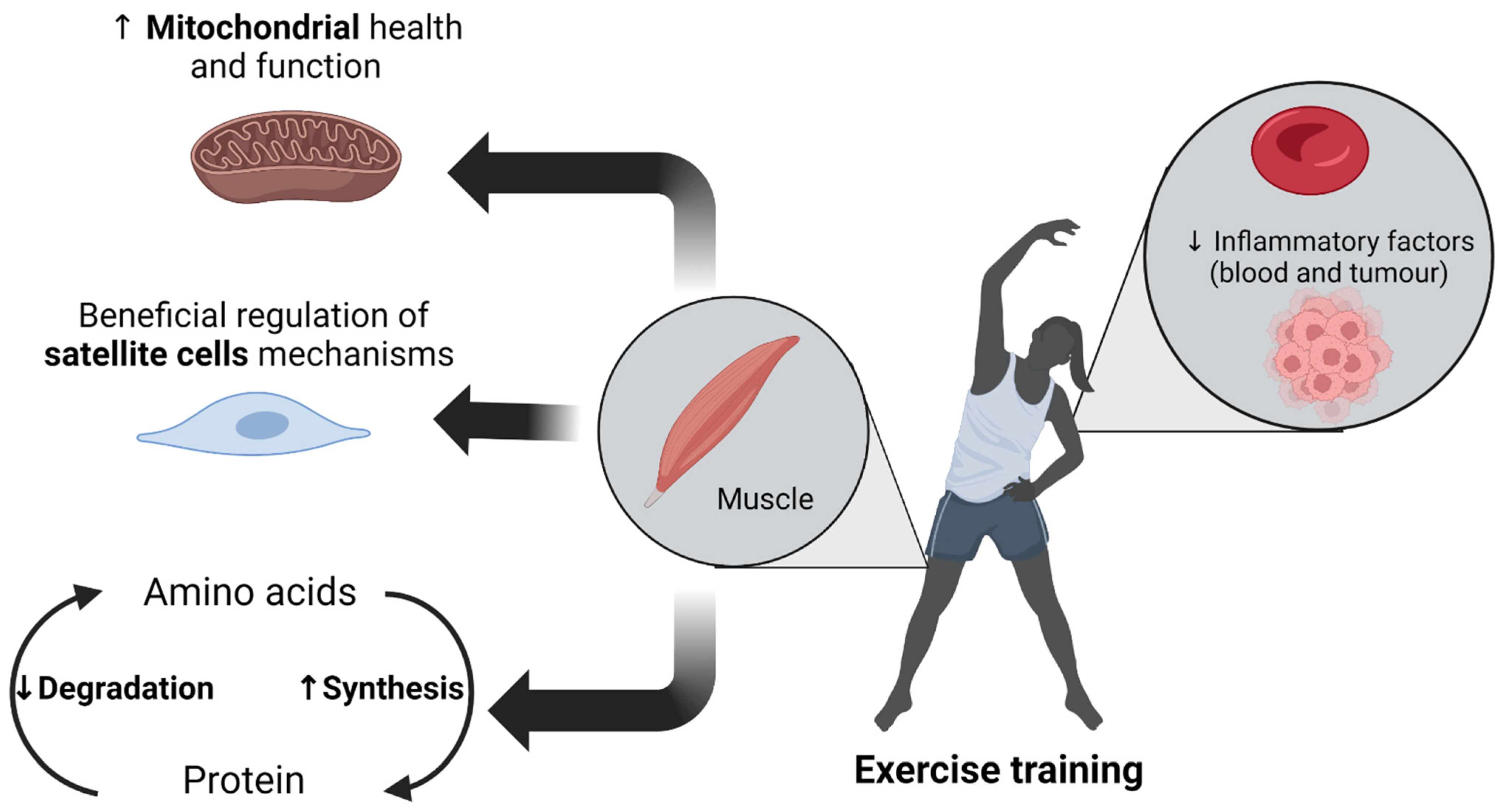
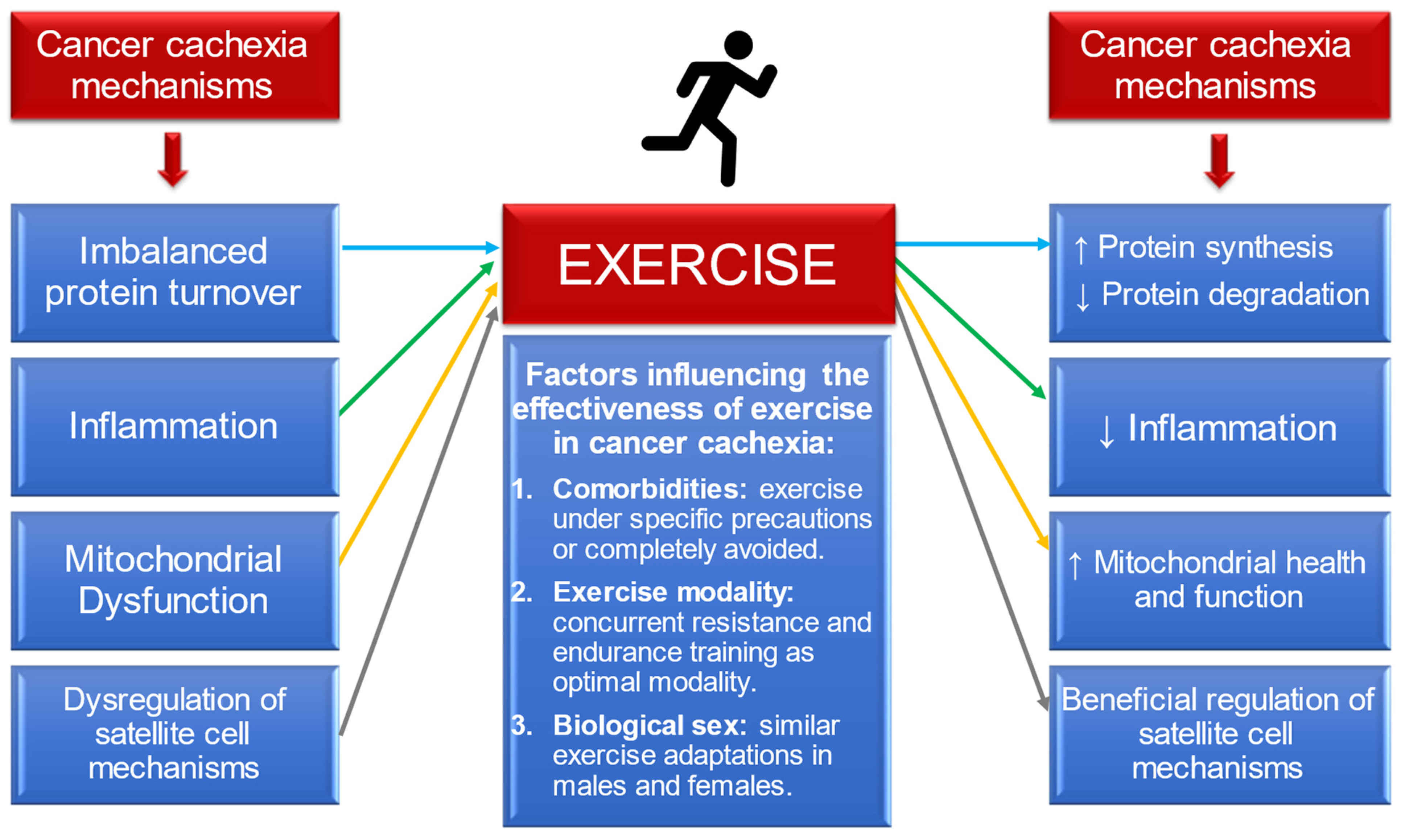
This review provides an overview of the effects of exercise training on the major mechanisms related to cancer cachexia (CC). The review also discusses how cancer comorbidities can influence the ability of patients/animals with cancer to perform exercise training and what precautions should be taken when they exercise. The contribution of other factors, such as exercise modality and biological sex, to exercise effectiveness in ameliorating CC are also elaborated in the final sections. We provide meticulous evidence for how advantageous exercise training can be in patients/animals with CC at molecular and cellular levels. Finally, we emphasise what factors should be considered to optimise and personalise an exercise training program in CC.
Abstract
Cancer cachexia (CC) is a multifactorial syndrome characterised by unintentional loss of body weight and muscle mass in patients with cancer. The major hallmarks associated with CC development and progression include imbalanced protein turnover, inflammatory signalling, mitochondrial dysfunction and satellite cell dysregulation. So far, there is no effective treatment to counteract muscle wasting in patients with CC. Exercise training has been proposed as a potential therapeutic approach for CC. This review provides an overview of the effects of exercise training in CC-related mechanisms as well as how factors such as cancer comorbidities, exercise modality and biological sex can influence exercise effectiveness in CC. Evidence in mice and humans suggests exercise training combats all of the hallmarks of CC. Several exercise modalities induce beneficial adaptations in patients/animals with CC, but concurrent resistance and endurance training is considered the optimal type of exercise. In the case of cancer patients presenting comorbidities, exercise training should be performed only under specific guidelines and precautions to avoid adverse effects. Observational comparison of studies in CC using different biological sex shows exercise-induced adaptations are similar between male and female patients/animals with cancer, but further studies are needed to confirm this.