Isoforms of the p53 Family and Gastric Cancer: A Ménage à Trois for an Unfinished Affair
by

Anais Blanchet
1, 
Agathe Bourgmayer
1,2,
Jean-Emmanuel Kurtz
1,2,
Georg Mellitzer
1 and
Christian Gaiddon
1,* 1
Laboratory “Streinth” (STress REsponse and INnovative Therapies in Cancer), Inserm UMR_S 1113, IRFAC, ITI InnoVec, Université de Strasbourg, 67200 Strasbourg, France
2
ICANS (Institut du Cancer Strasbourg Europe), 67200 Strasbourg, France
*
Author to whom correspondence should be addressed.
Cancers 2021, 13(4), 916; https://doi.org/10.3390/cancers13040916
Submission received: 31 December 2020
/
Revised: 6 February 2021
/
Accepted: 17 February 2021
/
Published: 22 February 2021
/
Corrected: 14 August 2026
(This article belongs to the Special Issue The Isoforms of the p53 Gene Family and Their Role in Cancer and Aging:Selection Papers from International p53/p63/p73 Isoforms Workshop)
Simple Summary
The p53 family is a complex family of transcription factors with different cellular functions that are involved in several physiological processes. A massive amount of data has been accumulated on their critical role in the tumorigenesis and the aggressiveness of cancers of different origins. If common features are observed, there are numerous specificities that may reflect particularities of the tissues from which the cancers originated. In this regard, gastric cancer tumorigenesis is rather remarkable, as it is induced by bacterial and viral infections, various chemical carcinogens, and familial genetic alterations, which provide an example of the variety of molecular mechanisms responsible for cell transformation and how they impact the p53 family. This review summarizes the knowledge gathered from over 40 years of research on the role of the p53 family in gastric cancer, which still displays one of the most elevated mortality rates amongst all types of cancers.
Abstract
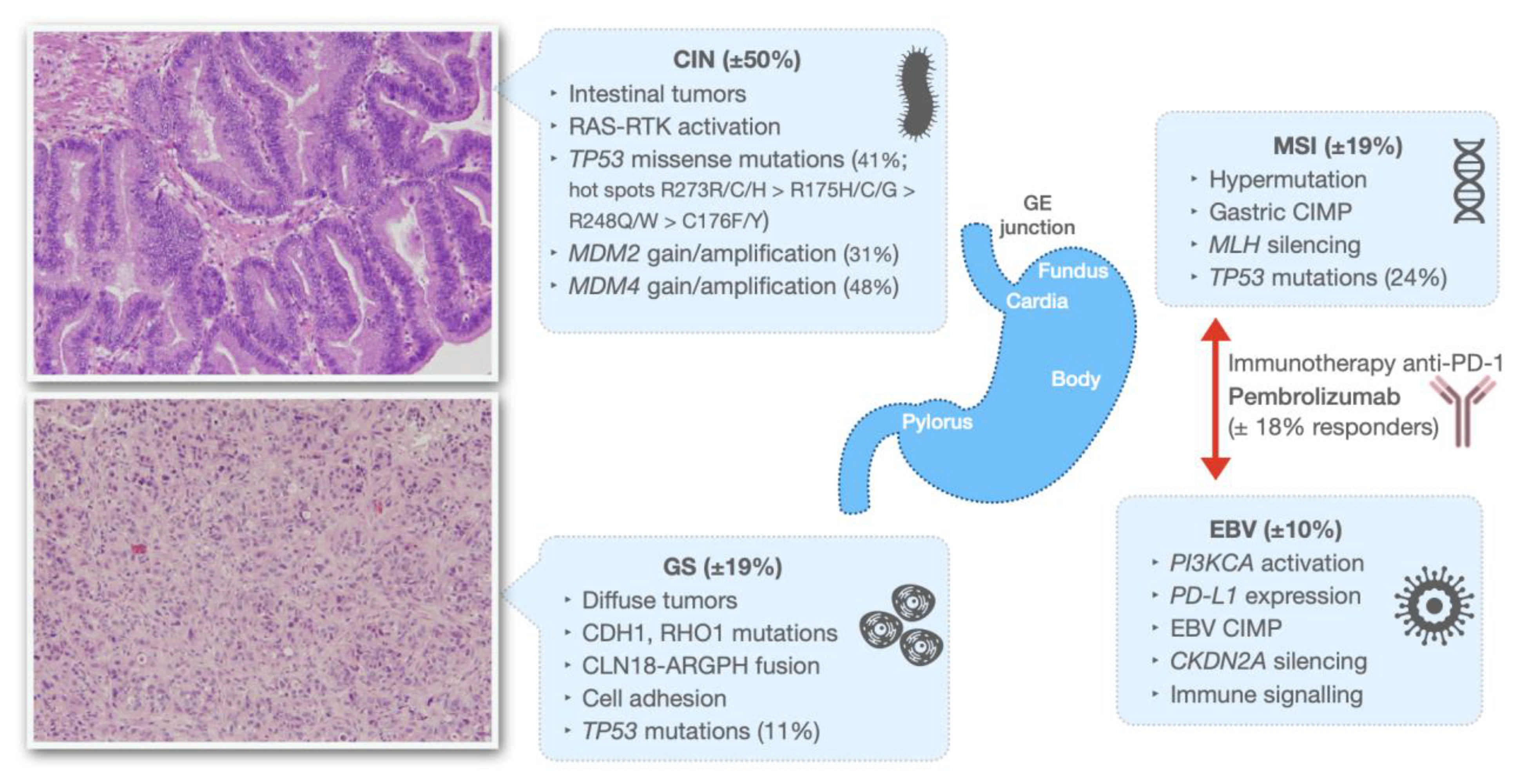
Gastric cancer is one of the most aggressive cancers, with a median survival of 12 months. This illustrates its complexity and the lack of therapeutic options, such as personalized therapy, because predictive markers do not exist. Thus, gastric cancer remains mostly treated with cytotoxic chemotherapies. In addition, less than 20% of patients respond to immunotherapy. TP53 mutations are particularly frequent in gastric cancer (±50% and up to 70% in metastatic) and are considered an early event in the tumorigenic process. Alterations in the expression of other members of the p53 family, i.e., p63 and p73, have also been described. In this context, the role of the members of the p53 family and their isoforms have been investigated over the years, resulting in conflicting data. For instance, whether mutations of TP53 or the dysregulation of its homologs may represent biomarkers for aggressivity or response to therapy still remains a matter of debate. This uncertainty illustrates the lack of information on the molecular pathways involving the p53 family in gastric cancer. In this review, we summarize and discuss the most relevant molecular and clinical data on the role of the p53 family in gastric cancer and enumerate potential therapeutic innovative strategies.