Clinical and Molecular-Based Approach in the Evaluation of Hepatocellular Carcinoma Recurrence after Radical Liver Resection
by
 , , , , ,
Salvatore Gruttadauria
1,2,* ,
,
Floriana Barbera
3, 
Pier Giulio Conaldi
3,
Duilio Pagano
1 ,
,
Rosa Liotta
4,
Enrico Gringeri
5 ,
,
Roberto Miraglia
6,
Gaetano Burgio
7,
Marco Barbara
3 ,
,
Giada Pietrosi
1,
Calogero Cammà
8 and
Fabrizio Di Francesco
1 1
Department for the Treatment and Study of Abdominal Diseases and Abdominal Transplantation, Istituto di Ricovero e Cura a Carattere Scientifico—Istituto Mediterraneo per i Trapianti e Terapie ad Alta Specializzazione (IRCCS-ISMETT), University of Pittsburgh Medical Center (UPMC), 90127 Palermo, Italy
2
Department of Surgery and Medical and Surgical Specialties, University of Catania, 95124 Catania, Italy
3
Research Department, Istituto di Ricovero e Cura a Carattere Scientifico—Istituto Mediterraneo per i Trapianti e Terapie ad Alta Specializzazione (IRCCS-ISMETT), 90127 Palermo, Italy
4
Pathology Unit, Department of Diagnostic and Therapeutic Services, Istituto di Ricovero e Cura a Carattere Scientifico—Istituto Mediterraneo per i Trapianti e Terapie ad Alta Specializzazione (IRCCS-ISMETT), 90127 Palermo, Italy
5
Hepatobiliary Surgery and Liver Transplantation Unit, Department of Surgery, Oncology and Gastroenterology, University of Padova, 35122 Padova, Italy
6
Radiology Unit, Department of Diagnostic and Therapeutic Services, Istituto di Ricovero e Cura a Carattere Scientifico—Istituto Mediterraneo per i Trapianti e Terapie ad Alta Specializzazione (IRCCS-ISMETT), 90127 Palermo, Italy
7
Department of Anesthesia and Intensive Care, Istituto di Ricovero e Cura a Carattere Scientifico—Istituto Mediterraneo per i Trapianti e Terapie ad Alta Specializzazione (IRCCS-ISMETT), 90127 Palermo, Italy
8
Section of Gastroenterology & Hepatology, Department of Health Promotion, Mother and Child Care, Internal Medicine and Medical Specialties (PROMISE), University of Palermo, 90127 Palermo, Italy
*
Author to whom correspondence should be addressed.
Cancers 2021, 13(3), 518; https://doi.org/10.3390/cancers13030518
Submission received: 31 December 2020
/
Revised: 21 January 2021
/
Accepted: 25 January 2021
/
Published: 29 January 2021
(This article belongs to the Special Issue Prognosis and Treatment of Hepatocellular Carcinoma)
Simple Summary
Hepatocellular carcinoma (HCC) recurrence is still a major issue after liver resection. While several clinical factors were found to be associated with tumor recurrence, HCC pathogenesis is a complex process of accumulation of somatic genomic alterations, which has not been completely understood, especially with respect to tumor recurrence. The aim of this study is to complement potentially predictive clinical factors with next-generation sequencing genomic profiling and loss of heterozygosity analysis. We confirmed that serum bilirubin level, number of HCC nodules and size of the larger nodule are linked to a higher risk of tumor recurrence. Loss of heterozygosity in the PTEN loci was found to be associated with a lower risk of HCC recurrence.
Abstract
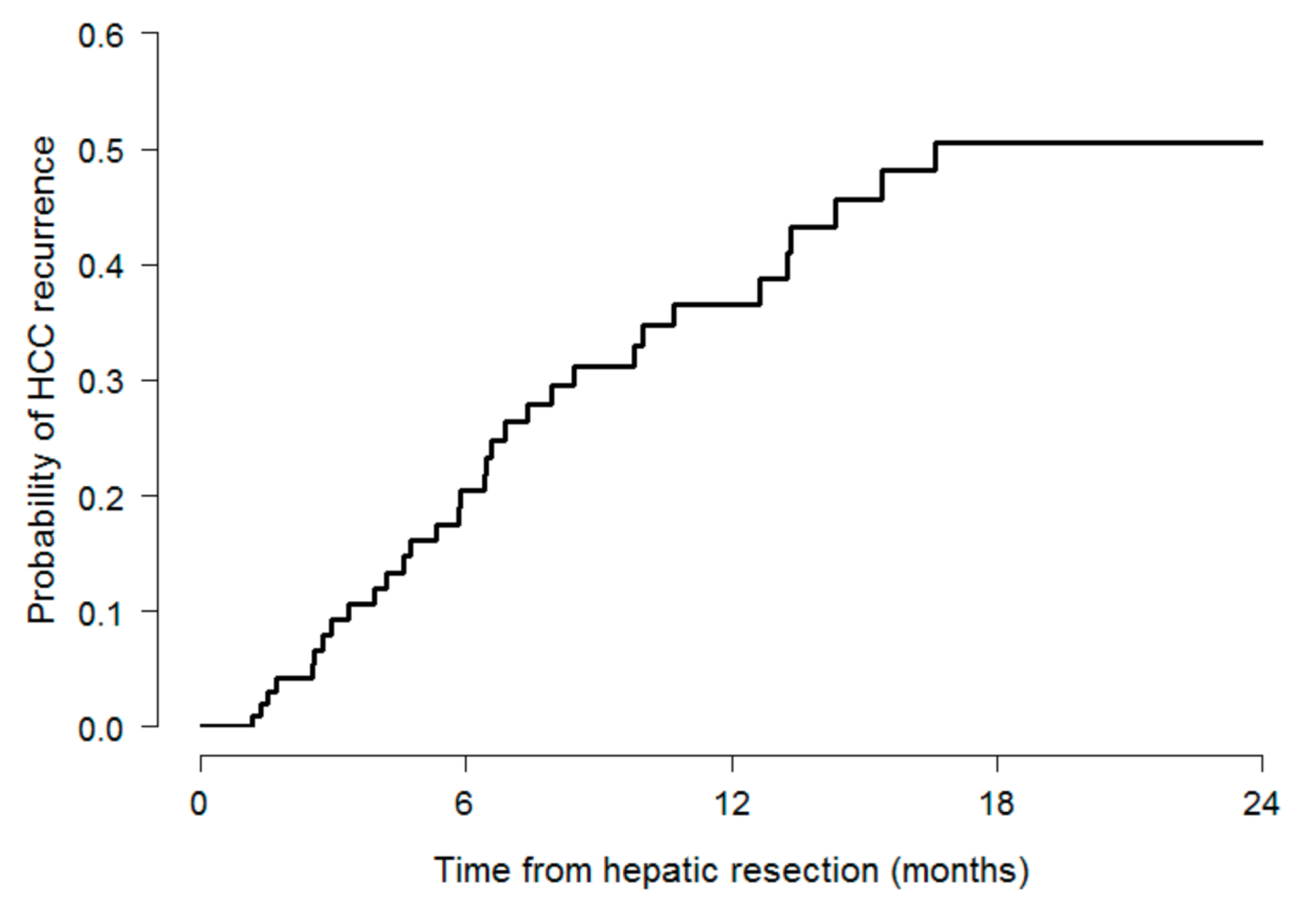
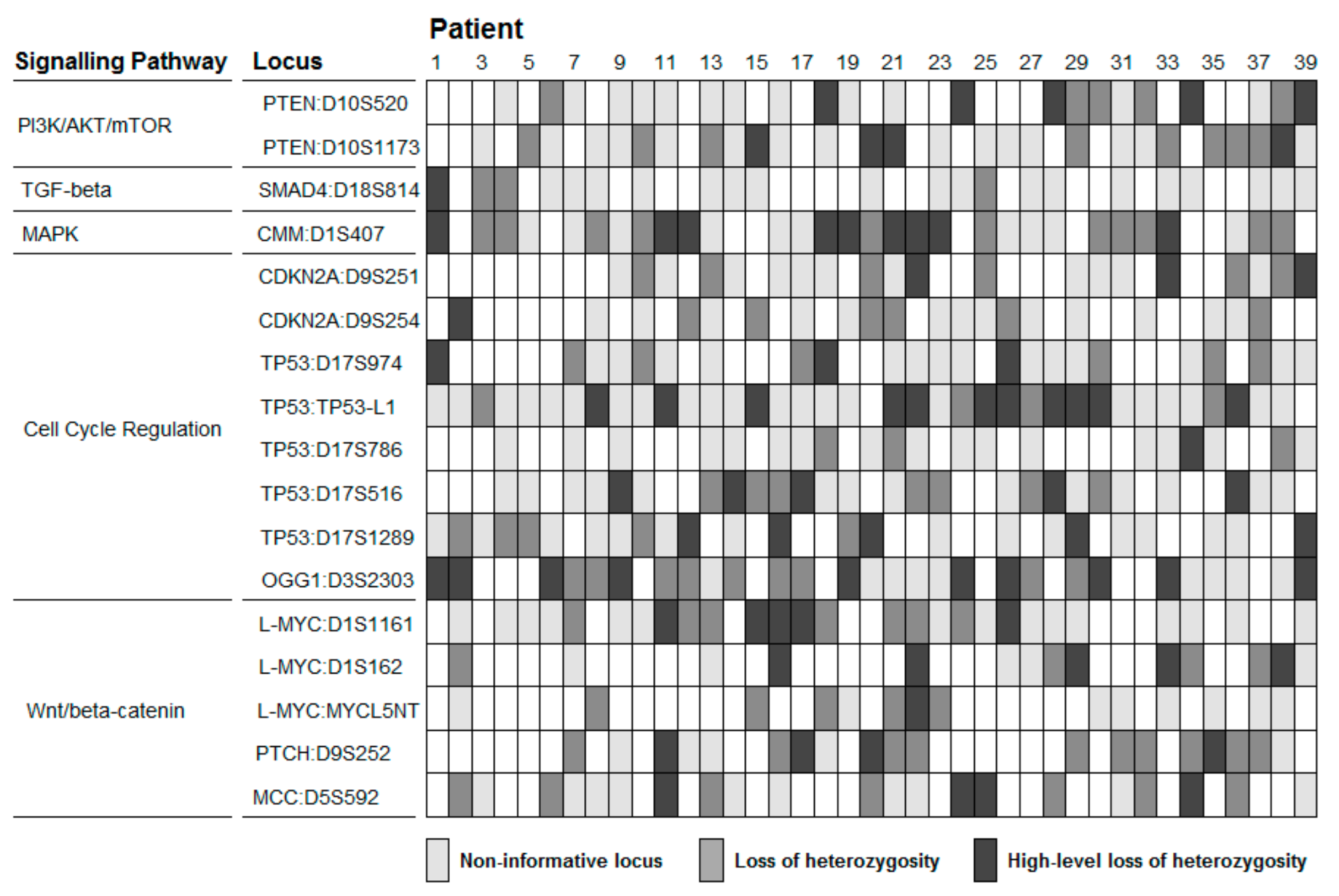
Background: Hepatic resection remains the treatment of choice for patients with early-stage HCC with preserved liver function. Unfortunately, however, the majority of patients develop tumor recurrence. While several clinical factors were found to be associated with tumor recurrence, HCC pathogenesis is a complex process of accumulation of somatic genomic alterations, which leads to a huge molecular heterogeneity that has not been completely understood. The aim of this study is to complement potentially predictive clinical and pathological factors with next-generation sequencing genomic profiling and loss of heterozygosity analysis. Methods: 124 HCC patients, who underwent a primary hepatic resection from January 2016 to December 2019, were recruited for this study. Next-generation sequencing (NGS) analysis and allelic imbalance assessment in a case-control subgroup analysis were performed. A time-to-recurrence analysis was performed as well by means of Kaplan–Meier estimators. Results: Cumulative number of HCC recurrences were 26 (21%) and 32 (26%), respectively, one and two years after surgery. Kaplan–Meier estimates for the probability of recurrence amounted to 37% (95% C.I.: 24–47) and to 51% (95% C.I.: 35–62), after one and two years, respectively. Multivariable analysis identified as independent predictors of HCC recurrence: hepatitis C virus (HCV) infection (HR: 1.96, 95%C.I.: 0.91–4.24, p = 0.085), serum bilirubin levels (HR: 5.32, 95%C.I.: 2.07–13.69, p = 0.001), number of nodules (HR: 1.63, 95%C.I.: 1.12–2.38, p = 0.011) and size of the larger nodule (HR: 1.11, 95%C.I.: 1.03–1.18, p = 0.004). Time-to-recurrence analysis showed that loss of heterozygosity in the PTEN loci (involved in the PI3K/AKT/mTOR signaling pathway) was significantly associated with a lower risk of HCC recurrence (HR: 0.35, 95%C.I.: 0.13–0.93, p = 0.036). Conclusions: multiple alterations of cancer genes are associated with HCC progression. In particular, the evidence of a specific AI mutation presented in 20 patients seemed to have a protective effect on the risk of HCC recurrence.