


Simple Summary
Recently, biomarkers have become a supplemental tool to aid in the diagnosis and evaluation of prostate cancer. Numerous biomarkers are being developed, but no one has a place in current clinical practice for active surveillance. However, active surveillance is a curative treatment option that shifts the possible timing of treatment, but misclassification and progression impose regular monitoring of patients that could be improve by biomarkers. The aim of this review is to investigate the potential of biomarker performance for active surveillance selection and outcome prediction. Our study has identified the critical role that biomarkers could play in piecing together an individualised prognostic for each patient and their use in active surveillance. Although no single biomarker should determine therapy, each biomarker should be considered as a piece of the puzzle in the important decision-making process.
Abstract
Active surveillance (AS) in prostate cancer (PCa) represents a curative alternative for men with localised low-risk PCa. Continuous improvement of AS patient’s selection and surveillance modalities aims at reducing misclassification, simplifying modalities of surveillance and decreasing need for invasive procedures such repeated biopsies. Biomarkers represent interesting tools to evaluate PCa diagnosis and prognosis, of which many are readily available or under evaluation. The aim of this review is to investigate the biomarker performance for AS selection and patient outcome prediction. Blood, urinary and tissue biomarkers were studied and a brief description of use was proposed along with a summary of major findings. Biomarkers represent promising tools which could be part of a more tailored risk AS strategy aiming to offer personalized medicine and to individualize the treatment and monitoring of each patient. The usefulness of biomarkers has mainly been suggested for AS selection, whereas few studies have investigated their role during the monitoring phase. Randomized prospective studies dealing with imaging are needed as well as larger prospective studies with long-term follow-up and strong oncologic endpoints.
1. Introduction
Prostate cancer (PCa) is the second most frequent cancer and the fifth leading cause of cancer death in men worldwide [1]. Prostate specific antigen (PSA), FDA approved in 1986 as a prognostic marker in PCa, revolutionized PCa screening with consequent reduction in mortality rates due to diagnosis at earlier stage. However, PSA is characteristic of prostate epithelium but not a cancer specific marker, PSA could be elevated in PCa but in non-malignant condition as benign prostatic hypertrophy or prostatitis. Early detection of PCa by prostate specific antigen (PSA) testing is controversial, with the aim of increasing the detection of localized PCa in order to decrease mortality related to prostate cancer [2]. Two large trials evaluating early detection have reported different results. The PLCO trial conducted in the USA, has shown a higher incidence of PCa but no reduction in PCa mortality [3], but the control arm was contaminated [4]. The more robust European lead ERSPC trial done in Europe, has proven that organized PSA screening provided a PCa specific survival benefit [5]. Over the last few years, we have distinguished between patients with clinically significant PCa and less aggressive PCa that can benefit of active surveillance (AS). AS is a curative treatment option [6,7,8] that shifts the possible timing of treatment while remaining within the window of disease curability and avoids unnecessary aggressive treatment with life-altering side effect [9,10]. The ProtecT study compared surgery, radiotherapy and AS for low and intermediate PCa with no difference between the three approaches confirming the curative possibility by using AS after ten years of median follow up [11,12]. Nevertheless, the criteria for selecting patients eligible for AS and surveillance modalities vary between studies. Overall, criteria are based on digital rectal examination (DRE), PSA or PSA density, ISUP grade and the tumoral burden on the biopsies (number of positive biopsies, percentage of invasion per core). Multiparametric magnetic resonance imaging (mpMRI) has good sensitivity for the detection and location of ISUP grade > 1 [13,14], improves evaluation of PCa with targeted biopsies and could limits the risk of misclassification [15,16].
Misclassification and progression impose regular monitoring of patients in AS. Surveillance frequencies vary between studies but systematically include PSA monitoring, DRE, and repeat biopsies. Repeated biopsies may associated with significant morbidity [17] and non-compliance in men on AS [18]. mpMRI is recommended [6,7] before a confirmatory biopsy but it remains unclear if regular repeat mpMRI should be performed systematically [19,20]. PSA testing reduces death from prostate cancer, but has limited specificity for detecting clinically significant disease. PSA is characteristic of prostate epithelium but not a cancer specific marker, PSA could be elevated in PCa but in non-malignant condition as benign prostatic hypertrophy or prostatitis.
Recently, biomarkers have become a supplemental tool to aid in the diagnosis and evaluation of localized PCa and could allow a more personalized approach to tailor the surveillance of each man. Currently, biomarkers do not yet have a place in current clinical practice for AS.
The aim of this review is to investigate the potential of biomarker performance for active surveillance selection and outcome prediction.
2. Methods
A systematic web search was performed according to the Preferred Reporting Items for Systematic Reviews and Meta-analyses (PRISMA) guidelines through the PubMed and Cochrane databases was performed from 2010 to March 2021. A systematic web search was performed according to the Preferred Reporting Items for Systematic Reviews and Meta-analyses (PRISMA) guidelines An ‘a priori’ protocol was submitted to PROSPERO, Registration Number: CRD42021253332.
A systematic web search was performed according to the Preferred Reporting Items for Systematic Reviews and Meta-analyses (PRISMA) guidelines, various algorithms, including the following terms, were used: prostate cancer, active surveillance, localized prostate cancer, biomarker, genomic score, liquid biomarker. Full-text publications using Roman alphabet were considered.
The study population comprised male patients with histologically proven PCa in AS cohort or eligible for AS. We included published full articles, clinical trials, prospective studies and retrospective series, written in English. We excluded retrospective studies with less than 100 patients, abstracts and congress communications. For tissue biomarkers only commercially available biomarkers were studied. Each identified article was analysed and classified.
Main objectives were biomarker performance for active surveillance selection and oncological outcome prediction. Biomarker performance was assessed by their ability to identify grade reclassification (upgrading) or to improve models to identify grade reclassification. They could be used alone but was most often included in models including other criteria.
Risk of bias and study quality was assessed according to EAU recommendations for performing systematic reviews and meta-analysis [21]. The Cochrane risk of bias assessment tool was used for RCTs and the Quality Appraisal tool for case series using a Modified Delphi technique for retrospective studies (Table S1).
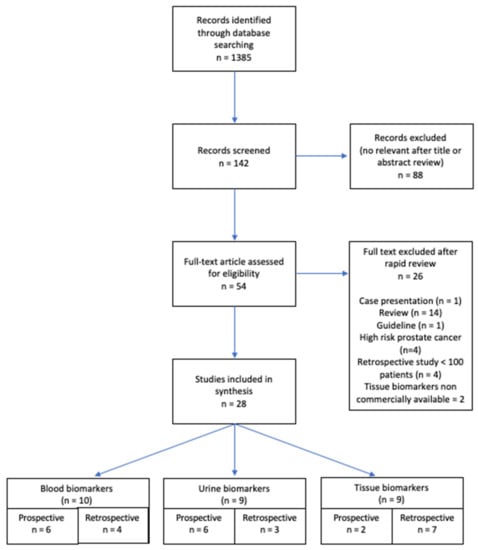
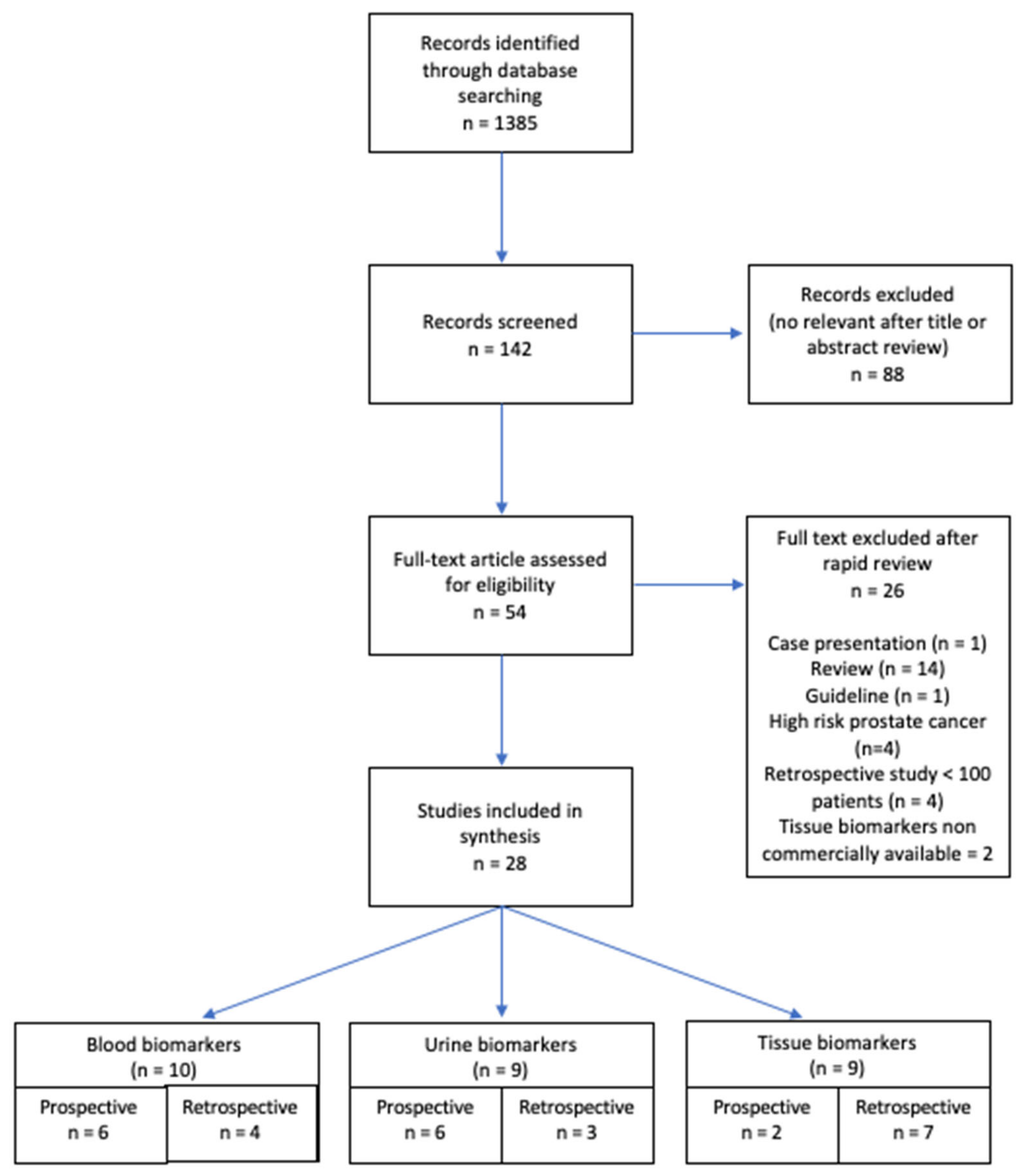
Selection of article is shown in a flow diagram (Figure 1). Articles were separated for the synthesis into three categories: blood biomarkers, urinary biomarkers, tissue biomarkers.
Figure 1.
Literature search and selection of studies flowchart.
3. Results
A total of 28 articles were selected, of which 10 have a focus on blood biomarkers, 9 on urine biomarkers and 9 on tissue biomarkers.
3.1. Blood Biomarkers
Blood biomarkers represent non- or minimally invasive tests which may not be influenced by tumor sampling inherent to prostate needle biopsies.
At the present time, in addition to the PSA, the FDA approved 2 blood biomarkers only for the diagnosis of PCa; the Prostate Health Index (PHI) test and the four-kallikrein (4KScore) score test. Our research has identified 8 biomarkers (Table 1).
Table 1.
Blood biomarkers.
3.2. ProPSA and Prostate Health Index (PHI)
ProPSA is an enzymatic inactive form of PSA. PSA is secreted as an inactive proenzyme (proPSA) into seminal fluid and activated by the kallikrein-related peptidase 2 and other endopeptidases. In normal situation proPSA do not diffuse into peripherical circulation. In prostate cancer, loss of basal cells, disordering of the basement membrane, and disruption of normal lumen architecture leads to a decrease in luminal processing and a relative increase in bound PSA and proPSA as well as other serous PSA isoforms [32]. Retrospective studies have identified (−2)proPSA as a superior predictor of significant prostate cancer than PSA [33,34,35]. The Prostate Health Index (PHI) is a calculated factor improving the performance of proPSA by combining PSA, freePSA and (−2)proPSA, differentiating the presence of significant PCa from noncancerous prostatic disease [22,36,37]. The test costs about USD 100.
Tosoian et al. [23] examined the relationship between proPSA, PHI and biopsy results in men enrolled in an AS program in a retrospective study including 167 patients with NCCN very low risk PCa. Baseline and longitudinal proPSA and PHI measurements were significantly higher among who presented biopsy reclassification. Heidegger’s et al. [24] international multicenter prospective study, including patients (n = 112) with Gleason Score (GS) 6, yet only 44 patients meeting criteria for AS, showed that proPSA and PHI predicted aggressive pathology in univariate analysis but not in multivariate analysis.
More recently, Schwen et al. [38] combined the PHI and mpMRI to predict biopsy reclassification among 253 patients with NCCN low-risk or very low-risk PCa in a retrospective study. In this study PHI and mpMRI would have avoided nearly 20% surveillance biopsies. The inclusion of PHI in the Epstein or PRIAS model increased the accuracy of predicting non-significant PCa, and selecting patient eligible for AS [39,40].
PHI could therefore become a tool for the selection and follow-up of patients in AS, and combined with mpMRI could improve AS and decrease repeated biopsies.
3.3. The Four-Kallikrein Panel
The four-kallikrein algorithm was developed based on data from European Randomized Study of Screening for Prostate Cancer (ERSPC) studies and the Prostate Testing for Cancer and Treatment (ProtecT) study [41,42].
Four kallikreins (total PSA, free PSA, intact PSA, and human kallikrein 2) (4K panel) combined with age using a mathematical algorithm gives the 4KScore. The test costs about USD 750.
This score guides urologists’ decisions on whether to perform a biopsy by giving a measure of the probability of significant PCa (GS > 6) for each patient pre-biopsy. This score is known to have a good diagnostic performance in detecting significant PCa [25] and is FDA-approved. Lin et al. [43] explored the utility of the 4K panel to predict high-grade disease in men already diagnosed with GS 6 cancer and on active surveillance in a prospective study (n = 718). They used the 4K panel in a different model from the commercial 4K score; the new model included the 4K panel and clinical information available after a diagnosis of cancer, calibrated to an active surveillance population. Replacing the PSA with the 4K panel significantly improved the accuracy for predicting reclassification in the initial surveillance biopsy but there was no benefit for subsequent biopsies. These results should be validated in another larger cohort, but the 4K panel could be a new useful tool for selecting AS candidates.
3.4. IsoPSA
IsoPSA is a new blood-based assay for detection of PCa. IsoPSA is a structure-based (rather than concentration-based) assay that interrogates the entire spectrum of structural changes of complex PSA calculated by the equation, K = [([total PSA]bottom − [freePSA]bottom)/([total PSA]top − [free PSA]top)]. Recent studies reported the clinical performance for the detection of high grade (GS > 6) disease [44,45], however no study on AS cohort or low risk population have yet been performed.
3.5. Circulating Prostate Cells
Circulating tumoral cells (CTC) is a new simple and less invasive diagnostic concept to identify and investigate the molecular features of solid tumors when cancer cells disseminate into the blood circulation. Detection of CTC in prostate cancer remains in the field of research and is not yet performed in clinical practice.
Most studies looked for an association between CTC count and survival in metastatic PCa [26,46,47] with discordant results using different methods of detection. Murray et al. [27] investigated about the diagnostic performance of malignant prostatic cells detection in blood for early detection of PCa and found sensibility, specificity and negative predictive value of 86.2%, 90.8% and 94.3%, respectively. In another prospective study including 1123 patients referred for prostate biopsy (suspicious DRE or elevated PSA) [48], the authors found that patients with PCa and negative CTC had low grade, small volume tumors and most often would comply with the criteria for active surveillance. Comparison of the presence of CTCs with the clinical pathological findings after RP in men fulfilling the criteria for active surveillance confirmed that positive CTCs represent a high risk of disease upgrade, thus these men may not be ideal candidates for AS [49].
The works of Murray’s team seem interesting for the selection of candidates for AS, but we know that detection of CTCs is highly method dependent and further studies with larger populations are needed.
3.6. microRNA (miRNA)
MiRNA circulating in peripheral blood of patient, is a short noncoding RNA that regulate gene expression via modulation of specific messenger RNA (mRNA) targets [50]. In recent years, multiple circulating miRNAs have been shown to be associated with PCa progression or predictive of the response to therapy in high grade or metastatic PCa [28,50]. Liu et al. [51] investigated whether miRNA aberrations are detectable during the early stages of PCa and enables the differentiation from indolent to aggressive PCa. They presented a retrospective description cohort (n = 196) and a prospective validation cohort (n = 133); all patients had GS 6 and were enrolled in AS program. Three miRNA were significant to predict classification (miR-223, miR-24 and miR-375) and were combined in a 3 mi-RNA score. This study is the first to investigate circulating miRNAs to predict reclassification in patients on AS, but further validations are required.
3.7. Caveolin-1
Caveolin-1 (Cav-1), is a membrane protein involved in binding, localizing and regulating of various signalling proteins [52]. The carcinogenic role of caveolin-1 has been identified in many tumors, suggesting that it may act as a novel therapeutic target for tumors. Caveolin-1 is reportedly overexpressed in prostate cancer and could serve as a risk factor and adverse clinicopathological feature of PCa [29]. Basourakos et al. [53] evaluated Cav-1 performance as a biomarker for reclassification in men undergoing AS in a retrospective study (n = 542). Baseline Cav-1 level were significantly associated with disease reclassification.
This study suggests that Cav-1 levels may improve risk stratification for AS patients.
3.8. Testosterone
Some studies determined a relationship between androgens levels and PCa. Lower serum testosterone concentrations were associated with high-grade PCa, extraprostatic disease and early biochemical recurrence in localized PCa [30,54,55]. Ferro et al. [56] evaluated the association of circulating testosterone concentrations with a reclassification in a cohort of low-risk PCa patients meeting the inclusion criteria for the AS protocol but opting for radical prostatectomy in a restrospective study (n = 338). In accordance with previous studies, lower testosterone concentrations were associated with reclassification, disease upgrading and upstaging. Lower testosterone level could help to identify patients at high risk of reclassification and therefore poor candidates for AS.
3.9. Stockholm3 Test
The Stockholm3 score predicts the probability of GS > 6 on systematic and targeted biopsy using a combination of 5 plasma biomarkers (total PSA, free PSA, hK2, Macrophage inhibitory cytokine-1 [MIC-1], microseminoprotein-beta [MSMB]), 101 germline genetic markers, and 5 clinical variables (age, first-degree family history of PCa, a previous biopsy, DRE, and prostate volume assessed by transrectal ultrasound at PCa diagnosis) [31,57]. Olsson et al. [58] evaluated this model in AS prospective cohort (n = 280). The main outcome was reclassification to GS > 6 and clinically significant PCa. Adding the Stockholm3 test as a selection tool before mpMRI increased sensitivity by 27% to detect GS > 6 and by 53% to detect clinically significant PCa compared with performing systematic biopsies on all men. Of the men with negative Stockholm3 test, 7.9% harboured GS7 (3 + 4) but fewer than 50% of cores were positive and none were clinically significant PCa based on NCCN. These results suggested that Stockholm3 score could decrease the number of MRI investigations needed and biopsied men, whereas missing a small number of significative PCa. However, despite the more frequent use of mpMRI in AS protocol, the Stockholm3 test demonstrates a benefit for AS populations.
4. Urinary Biomarker
Urinary biomarkers are other minimally or non-invasive tests, all of which should be performed after DRE. At the present time, the FDA approved PCA3. Our research has identified 4 biomarkers (Table 2).
Table 2.
Urine biomarkers.
4.1. Prostate Cancer Antigen 3 (PCA3)
PCA3 is a prostate-specific noncoding mRNA detectable in urine. It is significantly over expressed in prostate cancer tissue and tends to be over-expressed in the urine of men with PCa [66,67]. The PCA3 score is a ratio between PCA3-mRNA and PSA-mRNA [68]. PCA3 can be used to risk-stratify men with elevated PSA levels who should undergo a biopsy [69,70]. Higher urinary PCA3 levels were noted in men with higher volume and higher grade PCa [59].
The yield of PCA3 in AS protocols is debatable; Tosoian et al. [60] found that PCA3 score was not significantly associated with progression in AS programs in a prospective study (n = 293), while Ploussard et al. [61] in another prospective study on low-risk PCa patients (n = 106), showed that a PCA3 score > 25 was an important predictive factor for significant PCa and could improve the selection for AS. Later, Tosoian et al. and Newcomb et al. [63,71] in a longitudinal study confirmed that PCA3 scores were significantly higher in men who underwent progression but the change in PCA3 over time was not associated with progression. The inclusion of PCA3 in the Epstein or PRIAS model increased the accuracy of predicting non-significant PCa, and selecting patient eligible for AS [39]. Porpiglia et al. [40] studied PCA3 the performance capabilities of the PHI, PCA3 and mpMRI in predicting the presence of pathologically confirmed significant PCa in patients eligible for AS, but PCA3 did not add value to base model.
According to these studies, PCA3 could be a tool to improve selection for AS but not for follow-ups of AS patients.
4.2. TMPRSS2-ERG Fusion
Approximately half of Caucasian patients with PCa over-expressed TMPRSS2:ERG fusion. TMPRSS2:ERG fusion is a rearrangement of the TMPRSS2 gene, an androgen-regulated transcriptional promoter, and the ERG oncogene [72]. TMPRSS2:ERG rearrangement can be detected in urine after DRE and can also be normalized to the amount of PSA mRNA to generate a TMPRSS2:ERG score. Detecting TMPRSS2:ERG fusion in urine was found to be associated with PCa detection, mortality and with tumor volume, and high GS [62].
Lin et al. [73] reported a correlation between urinary levels of combined PCA3 and TMPRSS2:ERG transcripts with aggressive cancer features as defined by tumor volume or Gleason score at the time of diagnosis in a multi-institutional, prospective active surveillance cohort (n = 413), but the increase in the markers was not significant. In contrast, the Newcomb et al. study [71] that failed to find an association between TMPRSS:ERG score and disease reclassification in a larger and a newer cohort (n = 782).
The relevance of the score is yet to be proven and does not seem to provide more benefit than the PCA3.
4.3. DNA Methylation and miRNA
Epigenetic alterations, include DNA methylation and microRNAs (miRNAs), dysregulated in CaP [64,74]. These changes are stable and can be detected in urine. Urinary detection of methylation biomarkers allows for global and non-invasive sampling, which is not the case with biopsies.
Eight genes (APC, CRIP3, GSTP1, HOXD3, HOXD8, KLK10, TBX15 and TGFb2) detected in radical prostatectomy samples were associated with high grade tumors and an adverse clinical prognosis [74], these genes have been looked for in urine sample.
A prospective study has investigated the predictive value of methylation biomarkers in urine samples from patients with PCa enrolled in an AS cohort (n = 153) [65]. A 4-gene methylation classifier panel (APC, CRIP3, GSTP1 and HOXD8) was identified and was able to predict patient reclassification.
Another study examined the combination of cell-free urinary miRNA and urinary sediment DNA methylation to develop a multiparametric model for predicting AS patients’ risk reclassification [75]. The authors identified a three-marker panel (CRIP3 methylation, miR-24, and miR-30c) that was a significant predictor for patient reclassification.
These preliminary studies represent a new direction but needs more investigations and validations.
5. Tissue Biomarker
All patients included in AS protocol have diagnosis biopsies and repeated monitoring biopsies. Tissular biomarkers have been developped to predict the prognosis of the disease by studying PCa cells. Currently 4 biomarkers are commercially available in some countries: Oncotype Dx GPS©, Decipher©, Prolaris© and Promark score©. The cost ranges from USD 3000 to USD 5000, but can be covered by commercial insurance.
Important studies are resumed in Table 3.
Table 3.
Tissular biomarkers.
5.1. Oncotype Dx Genomic Prostate Score©
The OncotypeDx Genomic Prostate Score is a RNA based expression assay of 12 PCa related genes normalized to 5 housekeeping genes. Quantitative reverse transcriptase-polymerase chain reaction assay is performed, and the genomic expression levels are used in an algorithm, the “genomic prostate score (GPS)“, in which different gene clusters are given different weight (those involved in the androgen pathway are given higher weight than others). The GPS ranges from 0 to 100 with higher scores indicating a greater genomic risk of aggressive disease. The assay is available in the US at a single platform. GPS can be performed on prostate specimens or on needle core biopsy tissue with more than 1 mm prostate tumor. It has been clinically validated to predict the risk of high grade and/or non-organ confined disease, and time to biochemical recurrence and metastasis [76,85,86].
Several retrospective studies [77,78,79] and one prospective study [76] characterized GPS in patients eligible for AS. A higher initial GPS was associated with an increased risk of upgrading, and an increased risk of adverse pathology [76,77,78,79]. For monitoring, the GPS is relatively stable with time even in men with a biopsy upgrade [79]. Some studies associated GPS and mpMRI, one associating PI-RADS and GPS on systematic biopsies [77], another associating PIRADS and GPS on targeted and systematic biopsies [80]. In these studies, the GPS score was predictive of adverse disease pathology on the prostate specimen, independently of the MRI scores.
However, most recently, a multicentre prospective-retrospective study evaluated the performance of GPS in patients on AS (n = 432) [81]. This study found that GPS scores were not associated with adverse pathology at RP nor upgrade on subsequent biopsy. Moreover, Nyame et al. [82], studied GPS in patients with very low- and low-risk NCCN PCa, and did not demonstrate any GPS differences with disease volume at prostate biopsy.
These inconsistencies make it impossible to conclude on the use of GPS for the selection of patients in AS. Prospective validations of this marker are awaited.
5.2. Genomic Classifier: Decipher©
Decipher uses a whole-transcriptome microarray assay. A total of 22 RNA biomarkers (coding and non-coding) selected by machine learning have been associated with PCa aggressiveness and metastasis prediction after RP [87]. An algorithm generates a score ranging from 0 to 1 with higher values indicating poor prognosis. The assay is available in the US at a single platform.
This test was performed on RP specimens, but recently results have been reported for the analysis of biopsy needle, however without defined pre-analytical conditions.
Recent review, showed the utility of Decipher© for intermediate-risk PCa and postprostatectomy decision-making and was prognostic for adverse pathology, biochemical failure, metastasis, and cancer-specific and overall survival [88].
Kim et al. [83] and Herleman et al. [84] evaluated the ability of Decipher© to predict adverse pathology in patients with NCCN favourable-intermediate risk PCa who undergone a RP at first treatment. Decipher was an independent predictor of adverse pathology and adding Decipher improved the CAPRA score. In this setting, Decipher©-high-risk patients were not good candidates for AS. Decipher© test could be a tool for patient selection but need more prospective studies.
5.3. Prolaris©
Prolaris evaluates genes related to cell cycle progression. The assay uses RT-PCR to look at expression levels of 31 genes involved in the cell cycle progression pathway and 15 housekeeper genes. The expression level of these genes is included in an algorithm that calculates a score, the CCP, which is a continuous variable between −3.0 and 7.0 with higher value indicating poor prognosis.
This test has been reported mainly on prostatectomy specimens, when performed on biopsy material, the test requires a tumour length of more than 2 mm. The assay is available in the US at a single platform.
It has been validated as an independent prognostic factor after RP in a cohort including low risk PCa [89] but since then no studies have been conducted on an AS cohort.
5.4. ProMark Score©
ProMark score use a quantitative multiplex proteomics in situ imaging system to identify and measure 8 protein-based biomarkers that are able to predict prostate cancer aggressiveness and lethal outcome. The ProMark score® ranges from 0 to 100 with higher score relating to more aggressive and lethal PCa [90]. It was initially developed on RP specimen and then on biopsy material. No pre-analytical criteria are reported for the minimum amount of tumour tissue required.
This score offered additional prognostic value for individual patients relative to NCCN risk categories alone. No supplementary study was carried out.
6. Discussion
With the heterogenous nature of prostate cancer, it is essential to identify optimal methods to guide physicians in selecting the best personalised treatment for their patients. Whilst AS aims to avoid unnecessary invasive treatment in men with localised PCa and simultaneously, examines and enables selection of patients needing further treatment in an ideal curative time window, the mode of AS could be improved. The recent development of numerous biomarkers could become a novel tool to improve PCa risk assessment and contribute to patient wellbeing. One study showed that among patients with PCa cancer at favourable risk, those classified as low risk using a biomarker were more likely to be managed on AS than those who had not been tested [91].
Table 4 lists the biomarkers performance presented in the article.
Table 4.
Biomarkers’ performance.
Serum and urine biomarkers are non- or minimally invasive tests, less invasive than repeated biopsy. Currently, PHI, 4KScore and PCA3 are FDA approved and seem to be of prognostic interest for the selection of AS-eligible patients. PHI also appears to be relevant for AS monitoring. Of note, the urinary biomarkers could reduce morbidity and facilitate compliance in men on AS. Moreover, these biomarkers are not influenced by tumour sampling which suggests a greater stability in the assays with a global disease assessment. Most of the other liquid biomarkers (circulating prostate cells, microRNA, Caveolin 1) seem like attractive tools for the selection of patients eligible for AS. The disease monitoring was less evaluated on AS although it represents the main challenge for these population and therefore studying disease progression is of significance.
Genomic scores represent new area in PCa, predicting prognosis by studying PCa cells. The limitations of these tests are tumour sampling and the minimum amount of tissue material required inherent to prostate needle biopsies but represent the only way to study tumour cell directly. Of the four tissular biomarkers commercially available, OncotypeDX GPS© and Decipher© have been studied in AS population and may become new helpful tools for AS selection in the case where tissue is available. Many genomic score are in development, but tumour heterogeneity and sampling fluctuations require large robust studies.
Biomarkers are of recent development in PCa and there are many limitations. They require increasingly complex technologies, and a lot of them are not yet available in clinical routines, which explains the low number of studies.
The majority of biomarkers recently published are still in the investigation or validation phases and AS population have not yet been studied. Furthermore, heterogeneity regarding study design and population characteristics could explain the discrepancy in results. No data is yet available with long term endpoints such as disease mortality in patients with more than 10 years life expectancy and a disease leading specifically to death on long-term follow-up. Finally, since most studies are retrospective, prospective studies investigating the performance of biomarkers in PCa have yet to be conducted. Additionally, biomarkers are currently expensive, the cost effectiveness of biomarkers has not been studied and is poorly described in literature but remains a key question in the management of patients.
7. Conclusions
Numerous biomarkers are being developed, which could become novel tools to improve PCa risk assessment and contribute to patient wellbeing. At present, it is difficult to conclude and establish recommendations. Nonetheless, biomarkers hold an exciting prospect as a new prognostic strategy that would make it possible to offer personalized medicine, individualizing the treatment and monitoring of each patient. Further larger prospective studies with long term outcomes are required to define how these novel biomarkers could be used to select men that would most benefit from an AS program and how these markers could be incorporated into the follow-up schedule of AS patients. Studies combining biomarkers with mpMRI data, known to be a strong diagnostic and prognostic tool, seem indispensable to be adapted to current practices. Combining the use of different biomarkers would provide greater understanding of each disease type, opening new avenues of research and prognostic options. Finally, despite a lack of research carried out with a specific focus on biomarkers, our study has identified the critical role that biomarkers could play in piecing together an individualised prognostic for each patient and their use in AS. Although no single biomarker should determine therapy, each biomarker should be considered as a piece of the puzzle in the important decision-making process.
Supplementary Materials
The following are available online at https://www.mdpi.com/article/10.3390/cancers13174251/s1, Table S1: Quality/Risk of Bias of the retrospective Included Studies.
Author Contributions
C.M., G.P.: project development, data collection and management, data analysis, manuscript writing, and manuscript editing. G.F. (Gaëlle Fromont), J.-B.B., E.B., L.B., G.C., C.D., G.F. (Gaëlle Fiard), M.G., R.M., R.R.-P., G.R., A.R., P.S., M.R.: data analysis, manuscript writing, and manuscript editing. All authors have read and agreed to the published version of the manuscript.
Funding
This research received no external funding.
Institutional Review Board Statement
Not applicable.
Informed Consent Statement
Not applicable.
Data Availability Statement
Not applicable.
Acknowledgments
The authors would like to thank Charlotte Somes for English editing of the manuscript.
Conflicts of Interest
The authors declare that there are no conflicts of interest.
Abbreviation
| 4K | 4 kallicrein |
| AS | Active Surveillance |
| CTC | Circulating Tumoral Cells |
| Cav-1 | Caveolin-1 |
| DRE | Digital Rectal Examination |
| GS | Gleason Score |
| mpMRI | Multiparametric Magnetic Resonance Imaging |
| NCCN | national comprehensive cancer network |
| PCa | Prostate Cancer |
| PCA3 | Prostate Cancer Antigen 3 |
| PHI | Prostate Health Index |
| PSA | Prostate Specific Antigen |
| RP | Radical prostatectomy |
References
- Bray, F.; Ferlay, J.; Soerjomataram, I.; Siegel, R.L.; Torre, L.A.; Jemal, A. Global cancer statistics 2018: GLOBOCAN estimates of incidence and mortality worldwide for 36 cancers in 185 countries. CA A Cancer J. Clin. 2018, 68, 394–424. [Google Scholar] [CrossRef] [Scilit]
- Draisma, G.; Boer, R.; Otto, S.J.; Van Der Cruijsen, I.W.; Damhuis, R.A.M.; Schröder, F.H.; De Koning, H.J. Lead times and overdetection due to prostate-specific antigen screening: Estimates from the European Randomized Study of Screening for Prostate Cancer. J. Natl. Cancer Inst. 2003, 95, 868–878. [Google Scholar] [CrossRef] [Scilit]
- Andriole, G.L.; Crawford, E.D.; Grubb, R.L.; Buys, S.S.; Chia, D.; Church, T.R.; Fouad, M.N.; Isaacs, C.; Kvale, P.A.; Reding, D.J.; et al. Prostate Cancer Screening in the Randomized Prostate, Lung, Colorectal, and Ovarian Cancer Screening Trial: Mortality Results after 13 Years of Follow-up. J. Natl. Cancer Inst. 2012, 104, 125–132. [Google Scholar] [CrossRef] [Scilit]
- Shoag, J.E.; Mittal, S.; Hu, J.C. Reevaluating PSA Testing Rates in the PLCO Trial. N. Engl. J. Med. 2016, 374, 1795–1796. [Google Scholar] [CrossRef] [Scilit] [PubMed]
- Schröder, F.H.; Hugosson, J.; Roobol-Bouts, M.; Tammela, T.L.; Ciatto, S.; Nelen, V.; Kwiatkowski, M.; Lujan, M.; Lilja, H.; Zappa, M.; et al. Prostate-Cancer Mortality at 11 Years of Follow-up. N. Engl. J. Med. 2012, 366, 981–990. [Google Scholar] [CrossRef] [Scilit] [PubMed]
- Mottet, N.; Bergh, R.C.V.D.; Briers, E.; Broeck, T.V.D.; Cumberbatch, M.G.; De Santis, M.; Fanti, S.; Fossati, N.; Gandaglia, G.; Gillessen, S.; et al. EAU-EANM-ESTRO-ESUR-SIOG Guidelines on Prostate Cancer—2020 Update. Part 1: Screening, Diagnosis, and Local Treatment with Curative Intent. Eur. Urol. 2021, 79, 243–262. [Google Scholar] [CrossRef] [Scilit]
- Rozet, F.; Mongiat-Artus, P.; Hennequin, C.; Beauval, J.; Beuzeboc, P.; Cormier, L.; Fromont-Hankard, G.; Mathieu, R.; Ploussard, G.; Renard-Penna, R.; et al. Recommandations françaises du Comité de cancérologie de l’AFU–actualisation 2020–2022: Cancer de la prostate. Progrès en Urologie 2020, 30, S136–S251. [Google Scholar] [CrossRef] [Scilit]
- Lam, T.B.; MacLennan, S.; Willemse, P.-P.M.; Mason, M.D.; Plass, K.; Shepherd, R.; Baanders, R.; Bangma, C.H.; Bjartell, A.; Bossi, A.; et al. EAU-EANM-ESTRO-ESUR-SIOG Prostate Cancer Guideline Panel Consensus Statements for Deferred Treatment with Curative Intent for Localised Prostate Cancer from an International Collaborative Study (DETECTIVE Study). Eur. Urol. 2019, 76, 790–813. [Google Scholar] [CrossRef] [Scilit]
- Klotz, L.; Vesprini, D.; Sethukavalan, P.; Jethava, V.; Zhang, L.; Jain, S.; Yamamoto, T.; Mamedov, A.; Loblaw, A. Long-Term Follow-Up of a Large Active Surveillance Cohort of Patients With Prostate Cancer. J. Clin. Oncol. 2015, 33, 272–277. [Google Scholar] [CrossRef] [Scilit]
- Bul, M.; Zhu, X.; Valdagni, R.; Pickles, T.; Kakehi, Y.; Rannikko, A.; Bjartell, A.; van der Schoot, D.K.; Cornel, E.B.; Conti, G.N.; et al. Active Surveillance for Low-Risk Prostate Cancer Worldwide: The PRIAS Study. Eur. Urol. 2013, 63, 597–603. [Google Scholar] [CrossRef] [Scilit] [PubMed]
- Hamdy, F.C.; Donovan, J.L.; Lane, J.A.; Mason, M.; Metcalfe, C.; Holding, P.; Davis, M.; Peters, T.; Turner, E.; Martin, R.; et al. 10-Year Outcomes after Monitoring, Surgery, or Radiotherapy for Localized Prostate Cancer. N. Engl. J. Med. 2016, 375, 1415–1424. [Google Scholar] [CrossRef] [Scilit]
- Donovan, J.L.; Hamdy, F.C.; Lane, J.A.; Mason, M.; Metcalfe, C.; Walsh, E.; Blazeby, J.; Peters, T.; Holding, P.; Bonnington, S.; et al. Patient-Reported Outcomes after Monitoring, Surgery, or Radiotherapy for Prostate Cancer. N. Engl. J. Med. 2016, 375, 1425–1437. [Google Scholar] [CrossRef] [Scilit]
- Bratan, F.; Niaf, E.; Melodelima, C.; Chesnais, A.L.; Souchon, R.; Mège-Lechevallier, F.; Colombel, M.; Rouvière, O. Influence of imaging and histological factors on prostate cancer detection and localisation on multiparametric MRI: A prospective study. Eur. Radiol. 2013, 23, 2019–2029. [Google Scholar] [CrossRef] [Scilit] [PubMed]
- Johnson, D.C.; Raman, S.S.; Mirak, S.A.; Kwan, L.; Bajgiran, A.M.; Hsu, W.; Maehara, C.K.; Ahuja, P.; Faiena, I.; Pooli, A.; et al. Detection of Individual Prostate Cancer Foci via Multiparametric Magnetic Resonance Imaging. Eur. Urol. 2019, 75, 712–720. [Google Scholar] [CrossRef] [Scilit] [PubMed]
- Luzzago, S.; de Cobelli, O.; Cozzi, G.; Peveri, G.; Bagnardi, V.; Catellani, M.; Di Trapani, E.; Mistretta, F.; Pricolo, P.; Conti, A.; et al. A novel nomogram to identify candidates for active surveillance amongst patients with International Society of Urological Pathology (ISUP) Grade Group (GG) 1 or ISUP GG2 prostate cancer, according to multiparametric magnetic resonance imaging findings. BJU Int. 2020, 126, 104–113. [Google Scholar] [CrossRef] [Scilit]
- Ploussard, G.; Beauval, J.-B.; LeSourd, M.; Almeras, C.; Assoun, J.; Aziza, R.; Gautier, J.-R.; Loison, G.; Portalez, D.; Salin, A.; et al. Impact of MRI and Targeted Biopsies on Eligibility and Disease Reclassification in MRI-positive Candidates for Active Surveillance on Systematic Biopsies. Urology 2020, 137, 126–132. [Google Scholar] [CrossRef] [Scilit] [PubMed]
- Loeb, S.; Vellekoop, A.; Ahmed, H.U.; Catto, J.; Emberton, M.; Nam, R.; Rosario, D.J.; Scattoni, V.; Lotan, Y. Systematic Review of Complications of Prostate Biopsy. Eur. Urol. 2013, 64, 876–892. [Google Scholar] [CrossRef] [Scilit] [PubMed]
- Bokhorst, L.P.; Alberts, A.R.; Rannikko, A.; Valdagni, R.; Pickles, T.; Kakehi, Y.; Bangma, C.H.; Roobol, M.J. Compliance Rates with the Prostate Cancer Research International Active Surveillance (PRIAS) Protocol and Disease Reclassification in Noncompliers. Eur. Urol. 2015, 68, 814–821. [Google Scholar] [CrossRef] [Scilit]
- Schoots, I.G.; Moore, C.M.; Rouvière, O. Role of MRI in low-risk prostate cancer. Curr. Opin. Urol. 2017, 27, 238–245. [Google Scholar] [CrossRef] [Scilit]
- Hsiang, W.; Ghabili, K.; Syed, J.S.; Holder, J.; Nguyen, K.A.; Suarez-Sarmiento, A.; Huber, S.; Leapman, M.S.; Sprenkle, P.C. Outcomes of Serial Multiparametric Magnetic Resonance Imaging and Subsequent Biopsy in Men with Low-risk Prostate Cancer Managed with Active Surveillance. Eur. Urol. Focus 2021, 7, 47–54. [Google Scholar] [CrossRef] [Scilit]
- Knoll, T.; Omar, M.I.; MacLennan, S.; Hernández, V.; Canfield, S.; Yuan, Y.; Bruins, M.; Marconi, L.; Van Poppel, H.; N’Dow, J.; et al. Key Steps in Conducting Systematic Reviews for Underpinning Clinical Practice Guidelines: Methodology of the European Association of Urology. Eur. Urol. 2018, 73, 290–300. [Google Scholar] [CrossRef] [Scilit]
- Jia, W.; Wu, B.; Shao, Y.; Cao, X.; Wang, D. Diagnostic performance of prostate cancer antigen 3 and the Prostate Health Index in detecting overall and clinically significant prostate cancer in men at first biopsy: A meta-analysis. Int. J. Urol. 2021, 28, 315–325. [Google Scholar] [CrossRef] [Scilit] [PubMed]
- Tosoian, J.J.; Loeb, S.; Feng, Z.; Isharwal, S.; Landis, P.; Elliot, D.J.; Veltri, R.W.; Epstein, J.I.; Partin, A.W.; Carter, H.B.; et al. Association of [−2]proPSA with Biopsy Reclassification During Active Surveillance for Prostate Cancer. J. Urol. 2012, 188, 1131–1136. [Google Scholar] [CrossRef] [Scilit] [PubMed]
- Heidegger, I.; Klocker, H.; Pichler, R.; Pircher, A.; Prokop, W.; Steiner, E.; Ladurner, C.; Comploj, E.; Lunacek, A.; Djordjevic, D.; et al. ProPSA and the Prostate Health Index as predictive markers for aggressiveness in low-risk prostate cancer—results from an international multicenter study. Prostate Cancer Prostatic Dis. 2017, 20, 271–275. [Google Scholar] [CrossRef] [Scilit] [PubMed]
- Parekh, D.J.; Punnen, S.; Sjoberg, D.D.; Asroff, S.W.; Bailen, J.L.; Cochran, J.S.; Concepcion, R.; David, R.D.; Deck, K.B.; Dumbadze, I.; et al. A Multi-institutional Prospective Trial in the USA Confirms that the 4Kscore Accurately Identifies Men with High-grade Prostate Cancer. Eur. Urol. 2015, 68, 464–470. [Google Scholar] [CrossRef] [Scilit]
- Pantel, K.; Hille, C.; Scher, H.I. Circulating Tumor Cells in Prostate Cancer: From Discovery to Clinical Utility. Clin. Chem. 2019, 65, 87–99. [Google Scholar] [CrossRef] [Scilit] [PubMed]
- Murray, N.P.; Reyes, E.; Tapia, P.; Orellana, N.; Dueñas, R.; Fuentealba, C.; Badinez, L. Diagnostic performance of malignant prostatic cells detection in blood for early detection of prostate cancer: Comparison to prostatic biopsy. Arch. Espanoles Urol. 2011, 64, 961–971. [Google Scholar]
- Bertoli, G.; Cava, C.; Castiglioni, I. MicroRNAs as Biomarkers for Diagnosis, Prognosis and Theranostics in Prostate Cancer. Int. J. Mol. Sci. 2016, 17, 421. [Google Scholar] [CrossRef] [Scilit]
- Chen, P.; Zhang, Y.-L.; Xue, B.; Xu, G.-Y. Association of Caveolin-1 Expression with Prostate Cancer: A Systematic Review and Meta-Analysis. Front. Oncol. 2021, 10, 2964. [Google Scholar] [CrossRef] [Scilit]
- Xylinas, E.; Ploussard, G.; Durand, X.; Fabre, A.; Salomon, L.; Allory, Y.; Vordos, D.; Hoznek, A.; Abbou, C.C.; De La Taille, A. Low pretreatment total testosterone (<3 ng/mL) predicts extraprostatic disease in prostatectomy specimens from patients with preoperative localized prostate cancer. BJU Int. 2011, 107, 1400–1403. [Google Scholar] [CrossRef] [Scilit] [PubMed]
- Grönberg, H.; Adolfsson, J.; Aly, M.; Nordström, T.; Wiklund, P.; Brandberg, Y.; Thompson, J.; Wiklund, F.; Lindberg, J.; Clements, M.; et al. Prostate cancer screening in men aged 50–69 years (STHLM3): A prospective population-based diagnostic study. Lancet Oncol. 2015, 16, 1667–1676. [Google Scholar] [CrossRef] [Scilit]
- Jansen, F.H.; Roobol, M.; Jenster, G.; Schröder, F.H.; Bangma, C.H. Screening for Prostate Cancer in 2008 II: The Importance of Molecular Subforms of Prostate-Specific Antigen and Tissue Kallikreins. Eur. Urol. 2009, 55, 563–574. [Google Scholar] [CrossRef] [Scilit]
- Sokoll, L.J.; Wang, Y.; Feng, Z.; Partin, A.W.; Sanda, M.G.; Thompson, I.M.; Chan, D.W. 1613: [−2] PROPSA for Prostate Cancer Detection: An NCI Early Detection Research Network Validation Study. J. Urol. 2007, 177, 534. [Google Scholar] [CrossRef] [Scilit]
- Catalona, W.J.; Bartsch, G.; Rittenhouse, H.G.; Evans, C.L.; Linton, H.J.; Horninger, W.; Klocker, H.; Mikolajczyk, S.D. Serum Pro-Prostate Specific Antigen Preferentially Detects Aggressive Prostate Cancers in Men with 2 To 4 Ng/Ml Prostate Specific Antigen. J. Urol. 2004, 171, 2239–2244. [Google Scholar] [CrossRef] [Scilit] [PubMed]
- Mikolajczyk, S.D.; Rittenhouse, H.G. Pro PSA: A more cancer specific form of prostate specific antigen for the early detection of prostate cancer. Keio J. Med. 2003, 52, 86–91. [Google Scholar] [CrossRef] [Scilit] [PubMed]
- Jansen, F.H.; van Schaik, R.H.; Kurstjens, J.; Horninger, W.; Klocker, H.; Bektic, J.; Wildhagen, M.F.; Roobol, M.J.; Bangma, C.H.; Bartsch, G. Prostate-Specific Antigen (PSA) Isoform p2PSA in Combination with Total PSA and Free PSA Improves Diagnostic Accuracy in Prostate Cancer Detection. Eur. Urol. 2010, 57, 921–927. [Google Scholar] [CrossRef] [Scilit] [PubMed]
- Loeb, S.; Sokoll, L.J.; Broyles, D.L.; Bangma, C.H.; Van Schaik, R.H.; Klee, G.G.; Wei, J.T.; Sanda, M.G.; Partin, A.W.; Slawin, K.M.; et al. Prospective Multicenter Evaluation of the Beckman Coulter Prostate Health Index Using WHO Calibration. J. Urol. 2013, 189, 1702–1706. [Google Scholar] [CrossRef] [Scilit] [PubMed]
- Schwen, Z.R.; Mamawala, M.; Tosoian, J.J.; Druskin, S.C.; Ross, A.E.; Sokoll, L.J.; Epstein, J.I.; Carter, H.B.; Gorin, M.A.; Pavlovich, C.P. Prostate Health Index and multiparametric magnetic resonance imaging to predict prostate cancer grade reclassification in active surveillance. BJU Int. 2020, 126, 373–378. [Google Scholar] [CrossRef] [Scilit]
- Cantiello, F.; Russo, G.I.; Cicione, A.; Ferro, M.; Cimino, S.; Favilla, V.; Perdonà, S.; De Cobelli, O.; Magno, C.; Morgia, G.; et al. PHI and PCA3 improve the prognostic performance of PRIAS and Epstein criteria in predicting insignificant prostate cancer in men eligible for active surveillance. World J. Urol. 2015, 34, 485–493. [Google Scholar] [CrossRef] [Scilit] [PubMed]
- Porpiglia, F.; De Luca, S.; Passera, R.; Manfredi, M.; Mele, F.; Bollito, E.; De Pascale, A.; Cossu, M.; Aimar, R.; Veltri, A. Multiparametric-Magnetic Resonance/Ultrasound Fusion Targeted Prostate Biopsy Improves Agreement Between Biopsy and Radical Prostatectomy Gleason Score. Anticancer. Res. 2016, 36, 4833–4840. [Google Scholar] [CrossRef] [Scilit]
- Vickers, A.J.; Cronin, A.M.; Aus, G.; Pihl, C.-G.; Becker, C.; Pettersson, K.; Scardino, P.T.; Hugosson, J.; Lilja, H. A panel of kallikrein markers can reduce unnecessary biopsy for prostate cancer: Data from the European Randomized Study of Prostate Cancer Screening in Göteborg, Sweden. BMC Med. 2008, 6, 1–10. [Google Scholar] [CrossRef] [Scilit]
- Bryant, R.J.; Sjoberg, D.D.; Vickers, A.; Robinson, M.C.; Kumar, R.; Marsden, L.; Davis, M.; Scardino, P.T.; Donovan, J.; Neal, D.E.; et al. Predicting High-Grade Cancer at Ten-Core Prostate Biopsy Using Four Kallikrein Markers Measured in Blood in the ProtecT Study. J. Natl. Cancer Inst. 2015, 107, djv095. [Google Scholar] [CrossRef] [Scilit] [PubMed]
- Lin, D.W.; Newcomb, L.F.; Brown, M.D.; Sjoberg, D.D.; Dong, Y.; Brooks, J.D.; Carroll, P.R.; Cooperberg, M.; Dash, A.; Ellis, W.J.; et al. Evaluating the Four Kallikrein Panel of the 4Kscore for Prediction of High-grade Prostate Cancer in Men in the Canary Prostate Active Surveillance Study. Eur. Urol. 2017, 72, 448–454. [Google Scholar] [CrossRef] [Scilit]
- Klein, E.A.; Chait, A.; Hafron, J.M.; Kernen, K.M.; Manickam, K.; Stephenson, A.J.; Wagner, M.; Zhu, H.; Kestranek, A.; Zaslavsky, B.; et al. The Single-parameter, Structure-based IsoPSA Assay Demonstrates Improved Diagnostic Accuracy for Detection of Any Prostate Cancer and High-grade Prostate Cancer Compared to a Concentration-based Assay of Total Prostate-specific Antigen: A Preliminary Report. Eur. Urol. 2017, 72, 942–949. [Google Scholar] [CrossRef] [Scilit]
- Stovsky, M.; Klein, E.A.; Chait, A.; Manickam, K.; Stephenson, A.J.; Wagner, M.; Dineen, M.; Lotan, Y.; Partin, A.; Baniel, J.; et al. Clinical Validation of IsoPSA™, a Single Parameter, Structure Based Assay for Improved Detection of High Grade Prostate Cancer. J. Urol. 2019, 201, 1115–1120. [Google Scholar] [CrossRef] [Scilit]
- Thalgott, M.; Rack, B.; Maurer, T.; Souvatzoglou, M.; Eiber, M.; Kreß, V.; Heck, M.M.; Andergassen, U.; Nawroth, R.; Gschwend, J.E.; et al. Detection of circulating tumor cells in different stages of prostate cancer. J. Cancer Res. Clin. Oncol. 2013, 139, 755–763. [Google Scholar] [CrossRef] [Scilit]
- Ma, X.; Xiao, Z.; Li, X.; Wang, F.; Zhang, J.; Zhou, R.; Wang, J.; Liu, L. Prognostic role of circulating tumor cells and disseminated tumor cells in patients with prostate cancer: A systematic review and meta-analysis. Tumor Biol. 2014, 35, 5551–5560. [Google Scholar] [CrossRef] [Scilit]
- Murray, N.P.; Reyes, E.; Fuentealba, C.; Orellana, N.; Jacob, O. Primary Circulating Prostate Cells Are Not Detected in Men with Low Grade Small Volume Prostate Cancer. J. Oncol. 2014, 2014, 612674. [Google Scholar] [CrossRef] [Scilit] [PubMed]
- Murray, N.P.; Reyes, E.; Fuentealba, C.; Aedo, S.; Jacob, O. The presence of primary circulating prostate cells is associated with upgrading and upstaging in patients eligible for active surveillance. Ecancermedicalscience 2017, 11, 711. [Google Scholar] [CrossRef] [Scilit] [PubMed]
- Filella, X.; Foj, L. miRNAs as novel biomarkers in the management of prostate cancer. Clin. Chem. Lab. Med. 2017, 55, 715–736. [Google Scholar] [CrossRef] [Scilit]
- Liu, R.S.; Olkhov-Mitsel, E.; Jeyapala, R.; Zhao, F.; Commisso, K.; Klotz, L.; Loblaw, A.; Liu, S.; Vesprini, D.; Fleshner, N.E.; et al. Assessment of Serum microRNA Biomarkers to Predict Reclassification of Prostate Cancer in Patients on Active Surveillance. J. Urol. 2018, 199, 1475–1481. [Google Scholar] [CrossRef] [Scilit]
- Parat, M.-O.; Riggins, G.J. Caveolin-1, caveolae, and glioblastoma. Neuro-Oncology 2012, 14, 679–688. [Google Scholar] [CrossRef] [Scilit]
- Basourakos, S.P.; Davis, J.W.; Chapin, B.F.; Ward, J.F.; Pettaway, C.A.; Pisters, L.L.; Navai, N.; Achim, M.F.; Wang, X.; Chen, H.-C.; et al. Baseline and longitudinal plasma caveolin-1 level as a biomarker in active surveillance for early-stage prostate cancer. BJU Int. 2018, 121, 69–76. [Google Scholar] [CrossRef] [Scilit]
- Yamamoto, S.; Yonese, J.; Kawakami, S.; Ohkubo, Y.; Tatokoro, M.; Komai, Y.; Takeshita, H.; Ishikawa, Y.; Fukui, I. Preoperative Serum Testosterone Level as an Independent Predictor of Treatment Failure following Radical Prostatectomy. Eur. Urol. 2007, 52, 696–701. [Google Scholar] [CrossRef] [Scilit]
- Salonia, A.; Abdollah, F.; Capitanio, U.; Gallina, A.; Suardi, N.; Briganti, A.; Zanni, G.; Ferrari, M.; Castiglione, F.; Clementi, M.C.; et al. Preoperative sex steroids are significant predictors of early biochemical recurrence after radical prostatectomy. World J. Urol. 2012, 31, 275–280. [Google Scholar] [CrossRef] [Scilit] [PubMed]
- Ferro, M.; Lucarelli, G.; Bruzzese, D.; Di Lorenzo, G.; Perdonà, S.; Autorino, R.; Cantiello, F.; La Rocca, R.; Busetto, G.M.; Cimmino, A.; et al. Low serum total testosterone level as a predictor of upstaging and upgrading in low-risk prostate cancer patients meeting the inclusion criteria for active surveillance. Oncotarget 2016, 8, 18424–18434. [Google Scholar] [CrossRef] [Scilit]
- Grönberg, H.; Eklund, M.; Picker, W.; Aly, M.; Jäderling, F.; Adolfsson, J.; Landquist, M.; Haug, E.S.; Ström, P.; Carlsson, S.; et al. Prostate Cancer Diagnostics Using a Combination of the Stockholm3 Blood Test and Multiparametric Magnetic Resonance Imaging. Eur. Urol. 2018, 74, 722–728. [Google Scholar] [CrossRef] [Scilit]
- Olsson, H.; Nordström, T.; Jäderling, F.; Egevad, L.; Vigneswaran, H.T.; Annerstedt, M.; Grönberg, H.; Eklund, M.; Lantz, A. Incorporating Magnetic Resonance Imaging and Biomarkers in Active Surveillance Protocols-Results From the Prospective Stockholm3 Active Surveillance Trial (STHLM3AS). J. Natl. Cancer Inst. 2021, 113, 632–640. [Google Scholar] [CrossRef] [Scilit] [PubMed]
- Whitman, E.J.; Groskopf, J.; Ali, A.; Chen, Y.; Blase, A.; Furusato, B.; Petrovics, G.; Ibrahim, M.; Elsamanoudi, S.; Cullen, J.; et al. PCA3 Score Before Radical Prostatectomy Predicts Extracapsular Extension and Tumor Volume. J. Urol. 2008, 180, 1975–1979. [Google Scholar] [CrossRef] [Scilit] [PubMed]
- Tosoian, J.J.; Loeb, S.; Kettermann, A.; Landis, P.; Elliot, D.J.; Epstein, J.I.; Partin, A.W.; Carter, H.B.; Sokoll, L.J. Accuracy of PCA3 Measurement in Predicting Short-Term Biopsy Progression in an Active Surveillance Program. J. Urol. 2010, 183, 534–538. [Google Scholar] [CrossRef] [Scilit] [PubMed]
- Ploussard, G.; Durand, X.; Xylinas, E.; Moutereau, S.; Radulescu, C.; Forgue, A.; Nicolaiew, N.; Terry, S.; Allory, Y.; Loric, S.; et al. Prostate Cancer Antigen 3 Score Accurately Predicts Tumour Volume and Might Help in Selecting Prostate Cancer Patients for Active Surveillance. Eur. Urol. 2011, 59, 422–429. [Google Scholar] [CrossRef] [Scilit]
- Tomlins, S.; Aubin, S.M.J.; Siddiqui, J.; Lonigro, R.J.; Sefton-Miller, L.; Miick, S.; Williamsen, S.; Hodge, P.; Meinke, J.; Blase, A.; et al. Urine TMPRSS2:ERG Fusion Transcript Stratifies Prostate Cancer Risk in Men with Elevated Serum PSA. Sci. Transl. Med. 2011, 3, 94ra72. [Google Scholar] [CrossRef] [Scilit]
- Tosoian, J.J.; Patel, H.D.; Mamawala, M.; Landis, P.; Wolf, S.; Elliott, D.J.; Epstein, I.J.; Carter, H.B.; E. Ross, A.; Sokoll, L.J.; et al. Longitudinal assessment of urinary PCA3 for predicting prostate cancer grade reclassification in favorable-risk men during active surveillance. Prostate Cancer Prostatic Dis. 2017, 20, 339–342. [Google Scholar] [CrossRef] [Scilit]
- Kron, K.J.; Liu, L.; Pethe, V.V.; Demetrashvili, N.; Nesbitt, E.M.; Trachtenberg, J.; Ozcelik, H.; E. Fleshner, N.; Briollais, L.; Van Der Kwast, T.H.; et al. DNA methylation of HOXD3 as a marker of prostate cancer progression. Lab. Investig. 2010, 90, 1060–1067. [Google Scholar] [CrossRef] [Scilit] [PubMed]
- Zhao, F.; Olkhov-Mitsel, E.; Van der Kwast, T.; Sykes, J.; Zdravic, D.; Venkateswaran, V.; Zlotta, A.R.; Loblaw, A.; Fleshner, N.E.; Klotz, L.; et al. Urinary DNA Methylation Biomarkers for Noninvasive Prediction of Aggressive Disease in Patients with Prostate Cancer on Active Surveillance. J. Urol. 2017, 197, 335–341. [Google Scholar] [CrossRef] [Scilit]
- Hessels, D.; Gunnewiek, J.M.K.; van Oort, I.; Karthaus, H.F.; van Leenders, G.J.; van Balken, B.; Kiemeney, L.; Witjes, J.; Schalken, J.A. DD3PCA3-based Molecular Urine Analysis for the Diagnosis of Prostate Cancer. Eur. Urol. 2003, 44, 8–16. [Google Scholar] [CrossRef] [Scilit]
- Bussemakers, M.J.; Van Bokhoven, A.; Verhaegh, G.W.; Smit, F.P.; Karthaus, H.F.; Schalken, A.J.; Debruyne, F.M.; Ru, N.; Isaacs, W.B. DD3: A new prostate-specific gene, highly overexpressed in prostate cancer. Cancer Res. 1999, 59, 5975–5979. [Google Scholar] [PubMed]
- Sokoll, L.J.; Ellis, W.; Lange, P.; Noteboom, J.; Elliott, D.J.; Deras, I.L.; Blase, A.; Koo, S.; Sarno, M.; Rittenhouse, H.; et al. A multicenter evaluation of the PCA3 molecular urine test: Pre-analytical effects, analytical performance, and diagnostic accuracy. Clin. Chim. Acta 2008, 389, 1–6. [Google Scholar] [CrossRef] [Scilit] [PubMed]
- De La Taille, A.; Irani, J.; Graefen, M.; Chun, F.; De Reijke, T.; Kil, P.; Gontero, P.; Mottaz, A.; Haese, A. Clinical Evaluation of the PCA3 Assay in Guiding Initial Biopsy Decisions. J. Urol. 2011, 185, 2119–2125. [Google Scholar] [CrossRef] [Scilit] [PubMed]
- Cui, Y.; Cao, W.; Li, Q.; Shen, H.; Liu, C.; Deng, J.; Xu, J.; Shao, Q. Evaluation of prostate cancer antigen 3 for detecting prostate cancer: A systematic review and meta-analysis. Sci. Rep. 2016, 6, 25776. [Google Scholar] [CrossRef] [Scilit] [PubMed]
- Newcomb, L.F.; Zheng, Y.; Faino, A.V.; Bianchi-Frias, D.; Cooperberg, M.R.; Brown, M.D.; Brooks, J.D.; Dash, A.; Fabrizio, M.D.; Gleave, M.; et al. Performance of PCA3 and TMPRSS2:ERG urinary biomarkers in prediction of biopsy outcome in the Canary Prostate Active Surveillance Study (PASS). Prostate Cancer Prostatic Dis. 2019, 22, 438–445. [Google Scholar] [CrossRef] [Scilit] [PubMed]
- Kong, D.-P.; Chen, R.; Zhang, C.-L.; Zhang, W.; Xiao, G.-A.; Wang, F.-B.; Ta, N.; Gao, X.; Sun, Y.-H. Prevalence and clinical application of TMPRSS2-ERG fusion in Asian prostate cancer patients: A large-sample study in Chinese people and a systematic review. Asian J. Androl. 2020, 22, 200–207. [Google Scholar] [CrossRef] [Scilit]
- Lin, D.W.; Newcomb, L.F.; Brown, E.C.; Brooks, J.D.; Carroll, P.R.; Feng, Z.; Gleave, M.; Lance, R.S.; Sanda, M.G.; Thompson, I.M.; et al. Urinary TMPRSS2:ERG and PCA3 in an Active Surveillance Cohort: Results from a Baseline Analysis in the Canary Prostate Active Surveillance Study. Clin. Cancer Res. 2013, 19, 2442–2450. [Google Scholar] [CrossRef] [Scilit] [PubMed]
- Kron, K.; Pethe, V.; Briollais, L.; Sadikovic, B.; Ozcelik, H.; Sunderji, A.; Venkateswaran, V.; Pinthus, J.; Fleshner, N.; Van der Kwast, T.; et al. Discovery of Novel Hypermethylated Genes in Prostate Cancer Using Genomic CpG Island Microarrays. PLoS ONE 2009, 4, e4830. [Google Scholar] [CrossRef] [Scilit] [PubMed]
- Zhao, F.; Vesprini, D.; Liu, R.S.; Olkhov-Mitsel, E.; Klotz, L.H.; Loblaw, A.; Liu, S.; Bapat, B. Combining urinary DNA methylation and cell-free microRNA biomarkers for improved monitoring of prostate cancer patients on active surveillance. Urol. Oncol. Semin. Orig. Investig. 2019, 37, 297.e9–297.e17. [Google Scholar] [CrossRef] [Scilit]
- Klein, E.A.; Cooperberg, M.R.; Magi-Galluzzi, C.; Simko, J.P.; Falzarano, S.M.; Maddala, T.; Chan, J.; Li, J.; Cowan, J.E.; Tsiatis, A.C.; et al. A 17-gene Assay to Predict Prostate Cancer Aggressiveness in the Context of Gleason Grade Heterogeneity, Tumor Multifocality, and Biopsy Undersampling. Eur. Urol. 2014, 66, 550–560. [Google Scholar] [CrossRef] [Scilit]
- Kornberg, Z.; Cowan, J.E.; Westphalen, A.C.; Cooperberg, M.R.; Chan, J.M.; Zhao, S.; Shinohara, K.; Carroll, P.R. Genomic Prostate Score, PI-RADS™ version 2 and Progression in Men with Prostate Cancer on Active Surveillance. J. Urol. 2018, 201, 300–307. [Google Scholar] [CrossRef] [Scilit]
- Kornberg, Z.; Cooperberg, M.R.; Cowan, J.E.; Chan, J.; Shinohara, K.; Simko, J.P.; Tenggara, I.; Carroll, P.R. A 17-Gene Genomic Prostate Score as a Predictor of Adverse Pathology in Men on Active Surveillance. J. Urol. 2019, 202, 702–709. [Google Scholar] [CrossRef] [Scilit]
- Cedars, B.E.; Washington, S.L.; Cowan, J.E.; Leapman, M.; Tenggara, I.; Chan, J.M.; Cooperberg, M.R.; Carroll, P.R. Stability of a 17-Gene Genomic Prostate Score in Serial Testing of Men on Active Surveillance for Early Stage Prostate Cancer. J. Urol. 2019, 202, 696–701. [Google Scholar] [CrossRef] [Scilit]
- Salmasi, A.; Said, J.; Shindel, A.W.; Khoshnoodi, P.; Felker, E.R.; Sisk, A.E.; Grogan, T.; McCullough, D.; Bennett, J.; Bailey, H.; et al. A 17-Gene Genomic Prostate Score Assay Provides Independent Information on Adverse Pathology in the Setting of Combined Multiparametric Magnetic Resonance Imaging Fusion Targeted and Systematic Prostate Biopsy. J. Urol. 2018, 200, 564–572. [Google Scholar] [CrossRef] [Scilit]
- Lin, D.W.; Zheng, Y.; McKenney, J.K.; Brown, M.D.; Lu, R.; Crager, M.; Boyer, H.; Tretiakova, M.; Brooks, J.D.; Dash, A.; et al. 17-Gene Genomic Prostate Score Test Results in the Canary Prostate Active Surveillance Study (PASS) Cohort. J. Clin. Oncol. 2020, 38, 1549–1557. [Google Scholar] [CrossRef] [Scilit] [PubMed]
- Nyame, Y.A.; Grimberg, D.C.; Greene, D.J.; Gupta, K.; Kartha, G.K.; Berglund, R.; Gong, M.; Stephenson, A.J.; Magi-Galluzzi, C.; Klein, E.A. Genomic Scores are Independent of Disease Volume in Men with Favorable Risk Prostate Cancer: Implications for Choosing Men for Active Surveillance. J. Urol. 2018, 199, 438–444. [Google Scholar] [CrossRef] [Scilit]
- Kim, H.L.; Li, P.; Huang, H.-C.; Deheshi, S.; Marti, T.; Knudsen, B.; Abou-Ouf, H.; Alam, R.; Lotan, T.; Lam, L.L.C.; et al. Validation of the Decipher Test for predicting adverse pathology in candidates for prostate cancer active surveillance. Prostate Cancer Prostatic Dis. 2019, 22, 399–405. [Google Scholar] [CrossRef] [Scilit] [PubMed]
- Herlemann, A.; Huang, H.-C.; Alam, R.; Tosoian, J.J.; Kim, H.L.; Klein, E.A.; Simko, J.P.; Chan, J.; Lane, B.R.; Davis, J.W.; et al. Decipher identifies men with otherwise clinically favorable-intermediate risk disease who may not be good candidates for active surveillance. Prostate Cancer Prostatic Dis. 2020, 23, 136–143. [Google Scholar] [CrossRef] [Scilit]
- Cullen, J.; Rosner, I.L.; Brand, T.C.; Zhang, N.; Tsiatis, A.C.; Moncur, J.; Ali, A.; Chen, Y.; Knezevic, D.; Maddala, T.; et al. A Biopsy-based 17-gene Genomic Prostate Score Predicts Recurrence After Radical Prostatectomy and Adverse Surgical Pathology in a Racially Diverse Population of Men with Clinically Low- and Intermediate-risk Prostate Cancer. Eur. Urol. 2015, 68, 123–131. [Google Scholar] [CrossRef] [Scilit]
- Knezevic, D.; Goddard, A.D.; Natraj, N.; Cherbavaz, D.B.; Clark-Langone, K.M.; Snable, J.; Watson, D.; Falzarano, S.M.; Magi-Galluzzi, C.; Klein, A.E.; et al. Analytical validation of the Oncotype DX prostate cancer assay–a clinical RT-PCR assay optimized for prostate needle biopsies. BMC Genom. 2013, 14, 690. [Google Scholar] [CrossRef] [Scilit]
- Erho, N.; Crisan, A.; Vergara, I.A.; Mitra, A.P.; Ghadessi, M.; Buerki, C.; Bergstralh, E.J.; Kollmeyer, T.; Fink, S.; Haddad, Z.; et al. Discovery and Validation of a Prostate Cancer Genomic Classifier that Predicts Early Metastasis Following Radical Prostatectomy. PLoS ONE 2013, 8, e66855. [Google Scholar] [CrossRef] [Scilit] [PubMed]
- Jairath, N.K.; Pra, A.D.; Vince, R.; Dess, R.T.; Jackson, W.C.; Tosoian, J.J.; McBride, S.M.; Zhao, S.G.; Berlin, A.; Mahal, B.A.; et al. A Systematic Review of the Evidence for the Decipher Genomic Classifier in Prostate Cancer. Eur. Urol. 2021, 79, 374–383. [Google Scholar] [CrossRef] [Scilit]
- Cooperberg, M.R.; Simko, J.P.; Cowan, J.E.; Reid, J.E.; Djalilvand, A.; Bhatnagar, S.; Gutin, A.; Lanchbury, J.S.; Swanson, G.; Stone, S.; et al. Validation of a Cell-Cycle Progression Gene Panel to Improve Risk Stratification in a Contemporary Prostatectomy Cohort. J. Clin. Oncol. 2013, 31, 1428–1434. [Google Scholar] [CrossRef] [Scilit]
- Blume-Jensen, P.; Berman, D.; Rimm, D.L.; Shipitsin, M.; Putzi, M.; Nifong, T.P.; Small, C.; Choudhury, S.; Capela, T.; Coupal, L.; et al. Development and Clinical Validation of an In Situ Biopsy-Based Multimarker Assay for Risk Stratification in Prostate Cancer. Clin. Cancer Res. 2015, 21, 2591–2600. [Google Scholar] [CrossRef] [Scilit] [PubMed]
- Hu, J.C.; Tosoian, J.J.; Qi, J.; Kaye, D.; Johnson, A.; Linsell, S.; Montie, J.E.; Ghani, K.R.; Miller, D.C.; Wojno, K.; et al. Clinical Utility of Gene Expression Classifiers in Men With Newly Diagnosed Prostate Cancer. JCO Precis. Oncol. 2018, 2, 1–15. [Google Scholar] [CrossRef] [Scilit] [PubMed]

Publisher’s Note: MDPI stays neutral with regard to jurisdictional claims in published maps and institutional affiliations. |
© 2021 by the authors. Licensee MDPI, Basel, Switzerland. This article is an open access article distributed under the terms and conditions of the Creative Commons Attribution (CC BY) license (https://creativecommons.org/licenses/by/4.0/).