Aflibercept Plus FOLFIRI as Second-Line Treatment for Metastatic Colorectal Cancer: A Single-Institution Real-Life Experience

 ,
,  , and
, and
Simple Summary
Abstract
1. Introduction
2. Patients and Methods
2.1. Study Population
2.2. Treatment
2.3. Data Collection and Study Endpoints
2.4. Statistical Analysis
3. Results
3.1. Patient Characteristics
3.2. Treatment
3.3. Efficacy
3.4. Safety
4. Discussion
5. Conclusions
Supplementary Materials
Author Contributions
Funding
Institutional Review Board Statement
Informed Consent Statement
Data Availability Statement
Conflicts of Interest
Abbreviations
References
- Araghi, M.; Soerjomataram, I.; Bardot, A.; Ferlay, J.; Cabasag, C.J.; Morrison, D.S.; De, P.; Tervonen, H.; Walsh, P.M.; Bucher, O.; et al. Changes in colorectal cancer incidence in seven high-income countries: A population-based study. Lancet Gastroenterol. Hepatol. 2019, 4, 511–518. [Google Scholar] [CrossRef]
- Jain, R.K. Normalization of Tumor Vasculature: An Emerging Concept in Antiangiogenic Therapy. Science 2005, 307, 58–62. [Google Scholar] [CrossRef]
- Mousa, L.; Salem, M.E.; Mikhail, S. Biomarkers of Angiogenesis in Colorectal Cancer. Biomark. Cancer 2015, 7, BIC-S25250. [Google Scholar] [CrossRef]
- Sun, W. Angiogenesis in metastatic colorectal cancer and the benefits of targeted therapy. J. Hematol. Oncol. 2012, 5, 1–9. [Google Scholar] [CrossRef] [PubMed]
- Hanahan, D.; Weinberg, R.A. Hallmarks of Cancer: The Next Generation. Cell 2011, 144, 646–674. [Google Scholar] [CrossRef] [PubMed]
- Raica, M.; Cimpean, A.M.; Ribatti, D. Angiogenesis in pre-malignant conditions. Eur. J. Cancer 2009, 45, 1924–1934. [Google Scholar] [CrossRef] [PubMed]
- National Comprehensive Cancer Network. Colon Cancer (Version 2.2021). Available online: https://www.nccn.org/professionals/physician_gls/pdf/colon.pdf (accessed on 27 June 2021).
- Cremolini, C.; Loupakis, F.; Antoniotti, C.; Lupi, C.; Sensi, E.; Lonardi, S.; Mezi, S.; Tomasello, G.; Ronzoni, M.; Zaniboni, A.; et al. FOLFOXIRI plus bevacizumab versus FOLFIRI plus bevacizumab as first-line treatment of patients with metastatic colorectal cancer: Updated overall survival and molecular subgroup analyses of the open-label, phase 3 TRIBE study. Lancet Oncol. 2015, 16, 1306–1315. [Google Scholar] [CrossRef]
- Tabernero, J.; Yoshino, T.; Cohn, A.L.; Obermannova, R.; Bodoky, G.; Garcia-Carbonero, R.; Ciuleanu, T.E.; Portnoy, D.C.; Van Cutsem, E.; Grothey, A.; et al. Ramucirumab versus placebo in combination with second-line FOLFIRI in patients with metastatic colorectal carcinoma that progressed during or after first-line therapy with bevacizumab, oxaliplatin, and a fluoropyrimidine (RAISE): A randomised, double-blind, multicentre, phase 3 study. Lancet Oncol. 2015, 16, 499–508. [Google Scholar] [CrossRef]
- Hurwitz, H.; Fehrenbacher, L.; Novotny, W.; Cartwright, T.; Hainsworth, J.; Heim, W.; Berlin, J.; Baron, A.; Griffing, S.; Holmgren, E.; et al. Bevacizumab plus Irinotecan, Fluorouracil, and Leucovorin for Metastatic Colorectal Cancer. N. Engl. J. Med. 2004, 350, 2335–2342. [Google Scholar] [CrossRef]
- Loupakis, F.; Antonuzzo, L.; Bachet, J.-B.; Kuan, F.-C.; Macarulla, T.; Pietrantonio, F.; Xu, R.-H.; Taniguchi, H.; Winder, T.; Yuki, S.; et al. Practical considerations in the use of regorafenib in metastatic colorectal cancer. Ther. Adv. Med Oncol. 2020, 12. [Google Scholar] [CrossRef]
- Van Cutsem, E.; Tabernero, J.; Lakomy, R.; Prenen, H.; Prausová, J.; Macarulla, T.; Ruff, P.; Van Hazel, G.A.; Moiseyenko, V.; Ferry, D.; et al. Addition of Aflibercept to Fluorouracil, Leucovorin, and Irinotecan Improves Survival in a Phase III Randomized Trial in Patients with Metastatic Colorectal Cancer Previously Treated With an Oxaliplatin-Based Regimen. J. Clin. Oncol. 2012, 30, 3499–3506. [Google Scholar] [CrossRef]
- Chau, I.; Fakih, M.; García-Alfonso, P.; Linke, Z.; Casado, A.R.; Marques, E.P.; Picard, P.; Celanovic, M.; Cartwright, T. Safety and Effectiveness of Aflibercept + Fluorouracil, Leucovorin, and Irinotecan (FOLFIRI) for the Treatment of Patients with Metastatic Colorectal Cancer (mCRC) in Current Clinical Practice: OZONE Study. Cancers 2020, 12, 657. [Google Scholar] [CrossRef] [PubMed]
- Ivanova, J.I.; Saverno, K.R.; Sung, J.; Duh, M.S.; Zhao, C.; Cai, S.; Vekeman, F.; Peevyhouse, A.; Dhawan, R.; Fuchs, C.S. Real-world treatment patterns and effectiveness among patients with metastatic colorectal cancer treated with ziv-aflibercept in community oncology practices in the USA. Med. Oncol. 2017, 34, 193. [Google Scholar] [CrossRef] [PubMed]
- Buchler, T.; Kiss, I.; Hornova, J.; Fiala, O.; Wiesnerova, M.; Svoboda, M.; Silar, J.; Kopeckova, K.; Poprach, A.; Finek, J.; et al. Sequential Treatment with Bevacizumab and Aflibercept for Metastatic Colorectal Cancer in Real-World Clinical Practice. Target. Oncol. 2020, 15, 193–201. [Google Scholar] [CrossRef] [PubMed]
- Vera, R.; Mata, E.; González, E.; Juez, I.; Alonso, V.; Iranzo, P.; Martínez, N.P.; Lopez, C.L.; Cabrera, J.M.; Safont, M.J.; et al. Is aflibercept an optimal treatment for wt RAS mCRC patients after progression to first line containing anti-EGFR? Int. J. Color. Dis. 2020, 35, 739–746. [Google Scholar] [CrossRef]
- Feliu, J.; De Corcuera, I.D.; Manzano, J.L.; Valladares-Ayerbes, M.; Alcaide, J.; García, J.A.; Vera, R.; Sastre, J. Effectiveness and safety of aflibercept for metastatic colorectal cancer: Retrospective review within an early access program in Spain. Clin. Transl. Oncol. 2016, 19, 498–507. [Google Scholar] [CrossRef]
- Yusof, M.M.; Abdullah, N.M.; Sharial, M.M.; Zaatar, A. Safety and Management of Toxicity Related to Aflibercept in Combination with Fluorouracil, Leucovorin and Irinotecan in Malaysian Patients with Metastatic Colorectal Cancer. Asian Pac. J. Cancer Prev. 2016, 17, 973–978. [Google Scholar] [CrossRef]
- Montes, A.F.; Lago, N.M.; Rúa, M.C.; Gómez, J.D.L.C.; Villaroel, P.G.; Méndez, J.C.M.; Fernández, M.J.; Fernández, M.S.; López, M.R.; Aldana, G.Q.; et al. Efficacy and safety of FOLFIRI/aflibercept in second-line treatment of metastatic colorectal cancer in a real-world population: Prognostic and predictive markers. Cancer Med. 2019, 8, 882–889. [Google Scholar] [CrossRef] [PubMed]
- Kim, J.; Kim, H.; Hong, J.Y.; Lee, J.; Park, S.H.; Park, J.O.; Park, Y.S.; Lim, H.Y.; Kang, W.K.; Kim, S.T. Prognostic Factors of Survival with Aflibercept and FOLFIRI (fluorouracil, leucovorin, irinotecan) as Second-line Therapy for Patients with Metastatic Colorectal Cancer. J. Cancer 2021, 12, 460–466. [Google Scholar] [CrossRef] [PubMed]
- Chong, D.Q.; Manalo, M.; Imperial, M.; Teo, P.; Yong, G.; Ng, M.; Tan, I.B.; Choo, S.P.; Chua, C. Safety and efficacy of aflibercept in combination with fluorouracil, leucovorin and irinotecan in the treatment of Asian patients with metastatic colorectal cancer. Asia-Pac. J. Clin. Oncol. 2016, 12, 275–283. [Google Scholar] [CrossRef] [PubMed]
- Ottaiano, A.; Capozzi, M.; Tafuto, S.; De Stefano, A.; De Divitiis, C.; Romano, C.; Avallone, A.; Nasti, G. Folfiri-Aflibercept vs. Folfiri-Bevacizumab as Second Line Treatment of RAS Mutated Metastatic Colorectal Cancer in Real Practice. Front. Oncol. 2019, 9, 766. [Google Scholar] [CrossRef]
- Auvray, M.; Tougeron, D.; Auclin, E.; Moulin, V.; Artru, P.; Hautefeuille, V.; Hammel, P.; LeComte, T.; Locher, C.; Sickersen, G.; et al. Efficacy and Safety of Aflibercept in Combination with Chemotherapy Beyond Second-Line Therapy in Metastatic Colorectal Carcinoma Patients: An AGEO Multicenter Study. Clin. Color. Cancer 2020, 19, 39–47.e5. [Google Scholar] [CrossRef]
- Common Terminology Criteria for Adverse Events (CTCAE) v4.0 (CTCAE v4.03). Available online: https://evs.nci.nih.gov/ftp1/CTCAE/CTCAE_4.03/CTCAE_4.03_2010-06-14_QuickReference_5x7.pdf (accessed on 26 May 2021).
- Eisenhauer, E.A.; Therasse, P.; Bogaerts, J.; Schwartz, L.; Sargent, D.; Ford, R.; Dancey, J.; Arbuck, S.; Gwyther, S.; Mooney, M.; et al. New response evaluation criteria in solid tumours: Revised RECIST guideline (version 1.1). Eur. J. Cancer 2009, 45, 228–247. [Google Scholar] [CrossRef]
- Tabernero, J.; Van Cutsem, E.; Lakomý, R.; Prausová, J.; Ruff, P.; van Hazel, G.A.; Moiseyenko, V.; Ferry, D.R.; McKendrick, J.J.; Soussan-Lazard, K.; et al. Aflibercept versus placebo in combination with fluorouracil, leucovorin and irinotecan in the treatment of previously treated metastatic colorectal cancer: Prespecified subgroup analyses from the VELOUR trial. Eur. J. Cancer 2014, 50, 320–331. [Google Scholar] [CrossRef]
- Abrams, T.A.; Meyer, G.; Schrag, D.; Meyerhardt, J.A.; Moloney, J.; Fuchs, C.S. Chemotherapy Usage Patterns in a US-Wide Cohort of Patients With Metastatic Colorectal Cancer. J. Natl. Cancer Inst. 2014, 106, djt371. [Google Scholar] [CrossRef]
- Park, H.S.; Chun, Y.J.; Kim, H.S.; Kim, J.H.; Lee, C.-K.; Beom, S.-H.; Shin, S.J.; Ahn, J.B. Clinical features and KRAS mutation in colorectal cancer with bone metastasis. Sci. Rep. 2020, 10, 21180. [Google Scholar] [CrossRef] [PubMed]
- Nozue, M.; Oshiro, Y.; Kurata, M.; Seino, K.-I.; Koike, N.; Kawamoto, T.; Taniguchi, H.; Todoroki, T.; Fukao, K. Treatment and prognosis in colorectal cancer patients with bone metastasis. Oncol. Rep. 2002, 9, 109–112. [Google Scholar] [CrossRef] [PubMed]
- Maiello, E.; Pomella, V.; Wirapati, P.; Di Bartolomeo, M.; Zampino, M.; Leone, F.; Latiano, T.; Pietrantonio, F.; Ravenda, P.; Marino, D.; et al. Aflibercept efficacy according to sidedness, RAS and BRAF mutations. Findings from the VELOUR trial in second line therapy of advanced colorectal cancer patients. Ann. Oncol. 2017, 28, vi7. [Google Scholar] [CrossRef]
- Riechelmann, R.P.; Srimuninnimit, V.; Bordonaro, R.; Kavan, P.; Di Bartolomeo, M.; Maiello, E.; Cicin, I.; García-Alfonso, P.; Chau, I.; Fedyanin, M.Y.; et al. Aflibercept Plus FOLFIRI for Second-line Treatment of Metastatic Colorectal Cancer: Observations from the Global Aflibercept Safety and Health-Related Quality-of-Life Program (ASQoP). Clin. Color. Cancer 2019, 18, 183–191.e3. [Google Scholar] [CrossRef] [PubMed]
- Bennouna, J.; Sastre, J.; Arnold, D.; Österlund, P.; Greil, R.; Van Cutsem, E.; von Moos, R.; Viéitez, J.M.; Bouché, O.; Borg, C.; et al. Continuation of bevacizumab after first progression in metastatic colorectal cancer (ML18147): A randomised phase 3 trial. Lancet Oncol. 2013, 14, 29–37. [Google Scholar] [CrossRef]
- Masi, G.; Salvatore, L.; Boni, L.; Loupakis, F.; Cremolini, C.; Fornaro, L.; Schirripa, M.; Cupini, S.; Barbara, C.; Safina, V.; et al. Continuation or reintroduction of bevacizumab beyond progression to first-line therapy in metastatic colorectal cancer: Final results of the randomized BEBYP trial. Ann. Oncol. 2015, 26, 724–730. [Google Scholar] [CrossRef] [PubMed]
- Alcalay, A.; Wun, T.; Khatri, V.; Chew, H.K.; Harvey, D.; Zhou, H.; White, R.H. Venous Thromboembolism in Patients with Colorectal Cancer: Incidence and Effect on Survival. J. Clin. Oncol. 2006, 24, 1112–1118. [Google Scholar] [CrossRef] [PubMed]
- Zangari, M.; Fink, L.M.; Elice, F.; Zhan, F.; Adcock, D.M.; Tricot, G.J. Thrombotic Events in Patients with Cancer Receiving Antiangiogenesis Agents. J. Clin. Oncol. 2009, 27, 4865–4873. [Google Scholar] [CrossRef] [PubMed]



| Ref. | Treatment Setting | Patients Previously Treated with Bevacizumab | N. Patients | Known Mutations | Prognostic Factors | ORR | DCR | PFS (Months) | OS (Months) | G3–4 Hypertension (%) | Thromboembolic Events (%) | Proteinuria G3–4 (%) | Dose Reduction Rate for Aflibercept Due to AEs (%) | Discontinuation Rate for Aflibercept Due to AEs (%) |
|---|---|---|---|---|---|---|---|---|---|---|---|---|---|---|
| Riechelmann et al. [12] | In combination with FOLFIRI after at least one prior oxaliplatin-based regimen. | 46.2% | 798 |
| NA | NA | NA | NA | NA | 24.5% | 8.6% | 3.6% | 19% | 11.7% |
| Chau et al. [13] | In combination with FOLFIRI as second or further line of treatment. | 58.6% | 766 |
| None | 16.3% | 50.8% | 6.1 | 12.5 | 10.2% | NA | 2.7% | 36.2% | NA |
| Ivanova et al. [14] | In combination with FOLFIRI after at least one prior oxaliplatin-based regimen. | 91.7% | 218 |
| NA | 21.1% | 38.5% | 3.7 | 9.6 | 6.4% | 2.3% | NA | 9.2% | 23.4% |
| Buchler et al. [15] | Second-line treatment mainly in combination with FOLFIRI after standard CT plus bevacizumab. | 100% | 366 |
| PFS: duration of prior bevacizumab therapy. OS: presence of metastases at diagnosis. | NA | NA | 5.6 | 14.2 | NA | NA | NA | NA | 2.3% |
| Vera et al. [16] | Second-line treatment in combination with FOLFIRI after standard CT plus anti-EGFR moAb. | 0% | 120 |
| OS: ECOG PS and number of metastatic sites. | 33% | NA | 6.9 | 14.5 | 7.5% | NA | NA | 18.3% | 6.7% |
| Feliu et al. [17] | Second-line treatment in combination with FOLFIRI. | 60.6% | 71 |
| PFS: LDH, ECOG PS. | 19.7% | 57.7% | 5.3 | NA | 11.3% | 2.8% | 1.4% | 14.1% | 9.9% |
| Yusof et al. [18] | Second-line treatment in combination with FOLFIRI. | 8% | 25 |
| NA | 25% | 62.5% | 6.1 | 12.0 | 8% | NA | 4% | NA | NA |
| Montes et al. [19] | Second-line treatment in combination with FOLFIRI. | 47.4% | 78 |
| PFS and OS: metachronous metastases, left-side primary tumor location. | 21.8 | 70.5% | 6.8 | 12.0 | 3.8% | NA | 0% | NA | NA |
| Kim et al. [20] | Second-line treatment in combination with FOLFIRI. | 96.2% | 52 |
| PFS: response to first-line treatment, left-side primary tumor location, low baseline CEA level, WT RAS/RAF. OS: primary tumor location, baseline CEA level, RAS/RAF mutational status. | 48.1% | 84.6% | 7.0 | 16.8 | NA | NA | NA | NA | NA |
| Chong et al. [21] | Second-line treatment in combination with FOLFIRI. | 15.8% | 19 |
| NA | 21.1% | 42.1% | 4.1 | 11.6 | 5.3% | 5.3% | NA | NA | NA |
| Ottaiano et al (ARM B) [22] | Second-line treatment in combination with FOLFIRI. | 100% | 43 |
| NA | 11.6% | 48.8% | NA | 12.1 | 4.6% | 0% | NA | 2.3% | NA |
| Auvray et al. [23] | In combination with CT beyond second-line therapy. | 86.2% | 130 |
| PFS and OS: prior antiangiogenic treatment. | 6.9% | 45.4% | 3.3 | 7.6 | 0.8% | 0% | 1.5% | NA | 1.5% |
| Baseline Characteristics | N. of Patients (n = 49) |
|---|---|
| Sex: | |
| Male | 22 (44.9%) |
| Female | 27 (55.1%) |
| Age: | |
| ≥65 | 20 (40.8%) |
| <65 | 29 (59.2%) |
| ECOG PS: | |
| 0 | 38 (77.6%) |
| 1 | 11 (22.4%) |
| Primary tumor location: | |
| Left | 33 (67.3%) |
| Right | 16 (32.7%) |
| N. of metastatic organs involved at baseline: | |
| 1 | 13 (26.5%) |
| >1 | 36 (73.5%) |
| Metastatic organs involved at baseline: | |
| Liver | 36 (73.5%) |
| Peritoneum | 13 (26.5%) |
| Bone | 3 (6.1%) |
| Lymph nodes | 24 (49.0%) |
| Lung | 25 (51.0%) |
| Mucinous component: | |
| Yes | 18 (36.7%) |
| No | 31 (63.3%) |
| RAS, RAF, MSI status: | |
| KRAS-mutated | 34 (69.4%) |
| NRAS-mutated | 3 (6.1%) |
| BRAF-mutated among patients tested (n = 41) | 2 out of 41 (4.9%) |
| MSI-H among patients tested (n = 18) | 2 out of 18 (11.1%) |
| Weight loss in last 3 months: | |
| ≥5 kg | 44 (89.8%) |
| <5 kg | 5 (10.2%) |
| Characteristic | n° (%) |
|---|---|
| Previous surgery: | |
| Yes | 34 (69.4%) |
| No | 15 (30.6%) |
| Prior adjuvant CT: | |
| Yes | 9 (18.4%) |
| No | 40 (81.6%) |
| Best response to first-line CT: | |
| CR | 5 (10.2%) |
| PR | 20 (40.8%) |
| SD | 12 (24.5%) |
| PD | 12 (24.5%) |
| PFS in first-line CT: | |
| >6 months | 38 (77.6%) |
| >12 months | 14 (35.9%) |
| Prior bevacizumab: | |
| Yes | 39 (79.6%) |
| No | 10 (20.4%) |
| Characteristic | n° (percentage) |
|---|---|
| Prior hypertension: | |
| Yes | 16 (32.6%) |
| No | 33 (67.3%) |
| Prior thromboembolic events: | |
| Yes | 3 (6.1%) |
| No | 46 (93.9%) |
| Prior hemorrhagic events: | |
| Yes | 3 (6.1%) |
| No | 46 (93.9%) |
| Characteristic | All Patients (n = 49) N° (%) |
|---|---|
| CR | 2 (4.1%) |
| PR | 4 (8.2%) |
| SD | 18 (36.7%) |
| PD | 22 (44.9%) |
| ORR | 6 (12.3%) |
| DCR | 24 (49.1%) |
| NA | 3 (6.1%) |
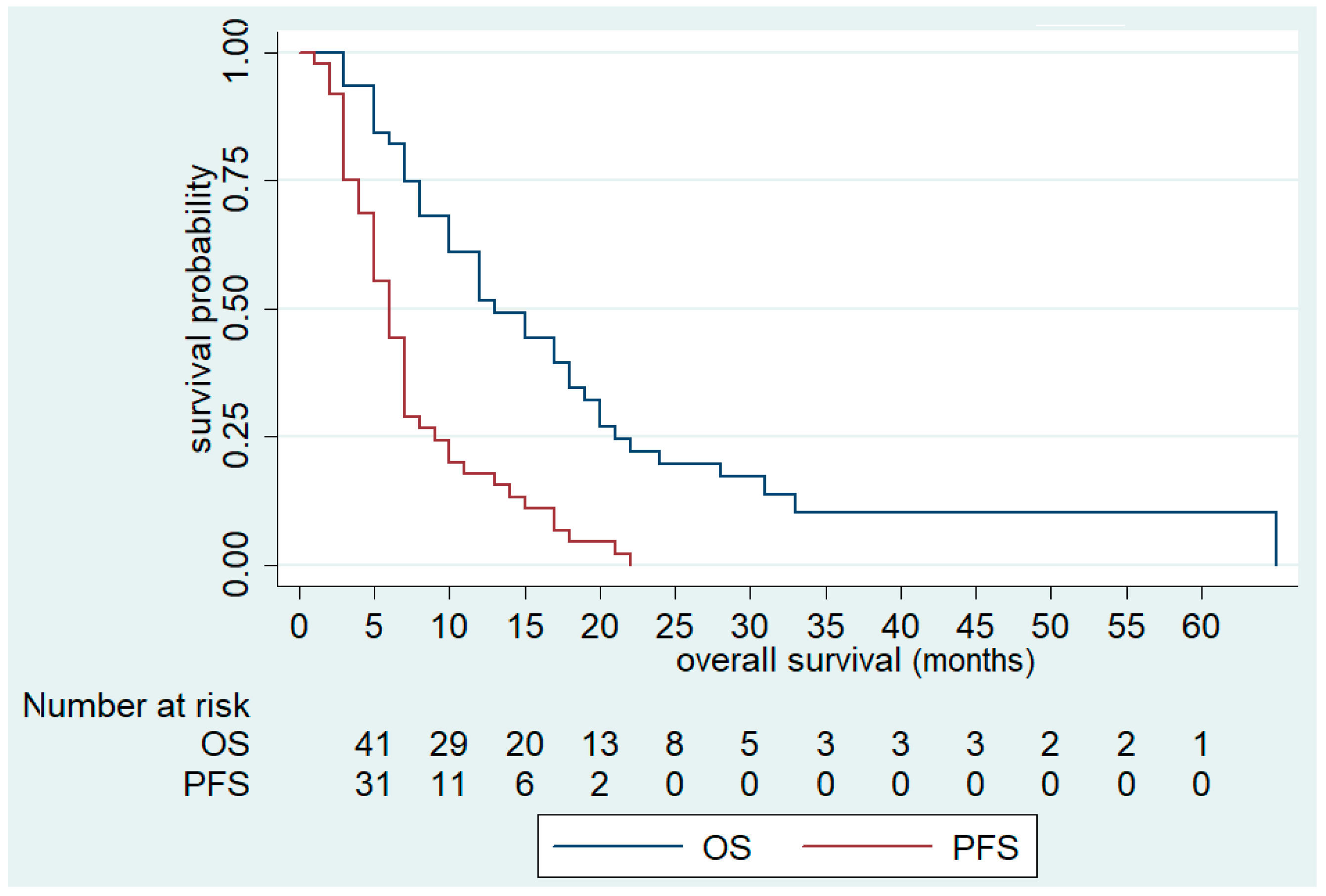
| PFS M-months (95% CI) | 6 (5–7) |
| OS M-months (95% CI) | 13 (10–18) |
| Cycles | |
| Median | 7 |
| Range | 1–13 |
| >10 | 17 (43.7%) |
| Dose reduction | CT: 35 (71.4%) Aflibercept: 13 (26.5%) |
| Treatment Interruption (aflibercept, FOLFIRI or both) due to AEs | 20 (40.8%) |
| Further Lines of treatment | 31 (63.3%) |
| TAS-102 | 10 |
| Regorafenib | 10 |
| Other | 11 |
| Characteristic | Univariate | Multivariate | ||||
|---|---|---|---|---|---|---|
| HR | CI 95% | p | HR | CI 95% | p | |
| ECOG PS (1 vs. 0) | 2.31 | 1.01–5.28 | 0.03 | 1.32 | 0.47–3.74 | 0.6 |
| Sex (male vs. female) | 1.30 | 0.68–2.48 | 0.4 | |||
| Primary site (right vs. left) | 1.43 | 0.71–2.89 | 0.3 | |||
| N. of metastatic sites > 1 | 2.27 | 1.03–5.03 | 0.03 | 2.18 | 0.67–7.03 | 0.2 |
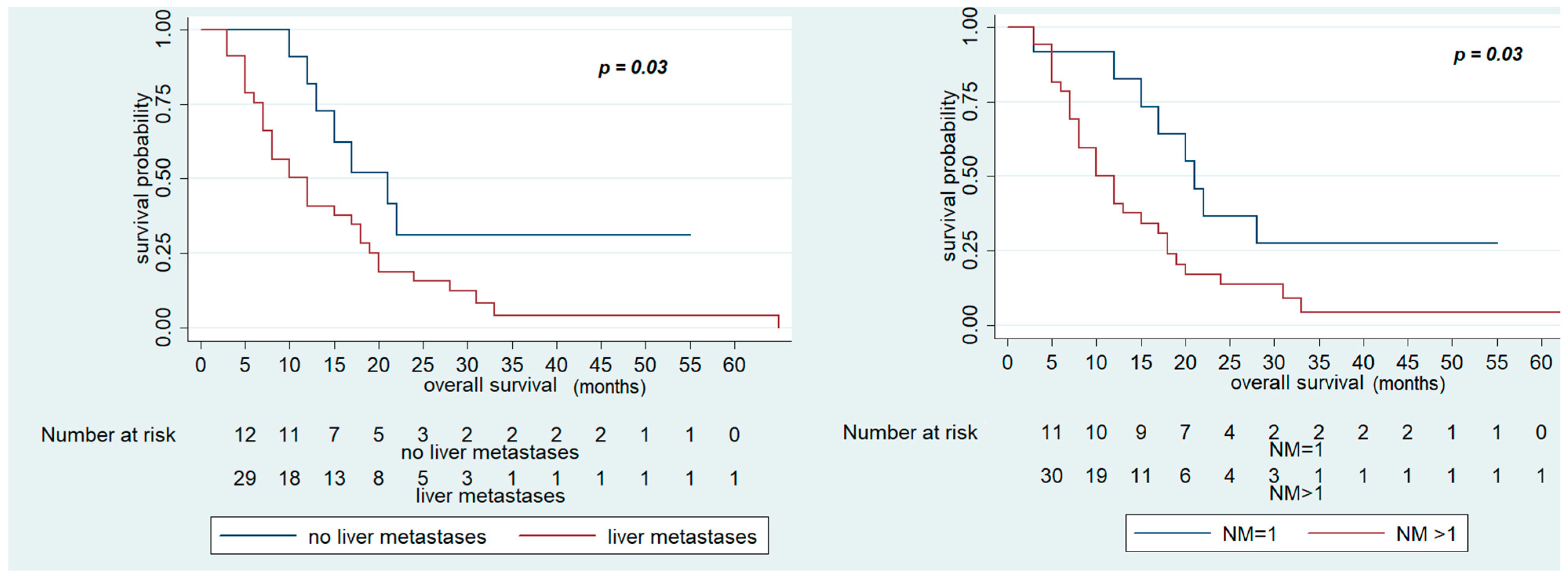
| Liver metastases (yes vs. no) | 2.31 | 1.01–5.28 | 0.03 | 0.79 | 0.23–2.73 | 0.7 |
| Bone metastases (yes vs. no) | 7.00 | 1.50–32.66 | <0.01 | 3.52 | 0.64–19.31 | 0.1 |
| Lung metastases (yes vs. no) | 1.60 | 0.80–3.20 | 0.2 | |||
| KRAS WT (yes vs. no) | 0.85 | 0.40–1.80 | 0.7 | |||
| NRAS WT (yes vs. no) | 1.39 | 0.33–5.81 | 0.6 | |||
| BRAF WT (yes vs. no) | 0.47 | 0.10–2.05 | 0.3 | |||
| Mucinous component (yes vs. no) | 0.87 | 0.44–1.74 | 0.7 | |||
| Weight loss in last 3 months (no vs. yes) | 1.15 | 0.41–3.28 | 0.7 | |||
| Prior bevacizumab (yes vs. no) | 1.25 | 0.55–2.86 | 0.5 | |||
| Prior adjuvant CT (yes vs. no) | 0.57 | 0.22–1.47 | 0.2 | |||
| PFS in first-line CT > 6 months (yes vs. no) | 0.66 | 0.30–1.41 | 0.3 | |||
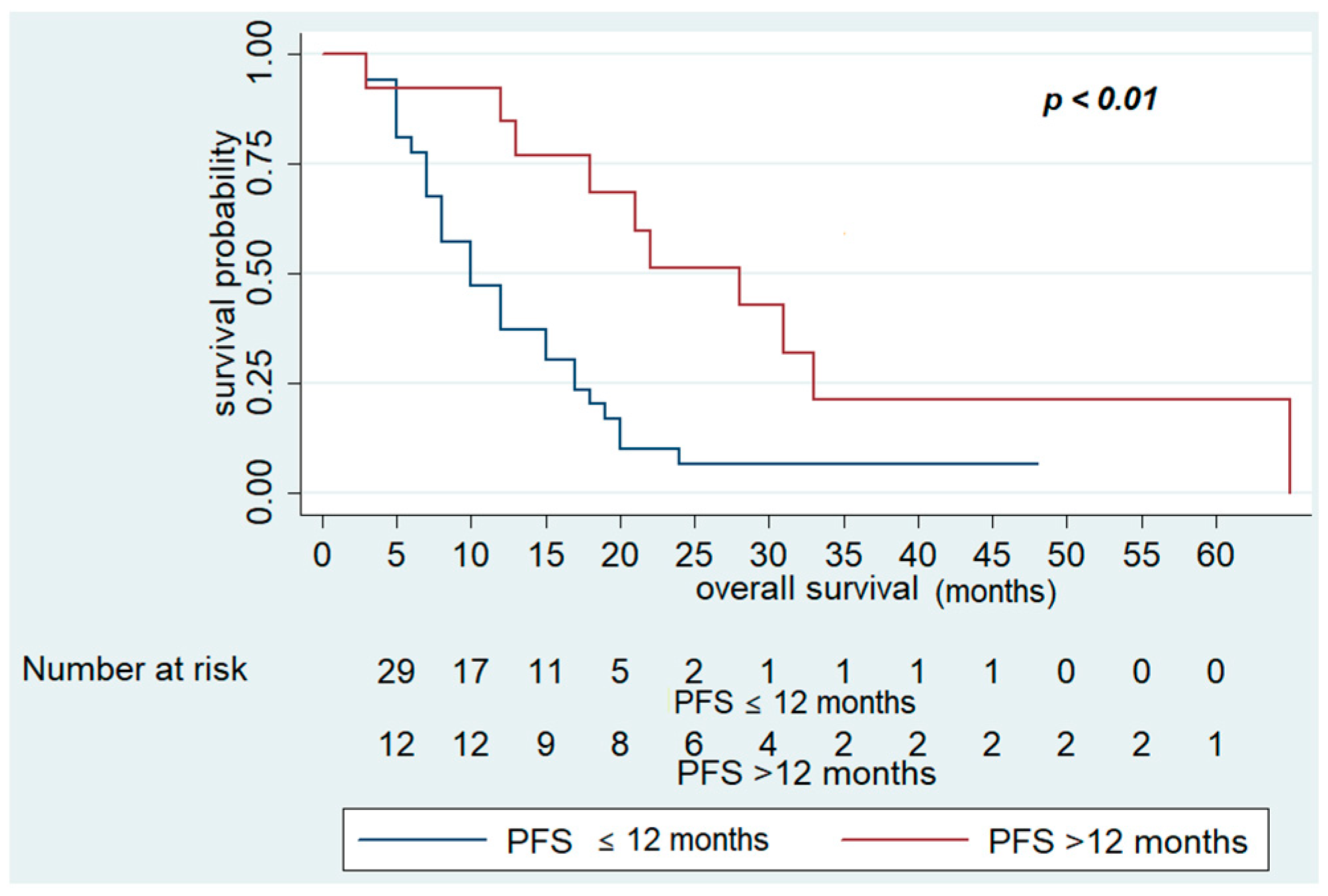
| PFS in first-line CT > 12 months (yes vs. no) | 0.33 | 0.15–0.72 | <0.01 | 0.32 | 0.13–0.79 | 0.01 |
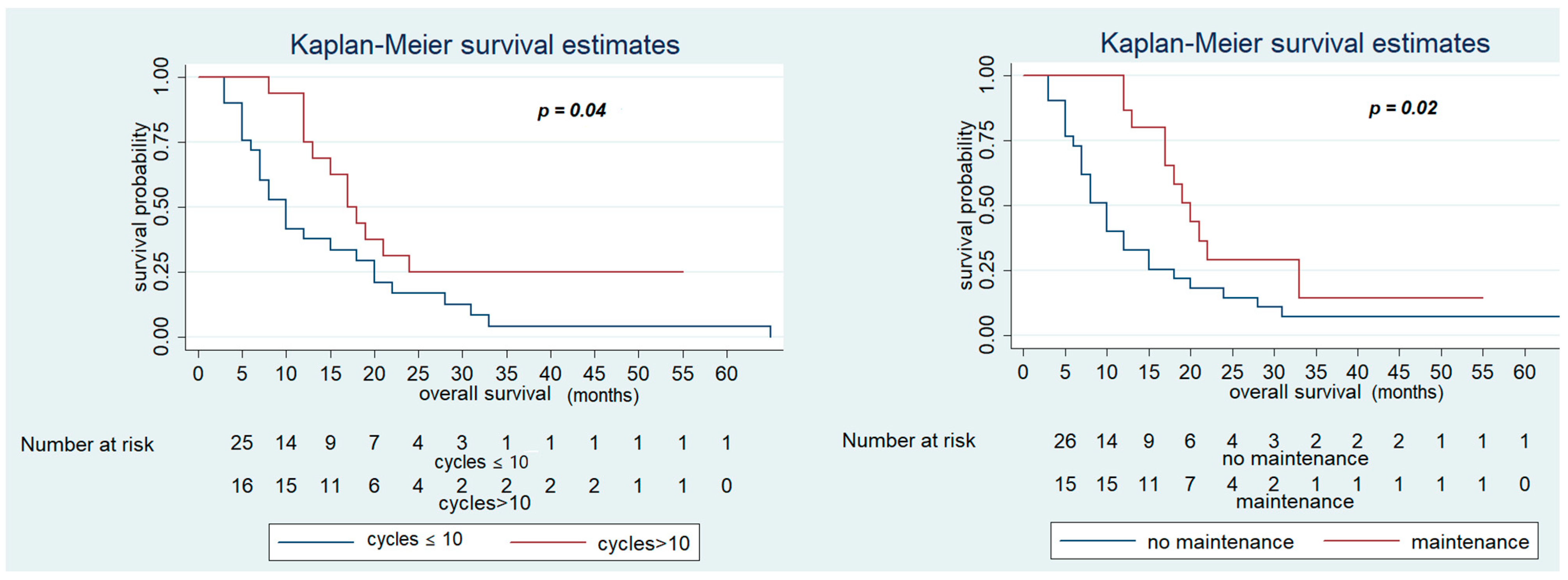
| Maintenance (yes vs. no) | 0.44 | 0.21–0.89 | 0.02 | 0.73 | 0.32–1.65 | 0.5 |
| Cycles of therapy > 10 | 0.50 | 0.25–1.00 | 0.04 | 0.50 | 0.22–1.16 | 0.1 |
| Age > 65 (yes vs. no) | 1.28 | 0.67–2.45 | 0.5 | |||
| Neutropenia G3–4 (yes vs. no) | 0.84 | 0.29–2.41 | 0.7 | |||
| Diarrhea G3–4 (yes vs. no) | 1.95 | 0.72–5.25 | 0.2 | |||
| Hypertension G1/2 (yes vs. no) | 1.20 | 0.61–2.35 | 0.6 | |||
| Hypertension G3–4 (yes vs. no) | 0.65 | 0.28–1.50 | 0.3 | |||
| Characteristic | HR | CI 95% | p |
|---|---|---|---|
| ECOG PS (1 vs. 0) | 1.75 | 0.80–3.80 | 0.1 |
| Sex (male vs. female) | 1.97 | 1.07–3.64 | 0.02 |
| Site (right vs. left) | 0.99 | 0.52–1.90 | 0.9 |
| N. of metastatic sites>1 | 1.48 | 0.77–2.85 | 0.2 |
| Liver metastases (yes vs. no) | 1.70 | 0.88–3.28 | 0.1 |
| Bone metastases (yes vs. no) | 3.73 | 0.81–17.07 | 0.1 |
| Lung metastases (yes vs. no) | 0.78 | 0.43–1.41 | 0.4 |
| KRAS WT (yes vs. no) | 1.27 | 0.66–2.44 | 0.5 |
| NRAS WT (yes vs. no) | 0.47 | 0.14–1.55 | 0.2 |
| BRAF WT (yes vs. no) | 1.30 | 0.30–5.48 | 0.7 |
| Mucinous component (yes vs. no) | 0.60 | 0.32–1.14 | 0.1 |
| Weight loss in last 3 months (no vs. yes) | 0.82 | 0.32–2.12 | 0.7 |
| Prior bevacizumab (yes vs. no) | 1.44 | 0.71–2.94 | 0.3 |
| Prior adjuvant CT (yes vs. no) | 0.85 | 0.39–1.33 | 0.7 |
| PFS in first-line CT > 6 months (yes vs. no) | 0.85 | 0.42–1.73 | 0.6 |
| PFS in first-line CT > 12 months (yes vs. no) | 0.76 | 0.40–1.48 | 0.4 |
| Age > 65 (yes vs. no) | 1.42 | 0.76–2,73 | 0.3 |
| Neutropenia G1–2 (yes vs. no) | 1.15 | 0.57–2.32 | 0.7 |
| Neutropenia G3–4 (yes vs. no) | 0.90 | 0.32–2.57 | 0.8 |
| Diarrhea G1/2 (yes vs. no) | 0.54 | 0.29–1.02 | 0.06 |
| Diarrhea G3/4 (yes vs. no) | 0.97 | 0.38–2.49 | 0.9 |
| Hypertension G1/2 (yes vs. no) | 0.68 | 0.47–1.26 | 0.2 |
| Hypertension G3/4 (yes vs. no) | 0.47 | 0.21–1.07 | 0.07 |
| AE | N. of Patients (n = 49) |
|---|---|
| Leukopenia G1/2 | 13 (26.5%) |
| Leukopenia G3/4 | 2 (4.1%) |
| Neutropenia G1/2 | 12 (24.5%) |
| Neutropenia G3/4 | 5 (10.2%) |
| Platelet count decreased G1/2 | 3 (6.1%) |
| Platelet count decreased G3/4 | 1 (2.0%) |
| Diarrhea G1/2 | 27 (55.1%) |
| Diarrhea G3/4 | 5 (10.2%) |
| Proteinuria | 4 (8.2%) |
| Asthenia G1/2 | 33 (67.3%) |
| Asthenia G3 | 7 (14.3%) |
| Arterial hypertension G1/2 | 22 (44.9%) |
| Arterial hypertension G3/4 | 9 (18.4%) |
| Hypertransaminasemia G1/2 | 8 (16.3%) |
| Hypertransaminasemia G3/4 | 1 (2.0%) |
| Stomatitis G1/2 | 17 (34.7%) |
| Stomatitis G3/4 | 3 (6.1%) |
| Infectious complications | 3 (6.1%) |
| Hypersensitivity | 2 (4.1%) |
| Arterial/venous thromboembolism | 8 (16.3%) |
| Perforation | 0 |
| Hemorrhagic events | 5 (10.2%) |
| Fistulas | 2 (4.1%) |
| Heart failure | 0 |
Publisher’s Note: MDPI stays neutral with regard to jurisdictional claims in published maps and institutional affiliations. |
© 2021 by the authors. Licensee MDPI, Basel, Switzerland. This article is an open access article distributed under the terms and conditions of the Creative Commons Attribution (CC BY) license (https://creativecommons.org/licenses/by/4.0/).
Share and Cite
Lavacchi, D.; Roviello, G.; Giommoni, E.; Dreoni, L.; Derio, S.; Brugia, M.; Amedei, A.; Pillozzi, S.; Antonuzzo, L. Aflibercept Plus FOLFIRI as Second-Line Treatment for Metastatic Colorectal Cancer: A Single-Institution Real-Life Experience. Cancers 2021, 13, 3863. https://doi.org/10.3390/cancers13153863
Lavacchi D, Roviello G, Giommoni E, Dreoni L, Derio S, Brugia M, Amedei A, Pillozzi S, Antonuzzo L. Aflibercept Plus FOLFIRI as Second-Line Treatment for Metastatic Colorectal Cancer: A Single-Institution Real-Life Experience. Cancers. 2021; 13(15):3863. https://doi.org/10.3390/cancers13153863
Chicago/Turabian StyleLavacchi, Daniele, Giandomenico Roviello, Elisa Giommoni, Lorenzo Dreoni, Silvia Derio, Marco Brugia, Amedeo Amedei, Serena Pillozzi, and Lorenzo Antonuzzo. 2021. "Aflibercept Plus FOLFIRI as Second-Line Treatment for Metastatic Colorectal Cancer: A Single-Institution Real-Life Experience" Cancers 13, no. 15: 3863. https://doi.org/10.3390/cancers13153863
APA StyleLavacchi, D., Roviello, G., Giommoni, E., Dreoni, L., Derio, S., Brugia, M., Amedei, A., Pillozzi, S., & Antonuzzo, L. (2021). Aflibercept Plus FOLFIRI as Second-Line Treatment for Metastatic Colorectal Cancer: A Single-Institution Real-Life Experience. Cancers, 13(15), 3863. https://doi.org/10.3390/cancers13153863