Fucoxanthin and Colorectal Cancer Prevention
by
 ,
,
Masaru Terasaki
1,2,*, 
Atsuhito Kubota
1,
Hiroyuki Kojima
1,2,
Hayato Maeda
3 ,
,
Kazuo Miyashita
4,
Chikara Kawagoe
5,
Michihiro Mutoh
6 and 
Takuji Tanaka
7
1
School of Pharmaceutical Sciences, Health Sciences University of Hokkaido, 1757 Kanazawa, Ishikari-Tobetsu, Hokkaido 061-0293, Japan
2
Advanced Research Promotion Center, Health Sciences University of Hokkaido, 1757 Kanazawa, Ishikari-Tobetsu, Hokkaido 061-0293, Japan
3
Faculty of Agriculture and Life Science, Hirosaki University, 3 Bunkyo-cho, Hirosaki, Aomori 036-8561, Japan
4
Center for Industry-University Collaboration, Obihiro University of Agriculture and Veterinary Medicine, Inada-cho, Obihiro, Hokkaido 080-8555, Japan
5
Algatech Kyowa, Kyowa Concrete Industry Co. Ltd., Hakodate, Hokkaido 040-0051, Japan
6
Department of Molecular-Targeting Prevention, Graduate School of Medical Science, Kyoto Prefectural University of Medicine, Kawaramachi-Hirokoji, Kamigyo-ku, Kyoto 602-856, Japan
7
Department of Diagnostic Pathology and Research Center of Diagnostic Pathology, Gifu Municipal Hospital, 7-1 Kashima-cho, Gifu 500-8513, Japan
*
Author to whom correspondence should be addressed.
Cancers 2021, 13(10), 2379; https://doi.org/10.3390/cancers13102379
Submission received: 9 April 2021
/
Revised: 8 May 2021
/
Accepted: 10 May 2021
/
Published: 14 May 2021
(This article belongs to the Special Issue Role of Diet in Cancer Prevention and Treatment)
Simple Summary
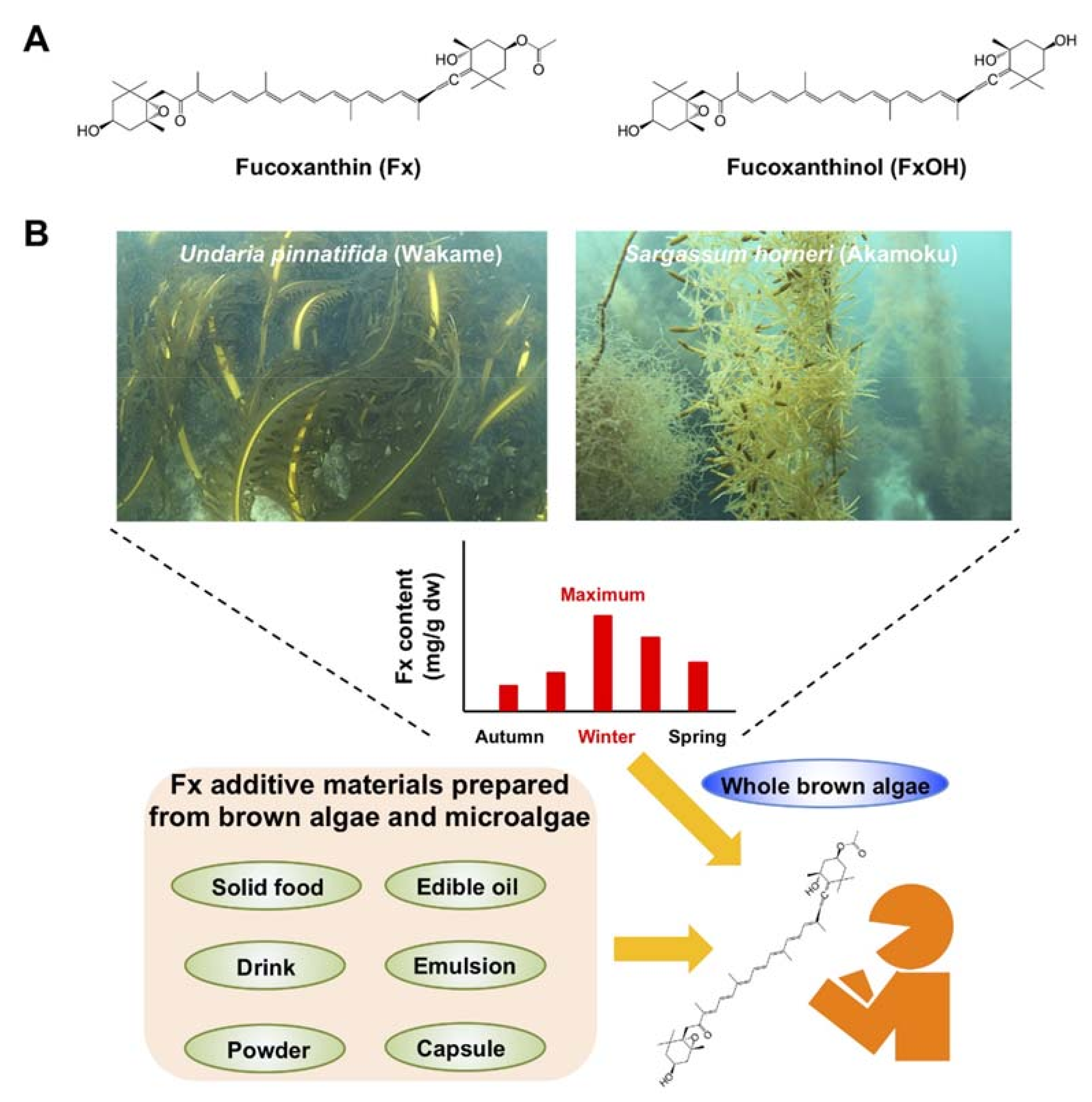
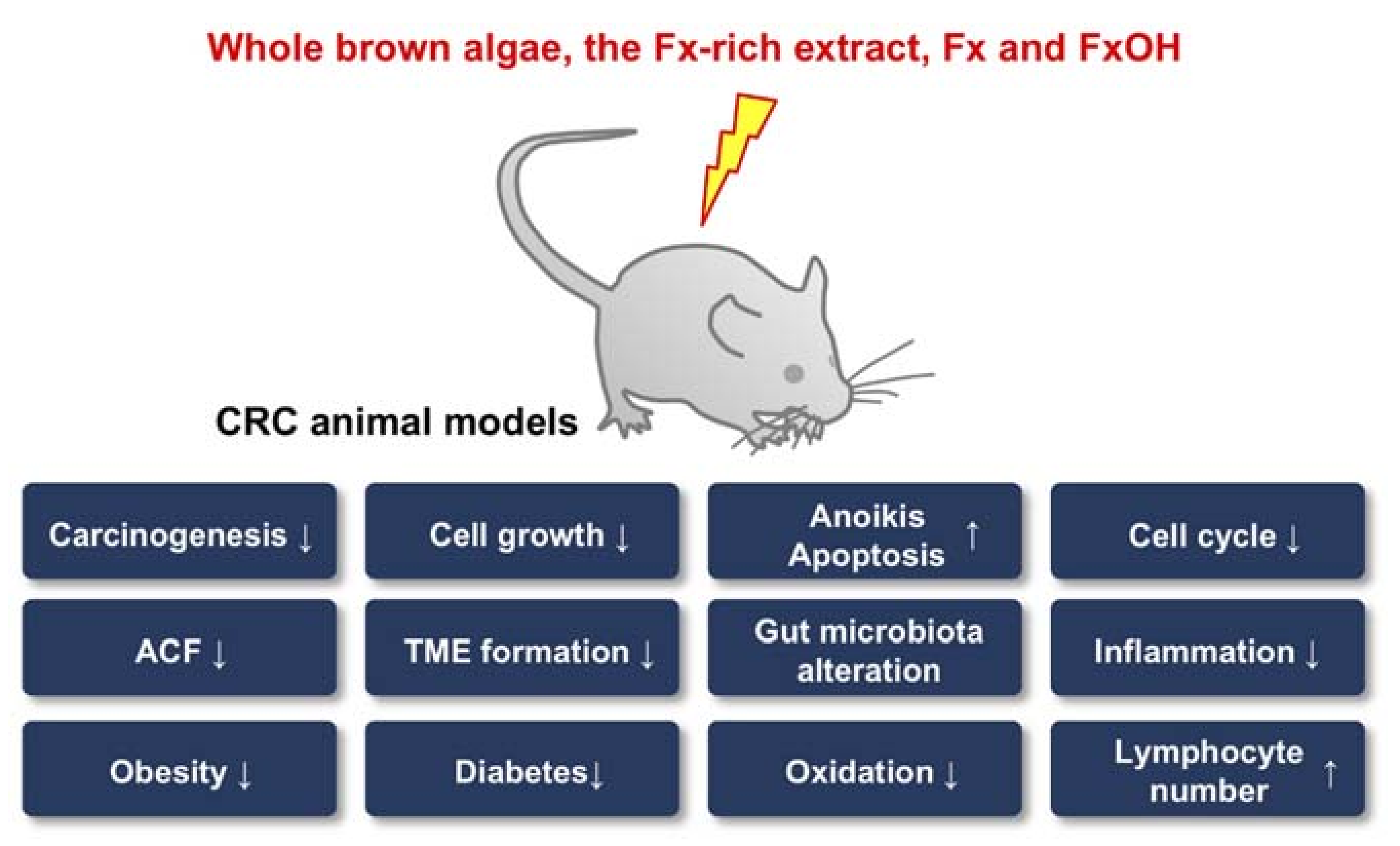
Colorectal cancer (CRC) is suggested to be preventable by certain food intakes. Fucoxanthin (Fx) is an anticancer agent contained abundantly in edible brown algae. However, epidemiological studies, in vivo and in vitro experiments for CRC, using Fx and Fx-rich foods, have not been fully outlined. To date, it has been reported that Fx, its metabolite of fucoxanthinol (FxOH) and Fx-rich algal extracts exerted anticancer potentials in human CRC cell lines, their cancer stem-cells-like spheroids and CRC animal models through a number of molecular mechanisms. Moreover, many in vivo experiments and interventional human trials have demonstrated that Fx, Fx-rich algal extracts and brown alga itself may improve CRC and/or certain risks, such as obesity, diabetes, metabolic syndrome, inflammation, oxidation, tumor microenvironment and/or gut microbiota. This review is the first report that summarizes the improving effects by Fx, FxOH and its rich brown algae for CRC and the risk factors.
Abstract
Colorectal cancer (CRC), which ranks among the top 10 most prevalent cancers, can obtain a good outcome with appropriate surgery and/or chemotherapy. However, the global numbers of both new cancer cases and death from CRC are expected to increase up to 2030. Diet-induced lifestyle modification is suggested to be effective in reducing the risk of human CRC; therefore, interventional studies using diets or diet-derived compounds have been conducted to explore the prevention of CRC. Fucoxanthin (Fx), a dietary carotenoid, is predominantly contained in edible brown algae, such as Undaria pinnatifida (wakame) and Himanthalia elongata (Sea spaghetti), which are consumed particularly frequently in Asian countries but also in some Western countries. Fx is responsible for a majority of the anticancer effects exerted by the lipophilic bioactive compounds in those algae. Interventional human trials have shown that Fx and brown algae mitigate certain risk factors for CRC; however, the direct mechanisms underlying the anti-CRC properties of Fx remain elusive. Fx and its deacetylated type “fucoxanthinol” (FxOH) have been reported to exert potential anticancer effects in preclinical cancer models through the suppression of many cancer-related signal pathways and the tumor microenvironment or alteration of the gut microbiota. We herein review the most recent studies on Fx as a potential candidate drug for CRC prevention.