
Article

A Dewetting Model for Double-Emulsion Droplets

1
Department of Mechanical Engineering, The University of Hong Kong, Hong Kong, China
2
Zhejiang Institute of Research and Innovation, The University of Hong Kong (HKU-ZIRI), Hangzhou 311300, Zhejiang, China
3
Guangdong Key Laboratory for Biomedical Measurements and Ultrasound Imaging, Department of Biomedical Engineering, Shenzhen University, 3688 Nanhai Avenue, Shenzhen 518060, China
*
Author to whom correspondence should be addressed.
Micromachines 2016, 7(11), 196; https://doi.org/10.3390/mi7110196
Submission received: 1 September 2016 / Revised: 21 October 2016 / Accepted: 27 October 2016 / Published: 1 November 2016

Abstract

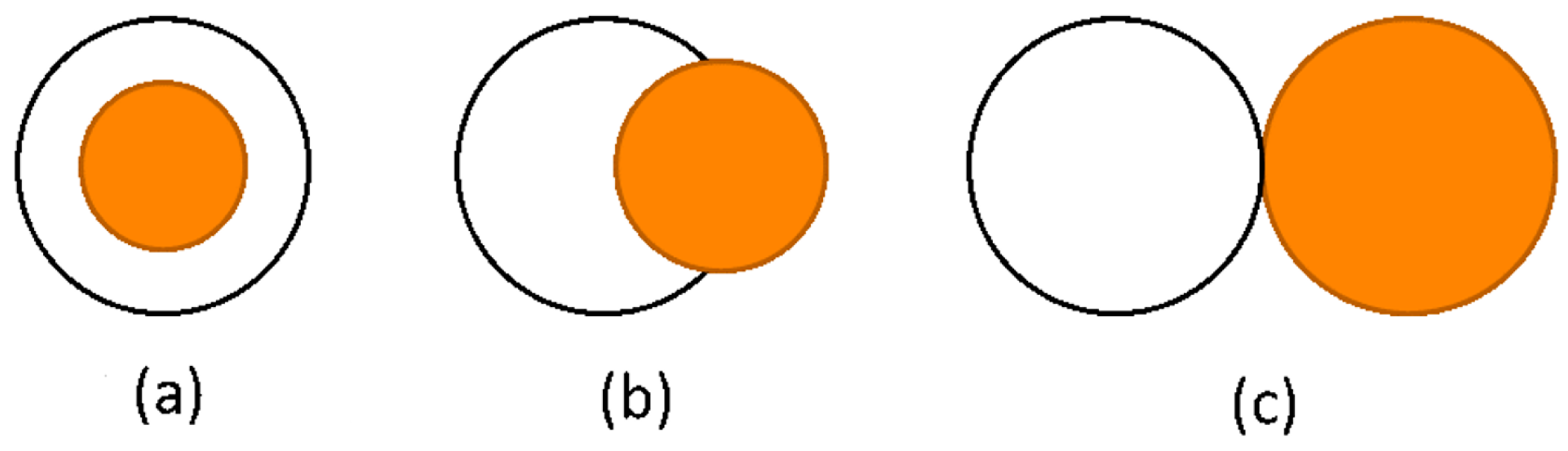
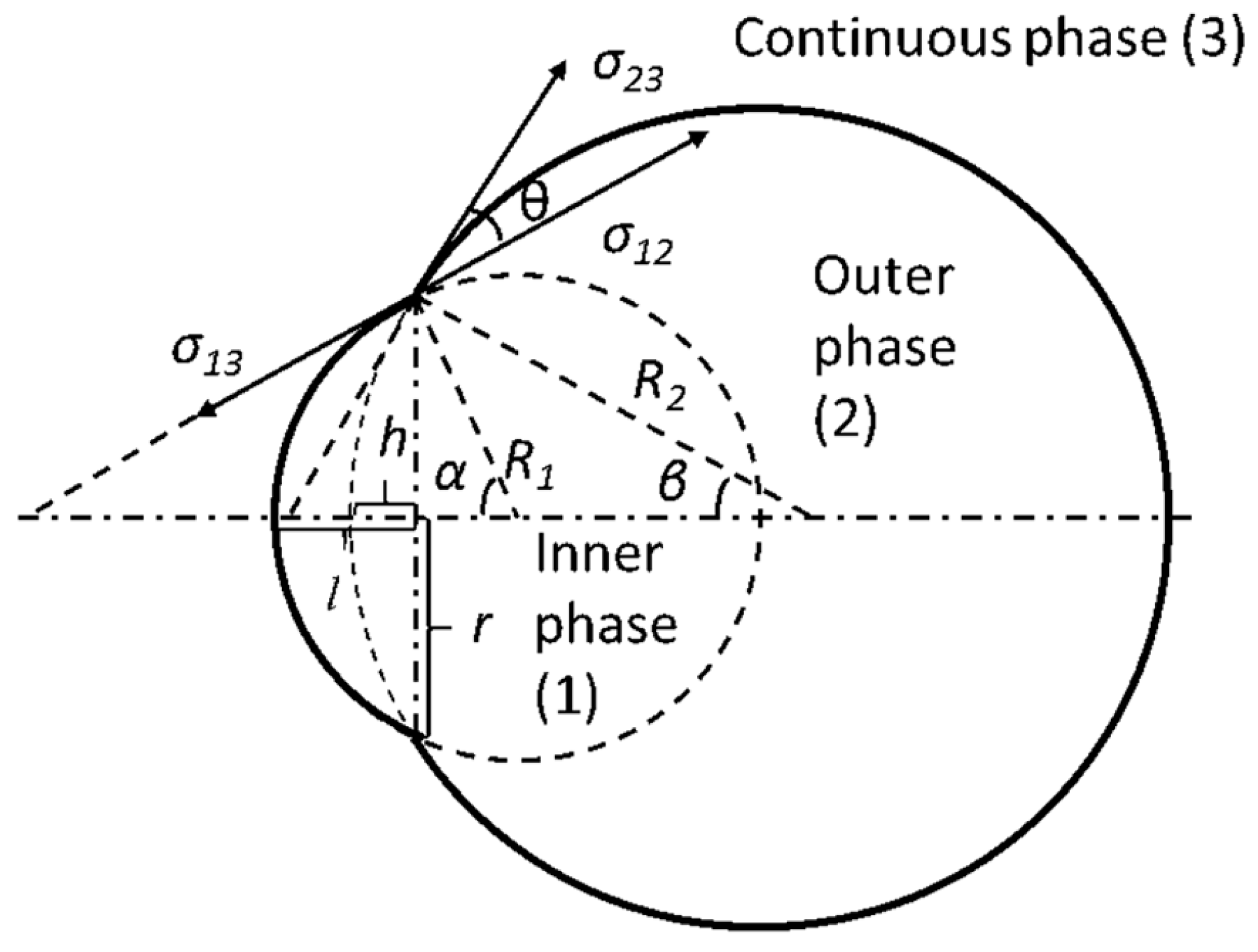
The evolution of double-emulsion droplets is of great importance for the application of microdroplets and microparticles. We study the driving force of the dewetting process, the equilibrium configuration and the dewetting time of double-emulsion droplets. Through energy analysis, we find that the equilibrium configuration of a partial engulfed droplet depends on a dimensionless interfacial tension determined by the three relevant interfacial tensions, and the engulfing part of the inner phase becomes larger as the volume of the outer phase increases. By introducing a dewetting boundary, the dewetting time can be calculated by balancing the driving force, caused by interfacial tensions, and the viscous force. Without considering the momentum change of the continuous phase, the dewetting time is an increasing function against the viscosity of the outer phase and the volume ratio between the outer phase and inner phase.
Keywords: double emulsion; dewetting force; equilibrium configuration; dewetting time double emulsion; dewetting force; equilibrium configuration; dewetting time
Graphical Abstract