Microstructured Finger-Joint Interfaces for Reducing Thermal Contact Resistance in Thermal Pad Assemblies

Abstract
1. Introduction
2. Materials and Methods
2.1. Thermal Pad Materials and Thermophysical Properties
2.2. Design and Assembly of the Double-Sided Finger-Joint Interface
2.3. Measurement of Thermal Resistance
2.4. Device-Level LED
2.5. Characterization of the Finger–Pad Contact Geometry
3. Results
3.1. Thermal Resistance of the Planar and Finger-Joint Assemblies
3.2. Device-Level Thermal Performance
4. Discussion
4.1. Mechanism of Thermal Contact Enhancement
4.2. Influence of Thermal Pad Properties
4.3. Practical Implications
5. Conclusions
Supplementary Materials
Author Contributions
Funding
Institutional Review Board Statement
Informed Consent Statement
Data Availability Statement
Acknowledgments
Conflicts of Interest
References
- Wang, Y.; Sun, X.; Kang, H.; Ma, X.; Zhang, T. Thermal contact resistance and heat transfer enhancement mechanisms at non-smooth contact interfaces. J. Therm. Sci. 2025, 34, 465–497. [Google Scholar] [CrossRef] [Scilit]
- Li, M.; Hao, M. Woodworking-inspired mechanical metainterfaces show improved energy transport. Nat. Electron. 2026, 9, 592–593. [Google Scholar] [CrossRef] [Scilit]
- Wei, B.; Luo, W.; Du, J.; Ding, Y.; Guo, Y.; Zhu, G.; Zhu, Y.; Li, B. Thermal interface materials: From fundamental research to applications. SusMat 2024, 4, e239. [Google Scholar] [CrossRef] [Scilit]
- He, W.; Feng, Y.; Wu, S.; Wang, W. Mechanical–thermal–electrical coupling modeling and temperature rise characteristic of a parallel groove clamp with improved representation of contact interactions. IEEE Trans. Compon. Packag. Manuf. Technol. 2023, 13, 356–364. [Google Scholar] [CrossRef] [Scilit]
- Chen, J.; Xu, X.; Zhou, J.; Li, B. Interfacial thermal resistance: Past, present, and future. Rev. Mod. Phys. 2022, 94, 025002. [Google Scholar] [CrossRef] [Scilit]
- Meng, X.; Wang, J.; Chen, Q.; Xuan, Z.; Wu, Z.; Zhang, Y.; Chen, X.; Wang, J.; Wang, J. Boosting flexible thermal management and absorption-dominant electromagnetic shielding through surface engineering of electrochemically-exfoliated graphene. Chem. Eng. J. 2025, 511, 162262. [Google Scholar] [CrossRef] [Scilit]
- Meng, X.; Nie, W.; Shu, T.; Tao, Z.; Zhao, H.; Wang, J.; Zhang, H.; Wang, J. Dispersible graphene/FeNi-N-C heterojunctions with dipole polarization for electromagnetic absorption and heat dissipation from vapor-induced graphite exfoliation. Chem. Eng. J. 2026, 545, 179441. [Google Scholar] [CrossRef] [Scilit]
- Dou, Z.; Lei, C.; Wu, K.; Yu, G. The development of thermal interface materials. Nat. Electron. 2025, 8, 1146–1155. [Google Scholar] [CrossRef] [Scilit]
- Dai, W.; Wang, Y.; Li, M.; Chen, L.; Yan, Q.; Yu, J.; Jiang, N.; Lin, C.-T. 2D materials-based thermal interface materials: Structure, properties, and applications. Adv. Mater. 2024, 36, 2311335. [Google Scholar] [CrossRef] [Scilit]
- Xing, W.; Xu, Y.; Song, C.; Deng, T. Recent advances in thermal interface materials for thermal management of high-power electronics. Nanomaterials 2022, 12, 3365. [Google Scholar] [CrossRef] [Scilit]
- Xie, Z.; Dou, Z.; Wu, D.; Zeng, X.; Feng, Y.; Tian, Y.; Fu, Q.; Wu, K. Joint-inspired liquid and thermal conductive interface for designing thermal interface materials with high solid filling yet excellent thixotropy. Adv. Funct. Mater. 2023, 33, 2214071. [Google Scholar] [CrossRef] [Scilit]
- Chen, H.; Ginzburg, V.V.; Yang, J.; Yang, Y.; Liu, W.; Huang, Y.; Du, L.; Chen, B. Thermal conductivity of polymer-based composites: Fundamentals and applications. Prog. Polym. Sci. 2016, 59, 41–85. [Google Scholar] [CrossRef] [Scilit]
- Wang, Q.; Li, Y. Research advances in preparation, mechanism and application of thermally conductive and electrically insulating polymer composites in thermal management materials: A review. High Perform. Polym. 2023, 35, 665–685. [Google Scholar] [CrossRef] [Scilit]
- Wang, Z.; Wu, Z.; Weng, L.; Ge, S.; Jiang, D.; Huang, M.; Mulvihill, D.M.; Chen, Q.; Guo, Z.; Jazzar, A.; et al. A roadmap review of thermally conductive polymer composites: Critical factors, progress, and prospects. Adv. Funct. Mater. 2023, 33, 2301549. [Google Scholar] [CrossRef] [Scilit]
- Prasher, R.S.; Koning, P.; Shipley, J.; Devpura, A. Dependence of thermal conductivity and mechanical rigidity of particle-laden polymeric thermal interface material on particle volume fraction. J. Electron. Packag. 2003, 125, 386–391. [Google Scholar] [CrossRef] [Scilit]
- Lin, Y.; Li, P.; Liu, W.; Chen, J.; Liu, X.; Jiang, P.; Huang, X. Application-driven high-thermal-conductivity polymer nanocomposites. ACS Nano 2024, 18, 3851–3870. [Google Scholar] [CrossRef] [Scilit]
- Li, J.; Zhang, Y.; Liang, T.; Bai, X.; Pang, Y.; Zeng, X.; Hu, Q.; Tu, W.; Ye, Z.; Du, G.; et al. Thermal interface materials with both high through-plane thermal conductivity and excellent elastic compliance. Chem. Mater. 2021, 33, 8926–8937. [Google Scholar] [CrossRef] [Scilit]
- Zhao, L.; Yan, L.; Wei, C.; Li, Q.; Huang, X.; Wang, Z.; Fu, M.; Ren, J. Synergistic enhanced thermal conductivity of epoxy composites with boron nitride nanosheets and microspheres. J. Phys. Chem. C 2020, 124, 12723–12733. [Google Scholar] [CrossRef] [Scilit]
- Yu, H.; Guo, P.; Qin, M.; Han, G.; Chen, L.; Feng, Y.; Feng, W. Highly thermally conductive polymer composite enhanced by two-level adjustable boron nitride network with leaf venation structure. Compos. Sci. Technol. 2022, 222, 109406. [Google Scholar] [CrossRef] [Scilit]
- Meng, Q.; Han, S.; Liu, T.; Ma, J.; Ji, S.; Dai, J.; Kang, H.; Ma, J. Noncovalent modification of boron nitrite nanosheets for thermally conductive, mechanically resilient epoxy nanocomposites. Ind. Eng. Chem. Res. 2020, 59, 20701–20710. [Google Scholar] [CrossRef] [Scilit]
- Lee, D.H.; Lee, N.; Park, H. Role of silica nanoparticle in multicomponent epoxy composites for electrical insulation with high thermal conductivity. J. Am. Ceram. Soc. 2018, 101, 2450–2458. [Google Scholar] [CrossRef] [Scilit]
- Chung, D.D.L. Performance of thermal interface materials. Small 2022, 18, 2200693. [Google Scholar] [CrossRef] [Scilit]
- Sudhindra, S.; Kargar, F.; Balandin, A.A. Noncured graphene thermal interface materials for high-power electronics: Minimizing the thermal contact resistance. Nanomaterials 2021, 11, 1699. [Google Scholar] [CrossRef] [Scilit]
- Cui, Y.; Qin, Z.; Wu, H.; Li, M.; Hu, Y. Flexible thermal interface based on self-assembled boron arsenide for high-performance thermal management. Nat. Commun. 2021, 12, 1284. [Google Scholar] [CrossRef] [Scilit]
- Mannsfeld, S.C.B.; Tee, B.C.K.; Stoltenberg, R.M.; Chen, C.V.H.H.; Barman, S.; Muir, B.V.O.; Sokolov, A.N.; Reese, C.; Bao, Z. Highly sensitive flexible pressure sensors with microstructured rubber dielectric layers. Nat. Mater. 2010, 9, 859–864. [Google Scholar] [CrossRef] [Scilit]
- Bai, N.; Wang, L.; Xue, Y.; Wang, Y.; Hou, X.; Li, G.; Zhang, Y.; Cai, M.; Zhao, L.; Guan, F.; et al. Graded interlocks for iontronic pressure sensors with high sensitivity and high linearity over a broad range. ACS Nano 2022, 16, 4338–4347. [Google Scholar] [CrossRef] [Scilit]
- Bullock, J.; Ota, H.; Wang, H.; Xu, Z.; Hettick, M.; Yan, D.; Samundsett, C.; Wan, Y.; Essig, S.; Morales-Masis, M.; et al. Microchannel contacting of crystalline silicon solar cells. Sci. Rep. 2017, 7, 9085. [Google Scholar] [CrossRef] [Scilit]
- Khanna, A.; Basu, P.K.; Filipovic, A.; Shanmugam, V.; Schmiga, C.; Aberle, A.G.; Mueller, T. Influence of random pyramid surface texture on silver screen-printed contact formation for monocrystalline silicon wafer solar cells. Sol. Energy Mater. Sol. Cells 2015, 132, 589–596. [Google Scholar] [CrossRef] [Scilit]
- Hao, M.; Li, M.; Zou, Z.; Kuo, H.; Bhat, A.; Li, X.; Liu, J.; Wei, Y.; Xu, S.; Sun, Y.; et al. Carpentry-inspired interfaces for improved electronic and thermal transport. Nat. Electron. 2026, 9, 686–697. [Google Scholar] [CrossRef] [Scilit]
- Yu, H.; Li, M.; Deng, Y.; Fu, S.; Guo, J.; Zhao, H.; Zhang, J.; Dang, S.; Zhang, P.; Zhou, J.; et al. Chemically bonded multi-nanolayer inorganic aerogel with a record-low thermal conductivity in a vacuum. Natl. Sci. Rev. 2023, 10, nwad129. [Google Scholar] [CrossRef] [Scilit]
- Gent, A.N. On the relation between indentation hardness and Young’s modulus. Rubber Chem. Technol. 1958, 31, 896–906. [Google Scholar] [CrossRef] [Scilit]
- Henkel Corporation. BERGQUIST SIL PAD TSP 3500 Technical Data Sheet. Available online: https://datasheets.tdx.henkel.com/BERGQUIST-SIL-PAD-TSP-3500-en_GL.pdf (accessed on 26 September 2026).
- Copper Development Association Inc. C36000 Alloy. Available online: https://alloys.copper.org/alloy/C36000 (accessed on 26 September 2026).
- Li, M.; Zhang, J.; Zhang, X.; Hao, M. Finger-joint-assembled graphitic interface materials for enhanced thermal contact conductance. Appl. Phys. Lett. 2026, 129, 081603. [Google Scholar] [CrossRef] [Scilit]
- Han, J.; Kwon, D.; Kim, B.; Bae, J.; Jeong, S. Investigation of thermal contact conductance of bare copper–copper and aluminum 1070–aluminum 1070 interfaces at low temperatures between 10 and 70 K. Cryogenics 2023, 133, 103710. [Google Scholar] [CrossRef] [Scilit]
- Ajul, E.; Chanda, S. Estimation of spatially varying thermal contact conductance in metal foam heat sink joints using measured pressure distribution. Int. J. Heat Mass Transf. 2026, 270, 129182. [Google Scholar] [CrossRef] [Scilit]



| Thermal Pad | Manufacturer and Product | Thickness (mm) | Density (g cm−3) | Specific Heat Capacity (J g−1 K−1) | Thermal Diffusivity (mm2 s−1) | Through-Thickness Thermal Conductivity (W m−1 K−1) | Rbulk (K mm2 W−1) |
|---|---|---|---|---|---|---|---|
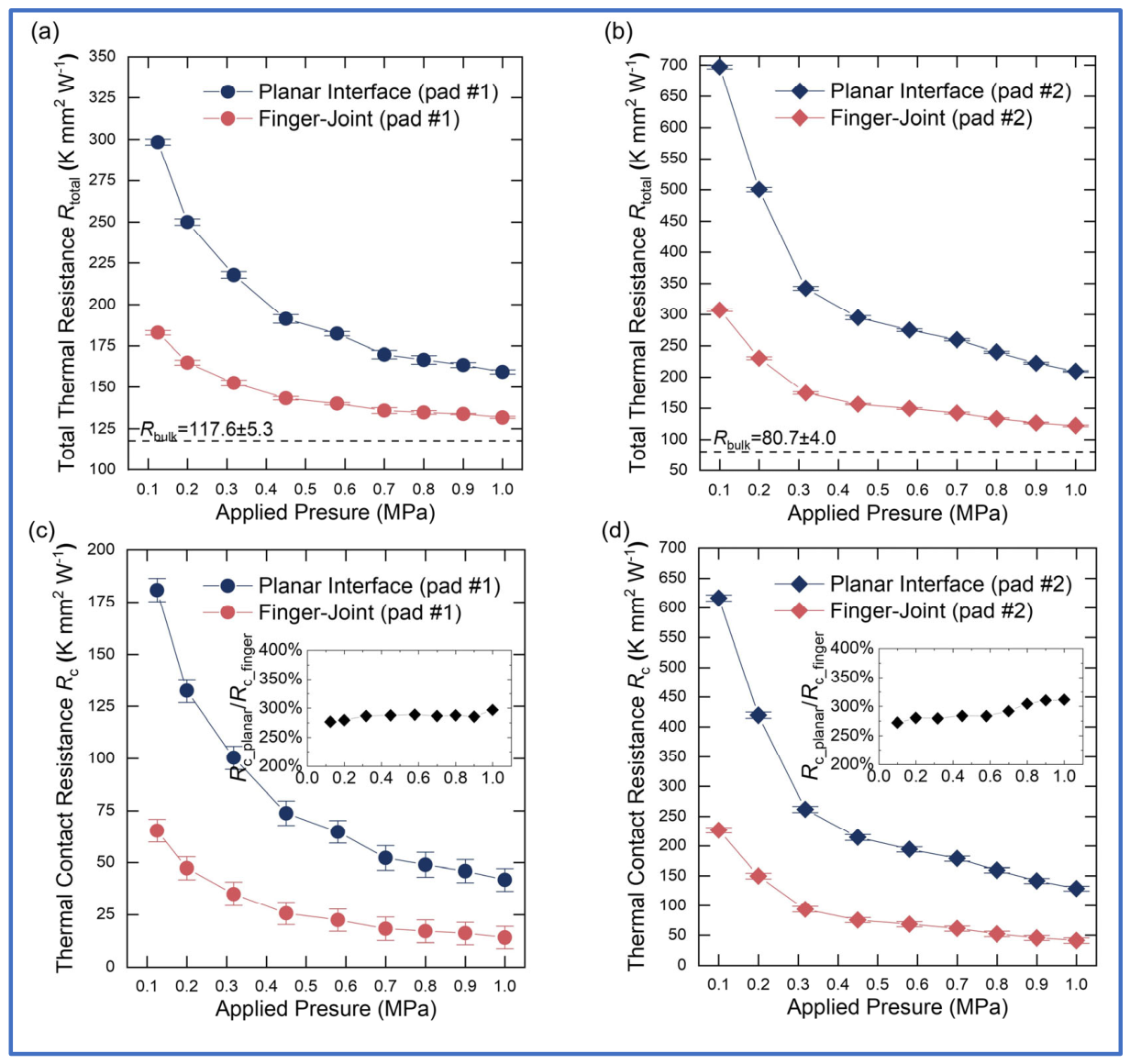
| Pad #1 | Beilong Electronics Co., Ltd.; Model 8W | 0.29 ± 0.01 | 3.50 ± 0.02 | 0.99 | 0.71 ± 0.02 | 2.47 ± 0.07 | 117.6 ± 5.3 |
| Pad #2 | Bergquist; SIL-PAD 2000 | 0.27 ± 0.01 | 1.94 ± 0.01 | 1.13 | 1.52 ± 0.05 | 3.34 ± 0.11 | 80.7 ± 4.0 |
Disclaimer/Publisher’s Note: The statements, opinions and data contained in all publications are solely those of the individual author(s) and contributor(s) and not of MDPI and/or the editor(s). MDPI and/or the editor(s) disclaim responsibility for any injury to people or property resulting from any ideas, methods, instructions or products referred to in the content. |
© 2026 by the authors. Licensee MDPI, Basel, Switzerland. This article is an open access article distributed under the terms and conditions of the Creative Commons Attribution (CC BY) license.
Share and Cite
Li, M.; Liu, J.; Ma, M. Microstructured Finger-Joint Interfaces for Reducing Thermal Contact Resistance in Thermal Pad Assemblies. Micromachines 2026, 17, 1142. https://doi.org/10.3390/mi17101142
Li M, Liu J, Ma M. Microstructured Finger-Joint Interfaces for Reducing Thermal Contact Resistance in Thermal Pad Assemblies. Micromachines. 2026; 17(10):1142. https://doi.org/10.3390/mi17101142
Chicago/Turabian StyleLi, Menglin, Jie Liu, and Mingyang Ma. 2026. "Microstructured Finger-Joint Interfaces for Reducing Thermal Contact Resistance in Thermal Pad Assemblies" Micromachines 17, no. 10: 1142. https://doi.org/10.3390/mi17101142
APA StyleLi, M., Liu, J., & Ma, M. (2026). Microstructured Finger-Joint Interfaces for Reducing Thermal Contact Resistance in Thermal Pad Assemblies. Micromachines, 17(10), 1142. https://doi.org/10.3390/mi17101142