Crack-Configuration Analysis of Metal Conductive Track Embedded in Stretchable Elastomer


Abstract
1. Introduction
2. Material and Methods
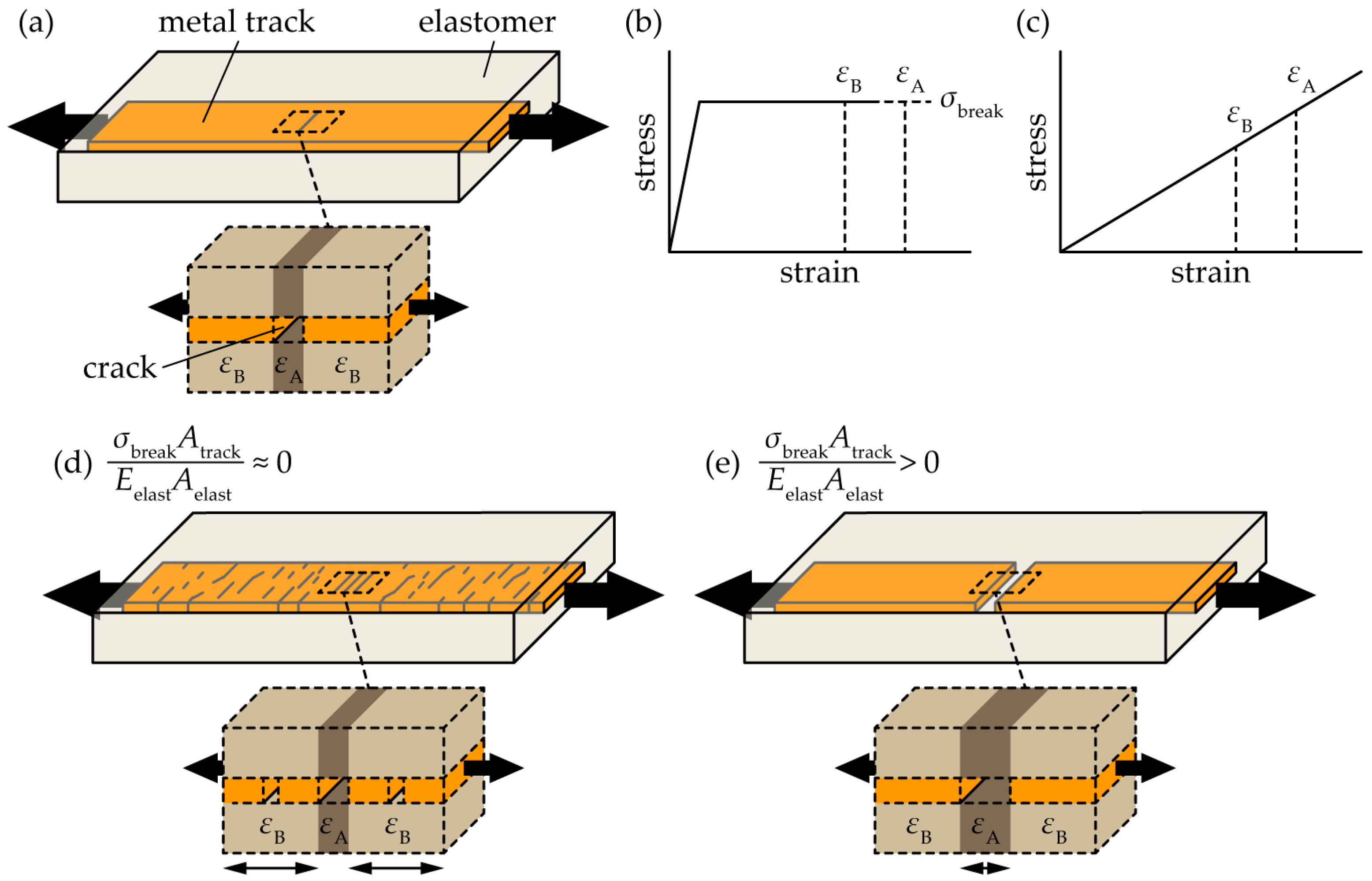
2.1. Modeling Analysis
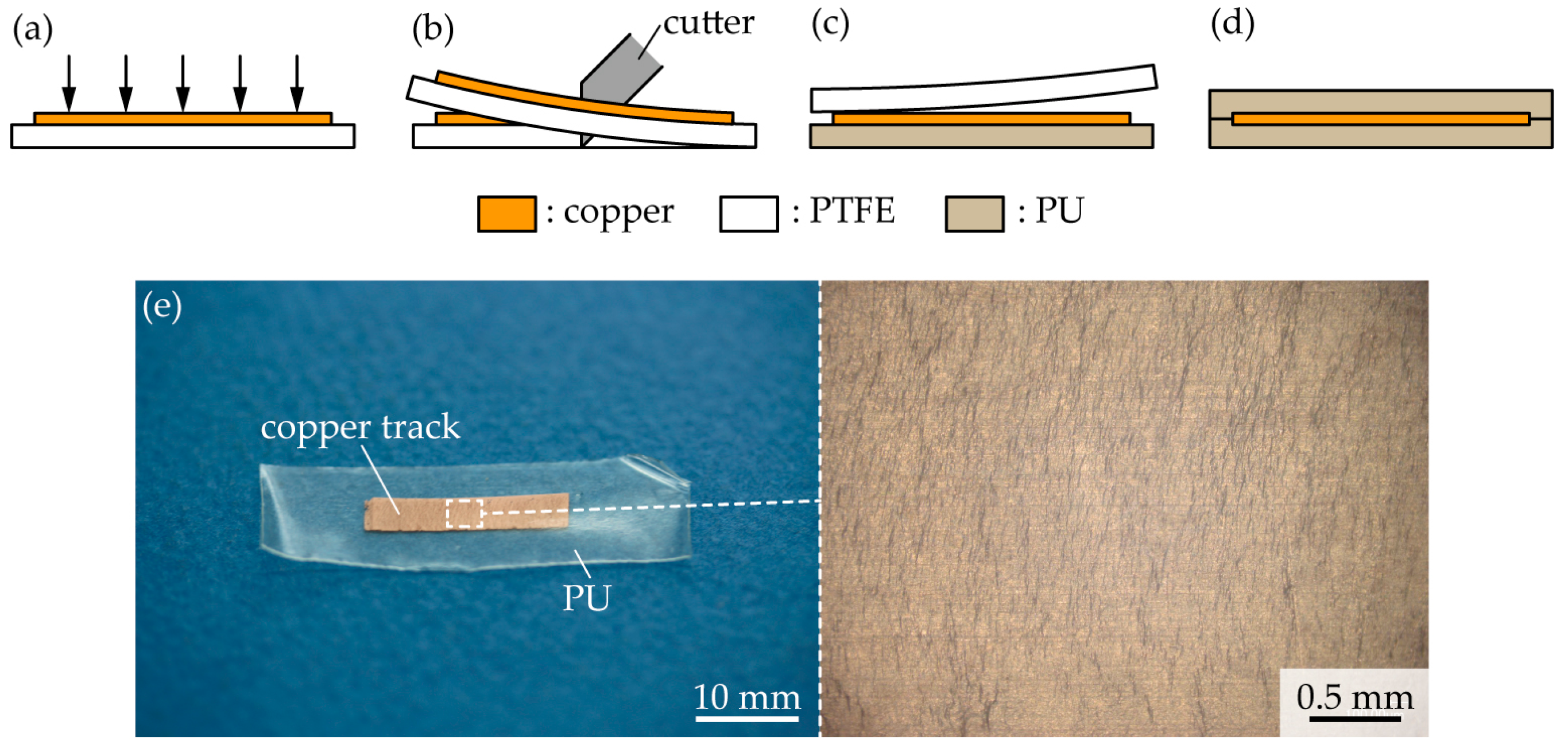
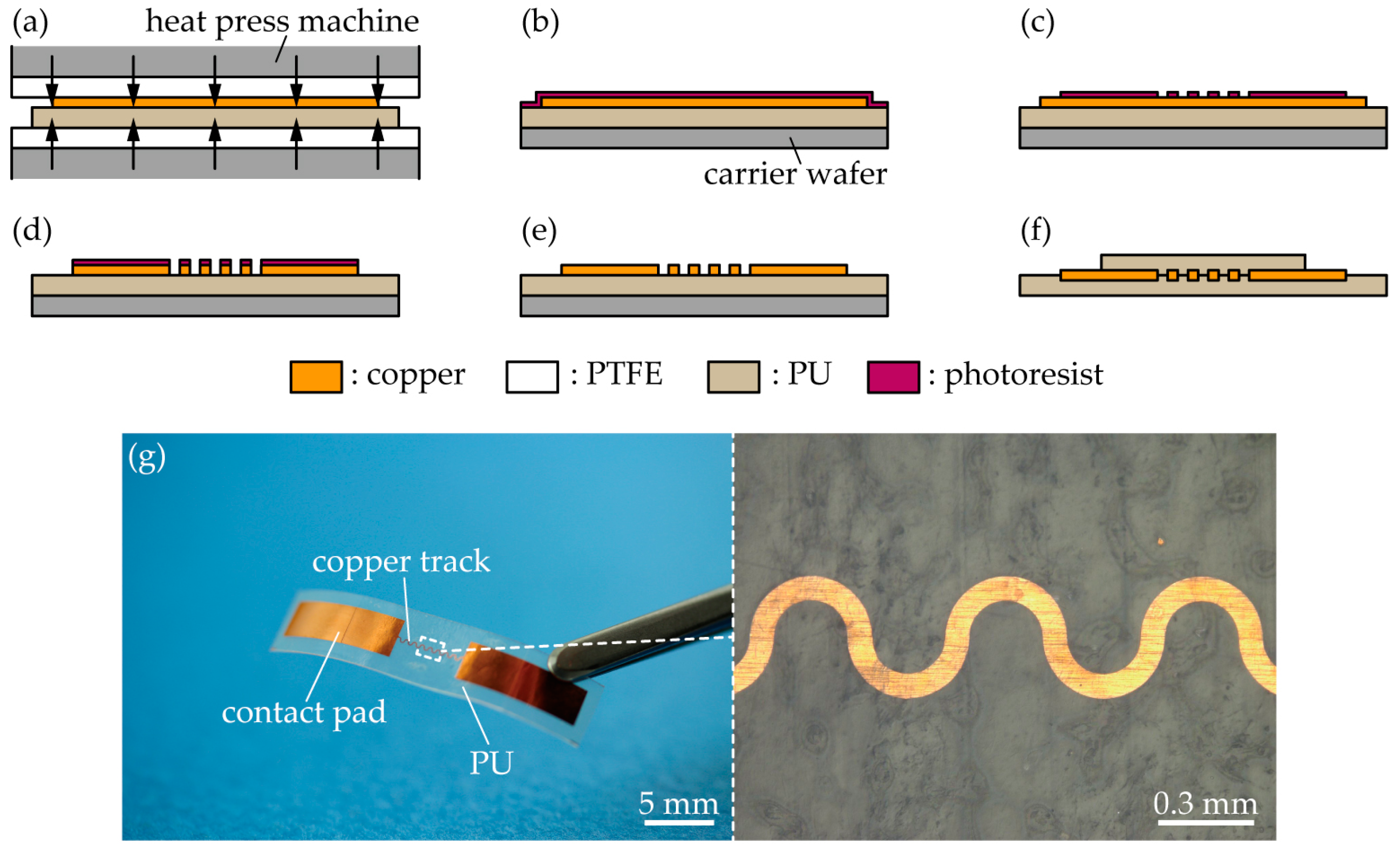
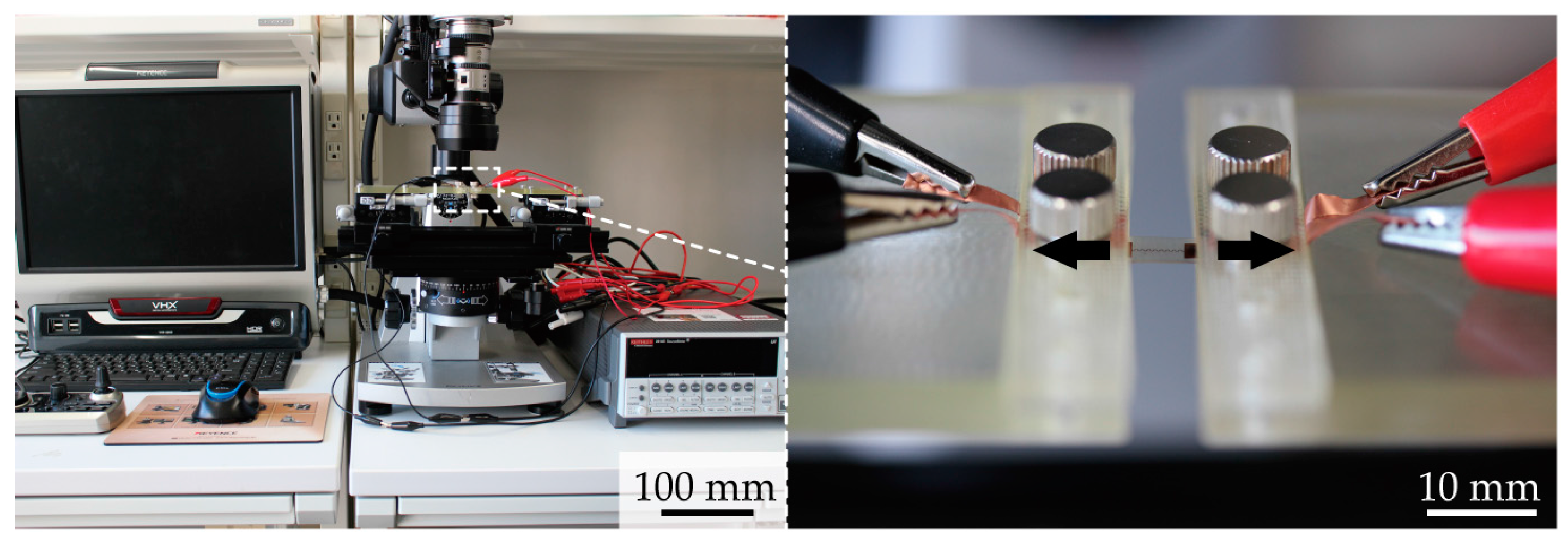
2.2. Fabrication and Experimental Setup
3. Result and Discussion
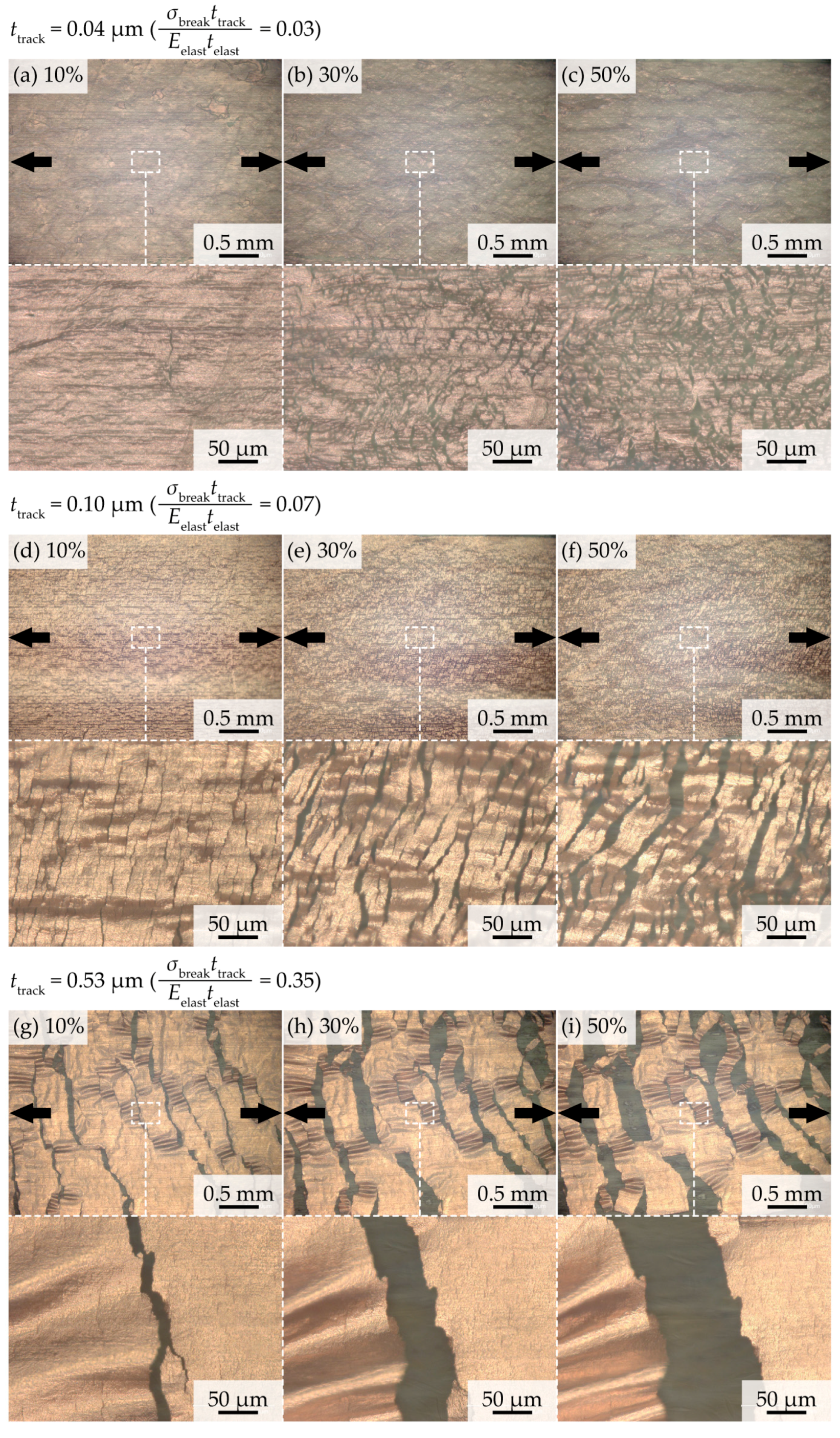
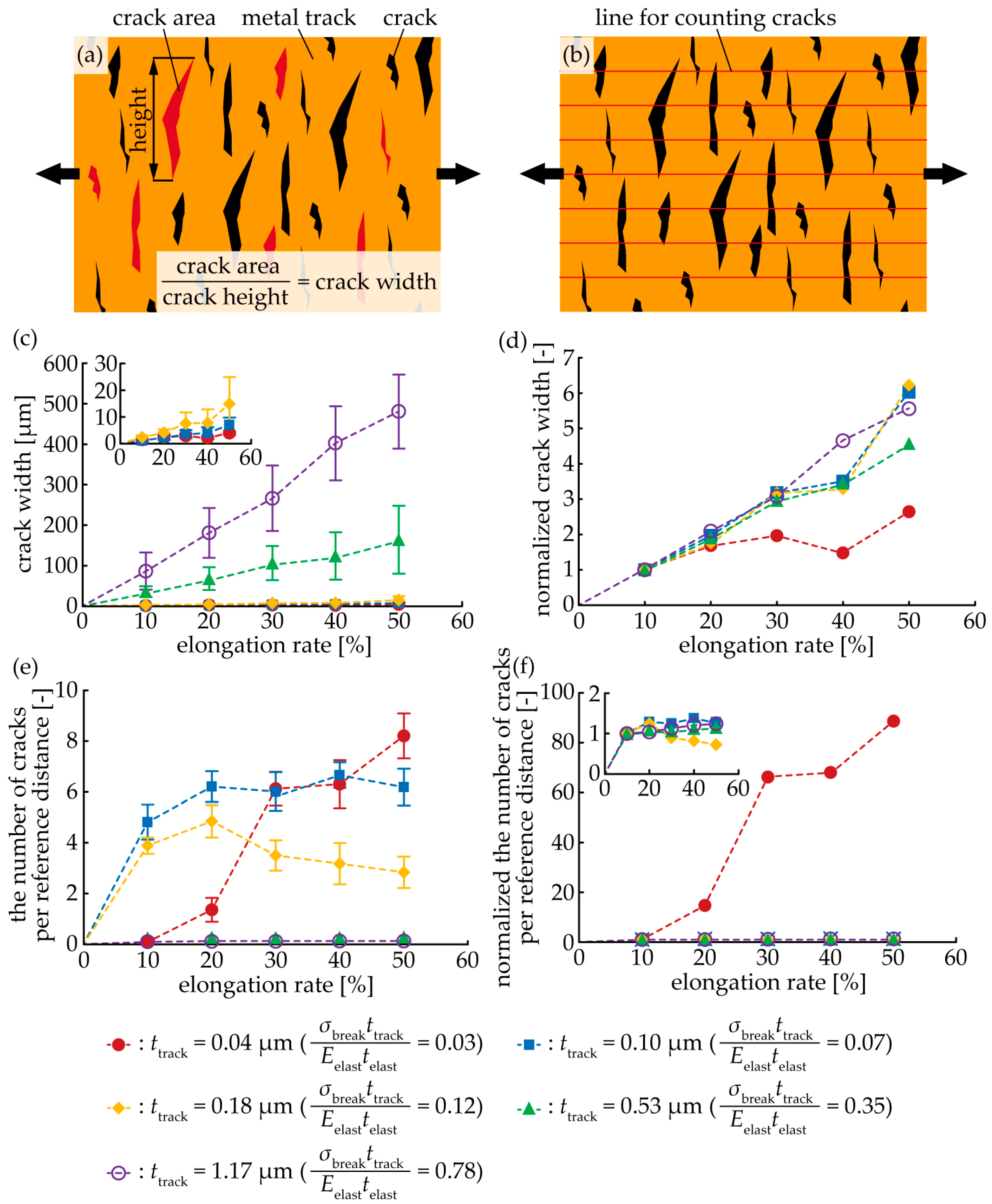
3.1. Straight-Shaped Track
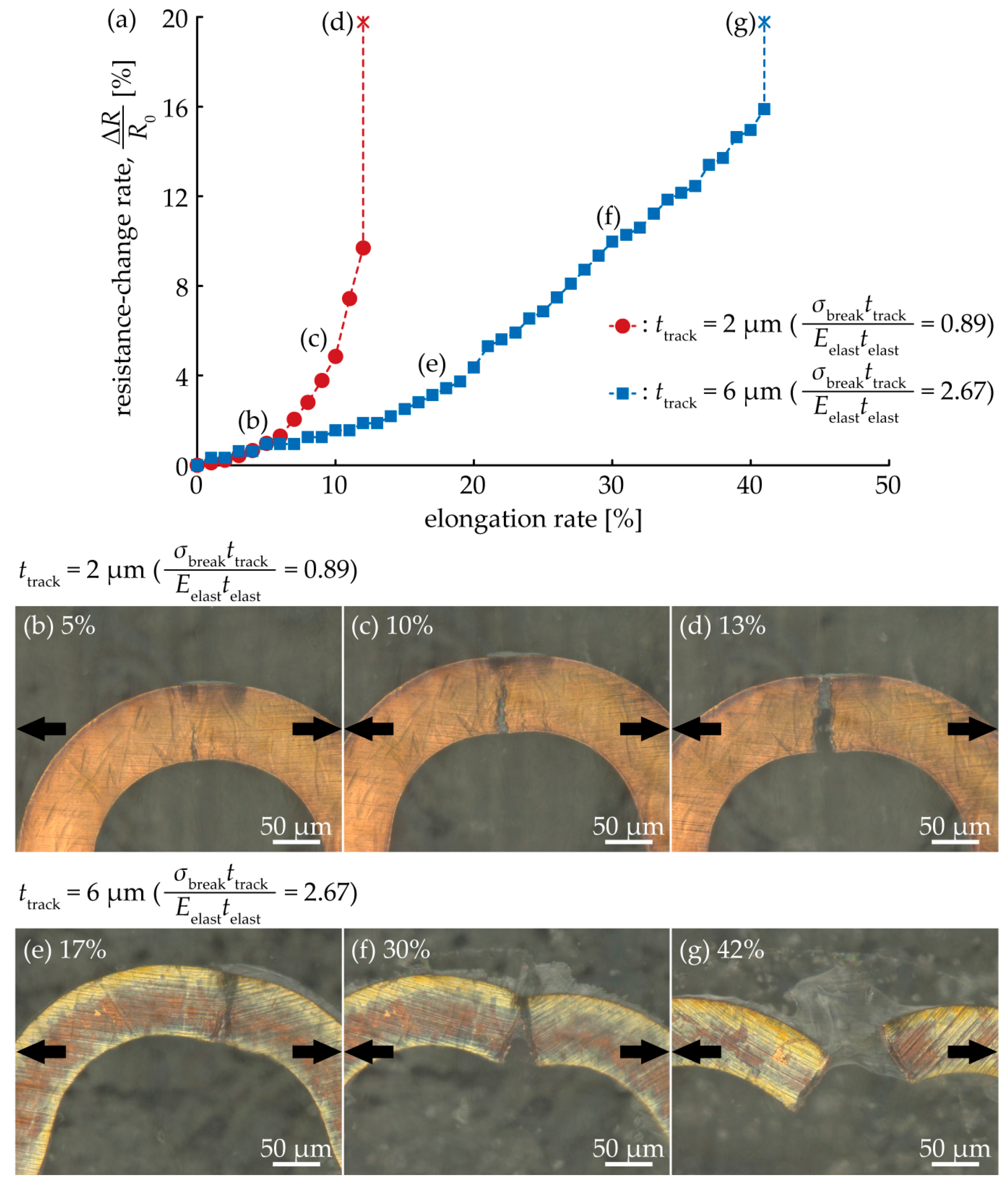
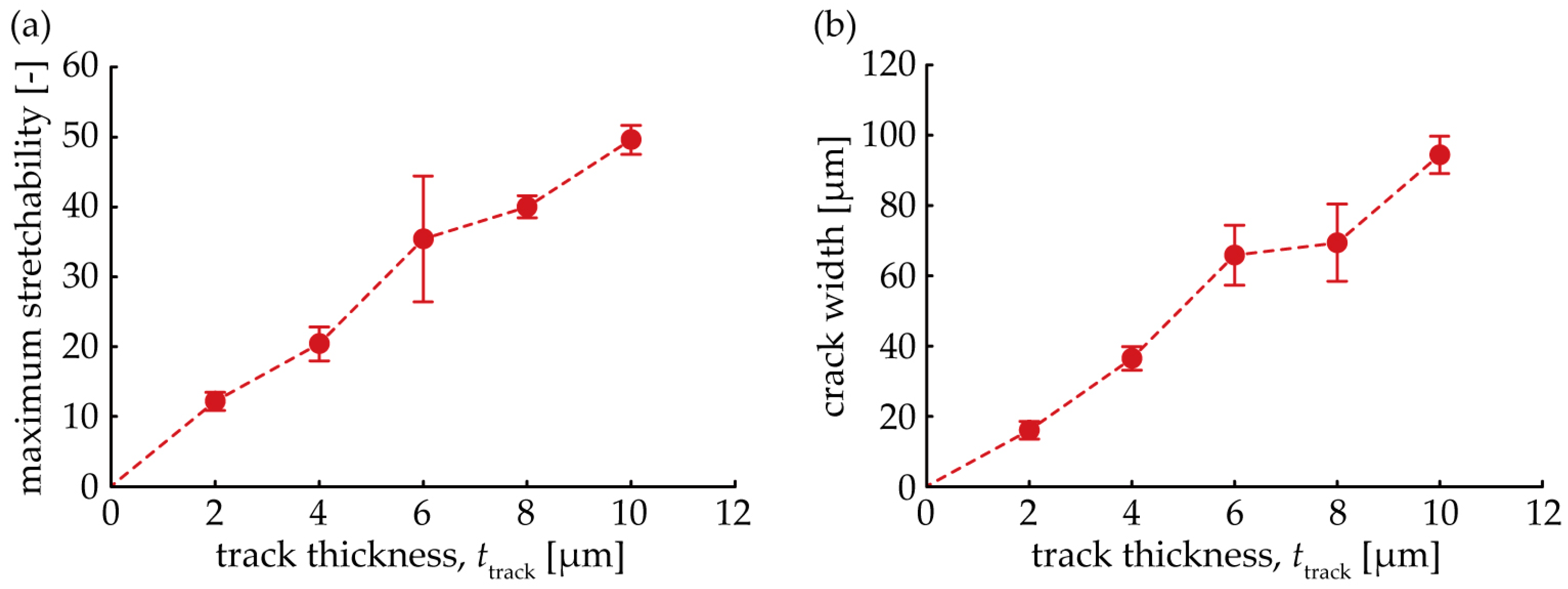
3.2. Wave-Shaped Track
4. Conclusions
Acknowledgments
Author Contributions
Conflicts of Interest
References
- Hammock, M.L.; Chortos, A.; Tee, B.C.K.; Tok, J.B.H.; Bao, Z. 25th anniversary article: The evolution of electronic skin (E-skin): A Brief history, design considerations, and recent progress. Adv. Mater. 2013, 25, 5997–6038. [Google Scholar] [CrossRef] [PubMed]
- Kim, D.H.; Xiao, J.; Song, J.; Huang, Y.; Rogers, J.A. Stretchable, curvilinear electronics based on inorganic materials. Adv. Mater. 2010, 22, 2108–2124. [Google Scholar] [CrossRef] [PubMed]
- Rogers, J.A.; Someya, T.; Huang, Y. Materials and mechanics for stretchable electronics. Science 2010, 327, 1603–1607. [Google Scholar] [CrossRef] [PubMed]
- Ohmea, H.; Tomita, Y.; Kashara, M.; Schram, J.; Smits, E.; Brand, J.; Bossuyt, F.; Vanfleteren, J.; Baets, J.D. Stretchable 45 × 80 RGB LED display using meander wiring technology. SID Symp. Dig. Tech. Pap. 2015, 46, 102–105. [Google Scholar] [CrossRef]
- Sekitani, T.; Nakajima, H.; Maeda, H.; Fukushima, T.; Aida, T.; Hata, K.; Someya, T. Stretchable active-matrix organic light-emitting diode display using printable elastic conductors. Nat. Mater. 2009, 8, 494–499. [Google Scholar] [CrossRef] [PubMed]
- Kim, D.H.; Lu, N.; Ma, R.; Kim, Y.S.; Kim, R.H.; Wang, S.; Wu, J.; Won, S.M.; Tao, H.; Islam, A.; et al. Epidermal electronics. Science 2011, 333, 838–843. [Google Scholar] [CrossRef] [PubMed]
- Kim, J.; Salvatore, G.A.; Araki, H.; Chiarelli, A.M.; Xie, Z.; Banks, A.; Sheng, X.; Liu, Y.; Lee, J.W.; Jang, K.I.; et al. Battery-free, stretchable optoelectronic systems for wireless optical characterization of the skin. Sci. Adv. 2016, 2, e1600418. [Google Scholar] [CrossRef] [PubMed]
- Liu, Z.; Wang, X.; Qi, D.; Xu, C.; Yu, J.; Liu, Y.; Jiang, Y.; Liedberg, B.; Che, X. High-adhesion stretchable electrodes based on nanopile interlocking. Adv. Mater. 2016, 29, 1603382. [Google Scholar] [CrossRef] [PubMed]
- Matsuhisa, N.; Kaltenbrunner, M.; Yokota, T.; Jinno, H.; Kuribara, K.; Sekitani, T.; Someya, T. Printable elastic conductors with a high conductivity for electronic textile applications. Nat. Commun. 2015, 6, 7461. [Google Scholar] [CrossRef] [PubMed]
- Son, D.; Lee, J.; Qiao, S.; Ghaffari, R.; Kim, J.; Lee, J.E.; Song, C.; Kim, S.J.; Lee, D.J.; Jun, S.W.; et al. Multifunctional wearable devices for diagnosis and therapy of movement disorders. Nat. Nanotechnol. 2014, 9, 397–404. [Google Scholar] [CrossRef] [PubMed]
- Xu, S.; Zhang, Y.; Jia, L.; Mathewson, K.E.; Jang, K.I.; Kim, J.; Fu, H.; Huang, X.; Chava, P.; Wang, R.; et al. Soft microfluidic assemblies of sensors, circuits, and radios for the skin. Science 2014, 344, 70–74. [Google Scholar] [CrossRef] [PubMed]
- Minev, I.J.; Musienko, P.; Hirsch, A.; Barraud, Q.; Wenger, N.; Moraud, E.M.; Gandar, J.; Capogrosso, M.; Milekovic, T.; Asboth, L.; et al. Electronic dura mater for long-term multimodal neural interfaces. Science 2015, 347, 159–163. [Google Scholar] [CrossRef] [PubMed]
- Graz, I.M.; Cotton, D.P.J.; Lacour, S.P. Extended cyclic uniaxial loading of stretchable gold thin-films on elastomeric substrates. Appl. Phys. Lett. 2009, 94, 071902. [Google Scholar] [CrossRef]
- Graudejus, O.; Jia, Z.; Li, T.; Wagner, S. Size-dependent rupture strain of elastically stretchable metal. Scr. Mater. 2012, 66, 919–922. [Google Scholar] [CrossRef] [PubMed][Green Version]
- Adrega, T.; Lacour, S.P. Stretchable gold conductors embedded in PDMS and patterned by photolithography: Fabrication and electromechanical characterization. J. Micromech. Microeng. 2010, 20, 055025. [Google Scholar] [CrossRef]
- Akogwua, O.; Kwabia, D.; Midturi, S.; Eleruja, M.; Babatope, B.; Soboyejoa, W.O. Large strain deformation and cracking of nano-scale gold films on PDMS substrate. Mater. Sci. Eng. B 2010, 170, 32–40. [Google Scholar] [CrossRef]
- Jones, J.; Lacour, S.P.; Wagner, S. Stretchable wavy metal interconnects. J. Vac. Sci. Technol. A Vac. Surf. Films 2004, 22, 1723–1725. [Google Scholar] [CrossRef]
- Lacour, S.P.; Jones, J.; Wagner, S.; Li, T.; Suo, Z. Stretchable interconnects for elastic electronic surfaces. Proc. IEEE 2005, 93, 1459–1467. [Google Scholar] [CrossRef]
- Gray, D.S.; Tien, J.; Chen, S.C. High-conductivity elastomeric electronics. Adv. Mater. 2004, 16, 393–397. [Google Scholar] [CrossRef]
- Gonzalez, M.; Axisa, F.; Bulcke, M.V.; Brosteaux, D.; Vandevelde, B.; Vanfleteren, J. Design of metal interconnects for stretchable electronic circuits. Microelectron. Reliab. 2008, 48, 825–832. [Google Scholar] [CrossRef]
- Hsu, Y.Y.; Gonzalez, M.; Bossuyt, F.; Axisa, F.; Vanfleteren, J.; DeWolf, I. The effect of pitch on deformation behavior and the stretching-induced failure of a polymer-encapsulated stretchable circuit. J. Micromech. Microeng. 2010, 20, 075036. [Google Scholar] [CrossRef]
- Löher, T.; Seckel, M.; Vieroth, R.; Dils, C.; Kallmayer, C.; Ostmann, A.; Aschenbrenner, R.; Reichl, H. Stretchable electronic systems: Realization and applications. In Proceedings of the 11th Electronic Packaging Technology Conference (EPTC2009), Singapore, 9–11 December 2009; pp. 893–898. [Google Scholar]
- Koshi, T.; Iwase, E. Self-Healing metal wire using electric field trapping of metal nanoparticles. Jpn. J. Appl. Phys. 2015, 54, 06FP03. [Google Scholar] [CrossRef]
- Koshi, T.; Iwase, E. Stretchable electronic device with repeat self-Healing ability of metal wire. In Proceedings of the 30th IEEE International Conference on Micro Electro Mechanical Systems (MEMS2017), Las Vegas, NV, USA, 22–26 January 2017; pp. 262–265. [Google Scholar]
- Emry, R.D.; Povirk, G.L. Tensile behavior of free-standing gold films. Part II. Fine-grained films. Acta Mater. 2003, 51, 2067–2078. [Google Scholar] [CrossRef]
- Zhang, S.; Sakane, M.; Nagasawa, T.; Kobayashi, K. Mechanical properties of copper thin films used in electronic devices. Procedia Eng. 2011, 10, 1497–1502. [Google Scholar] [CrossRef]
- Jhonston, I.D.; McCluskey, D.K.; Tan, C.K.L.; Tracey, M.C. Mechanical characterization of bulk Sylgard 184 for microfluidics and microengineering. J. Micromech. Microeng. 2014, 24, 035017. [Google Scholar] [CrossRef]




| Ref. | Structure | Crack Configuration | |
|---|---|---|---|
| [13] (straight-shaped track) | ttrack = 0.05 µm (gold) telast = 1 mm (PDMS) | 0.01 | Multiple-crack growth type |
| [16] (straight-shaped track) | ttrack = 0.05–0.1 µm (gold) telast = 1 mm (PDMS) | 0.01–0.02 | |
| [14] (straight-shaped track) | ttrack = 0.075 µm (gold) telast = 0.3 mm (PDMS) | 0.06 | |
| [12] (straight-shaped track) | ttrack = 0.035 µm (gold) telast = 0.12 mm (PDMS) | 0.07 | |
| [15] (straight-shaped track) | ttrack = 0.04 µm (gold) telast = 0.076 mm (PDMS) | 0.12 | |
| [19] (straight-shaped/wave-shaped track) | ttrack = 2.5–5 µm (gold) telast = 0.4 mm (PDMS) | 1.44–2.88 | Single-crack growth type |
| [21] (wave-shaped track) | ttrack = 18 µm (copper) telast = 1 mm (PDMS) | 2.76 | |
| [20] (wave-shaped track) | ttrack = 17 µm (copper) telast = 0.1 mm (PDMS) | 26.15 | |
| This study (straight-shaped track) | ttrack = 0.04–1.17 µm (copper) telast = 0.1 mm (PU) | 0.03–0.78 | Multiple-crack growth/Single-crack growth type |
| This study (wave-shaped track) | ttrack = 2–10 µm (copper) telast = 0.1 mm (PU) | 0.89–4.45 | Single-crack growth type |
© 2018 by the authors. Licensee MDPI, Basel, Switzerland. This article is an open access article distributed under the terms and conditions of the Creative Commons Attribution (CC BY) license (http://creativecommons.org/licenses/by/4.0/).
Share and Cite
Koshi, T.; Iwase, E. Crack-Configuration Analysis of Metal Conductive Track Embedded in Stretchable Elastomer. Micromachines 2018, 9, 130. https://doi.org/10.3390/mi9030130
Koshi T, Iwase E. Crack-Configuration Analysis of Metal Conductive Track Embedded in Stretchable Elastomer. Micromachines. 2018; 9(3):130. https://doi.org/10.3390/mi9030130
Chicago/Turabian StyleKoshi, Tomoya, and Eiji Iwase. 2018. "Crack-Configuration Analysis of Metal Conductive Track Embedded in Stretchable Elastomer" Micromachines 9, no. 3: 130. https://doi.org/10.3390/mi9030130
APA StyleKoshi, T., & Iwase, E. (2018). Crack-Configuration Analysis of Metal Conductive Track Embedded in Stretchable Elastomer. Micromachines, 9(3), 130. https://doi.org/10.3390/mi9030130