
Improving Long-Range Intramolecular Proton Transfer—Further Molecular Design Using the Successful Molecular Switch 8-(Benzo[d]thiazol-2-yl)quinolin-7-ol (HQBT) as a Structural Model
 ,
,  ,
,  and
and 
Abstract
1. Introduction
2. Theoretical Methodology
3. Results and Discussion
- (1)
- HQ, HQO, HQZ, and HC (pyridine/diazine-fused systems) show a large but incomplete loss of aromaticity in the ring bearing the phenolic oxygen upon tautomerization (OH ring → O ring), consistent with C=O bond localization upon proton transfer: HOMA falls from 0.78 to 0.83 (E) to 0.03–0.22 (K), with HQO (HOMA = 0.028) approaching the fully localized limit. The N ring → NH ring change is comparatively small (e.g., HQ: 0.87 → 0.77), indicating a more spatially localized geometric perturbation that does not propagate strongly through the fused system.
- (2)
- HBOD and HBTD (oxadiazole/thiadiazole-fused systems) show an exaggerated version of this loss. Aromaticity is already reduced in the enol form (OH ring HOMA 0.53–0.56, well below the 0.78–0.83 range of group 1), and the keto-form O ring becomes not merely dearomatized but genuinely antiaromatic (HOMA = −0.20, −0.14). This indicates that the electron-withdrawing oxadiazole/thiadiazole substituent intensifies the quinoidal distortion at every stage of the tautomeric equilibrium rather than only upon keto-form formation.
- (3)
- HBO and HBT (oxazole/thiazole-fused systems) show a suppressed version of this loss. Their keto-form O rings retain substantially higher aromaticity (HOMA ≈ 0.60) than any compound in groups 1 or 2, meaning the six-membered ring largely escapes the aromaticity penalty seen elsewhere. This suppression is offset by an unexpected loss of aromaticity in the enol-form N ring (HOMA 0.28–0.70), unusually low relative to the highly aromatic OH ring of the same tautomer (0.97–0.98)—a deviation not seen in groups 1 or 2, where both enol rings are comparably aromatic. Notably, this retained O-ring aromaticity in the keto form occurs despite a substantial negative NBO charge on that ring (HBT: −0.698, comparable in magnitude to the charges seen in groups 1 and 2, where such charges do coincide with low HOMA). Since HOMA and NBO charge track different properties—bond-length geometry and electron density, respectively—this decoupling is not inherently contradictory, but it does indicate that here, unlike in groups 1 and 2, charge redistribution is not matched by geometric relaxation of the six-membered ring. Instead, the structural reorganization appears to be absorbed by the five-membered azole ring, sparing the benzenoid ring from the bond-length changes that drive aromaticity loss elsewhere in the series.
4. Conclusions
Supplementary Materials
Author Contributions
Funding
Institutional Review Board Statement
Informed Consent Statement
Data Availability Statement
Acknowledgments
Conflicts of Interest
References
- Joshi, H.C.; Antonov, L. Excited-State Intramolecular Proton Transfer: A Short Introductory Review. Molecules 2021, 26, 1475. [Google Scholar] [CrossRef] [Scilit] [PubMed]
- Ewing, G.W.; Steck, E.A. Absorption Spectra of Heterocyclic Compounds. I. Quinolinols and Isoquinolinols 1. J. Am. Chem. Soc. 1946, 68, 2181–2187. [Google Scholar] [CrossRef] [Scilit] [PubMed]
- Mason, S.F. The Tautomerism of N-Heteroaromatic Hydroxy-Compounds. Part I. Infrared Spectra. J. Chem. Soc. 1957, 160, 4874–4880. [Google Scholar] [CrossRef] [Scilit]
- Mason, S.F. The Tautomerism of N-Heteroaromatic Hydroxy-Compounds. Part II. Ultraviolet Spectra. J. Chem. Soc. 1957, 160, 5010–5017. [Google Scholar] [CrossRef] [Scilit]
- Mason, S.F.; Philp, J.; Smith, B.E. Prototropic Equilibria of Electronically Excited Molecules. Part II. 3-, 6-, and 7-Hydroxyquinoline. J. Chem. Soc. A 1968, 3, 3051–3056. [Google Scholar] [CrossRef] [Scilit]
- Lee, S.-I.; Jang, D.-J. Proton Transfers of Aqueous 7-Hydroxyquinoline in the First Excited Singlet, Lowest Triplet, and Ground States. J. Phys. Chem. 1995, 99, 7537–7541. [Google Scholar] [CrossRef] [Scilit]
- García-Ochoa, I.; Bisht, P.B.; Sánchez, F.; Martinez-Atáz, E.; Santos, L.; Tripathi, H.B.; Douhal, A. Experimental and Theoretical Studies of the Proton-Hopping Reaction of 7-Hydroxyquinoline in Viscous Hydroxylic Media. J. Phys. Chem. A 1998, 102, 8871–8880. [Google Scholar] [CrossRef] [Scilit]
- Chou, P.-T.; Wei, C.-Y.; Chris Wang, C.-R.; Hung, F.-T.; Chang, C.-P. Proton-Transfer Tautomerism of 7-Hydroxyquinolines Mediated by Hydrogen-Bonded Complexes. J. Phys. Chem. A 1999, 103, 1939–1949. [Google Scholar] [CrossRef] [Scilit]
- Kwon, O.-H.; Lee, Y.-S.; Yoo, B.K.; Jang, D.-J. Excited-State Triple Proton Transfer of 7-Hydroxyquinoline along a Hydrogen-Bonded Alcohol Chain: Vibrationally Assisted Proton Tunneling. Angew. Chem. Int. Ed. 2006, 45, 415–419. [Google Scholar] [CrossRef] [Scilit] [PubMed]
- Park, S.-Y.; Lee, Y.-S.; Kwon, O.-H.; Jang, D.-J. Proton Transport of Water in Acid–Base Reactions of 7-Hydroxyquinoline. Chem. Commun. 2009, 45, 926–928. [Google Scholar] [CrossRef] [Scilit] [PubMed]
- Park, S.-Y.; Jang, D.-J. Excited-State Hydrogen Relay along a Blended-Alcohol Chain as a Model System of a Proton Wire: Deuterium Effect on the Reaction Dynamics. Phys. Chem. Chem. Phys. 2012, 14, 8885. [Google Scholar] [CrossRef] [Scilit] [PubMed]
- Kumpulainen, T.; Lang, B.; Rosspeintner, A.; Vauthey, E. Ultrafast Elementary Photochemical Processes of Organic Molecules in Liquid Solution. Chem. Rev. 2017, 117, 10826–10939. [Google Scholar] [CrossRef] [Scilit] [PubMed]
- Vetokhina, V.; Nowacki, J.; Pietrzak, M.; Rode, M.F.; Sobolewski, A.L.; Waluk, J.; Herbich, J. 7-Hydroxyquinoline-8-Carbaldehydes. 1. Ground- and Excited-State Long-Range Prototropic Tautomerization. J. Phys. Chem. A 2013, 117, 9127–9146. [Google Scholar] [CrossRef] [Scilit] [PubMed]
- Miura, M.; Harada, J.; Ogawa, K. Temperature-Induced Reversal of Proton Tautomerism: Role of Hydrogen Bonding and Aggregation in 7-Hydroxyquinolines. J. Phys. Chem. A 2007, 111, 9854–9858. [Google Scholar] [CrossRef] [Scilit] [PubMed]
- Sekine, M.; Nagai, Y.; Sekiya, H.; Nakata, M. Photoinduced Hydrogen-Atom Eliminations of 6-Hydroxyquinoline and 7-Hydroxyquinoline Studied by Low-Temperature Matrix-Isolation Infrared Spectroscopy and Density-Functional-Theory Calculations. J. Phys. Chem. A 2009, 113, 8286–8298. [Google Scholar] [CrossRef] [Scilit] [PubMed]
- Nagai, Y.; Saita, K.; Sakota, K.; Nanbu, S.; Sekine, M.; Nakata, M.; Sekiya, H. Electronic Spectra of Two Long-Lived Photoproducts: Double-Proton Transfer in 7-Hydroxyquinoline Dimer in a 2-Methyltetrahydrofuran Glass Matrix. J. Phys. Chem. A 2010, 114, 5041–5048. [Google Scholar] [CrossRef] [Scilit] [PubMed]
- Lim, H.; Park, S.-Y.; Jang, D.-J. Excited-State Double Proton Transfer Dynamics of Model DNA Base Pairs: 7-Hydroxyquinoline Dimers. J. Phys. Chem. A 2010, 114, 11432–11435. [Google Scholar] [CrossRef] [Scilit] [PubMed]
- Sekine, M.; Nagai, Y.; Sekiya, H.; Nakata, M. Electronic Absorption Spectra of Photoreaction Intermediates of 7-Hydroxyquinoline Monomer in a Low-Temperature Argon Matrix and Time-Dependent Density-Functional-Theory Calculations. Chem. Phys. Lett. 2010, 490, 46–49. [Google Scholar] [CrossRef] [Scilit]
- Meuwly, M.; Bach, A.; Leutwyler, S. Grotthus-Type and Diffusive Proton Transfer in 7-Hydroxyquinoline (NH3)n Clusters. J. Am. Chem. Soc. 2001, 123, 11446–11453. [Google Scholar] [CrossRef] [Scilit] [PubMed]
- Konijnenberg, J.; Ekelmans, G.B.; Huizer, A.H.; Varma, C.A.G.O. Mechanism and Solvent Dependence of the Solvent-Catalysed Pseudo-Intramolecular Proton Transfer of 7-Hydroxyquinoline in the First Electronically Excited Singlet State and in the Ground State of Its Tautomer. J. Chem. Soc. Faraday Trans. 2 1989, 85, 39–51. [Google Scholar] [CrossRef] [Scilit]
- Romanova, J.; Svenningsen, S.W.; Kamounah, F.S.; Todorova, M.; Genova, T.; Pittelkow, M.; Antonov, L. Proton Cranes─Tautomeric Systems for Intramolecular Cargo Delivery. ACS Cent. Sci. 2026. [Google Scholar] [CrossRef] [Scilit]
- Böhnke, H.; Bahrenburg, J.; Ma, X.; Röttger, K.; Näther, C.; Rode, M.F.; Sobolewski, A.L.; Temps, F. Ultrafast Dynamics of the ESIPT Photoswitch N-(3-Pyridinyl)-2-Pyridinecarboxamide. Phys. Chem. Chem. Phys. 2018, 20, 2646–2655. [Google Scholar] [CrossRef] [Scilit] [PubMed]
- Georgiev, A.; Deneva, V.; Yordanov, D.; Völzer, T.; Wolter, S.; Fennel, F.; Lochbrunner, S.; Antonov, L. Benzothiazol Picolin/Isonicotinamides Molecular Switches: Expectations and Reality. J. Mol. Liq. 2022, 356, 118968. [Google Scholar] [CrossRef] [Scilit]
- Jalink, C.J.; van Ingen, W.M.; Huizer, A.H.; Varma, C.A.G.O. Prospects for Using Photoinduced Intramolecular Proton Transfer to Study the Dynamics of Conformational Changes in Flexible Molecular Chains. J. Chem. Soc. Faraday Trans. 1991, 87, 1103. [Google Scholar] [CrossRef] [Scilit]
- Jalink, C.J.; Huizer, A.H.; Varma, C.A.G.O. Rate-Limiting Action of a Proton Crane in Long-Range Intramolecular Proton Transfer. J. Chem. Soc. Faraday Trans. 1992, 88, 2655–2659. [Google Scholar] [CrossRef] [Scilit]
- Sobolewski, A.L. Reversible Molecular Switch Driven by Excited-State Hydrogen Transfer. Phys. Chem. Chem. Phys. 2008, 10, 1243–1247. [Google Scholar] [CrossRef] [Scilit] [PubMed]
- Rode, M.F.; Sobolewski, A.L. Effect of Chemical Substitutions on Photo-Switching Properties of 3-Hydroxy-Picolinic Acid Studied by Ab Initio Methods. J. Chem. Phys. 2014, 140, 084301. [Google Scholar] [CrossRef] [Scilit] [PubMed]
- Georgiev, A.; Yordanov, D.; Ivanova, N.; Deneva, V.; Vassilev, N.; Kamounah, F.S.; Pittelkow, M.; Crochet, A.; Fromm, K.M.; Antonov, L. 7-OH Quinoline Schiff Bases: Are They the Long Awaited Tautomeric Bistable Switches? Dye. Pigment. 2021, 195, 109739. [Google Scholar] [CrossRef] [Scilit]
- Rehhagen, C.; Argüello Cordero, M.A.; Kamounah, F.S.; Deneva, V.; Angelov, I.; Krupp, M.; Svenningsen, S.W.; Pittelkow, M.; Lochbrunner, S.; Antonov, L. Reversible Switching Based on Truly Intramolecular Long-Range Proton Transfer—Turning the Theoretical Concept into Experimental Reality. J. Am. Chem. Soc. 2024, 146, 2043–2053. [Google Scholar] [CrossRef] [Scilit] [PubMed]
- Zaharieva, L.; Nedeltcheva-Antonova, D.; Antonov, L. 8-(Pyridin-2-Yl)Quinolin-7-Ol and Beyond: Theoretical Design of Tautomeric Molecular Switches with Pyridine as a Proton Crane Unit. Chemistry 2024, 6, 1608–1621. [Google Scholar] [CrossRef] [Scilit]
- Zaharieva, L.; Deneva, V.; Kamounah, F.S.; Vassilev, N.; Angelov, I.; Pittelkow, M.; Antonov, L. Tautomerism and Switching in 7-Hydroxy-8-(Azophenyl)Quinoline and Similar Compounds. Beilstein J. Org. Chem. 2025, 21, 1404–1421. [Google Scholar] [CrossRef] [Scilit] [PubMed]
- Nedeltcheva-Antonova, D.; Antonov, L. Improving the Long-Range Intramolecular Proton Transfer—Further Molecular Design of the Successful Molecular Switch 8-(Benzo[d]Thiazol-2-Yl)Quinolin-7-Ol (HQBT). Molecules 2025, 30, 1935. [Google Scholar] [CrossRef] [Scilit] [PubMed]
- Frisch, M.J.; Trucks, G.W.; Schlegel, H.B.; Scuseria, G.E.; Robb, M.A.; Cheeseman, J.R.; Scalmani, G.; Barone, V.; Petersson, G.A.; Nakatsuji, H.; et al. Gaussian, 16 Rev. C.01; Gaussian: Wallingford, CT, USA, 2016.
- Tomasi, J.; Mennucci, B.; Cammi, R. Quantum Mechanical Continuum Solvation Models. Chem. Rev. 2005, 105, 2999–3094. [Google Scholar] [CrossRef] [Scilit] [PubMed]
- Peng, C.; Ayala, P.Y.; Schlegel, H.B.; Frisch, M.J. Using Redundant Internal Coordinates to Optimize Equilibrium Geometries and Transition States. J. Comput. Chem. 1996, 17, 49–56. [Google Scholar]
- Weinhold, F.; Landis, C.R. Valency and Bonding: A Natural Bond Orbital Donor-Acceptor Perspective; Cambridge University Press: Cambridge, UK; New York, NY, USA, 2005; ISBN 978-0-521-83128-4. [Google Scholar]
- Zhao, Y.; Truhlar, D.G. Density Functionals with Broad Applicability in Chemistry. Acc. Chem. Res. 2008, 41, 157–167. [Google Scholar] [CrossRef] [Scilit] [PubMed]
- Zhao, Y.; Truhlar, D.G. The M06 Suite of Density Functionals for Main Group Thermochemistry, Thermochemical Kinetics, Noncovalent Interactions, Excited States, and Transition Elements: Two New Functionals and Systematic Testing of Four M06-Class Functionals and 12 Other Functionals. Theor. Chem. Acc. 2008, 120, 215–241. [Google Scholar] [CrossRef] [Scilit]
- Weigend, F.; Ahlrichs, R. Balanced Basis Sets of Split Valence, Triple Zeta Valence and Quadruple Zeta Valence Quality for H to Rn: Design and Assessment of Accuracy. Phys. Chem. Chem. Phys. 2005, 7, 3297–3305. [Google Scholar] [CrossRef] [Scilit] [PubMed]
- Kawauchi, S.; Antonov, L. Description of the Tautomerism in Some Azonaphthols. J. Phys. Org. Chem. 2013, 26, 643–652. [Google Scholar] [CrossRef] [Scilit]
- Rayne, S.; Forest, K. A Comparative Examination of Density Functional Performance against the ISOL24/11 Isomerization Energy Benchmark. Comput. Theor. Chem. 2016, 1090, 147–152. [Google Scholar] [CrossRef] [Scilit]
- Antonov, L. Tautomerism in Azo and Azomethyne Dyes: When and If Theory Meets Experiment. Molecules 2019, 24, 2252. [Google Scholar] [CrossRef] [Scilit] [PubMed]
- Krygowski, T.M.; Cyrański, M.K. Structural Aspects of Aromaticity. Chem. Rev. 2001, 101, 1385–1420. [Google Scholar] [CrossRef] [Scilit] [PubMed]
- Krygowski, T.M.; Szatylowicz, H. Aromaticity: What Does It Mean? ChemTexts 2015, 1, 12. [Google Scholar] [CrossRef] [Scilit] [PubMed]
- Zhu, Q.; Chen, S.; Chen, D.; Lin, L.; Xiao, K.; Zhao, L.; Solà, M.; Zhu, J. The Application of Aromaticity and Antiaromaticity to Reaction Mechanisms. Fundam. Res. 2023, 3, 926–938. [Google Scholar] [CrossRef] [Scilit] [PubMed]
- Yan, J.; Slanina, T.; Bergman, J.; Ottosson, H. Photochemistry Driven by Excited-State Aromaticity Gain or Antiaromaticity Relief. Chem. A Eur. J. 2023, 29, e202203748. [Google Scholar] [CrossRef] [Scilit] [PubMed]
- Lu, T. A Comprehensive Electron Wavefunction Analysis Toolbox for Chemists, Multiwfn. J. Chem. Phys. 2024, 161, 082503. [Google Scholar] [CrossRef] [Scilit] [PubMed]
- Lu, T.; Chen, F. Multiwfn: A Multifunctional Wavefunction Analyzer. J. Comput. Chem. 2012, 33, 580–592. [Google Scholar] [CrossRef] [Scilit] [PubMed]
- Guo, Y.; Riplinger, C.; Becker, U.; Liakos, D.G.; Minenkov, Y.; Cavallo, L.; Neese, F. Communication: An Improved Linear Scaling Perturbative Triples Correction for the Domain Based Local Pair-Natural Orbital Based Singles and Doubles Coupled Cluster Method [DLPNO-CCSD(T)]. J. Chem. Phys. 2018, 148, 011101. [Google Scholar] [CrossRef] [Scilit] [PubMed]
- Antonov, L.; Kawauchi, S.; Okuno, Y. Prediction of the Color of Dyes by Using Time-Dependent Density Functional Theory. Bulg. Chem. Commun. 2014, 46, 228–237. [Google Scholar]
- Nedeltcheva-Antonova, D.; Antonov, L. Ground-State Tautomerism and Excited-State Proton Transfer in 7-Hydroxy-4-Methyl-8-((Phenylimino)Methyl)-2H-Chromen-2-One as a Potential Proton Crane. Physchem 2024, 4, 91–105. [Google Scholar] [CrossRef] [Scilit]
- Lavin, A.; Collins, S. The Ground-State Stabilization of the Keto Tautomer of 7-Hydroxyquinoline in Methanol/Argon Matrices at 10 K. Chem. Phys. Lett. 1993, 204, 96–100. [Google Scholar] [CrossRef] [Scilit]
- Itoh, M.; Adachi, T. Transient Absorption and Two-Step Laser Excitation Fluorescence Studies of the Excited-State Proton Transfer and Relaxation in the Methanol Solution of 7-Hydroxyflavone. J. Am. Chem. Soc. 1984, 106, 4320–4324. [Google Scholar] [CrossRef] [Scilit]
- Kang, W.-K.; Cho, S.-J.; Lee, M.; Kim, D.-H.; Ryoo, R.; Jung, K.-H.; Jang, D.-J. Excited State Intramolecular Proton Transfer and Physical Properties of 7-Hydroxyquinoline. Bull. Korean Chem. Soc. 1992, 13, 140–145. [Google Scholar]
- Al-Lawatia, N.; Husband, J.; Steinbrecher, T.; Abou-Zied, O.K. Tautomerism in 7-Hydroxyquinoline: A Combined Experimental and Theoretical Study in Water. J. Phys. Chem. A 2011, 115, 4195–4201. [Google Scholar] [CrossRef] [Scilit] [PubMed]
- Park, S.-Y.; Jang, D.-J. Accumulated Proton-Donating Ability of Solvent Molecules in Proton Transfer. J. Am. Chem. Soc. 2010, 132, 297–302. [Google Scholar] [CrossRef] [Scilit] [PubMed]
- Bardez, E. Excited-State Proton Transfer in Bifunctional Compounds. Isr. J. Chem. 1999, 39, 319–332. [Google Scholar] [CrossRef] [Scilit]
- Hoffmann, F.; Ekimova, M.; Bekçioğlu-Neff, G.; Nibbering, E.T.J.; Sebastiani, D. Combined Experimental and Theoretical Study of the Transient IR Spectroscopy of 7-Hydroxyquinoline in the First Electronically Excited Singlet State. J. Phys. Chem. A 2016, 120, 9378–9389. [Google Scholar] [CrossRef] [Scilit] [PubMed]
- Ekimova, M.; Hoffmann, F.; Bekçioğlu-Neff, G.; Rafferty, A.; Kornilov, O.; Nibbering, E.T.J.; Sebastiani, D. Ultrafast Proton Transport between a Hydroxy Acid and a Nitrogen Base along Solvent Bridges Governed by the Hydroxide/Methoxide Transfer Mechanism. J. Am. Chem. Soc. 2019, 141, 14581–14592. [Google Scholar] [CrossRef] [Scilit] [PubMed]
- Fang, H.; Kim, Y. Hydrogen-Bonded Channel-Dependent Mechanism of Long-Range Proton Transfer in the Excited-State Tautomerization of 7-Hydroxyquinoline: A Theoretical Study. Theor. Chem. Acc. 2017, 136, 28. [Google Scholar] [CrossRef] [Scilit]
- Mori, Y. Reaction Pathway and H/D Kinetic Isotope Effects of the Triple Proton Transfer in a 7-Hydroxyquinoline-Methanol Complex in the Ground State: A Computational Approach. J. Phys. Org. Chem. 2018, 31, e3747. [Google Scholar] [CrossRef] [Scilit]
- Kerdpol, K.; Daengngern, R.; Meeprasert, J.; Namuangruk, S.; Kungwan, N. Theoretical Insights into Photoinduced Proton Transfer of 7-Hydroxyquinoline via Intermolecular Hydrogen-Bonded Wire of Mixed Methanol and Water. Theor. Chem. Acc. 2016, 135, 208. [Google Scholar] [CrossRef] [Scilit]
- Partovi–Azar, P.; Sebastiani, D. Optimized Effective Potentials to Increase the Accuracy of Approximate Proton Transfer Energy Calculations in the Excited State. J. Chem. Phys. 2020, 152, 064101. [Google Scholar] [CrossRef] [Scilit] [PubMed]
- Osborn, A.R.; Schofield, K. 811. Cinnolines. Part XXXV. Studies of the Chloro- and Hydroxy-Cinnolines. J. Chem. Soc. 1956, 159, 4207. [Google Scholar] [CrossRef] [Scilit]
- Katritzky, A.R.; Reavill, R.E.; Swinbourne, F.J. Proton Resonance Spectra of Heterocycles. Part II. Quinazoline and Monosubstituted Quinazolines. J. Chem. Soc. B 1966, 1, 351. [Google Scholar] [CrossRef] [Scilit]
- Katritzky, A.R.; Takeuchi, Y. The Proton Resonance Spectra of Heterocycles. Part VIII. Substituent Effects on Coupling Constants in Bicyclic Heteroaromatic Compounds and the Prediction of Chemical Shifts from Coupling Constants. J. Chem. Soc. Perkin Trans. 2 1972, 1, 1682. [Google Scholar] [CrossRef] [Scilit]
- Angeloni, A.S.; Dal Monte, D.; Pollicino, S.; Sandri, E.; Scapini, G. Monoximes and Dioximes of 2,1,3-Benzothiadiazole Dignes. Tetrahedron 1974, 30, 3839–3848. [Google Scholar] [CrossRef] [Scilit]
- Posada Urrutia, M.; Dyrager, C. Tuning the Emission Properties of 2,1,3-Benzothiadiazoles via Regioselective Substitution. Chem. A Eur. J. 2024, 30, e202400644. [Google Scholar] [CrossRef] [Scilit] [PubMed]
- Albert, A.; Hampton, A. Analogues of 8-Hydroxyquinoline Having Additional Cyclic Nitrogen Atoms. Part II. Further Preparations, and Some Physico-Chemical Properties. J. Chem. Soc. 1954, 157, 505. [Google Scholar] [CrossRef] [Scilit]
- Lõkov, M.; Tshepelevitsh, S.; Heering, A.; Plieger, P.G.; Vianello, R.; Leito, I. On the Basicity of Conjugated Nitrogen Heterocycles in Different Media. Eur. J. Org. Chem. 2017, 2017, 4475–4489. [Google Scholar] [CrossRef] [Scilit]
- Albert, A.; Goldacre, R.; Phillips, J. 455. The Strength of Heterocyclic Bases. J. Chem. Soc. 1948, 151, 2240. [Google Scholar] [CrossRef] [Scilit]
- Karpińska, G.; Mazurek, A.P.; Dobrowolski, J.C. Hydroxyquinolines: Constitutional Isomers and Tautomers. Comput. Theor. Chem. 2011, 972, 48–56. [Google Scholar] [CrossRef] [Scilit]
- Frizzo, C.P.; Martins, M.A.P. Aromaticity in Heterocycles: New HOMA Index Parametrization. Struct. Chem. 2012, 23, 375–380. [Google Scholar] [CrossRef] [Scilit]
- Erdem, S.S.; Özpınar, G.A.; Saçan, M.T. Investigation on the Aromaticity of 1,3,4-Thiadiazole-2-Thione and Its Oxygen Analogs Including Their Tautomeric Forms. J. Mol. Struct. THEOCHEM 2005, 726, 233–243. [Google Scholar] [CrossRef] [Scilit]
- Malek, K.; Zborowski, K.; Gebski, K.; Proniewicz, L.M.; Schroeder, G. 1,3,4-Oxadiazoles: Evaluation of Aromaticity and Atomic Charge Distribution. Mol. Phys. 2008, 106, 1823–1833. [Google Scholar] [CrossRef] [Scilit]
- Karolak-Wojciechowska, J.; Mrozek, A.; Czylkowski, R.; Tekiner-Gulbas, B.; Akı-Şener, E.; Yalçin, I. Five-Membered Heterocycles. Part IV: Impact of Heteroatom on Benzazole Aromaticity. J. Mol. Struct. 2007, 839, 125–131. [Google Scholar] [CrossRef] [Scilit]
- Li, Y.; Bai, X.; Liang, R.; Zhang, X.; Nguyen, Y.H.; VanVeller, B.; Du, L.; Phillips, D.L. Investigation of a Series of 2-(2′-Hydroxyaryl)Benzazole Derivatives: Photophysical Properties, Excited-State Intramolecular Proton-Transfer Reactions, and Observation of Long-Lived Triplet Excited States. J. Phys. Chem. B 2021, 125, 12981–12989. [Google Scholar] [CrossRef] [Scilit] [PubMed]
- Liu, Q.; Tang, Z.; Liu, S.; Zhao, J.; Zheng, D. Exploring the ESIPT Process and Fluorescence Properties of 2-(2′-Hydroxyaryl)Benzazole Derivatives by Expanding the π-Conjugation Framework. Chem. Phys. Lett. 2022, 793, 139465. [Google Scholar] [CrossRef] [Scilit]




| Compound | E | K | ||||||
|---|---|---|---|---|---|---|---|---|
| ΔE | ΔG | μ | λmax | ΔE | ΔG | μ | λmax | |
| [kcal/mol] | [D] | [nm] | [kcal/mol] | [D] | [nm] | |||
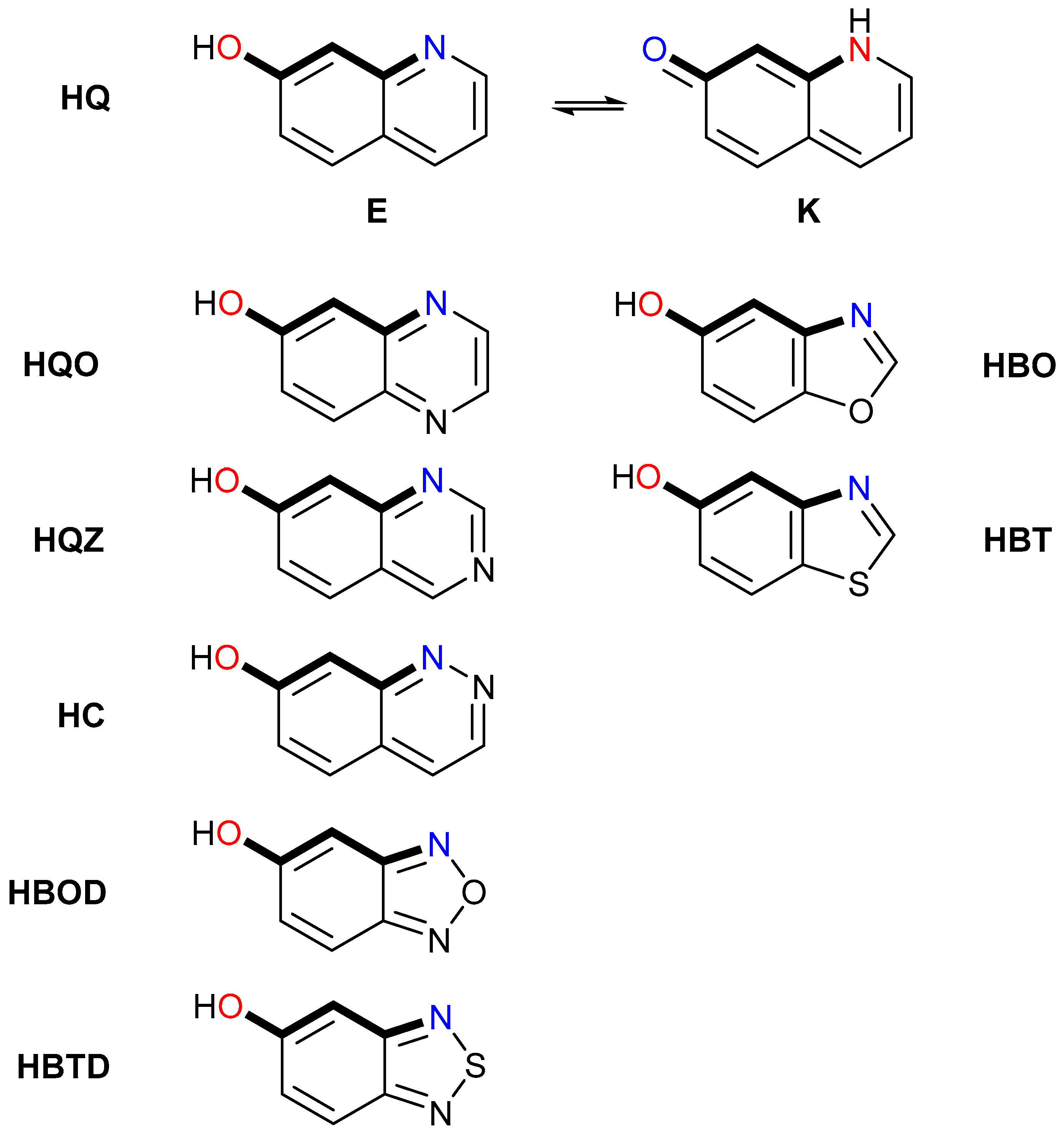
| HQ | 0.0 | 0.0 | 1.5 | 301 | 11 (6.8) | 12 (7.2) | 10.0 | 430 |
| HQO | 0.0 | 0.0 | 1.2 | 340 | 15 (11) | 15 (11) | 8.4 | 453 |
| HQZ * | 0.0 | 0.0 | 2.8 | 313 ** 289 | 11 (6.9) | 11 (7.5) | 6.7 | 395 |
| HC | 0.0 | 0.0 | 3.9 | 404 ** 321 | 6.1 (4.5) | 7.1 (5.4) | 7.2 | 462 |
| HBOD | 0.0 | 0.0 | 4.7 | 317 | 20 (19) | 20 (18) | 3.5 | 408 ** 372 |
| HBTD | 0.0 | 0.0 | 2.0 | 339 | 18 (15) | 17 (14) | 6.7 | 401 |
| HBO | 0.0 | 0.0 | 0.2 | 269 | 35 (25) | 34 (25) | 13.7 | 498 |
| HBT | 0.0 | 0.0 | 0.4 | 285 | 31 (22) | 31 (22) | 13.4 | 575 |
| Compound | E | K | ||
|---|---|---|---|---|
| OH Ring | N Ring | O Ring | NH Ring | |
| HQ | 0.809 (0.134) | 0.869 (−0.107) | 0.224 (−0.297) | 0.766 (0.369) |
| HQO | 0.815 (0.332) | 0.881 (−0.136) | 0.028 (0.005) | 0.690 (0.298) |
| HQZ | 0.832 (0.165) | 0.911 (−0.150) | 0.145 (−0.384) | 0.764 (0.414) |
| HC | 0.783 (0.177) | 0.923 (−0.154) | 0.104 (−0.313) | 0.708 (0.412) |
| HBOD | 0.525 (0.281) | 0.635 (−0.167) | −0.200 (−0.004) | 0.248 (0.251) |
| HBTD | 0.557 (0.216) | - * (−0.093) | −0.144 (0.021) | - * (0.276) |
| HBO | 0.984 (0.373) | 0.282 (−0.058) | 0.597 (−0.067) | 0.400 (0.508) |
| HBT | 0.969 (−0.336) | 0.698 (−0.132) | 0.602 (−0.698) | 0.839 (0.510) |
| E | KE | KK | K | |||||||||
|---|---|---|---|---|---|---|---|---|---|---|---|---|
| ΔE | ΔG | μ | ΔE | ΔG | μ | ΔE | ΔG | μ | ΔE | ΔG | μ | |
| [kcal/mol] | [D] | [kcal/mol] | [D] | [kcal/mol] | [D] | [kcal/mol] | [D] | |||||
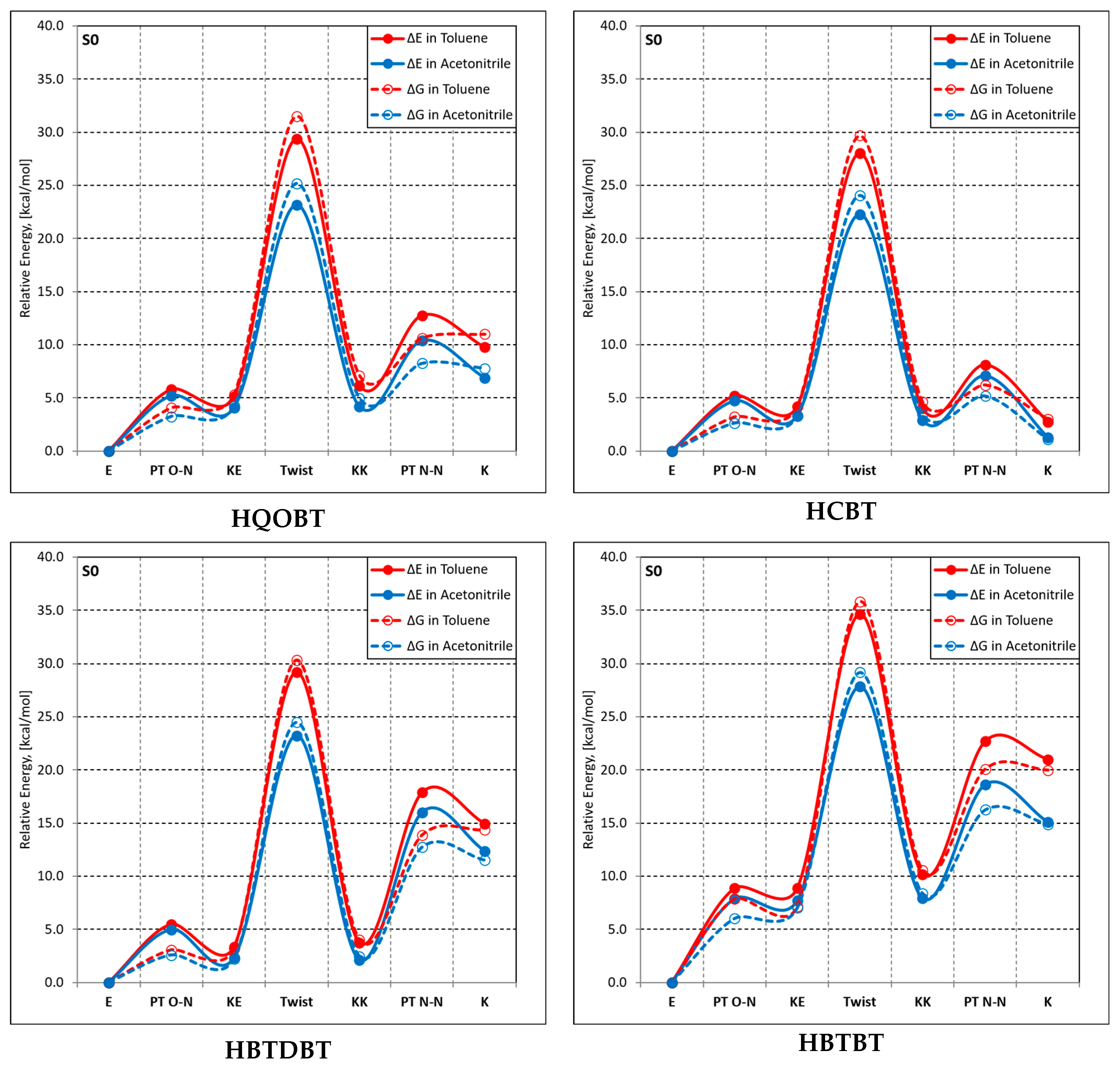
| HQBT | 0.0 | 0.0 | 2.9 | 5.5 (4.5) | 5.1 (4.3) | 2.9 | 6.2 (4.3) | 6.4 (4.6) | 5.9 | 6.4 (3.1) | 5.9 (2.9) | 8.8 |
| HQOBT | 0.0 | 0.0 | 2.4 | 5.1 (4.1) | 5.3 (4.2) | 4.9 | 6.2 (4.2) | 7.1 (5.0) | 6.6 | 9.8 (6.8) | 11 (7.8) | 7.0 |
| HQZBT | 0.0 | 0.0 | 0.8 | 4.5 (3.5) | 5.1 (3.8) | 3.7 | 5.2 (3.4) | 6.6 (4.5) | 4.4 | 7.0 (4.4) | 8.4 (5.3) | 5.1 |
| HCBT | 0.0 | 0.0 | 2.6 | 4.2 (3.3) | 4.2 (3.3) | 0.7 | 4.0 (2.9) | 4.6 (3.5) | 2.8 | 2.74 (1.25) | 3.0 (1.09) | 6.6 |
| HBODBT | 0.0 | 0.0 | 3.4 | 2.27 (1.04) | 2.33 (1.14) | 5.7 | 2.88 (1.39) | 3.2 (1.71) | 4.5 | 19 (17) | 18 (16) | 3.3 |
| HBTDBT | 0.0 | 0.0 | 1.3 | 3.4 (2.33) | 3.2 (2.20) | 4.4 | 3.8 (2.12) | 4.0 (2.46) | 5.1 | 15 (12) | 14 (11) | 5.4 |
| HBOBT | 0.0 | 0.0 | 2.0 | 10 (8.7) | 9.0 (8.2) | 4.0 | 12 (9.3) | 12 (9.6) | 6.4 | 26 (20) | 26 (20) | 11.0 |
| HBTBT | 0.0 | 0.0 | 2.3 | 8.9 (7.7) | 7.1 (7.0) | 3.8 | 10 (7.9) | 11 (8.4) | 6.5 | 21 (15) | 20 (15) | 10.8 |
Disclaimer/Publisher’s Note: The statements, opinions and data contained in all publications are solely those of the individual author(s) and contributor(s) and not of MDPI and/or the editor(s). MDPI and/or the editor(s) disclaim responsibility for any injury to people or property resulting from any ideas, methods, instructions or products referred to in the content. |
© 2026 by the authors. Licensee MDPI, Basel, Switzerland. This article is an open access article distributed under the terms and conditions of the Creative Commons Attribution (CC BY) license.
Share and Cite
Nedeltcheva-Antonova, D.; Kircheva, N.; Angelova, S.; Antonov, L. Improving Long-Range Intramolecular Proton Transfer—Further Molecular Design Using the Successful Molecular Switch 8-(Benzo[d]thiazol-2-yl)quinolin-7-ol (HQBT) as a Structural Model. Micromachines 2026, 17, 1084. https://doi.org/10.3390/mi17091084
Nedeltcheva-Antonova D, Kircheva N, Angelova S, Antonov L. Improving Long-Range Intramolecular Proton Transfer—Further Molecular Design Using the Successful Molecular Switch 8-(Benzo[d]thiazol-2-yl)quinolin-7-ol (HQBT) as a Structural Model. Micromachines. 2026; 17(9):1084. https://doi.org/10.3390/mi17091084
Chicago/Turabian StyleNedeltcheva-Antonova, Daniela, Nikoleta Kircheva, Silvia Angelova, and Liudmil Antonov. 2026. "Improving Long-Range Intramolecular Proton Transfer—Further Molecular Design Using the Successful Molecular Switch 8-(Benzo[d]thiazol-2-yl)quinolin-7-ol (HQBT) as a Structural Model" Micromachines 17, no. 9: 1084. https://doi.org/10.3390/mi17091084
APA StyleNedeltcheva-Antonova, D., Kircheva, N., Angelova, S., & Antonov, L. (2026). Improving Long-Range Intramolecular Proton Transfer—Further Molecular Design Using the Successful Molecular Switch 8-(Benzo[d]thiazol-2-yl)quinolin-7-ol (HQBT) as a Structural Model. Micromachines, 17(9), 1084. https://doi.org/10.3390/mi17091084