HMQ-ES-Stack-GBR: A Hybrid Ensemble Learning Model for Mechanical and Physical Quality Prediction in FDM 3D Printing

Abstract
1. Introduction
2. Materials and Methods
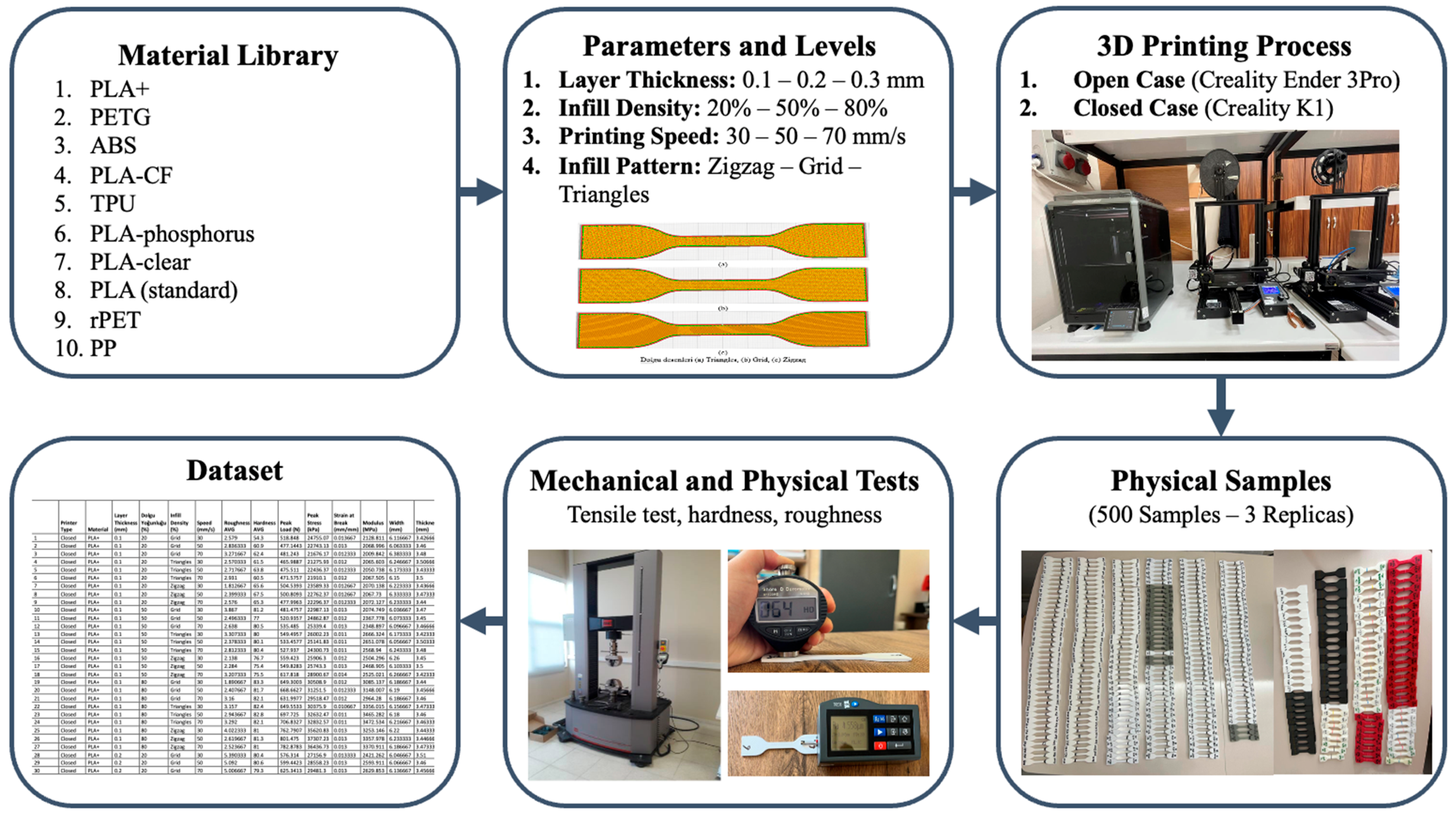
2.1. Experimental Design and Data Generation
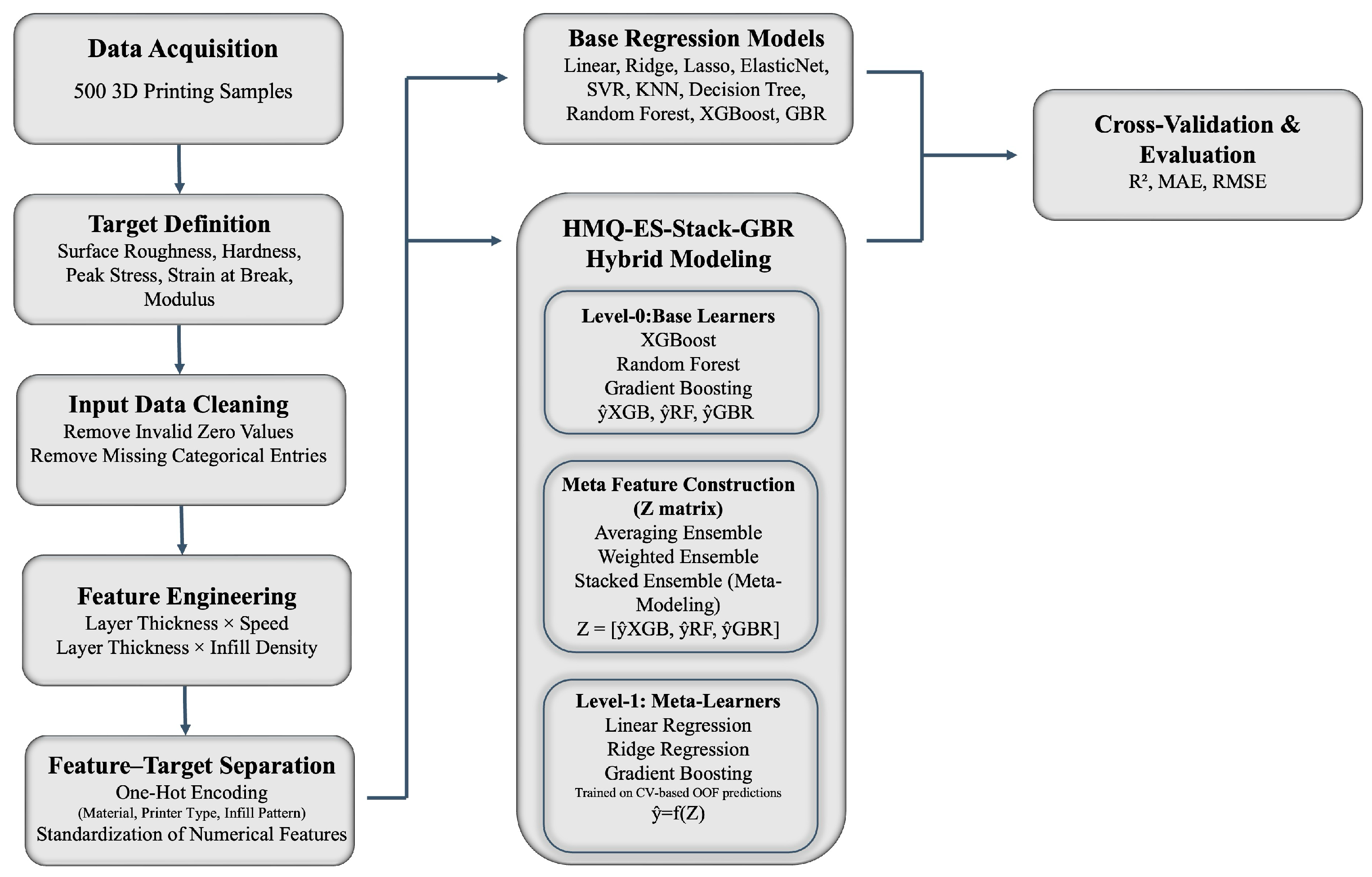
2.2. Proposed Methodology: The HMQ-ES-Stack-GBR Framework
2.3. Multi-Objective Process Optimization Framework
2.3.1. NSGA-II Algorithm
2.3.2. PSO Algorithm
2.3.3. GWO Algorithm
2.3.4. Objective Function and Optimization Criteria
- Ra: surface roughness;
- H: hardness;
- : maximum stress;
- : elongation at break;
- E: modulus of elasticity.
3. Results
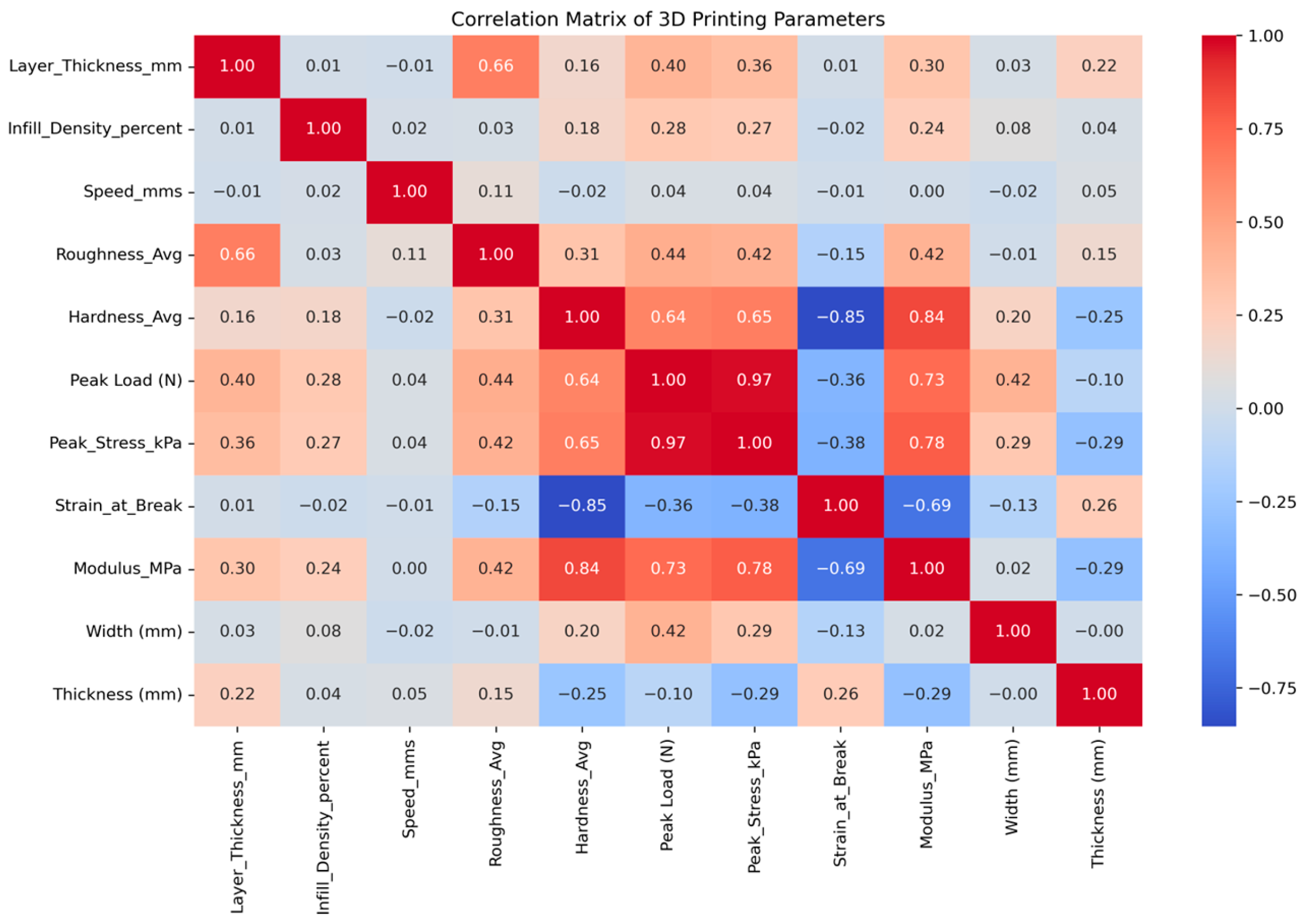
3.1. Dataset Analysis
3.2. Baseline Models and Comparative Evaluation
3.3. Overall Performance Evaluation Across Mechanical and Physical Outputs
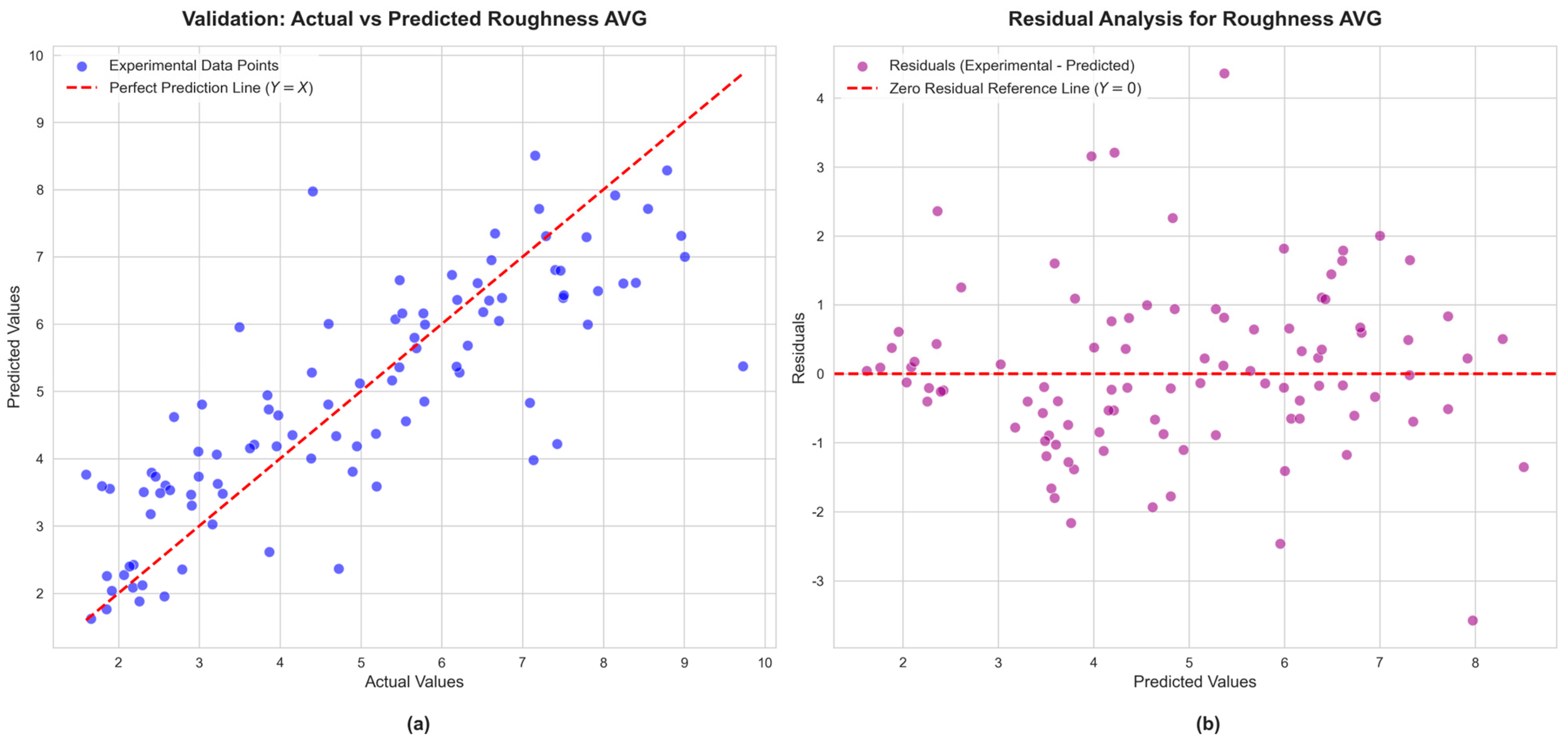
3.4. Model Validation and Predictive Performance Analysis
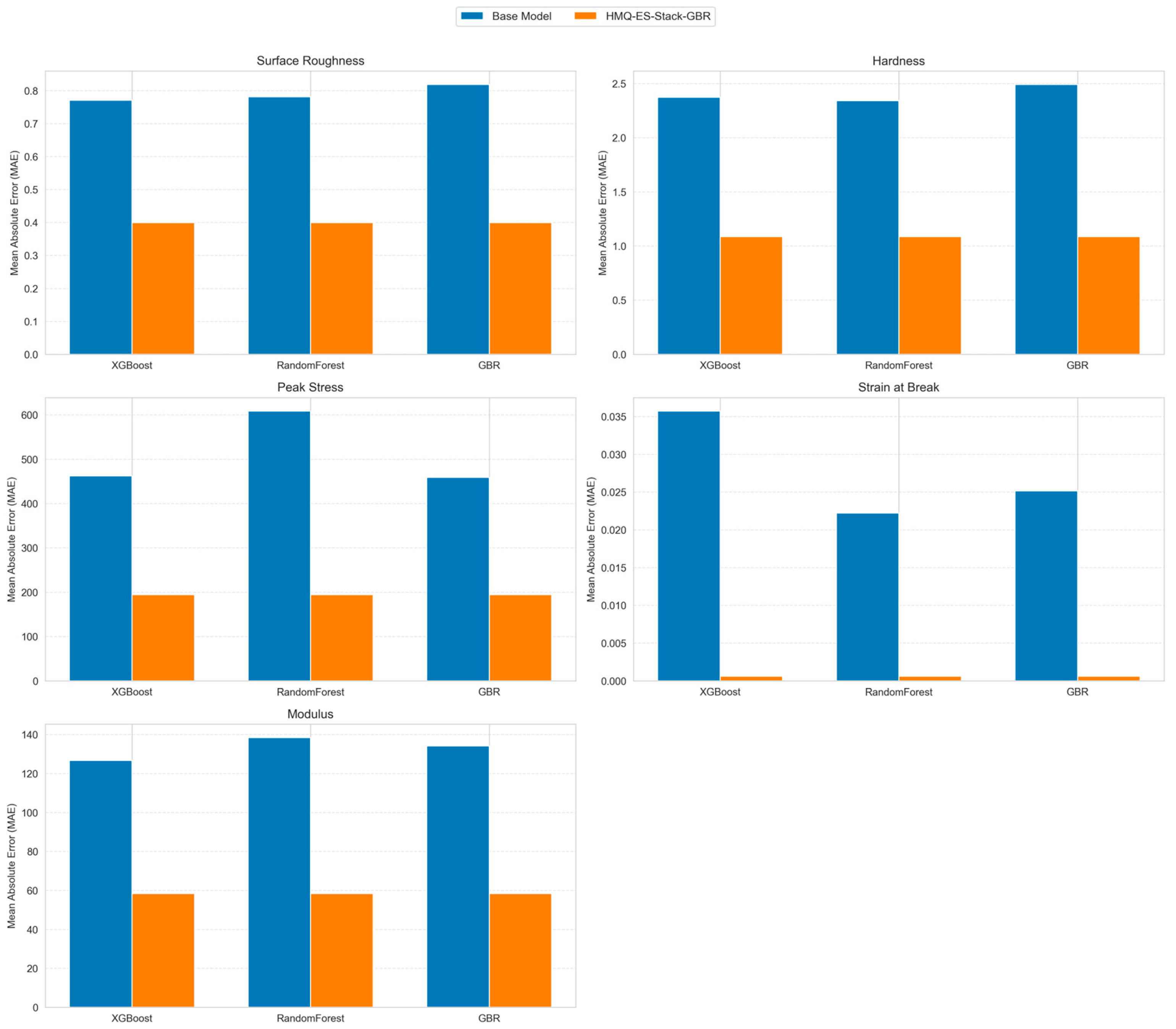
3.5. Statistical Significance Analysis
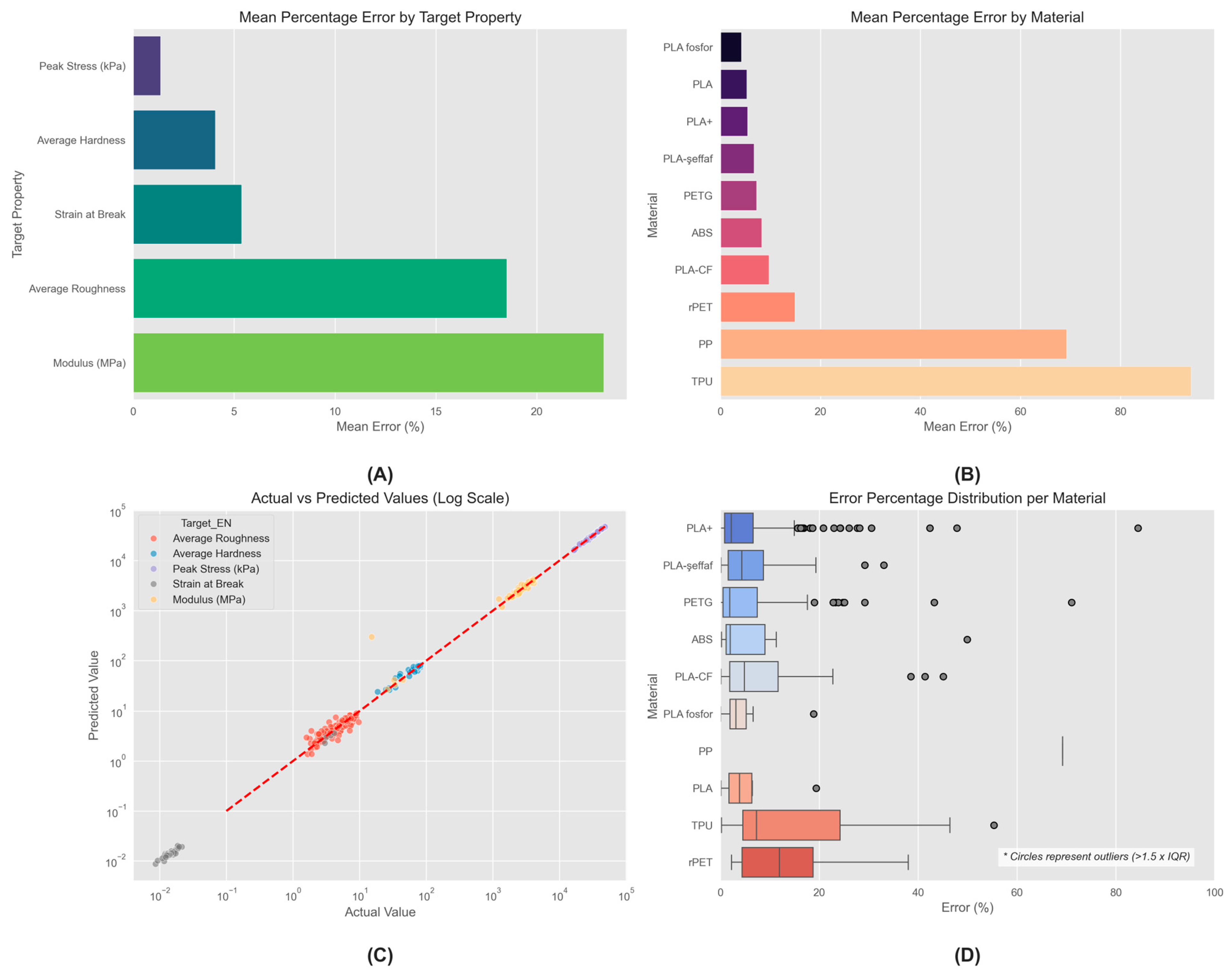
3.6. Material-Specific Performance Analysis
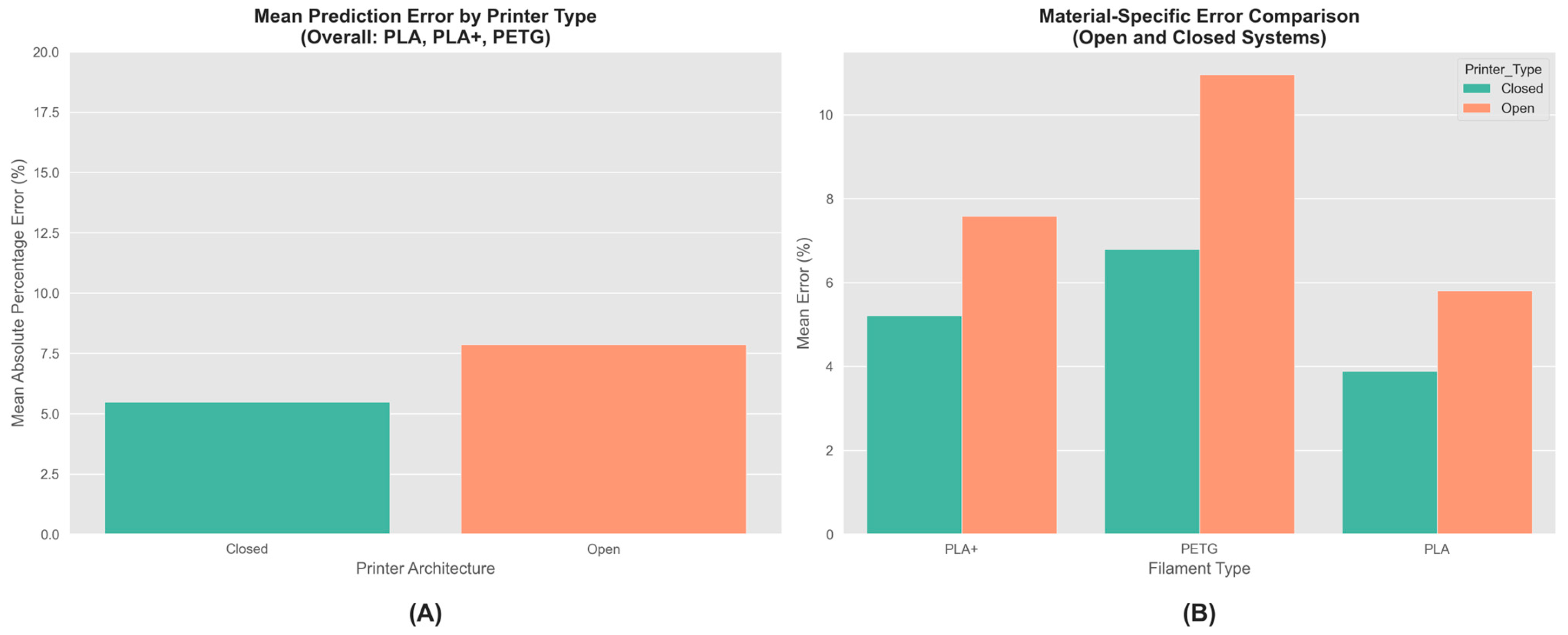
3.7. Printer System-Based Performance Analysis
3.8. Multi-Material Process Optimization and Design Guidelines
4. Discussion
4.1. Validation Scope and Study Boundaries
Effect of Replicate Averaging on Model Performance
5. Conclusions
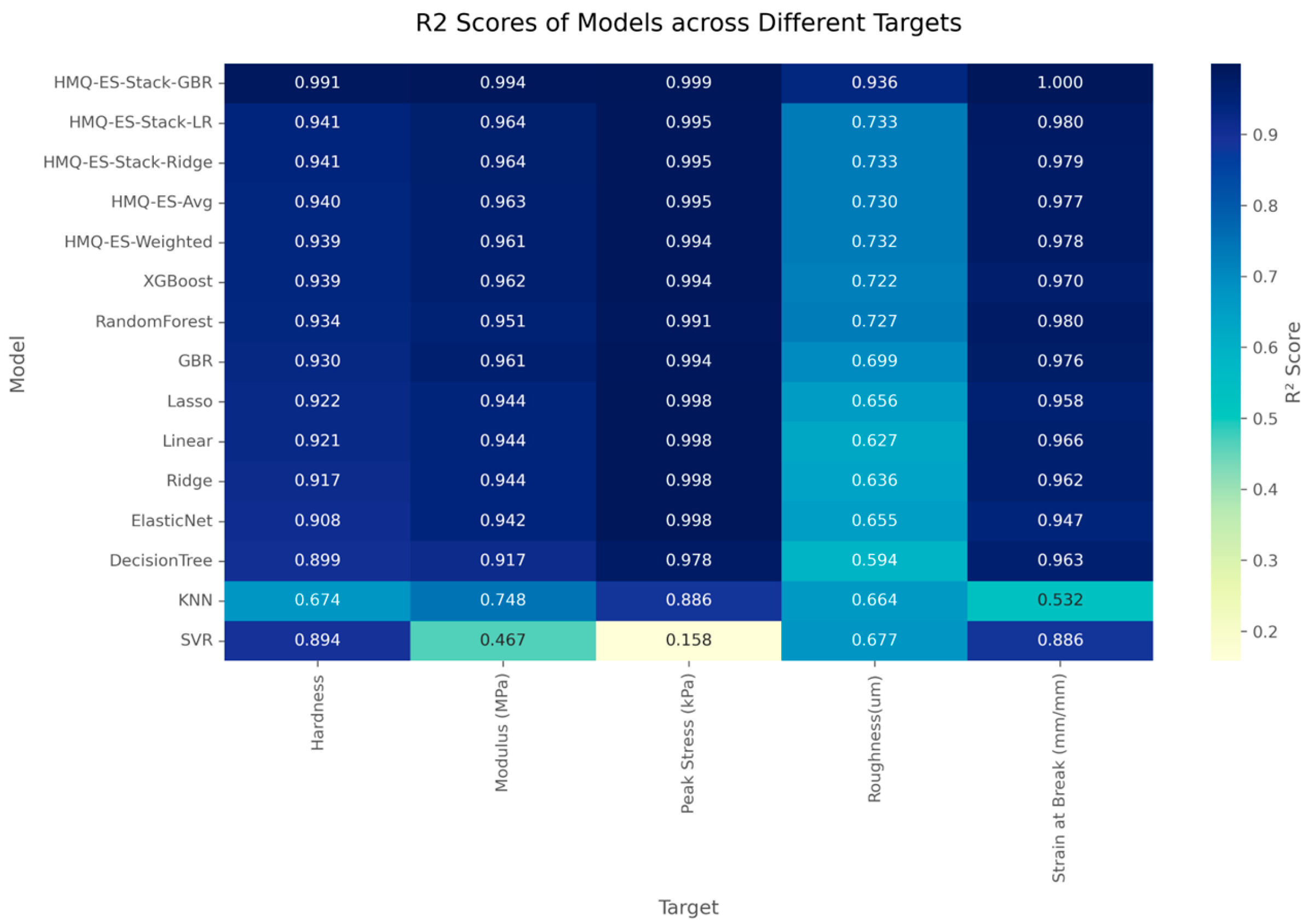
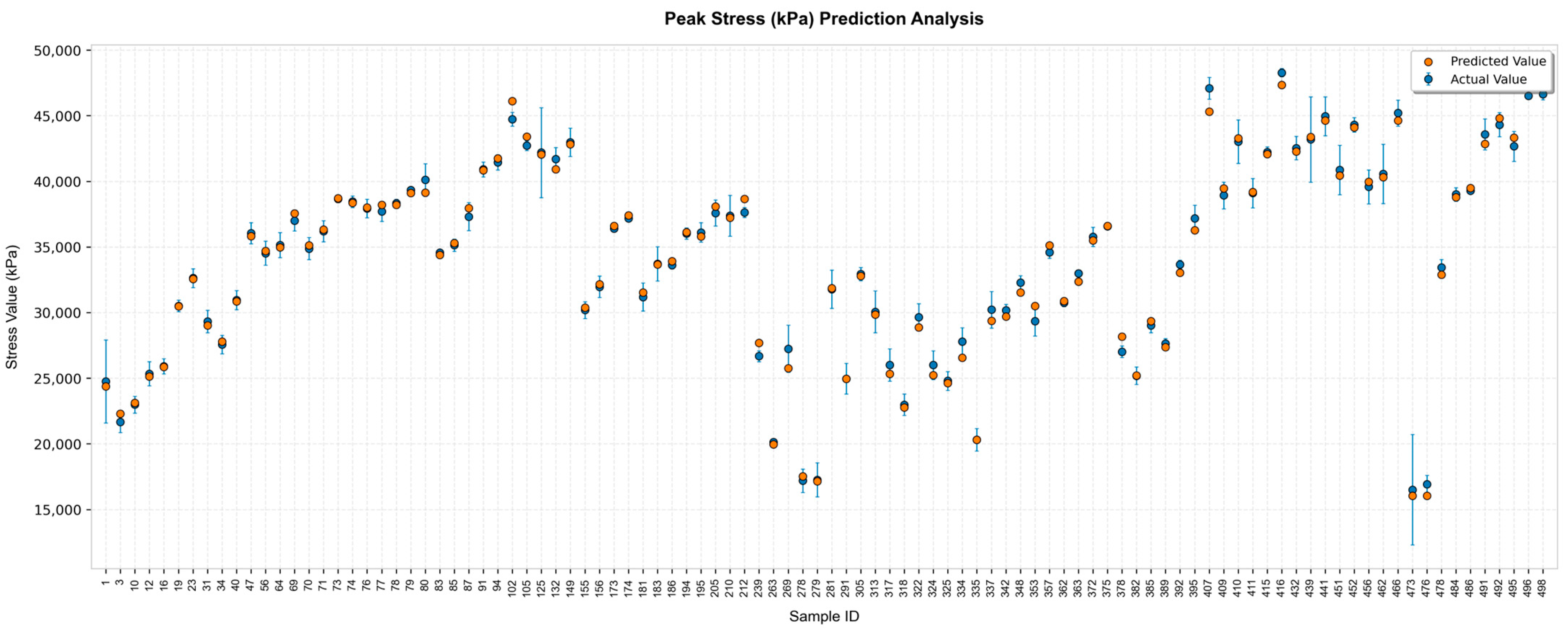
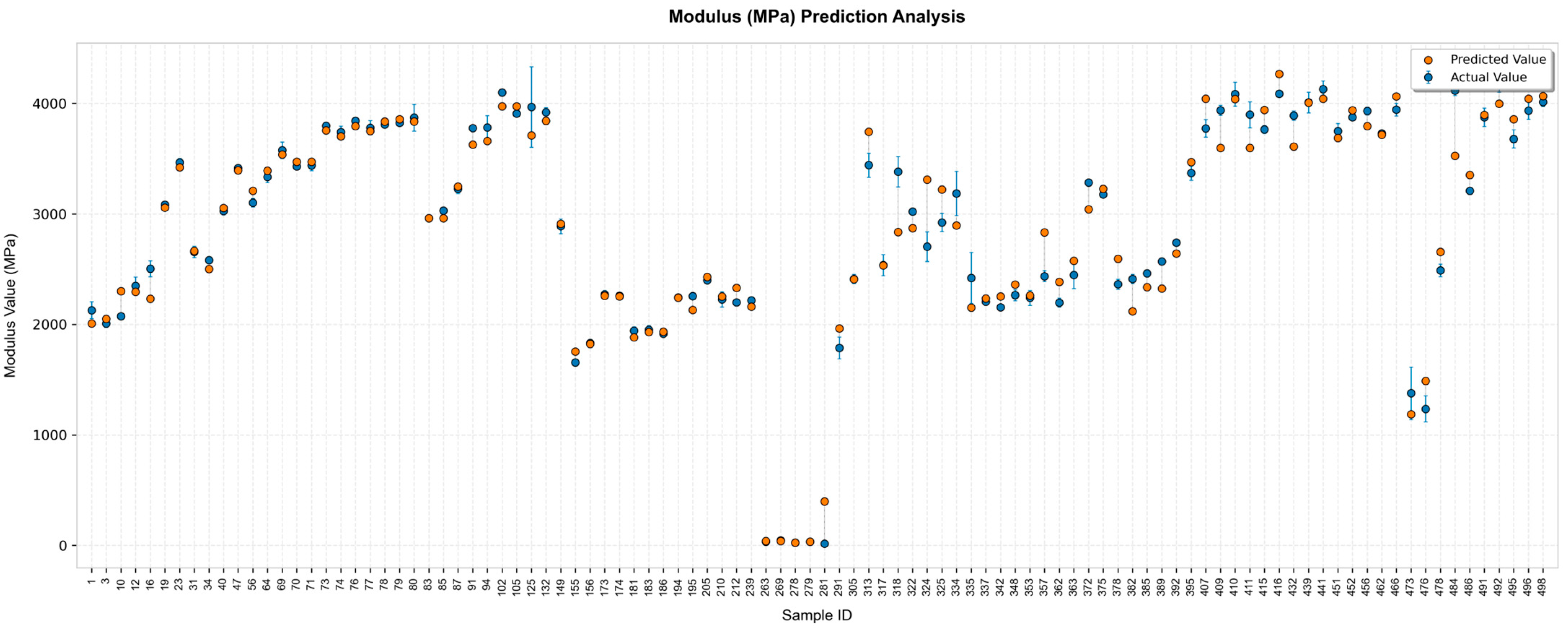
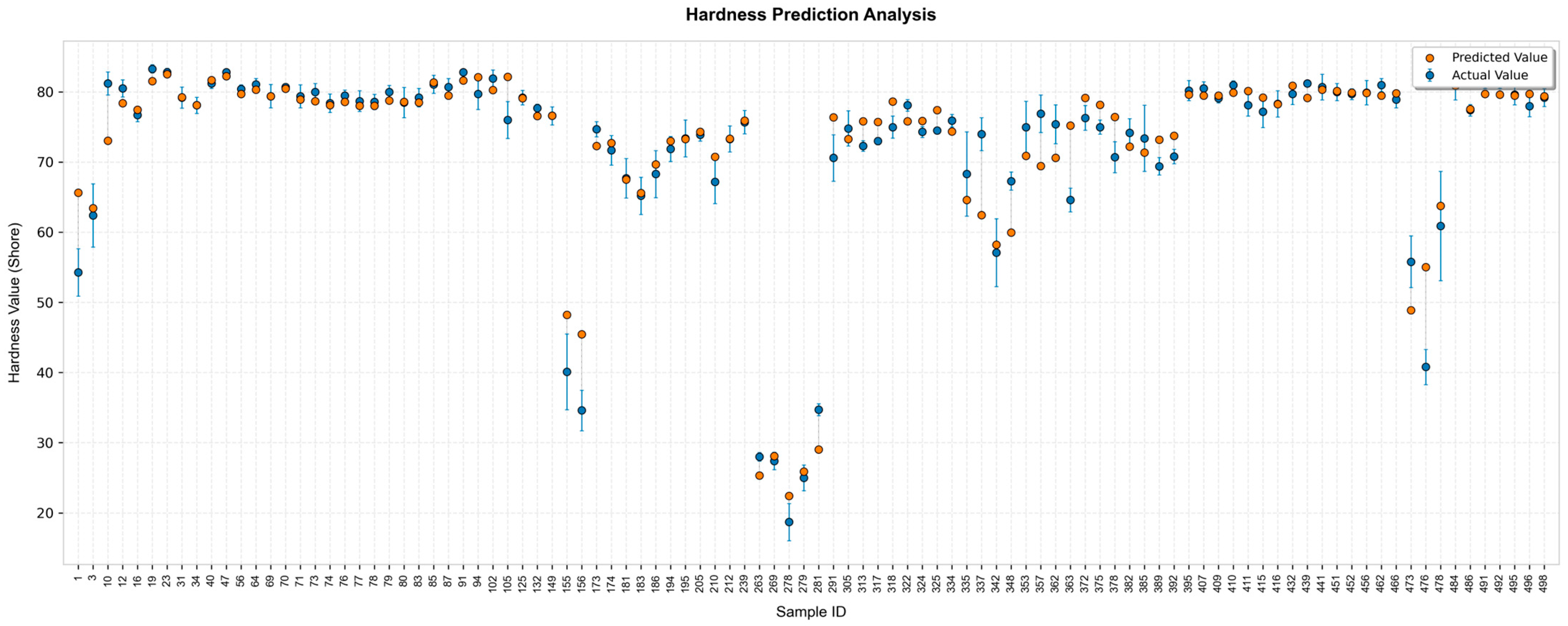
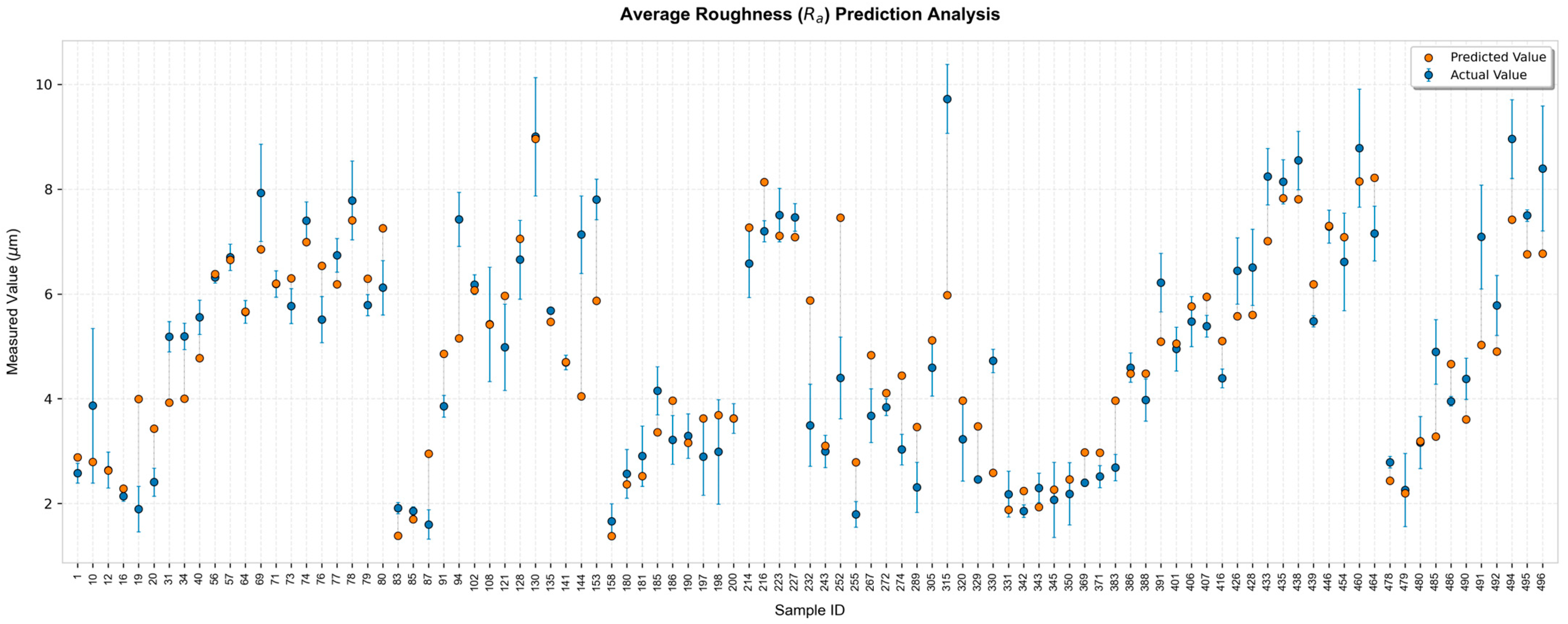
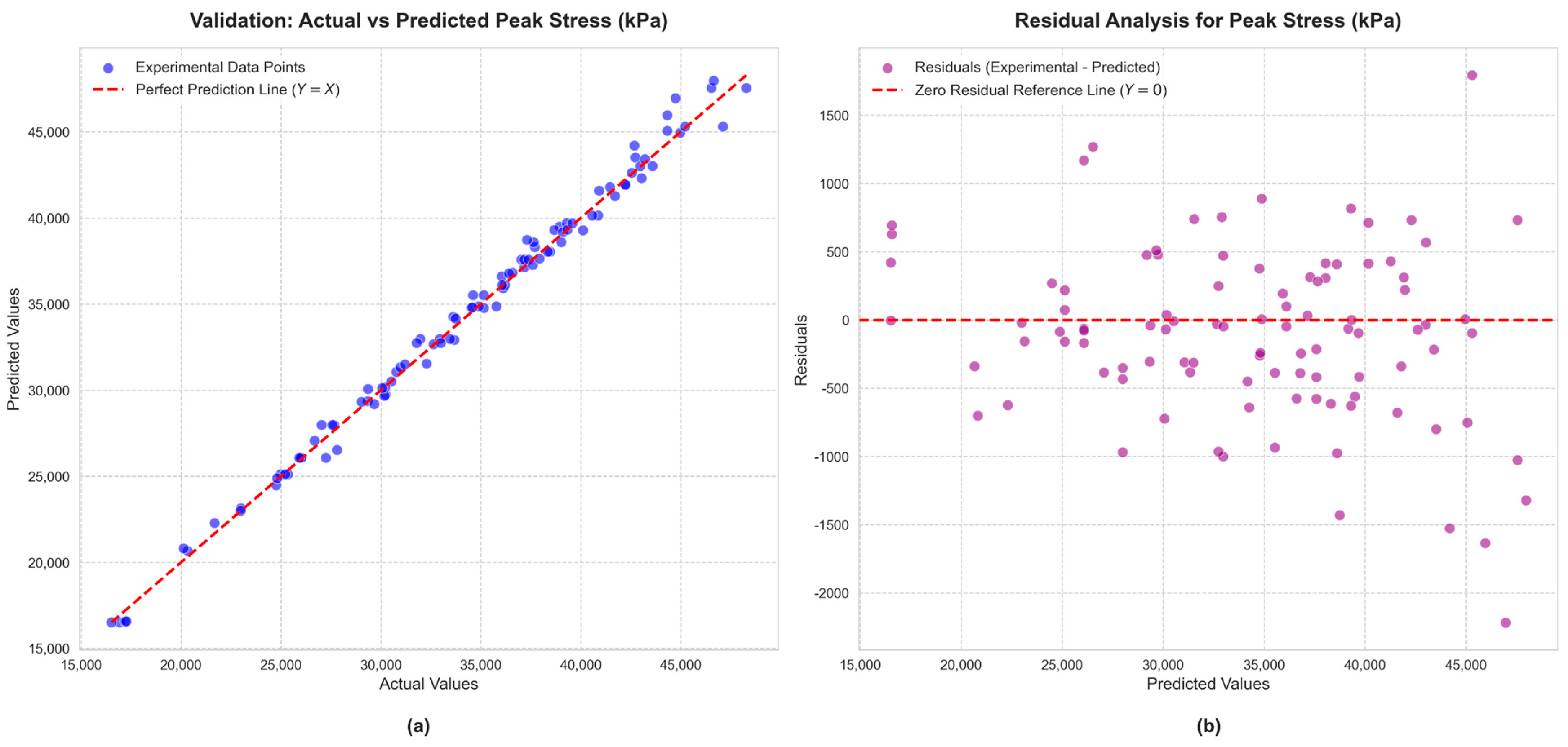
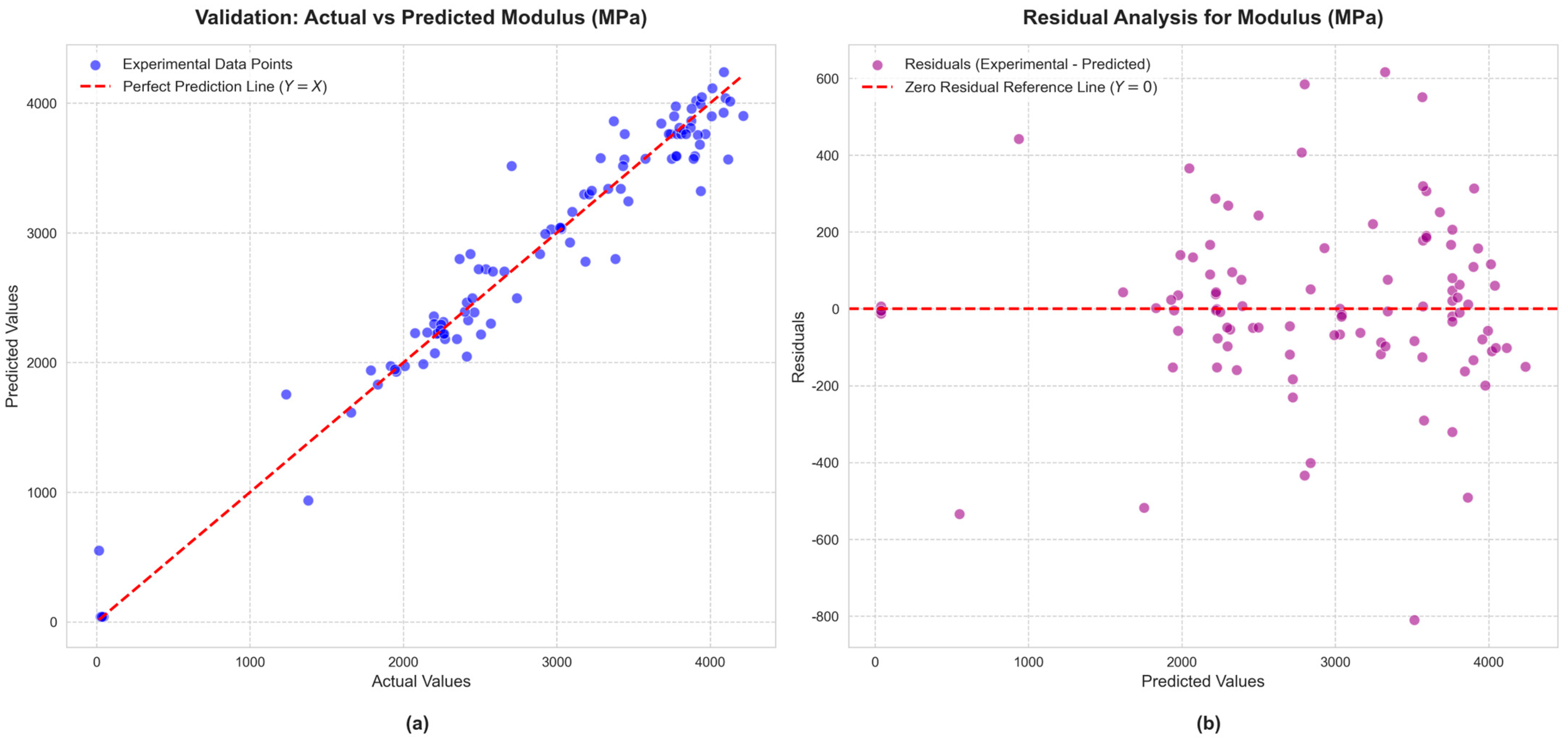
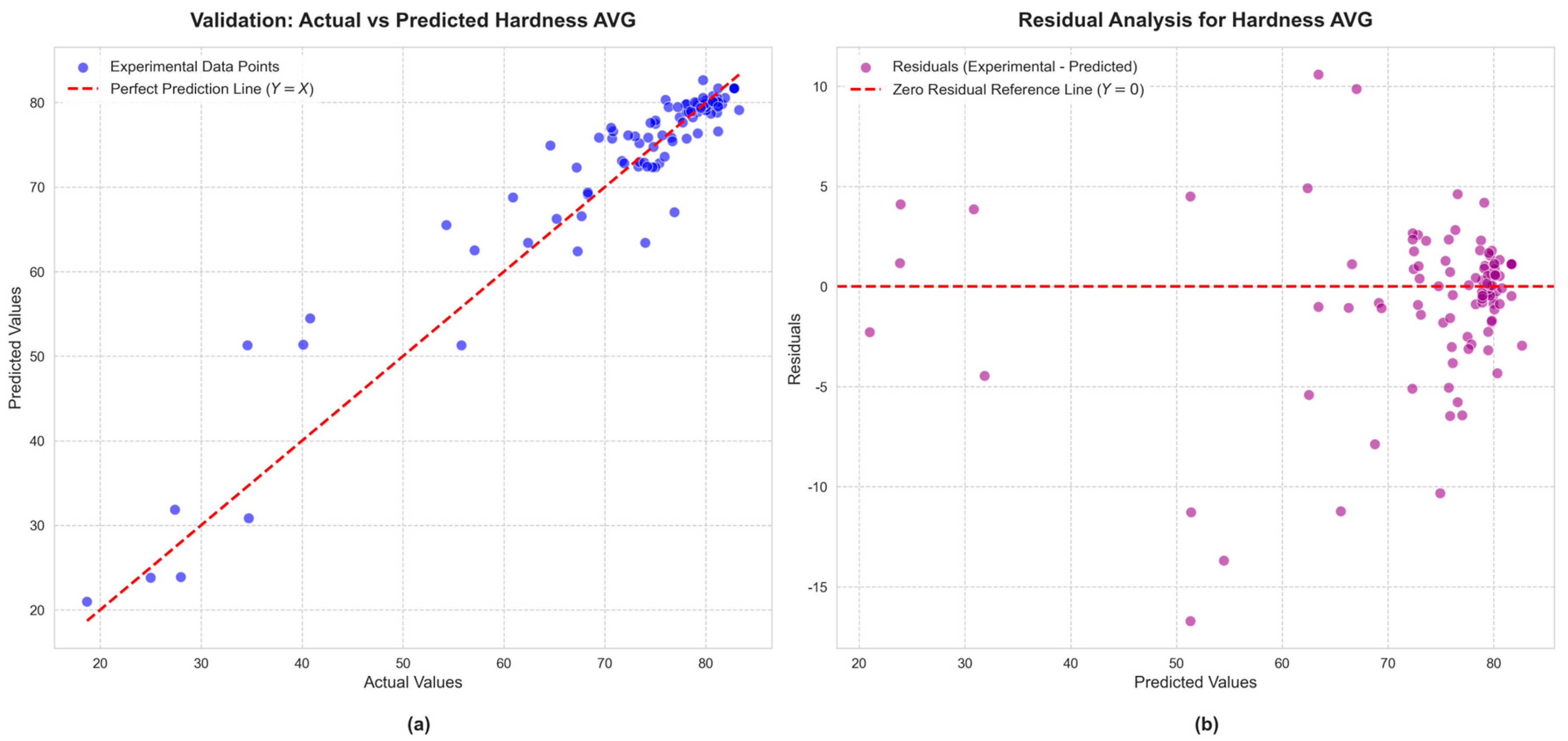
- The proposed framework achieved strong predictive performance for all investigated quality outputs within the studied dataset. R2 values reached 0.999 for peak stress and strain at break, 0.994 for modulus, 0.991 for hardness, and 0.936 for Surface Roughness.
- Comparative analyses demonstrated that the HMQ-ES-Stack-GBR framework outperformed the baseline models evaluated in this study, including XGBoost, Random Forest, Gradient Boosting Regressor, SVR, KNN, and conventional linear regression approaches.
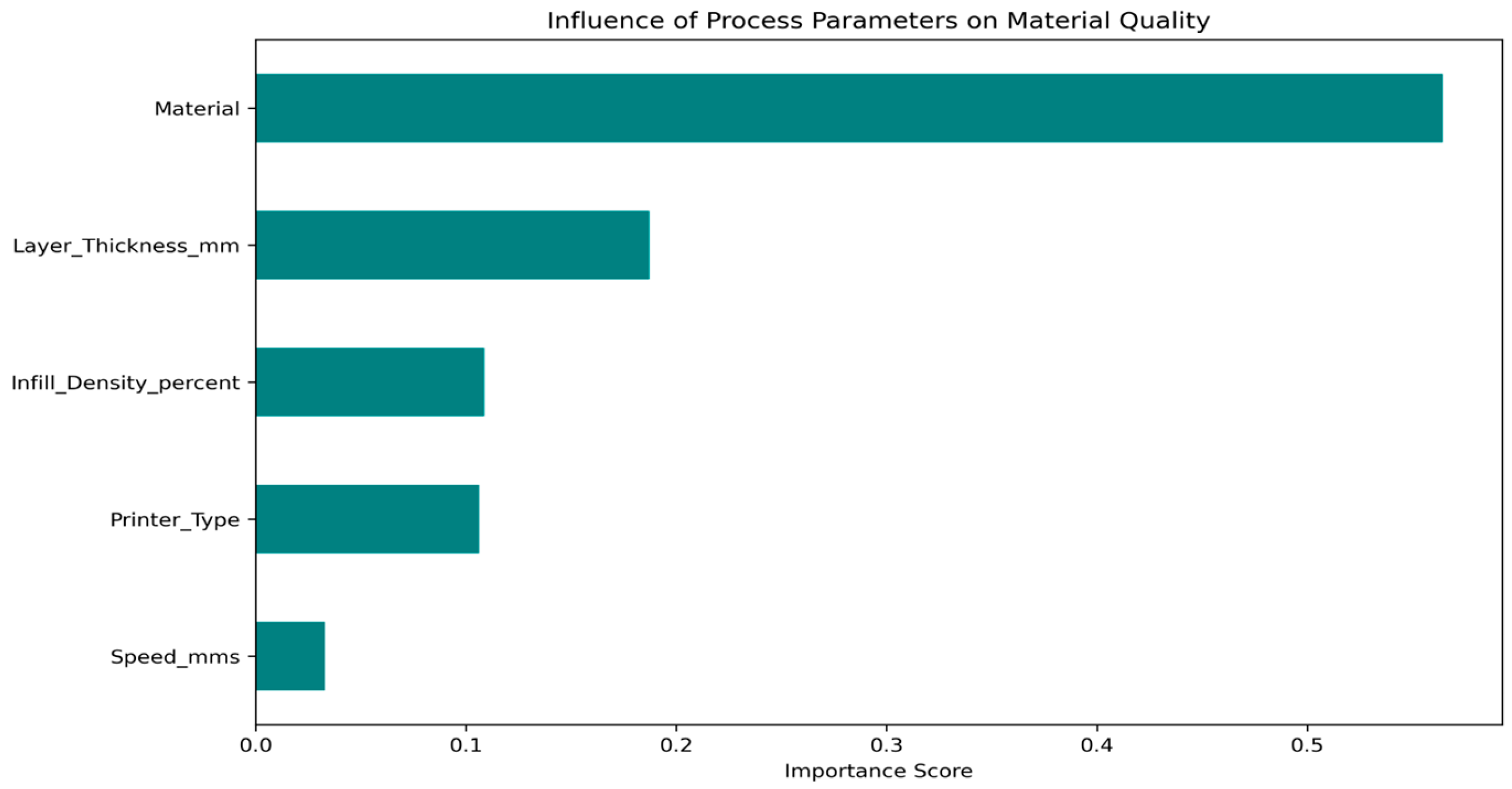
- Feature importance analysis revealed that material type was the dominant factor affecting quality outputs, accounting for approximately 55% of the total feature contribution. This finding highlights the importance of material-dependent variability in FDM processes.
- The inclusion of both open- and closed-frame printer systems enabled the framework to capture system-induced variability within the experimental dataset. For the investigated PLA, PLA+, and PETG materials, higher prediction errors were observed in open-frame printing conditions than in closed-frame systems.
- To bridge the gap between predictive accuracy and practical shop-floor applications, a multi-objective optimization framework driven by three meta-heuristic algorithms (NSGA-II, PSO, and GWO) was successfully coupled with the predictive system. This optimization pipeline yielded a robust, material-specific process design guideline that defines the precise combinations of infill patterns, layer thickness, printing speeds, and infill densities required to achieve targeted multi-output mechanical and physical properties across the 10 investigated filament classes.
Author Contributions
Funding
Institutional Review Board Statement
Informed Consent Statement
Data Availability Statement
Acknowledgments
Conflicts of Interest
Abbreviations
| 3D | Three-Dimensional |
| AM | Additive Manufacturing |
| FDM | Fused Deposition Modeling |
| ISO | International Organization for Standardization |
| IQR | Interquartile Range |
| ML | Machine Learning |
| DL | Deep Learning |
| ANN | Artificial Neural Network |
| MLP | Multilayer Perceptron |
| KNN | K-Nearest Neighbors |
| SVR | Support Vector Regression |
| RF | Random Forest |
| GBR | Gradient Boosting Regressor |
| XGBoost | Extreme Gradient Boosting |
| PLA | Polylactic Acid |
| ABS | Acrylonitrile Butadiene Styrene |
| PETG | Polyethylene Terephthalate Glycol |
| TPU | Thermoplastic Polyurethane |
| PP | Polypropylene |
| PLA-CF | Carbon Fiber Reinforced Polylactic Acid |
| rPET | Recycled Polyethylene Terephthalate |
| HMQ-ES-Stack-GBR | Hybrid Multi-Material Quality Ensemble System—Stacking Gradient Boosting Regressor |
| NSGA-II | Non-dominated Sorting Genetic Algorithm II |
| OOF | Out-of-Fold |
| MPE | Mean Percentage Error |
| RMSE | Root Mean Square Error |
| MAE | Mean Absolute Error |
| R2 | Coefficient of Determination |
| Ra | Arithmetic Average Surface Roughness |
References
- Aktepe, E.; Ergün, U. A systematic analysis of 3D printing research in doctoral and specialization theses in Turkey. In Next Generation Engineering: Smart Solutions and Applications; Kocer, S., Dundar, O., Eds.; ISRES Publishing: Konya, Turkey, 2015; pp. 13–36. [Google Scholar]
- Ngo, T.D.; Kashani, A.; Imbalzano, G.; Nguyen, K.T.Q.; Hui, D. Additive Manufacturing (3D Printing): A Review of Materials, Methods, Applications and Challenges. Compos. B Eng. 2018, 143, 172–196. [Google Scholar] [CrossRef] [Scilit]
- Zohdi, N.; Yang, R.C. Material Anisotropy in Additively Manufactured Polymers and Polymer Composites: A Review. Polymers 2021, 13, 3368. [Google Scholar] [CrossRef] [Scilit] [PubMed]
- Bouhamed, A.; Dammak, M.; Hagui, H.; Jrad, H. Multiscale Mechanical Characterization of 3D-Printed PLA Composites with Carbon Fiber Reinforcement: Effect of Raster Angle and Layer Thickness. Int. J. Adv. Manuf. Technol. 2025, 137, 4805–4824. [Google Scholar] [CrossRef] [Scilit]
- Garg, S.; Sardar, A.; Srivastava, R.; Verma, S.; Madan, A.K. Variation in Tensile Strength of 3D Printed PLA Parts by Varying Infill Density and Infill Pattern. Saudi J. Eng. Technol. 2023, 8, 103–107. [Google Scholar] [CrossRef] [Scilit]
- Lorkowski, L.; Wybrzak, K.; Brancewicz-Steinmetz, E.; Świniarski, J.; Sawicki, J. Influence of Print Speed on the Mechanical Performance of 3D-Printed Bio-Polymer Polylactic Acid. Materials 2025, 18, 1765. [Google Scholar] [CrossRef] [Scilit] [PubMed]
- Lokesh, N.; Praveena, B.A.; Sudheer Reddy, J.; Vasu, V.K.; Vijaykumar, S. Evaluation on Effect of Printing Process Parameter through Taguchi Approach on Mechanical Properties of 3D Printed PLA Specimens Using FDM at Constant Printing Temperature. In the Materials Today: Proceedings; Elsevier Ltd.: Amsterdam, The Netherlands, 2022; Volume 52, pp. 1288–1293. [Google Scholar]
- Aktepe, E.; Aktepe, Ş. Comparison of Dimensional Accuracy and Shrinkage Performance of PLA and Recycled PET Filaments in 3D FDM Printing. Int. J. 3D Print. Technol. Digit. Ind. 2024, 8, 114–123. [Google Scholar] [CrossRef] [Scilit]
- Aktepe, E.; Ergün, U. Machine Learning Approaches for FDM-Based 3D Printing: A Literature Review. Appl. Sci. 2025, 15, 10001. [Google Scholar] [CrossRef] [Scilit]
- Alli, Y.A.; Anuar, H.; Manshor, M.R.; Okafor, C.E.; Kamarulzaman, A.F.; Akçakale, N.; Mohd Nazeri, F.N.; Bodaghi, M.; Suhr, J.; Mohd Nasir, N.A. Optimization of 4D/3D Printing via Machine Learning: A Systematic Review. Hybrid Adv. 2024, 6, 100242. [Google Scholar] [CrossRef] [Scilit]
- Goh, G.D.; Sing, S.L.; Yeong, W.Y. A Review on Machine Learning in 3D Printing: Applications, Potential, and Challenges. Artif. Intell. Rev. 2021, 54, 63–94. [Google Scholar] [CrossRef] [Scilit]
- Rojek, I.; Mikołajewski, D.; Kempiński, M.; Galas, K.; Piszcz, A. Emerging Applications of Machine Learning in 3D Printing. Appl. Sci. 2025, 15, 1781. [Google Scholar] [CrossRef] [Scilit]
- Ukwaththa, J.; Herath, S.; Meddage, D.P.P. A Review of Machine Learning (ML) and Explainable Artificial Intelligence (XAI) Methods in Additive Manufacturing (3D Printing). Mater. Today Commun. 2024, 41, 110294. [Google Scholar] [CrossRef] [Scilit]
- Zhang, X.; Chu, D.; Zhao, X.; Gao, C.; Lu, L.; He, Y.; Bai, W. Machine Learning-Driven 3D Printing: A Review. Appl. Mater. Today 2024, 39, 102306. [Google Scholar] [CrossRef] [Scilit]
- Liu, P.; Chang, B.; Xu, C.; Zhang, W.; Yang, T.; Wu, T. Optimizing 3D Printed Continuous CF/PEEK Composites: A Machine Learning Approach to Strength Prediction. J. Reinf. Plast. Compos. 2025, 45, 3200–3215. [Google Scholar] [CrossRef] [Scilit]
- Zhang, J.; Wang, P.; Gao, R.X. Deep Learning-Based Tensile Strength Prediction in Fused Deposition Modeling. Comput. Ind. 2019, 107, 11–21. [Google Scholar] [CrossRef] [Scilit]
- Nikzad, M.H.; Heidari-Rarani, M.; Rasti, R.; Sareh, P. Machine Learning-Driven Prediction of Tensile Strength in 3D-Printed PLA Parts. Expert Syst. Appl. 2025, 264, 125836. [Google Scholar] [CrossRef] [Scilit]
- Da Silva, M.A.; Amaro Junior, B.; Medeiros, R.R.B.; Pinheiro, P.R. A Neuroevolutionary Model to Estimate the Tensile Strength of Manufactured Parts Made by 3D Printing. Algorithms 2022, 15, 263. [Google Scholar] [CrossRef] [Scilit]
- Pazhamannil, R.V.; Govindan, P.; Sooraj, P. Prediction of the Tensile Strength of Polylactic Acid Fused Deposition Models Using Artificial Neural Network Technique. In Proceedings of the Materials Today: Proceedings; Elsevier Ltd.: Amsterdam, The Netherlands, 2019; Volume 46, pp. 9187–9193. [Google Scholar]
- Aktepe, E.; Koca, Y.B. Optimization of 3D Printing Parameters Using Machine Learning Techniques. In Proceedings of the EAI/Springer Innovations in Communication and Computing; Springer Science and Business Media Deutschland GmbH: Berlin, Germany, 2025; pp. 277–286. [Google Scholar]
- Ridlo, A.H.; Kusmono; Muflikhun, M.A.; Putra, R.A.; Thongking, W.; Wiranata, A. Optimization of Stretchable Fused Deposition Modeling Filament From Polypropylene-Based Elastomer/Thermoplastic Elastomer Blends Using a Machine Learning Approach. J. Appl. Polym. Sci. 2025, 142, e57435. [Google Scholar] [CrossRef] [Scilit]
- Wang, Z.; Yang, Y.; Suo, S.; Guo, J.; Rao, W.F. Predicting 4D Hardness Property from 3D Datasets for Performance-Tunable Material Extrusion Additive Manufacturing. Mater. Today Commun. 2024, 38, 108216. [Google Scholar] [CrossRef] [Scilit]
- Veeman, D.; Vellaisamy, M.; Ponnusamy, P.C.; Subathra, D.P.; Katiyar, J.K. Impact of Process Parameters on Hardness of Melt Fabricated PA6 Carbon Fiber-Reinforced Composites and Prediction of Properties Using Machine Learning. J. Mater. Eng. Perform. 2025, 34, 24323–24336. [Google Scholar] [CrossRef] [Scilit]
- Zeng, Y.S.; Hsueh, M.H.; Lai, C.J.; Hsiao, T.C.; Pan, C.Y.; Huang, W.C.; Chang, C.H.; Wang, S.H. An Investigation on the Hardness of Polylactic Acid Parts Fabricated via Fused Deposition Modeling. Polymers 2022, 14, 2789. [Google Scholar] [CrossRef] [Scilit] [PubMed]
- Reddy, B.V.S.; Shaik, A.M.; Sastry, C.C.; Krishnaiah, J.; Patil, S.; Nikhare, C.P. Performance Evaluation of Machine Learning Techniques in Surface Roughness Prediction for 3D Printed Micro-Lattice Structures. J. Manuf. Process. 2025, 137, 320–341. [Google Scholar] [CrossRef] [Scilit]
- Sharma, A.; Bharti, P.S. Optimization of Resin Printing Parameters for Improved Surface Roughness Using Metaheuristic Algorithms: A Multifaceted Approach. J. Mater. Eng. Perform. 2025, 34, 8525–8539. [Google Scholar] [CrossRef] [Scilit]
- Xie, S.; He, Z.; Wang, C.; Liu, C.; Ke, X. A Generic Evolutionary Ensemble Learning Framework for Surface Roughness Prediction in Manufacturing. Int. J. Comput. Integr. Manuf. 2023, 36, 1572–1594. [Google Scholar] [CrossRef] [Scilit]
- Kim, M.K.; Lee, I.H.; Kim, H.C. Effect of Fabrication Parameters on Surface Roughness of FDM Parts. Int. J. Precis. Eng. Manuf. 2018, 19, 137–142. [Google Scholar] [CrossRef] [Scilit]
- Abdulshahed, A.M.; Wafa, F. Surface Roughness Prediction in Additive Manufacturing: Presenting the Power of Neural Networks Compared to Linear Regression. J. Adv. Manuf. Syst. 2025, 24, 69–88. [Google Scholar] [CrossRef] [Scilit]
- Kharate, N.; Anerao, P.; Kulkarni, A.; Abdullah, M. Explainable AI Techniques for Comprehensive Analysis of the Relationship between Process Parameters and Material Properties in FDM-Based 3D-Printed Biocomposites. J. Manuf. Mater. Process. 2024, 8, 171. [Google Scholar] [CrossRef] [Scilit]
- Khusheef, A.S.; Shahbazi, M.; Hashemi, R. Predicting 3D Printed Plastic Part Properties: A Deep Learning Approach with Thermographic and Vibration Data Fusion. Expert Syst. Appl. 2024, 255, 124605. [Google Scholar] [CrossRef] [Scilit]
- Marappan, K.; Jenarthanan, M.P.; Begum, K.G.; Moorthy, V. Prediction of Effective Parameters for 3D Printing of Poly Lactic Acid-Carbon Fibre Composites Using Intelligent Frameworks Based on Mechanical Response. Pigment Resin Technol. 2024, 54, 549–560. [Google Scholar] [CrossRef] [Scilit]
- Selvan, S.P.; Raja, D.E.; Muthukumar, V.; Sonar, T. Optimization of Process Parameters and Predicting Surface Finish of PLA in Additive Manufacturing—A Neural Network Approach. Int. J. Interact. Des. Manuf. 2024, 19, 2511–2520. [Google Scholar] [CrossRef] [Scilit]
- Wolpert, D.H. Stacked Generalization. Neural Netw. 1992, 5, 241–259. [Google Scholar] [CrossRef] [Scilit]
- Breiman, L. Stacked Regressions. Mach. Learn. 1996, 24, 49–64. [Google Scholar] [CrossRef] [Scilit]
- Friedman, J.H. Greedy Function Approximation: A Gradient Boosting Machine. Ann. Stat. 2001, 29, 1189–1232. [Google Scholar] [CrossRef] [Scilit]
- Mulugundam, S.S.; Gugulothu, S.K.; Varshith, M. A Machine Learning Approach to Refining Surface Quality and Material Durability in Additive Manufacturing. Prog. Addit. Manuf. 2025, 10, 7779–7790. [Google Scholar] [CrossRef] [Scilit]
- Ogunsanya, M.A.; Parupelli, S.K.; Isichei, J.C.; Desai, S. Predictive Quality Assurance of Material Extrusion Process Using Artificial Neural Networks and Ensemble Models. Int. J. Adv. Manuf. Technol. 2025, 140, 2691–2714. [Google Scholar] [CrossRef] [Scilit]
- Nguyen, P.Q.K.; Zhang, Y.S.; Zhang, Z.; Yang, R.C. Multi-Objective Optimisation of Fused Filament Fabrication of Acrylonitrile Butadiene Styrene for Enhancing Mechanical Performance and Build Time. Int. J. Adv. Manuf. Technol. 2025, 137, 5431–5449. [Google Scholar] [CrossRef] [Scilit]
- Panico, A.; Corvi, A.; Collini, L.; Sciancalepore, C. Multi Objective Optimization of FDM 3D Printing Parameters Set via Design of Experiments and Machine Learning Algorithms. Sci. Rep. 2025, 15, 16753. [Google Scholar] [CrossRef] [Scilit] [PubMed]
- Özkül, M.; Kuncan, F.; Ulkir, O. Predicting Mechanical Properties of FDM-Produced Parts Using Machine Learning Approaches. J. Appl. Polym. Sci. 2025, 142, e56899. [Google Scholar] [CrossRef] [Scilit]
- Nagarjun, J.; Saravanakumar, N.; Thirumalai Kumaran, S.; Anto Dilip, A.; Balasuadhakar, A. Empirical Study and Machine Learning Prediction of Tensile Strength in 3D Printed Eco-Friendly Polylactic Acid. Prog. Rubber Plast. Recycl. Technol. 2025, 42, 234–256. [Google Scholar] [CrossRef] [Scilit]
- Saylık, A.; Kösedağ, E.; Etem, T. Copula-Based Data Augmentation and Machine Learning for Predicting Tensile Strength of 3D-Printed PLA Under Anisotropic Conditions. J. Appl. Polym. Sci. 2025, 142, e57533. [Google Scholar] [CrossRef] [Scilit]
- Soundararajan, R.; Sathishkumar, A.; Aathil, S.A.; Chandran, N.G. Evaluating Machine Learning Methods for Predicting Surface Roughness of FDM Printed Parts Using PLA plus Material. Int. J. Interact. Des. Manuf. 2025, 1–14. [Google Scholar] [CrossRef] [Scilit]
- Sharma, V.; Singh, J.; Sharma, R.C.; Singh, A. Machine Learning-Based Prediction and Optimization of Surface Roughness in FDM-Printed PLA Using ANN and Box-Behnken Design. Mater. Sci. Technol. 2025, 41, 1153–1173. [Google Scholar] [CrossRef] [Scilit]
- Tzotzis, A.; Nedelcu, D.; Mazurchevici, S.N.; Kyratsis, P. Investigating the Machining Behavior of the Additively Manufactured Polymer-Based Composite Using Adaptive Neuro-Fuzzy Learning. Appl. Sci. 2025, 15, 5373. [Google Scholar] [CrossRef] [Scilit]
- Islahudin, N.; Nugroho, D.S.; Wijaya, D.K.; Amalia; Suprijono, H.; Ginta, T.L.; Azka, M.; Rahadian, H. Machine Learning-Driven Optimization for Surface Roughness Prediction of Vertical Orientation Measurements on 3D Printed Components. Clean. Eng. Technol. 2025, 28, 101046. [Google Scholar] [CrossRef] [Scilit]
- Mohammed Raffic, N.; Ganesh Babu, K.; Dharani Kumar, S.; Parrthipan, B.K. Surface Roughness and Printing Time Minimization in 3D Printed Aramid Fiber Reinforced Polyamide Parts through Taguchi-CoCoSo-Machine Learning Techniques. J. Mater. Eng. Perform. 2025, 34, 9654–9680. [Google Scholar] [CrossRef] [Scilit]
- Vishwadarshan; Shetty, G.; Shetty, R.; Supriya, J.P.; Balaji, V.; Hegde, A. Comprehensive Analysis of Drilling Responses in Additively Manufactured PLA Using a Regression—Based Statistical Learning Approach. Mater. Res. Express 2025, 12, 055302. [Google Scholar] [CrossRef] [Scilit]
- Sharma, A.; Saini, R.S.; Kaushik, A.; Okshah, A.; Kuruniyan, M.S.; Gurumurthy, V.; Vyas, R.; Binduhayyim, R.I.H.; Heboyan, A. Machine Learning Based Approach for Surface Roughness Prediction in Precision Dental Prototyping. Sci. Rep. 2025, 15, 32239. [Google Scholar] [CrossRef] [Scilit] [PubMed]
- Patil, S.; Sathish, T.; Nelson, M.; Ghodhbani, R.; Tarawneh, B.; Othman, N.A. Optimization and Prediction of Tensile Strength in 3D-Printed PLA/HAp Composites Using Response Surface Methodology and Integrated Machine Learning Technique. J. Appl. Polym. Sci. 2025, 142, e57505. [Google Scholar] [CrossRef] [Scilit]
- Ozkul, M.; Kuncan, F.; Ulkir, O. Predictive Modeling of Additively Manufactured Carbon Fiber-PLA Mechanical Components via ML. Multidiscip. Model. Mater. Struct. 2025, 21, 1092–1110. [Google Scholar] [CrossRef] [Scilit]
- Raffic Noor Mohamed, M.; Karuppiah, G.B.; Selvan, D.K.; Saminathan, R.; Sharma, S.; Dwivedi, S.P.; Kumar, S.; Abbas, M.; Kozak, D.; Lozanovic, J. Exploring the Process—Structure–Property Relationship of Nylon Aramid 3D Printed Composites and Parameter Optimization Using Supervised Machine Learning Techniques. J. Eng. Fibers Fabr. 2025, 20, 15589250241293883. [Google Scholar] [CrossRef] [Scilit]
- Shi, D.; Xu, K.; Chao, Z.; Cui, P. Experimental Study on Mechanical Properties of Triaxial Geogrid Reinforced Marine Coral Sand-Clay Mixture Based on 3D Printing Technology. Front. Mar. Sci. 2025, 12, 1660611. [Google Scholar] [CrossRef] [Scilit]
- Kartal, F. Mechanical Performance Optimization in FFF 3D Printing Using Taguchi Design and Machine Learning Approach with PLA/Walnut Shell Composites Filaments. J. Vinyl Addit. Technol. 2025, 31, 622–638. [Google Scholar] [CrossRef] [Scilit]
- Razzaq, M.H.; Zaheer, M.U.; Asghar, H.; Aktas, O.C.; Aycan, M.F.; Mishra, Y.K. Additive Manufacturing for Biomedical Bone Implants: Shaping the Future of Bones. Mater. Sci. Eng. R Rep. 2025, 163, 100931. [Google Scholar] [CrossRef] [Scilit]
- Ziadia, A.; Habibi, M.; Kelouwani, S. Digital Twin-Driven Real-Time Optimization of Layer-Specific Surface Roughness in FDM 3D Printing. Prog. Addit. Manuf. 2025, 10, 10053–10076. [Google Scholar] [CrossRef] [Scilit]
- Tran, N.H.; Phan, N.D.M. Analyzing the Impact of Process Parameters on Surface Roughness and Mechanical Properties in FDM 3D Printing Using Machine Learning. Int. J. Interact. Des. Manuf. 2025, 19, 8709–8728. [Google Scholar] [CrossRef] [Scilit]
- Kumar, S.; Kumar, R. A Comprehensive Study on Additive Manufacturing Techniques, Machine Learning Integration, and Internet of Things-Driven Sustainability Opportunities. J. Mater. Eng. Perform. 2025, 34, 8253–8320. [Google Scholar] [CrossRef] [Scilit]
- Guirguis, D.; Tucker, C.; Beuth, J. Accelerating Process Development for 3D Printing of New Metal Alloys. Nat. Commun. 2024, 15, 582. [Google Scholar] [CrossRef] [Scilit] [PubMed]
- Nasrin, T.; Pourali, M.; Pourkamali-Anaraki, F.; Peterson, A.M. Active Learning for Prediction of Tensile Properties for Material Extrusion Additive Manufacturing. Sci. Rep. 2023, 13, 11460. [Google Scholar] [CrossRef] [Scilit] [PubMed]
- Aktepe, E.; Ergün, U. Deep Learning Application for Image-Based Defect Detection in 3D Printing Processes. J. Mater. Mechatron. A 2026, 7, 109–121. [Google Scholar] [CrossRef] [Scilit]
- Saleh, S.; Guo, Y.B.; Guo, W. “Grace” Enhanced Counterfactual Explanations for Optimizing Three-Dimensional Printing Parameters Using SHAP and Nearest-Neighbor Constraints With Physics-Based Validation. J. Manuf. Sci. Eng. 2025, 147, 111007. [Google Scholar] [CrossRef] [Scilit]
- Fang, Q.; Yu, J.; Liu, Y.; Shi, B. Machine Learning and SHAP for Predicting Impact Strength of FDM-Printed Short Carbon Fiber-Reinforced Nylon. J. Reinf. Plast. Compos. 2026, 07316844261421791. [Google Scholar] [CrossRef] [Scilit]
- Abbili, K.K. Explainable Artificial Intelligence (XAI) and Machine Learning Technique for Prediction of Properties in Additive Manufacturing. J. Adv. Manuf. Syst. 2024, 24, 229–240. [Google Scholar] [CrossRef] [Scilit]
- ISO 527-2; Plastics—Determination of Tensile Properties—Part 2: Test Conditions for Moulding and Extrusion Plastics. International Organization for Standardization: Geneva, Switzerland, 2012.
- ISO 868; 2003: Plastics—Determination of Indentation Hardness by Means of a Durometer (Shore Hardness). International Organization for Standardization: Geneva, Switzerland, 2003.
- ISO 21920-2; 2021 Specifications, Geometrical Product. “Surface Texture: Profile—Part 2: Terms, Definitions and Surface Texture Parameters”. International Organization for Standardization: Geneva, Switzerland, 2021.
- Deb, K.; Pratap, A.; Agarwal, S.; Meyarivan, T. A Fast and Elitist Multiobjective Genetic Algorithm: NSGA-II. IEEE Trans. Evol. Comput. 2002, 6, 182–197. [Google Scholar] [CrossRef] [Scilit]
- Kennedy, J.; Eberhart, R.C. A Discrete Binary Version of the Particle Swarm Algorithm. In Proceedings of the 1997 IEEE International Conference on Systems, Man, and Cybernetics. Computational Cybernetics and Simulation, Orlando, FL, USA, 12–15 October 1997; Volume 5, pp. 4104–4108. [Google Scholar] [CrossRef] [Scilit]
- Mirjalili, S.; Mirjalili, S.M.; Lewis, A. Grey Wolf Optimizer. Adv. Eng. Softw. 2014, 69, 46–61. [Google Scholar] [CrossRef] [Scilit]
- Ege, D.; Sertturk, S.; Acarkan, B.; Ademoglu, A. Machine Learning Models to Predict the Relationship between Printing Parameters and Tensile Strength of 3D Poly (Lactic Acid) Scaffolds for Tissue Engineering Applications. Biomed. Phys. Eng. Express 2023, 9. [Google Scholar] [CrossRef] [Scilit] [PubMed]
- Jayasudha, M.; Elangovan, M.; Mahdal, M.; Priyadarshini, J. Accurate Estimation of Tensile Strength of 3D Printed Parts Using Machine Learning Algorithms. Processes 2022, 10, 1158. [Google Scholar] [CrossRef] [Scilit]
- Jatti, V.S.; Sapre, M.S.; Jatti, A.V.; Khedkar, N.K.; Jatti, V.S. Mechanical Properties of 3D-Printed Components Using Fused Deposition Modeling: Optimization Using the Desirability Approach and Machine Learning Regressor. Appl. Syst. Innov. 2022, 5, 112. [Google Scholar] [CrossRef] [Scilit]
- Tandon, S.; Singh, S.K.; Kacker, R.; Gautam, S.S.; Tamang, S.K. Multi-Response Optimization of 3D Printed Parts with Triangular Patterns Using Nonlinear Machine Learning Regressor Technique. J. Mater. Eng. Perform. 2025, 34, 10642–10658. [Google Scholar] [CrossRef] [Scilit]



| Process/ Metric | Standard/ Reference | Equipment/ Calibration | Operational Details & Parameter Levels | Error and Noise Control (Generalization Strategy) |
|---|---|---|---|---|
| Specimen Geometry | ISO 527-2 [66] Type 4 (Equiv. to ASTM D638) | FDM 3D Printers | 10 material types and 500 parameter combinations, resulting in 1500 specimens. | Three independent replicates per configuration were used to reduce experimental variance and improve statistical reliability within the studied dataset. |
| Printer Systems | Hardware-aware for specific architectures | Creality Ender-3 Pro (Open) & Creality K1 (Closed) | Comparative evaluation of open and closed systems to assess thermal and hardware-induced variability. | Variability across printer types was incorporated into the dataset, enabling the model to learn system-related deviations specifically for the compared systems. |
| Production Parameters | Systematic Experimental Design | 4 Independent Variables | Layer Thickness: 0.1, 0.2, 0.3 mm; Infill: 20, 50, 80%; Speed: 30, 50, 70 mm/s; Pattern: Zigzag, Grid, Triangles. | Nonlinear parameter interactions were modeled using an ensemble learning framework to capture system-induced variability. |
| Tensile Testing | ISO 527-2 [66]/ASTM D638 | MTS Criterion Series Model 45 Universal Testing Machine | Conducted in an accredited laboratory; peak stress, modulus, and strain at break were measured. ISO 527-2 Type 4 specimens; Test speed: 50 mm/min for TPU, 5 mm/min for all other rigid polymers. | All equipment was calibrated in accordance with accredited standards prior to testing to ensure measurement consistency. |
| Hardness | ISO 868 [67]/ASTM D2240 | PCE Instruments Shore D Digital Durometer (Verified with calibration blocks) | Mean of five different measurements taken from different surface locations. | Multi-point sampling was applied to reduce local measurement variability. |
| Surface Roughness | ISO 21920-2:2021 [68] | TR200 (Calibrated with reference specimen) | Average of three independent measurements per specimen. | Outlier filtering and consistency checks were applied to remove non-representative values. |
| HMQ-ES-Stack-GBR Algorithm | Hybrid Ensemble Architecture | Two-Level Stacking Framework | Integration of XGBoost, Random Forest, and Gradient Boosting Regressor trained on a multi-material, multi-parameter dataset. | Out-of-Fold (OOF) predictions were used for meta-learner training, reducing overfitting and limiting information leakage under internal validation. |
| Model | Hyperparameter | Used Value |
|---|---|---|
| Ridge | alpha | 1.0 |
| ElasticNet | alpha | 0.01 |
| ElasticNet | l1_ratio | 0.5 |
| SVR | C | 50 |
| SVR | epsilon | 0.1 |
| KNN | n_neighbors | 7 |
| Decision Tree | max_depth | 10 |
| Random Forest | n_estimators | 300 |
| Random Forest | random_state | 42 |
| GBR | n_estimators | 300 |
| XGBoost | n_estimators | 500 |
| XGBoost | max_depth | 5 |
| XGBoost | learning_rate | 0.05 |
| XGBoost | subsample | 0.9 |
| XGBoost | colsample_bytree | 0.9 |
| XGBoost | objective | reg:squarederror |
| XGBoost | random_state | 42 |
| HMQ-ES-Stack-GBR | Base learners | XGBoost + Random Forest + GBR |
| HMQ-ES-Stack-GBR | Meta learner | GradientBoostingRegressor |
| HMQ-ES-Stack-GBR | Meta learner n_estimators | 200 |
| HMQ-ES-Stack-GBR | CV strategy | 5-fold KFold |
| HMQ-ES-Stack-GBR | shuffle | True |
| HMQ-ES-Stack-GBR | random_state | 42 |
| Quality Output | Mean CV (%) | Median CV (%) |
|---|---|---|
| Peak Stress | 2.89 | 2.08 |
| Strain at Break | 3.00 | 3.41 |
| Modulus | 2.83 | 1.65 |
| Hardness | 2.95 | 1.76 |
| Surface Roughness | 11.22 | 8.77 |
| Target | MAE | RMSE | |
|---|---|---|---|
| Strain at Break (mm/mm) | 0.999 | 0.0006 | 0.0009 |
| Peak Stress (kPa) | 0.999 | 194.5932 | 256.1791 |
| Modulus (MPa) | 0.994 | 57.9000 | 76.4403 |
| Hardness | 0.991 | 1.0843 | 1.4143 |
| Roughness (um) | 0.936 | 0.4058 | 0.5290 |
| Target | Compared Model | Mean Error (Base Model) | Mean Error (HMQ-ES-Stack-GBR) | Paired t-Test p-Value | Wilcoxon p-Value |
|---|---|---|---|---|---|
| Roughness | XGBoost | 0.77 | 0.399 | 1.07 × 10⁻³⁵ | 8.04 × 10−49 |
| Random Forest | 0.781 | 0.399 | 1.66 × 10−38 | 6.90 × 10−52 | |
| GBR | 0.818 | 0.399 | 1.28 × 10−38 | 1.73 × 10−51 | |
| Hardness | XGBoost | 2.373 | 1.087 | 3.41 × 10⁻²⁸ | 3.54 × 10−39 |
| Random Forest | 2.341 | 1.087 | 1.62 × 10⁻²⁴ | 1.08 × 10−38 | |
| GBR | 2.491 | 1.087 | 2.08 × 10⁻²⁹ | 1.17 × 10−43 | |
| Peak Stress (kPa) | XGBoost | 461.817 | 194.489 | 6.70 × 10−42 | 5.08 × 10−50 |
| Random Forest | 608.371 | 194.489 | 1.75 × 10−59 | 4.45 × 10−60 | |
| GBR | 458.992 | 194.489 | 1.39 × 10−45 | 2.80 × 10−51 | |
| Strain at Break (mm/mm) | XGBoost | 0.036 | 0.0006 | 6.30 × 10⁻⁸ | 1.21 × 10−38 |
| Random Forest | 0.022 | 0.0006 | 1.79 × 10⁻⁵ | 9.01 × 10⁻²⁰ | |
| GBR | 0.025 | 0.0006 | 7.85 × 10⁻⁶ | 4.06 × 10⁻²² | |
| Modulus (MPa) | XGBoost | 126.667 | 58.369 | 9.36 × 10⁻²⁸ | 2.31 × 10−42 |
| Random Forest | 138.387 | 58.369 | 1.27 × 10⁻²⁵ | 6.74 × 10−41 | |
| GBR | 134.065 | 58.369 | 1.67 × 10⁻³⁴ | 5.52 × 10−51 |
| Material Type | Optimization Algorithm | Infill Pattern | Layer Thickness (mm) | Printing Speed (mm/s) | Infill Density (%) | Surface Roughness (Ra, µm) | Indentation Hardness (Shore D) | Peak Stress (kPa) | Strain at Break (mm/mm) | Elastic Modulus (MPa) | Holistic Optimization Score |
|---|---|---|---|---|---|---|---|---|---|---|---|
| TPU | NSGA-II | Zigzag | 0.30 | 30.19 | 79.23 | 4.11 | 34.67 | 32,855.90 | 4.2386 | 297.57 | 490.25 |
| PLA+ | PSO | Quarter Cubic | 0.22 | 51.77 | 80.00 | 4.58 | 78.96 | 50,570.28 | 0.0138 | 4280.94 | 169.14 |
| PLA-transparent | GWO | Zigzag | 0.23 | 55.45 | 80.00 | 5.31 | 81.50 | 48,983.38 | 0.0138 | 4210.60 | 168.66 |
| PLA (standard) | PSO | Zigzag | 0.29 | 43.15 | 80.00 | 5.77 | 80.22 | 44,438.96 | 0.0121 | 4169.40 | 161.79 |
| PLA-phosphorus | GWO | Zigzag | 0.23 | 36.48 | 80.00 | 5.24 | 81.74 | 46,061.43 | 0.0131 | 3779.74 | 161.68 |
| PLA-CF | PSO | Triangles | 0.30 | 60.12 | 66.66 | 4.87 | 77.75 | 31,934.11 | 0.0085 | 4396.80 | 149.63 |
| ABS | GWO | Zigzag | 0.26 | 53.79 | 20.00 | 7.23 | 77.92 | 39,089.77 | 0.0155 | 3392.38 | 145.25 |
| PETG | PSO | Zigzag | 0.30 | 50.37 | 80.00 | 5.17 | 73.68 | 44,062.41 | 0.0185 | 2675.99 | 141.18 |
| rPET | NSGA-II | Triangles | 0.25 | 69.58 | 20.80 | 5.36 | 55.75 | 33,004.79 | 0.0176 | 2732.74 | 112.49 |
| PP | GWO | Grid | 0.25 | 61.42 | 20.00 | 3.09 | 35.69 | 13,043.73 | 0.0140 | 1929.23 | 66.34 |
| PLA+ (Open) | NSGA-II | Triangles | 0.21 | 57.42 | 78.28 | 3.88 | 83.01 | 43,868.00 | 0.0119 | 4097.00 | 165.17 |
| PLA (Open) | NSGA-II | Triangles | 0.21 | 63.66 | 78.15 | 4.02 | 81.74 | 42,809.00 | 0.0125 | 4007.00 | 161.84 |
| PETG (Open) | PSO | Zigzag | 0.25 | 44.60 | 22.04 | 4.40 | 76.57 | 40,304.00 | 0.0183 | 3426.00 | 148.56 |
| Study | Material(s) | Number of Samples | Framework Type & Best Model | Outlier/Noise Handling Protocol | Level-1 Meta-Learner Type | Prediction Pipeline Strategy | Target Outputs & Performance Metrics |
|---|---|---|---|---|---|---|---|
| [33] | PLA | 27 | ANN | None/Not Specified | None (No Stacking Architecture) | Infill density Printing speed Layer thickness | Surface roughness (Percentage error = 0.71) Tensile strength (Percentage error = 1.77) |
| [41] | ABS | 27 | KSTAR MLP | None/Not Specified | None | Independent Target-Specific Prediction using Best-Per-Output Model Selection | Hardness (KSTAR R2 = 0.99) Surface roughness (KSTAR (R2 = 0.92) Tensile strength (MLP R2 = 0.99) Bending strength (MLP R2 = 0.99) |
| [44] | PLA+ | 42 | RF and J48 | Standard Outlier Filtering | None | Layer height Print speed Nozzle temperature | Surface roughness (R2 ≈ 0.93–0.95) |
| [55] | PLA/With added walnut shells | 18 | RF | 10-fold cross-validation | None | Global Joint Target (Simultaneous optimization of manufacturing parameters) | Tensile strength (R2 = 0.92) Modulus of elasticity (R2 = 0.92) |
| [72] | PLA | 68 | XGBoost paired with SHAP Analysis | Standard Dataset Splitting (80/20 Train/Test) | None | Global Joint Target (Simultaneous nozzle temperature, print speed, and layer height mapping) | Tensile strength (R2 = 0.94) |
| [73] | PLA | 27 | XGBoost | Standard Validation Approach | None | Global Joint Target (Focus on traditional layer thickness, infill density, and orientation variables) | Tensile strength (R2 = 0.97) |
| [74] | PLA | 31 | Nonlinear Regression | Desirability Approach | None | Printing speed, layer thickness, extrusion temperature, and infill percentage | Tensile strength (Percentage error = %2.977) Impact resistance (Percentage error = %6.532) Bending strength (Percentage error = %3.474) |
| [75] | ABS PLA PLA + CF | 20 | Nonlinear Regression | Desirability Approach | None | Triangular infill patterns across layer thickness, infill density, and speed) | Tensile strength (Percentage error = %8.98) Modulus of elasticity (Percentage error = %4.39) |
| This study | PLA+, PLA, PETG, ABS, TPU, PLA-CF, PLA-PHOS, PLA-CLR, rPET, PP | 500 | HMQ-ES-Stack-GBR | Removal of catastrophic failures and sensor anomalies; IQR-based outlier filtering (Q1–1.5×IQR or above Q3+1.5×IQR); replicate averaging for smart matrix construction. | GBR trained on 5-fold cross-validation-based OOF predictions. | Output-specific independent prediction pipeline with data subclustering and localized error optimization to prevent cross-property noise. | Peak Stress (R2 = 0.99) Strain at Break (R2 = 0.99) Elastic Modulus (R2 = 0.99) Hardness (R2 = 0.99) Surface Roughness (R2 = 0.93) |
| Target | Averaged R2 | Raw R2 |
|---|---|---|
| Surface Roughness | 0.936 | 0.947 |
| Hardness | 0.991 | 0.946 |
| Peak Stress | 0.999 | 0.978 |
| Strain at Break | 0.999 | 0.960 |
| Modulus | 0.994 | 0.986 |
Disclaimer/Publisher’s Note: The statements, opinions and data contained in all publications are solely those of the individual author(s) and contributor(s) and not of MDPI and/or the editor(s). MDPI and/or the editor(s) disclaim responsibility for any injury to people or property resulting from any ideas, methods, instructions or products referred to in the content. |
© 2026 by the authors. Licensee MDPI, Basel, Switzerland. This article is an open access article distributed under the terms and conditions of the Creative Commons Attribution (CC BY) license.
Share and Cite
Aktepe, E.; Ergün, U. HMQ-ES-Stack-GBR: A Hybrid Ensemble Learning Model for Mechanical and Physical Quality Prediction in FDM 3D Printing. Micromachines 2026, 17, 859. https://doi.org/10.3390/mi17070859
Aktepe E, Ergün U. HMQ-ES-Stack-GBR: A Hybrid Ensemble Learning Model for Mechanical and Physical Quality Prediction in FDM 3D Printing. Micromachines. 2026; 17(7):859. https://doi.org/10.3390/mi17070859
Chicago/Turabian StyleAktepe, Elif, and Uçman Ergün. 2026. "HMQ-ES-Stack-GBR: A Hybrid Ensemble Learning Model for Mechanical and Physical Quality Prediction in FDM 3D Printing" Micromachines 17, no. 7: 859. https://doi.org/10.3390/mi17070859
APA StyleAktepe, E., & Ergün, U. (2026). HMQ-ES-Stack-GBR: A Hybrid Ensemble Learning Model for Mechanical and Physical Quality Prediction in FDM 3D Printing. Micromachines, 17(7), 859. https://doi.org/10.3390/mi17070859