Article

Microstructure-Driven Loss Mechanisms and Tensor-Based FEM Calibration

1
Institute for Microelectronics and Microsystems(IMM), National Research Council (CNR), Strada VIII, 5, 95121 Catania, Italy
2
Materials Science Department, Milano—Bicocca University, Via R. Cozzi 55, 20125 Milan, Italy
*
Authors to whom correspondence should be addressed.
Micromachines 2026, 17(7), 850; https://doi.org/10.3390/mi17070850
Submission received: 13 June 2026 / Revised: 13 July 2026 / Accepted: 14 July 2026 / Published: 17 July 2026
(This article belongs to the Special Issue SiC Based Miniaturized Devices, 4th Edition)

Abstract

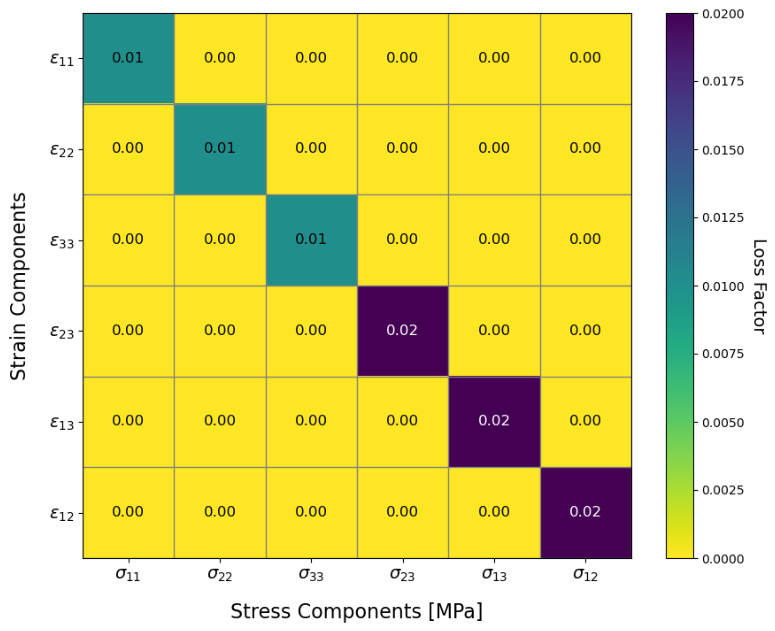
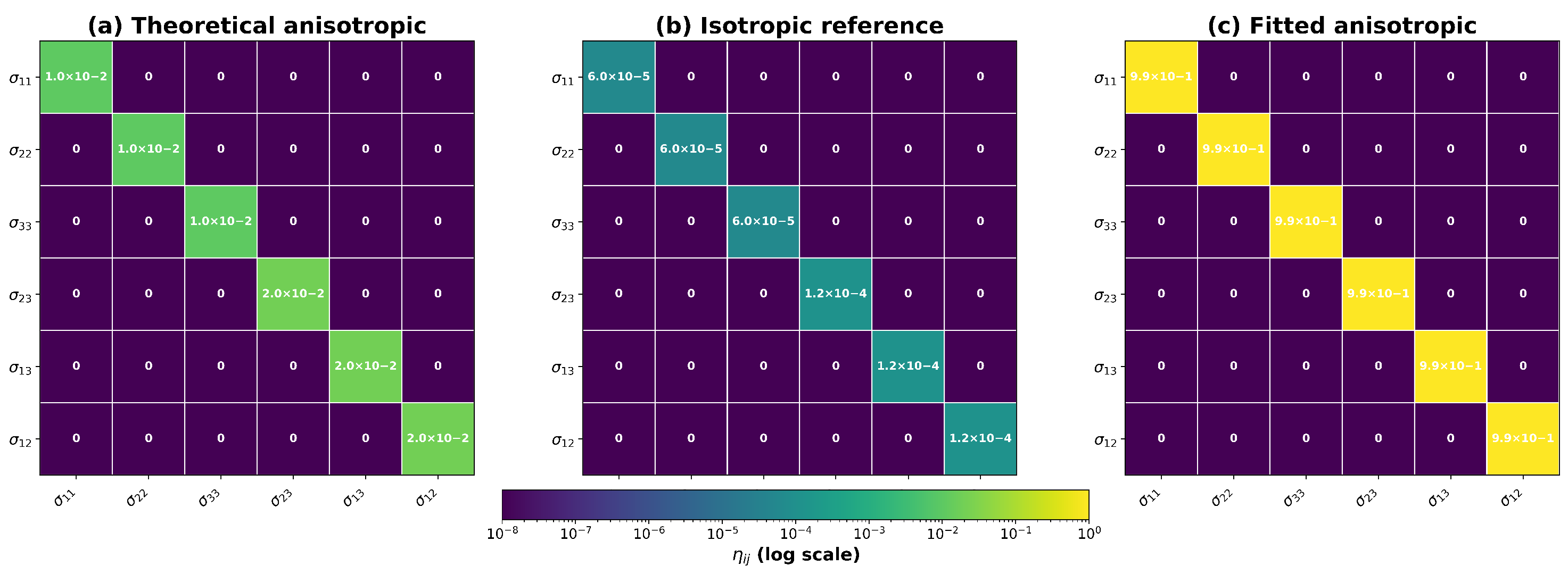
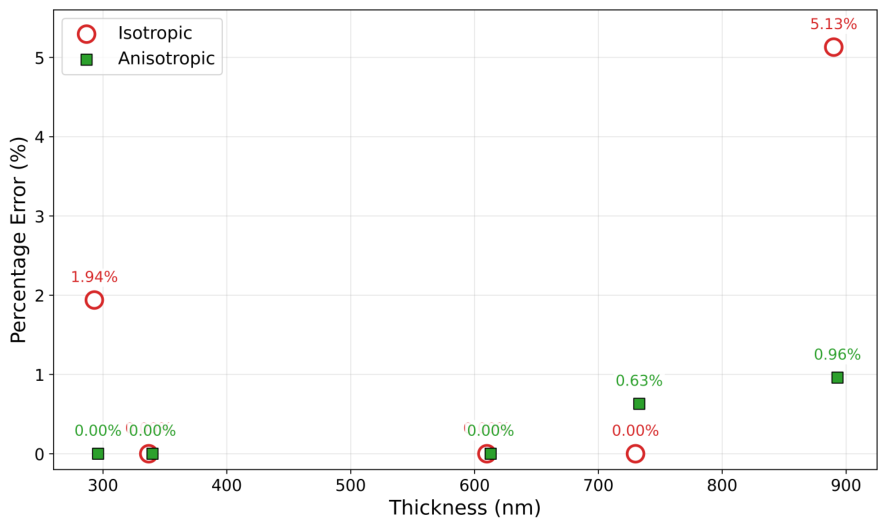
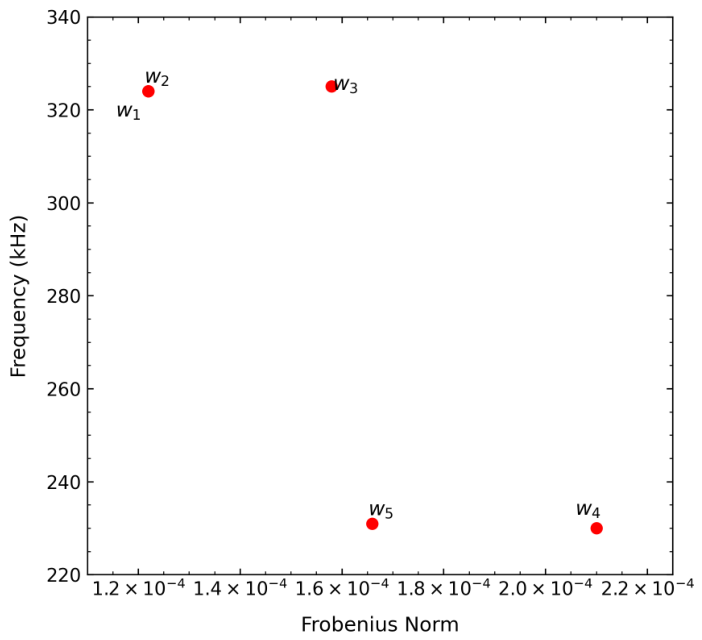
Silicon carbide (SiC) is a key material for next-generation miniaturized devices and MEMS operating in harsh environments. This paper presents a comprehensive investigation of anisotropic damping mechanisms in heteroepitaxial 3C-SiC double-clamped beam resonators for MEMS applications. Unlike conventional isotropic loss-factor models, which assign a single scalar damping coefficient to all deformation directions, the proposed framework employs a full 6 × 6 loss-factor tensor expressed in Voigt notation, implemented within the COMSOL Multiphysics finite element environment. The tensor formulation enables the direction-dependent description of energy dissipation, capturing the coupling between shear and normal strain modes that arises from the (111) crystallographic orientation and from the heteroepitaxial defect structure of 3C-SiC grown on silicon substrates. The effects of film thickness, effective Young’s modulus, and residual stress on elastic modulus, resonance frequency, and Q-factor are systematically analyzed across five wafers (w1–w5, thickness range 293–890 nm). Experimentally calibrated anisotropic loss-factor matrices are extracted via least-squares fitting to measured Q-factors, and their Frobenius norms are found to correlate negatively with resonance frequency. The anisotropic model reduces Q-factor prediction errors to below 1% for all wafers, significantly outperforming the isotropic approach, particularly for films thicker than 600 nm. These results demonstrate that an accurate treatment of directional dissipation is essential for the design of high-Q resonators and high-sensitivity strain sensors targeted at geophysical monitoring applications.
Keywords: 3C-SiC; SiC microsystem; heteroepitaxial SiC; residual stress; microresonators; anisotropic damping; quality factor (Q-factor); finite element method (FEM); resonators; strain sensors; harsh environment 3C-SiC; SiC microsystem; heteroepitaxial SiC; residual stress; microresonators; anisotropic damping; quality factor (Q-factor); finite element method (FEM); resonators; strain sensors; harsh environment