Sustainable Approach for Improving Tool Life and Surface Quality During Diamond Cutting of Ultra-Low-Expansion Glass Using Laser Assistance

Abstract
1. Introduction
2. Method
3. Experimental Procedure
4. Results and Discussion
4.1. Effect of Cutting Condition on Tool Wear and Surface Quality
4.2. Model Fitting and Optimization
5. Conclusions
- (1)
- ANOVA analysis reveals that both spindle speed and feed speed have a significant impact on tool wear and surface quality. Feed speed has a slightly higher contribution to tool wear, while spindle speed has a greater influence on surface quality compared to feed speed.
- (2)
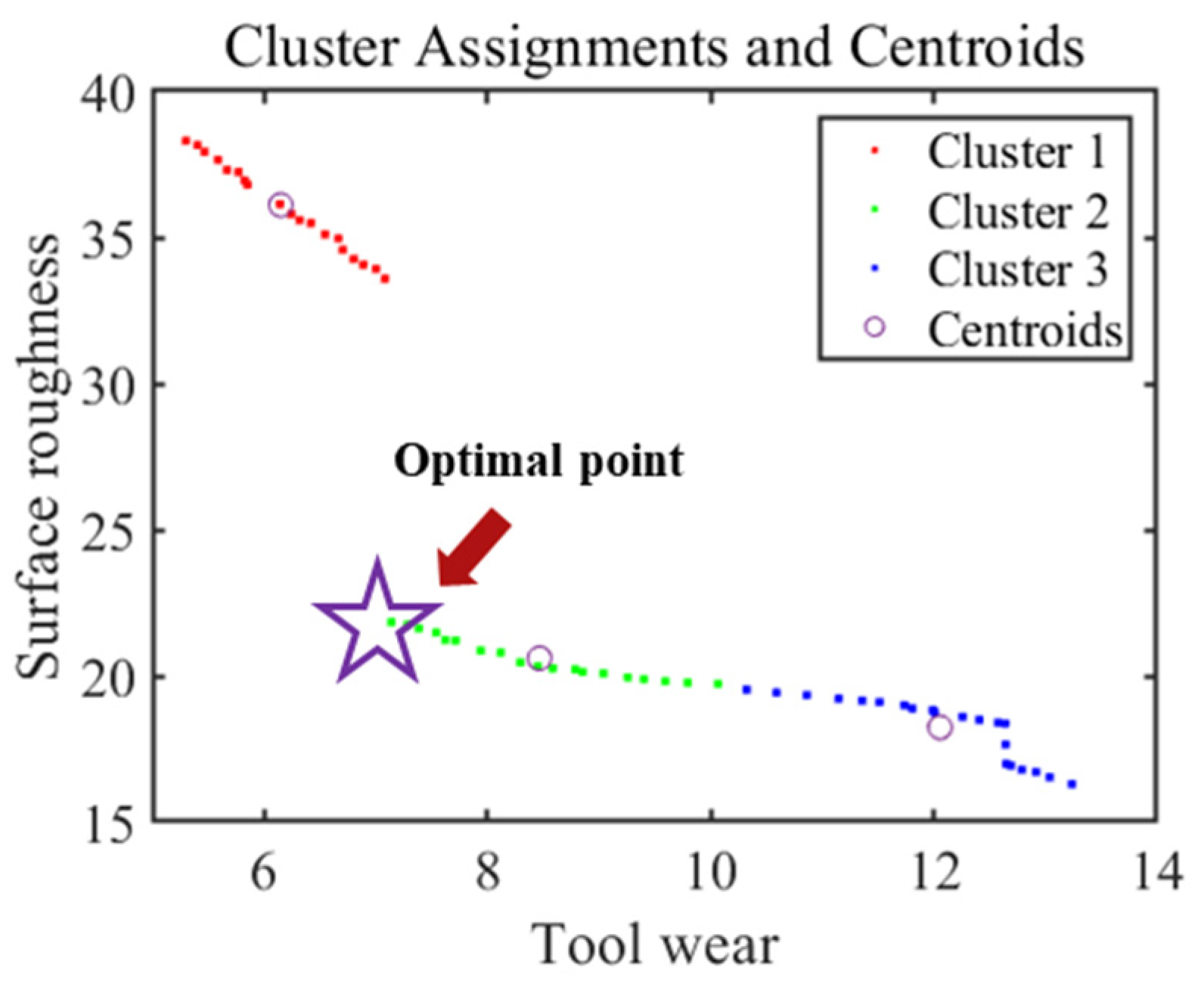
- The optimal parameter, as tool wear and surface roughness achieved their minimum values at the same time, is a spindle speed of 2900 rpm and a feed speed of 1.1 mm/min. The experimental results demonstrate that the synergistic employment of NSGA-II and ANN has an advantage in optimizing machining parameters and predicting minimum tool wear and surface roughness for in situ LADC of ULE glass.
- (3)
- Under the optimum machining parameters, in situ LADC resulted in a 70.08% reduction in surface roughness and 61.24% reduction in tool wear compared to CDC. In situ LADC can be recognized as a promising sustainable machining technique for machining of ULE glass.
Author Contributions
Funding
Institutional Review Board Statement
Informed Consent Statement
Data Availability Statement
Conflicts of Interest
Abbreviations
| ULE | Ultra-low-expansion |
| LADC | Laser-assisted diamond cutting |
| ANN | Artificial neural network |
| NSGA-II | Non-dominated sorting genetic algorithm II |
| CDC | Conventional diamond cutting |
| HBMs | Hard and brittle materials |
| MSE | Mean square error |
| LIME | Local Interpretable Model-Agnostic Explanations |
| ANOVA | Analysis of Variance |
| S/N | Signal-to-Noise |
References
- Zhao, W.; Wu, H.; Fu, Y.; Ge, J.; Yang, H.; Zhang, S. Design of a transportable miniaturized optical reference cavity with flexibly tunable thermal expansion properties. Front. Phys. 2023, 10, 1080196. [Google Scholar] [CrossRef] [Scilit]
- Zhou, L.; Wei, W.; Tang, Z.; Qi, X.; Wu, Z.; Deng, H. Quantitative Characterization of Bubble Defects in Ultra-Low Expansion Quartz Glass via Ultrasonic Interaction. Materials 2025, 18, 1639. [Google Scholar] [CrossRef] [Scilit]
- Hokin, C.; Chalifoux, B. Stability of Ultrafast Laser-Induced Stress in Fused Silica and Ultra-Low Expansion Glass. Photonics 2025, 12, 778. [Google Scholar] [CrossRef] [Scilit]
- Liu, B.; Fang, F.; Li, R.; Xu, Z.; Liang, Y. Experimental study on size effect of tool edge and subsurface damage of single crystal silicon in nano-cutting. Int. J. Adv. Manuf. Technol. 2018, 98, 1093–1101. [Google Scholar] [CrossRef] [Scilit]
- Hatefi, S.; Abou-El-Hossein, K. Review of single-point diamond turning process in terms of ultra-precision optical surface roughness. Int. J. Adv. Manuf. Technol. 2019, 106, 2167–2187. [Google Scholar] [CrossRef] [Scilit]
- Cheung, C.; Lee, W. Manufacture Characterisation of nanosurface generation in single-point diamond turning. Int. J. Mach. Tools Manuf. 2001, 41, 851–875. [Google Scholar] [CrossRef] [Scilit]
- An, Q.; Ming, W.; Chen, M. Experimental Investigation on Cutting Characteristics in Nanometric Plunge-Cutting of BK7 and Fused Silica Glasses. Materials 2015, 8, 1428–1441. [Google Scholar] [CrossRef] [Scilit] [PubMed]
- Liu, H.; Sun, Y.; Shan, D.; Zhang, C. Experimental research of brittle-ductile transition conditions and tool wear for micromilling of glass material. Int. J. Adv. Manuf. Technol. 2013, 68, 1901–1909. [Google Scholar] [CrossRef] [Scilit]
- Liu, C.; Chen, X.; Zhang, J.; Zhang, J.; Chu, J.; Xiao, J.; Xu, J. Molecular dynamic simulation of tool groove wear in nanoscale cutting of silicon. AIP Adv. 2020, 10, 015327. [Google Scholar] [CrossRef] [Scilit]
- Yan, J.; Syoji, K.; Tamaki, J. Some observations on the wear of diamond tools in ultra-precision cutting of single-crystal silicon. Wear 2003, 255, 1380–1387. [Google Scholar] [CrossRef] [Scilit]
- Jia, P.; Zhou, M. Tool wear and its effect on surface roughness in diamond cutting of glass soda-lime. Chin. J. Mech. Eng. 2012, 25, 1224–1230. [Google Scholar] [CrossRef] [Scilit]
- Goel, S.; Luo, X.; Comley, P.; Reuben, R.; Cox, A. Brittle–ductile transition during diamond turning of single crystal silicon carbide. Int. J. Mach. Tools Manuf. 2013, 65, 15–21. [Google Scholar] [CrossRef] [Scilit]
- You, K.; Yan, G.; Luo, X.; Gilchrist, M.; Fang, F. Advances in laser assisted machining of hard and brittle materials. J. Manuf. Process. 2020, 58, 677–692. [Google Scholar] [CrossRef] [Scilit]
- Sheng, X.; Zhu, Z.; Liu, C. A Review of the Machining Mechanisms in Field-Assisted Cutting of Brittle Materials. Micromachines 2026, 17, 361. [Google Scholar] [CrossRef] [Scilit]
- Mohammadi, H.; Ravindra, D.; Kode, S.; Patten, J. Experimental work on micro laser-assisted diamond turning of silicon (111). J. Manuf. Process. 2015, 19, 125–128. [Google Scholar] [CrossRef] [Scilit]
- You, K.; Fang, F.; Yan, G.; Zhang, Y. Experimental Investigation on Laser Assisted Diamond Turning of Binderless Tungsten Carbide by In-Process Heating. Micromachines 2020, 11, 1104. [Google Scholar] [CrossRef] [Scilit] [PubMed]
- You, K.; Fang, F.; Yan, G. Surface generation of tungsten carbide in laser-assisted diamond turning. Int. J. Mach. Tools Manuf. 2021, 168, 103770. [Google Scholar] [CrossRef] [Scilit]
- You, K.; Fang, F. High effective laser assisted diamond turning of binderless tungsten carbide. J. Mater. Process. Technol. 2022, 302, 117505. [Google Scholar] [CrossRef] [Scilit]
- Sim, J.-K.; Seo, D.-H.; Gwak, E.-J.; Jeong, J.-Y.; Maeng, H.-h.; Je, T.-J.; Choi, D.-S.; Kang, S.; Han, J.S. Ductile mode machining of piezoelectric single crystal by laser-assisted diamond turning process. J. Mater. Res. Technol. 2024, 29, 511–522. [Google Scholar] [CrossRef] [Scilit]
- Luo, H.; Wang, X.; Qin, L.; Zhao, H.; Zhu, D.; Ma, S.; Zhang, J.; Xiao, J. Investigation on the Machinability of Polycrystalline ZnS by Micro-Laser-Assisted Diamond Cutting. Micromachines 2024, 15, 1275. [Google Scholar] [CrossRef] [Scilit]
- Du, H.; Wang, Y.; Li, Y.; Yin, S.; Li, D.; Yip, W.S.; To, S. Improving the machinability of the high-entropy alloy CoCrFeMnNi by in-situ laser-assisted diamond turning. J. Mater. Res. Technol. 2023, 27, 7110–7118. [Google Scholar] [CrossRef] [Scilit]
- Huang, K.; Shen, Z.; Zheng, Z.; Lin, C.; Huang, W.; Zhang, J.; Chen, X.; Xiao, J.; Xu, J. Investigation on the machinability of nitriding mold steel by applying in-situ laser assisted diamond cutting. J. Manuf. Process. 2022, 84, 149–161. [Google Scholar] [CrossRef] [Scilit]
- Lin, C.; Chen, X.; He, W.; Xu, G.; Liu, C.; Zhang, J.; Xu, J. Experimental investigation on the ductile machinability of fused silica during in-situ laser assisted diamond cutting. J. Manuf. Process. 2022, 84, 383–393. [Google Scholar] [CrossRef] [Scilit]
- Lin, C.; He, W.; Chen, X.; Zheng, Z.; Huang, K.; Huang, W.; Zhang, J.; Xu, J. Experimental and theoretical investigation on the ductile removal mechanism in in-situ laser assisted diamond cutting of fused silica. J. Mater. Res. Technol. 2023, 24, 7704–7719. [Google Scholar] [CrossRef] [Scilit]
- Cheung, C.; Lee, W. Manufacture A theoretical and experimental investigation of surface roughness formation in ultra-precision diamond turning. Int. J. Mach. Tools Manuf. 2000, 40, 979–1002. [Google Scholar] [CrossRef] [Scilit]
- Sharif, M.; Seah, K.; Li, X.; Rahman, M.; Liu, K. Effect of crystallographic orientation on wear of diamond tools for nano-scale ductile cutting of silicon. Wear 2004, 257, 751–759. [Google Scholar] [CrossRef] [Scilit]
- Born, D.; Goodman, W. An empirical survey on the influence of machining parameters on tool wear in diamond turning of large single-crystal silicon optics. Precis. Eng. 2001, 25, 247–257. [Google Scholar] [CrossRef] [Scilit]
- Guo, Y.; Yang, X.; Kang, J.; Li, M.; Xie, Q.; Xiao, J.; Zhang, W. Experimental investigations on the laser-assisted machining of single crystal Si for optimal machining. Opt. Laser Technol. 2021, 141, 107113. [Google Scholar] [CrossRef] [Scilit]
- Geng, R.; Yang, X.; Xie, Q.; Zhang, R.; Zhang, W.; Qiu, H.; Mu, R.; Yang, W.; Li, R. Investigation of surface integrity and material removal mechanism of single-crystal Si subjected to micro-laser-assisted machining. Infrared Phys. Technol. 2021, 118, 103868. [Google Scholar] [CrossRef] [Scilit]
- Le, T.-T.; Nguyen, V.-H.; Le, M.V. Development of Deep Learning Model for the Recognition of Cracks on Concrete Surfaces. Appl. Comput. Intell. Soft Comput. 2021, 2021, 8858545. [Google Scholar] [CrossRef] [Scilit]
- Xiang, X.; Yu, H.; Wang, Y.; Wang, G. Stable local interpretable model-agnostic explanations based on a variational autoencoder. Appl. Intell. 2023, 53, 28226–28240. [Google Scholar] [CrossRef] [Scilit]
- Deb, K.; Pratap, A.; Agarwal, S.; Meyarivan, T. A fast and elitist multiobjective genetic algorithm: NSGA-II. IEEE Trans. Evol. Comput. 2002, 6, 182–197. [Google Scholar] [CrossRef] [Scilit]
- Wei, J.; He, W.; Lin, C.; Zhang, J.; Chen, X.; Xiao, J.; Xu, J. Optimizing process parameters of in-situ laser assisted cutting of glass–ceramic by applying hybrid machine learning models. Adv. Eng. Inform. 2024, 62, 102590. [Google Scholar] [CrossRef] [Scilit]
- Fan, M.; Sun, G.; Ding, J.; Song, J. Investigation on multi-objective optimization for in-situ laser-assisted machining of glass-ceramic. Appl. Phys. A 2024, 130, 747. [Google Scholar] [CrossRef] [Scilit]
- Jumare, A.; Abou, K.; Goosen, W.; Cheng, Y.; Abdulkadir, L.; Odedeyi, P.; Liman, M. Prediction model for single-point diamond tool-tip wear during machining of optical grade silicon. Int. J. Adv. Manuf. Technol. 2018, 98, 2519–2529. [Google Scholar] [CrossRef] [Scilit]
- Douglass, M. Book Review: Hands-on Machine Learning with Scikit-Learn, Keras, and Tensorflow, 2nd edition by Aurélien Géron. Phys. Eng. Sci. Med. 2020, 43, 1135–1136. [Google Scholar] [CrossRef] [Scilit]






| Machining Conditions | Parameters |
|---|---|
| Spindle speed (rpm) | 1000/2000/3000 |
| Feed speed (mm/min) | 1.0/2.0/3.0 |
| Cutting depth (μm) | 2.0 |
| Laser power (W) | 10 |
| Cutting distance (km) | 2.0 |
| No. | Machining Conditions | Experimental Results | |||
|---|---|---|---|---|---|
| Spindle Speed A (rpm) | Feed Speed B (mm/min) | Material Removal Volume ( ) | Tool Wear Vb (μm) | Surface Roughness Sa (nm) | |
| 1 | 1 (1000) | 1 (1.0) | 4.05 | 5.3 | 38.3 |
| 2 | 1 | 2 (2.0) | 8.11 | 12.3 | 29.8 |
| 3 | 1 | 3 (3.0) | 12.16 | 13.1 | 48.9 |
| 4 | 2 (2000) | 1 | 2.03 | 10.7 | 25.3 |
| 5 | 2 | 2 | 4.05 | 12.8 | 19.5 |
| 6 | 2 | 3 | 6.08 | 15.3 | 30.4 |
| 7 | 3 (3000) | 1 | 1.32 | 6.8 | 22.3 |
| 8 | 3 | 2 | 2.63 | 8.7 | 25.6 |
| 9 | 3 | 3 | 3.95 | 11.1 | 35.5 |
| Factors | Level 1 | Level 2 | Level 3 | Delta |
|---|---|---|---|---|
| Tool wear | ||||
| Mean of S/N ratio (dB) | ||||
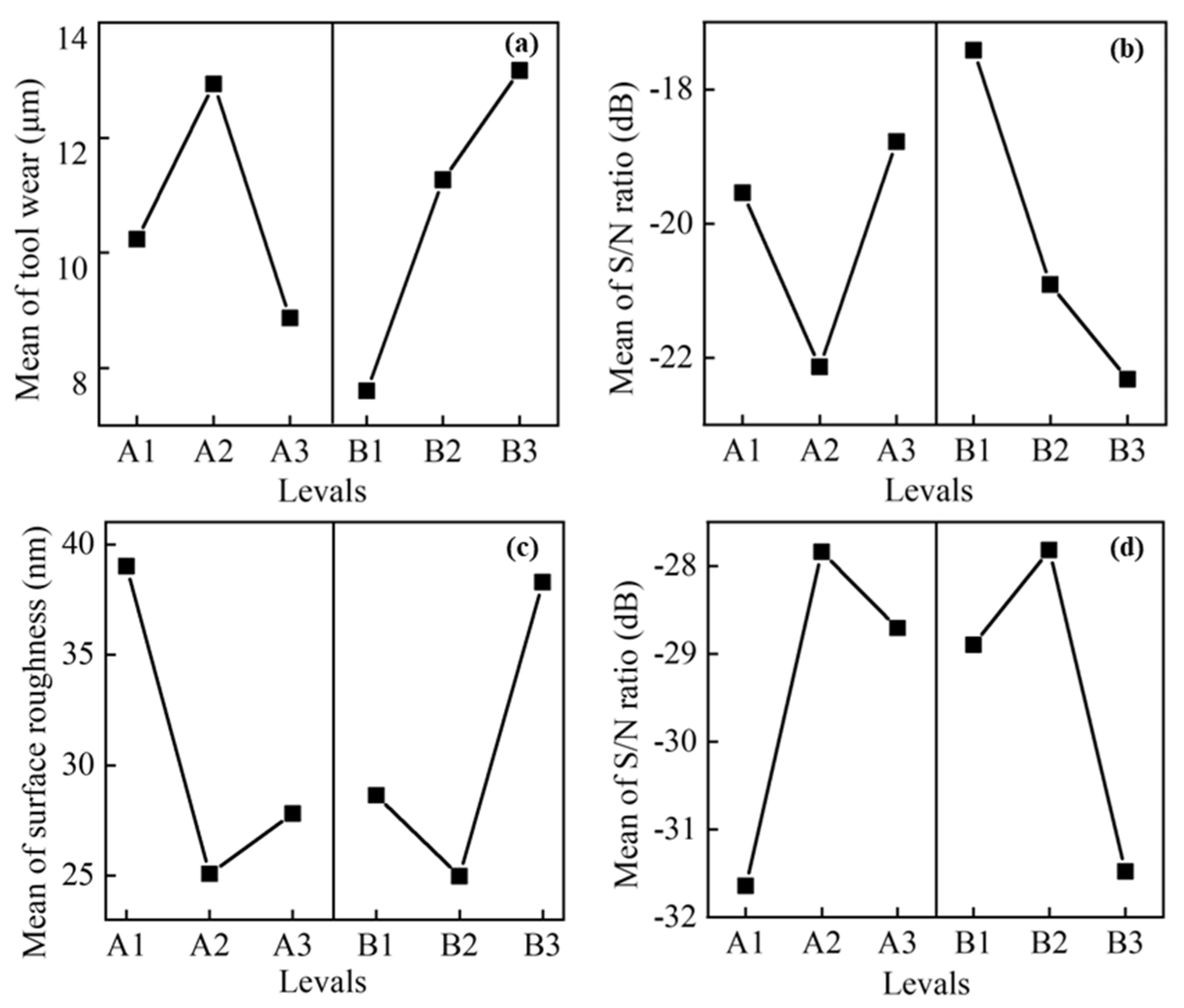
| A | −19.54 | −22.14 | −18.78 | 3.36 |
| B | −17.42 | −20.91 | −22.32 | 5.07 |
| Mean of tool wear (μm) | ||||
| A | 10.233 | 12.933 | 8.867 | 4.067 |
| B | 7.600 | 11.267 | 13.167 | 5.567 |
| Surface roughness | ||||
| Mean of S/N ratio (dB) | ||||
| A | −31.64 | −27.84 | −28.71 | 3.80 |
| B | −28.90 | −27.82 | −31.48 | 3.61 |
| Mean of surface quality (nm) | ||||
| A | 39.00 | 25.07 | 27.80 | 13.93 |
| B | 28.63 | 24.97 | 38.27 | 13.30 |
| Factor | D.O.E | Sum of Square | Sum of Mean Square | Contribution |
|---|---|---|---|---|
| Tool wear | ||||
| A | 2 | 25.696 | 12.848 | 31.18% |
| B | 2 | 48.042 | 24.021 | 58.29% |
| Error | 4 | 8.678 | 2.169 | 10.53% |
| Total | 8 | 82.416 | 39.038 | 100% |
| Surface roughness | ||||
| A | 2 | 1983.1 | 991.56 | 65.95% |
| B | 2 | 101.1 | 50.53 | 3.36% |
| Error | 4 | 922.8 | 230.70 | 30.69% |
| Total | 8 | 3007.0 | 1272.79 | 100% |
| Parameter Used | Grid Space | Vb Results | Sa Results |
|---|---|---|---|
| Epochs | Maximum 300 | 200 | 100 |
| Number of layers | Maximum 3 | 2 | 2 |
| Number of units | Maximum 30 | [10, 10] | [10, 10] |
| Activation function | [‘ReLU’, ‘Tanh’, ‘Sigmoid’] | ‘Tanh’ | ‘ReLU’ |
Disclaimer/Publisher’s Note: The statements, opinions and data contained in all publications are solely those of the individual author(s) and contributor(s) and not of MDPI and/or the editor(s). MDPI and/or the editor(s) disclaim responsibility for any injury to people or property resulting from any ideas, methods, instructions or products referred to in the content. |
© 2026 by the authors. Licensee MDPI, Basel, Switzerland. This article is an open access article distributed under the terms and conditions of the Creative Commons Attribution (CC BY) license.
Share and Cite
Zhang, H.; Zhu, S.; Chen, X.; Lin, C. Sustainable Approach for Improving Tool Life and Surface Quality During Diamond Cutting of Ultra-Low-Expansion Glass Using Laser Assistance. Micromachines 2026, 17, 633. https://doi.org/10.3390/mi17050633
Zhang H, Zhu S, Chen X, Lin C. Sustainable Approach for Improving Tool Life and Surface Quality During Diamond Cutting of Ultra-Low-Expansion Glass Using Laser Assistance. Micromachines. 2026; 17(5):633. https://doi.org/10.3390/mi17050633
Chicago/Turabian StyleZhang, Han, Shizhen Zhu, Xiao Chen, and Chuangting Lin. 2026. "Sustainable Approach for Improving Tool Life and Surface Quality During Diamond Cutting of Ultra-Low-Expansion Glass Using Laser Assistance" Micromachines 17, no. 5: 633. https://doi.org/10.3390/mi17050633
APA StyleZhang, H., Zhu, S., Chen, X., & Lin, C. (2026). Sustainable Approach for Improving Tool Life and Surface Quality During Diamond Cutting of Ultra-Low-Expansion Glass Using Laser Assistance. Micromachines, 17(5), 633. https://doi.org/10.3390/mi17050633