Research Progress of La1-xSrxMnO3-Based Flexible Wearable Sensors

 ,
,  and
and
Abstract
1. Introduction
2. Basic Characteristics and Sensing Mechanism of La1-xSrxMnO3
2.1. Structure and Physical Properties of La1-xSrxMnO3
2.2. Analysis of Sensing Mechanism
3. Preparation Method and Performance Optimization
3.1. Laser-Induced Processing Technology
3.2. Transfer Printing Technology
3.3. Element Doping
3.4. Microstructure Regulation
3.5. Comparison of Preparation Methods
4. Multi-Performance Integration and System Optimization
4.1. Multimodal Sensing Integration
4.2. Intelligent Algorithms

4.3. System Optimization
5. Expansion of Application Fields
5.1. Healthcare
5.1.1. Current Verified Applications
5.1.2. Future Potential Application Directions
- 1.
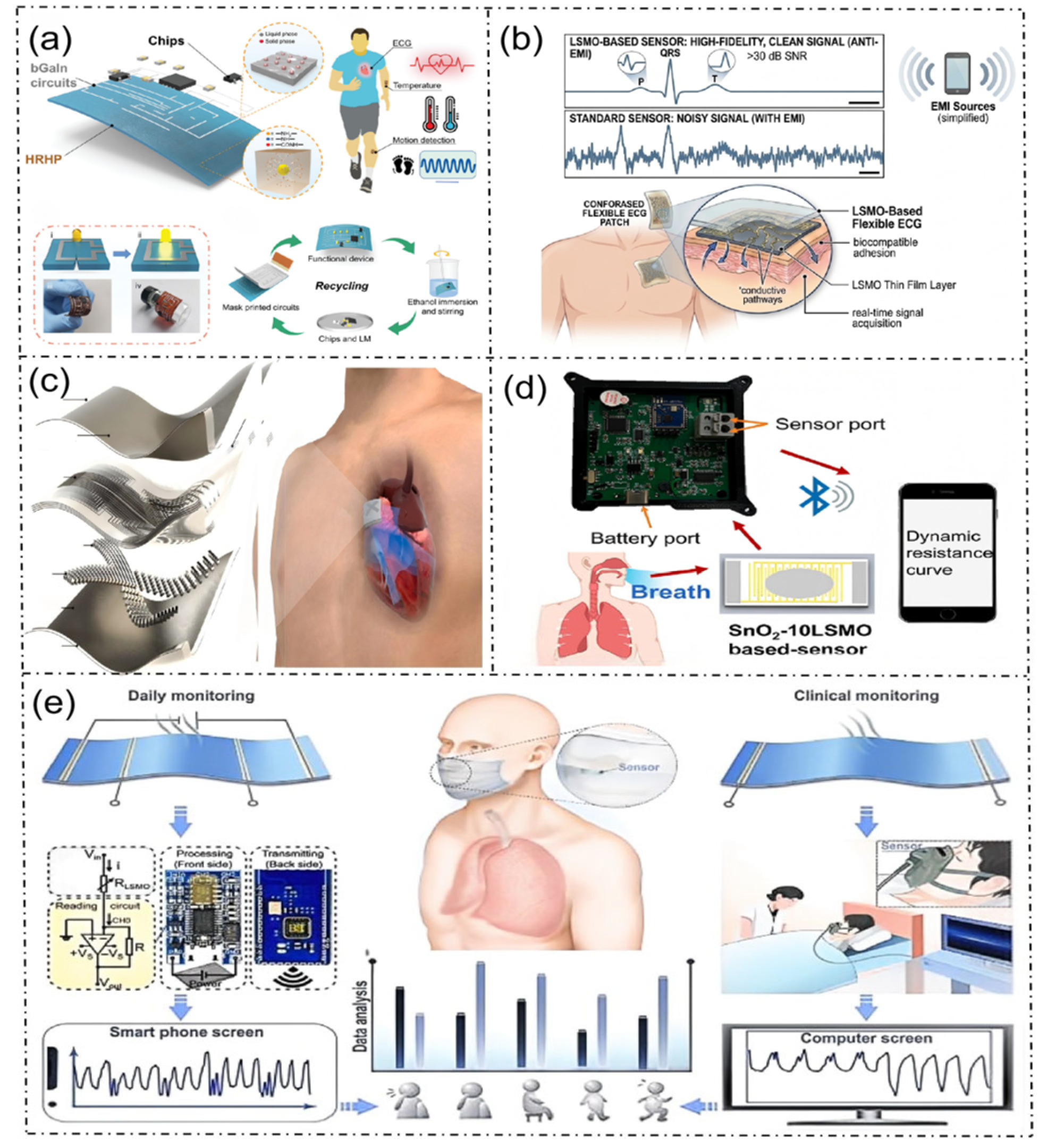
- An integrated multimodal physiological signal monitoring platform is presented in Figure 8a. This all-in-one flexible wearable physiological monitoring platform is consistent with the system architecture. It integrates LSMO-based multi-sensing units, an on-chip b-Gain gain circuit, a signal conditioning chip, and a wireless transmission module. It can be worn on the human body during exercise to achieve synchronous real-time monitoring of multiple physiological parameters, including ECG, body temperature, motion state, and CO2 concentration. Through micro–nano processing integration, the platform can perform multi-signal acquisition, amplification, processing, and wireless transmission on a single flexible substrate. It can meet the comprehensive health monitoring requirements of athletes, outdoor workers, and patients with chronic disease, overcoming the limitations of traditional split-type monitoring equipment, which is characterized by large volume and poor portability.
- 2.
- A high-fidelity anti-interference ECG monitoring patch is shown in Figure 8b. By leveraging the inherent anti-EMI performance of LSMO materials, a chest-worn flexible ECG patch conforming to the illustrated structure is developed. The patch employs a layered design consisting of a flexible substrate, an LSMO thin-film sensing layer, and a real-time signal acquisition unit, enabling conformal attachment to the human chest surface. Compared with traditional sensors that are susceptible to environmental EMI and produce noisy signals, the LSMO-based ECG patch achieves high-fidelity ECG signal acquisition with a signal-to-noise ratio (SNR) exceeding 35 dB. Subsequently, it can transmit the clean ECG waveform to a mobile terminal through wireless communication. This makes it suitable for long-term dynamic ECG monitoring in both home and clinical scenarios, and provides a novel solution for early screening of arrhythmia and myocardial ischemia.
- 3.
- A flexible ultrasonic imaging system for echocardiography is demonstrated in Figure 8c. When combined with the excellent magnetoelectric coupling effect and wide-temperature stability of LSMO materials, a flexible ultrasonic transducer array is consistent with the structure. The array exhibits excellent bending and conformal performance, allowing it to be closely attached to the curved surface of the human chest for non-invasive dynamic ultrasonic imaging of the heart. It provides a portable technical solution for bedside echocardiography monitoring of critically ill patients, home-based cardiac function assessment of patients with cardiovascular diseases, and perioperative cardiovascular monitoring. This application expands the application of LSMO-based sensors, from surface physiological signal monitoring to in vivo tissue imaging, and creates a new application scenario in the field of high-end medical imaging.
- 4.
- A high-sensitivity respiratory monitoring system based on LSMO composite material is illustrated in Figure 8d. This portable respiratory monitoring system, consistent with the architecture, utilizes SnO2-10LSMO composite material as the sensitive layer. The system comprises an LSMO composite respiratory sensor, a hardware acquisition unit equipped with sensor and battery interfaces, and a mobile-terminal monitoring platform. The sensor converts respiratory physiological changes into dynamic resistance signals, which are collected by the hardware circuit and transmitted to a smartphone through Bluetooth, where the real-time dynamic resistance curve is displayed. In comparison with the existing LSMO temperature-type respiratory sensor, the composite material system achieves dual-parameter coupled monitoring of respiratory temperature and humidity, further improving the accuracy of respiratory function assessment. Moreover, it can be applied to home respiratory monitoring for patients with respiratory diseases such as chronic obstructive pulmonary disease and asthma.
5.2. Human–Computer Interaction


5.3. Electromyography

6. Challenges and Prospects
6.1. The Current Technical Challenges
6.2. Future Development
- 1.
- Within the domain of new material systems and interface engineering, it is necessary to transcend the traditional perovskite framework and actively explore the construction of heterojunctions with two-dimensional materials such as MXene. By means of band engineering and interface control strategies, the sensitivity and stability of the sensors can be synergistically enhanced, especially to meet the high stability requirements of extreme environments. In particular, interface passivation strategies, such as atomic layer deposition (ALD) coating and hydrophobic modification, should be developed to inhibit the leaching of Sr2+ and Mn ions from LSMO films in sweat and body-temperature environments. In addition, high-adhesion interface structures should be constructed to suppress the swelling and delamination of the encapsulation layer under high-humidity and salt-spray conditions.
- 2.
- An intelligent leap from perception to cognition is achieved. The chip-level integration of lightweight artificial intelligence algorithms is promoted to enable sensors with edge computing capabilities, achieving an integrated process from data collection to processing and decision-making, and meeting the real-time response requirements of scenarios such as health monitoring.
- 3.
- Green electronics and sustainable design involve implementing the concept of environmental friendliness, the development of biodegradable packaging materials and environmentally friendly low-temperature preparation processes, and the assurance that devices exhibit both biocompatibility for wearable scenarios and durability in extreme environments throughout their entire life cycle. Specifically, a full-life-cycle biosafety evaluation system should be established in accordance with the ISO 10993 series standards. In vitro and in vivo long-term safety tests lasting over 12 months should be conducted. The safe threshold of ion release from LSMO-based wearable sensors should be defined, and a comprehensive biocompatibility evaluation system for long-term skin contact scenarios should be formulated.
- 4.
- Self-powered system integration. At the system level, self-functional solutions are constructed through the in-depth integration of sensing units with energy collection modules, such as triboelectric nanogenerators, to create long-term, independently operating intelligent microsystems matching the needs of unattended aerospace monitoring.
- 5.
- Standardization and industrialization promotion. Initiative must be taken in establishing unified performance evaluation standards, reliability testing norms, and quality certification systems. The construction of clinical approval channels for medical devices for the healthcare monitoring scenario must be promoted, laying the foundation for the clinical transformation and commercial application of La1-xSrxMnO3-based flexible sensors. Efforts should be concentrated on formulating special accelerated aging test specifications and performance failure threshold standards for LSMO-based multi-modal flexible sensors. The environmental reliability evaluation system under multi-stress coupling conditions (high temperature and humidity, salt spray, and cyclic bending) should be improved, and a standardized test system that supports the clinical registration of medical wearable devices should be developed.
7. Conclusions
Author Contributions
Funding
Institutional Review Board Statement
Informed Consent Statement
Data Availability Statement
Conflicts of Interest
References
- Asamitsu, A.; Moritomo, Y.; Kumai, R.; Tomioka, Y.; Tokura, Y. Magnetostructural phase transitions in La1-xSrxMnO3 with controlled carrier density. Phys. Rev. B 1996, 54, 171–177. [Google Scholar] [CrossRef] [PubMed]
- Yi, D.; Lu, N.; Chen, X.; Shen, S.; Yu, P. Engineering magnetism at functional oxides interfaces: Manganites and Beyond. J. Phys. Condens. Matter 2017, 29, 443001. [Google Scholar] [CrossRef] [PubMed]
- Qian, J.J.; Qi, W.H.; Li, Z.Z.; Xu, L.; Chen, X.H. Spin-dependent and spin-independent channels of electrical transport in perovskite manganites. RSC Adv. 2018, 8, 4417–4425. [Google Scholar] [CrossRef]
- Zhang, L.; Liu, Y.Q.; Wei, R.H.; Kong, X.T.; Li, P.; Yu, J.Y.; Huang, K.; Zhu, X.B. Chemical solution deposition of epitaxial La0.7Sr0.3MnO3 thin films by laser-assisted annealing. J. Mater. Sci. Mater. Electron. 2022, 33, 26414–26423. [Google Scholar] [CrossRef]
- Hemberger, J.; Krimmel, A.; Kurz, T.; Von Nidda, H.A.K.; Ivanov, V.Y.; Mukhin, A.A.; Loidl, A. Structural, magnetic, and electrical properties of single-crystalline La1−xSrxMnO3 (0.4 < x < 0.85). Phys. Rev. B 2002, 66, 094410. [Google Scholar]
- Guo, M.; Yang, C.; Gao, D.; Wang, X.; Liu, Y.; Zhang, Y. A flexible and high temperature tolerant strain sensor of La0.7Sr0.3MnO3/Mica. J. Mater. Sci. Technol. 2020, 44, 42–47. [Google Scholar] [CrossRef]
- Ramirez Camacho, M.C.; Sanchez Valdes, C.F.; Curiel, M.; Espinoza Guerrero, R.; Orozco Melgar, A.; Barrera Calva, E. Superparamagnetic state in La0.7Sr0.3MnO3 thin films obtained by rf-sputtering. Sci. Rep. 2020, 10, 2568. [Google Scholar] [CrossRef]
- Lau, W.; Gao, L.; Liu, J.; Zhang, H.; Wang, S.; Chen, Y. The physical properties of submicron and nano grained La0.7Sr0.3MnO3 and NSMO. Coatings 2021, 11, 456. [Google Scholar]
- Li, X.; Zhang, J.; Wang, Y.; Liu, H.; Chen, L.; Zhao, H. XRD temperature-dependent phase transitions in La1-xSrxMnO3. J. Mater. Chem. C 2020, 8, 2739–2745. [Google Scholar]
- Zhang, C.; Ding, S.; Qiao, K.; Liu, X.; Wang, Y.; Li, J.; Yang, W. Large Low-Field Magnetoresistance (LFMR) Effect in Free-Standing La0.7Sr0.3MnO3 Films. ACS Appl. Mater. Interfaces 2021, 13, 28442–28450. [Google Scholar] [CrossRef]
- Huang, Y.; Yang, J.; Zhang, X.; Liu, J.; Wang, H. Freestanding La0.7Sr0.3MnO3:NiO vertically aligned nanocomposite thin films for flexible interfacial exchange coupling. Mater. Res. Lett. 2022, 10, 221–226. [Google Scholar] [CrossRef]
- Pan, H. Elastomeric substrates with femtosecond(fs)-laser fabricated hierarchical micropillar-nanostructures for strain-active sub-FM ultrasensitive Raman detection. Small Methods 2025, 9, 2500198. [Google Scholar] [CrossRef] [PubMed]
- Jiang, Y.; Liang, M.; Zhang, H.; Liu, S.; Chen, W. Flexible piezoresistive sensor based on laser-induced composite graphene. In Proceedings of the 2025 IEEE Sensors Conference, Vancouver, BC, Canada, 19–22 October 2025. [Google Scholar]
- Lu, Y.; Wu, D.; Huang, Y.; Chen, L.; Zhou, X.; Wang, H. Design and Preparation of Flexible Sensors Based on Microimprinting Technology. Plastics 2020, 49, 70–74. [Google Scholar]
- Jiang, S.P. Development of lanthanum strontium manganite perovskite cathode materials of solid oxide fuel cells: A review. J. Mater. Sci. 2008, 43, 6799–6833. [Google Scholar] [CrossRef]
- Naray-Szabo, S. Die strukturen von verbindungen ABO3 Schwesterstrukturen. Naturwissenschaften 1943, 31, 466. [Google Scholar] [CrossRef]
- Jain, A.; Ong, S.P.; Hautier, G.; Kocher, M.; Cholia, S.; Gunter, D.; Chevrier, V.L.; Persson, K.A.; Ceder, G. Commentary: The materials project: A materials genome approach to accelerating materials innovation. APL Mater. 2013, 1, 011002. [Google Scholar] [CrossRef]
- Kramers, H.A. L’interaction entre les atomes magnétogènes dans un cristal paramagnétique. Physica 1934, 1, 182–192. [Google Scholar] [CrossRef]
- Zhou, Z.Q. Hydrothermal Synthesis and Magnetic Properties of Several ABO3-Type Rare Earth Manganates and Ferrites. Ph.D. Thesis, Harbin Institute of Technology, Harbin, China, 2014. [Google Scholar]
- Qin, J.D. Study on the Structure and Magnetic Properties of High-Entropy Perovskite Manganese Oxides Controlled by A-Site Rare-Earth Ions. Master’s Thesis, Guilin University of Technology, Guilin, China, 2025. [Google Scholar]
- Qi, J. Research on Electronic State Modulation and Electrocatalytic Oxygen Evolution Reaction of Perovskite-Structured Manganese Oxides. Ph.D. Thesis, Harbin Institute of Technology, Harbin, China, 2023. [Google Scholar]
- Urushibara, A.; Moritomo, Y.; Arima, T.; Tokura, Y. Insulator-metal transition and giant magnetoresistance in La1-xSrxMnO3. Phys. Rev. B 1995, 51, 14103. [Google Scholar] [CrossRef]
- Lin, L.W.; Wu, C.Q.; Cui, Y.F.; Pan, M.H.; Fang, N.; Zhou, M.; Zhang, Y.Z.; Zhang, W.; Li, Z.Y.; Zhou, Z.Y.; et al. Flexible physical sensors based on membranes: From design to application. Int. J. Extrem. Manuf. 2025, 7, 022008. [Google Scholar] [CrossRef]
- Verhage, M.; van der Minne, E.; Kiens, E.M.; van der Marel, D.; de Jong, M.P.; Huber, A.J. Electronic and Structural Disorder of the Epitaxial La0.67Sr0.33MnO3 Surface. ACS Appl. Mater. Interfaces 2024, 16, 21273–21282. [Google Scholar] [CrossRef]
- Uesugi, Y.; Kadoguchi, N.; Ono, T.; Tanaka, K.; Sato, S.; Miyamoto, Y. Nanoprocessing of self-suspended monolayer graphene and defect formation by femtosecond-laser irradiation. Nano Lett. 2023, 23, 4321–4328. [Google Scholar]
- Cui, X.; Gu, T.; Ma, K.; Liu, Y.; Zhang, H.; Wang, J. Laser-induced graphene electrochemical sensors: An emerging platform for agricultural food and environmental detection. Chem. Sens. 2025, 13, 432. [Google Scholar] [CrossRef]
- Jiang, C.; Ye, J.; Liu, C.; Wang, X.; Li, Y.; Zhang, Q.; Zhao, L.; Sun, H.; Chen, M.; Zhou, S.; et al. Multiple artificial mechanoreceptors embedded waterproof ciliated e-skin via direct-ink-writing vertically 3D printing toward health management of seafarers. J. Mater. Chem. A. 2025, 13, 39174–39182. [Google Scholar] [CrossRef]
- Wang, T.; Li, M.; Zhang, Q.; Liu, H.; Chen, J.; Zhao, Y.; Yang, L.; Xu, S.; Zhou, B.; Wu, P.; et al. Stretchable curvature sensors for motion capture with bending-stretching coupling deformation. Adv. Sci. 2025, 12, 2501234. [Google Scholar] [CrossRef]
- Tokura, Y.; Nagaosa, N. Orbital physics in transition-metal oxides. Science 2000, 288, 462–468. [Google Scholar] [CrossRef]
- Tebano, A.; Aruta, C.; Medaglia, P.G.; Balestrino, G. Strain-induced phase separation in La0.7Sr0.3MnO3 thin films. Phys. Rev. B 2006, 74, 245116. [Google Scholar] [CrossRef]
- Jia, C.L.; Wei, T.L.; Jiang, C.J. Mechanism of interfacial magnetoelectric coupling in composite multiferroics. Phys. Rev. B 2014, 90, 054423. [Google Scholar] [CrossRef]
- Moreo, A.; Yunoki, S.; Dagotto, E. Phase separation scenario for manganese oxides and related materials. Science 1999, 283, 2034–2040. [Google Scholar] [CrossRef]
- Zhang, P.Y.; Yang, H.F.; Zhang, S.Y. Magnetic and magnetocaloric properties of perovskite La0.7Sr0.3Mn1-xCoxO3. Phys. B Condens. Matter 2013, 410, 1–4. [Google Scholar] [CrossRef]
- Deb, M.; Lu, C.J.; Zan, H.W. Achieving room-temperature ppb-level H2S detection in a Au–SnO2 sensor with low voltage enhancement effect. ACS Sens. 2024, 9, 4568–4577. [Google Scholar] [CrossRef] [PubMed]
- Bowen, M.; Bibes, M.; Barthélémy, A.; Jacquet, J.; Contour, J.P.; Fert, A. Nearly total spin polarization in La2/3Sr1/3MnO3 from tunneling experiments. Appl. Phys. Lett. 2003, 82, 233–235. [Google Scholar] [CrossRef]
- Qin, Q.; He, S.; Song, W. Ultra-low magnetic damping of perovskite La0.7Sr0.3MnO3 thin films. Appl. Phys. Lett. 2017, 110, 112401. [Google Scholar] [CrossRef]
- Wahler, M.; Homonnay, N.; Richter, T.; Schmid, M.; Geisler, B.; Kataev, V.; Büchner, B.; Ruckriegel, M. Inverse spin Hall effect in a complex ferromagnetic oxide heterostructure. Sci. Rep. 2016, 6, 28727. [Google Scholar] [CrossRef] [PubMed]
- Guo, H.F.; Wang, X.Z.; Hou, G.Y. Multiscale simulation-based investigation of optical absorption properties of lanthanum strontium manganese oxide thermal control coatings for spacecraft. Spacecr. Environ. Eng. 2025, 42, 201–207. [Google Scholar]
- Zhao, J. Research on the Magnetic Properties and Critical Behavior in ABO3-Type Manganese Oxides. Master’s Thesis, Baotou Normal College, Inner Mongolia University of Science and Technology, Baotou, China, 2024. [Google Scholar]
- Zhao, Y.J. Investigation of Spin Dynamics in Perovskite Oxide La0.67Sr0.33MnO3. Ph.D. Thesis, Lanzhou University, Lanzhou, China, 2023. [Google Scholar]
- Wang, M. Performance Optimization of Lanthanum–Strontium–Manganese-Based Cathode for Intermediate-Temperature Solid Oxide Fuel Cells. Master’s Thesis, Shenyang Normal University, Shenyang, China, 2020. [Google Scholar]
- Wu, Y.J. Structural Characteristics and Low-Field Magnetoresistance Properties of La0.7Sr0.3MnO3 Polycrystalline Thin Films. Master’s Thesis, Northeastern University, Shenyang, China, 2015. [Google Scholar]
- González, O.J.; Castaño, E.; Castellano, J.C.; García, J.; Hernando, B.; López, E. Magnetic position sensor based on nanocrystalline colossal magnetoresistances. Sens. Actuators A Phys. 2001, 92, 137–143. [Google Scholar] [CrossRef]
- Liedienov, N.A.; Fesych, I.V.; Prokopenkov, V.K.; Pashchenko, A.V.; Vasiliev, A.N.; Fedorenko, O.A. Giant baroresistance effect in lanthanum-strontium manganite nanopowder compacts. J. Alloys Compd. 2023, 938, 168591. [Google Scholar] [CrossRef]
- Enger, L.G.; Flament, S.; Bhatti, I.N.; Dimopoulos, T.; Givord, D.; Vila, L. Key parameters for detectivity improvement of low noise anisotropic magnetoresistive sensors made of La2/3Sr1/3MnO3 single layers on vicinal substrates. ACS Appl. Electron. Mater. 2023, 5, 729–739. [Google Scholar] [CrossRef]
- Duan, Z.; Xu, M.; Li, T.; Zhang, Y.; Wang, J.; Liu, H. Super-fast response humidity sensor based on La0.7Sr0.3MnO3 nanocrystals prepared by PVP-assisted sol-gel method. Sens. Actuators B Chem. 2018, 258, 527–534. [Google Scholar] [CrossRef]
- Yu, X.; Jin, S.; Li, H.; Wang, Q.; Zhang, L.; Liu, Y.; Chen, J. High room-temperature TCR and MR of La1-xSrxMnO3 thin films for advanced uncooled infrared bolometers and magnetic sensors. Appl. Surf. Sci. 2021, 570, 151221. [Google Scholar] [CrossRef]
- Chen, Z.X.; Yang, Z.T.; Yu, T.Y.; Liu, J.; Wang, H.; Zhang, L.; Li, Y. Sandwich-structured flexible PDMS@graphene multimodal sensors capable of strain and temperature monitoring with superlative temperature range and sensitivity. Compos. Sci. Technol. 2022, 232, 109881. [Google Scholar] [CrossRef]
- Peng, X.Y.; Zhang, X.Q.; Wang, R.; Li, J.; Liu, H.; Chen, L.; Zhao, Y. Printing of carbon nanotube-based temperature and bending sensors for high-temperature-resistant intelligent textiles. ACS Appl. Electron. Mater. 2022, 4, 1949–1957. [Google Scholar] [CrossRef]
- Xie, Y.M.; Cheng, Y.F.; Ma, Y.N.; Liu, Z.W.; Wang, H.; Zhang, L.; Li, J.H. 3D MXene-based flexible network for high-performance pressure sensor with a wide temperature range. Adv. Sci. 2022, 10, 2205303. [Google Scholar] [CrossRef]
- Vijayan, V.; Connolly, J.P.; Condell, J.; McKelvey, K.; O’Laighin, G. Review of wearable devices and data collection considerations for connected health. Sensors 2021, 21, 5589. [Google Scholar] [CrossRef]
- Kamencay, P.; Hockicko, P.; Hudec, R. Sensors data processing using machine learning. Sensors 2024, 24, 1694. [Google Scholar] [CrossRef]
- Matsumura, G.; Honda, S.; Kikuchi, T.; Tanaka, M. Real-time personal healthcare data analysis using edge computing for multimodal wearable sensors. Device 2025, 3, 100597. [Google Scholar] [CrossRef]
- Xiong, X.Q.; Xiong, X.M.; Zeng, K.D.; Liu, Y.; Chen, H. A Survey of motion data processing and classification techniques based on wearable sensors. IgMin Res. 2023, 1, 105–115. [Google Scholar] [CrossRef]
- Nath, D.; Deb, D.; Roy, J.; Das, S.; Ghosh, A. Machine learning approach to predict the spacer layer thickness-dependent tunnel magnetoresistance in organic magnetic tunnel junctions. Eur. Phys. J. B 2025, 98, 234. [Google Scholar] [CrossRef]
- Ryou, S.; Lim, J.; Jang, M.; Park, S.; Kim, J.; Lee, H. Machine learning approach to characterize ferromagnetic La0.7Sr0.3MnO3 thin films via featurization of surface morphology. Adv. Sci. 2025, 12, 2417811. [Google Scholar] [CrossRef] [PubMed]
- Stankevic, V.; Šimkevicius, C.; Kersulis, S.; Dargys, A.; Žurauskas, R. Improvement in the long-term stability of parameters of encapsulated magnetic field sensors based on La1-xSrxMnO3 thin films. Sens. Actuators A Phys. 2015, 228, 112–117. [Google Scholar] [CrossRef]
- Vera, A.; Martinez, I.; Enger, L.G.; Vila, L.; Givord, D. High-performance implantable sensors based on anisotropic magnetoresistive La0.67Sr0.33MnO3 for biomedical applications. ACS Biomater. Sci. Eng. 2023, 9, 1020–1029. [Google Scholar] [CrossRef]
- Pang, G.S.; Xu, X.N.; Markovichc, V.; Zhou, Y.; Li, J. Preparation of La1−xSrxMnO3 nanoparticles by sonication-assisted coprecipitation. Mater. Res. Bull. 2003, 38, 11–16. [Google Scholar] [CrossRef]
- Zhang, X.; Ke, L.; Zhang, X.; Wang, Y.; Li, M.; Zhao, J. Breathable and wearable strain sensors based on synergistic conductive carbon nanotubes/cotton fabrics for multi-directional motion detection. ACS Appl. Mater. Interfaces 2022, 14, 25753–25762. [Google Scholar] [CrossRef]
- Liu, H.; Yamamoto, M.; Takamatsu, S.; Ohta, K.; Nakamura, T. Flexible stretch-free, liquid-sealed packaging method for ultra-thin silicon-based bending sensor. In Proceedings of the 2024 IEEE Sensors, Kobe, Japan, 20–23 October 2024; IEEE: New York, NY, USA, 2024; pp. 1–4. [Google Scholar]
- Hiroyuki, K.; Takanori, S.; Elito, K.; Masahiro, T. A flexible and wearable glucose sensor based on functional polymers with Soft-MEMS techniques. Biosens. Bioelectron. 2006, 22, 558–562. [Google Scholar] [CrossRef]
- Sunder, R.; Lilhore, U.K.; Rai, A.K.; Sharma, S.; Singh, P. SmartAPM framework for adaptive power management in wearable devices using deep reinforcement learning. Sci. Rep. 2025, 15, 6911. [Google Scholar] [CrossRef]
- Newell, D.; Duffy, M. Review of power conversion and energy management for low-power, low-voltage energy harvesting powered wireless sensors. IEEE Trans. Power Electron. 2019, 34, 9794–9805. [Google Scholar] [CrossRef]
- Le Bourdais, D.; Agnus, G.; Maroutian, T.; Pillard, V.; Aubert, P.; Bachelet, R.; Lecoeur, P. Epitaxial manganite freestanding bridges for low power pressure sensors. J. Appl. Phys. 2015, 118, 124509. [Google Scholar] [CrossRef]
- Megha, T.M.; Mohan, P. Performance analysis using time splitter method for power management in wireless sensor network. In Proceedings of the 2021 2nd International Conference for Emerging Technology (INCET), Belagavi, India, 21–23 May 2021; IEEE: New York, NY, USA, 2021; pp. 1–4. [Google Scholar]
- Wang, J.; Li, S.; Yi, F.; Wang, X.; Zhang, Y. Sustainably powering wearable electronics solely by biomechanical energy. Nat. Commun. 2016, 7, 12744. [Google Scholar] [CrossRef]
- Yang, L.; Wang, Z.H.; Wang, H.; Liu, Y.; Chen, J. Self-healing, reconfigurable, thermal-switching, transformative electronics for health monitoring. Adv. Mater. 2023, 35, e2207742. [Google Scholar] [CrossRef]
- Zhang, T.Q.; Liu, N.; Xu, J.; Li, Y.; Zhou, X. Flexible electronics for cardiovascular healthcare monitoring. Innovation 2023, 4, 100485. [Google Scholar] [CrossRef]
- Sun, H.M.; Yang, J.; Li, J.X.; Zhang, L.; Wang, Y. Breath-to-exercise monitoring via ultrafast SnO2-LSMO humidity sensors. J. Alloys Compd. 2026, 1056, 186421. [Google Scholar] [CrossRef]
- Ye, L.X.; Wu, F.; Xu, R.X.; Liu, H.; Chen, L. Face mask integrated with flexible and wearable manganite oxide respiration sensor. Nano Energy 2023, 112, 108460. [Google Scholar] [CrossRef]
- He, Q.; Zhou, Z.L.; Swe, M.M.; Zhang, Q.; Zhao, L. Skin-inspired flexible and printed iontronic sensor enables bimodal sensing of robot skin for machine-learning-assisted object recognition. Nano Energy 2025, 134, 110583. [Google Scholar] [CrossRef]
- Wang, Y.J.; Mukhtar, L.A.; Zhao, Y.L.; Li, J.; Liu, Z. Machine learning-enhanced flexible mechanical sensing. Nano-Micro Lett. 2023, 15, 55. [Google Scholar] [CrossRef]
- Yu, Y.; Li, J.H.; Solomon, S.A.; Wang, H.; Zhang, M. All-printed soft human-machine interface for robotic physicochemical sensing. Sci. Robot. 2022, 7, eabn0495. [Google Scholar] [CrossRef]
- Lee, H.; Lee, S.; Kim, J.; Park, M.; Choi, S. Stretchable array electromyography sensor with graph neural network for static and dynamic gestures recognition system. npj Flex. Electron. 2023, 7, 20. [Google Scholar] [CrossRef]
- Zhang, D.; Chen, Z.T.; Xiao, L.Y.; Wang, Y.; Liu, J. Stretchable and durable HD-sEMG electrodes for accurate recognition of swallowing activities on complex epidermal surfaces. Microsyst. Nanoeng. 2023, 9, 115. [Google Scholar] [CrossRef]
- Suo, J.; Liu, Y.F.; Wang, J.F.; Zhou, B.; Zhang, H. AI-enabled soft sensing array for simultaneous detection of muscle deformation and mechanomyography for metaverse somatosensory interaction. Adv. Sci. 2024, 11, 2305025. [Google Scholar] [CrossRef]
- ISO 10993-5:2009; Biological Evaluation of Medical Devices—Part 5: Tests for In Vitro Cytotoxicity. International Organization for Standardization: Geneva, Switzerland, 2009.
- ISO 3160-2:1999; Wrought Gold, Silver and Platinum Alloys—Determination of Silver Content in Gold Alloys—Part 2: Titrimetric Method. International Organization for Standardization: Geneva, Switzerland, 1999.
- Li, Y.; Wang, H.; Zhang, L.; Liu, X.; Yang, Y. Ion leaching behavior and cytotoxicity of perovskite oxide thin films for skin-contact wearable electronic devices. J. Mater. Chem. B 2024, 12, 3214–3225. [Google Scholar]
- ISO 10993-10:2010; Biological Evaluation of Medical Devices—Part 10: Tests for Irritation and Skin Sensitization. International Organization for Standardization: Geneva, Switzerland, 2010.
- ISO/IEC 60068-1:2013; Environmental Testing—Part 1: General and Guidance. International Organization for Standardization/International Electrotechnical Commission: Geneva, Switzerland, 2013.
- Jeong, S.; Kim, J.; Lee, S.; Park, H.; Choi, J. Long-term reliability of PDMS-encapsulated flexible electronics under harsh environmental conditions. IEEE Trans. Electron Devices 2022, 69, 4562–4568. [Google Scholar]
- Min, J.; Demchyshyn, S.; Sempionatto, J.R.; Lin, Y.; Wang, J. An autonomous wearable biosensor powered by a perovskite solar cell. Nat. Electron. 2023, 6, 630–641. [Google Scholar] [CrossRef]
- Guo, D.; Li, Y.; Zhou, Q.; Chen, W.; Zhao, J. Degradable, biocompatible, and flexible capacitive pressure sensor for intelligent gait recognition and rehabilitation training. Nano Energy 2024, 127, 109750. [Google Scholar] [CrossRef]
- IEC 60068-2-78; Environmental Testing–Part 2-78: Tests–Test Cab: Damp Heat, Steady State. International Electrotechnical Commission: Geneva, Switzerland, 2025.
- IEC 60068-2-11; Environmental Testing–Part 2-11: Tests–Test Ka: Salt Mist. International Electrotechnical Commission: Geneva, Switzerland, 2021.






| Performance Parameters | Numerical Ranges | Influencing Factors | Application Correlations |
|---|---|---|---|
| Temperature Coefficient of Resistivity | −(1–5)%/K | Sr Doping Concentration, Oxygen Vacancies | Temperature Sensitivity |
| Magnetoresistance Ratio | A maximum value of up to 100% | Magnetic Field Strength, Temperature | Magnetic Sensing Capability |
| Bending Durability | >3600 cycles | Substrate Material, Film Thickness | Mechanical Stability |
| Operating Temperature Range | 20–773 K | Material Composition, Interfacial Bonding | Applicability in Extreme Environments |
| Bending Endurance | Millisecond-scale | Film Quality, Interfacial Thermal Conductivity | Dynamic Monitoring Capability |
| Preparation Methods | Process Characteristics | Advantages | Limitations | Applicable Scenarios | Suitability for High-Sensitivity Devices | Suitability for Wearable Mass Production |
|---|---|---|---|---|---|---|
| Interface Engineering | Regulate substrate surface hydrophobicity, chemical modification, and microstructure | Improve film formation quality, enhance interfacial bonding force, reduce delamination risk | High requirement for surface treatment uniformity, specific process compatibility | High-performance implantable sensors, spin electronic magnetic sensor | High (Eliminates interface-related signal drift) | Low (Poor batch consistency) |
| Transfer Technology | High-quality growth on rigid substrates followed by transfer to flexible substrates via adhesive force | High crystalline quality of films, retention of intrinsic properties, compatibility with various substrates | Complex process, yield needs improvement | High-performance flexible electronics, heterogeneous integrated devices | Very High (Retains intrinsic material properties) | Medium (Limited by large-area transfer yield) |
| Laser-induced Processing Technology | Femtosecond laser direct-writing, non-contact patterning, programmable control | High precision, simplified process, maskless, supports rapid prototyping and customization | High equipment cost, efficiency of large-area processing is limited | High-precision micro–nano sensors, patterning of flexible electrodes | High (Enables micro–nano patterning without performance degradation) | Low (Low throughput, high equipment cost) |
| Encapsulation Process | Encapsulation and insulation protection using flexible materials like PDMS | Good biocompatibility, high flexibility, strong fatigue resistance, can conform to complex curved surfaces | Precise control of encapsulation thickness and adhesion is required, long-term hermeticity needs validation | Wearable devices, biomedical implants, flexible e-skins | Medium (Protects against interference but adds minor stress) | Very High (Mature, scalable process) |
| Material System | Key Response | Cycling Stability | Operating Temperature Range | Cost/Fabrication Complexity | Demonstrated Applications | References |
|---|---|---|---|---|---|---|
| LSMO | Strain sensitivity: ΔR/R0 ≈ 5%, bending radius 3 mm. Magnetoresistance (MR): 32%(20 K, 2 T) | 3600 bending cycles, ΔR/R0 degradation < 0.5% | −253–500 °C | High (pulsed laser deposition) | Aerospace, harsh-environment flexible electronics, multimodal sensing | [6] |
| Graphene | Strain gauge factor (GF):2175.8 Thermal index: 12,015.86 K (25–300 °C) | 1000 stretching cycles (0–5% strain) | –40–300 °C | Low (solvent evaporation) | Harsh-environment-flexible electronics; Human joint motion monitoring, respiration detection | [48] |
| MWCNT | Temperature TCR: −1.18 × 10⁻³/°C (30–300 °C) Bending sensing: 0–88° | 3000 bending cycles | 30–600 °C | Low (dispensing printing) | Firefighting suits, petroleum industry | [49] |
| MXene | Piezoresistive sensitivity: 80 kPa−1 (−5 °C) 156 kPa−1 (RT) 20 kPa−1 (150 °C) | 10,000 cycles (RT), 2000 cycles (100 °C), 500 cycles (–5 °C:) | –5–150 °C | Medium (electrospinning and dip-coating) | Wearable health monitoring (pulse and joint motion), human–machine interaction | [50] |
| Evaluation Dimension | Core Test Items | Existing Research Progress | Standard Basis | Core Research Gaps |
|---|---|---|---|---|
| Long-term Biocompatibility | In vitro cytotoxicity | 24–72 h leach liquor, cell viability > 80% (non-cytotoxic) | ISO 10993-5 | Lack of >12 months long-term cytotoxicity data; no bending-coupled toxicity test |
| Ion release kinetics | 28 d cumulative release: Sr2+ 0.51 μg/cm2, Mn 0.38 μg/cm2 | ISO 3160 | Lack of long-term release data; no study on sweat composition/temperature fluctuation effects | |
| Environmental Tolerance | 85 °C/85%RH aging | 1000 h aging, PDMS swelling rate 2.7%, peel strength down 42% | IEC 60068-2-78 [86] | Lack of life extrapolation data; no multi-stress coupled aging test |
| Salt spray aging | 500 h aging, device resistance drift > 20% | IEC 60068-2-11 [87] | Lack of special aging specifications and failure threshold for LSMO sensors |
Disclaimer/Publisher’s Note: The statements, opinions and data contained in all publications are solely those of the individual author(s) and contributor(s) and not of MDPI and/or the editor(s). MDPI and/or the editor(s) disclaim responsibility for any injury to people or property resulting from any ideas, methods, instructions or products referred to in the content. |
© 2026 by the authors. Licensee MDPI, Basel, Switzerland. This article is an open access article distributed under the terms and conditions of the Creative Commons Attribution (CC BY) license.
Share and Cite
Xing, X.; Fan, X.; Li, R.; Lu, B.; Ma, Y.; Jia, C.; Gao, D.; Wu, J.; Ren, G.; Zhong, M. Research Progress of La1-xSrxMnO3-Based Flexible Wearable Sensors. Micromachines 2026, 17, 629. https://doi.org/10.3390/mi17050629
Xing X, Fan X, Li R, Lu B, Ma Y, Jia C, Gao D, Wu J, Ren G, Zhong M. Research Progress of La1-xSrxMnO3-Based Flexible Wearable Sensors. Micromachines. 2026; 17(5):629. https://doi.org/10.3390/mi17050629
Chicago/Turabian StyleXing, Xiaoqing, Xinjie Fan, Ruoshi Li, Boxin Lu, Yin Ma, Chun Jia, Dong Gao, Jie Wu, Guogang Ren, and Mian Zhong. 2026. "Research Progress of La1-xSrxMnO3-Based Flexible Wearable Sensors" Micromachines 17, no. 5: 629. https://doi.org/10.3390/mi17050629
APA StyleXing, X., Fan, X., Li, R., Lu, B., Ma, Y., Jia, C., Gao, D., Wu, J., Ren, G., & Zhong, M. (2026). Research Progress of La1-xSrxMnO3-Based Flexible Wearable Sensors. Micromachines, 17(5), 629. https://doi.org/10.3390/mi17050629