


A Microfabricated Branch Selection Platform for Quantitative Measurement of Leader–Follower Interaction Strength and Interaction Range in Collective Cell Migration


Abstract
1. Introduction
2. Materials and Methods
2.1. Cells
2.2. 1064/1480-nm Laser Photothermal Microfabrication System
2.3. Agarose Microstructure Fabrication on Cultivation Dish
2.4. Cell Cultivation in Agarose Microstructures
2.5. Time-Lapse Recording and Analysis of Cellular Dynamics
2.6. Branch Selection Measurement Assay and Data Analysis
2.6.1. Branch Selection Sequence Extraction
2.6.2. Cluster Size (Run Length) Definition
2.6.3. Null Model Comparison
2.6.4. Interaction Parameter Estimation
2.6.5. Geometrical Baseline Calibration
2.7. Monte Carlo Simulations
2.8. Statistical Analysis
3. Results and Discussion
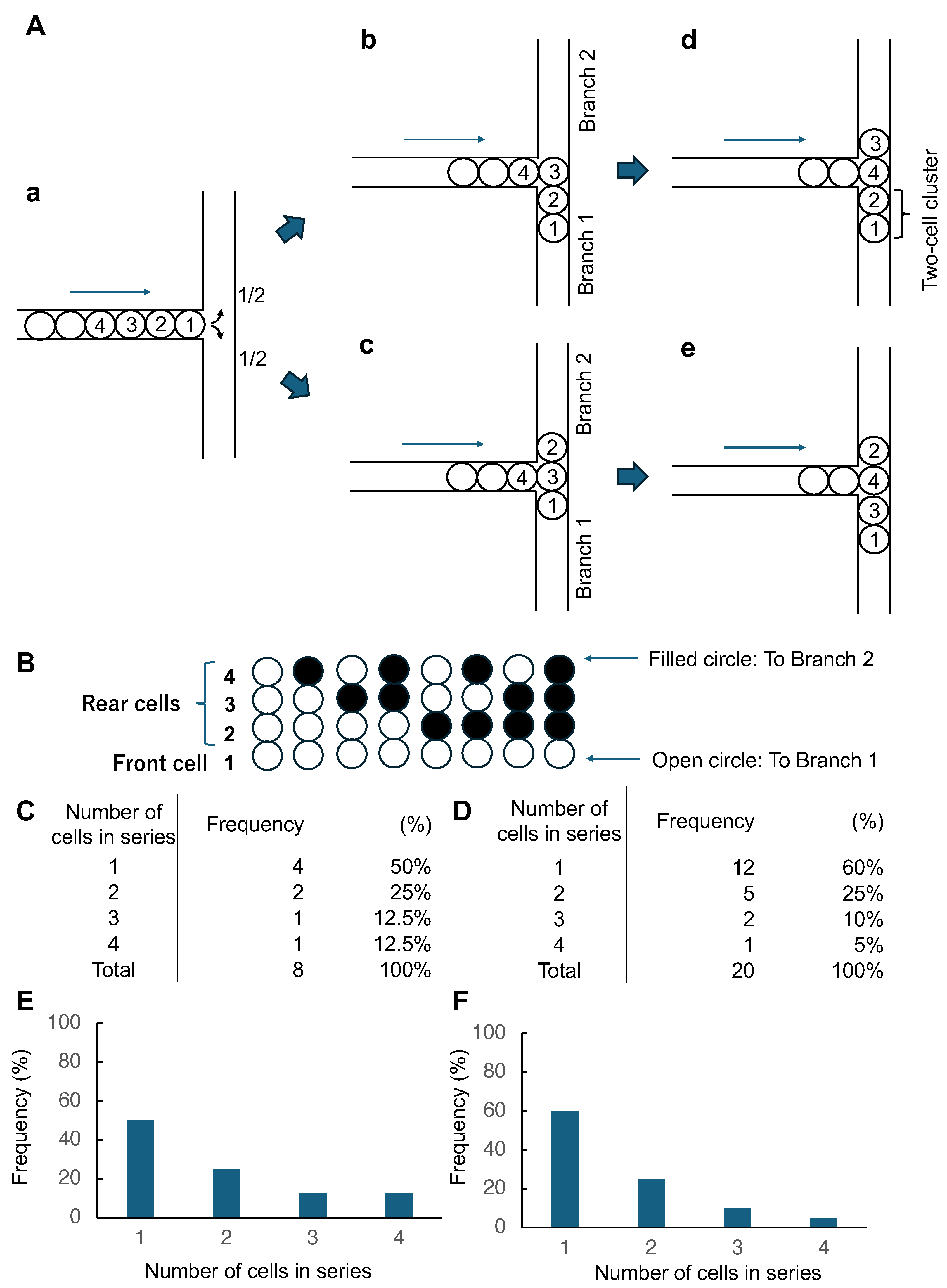
3.1. Conceptual Idea of Front–Rear Cell Interaction Measurement in Migrating Single-Cell Trains Using Path Selection Frequencies of Branched Micro-Pathways
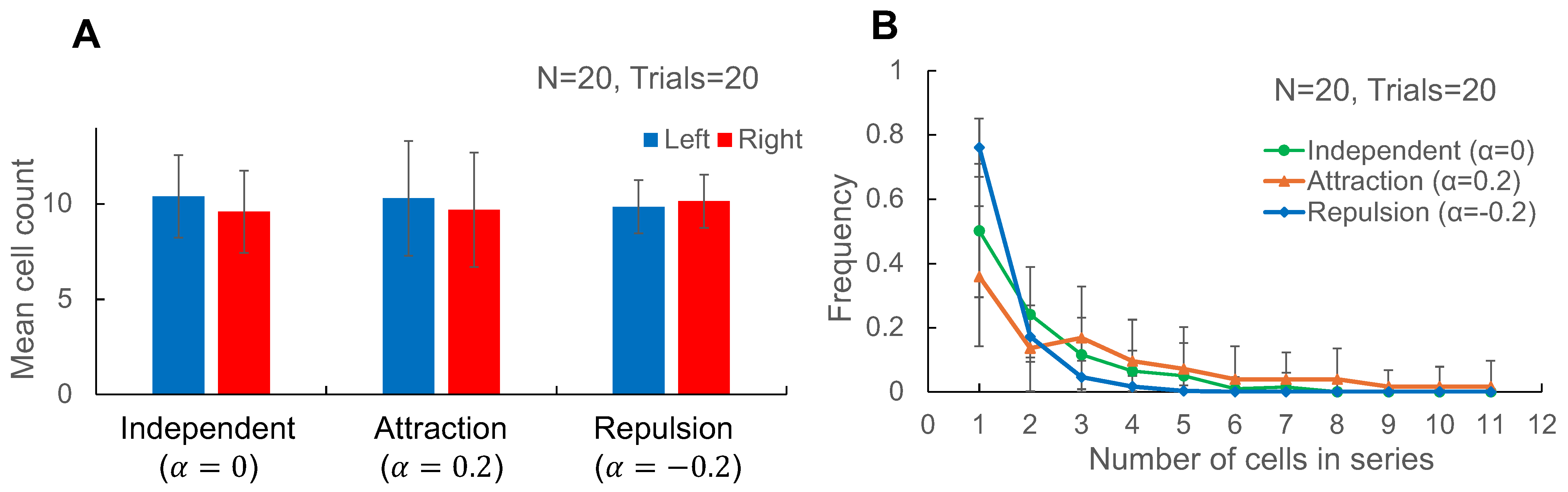
3.2. Probabilistic Analysis of Branch Selection in Confined Micro-Pathways
Estimation of Interaction Parameter from Run Length Statistics
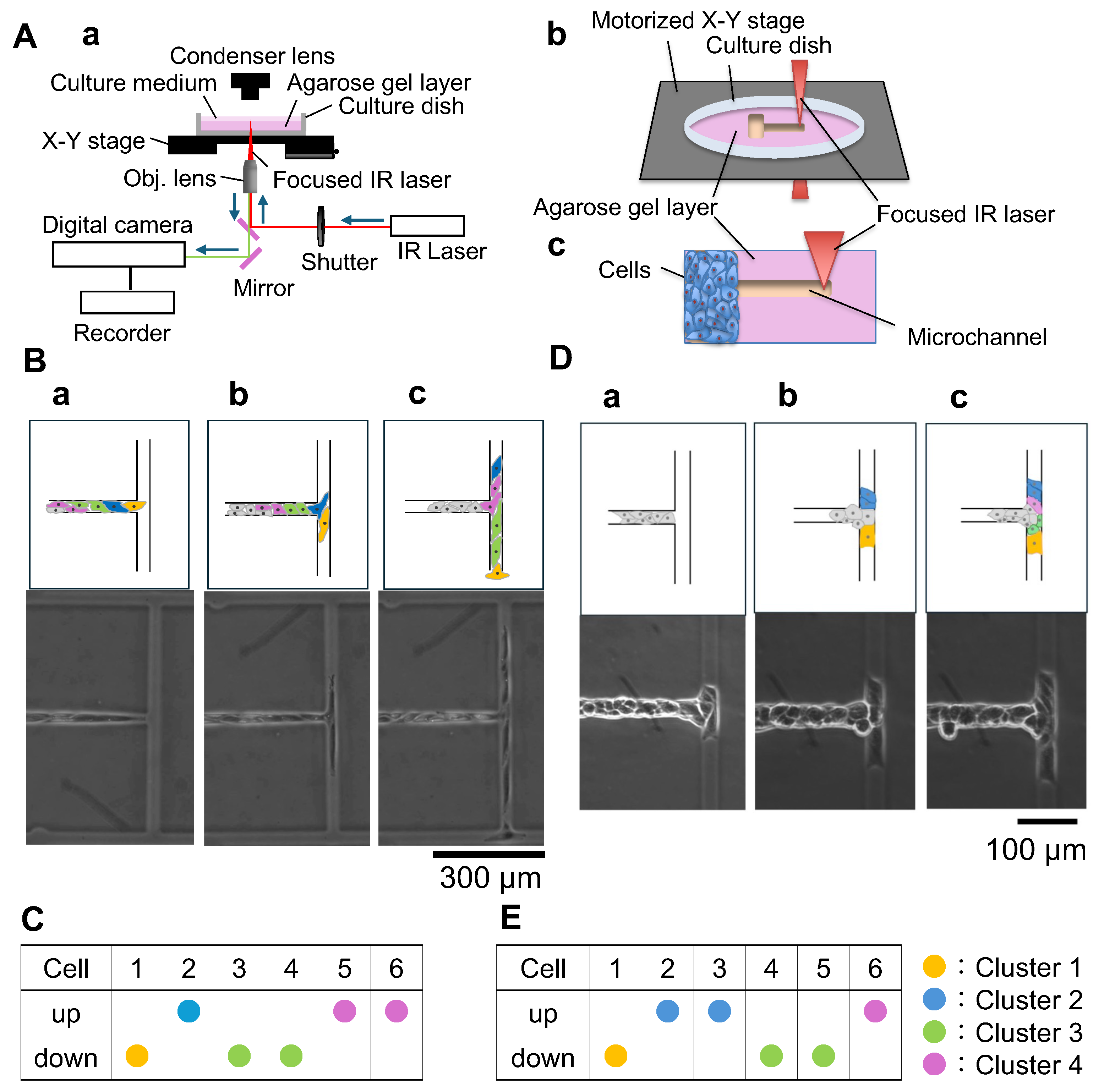
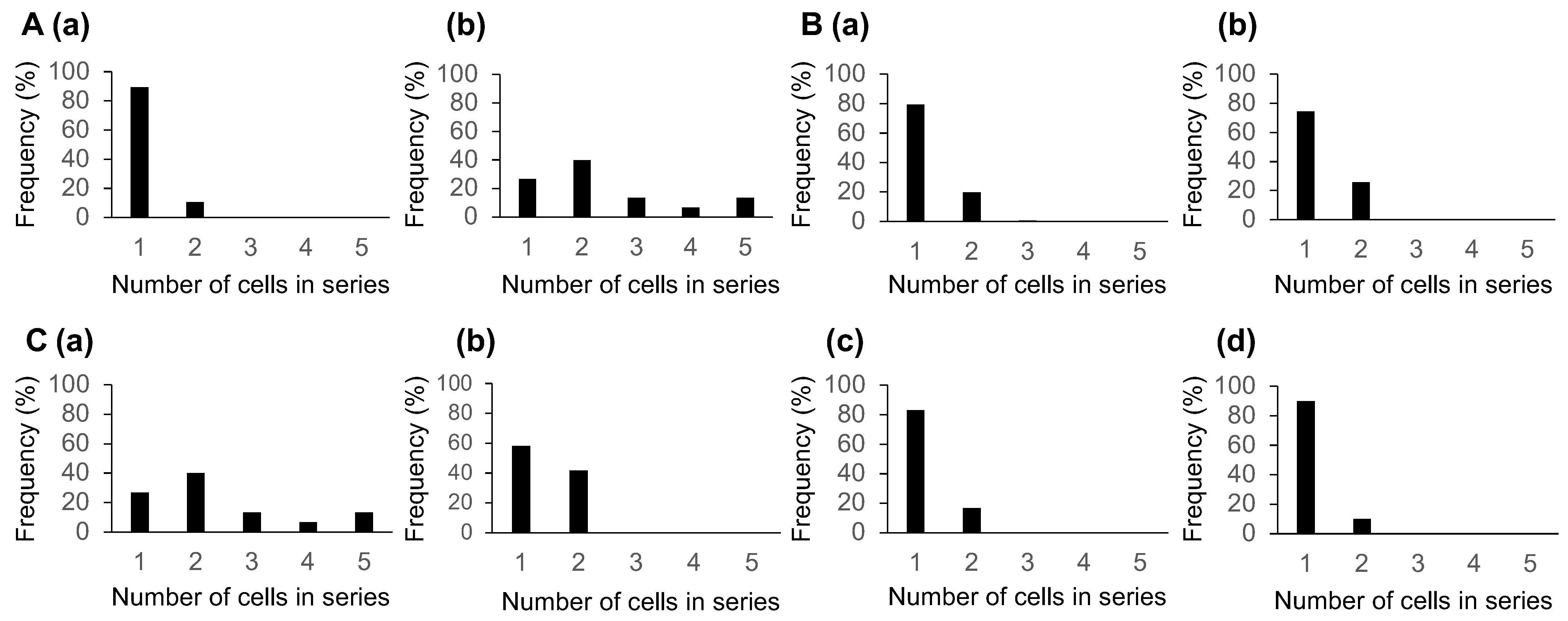
3.3. Measurement of Leader–Follower Interaction Strength Using Symmetric T-Junction Branching Experiments
3.4. Quantitative Estimation of Interaction Strength and Interaction Range from Experimental Cluster Size Distributions
Statistical Validation Using Likelihood Ratio Test
3.5. Methodological Implications
3.6. Limitations
3.6.1. Influence of Cell Shape and Deformation
3.6.2. Model Order and Higher-Order Interactions
3.6.3. Stationarity Assumption and Position-Dependent Coupling
3.6.4. Annotation Uncertainty and Run Length Extraction
3.6.5. Effect of Limited Sample Size in Cluster Statistics
3.6.6. Baseline Bias and Geometric Asymmetry
3.6.7. Hydrodynamic Resistance Analogy and Junction Occupancy Effects
4. Conclusions
Author Contributions
Funding
Institutional Review Board Statement
Informed Consent Statement
Data Availability Statement
Acknowledgments
Conflicts of Interest
References
- Friedl, P.; Gilmour, D. Collective cell migration in morphogenesis, regeneration and cancer. Nat. Rev. Mol. Cell Biol. 2009, 10, 445–457. [Google Scholar] [CrossRef]
- Rørth, P. Collective Cell Migration. Annu. Rev. Cell Dev. Biol. 2009, 25, 407–429. [Google Scholar] [CrossRef]
- Mayor, R.; Etienne-Manneville, S. The front and rear of collective cell migration. Nat. Rev. Mol. Cell Biol. 2016, 17, 97–109. [Google Scholar] [CrossRef] [PubMed]
- Trepat, X.; Sahai, E. Mesoscale physical principles of collective cell organization. Nature Phys. 2018, 14, 671–682. [Google Scholar] [CrossRef]
- Mishra, A.K.; Campanale, J.P.; Mondo, J.A.; Montell, D.J. Cell interactions in collective cell migration. Development 2019, 146, dev172056. [Google Scholar] [CrossRef] [PubMed]
- Yamaguchi, N.; Mizutani, T.; Kawabata, K.; Haga, H. Leader cells regulate collective cell migration via Rac activation in the downstream signaling of integrin β1 and PI3K. Sci. Rep. 2015, 5, 7656. [Google Scholar] [CrossRef]
- Omelchenko, T.; Vasiliev, J.M.; Gelfand, I.M.; Feder, H.H.; Bonder, E.M. Rho-dependent formation of epithelial “leader” cells during wound healing. Proc. Natl. Acad. Sci. USA 2003, 100, 10788–10793. [Google Scholar] [CrossRef]
- MacHacek, M.; Hodgson, L.; Welch, C.; Elliott, H.; Pertz, O.; Nalbant, P.; Abell, A.; Johnson, G.L.; Hahn, K.M.; Danuser, G. Coordination of Rho GTPase activities during cell protrusion. Nature 2009, 461, 99–103. [Google Scholar] [CrossRef]
- Reffay, M.; Petitjean, L.; Coscoy, S.; Grasland-Mongrain, E.; Amblard, F.; Buguin, A.; Silberzan, P. Orientation and Polarity in Collectively Migrating Cell Structures: Statics and Dynamics. Biophys. J. 2011, 100, 2566–2575. [Google Scholar] [CrossRef]
- Wang, X.; He, L.; Wu, Y.I.; Hahn, K.M.; Montell, D.J. Light-mediated activation reveals a key role for Rac in collective guidance of cell movement in vivo. Nat. Cell Biol. 2010, 12, 591–597. [Google Scholar] [CrossRef]
- Gerhardt, H.; Golding, M.; Fruttiger, M.; Ruhrberg, C.; Lundkvist, A.; Abramsson, A.; Jeltsch, M.; Mitchell, C.; Alitalo, K.; Shima, D.; et al. VEGF guides angiogenic sprouting utilizing endothelial tip cell filopodia. J. Cell Biol. 2003, 161, 1163–1177. [Google Scholar] [CrossRef]
- Caussinus, E.; Colombelli, J.; Affolter, M. Tip-Cell Migration Controls Stalk-Cell Intercalation during Drosophila Tracheal Tube Elongation. Curr. Biol. 2008, 18, 1727–1734. [Google Scholar] [CrossRef] [PubMed]
- Arima, S.; Nishiyama, K.; Ko, T.; Arima, Y.; Hakozaki, Y.; Sugihara, K.; Koseki, H.; Uchijima, Y.; Kurihara, Y.; Kurihara, H. Angiogenic morphogenesis driven by dynamic and heterogeneous collective endothelial cell movement. Development 2011, 138, 4763–4776. [Google Scholar] [CrossRef] [PubMed]
- Jakobsson, L.; Franco, C.A.; Bentley, K.; Collins, R.T.; Ponsioen, B.; Aspalter, I.M.; Rosewell, I.; Busse, M.; Thurston, G.; Medvinsky, A.; et al. Endothelial cells dynamically compete for the tip cell position during angiogenic sprouting. Nat. Cell Biol. 2010, 12, 943–953. [Google Scholar] [CrossRef]
- Campanale, J.P.; Montell, D.J. Who’s really in charge: Diverse follower cell behaviors in collective cell migration. Curr. Opin. Cell Biol. 2023, 81, 102160. [Google Scholar] [CrossRef]
- Lebreton, G.; Casanova, J. Specification of leading and trailing cell features during collective migration in the Drosophila trachea. J. Cell Sci. 2014, 127, 465–474. [Google Scholar] [CrossRef][Green Version]
- Bianco, A.; Poukkula, M.; Cliffe, A.; Mathieu, J.; Luque, C.M.; Fulga, T.A.; Rørth, P. Two distinct modes of guidance signalling during collective migration of border cells. Nature 2007, 448, 362–365. [Google Scholar] [CrossRef]
- Prasad, M.; Montell, D.J. Cellular and Molecular Mechanisms of Border Cell Migration Analyzed Using Time-Lapse Live-Cell Imaging. Dev. Cell 2007, 12, 997–1005. [Google Scholar] [CrossRef]
- Theveneau, E.; Mayor, R. Integrating chemotaxis and contact-inhibition during collective cell migration: Small GTPases at work. Small GTPases 2010, 1, 113–117. [Google Scholar] [CrossRef]
- Shellard, A.; Szabó, A.; Trepat, X.; Mayor, R. Supracellular contraction at the rear of neural crest cell groups drives collective chemotaxis. Science 2018, 362, 339–343. [Google Scholar] [CrossRef] [PubMed]
- Qin, L.; Yang, D.; Yi, W.; Cao, H.; Xiao, G. Roles of leader and follower cells in collective cell migration. Mol. Biol. Cell 2021, 32, 1267–1272. [Google Scholar] [CrossRef] [PubMed]
- Vishwakarma, M.; Di Russo, J.; Probst, D.; Schwarz, U.S.; Das, T.; Spatz, J.P. Mechanical interactions among followers determine the emergence of leaders in migrating epithelial cell collectives. Nat. Commun. 2018, 9, 3469. [Google Scholar] [CrossRef]
- Rossetti, L.; Grosser, S.; Abenza, J.F.; Valon, L.; Roca-Cusachs, P.; Alert, R.; Trepat, X. Optogenetic generation of leader cells reveals a force–velocity relation for collective cell migration. Nat. Phys. 2024, 20, 1659–1669. [Google Scholar] [CrossRef]
- Farooqui, R.; Fenteany, G. Multiple rows of cells behind an epithelial wound edge extend cryptic lamellipodia to collectively drive cell-sheet movement. J. Cell Sci. 2005, 118, 51–63. [Google Scholar] [CrossRef]
- Yang, Y.; Jamilpour, N.; Yao, B.; Dean, Z.S.; Riahi, R.; Wong, P.K. Probing Leader Cells in Endothelial Collective Migration by Plasma Lithography Geometric Confinement. Sci. Rep. 2016, 6, 22707. [Google Scholar] [CrossRef]
- Mehta, P.; Rahman, Z.; ten Dijke, P.; Boukany, P. Microfluidics meets 3D cancer cell migration. Trends Cancer 2022, 8, 683–697. [Google Scholar] [CrossRef]
- Cheung, K.J. Collective cell migration modes in development, tissue repair and cancer. Nat. Rev. Mol. Cell Biol. 2025, 26, 741–758. [Google Scholar] [CrossRef] [PubMed]
- Morikis, V.A.; Avila, D.B.; DiMauro, A.; Cao, Y.; Hwang, P.Y.; Pathak, A.; Longmore, G.D. Cadherin-1-mediated communication at the leader–follower boundary controls mouse breast tumor organoid collective migration. Cell Rep. 2025, 44, 116631. [Google Scholar] [CrossRef]
- Ilina, O.; Gritsenko, P.G.; Syga, S.; Lippoldt, J.; La Porta, C.A.M.; Chepizhko, O.; Grosser, S.; Vullings, M.; Bakker, G.J.; Starruß, J.; et al. Cell–cell adhesion and 3D matrix confinement determine jamming transitions in breast cancer invasion. Nat. Cell Biol. 2020, 22, 1103–1115. [Google Scholar] [CrossRef]
- Law, R.A.; Kiepas, A.; Desta, H.E.; Perez Ipiña, E.; Parlani, M.; Lee, S.J.; Yankaskas, C.L.; Zhao, R.; Mistriotis, P.; Wang, N.; et al. Cytokinesis machinery promotes cell dissociation from collectively migrating strands in confinement. Sci. Adv. 2023, 9, eabq6480. [Google Scholar] [CrossRef] [PubMed]
- Whitesides, G.M. The origins and the future of microfluidics. Nature 2006, 442, 368–373. [Google Scholar] [CrossRef]
- Irimia, D.; Charras, G.; Agrawal, N.; Mitchison, T.; Toner, M. Polar stimulation and constrained cell migration in microfluidic channels. Lab Chip 2007, 7, 1783–1790. [Google Scholar] [CrossRef]
- Sunyer, R.; Conte, V.; Escribano, J.; Elosegui-Artola, A.; Labernadie, A.; Valon, L.; Navajas, D.; García-Aznar, J.M.; Muñoz, J.J.; Roca-Cusachs, P.; et al. Collective cell durotaxis emerges from long-range intercellular force transmission. Science 2016, 353, 1157–1161. [Google Scholar] [CrossRef]
- Leclech, C.; Gonzalez-Rodriguez, D.; Villedieu, A.; Lok, T.; Déplanche, A.M.; Barakat, A.I. Topography-induced large-scale antiparallel collective migration in vascular endothelium. Nat. Commun. 2022, 13, 2797. [Google Scholar] [CrossRef] [PubMed]
- Lu, C.H.; Lee, C.E.; Nakamoto, M.L.; Cui, B. Cellular Signaling at the Nano-Bio Interface: Spotlighting Membrane Curvature. Annu. Rev. Phys. Chem. 2025, 76, 251–277. [Google Scholar] [CrossRef] [PubMed]
- Wang, X.W.; Ye, C.Q.; Tang, Q.; Yu, H.M.; Wang, J.; Fu, G.S.; Ren, K.F.; Yu, L.; Ji, J. Drop-shaped microgrooves guide unidirectional cell migration for enhanced endothelialization. Nat. Commun. 2025, 16, 1928. [Google Scholar] [CrossRef] [PubMed]
- Vedula, S.R.K.; Leong, M.C.; Lai, T.L.; Hersen, P.; Kabla, A.J.; Lim, C.T.; Ladoux, B. Emerging modes of collective cell migration induced by geometrical constraints. Proc. Natl. Acad. Sci. USA 2012, 109, 12974–12979. [Google Scholar] [CrossRef]
- Sentoku, M.; Hashimoto, H.; Iida, K.; Endo, M.; Yasuda, K. Photothermal Agarose Microfabrication Technology for Collective Cell Migration Analysis. Micromachines 2021, 12, 1015. [Google Scholar] [CrossRef]
- Szabó, A.; Melchionda, M.; Nastasi, G.; Woods, M.L.; Campo, S.; Perris, R.; Mayor, R. In vivo confinement promotes collective migration of neural crest cells. J. Cell Biol. 2016, 213, 543–555. [Google Scholar] [CrossRef]
- Mohammed, D.; Charras, G.; Vercruysse, E.; Versaevel, M.; Lantoine, J.; Alaimo, L.; Bruyère, C.; Luciano, M.; Glinel, K.; Delhaye, G.; et al. Substrate area confinement is a key determinant of cell velocity in collective migration. Nat. Phys. 2019, 15, 858–866. [Google Scholar] [CrossRef]
- Li, Y.; Yan, X.; Feng, X.; Wang, J.; Du, W.; Wang, Y.; Chen, P.; Xiong, L.; Liu, B.F. Agarose-based microfluidic device for point-of-care concentration and detection of pathogen. Anal. Chem. 2014, 86, 10653–10659. [Google Scholar] [CrossRef]
- Zhang, H.; Jenkins, G.; Zou, Y.; Zhu, Z.; Yang, C.J. Massively Parallel Single-Molecule and Single-Cell Emulsion Reverse Transcription Polymerase Chain Reaction Using Agarose Droplet Microfluidics. Anal. Chem. 2012, 84, 3599–3606. [Google Scholar] [CrossRef]
- Agnihotri, S.N.; Das, P.K.; Tolboom, F.; Werr, G.; Palierse, E.; Persson, C.; Tenje, M. Dynamics of non-Newtonian agarose gel droplet formation in two-phase microfluidic systems. Phys. Fluids 2025, 37, 32010. [Google Scholar] [CrossRef]
- Oh, K.W.; Lee, K.; Ahn, B.; Furlani, E.P. Design of pressure-driven microfluidic networks using electric circuit analogy. Lab Chip 2012, 12, 515–545. [Google Scholar] [CrossRef]
- Agnihotri, S.N.; Raveshi, M.R.; Nosrati, R.; Bhardwaj, R.; Neild, A. Droplet splitting in microfluidics: A review. Phys. Fluids 2025, 37, 51304. [Google Scholar] [CrossRef]
- Li, D.; Wang, Y.L. Coordination of cell migration mediated by sitedependent cell-cell contact. Proc. Natl. Acad. Sci. USA 2018, 115, 10678–10683. [Google Scholar] [CrossRef]
- Sentoku, M.; Endo, M.; Takei, M.; Hanamoto, W.; Yasuda, K. Geometrical constraint change determines organized collective migration of follower cells. Sci. Rep. 2025, 15, 8199. [Google Scholar] [CrossRef]
- Moriguchi, H.; Wakamoto, Y.; Sugio, Y.; Takahashi, K.; Inoue, I.; Yasuda, K. An agar-microchamber cell-cultivation system: Flexible change of microchamber shapes during cultivation by photo-thermal etching. Lab Chip 2002, 2, 125–132. [Google Scholar] [CrossRef]
- Sugihara, K.; Nishiyama, K.; Fukuhara, S.; Uemura, A.; Arima, S.; Kobayashi, R.; Köhn-Luque, A.; Mochizuki, N.; Suda, T.; Ogawa, H.; et al. Autonomy and Non-autonomy of Angiogenic Cell Movements Revealed by Experiment-Driven Mathematical Modeling. Cell Rep. 2015, 13, 1814–1827. [Google Scholar] [CrossRef] [PubMed]
- Tarle, V.; Gauquelin, E.; Vedula, S.R.; D’Alessandro, J.; Lim, C.T.; Ladoux, B.; Gov, N.S. Modeling collective cell migration in geometric confinement. Phys. Biol. 2017, 14, 035001. [Google Scholar] [CrossRef] [PubMed]
- Buttenschön, A.; Edelstein-Keshet, L. Bridging from single to collective cell migration: A review of models and links to experiments. PLoS Comput. Biol. 2020, 16, e1008411. [Google Scholar] [CrossRef] [PubMed]
- Ron, J.E.; D’Alessandro, J.; Cellerin, V.; Voituriez, R.; Ladoux, B.; Gov, N.S. Polarization and motility of one-dimensional multi-cellular trains. Biophys. J. 2023, 122, 4598–4613. [Google Scholar] [CrossRef] [PubMed]



| Dataset | Mean Cluster Size | SE | 95% CI | |
|---|---|---|---|---|
| MS-1 front cluster | 1.105 | −0.405 | 0.056 | [−0.500, −0.292] |
| MS-1 rear clusters | 1.230 | −0.313 | 0.027 | [−0.369, −0.264] |
| MDCK front cluster | 2.400 | +0.083 | 0.060 | [−0.056, +0.174] |
| MDCK rear clusters | 1.256 | −0.296 | 0.044 | [−0.386, −0.209] |
| MDCK cluster 2 | 1.417 | −0.206 | 0.073 | [−0.357, −0.100] |
| MDCK cluster 3 | 1.167 | −0.357 | 0.078 | [−0.500, −0.206] |
| MDCK cluster 4 | 1.100 | −0.409 | 0.075 | [−0.500, −0.269] |
Disclaimer/Publisher’s Note: The statements, opinions and data contained in all publications are solely those of the individual author(s) and contributor(s) and not of MDPI and/or the editor(s). MDPI and/or the editor(s) disclaim responsibility for any injury to people or property resulting from any ideas, methods, instructions or products referred to in the content. |
© 2026 by the authors. Licensee MDPI, Basel, Switzerland. This article is an open access article distributed under the terms and conditions of the Creative Commons Attribution (CC BY) license.
Share and Cite
Ashizawa, T.; Yamamoto, K.; Tsuneishi, K.; Yasuda, K. A Microfabricated Branch Selection Platform for Quantitative Measurement of Leader–Follower Interaction Strength and Interaction Range in Collective Cell Migration. Micromachines 2026, 17, 449. https://doi.org/10.3390/mi17040449
Ashizawa T, Yamamoto K, Tsuneishi K, Yasuda K. A Microfabricated Branch Selection Platform for Quantitative Measurement of Leader–Follower Interaction Strength and Interaction Range in Collective Cell Migration. Micromachines. 2026; 17(4):449. https://doi.org/10.3390/mi17040449
Chicago/Turabian StyleAshizawa, Taichi, Kei Yamamoto, Kazuhiro Tsuneishi, and Kenji Yasuda. 2026. "A Microfabricated Branch Selection Platform for Quantitative Measurement of Leader–Follower Interaction Strength and Interaction Range in Collective Cell Migration" Micromachines 17, no. 4: 449. https://doi.org/10.3390/mi17040449
APA StyleAshizawa, T., Yamamoto, K., Tsuneishi, K., & Yasuda, K. (2026). A Microfabricated Branch Selection Platform for Quantitative Measurement of Leader–Follower Interaction Strength and Interaction Range in Collective Cell Migration. Micromachines, 17(4), 449. https://doi.org/10.3390/mi17040449