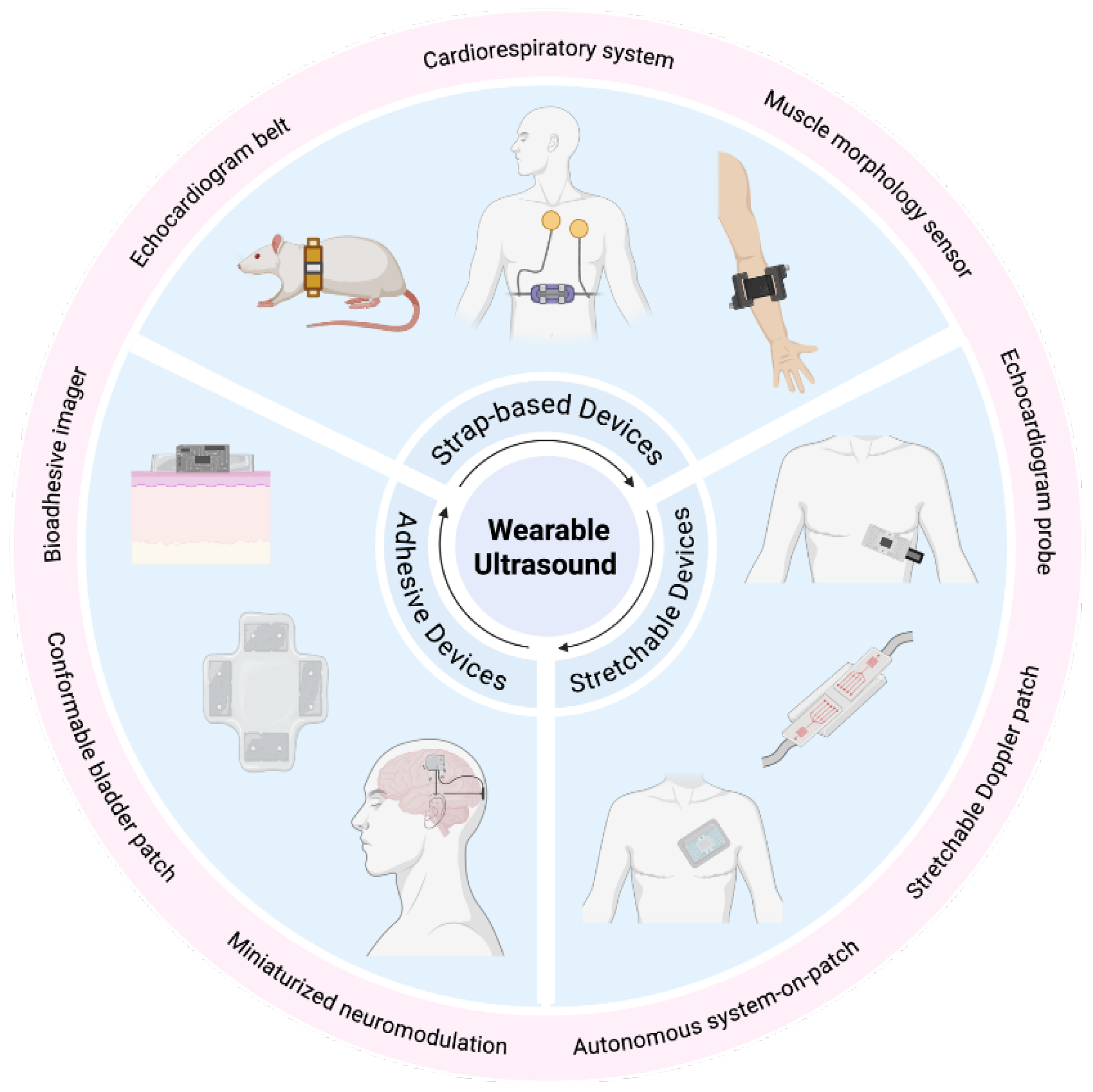
Advances and Prospects of Wearable Ultrasound Devices

 , and
, and 
1. Introduction
2. Classification of Advanced Wearable Ultrasound
2.1. Strap-Based Wearable Ultrasound
2.2. Adhesive Wearable Ultrasound
3. Current Limitations and Future Prospects
4. Conclusions
Acknowledgments
Conflicts of Interest
References
- Chan, V.; Perlas, A. Basics of Ultrasound Imaging. In Atlas of Ultrasound-Guided Procedures in Interventional Pain Management; Narouze, S.N., Ed.; Springer: New York, NY, USA, 2011; pp. 13–19. [Google Scholar]
- Wells, P.N.T. Ultrasound imaging. Phys. Med. Biol. 2006, 51, R83–R98. [Google Scholar] [CrossRef]
- Shung, K.K.; Cannata, J.M.; Zhou, Q.F. Piezoelectric materials for high frequency medical imaging applications: A review. J. Electroceram. 2007, 19, 141–147. [Google Scholar] [CrossRef]
- Routh, H.F. Doppler ultrasound. IEEE Eng. Med. Biol. Mag. 1996, 15, 31–40. [Google Scholar] [CrossRef]
- Matsuoka, N.; Paeng, D.-G.; Chen, R.; Ameri, H.; Abdallah, W.; Zhou, Q.; Fawzi, A.; Shung, K.K.; Humayun, M. Ultrasonic Doppler measurements of blood flow velocity of rabbit retinal vessels using a 45-MHz needle transducer. Graefes Arch. Clin. Exp. Ophthalmol. 2010, 248, 675–680. [Google Scholar] [CrossRef]
- Oglat, A.; Matjafri, M.; Suardi, N.; Oqlat, M.; Abdelrahman, M.; Oqlat, A. A review of medical doppler ultrasonography of blood flow in general and especially in common carotid artery. J. Med. Ultrasound 2018, 26, 3. [Google Scholar] [CrossRef]
- Ren, M.X.; Zeng, Y.; Nowlen, P.; Zhou, Q. Advancements in Flexible and Wearable Echocardiograms for Real-Time Continuous Cardiovascular Monitoring. Curr. Treat. Options Cardiovasc. Med. 2025, 27, 52. [Google Scholar] [CrossRef]
- La, T.; Le, L.H. Flexible and Wearable Ultrasound Device for Medical Applications: A Review on Materials, Structural Designs, and Current Challenges. Adv. Mater. Technol. 2022, 7, 2100798. [Google Scholar] [CrossRef]
- Wilkinson, J.N.; Saxhaug, L.M. Handheld ultrasound in training—The future is getting smaller! J. Intensive Care Soc. 2021, 22, 220–229. [Google Scholar] [CrossRef] [PubMed]
- Royse, C.F.; Seah, J.L.; Donelan, L.; Royse, A.G. Point of care ultrasound for basic haemodynamic assessment: Novice compared with an expert operator. Anaesthesia 2006, 61, 849–855. [Google Scholar] [CrossRef] [PubMed]
- Gilbertson, M.W.; Anthony, B.W. Force and Position Control System for Freehand Ultrasound. IEEE Trans. Robot. 2015, 31, 835–849. [Google Scholar] [CrossRef]
- Jeong, E.Y.; Kim, H.L.; Ha, E.J.; Park, S.Y.; Cho, Y.J.; Han, M. Computer-aided diagnosis system for thyroid nodules on ultrasonography: Diagnostic performance and reproducibility based on the experience level of operators. Eur. Radiol. 2019, 29, 1978–1985. [Google Scholar] [CrossRef]
- Peng, C.; Cai, Q.; Chen, M.; Jiang, X. Recent Advances in Tracking Devices for Biomedical Ultrasound Imaging Applications. Micromachines 2022, 13, 1855. [Google Scholar] [CrossRef]
- Glor, F.P.; Ariff, B.; Hughes, A.D.; Verdonck, P.R.; Thom, S.A.M.c.G.; Barratt, D.C.; Xu, X. Operator dependence of 3-D ultrasound-based computational fluid dynamics for the carotid bifurcation. IEEE Trans. Med. Imaging 2005, 24, 451–456. [Google Scholar] [CrossRef]
- Qian, X.; Wodnicki, R.; Kang, H.; Zhang, J.; Tchelepi, H.; Zhou, Q. Current Ultrasound Technologies and Instrumentation in the Assessment and Monitoring of COVID-19 Positive Patients. IEEE Trans. Ultrason. Ferroelectr. Freq. Control 2020, 67, 2230–2240. [Google Scholar] [CrossRef]
- Jafleh, E.A.; Alnaqbi, F.A.; Almaeeni, H.A.; Faqeeh, S.; Alzaabi, M.A.; Al Zaman, K. The Role of Wearable Devices in Chronic Disease Monitoring and Patient Care: A Comprehensive Review. Cureus 2024, 16, e68921. [Google Scholar] [CrossRef]
- Lei, Y.; Duan, J.; Qi, Q.; Fang, J.; Liu, Q.; Zhou, S.; Wu, Y. The Design and Application of Wearable Ultrasound Devices for Detection and Imaging. Biosensors 2025, 15, 561. [Google Scholar] [CrossRef]
- Sun, Y.; Quan, Y.; Xing, J.; Tan, Z.; Sun, X.; Lou, L.; Fei, C.; Zhu, J.; Yang, Y. Lead-Free Potassium Sodium Niobate-Based Wearable Ultrasonic Patches for Blood Pressure Detection. Micromachines 2025, 16, 392. [Google Scholar] [CrossRef] [PubMed]
- Ottakath, N.; Al-maadeed, S.; Bouridane, A.; Chowdhury, M.E.H.; Sadasivuni, K.K. Wearable Ultrasound Devices for Continuous Health Monitoring: Current and Future Prospects. In 2024 IEEE 8th Energy Conference (ENERGYCON); IEEE: New York, NY, USA, 2024. [Google Scholar]
- Zhou, S.; Park, G.; Lin, M.; Yang, X.; Xu, S. Wearable ultrasound technology. Nat. Rev. Bioeng. 2025, 3, 835–854. [Google Scholar] [CrossRef]
- Huang, H.; Wu, R.S.; Lin, M.; Xu, S. Emerging Wearable Ultrasound Technology. IEEE Trans. Ultrason. Ferroelectr. Freq. Control 2024, 71, 713–729. [Google Scholar] [CrossRef] [PubMed]
- Chen, S.; Ouyang, Q.; Miao, X.; Zhang, F.; Chen, Z.; Qian, X.; Xie, J.; Yan, Z. Wearable Ultrasound Devices for Therapeutic Applications. Nano-Micro Lett. 2026, 18, 45. [Google Scholar] [CrossRef] [PubMed]
- Xue, X.; Wu, H.; Cai, Q.; Chen, M.; Moon, S.; Huang, Z.; Kim, T.; Peng, C.; Feng, W.; Sharma, N.; et al. Flexible Ultrasonic Transducers for Wearable Biomedical Applications: A Review on Advanced Materials, Structural Designs, and Future Prospects. IEEE Trans. Ultrason. Ferroelectr. Freq. Control 2024, 71, 786–810. [Google Scholar] [CrossRef]
- Hu, H.; Hu, C.; Guo, W.; Zhu, B.; Wang, S. Wearable ultrasound devices: An emerging era for biomedicine and clinical translation. Ultrasonics 2024, 142, 107401. [Google Scholar] [CrossRef]
- Gopalakrishnan, P.H.; Panicker, M.R. Non-Newtonian fluid coupling media for wearable ultrasound imaging systems using rigid linear sensor array. Sens. Actuators A Phys. 2024, 376, 115588. [Google Scholar] [CrossRef]
- Li, L.; Zhao, L.; Hassan, R.; Ren, H. Review on Wearable System for Positioning Ultrasound Scanner. Machines 2023, 11, 325. [Google Scholar] [CrossRef]
- Seok, C.; Yamaner, F.Y.; Sahin, M.; Oralkan, O. A Wearable Ultrasonic Neurostimulator—Part I: A 1D CMUT Phased Array System for Chronic Implantation in Small Animals. IEEE Trans. Biomed. Circuits Syst. 2021, 15, 692–704. [Google Scholar] [CrossRef] [PubMed]
- Chen, J.; Liu, J.; Chen, W.; Shang, D.; Zhang, Q.; Li, Y.; Zheng, H.; Gu, D.; Wu, D.; Ma, T. Skin-Conformable Flexible and Stretchable Ultrasound Transducer for Wearable Imaging. IEEE Trans. Ultrason. Ferroelectr. Freq. Control 2024, 71, 811–820. [Google Scholar] [CrossRef] [PubMed]
- Giordano, M.; Leitner, C.; Vogt, C.; Benini, L.; Magno, M. PuLsE: Accurate and Robust Ultrasound-Based Continuous Heart-Rate Monitoring on a Wrist-Worn IoT Device. IEEE Internet Things J. 2025, 12, 36908–36925. [Google Scholar] [CrossRef]
- Zeng, Y.; Sun, X.; Zhang, J.; Chang, C.-F.; Liu, B.; Gong, C.; Ji, J.; Zhang, B.Z.; Wang, Y.; Ren, M.X.; et al. High-Frequency Wearable Ultrasound Array Belt for Small Animal Echocardiography. IEEE Trans. Ultrason. Ferroelectr. Freq. Control 2024, 71, 1915–1923. [Google Scholar] [CrossRef] [PubMed]
- Vostrikov, S.; Benini, L.; Cossettini, A. Complete Cardiorespiratory Monitoring via Wearable Ultra Low Power Ultrasound. In 2023 IEEE International Ultrasonics Symposium (IUS); IEEE: New York, NY, USA, 2023. [Google Scholar]
- Bing, R.W.; Shijo, V.; Zheng, E.; Zheng, W.; Huang, C.; Xia, J. Wearable Photoacoustic/Ultrasound Imaging with a Curved Linear Array. In 2023 IEEE International Ultrasonics Symposium (IUS); IEEE: New York, NY, USA, 2023. [Google Scholar]
- Yang, X.; Chen, Z.; Hettiarachchi, N.; Yan, J.; Liu, H. A Wearable Ultrasound System for Sensing Muscular Morphological Deformations. IEEE Trans. Syst. Man Cybern. Syst. 2021, 51, 3370–3379. [Google Scholar] [CrossRef]
- He, K. Ultrasound-Based Human Machine Interfaces for Hand Gesture Recognition: A Scoping Review and Future Direction. IEEE Trans. Med. Robot. Bionics 2025, 7, 200–212. [Google Scholar] [CrossRef]
- Putcha, A.; Nguyen, T.; Smith, R.; Choffin, R.; Bai, W. Intelligent Systems for Muscle Tracking: A Review on Sensor-Algorithm Synergy. Adv. Intell. Syst. 2023, 5, 2200351. [Google Scholar] [CrossRef]
- Lee, S.-M.; Lee, T.; Kim, H.; Jo, Y.; Kim, M.-G.; Kim, S.; Bae, H.-M.; Lee, H.J. Calcium-Modified Silk Patch as a Next-Generation Ultrasound Coupling Medium. ACS Appl. Mater. Interfaces 2021, 13, 55827–55839. [Google Scholar] [CrossRef]
- Liu, C.; Sun, H.; Ren, J.; Cheng, H.; Xie, M.; Liu, Y. Design and Optimization of Flexible and Stretchable Ultrasonic Transducer Array for Arterial Blood Pressure Monitoring. IEEE Sens. J. 2024, 24, 15055–15064. [Google Scholar] [CrossRef]
- Wu, S.J.; Zhao, X. Bioadhesive Technology Platforms. Chem. Rev. 2023, 123, 14084–14118. [Google Scholar] [CrossRef]
- Wang, C.; Chen, X.; Wang, L.; Makihata, M.; Liu, H.-C.; Zhou, T.; Zhao, X. Bioadhesive ultrasound for long-term continuous imaging of diverse organs. Science 2022, 377, 517–523. [Google Scholar] [CrossRef] [PubMed]
- Tomita, N.; Sato, S.; Noda, T.; Yamamoto, M.; Azuma, T.; Tomii, N.; Sakuma, I.; Itoh, T.; Takamatsu, S. Flexible Ultrasound Imaging Probe With Sub-Millimeter Element Pitch on Glass Fabric Using Xurography. IEEE Electron. Device Lett. 2026, 47, 172–175. [Google Scholar] [CrossRef]
- Bawiec, C.R.; Hollender, P.J.; Ornellas, S.B.; Schachtner, J.N.; Dahill-Fuchel, J.F.; Konecky, S.D.; Allen, J.J.B. A Wearable, Steerable, Transcranial Low-Intensity Focused Ultrasound System. J. Ultrasound Med. 2025, 44, 239–261. [Google Scholar] [CrossRef] [PubMed]
- Zhang, L.; Marcus, C.; Lin, D.; Mejorado, D.; Schoen, S.J.; Pierce, T.T.; Kumar, V.; Fernandez, S.V.; Hunt, D.; Li, Q.; et al. A conformable phased-array ultrasound patch for bladder volume monitoring. Nat. Electron. 2023, 7, 77–90. [Google Scholar] [CrossRef]
- Tang, K.W.K.; Jeong, J.; Hsieh, J.-C.; Yao, M.; Ding, H.; Wang, W.; Liu, X.; Pyatnitskiy, I.; He, W.; Moscoso-Barrera, W.D.; et al. Bioadhesive hydrogel-coupled and miniaturized ultrasound transducer system for long-term, wearable neuromodulation. Nat. Commun. 2025, 16, 4940. [Google Scholar] [CrossRef]
- Jiang, X.; Ng, W.T.; Chen, J. A Miniaturized Low-Intensity Ultrasound Device for Wearable Medical Therapeutic Applications. IEEE Trans. Biomed. Circuits Syst. 2019, 13, 1372–1382. [Google Scholar] [CrossRef]
- Song, P.; Andre, M.; Chitnis, P.; Xu, S.; Croy, T.; Wear, K.; Sikdar, S. Clinical, Safety, and Engineering Perspectives on Wearable Ultrasound Technology: A Review. IEEE Trans. Ultrason. Ferroelectr. Freq. Control 2023, 71, 730–744. [Google Scholar] [CrossRef]
- Wang, M.; Jia, L.; Li, H.; Feng, X. Wearable Ultrasound Devices for Biomedical Applications. FlexTech 2025, 1, 35–43. [Google Scholar] [CrossRef]
- Guo, L.; Liu, J.; Li, Y.; Xu, R.; Song, G.; Wu, J.; Qian, Z.; Ren, L.; Ren, L.; Zhou, Q. Wearable flexible ultrasonic transducers: Materials, applications, and challenges. Ultrasonics 2026, 159, 107872. [Google Scholar] [CrossRef] [PubMed]
- Yuan, J.; Li, Z.; Zhao, Y.; Luo, R.; Qin, S.; Li, J.; Li, M.; Han, G.; Li, Z.; Zhao, Z.; et al. Skin-adaptive focused flexible micromachined ultrasound transducers for wearable cardiovascular health monitoring. Sci. Adv. 2025, 11, eadw7632. [Google Scholar] [CrossRef]
- Zhou, S.; Park, G.; Longardner, K.; Lin, M.; Qi, B.; Yang, X.; Gao, X.; Huang, H.; Chen, X.; Bian, Y.; et al. Clinical validation of a wearable ultrasound sensor of blood pressure. Nat. Biomed. Eng. 2024, 9, 865–881. [Google Scholar] [CrossRef] [PubMed]
- Lu, C.; Huang, H.-J. Performance and development trends of ultrasound diagnostic systems in military settings: A review. Ultrasound J. 2025, 17, 54. [Google Scholar] [CrossRef] [PubMed]
- Guk, K.; Han, G.; Lim, J.; Jeong, K.; Kang, T.; Lim, E.-K.; Jung, J. Evolution of Wearable Devices with Real-Time Disease Monitoring for Personalized Healthcare. Nanomaterials 2019, 9, 813. [Google Scholar] [CrossRef]
- Ali, M.; Hoseyni, S.M.; Das, R.; Awais, M.; Basdogan, I.; Beker, L. A Flexible and Biodegradable Piezoelectric-Based Wearable Sensor for Non-Invasive Monitoring of Dynamic Human Motions and Physiological Signals. Adv. Mater. Technol. 2023, 8, 2300347. [Google Scholar] [CrossRef]
- Sahoo, A.; Zhou, S.; Smith, C.; Ebbini, E.S. Low-Power Full-Duplex Transmit-Receive Circuits for Wearable Ultrasound Transducers. In 2023 IEEE International Ultrasonics Symposium (IUS); IEEE: New York, NY, USA, 2022. [Google Scholar]
- Imenabadi, R.M.; Hasanpour Avanji, M.; Brown, K.; Bhatia, D. Advancing Towards a Lower-Power Wearable Ultrasound Sensor for Real-Time Bladder Volume Monitoring Using CNN Optimization. In 2024 IEEE Ultrasonics, Ferroelectrics, and Frequency Control Joint Symposium (UFFC-JS); IEEE: New York, NY, USA, 2024. [Google Scholar]
- Ma, H.; Huang, X.; Qian, R.; Jiang, L.; Wu, J. Hierarchical Lead-Free Piezoelectric Composites for Ultrasound Wireless Energy Harvesting. ACS Appl. Mater. Interfaces 2025, 17, 53767–53779. [Google Scholar] [CrossRef]
- Hinchet, R.; Yoon, H.-J.; Ryu, H.; Kim, M.-K.; Choi, E.-K.; Kim, D.-S.; Kim, S.-W. Transcutaneous ultrasound energy harvesting using capacitive triboelectric technology. Science 2019, 365, 491–494. [Google Scholar] [CrossRef]
- Bashatah, A.; Mukherjee, B.; Rima, A.; Patwardhan, S.; Otto, P.; Sutherland, R.; King, E.L.; Lancaster, B.; Aher, A.; Gibson, G.; et al. Wearable Ultrasound System Using Low-Voltage Time Delay Spectrometry for Dynamic Tissue Imaging. IEEE Trans. Biomed. Eng. 2024, 71, 3232–3243. [Google Scholar] [CrossRef]
- Xue, H.; Huang, X.; Sun, X.; Wu, K.; Tan, Z.; Fan, H.; Sun, J.; Jiang, L.; Wu, J. Superior lead-free piezoceramics for wearable multimodal ultrasound imaging arrays. Nat. Commun. 2025, 17, 218. [Google Scholar] [CrossRef]
- Olson, G.; Hansmann-Canas, I.; Karimi, Z.; Yazdkhasti, A.; Shabestanipour, G.; Ghaednia, H.; Schwab, J.H. The Impact of AI on the Development of Multimodal Wearable Devices in Musculoskeletal Medicine. HSS J. Musculoskelet. J. Hosp. Spec. Surg. 2025, 21, 314–324. [Google Scholar] [CrossRef] [PubMed]
- Kim, S.; Han, S.; Park, S.; Koo, J. Seeing inside the Body Using Wearable Sensing and Imaging Technologies. Adv. Healthc. Mater. 2025, 14, e02480. [Google Scholar] [CrossRef] [PubMed]
- Ghantasala, G.S.P.; Akhil, M.; Vidyullatha, P.; Guruguntla, V.; Rao, T.S.S.B.; Yuvaraju, B.A.G. Multimodal fusion of ultrasound images using HXM net for breast cancer diagnosis. Sci. Rep. 2025, 15, 40689. [Google Scholar] [CrossRef] [PubMed]

Disclaimer/Publisher’s Note: The statements, opinions and data contained in all publications are solely those of the individual author(s) and contributor(s) and not of MDPI and/or the editor(s). MDPI and/or the editor(s) disclaim responsibility for any injury to people or property resulting from any ideas, methods, instructions or products referred to in the content. |
© 2026 by the authors. Licensee MDPI, Basel, Switzerland. This article is an open access article distributed under the terms and conditions of the Creative Commons Attribution (CC BY) license.
Share and Cite
Ren, M.X.; Ngo, T.; Liu, X.; Liu, L.; Zeng, Y.; Zhou, Q. Advances and Prospects of Wearable Ultrasound Devices. Micromachines 2026, 17, 419. https://doi.org/10.3390/mi17040419
Ren MX, Ngo T, Liu X, Liu L, Zeng Y, Zhou Q. Advances and Prospects of Wearable Ultrasound Devices. Micromachines. 2026; 17(4):419. https://doi.org/10.3390/mi17040419
Chicago/Turabian StyleRen, Matthew Xinhu, Tyler Ngo, Xunan Liu, Leopard Liu, Yushun Zeng, and Qifa Zhou. 2026. "Advances and Prospects of Wearable Ultrasound Devices" Micromachines 17, no. 4: 419. https://doi.org/10.3390/mi17040419
APA StyleRen, M. X., Ngo, T., Liu, X., Liu, L., Zeng, Y., & Zhou, Q. (2026). Advances and Prospects of Wearable Ultrasound Devices. Micromachines, 17(4), 419. https://doi.org/10.3390/mi17040419