Article

Highly Sensitive Detection of Chymotrypsin Using Gold Nanoclusters with Peptide Sensors

1
Institute of Cancer Research, Affiliated Hospital of Jiangsu University, Zhenjiang 212013, China
2
School of Life Sciences, Jiangsu University, Zhenjiang 212013, China
3
P. E. Department, Jiangsu University, Zhenjiang 212013, China
*
Author to whom correspondence should be addressed.
Micromachines 2026, 17(1), 107; https://doi.org/10.3390/mi17010107
Submission received: 16 October 2025 / Revised: 9 January 2026 / Accepted: 12 January 2026 / Published: 14 January 2026
(This article belongs to the Special Issue Next-Generation Biomedical Devices)

Abstract

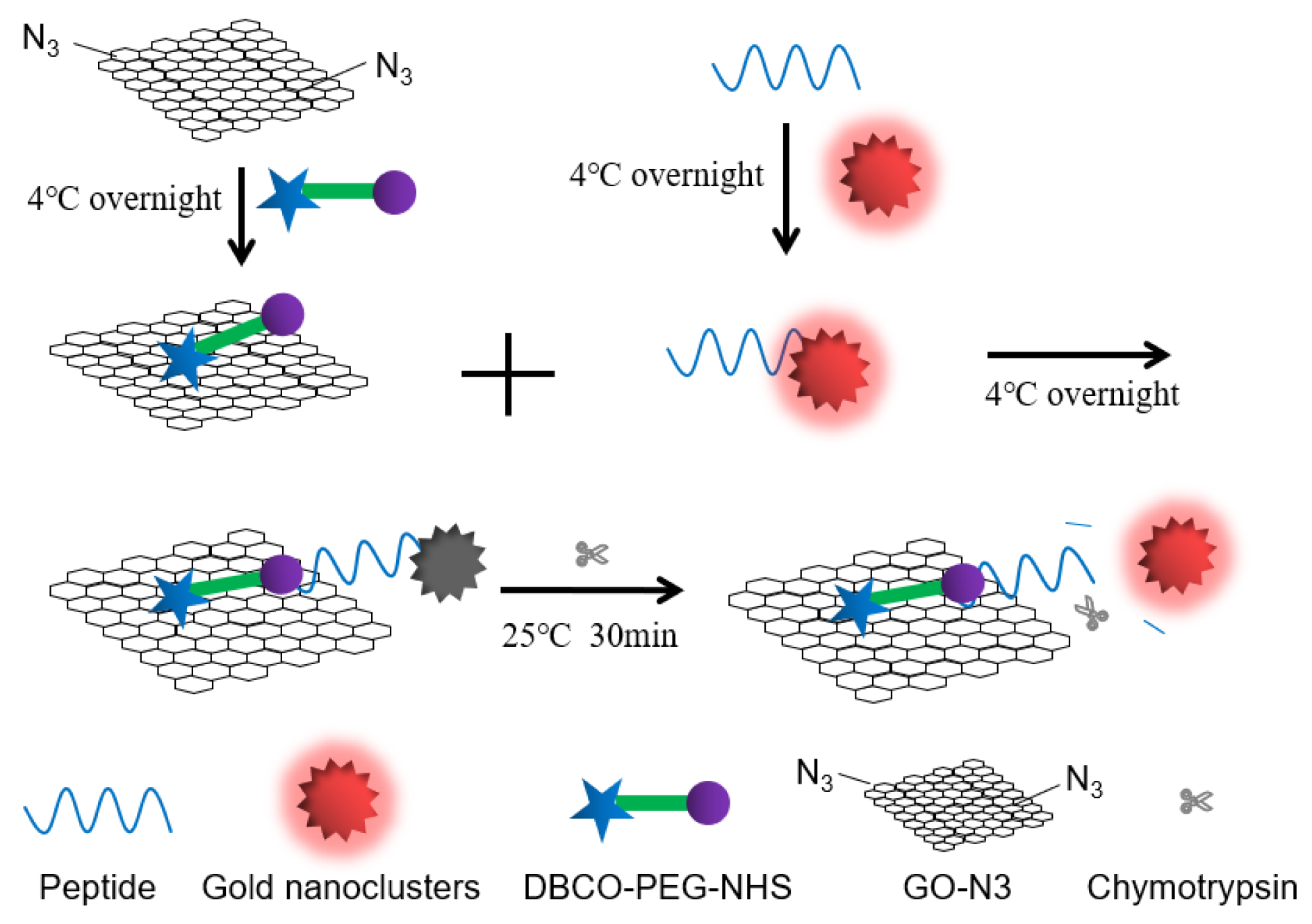
Pancreatic function tests are used to determine the presence of chronic pancreatitis, particularly in the early stage of the disease. Chymotrypsin is an indicator of pancreatic function and is thus related to pancreatic diseases. However, these methods often require specific equipment and cannot always meet on-site analysis requirements. Consequently, a highly sensitive detection method needs to be developed. This research employed graphene oxide modified with NHS sensors and peptides (RRHFFGC: Arginine-Arginine-Histidine-Phenylalanine-Phenylalanine-Glycine-Cysteine) tagged with gold nanoclusters (Au NCs) for the detection of chymotrypsin. The N-Hydroxysuccinimide-(Polyethylene Glycol)4-Dibenzocyclooctyne (NHS-PEG4-DBCO) and graphene oxide (GO)-N3 click reaction yielded GO-NHS material, appropriate for fluorescence quenching. The peptide chain was accurately broken with the introduction of chymotrypsin, and the Au NCs were situated far from the GO-NHS surface. The detection limit was 2.014 pg/mL. The results showed that the detection method had high sensitivity in comparison with the previous studies. This method is relevant to real samples due to its potential efficacy. Therefore, it is a promising method in the biomedical field.
Keywords: chymotrypsin; gold nanoclusters; limit of detection; high sensitivity chymotrypsin; gold nanoclusters; limit of detection; high sensitivity