1. Introduction
Gyro equipment and systems, in classical mechanical configuration or with magnetic suspension gyro motors (with active magnetic bearings) have a widespread use for the control of aerospace vehicles, as sensors, actuators, gyro stabilizers, or as guidance equipment. An important category is the CMG (Control Moment Gyroscope); this is an indispensable inertial actuator for the automatic attitude control systems of mini-satellites (under 500 kg), as it is suitable for fast rotational maneuvers [
1,
2,
3,
4,
5,
6,
7]. Compared to mechanical CMGs, those with gyroscopes arranged in magnetic suspension (MSCMG), with one gimbal (SGMSCMG) or with two gimbals (DGMSCMG), possess the advantages of zero friction (thus eliminating lubrication), low noise, low vibrations, and longevity [
6,
8,
9,
10,
11,
12,
13]. To increase efficiency, SGCMGs are used in equipment known as clusters with CMGs [
1,
14]. The DGMSCMGs generate two gyroscopic couples each, thus reducing the volume and the mass of the satellite. The construction of the AMB rotor allows the decoupling of its translation dynamics from the rotation dynamics and from the dynamics of the rotations of the gimbals and, implicitly, the decoupling of the control of the translation dynamics of the rotor from the control of the rotation dynamics of the rotor and of the gimbals; at the same time, it is allowed to decouple the control of the rotor translation dynamics from the control of the rotor rotation dynamics and from the control of the rotations of the gimbals [
14,
15,
16,
17,
18,
19,
20,
21,
22]. To control the dynamics of translation and rotation of the AMB rotor, different linear control laws, such as P type, P.D. type, P.I.D. type, sliding mode, and back-stepping, were used [
12,
23,
24,
25,
26,
27].
In this paper, a guidance gyro system architecture (for self-guided missiles) with two gimbals and a rotor in magnetic suspension (DGMSGG) using adaptive-type control laws is proposed and designed.
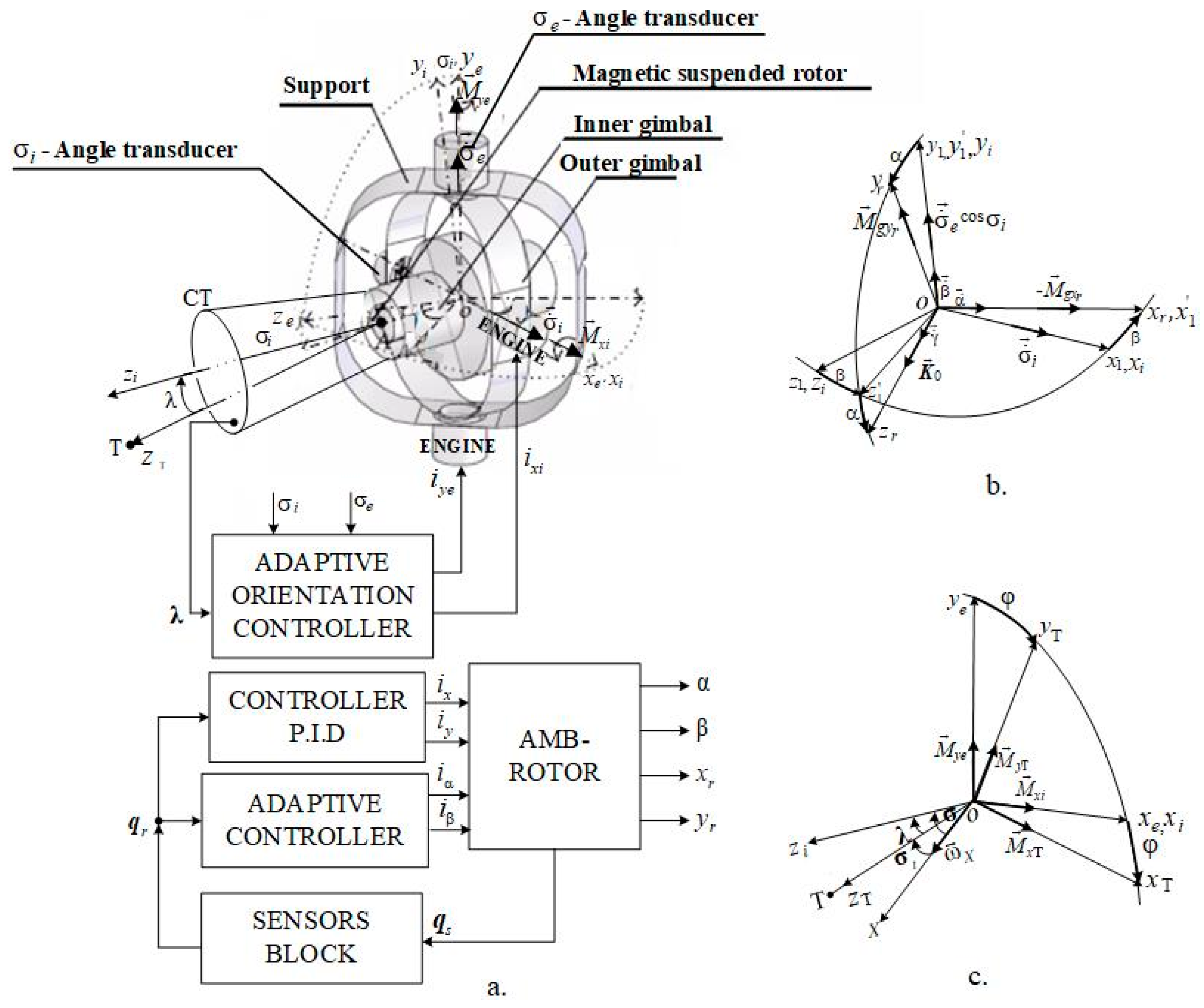
DGMSCMG is used as an actuator in the attitude control systems of the mini-satellites, being commanded by the attitude controller through some servo systems for controlling the gimbals’ angular rates (the gyroscopic rotor reacts to the angular rates through gyroscopic moments— control moment gyros—that are transmitted to the mini-satellites and produce their rotations). Unlike the DGMSCMG, a DGMSGG (with a similar architecture to the DGMSCMG) controls the gyroscopic rotor’s direction (the line of sight) and orients it so that it overlaps with the direction of the target line (the guidance line) by means of servo systems for controlling the gimbals’ angles.
Starting from the equations that describe the nonlinear gimbals’ and gyroscopic rotor’s dynamics [
16,
28], the control systems for the gyroscopic rotor’s translation and rotation dynamics, as well as the control system for the gimbals’ dynamics, are designed. Compared to the papers in which the dynamics of the gyroscopic rotor translation is decoupled from the dynamics of its rotations and from the dynamics of the gyro’s gimbals [
18,
19,
29], in this paper, all three dynamics are decoupled (the translation dynamics of the rotor from the dynamics of the rotor rotation and from the dynamics of the gimbals’ rotation) and, implicitly, one has designed three automatic control systems with superior performance to those presented in [
18,
20,
30]. Since the rotor translation dynamics are, in fact, physically decoupled from the other two, the decoupling of the rotor rotation dynamics model from the (physically interconnected) gimbals’ rotation dynamics model leads to dynamic inversion errors, which affect the dynamic and stationary performances of the DGMSGG. That is why the control laws (based on the concept of dynamic inversion) contain, in addition to P.D. type, P.I. type and P.I.D. type components, adaptive components modeled by neural networks [
29,
30,
31], which have the role of compensating the effects of dynamic inversion errors. The three automatic control systems include not only dynamic linear compensators, reference models, linear state observers, and neural networks but also sensors for measuring the deviation of the gyroscopic rotor, as well as transducers for measuring the gimbals’ rotation angles. The deviations of the line of sight from the guide line are determined by the target coordinator, located on the inner gimbal of the DGMSGG [
31].
The paper is structured as follows. In
Section 2, the DGMSGG’s architecture and functions are presented. In
Section 3, the rotor’s and gimbals’ dynamics models are determined. In
Section 4, the architectures of the DGMSGG’s subsystems are designed for the adaptive control of the three dynamic models. In
Section 5, the results of the numerical simulations, obtained based on the Matlab R2016b/Simulink model, are presented.
3. Rotor’s and Gimbals’ Dynamics Models
The models that describe the translation and rotation dynamics of the gyroscopic rotor, as well as those that describe the dynamics of the rotations of the gimbals placed on a fixed base, have been deduced and presented in [
15].
The translation’s dynamics along the axis
and
of the magnetic suspension gyroscopic rotor (which means the use of AMB—active magnetic bearings) is described by the equations:
where
m is the rotor’s mass,
proportionality coefficients (for displacement—force and for current—force),
the currents applied to the stator coils of the magnetic bearings to create electromagnetic forces along the
and
axis directions, in order to compensate for
and
linear deviations, while
and
are the components of the gravitational acceleration along the axes
and
of the rotor related frame.
The dynamics of the rotations (angular deviations) of the gyroscopic rotor around the
and
axis is described by the following equations:
where
are the inertia moments of the rotor, of the inner gimbal, and of the outer gimbal with respect to the axes
;
is the distance from the origin
O of the magnetic centers of the magnetic bearings’ coils;
;
and
are the torques created by the correction motors,
,
,
are the currents applied to the coils of the correction motors;
are the currents applied to the correction stator coils of the magnetic bearings arranged along the
and
axes to compensate for the angular deviations
and
. The total currents applied to the stator coils in the rotor half-axes
a and
b to compensate for the linear deviations
and
but also the angular ones
and
are [
16] as follows:
the total linear displacements of the rotor semi-axes measured from the center of the mass of the magnetic bearings and those measured by the displacement sensors arranged along the
and
axes are, respectively,
where
is the placement distance of the sensors from the origin of the frame
.
The vector of controlled linear and angular displacements of the gyroscopic rotor
and, respectively,
is the vector of total linear displacements (measured by the linear displacement sensors) are (as in [
17])
and, according to (4),
The dynamics of the gyroscopic gimbals’ rotations are described by the equations presented in [
1]:
Taking into account the fact that the base (flying object A) rotates around its axes (the
frame) with the angular rates
, it results an angular rate
, which depends on these
is the angular rate of A around its horizontal axis. To compensate the effect of the angular rate,
, i.e., to overlap the
frame over the
frame, the
frame should be rotated by the angle
(see
Figure 1c). However, the
axis cannot rotate because the bearings of the outer frame in its axis of rotation are located on the base (the support S is fixed to A). Therefore, it is necessary to make additional rotations around
and
axes. For this, the torque moments generated by the two motors must be functions not only of the angle
(
and
angles, (its components in the two planes perpendicular to the plane of the angle
)) but also of the angle
. Therefore, according to
Figure 1c, the role of the
moment is taken by
, and the role of the
moment is taken by
;
So, in Equations (2) and (7),
and
will be replaced by
and
; as a result, the equations systems (1), (2), and (7) can be expressed in the following forms:
where
,
,
;
with
;
with
.
4. The Design of Adaptive Control Subsystems of DGMSGG’s Dynamics
According to the dynamic models (1), (2), and (7), respectively, (9), (10), and (11), the dynamics of the rotations (precession motion) of the gyroscopic rotor are mutually influenced by the dynamics of the gimbals. The two dynamics can be decoupled and controlled independently, while the influences of the physical couplings between them can be expressed through disturbing vectors. Thus, for the dynamics of the gyroscopic rotor, the disturbance vector is expressed as a function of the vector of the control variables and the vector of the output variables (gimbals’ angles and ) of the gimbals’ dynamics, while for the gimbals’ dynamics, disturbance vector is expressed as a function of the vector of the control variables and the vector of the output variables (precession angles and ) of the rotor dynamics. In order to compensate the effects of the two disturbances, it is necessary to introduce some adaptive components in the control laws of the two dynamics.
Subsystems (9), (10), and (11) have relative degrees (with respect to the output vectors , , and ) .
Let the nonlinear system be described by the following equations:
where
is the state vector,
and
nonlinear functions (
and
),
input vector, and
output vector. The system (12) satisfies the conditions of hypothesis 1 in [
29]
that is, all the derivatives
do not depend on
u, while
depends on
u,
r being the relative degree of the system (12).
For the system described by Equations (12), a control law (pseudo control) is designed after the output vector
, so that
follows the
r times derivable
;
where
is the best approximation of the function
. The inverses of these functions are
If
, then
; otherwise,
where
is the approximation error (of dynamic inversion) of the function
, which behaves as a disturbance for that dynamic (
for the dynamics of the rotor precession, while
for the dynamics of the gyroscopic gimbals).
If the function
is developed in Taylor series around
, one obtains, successively,
The dynamics (9), (10), and (11) have the forms (12) and fulfill the conditions (13). Therefore, they will be represented in the form (16). In Equation (9), the term
plays the role of
; it results in
,
.
The inverse function is
and, according to (18), one obtains
The dynamics (10) may be described by the equation
, with
,
in the above-presented equations, the variables with “^” represent the estimated values of those variables (see Equations (57) and (58)).
The vector contains all the terms in Equation (10), which are functions of vector’s state variables (other than output vector’s components), as well as of the command variables, vector’s components.
Introducing (24) into (18), one obtains
The (11)—dynamics is described by the equation
, with
,
From (26) it results in
and according to Equation (18),
Therefore, for each of Equations (9)–(11), the conditions of hypothesis 1 from [
29] are used, which means Equations (12) and (13); it results in the relative degree
r of the subsystem
j in relation to the output
and to the input
.
If the dynamics described by equation have one of the forms (9) to (11), the function
is selected from it; that is, the function containing only the output vector and the input vector ; the remaining terms in are introduced into the vector , which is the approximation error vector (see Equations (14)–(18)). The function describing the inverse dynamics (the inverse of the function) is . Thus, Formulas (20)–(28) were obtained.
Considering the fact that the relative degree in relation to each of the output variables is
, for each of the three structures in
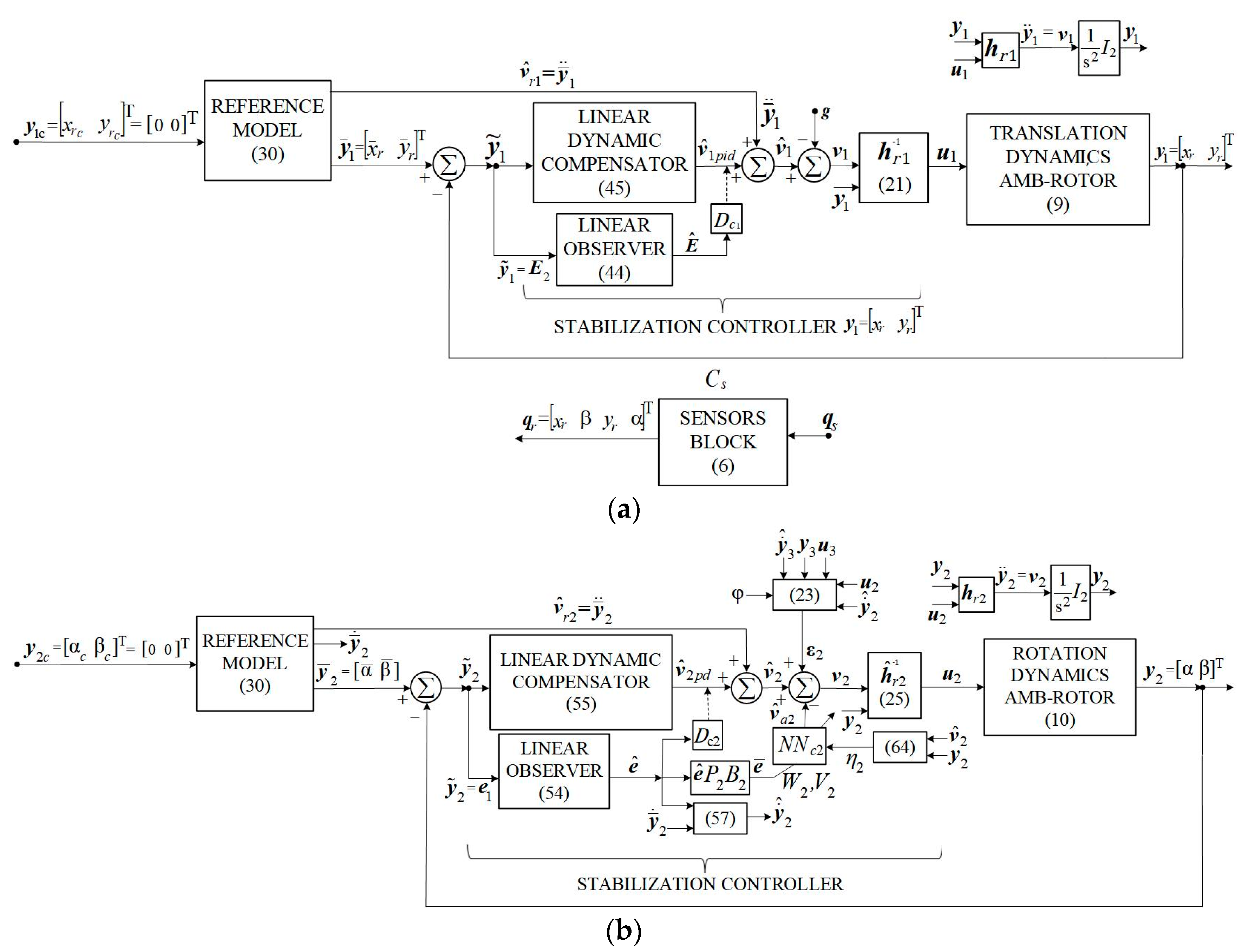
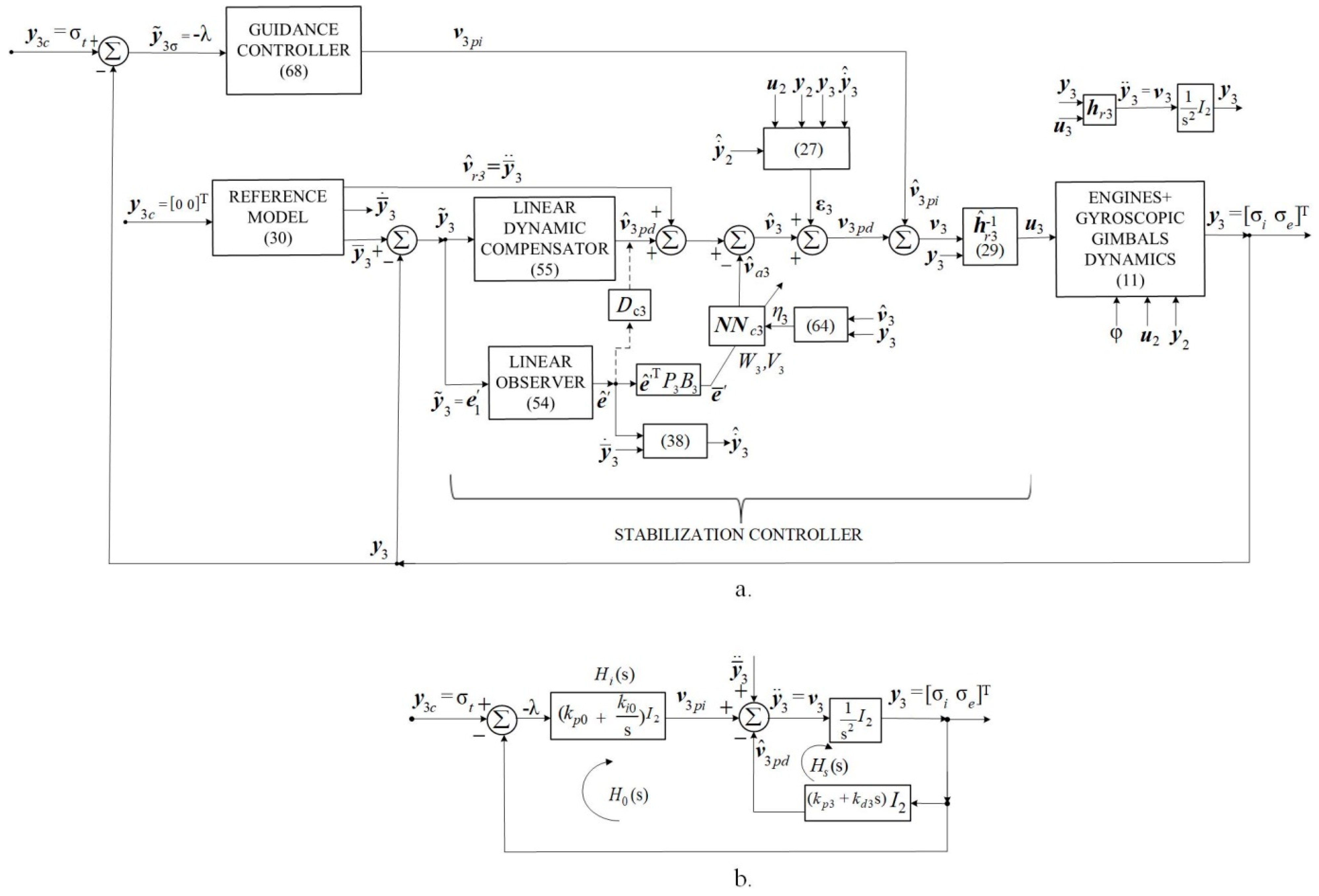
Figure 2 and
Figure 3, one reference model of 2nd order is chosen each with the transfer matrix form from [
32].
where
the unit matrix (2 × 2),
and
rad/s.
The mission of the adaptive component
is to compensate the inversion error
; for a stabilized regime,
, and the dynamic compensator’s output
; implicitly,
and
. The presence on the direct path of each system in
Figure 2 and
Figure 3 of some 2nd order ideal integrators, and the choice of the P.D. type or P.I.D. type linear dynamic compensators, leads to the conclusion that, in a stabilized regime,
and
. If one chooses
, then, for a stabilized mode,
; this is why the component
was introduced into
.
In order to increase the accuracy of the control system of the gyroscopic rotor’s linear deviations
and
compared to the zero values imposed on the control law of the vector
, an integrating component was also introduced. So, for the structure in
Figure 2a, a dynamic compensator is chosen, whose transfer matrix is
where
,
,
, while for the systems in
Figure 2b and
Figure 3
where
,
.
To calculate the coefficients of the linear dynamic compensators, the following characteristic equation is used:
based on the hypothesis
.
Equation (33) is equivalent, for the systems in
Figure 2a, to the following form:
The output of the P.I.D. type dynamic compensator in
Figure 2a is
where
,
,
,
.
Introducing Equation (36) into
, one obtains a new form, as follows:
equivalent to
Let
be the state vector of the linear subsystem resulting from the compensation of the
function with the
function
;
, where
Equation (38) is equivalent to the following state equation system:
or to the state equation
where the matrices
and
have the forms
The linear state observer is described by the following equation (where
is the estimate of the state vector
):
where
State observer’s Equation (42) is equivalent to
where
Linear state observer’s amplification matrix is calculated so that the matrix has the imposed eigenvalues located in the left complex semiplane.
The coefficients , and of the matrices , and are calculated according to the roots imposed on Equation (34).
According to Equation (35), the command law
might be expressed by one of the following forms:
where
the second form, (45b), is advantageous, because the first form, (45a), involves the introduction of additional sensors (linear speed sensors, for
and
) to determine the derivative component
, while the second form uses the estimated vector
.
For the subsystem in
Figure 2b and the stabilizing subsystem in
Figure 3,
with
and
.
The command law
has the form
The state vector of each linear system
j (
) consisting of a linear dynamic compensator and the subsystem with the transfer matrix
is
for
,
, while for
one obtains
.
Introducing Equation (47) into
, one obtains the equation of the linear system with the input
and the output
:
equation equivalent to the following state equation system
respectively, to the state equation
where
The linear state observer (with
the estimate of the vector
) is described by the following equations:
with
The Equation (52) are equivalent to
The amplification matrix of the linear state observer j is calculated so that the matrix has the imposed eigenvalues located in the left complex semiplane.
According to Equation (46), the command law
might be expressed by one of the following forms:
where
To avoid the need to introduce additional sensors for angular velocities ( and , respectively, and ), the second form of the law (55b) will be used.
The coefficients
and
of the matrices
and
are calculated according to the roots imposed on the following equation:
We specify the fact that in the calculation form of the function
, of the form in (29), respectively, in Equation (23) for the calculation of
, the estimated vectors
and
are used instead of the vectors
and
. Therefore,
with
as the second component of the estimated vector
, respectively,
with
as the second component of the estimated vector
;
and
are provided by the reference models;
. Similarly,
and
;
.
With the estimated vectors
and
, the
neural network’s training vectors are calculated:
where
and
are
matrices, solutions of the Lyapunov equations:
and
are positively defined matrices, while the adaptive command laws are calculated with the formulas in [
30]:
where
and
are the weight matrices of the neural networks
, the solutions of the differential equations
with
and
,
the derivative of the sigmoidal function
having the form
, being the activation potentials,
and
the number of neurons in the input layer and, respectively, in the hidden layer of the neural network
j.
The input vector
, of the
neural network has the form in [
30]:
where
is the sampling step.
The AMB rotor’s translation dynamics are physically decoupled from the other two dynamics and, implicitly, the control of the first one is decoupled from the control of the other two. These ones, the dynamics 2 (of the AMB rotor’s rotation) and the dynamics 3 (of the gyroscopic gimbal’s rotations) are connected (intrinsically, physically, and phenomenologically). These two dynamics’ terms, other than those that contain exclusively the dynamics’ inputs and outputs, are included in the blocks for calculating dynamic inversion errors ( and ); the effects of these dynamic inversion errors are compensated by the adaptive components of the control laws () provided by neural networks. As a result, in a stabilized regime, the two subsystems effectively become (physically) decoupled.
The adaptive control law for the compensation of the disturbance effect was deduced by the authors of the paper [
30], using the theory of Lyapunov functions, for a wide class of nonlinear systems that verifies the conditions of hypothesis 1 in [
29].
According to
Figure 1a,c, the elevations of the guide line
and of the sight line
, as well as the deviation of the sight line from the guide line, can be expressed in the form of algebraic vectors, which have as component elements the respective angles in the planes
and
,
In stabilized mode, the gyroscopic rotor is centered, which means that the gyroscopic rotor’s
axis overlaps the inner gimbal’s
axis (identical to the CT’s axis); therefore,
while the line of sight overlaps the target line (the guide line), that means that
and the kinetic moment vector
is oriented in the direction of the guide line.
The guidance controller will be chosen as P.I. type, having the output
with
and
.
Figure 3b depicts the block diagram of the linear subsystem (for
,
). The inner (stabilization) contour has the transfer matrix
while the outer (guidance, orientation) contour has the transfer matrix
For the calculation of the coefficients
and
of the matrices
and
, the roots of the characteristic equation
must be located in the left complex semiplane.
According to
Figure 3b,
in stabilized mode
so
~ (OT—guidance line’s angular rate). Therefore, the signals proportional to the
vector’s components
and
, provided by the CT target’s coordinator, are applied to the flight vehicle’s (missile) autopilot, in order to orientate it toward the T—target, so, the guidance line translates parallel to itself until the interception point (
), according to the self-steering method by parallel approach [
31].
5. Numerical Simulations
One has studied the dynamics of the DGMSGG, consisting of the systems shown in
Figure 2. The numerical values of the parameters used for the calculations are as follows:
kg;
m;
m;
N/A;
N/m;
N.m.s
2/rad;
N.m.s
2/rad;
N.m.s
2/rad;
N.m.s
2/rad;
N.m.s
2/rad;
N.m/A;
N.m/A;
N.m/rad/s;
m;
m;
m/s;
rad;
rad;
rad/s;
deg;
deg;
rad/s;
deg;
deg;
rad;
;
rad/s;
rad/s;
rad;
rad.
The coefficients related to the neural networks have the values: ; ; ; ; ; ; neurons; neurons; neurons; ; ; neurons; neurons; neurons; ; ; ; . For the controllers, the following coefficients were chosen: ; ; ; ; ; ; .
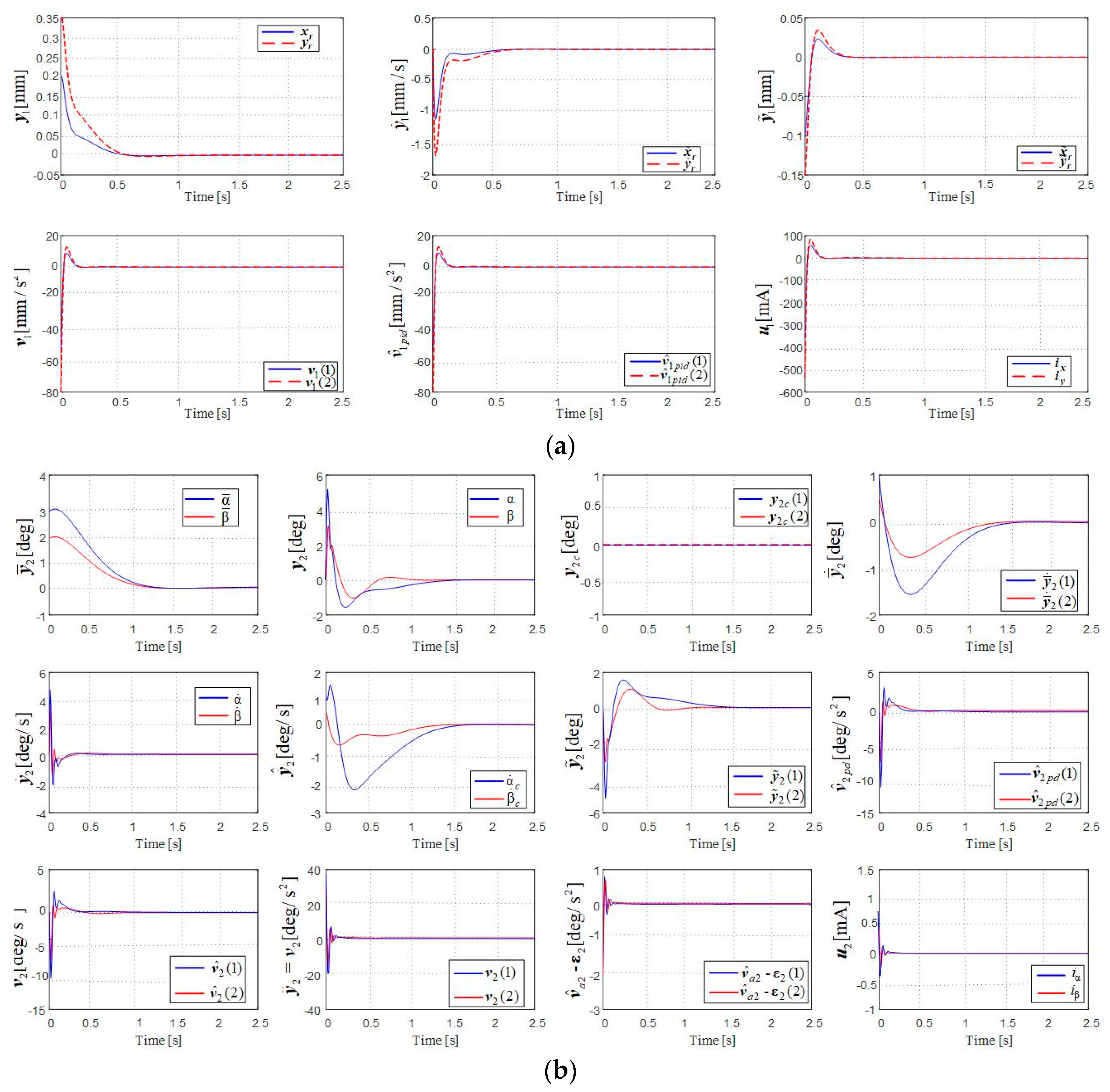
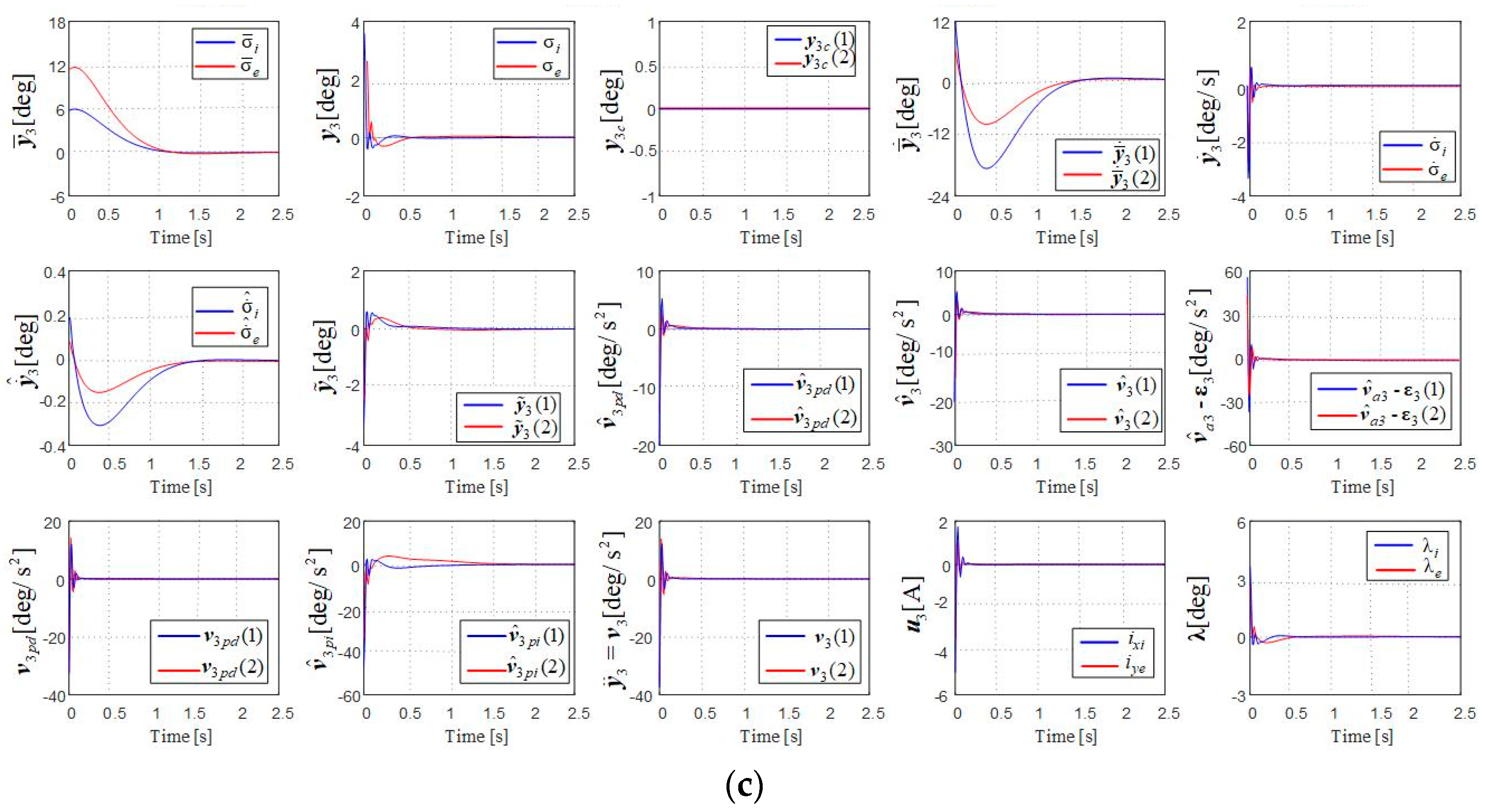
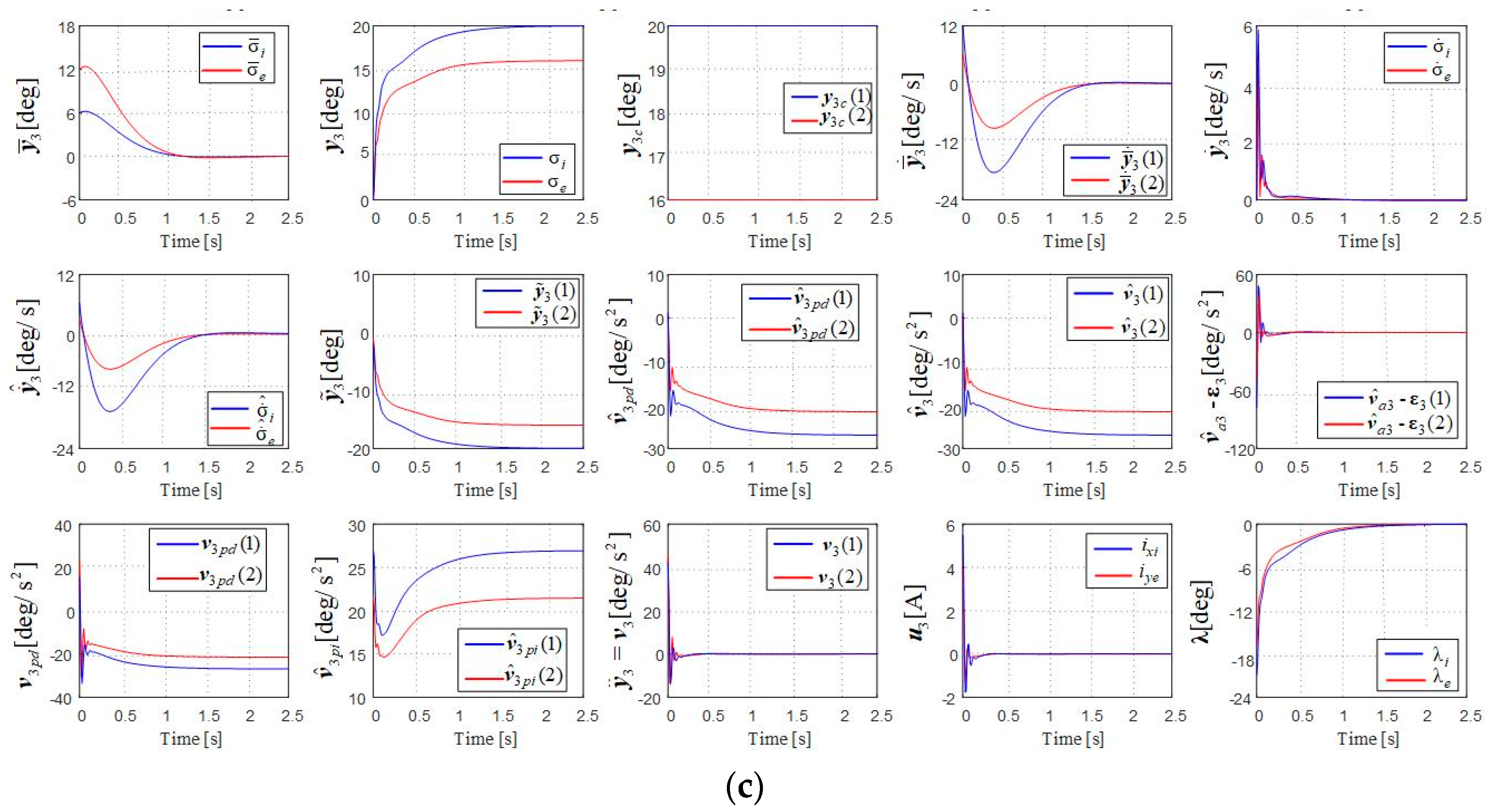
One has performed a simulation using Matlab/Simulink, and the dynamic characteristics were obtained, as depicted in
Figure 4 and
Figure 5.
The durations of the dynamic regimes are under one second, even under 0.5 s and fall within the imposed limits. The stationary errors are zero.
The dynamic characteristics for the first subsystem (in
Figure 2a) for the stabilization and orientation modes are identical (the first six groups of graphs in
Figure 4a and the first six groups of graphs in
Figure 5a), because the subsystem in
Figure 2a is decoupled from those in
Figure 2b and
Figure 3a for both modes (stabilization and orientation).
The next 12 groups of graphs in
Figure 4b and in
Figure 5b express the dynamics of the variables of the subsystem in
Figure 2b for the stabilization mode and the orientation mode, respectively. The graphs for
,
, and
are effectively identical for the two operating modes, as they are state variables related to the reference model (30), which is not influenced by the subsystem in
Figure 3a.
For both modes, the variables in
Figure 2b stabilize at zero (
). So, the adaptive components compensate for dynamic inversion errors, implicitly
, and the AMB rotor’s rotation angles, its rates and its angular accelerations cancel out, as required (imposed) in the design stages.
Therefore, the first six groups of graphs, as well as the next twelve groups of graphs, confirm that the linear and angular (precession angle) displacements, along with their rates and accelerations, cancel out, meaning that the AMB rotor’s axis overlaps the inner gimbal axis (the same as the CT axis). The currents applied to the stator coils of the magnetic bearings also become zero ( mA).
The last 15 groups of graphs in
Figure 4c and in
Figure 5c express the dynamics of the variables belonging to the subsystems in
Figure 3a, for the stabilization mode
and, respectively, for the orientation mode
and
. The state variables of the reference model are identical for both regimes, since the reference model is not influenced by either of the two subsystems. Other conclusions are similar to those for
Figure 2b;
,
,
,
,
,
A,
.
6. Conclusions
This paper first introduced the DGMSGG’s structure and functions/tasks. Starting from the dynamic models of the DGMSCMG’s subsystems in [
8,
15], the models of the DGMSGG’s subsystems are established (see (9), (10) and (11)), also taking into account the angular rates of the base (missile), with the predominance of the angular rate of the missile around its longitudinal axis, which generates the angular rate
around the guidance line. The relative degree in relation to each of the output variables is two.
The three DGMSGG’s subsystems were designed as decoupled systems, using linear dynamic compensators of P.I.D., P.D. and P.I. type. Excepting the subsystems for the automatic control of the dynamics of translation and rotation of the AMB rotor, the subsystem for the control of the gyroscopic gimbal’s dynamics consists of the stabilization contour (with a P.D. type dynamic compensator) and the guidance contour (with a P.I. type dynamic compensator). The controllers for stabilizing the rotations of the AMB rotor and of the gimbals contain, in addition to the linear dynamic compensators of P.D. type, a state observer and a neural network for modeling the adaptive component, this playing the role of compensating the effect of dynamic inversion errors. The design of the adaptive control laws for the three subsystems is based on the works of Calise, for example [
30], using the concept of dynamic inversion and the theory of Lyapunov functions, applicable for wide classes of systems described by nonlinear functions, which satisfy the conditions of hypothesis 1 in [
29].
The control vector
contains (see
Figure 2a) the currents
and
, which are applied to the stator coils of the magnetic bearings in the
and
axes of the AMB rotor to cancel its linear displacements, while the vector
contains the currents
and
, which are applied to the same coils to cancel the angular displacements of the rotor; these currents generate electromagnetic forces and, respectively, correction torques, with the aim of centering (orienting) the axis of the gyroscopic rotor (the axis of the kinetic moment
) in the direction of the axis of the inner frame (CT‘s axis), in fact, the line of sight. The command vector
contains the currents
and
, which are applied to the motors for driving the gimbals, for their stabilization and orientation, so that the
axis (CT’s axis, the line of sight) overlaps with the
axis (the guide line).
The calculation of the linear dynamic compensators’ parameters is performed by imposing the roots of the characteristic Equations (34), (56), and (71) related to the linear subsystems, resulting from the compensation of the dynamic inversion errors by the adaptive components of the control laws (following the compensation of the nonlinear functions by the functions ).
The controlled state variables related to the AMB rotor (components of the
vector) are calculated with Formula (6) using the components of the
vector (measured by the total linear displacement sensors, arranged on the rotor axes). The rotation angles
and
of the gimbals are measured by the angular transducers arranged along the DGMSGG gimbals’ axes (both inner and outer gimbal), as shown in
Figure 1a. To determine the state variables
,
,
,
,
, and
, the three linear state observers (44), (55), and (54) are used, as well as the state variable vectors
and
of the reference models.
According to Formula (73), the missile guidance signals are the very components of the
vector (signals provided by the CT for the orientation contour of the system in
Figure 3), which is applied to the missile autopilot for its guidance by the parallel approach method (the translation of the guidance line parallel to itself to the point of interception of the target).
The theoretical results are validated by numerical simulation, using Matlab/Simulink models. The dynamic characteristics in
Figure 4 and in
Figure 5 express superior quality indicators (small overshoots, small stationary errors and also small settling times or small durations of dynamic regimes).
Summarizing the above, we can specify the following elements of novelty and modernity brought by this paper:
A new guidance system structure (guiding head) with a magnetically suspended gyroscope.
New nonlinear models describing the interconnected dynamics of the gimbals and rotations of the magnetically suspended gyroscope.
Decoupling the three nonlinear dynamics (the dynamics of the gyroscopic rotor’s translations from the dynamics of its rotations and from the dynamics of gimbals’ rotations), the physical coupling terms of the three dynamics being included in the dynamic inversion errors.
Deducing the relative degrees of the three output vectors of those three nonlinear dynamics, separating the nonlinear functions , (which depend only on the input and output vectors of the nonlinear dynamics ) from the dynamic inversion errors (which contain nonlinear terms—acting as internal perturbations—and the terms depending on the external perturbations induced by the rotations of the base—the missile).
Design of control structures for the three nonlinear dynamics. Using the concept of dynamic inversion, if dynamic inversion errors were absent, the three dynamics would be linear (having transfer matrices ) and the controllers used would be conventional linear (P.D. or P.I.D. type). However, even in this case (with linear models), coupling errors would lead to stabilization and orientation errors (thus, reducing the accuracy of these subsystems), errors which could not be eliminated, but only diminished.
To increase the precision and other quality indicators of the above-mentioned three subsystems’ dynamics, we considered it necessary to compensate for the effects of these dynamic inversion errors (which, in fact, represent disturbances). Their effects are the same as those of some disturbing external inputs, which cannot be eliminated, but can be completely compensated by the adaptive components , which represent the estimation of the dynamic inversion errors . Based on the information collected from the evolution of the vectors , from the output vectors , as well as from the training vectors , the neural networks estimate the effects of the internal disturbances of the dynamics of the rotors and gimbals’ rotations. As a result, the equivalent dynamics are reduced to two ideal integrators in series and, implicitly, the deviations are canceled (zero static errors). So, such structures with adaptive control, from the performance’s point of view, are superior to those based on conventional control.
In order to use a minimum number of sensors, both for calculating the linear components of the controllers (the outputs of the linear dynamic compensators) and for calculating the training vectors of the neural networks, linear state observers and reference models were used.
A comparison with the performance of other similar system structures can only be made if the same dynamic models are used, having the same numerical values of their physical parameters, but only on the condition of using suitable estimators for disturbances.