Article

Simple Fabrication of Solid-State Nanopores on a Carbon Film
1
Department of Biotechnology and Life Science, Tokyo University of Agriculture and Technology, Tokyo 184-8588, Japan
2
Department of Mechanical Engineering, Nagaoka University of Technology, Niigata 940-2188, Japan
3
JEOL Ltd., Tokyo 196-8558, Japan
*
Authors to whom correspondence should be addressed.
Micromachines 2021, 12(9), 1135; https://doi.org/10.3390/mi12091135
Submission received: 6 August 2021 / Revised: 15 September 2021 / Accepted: 18 September 2021 / Published: 21 September 2021
(This article belongs to the Special Issue Frontiers in Micromachines in Japan)

Abstract

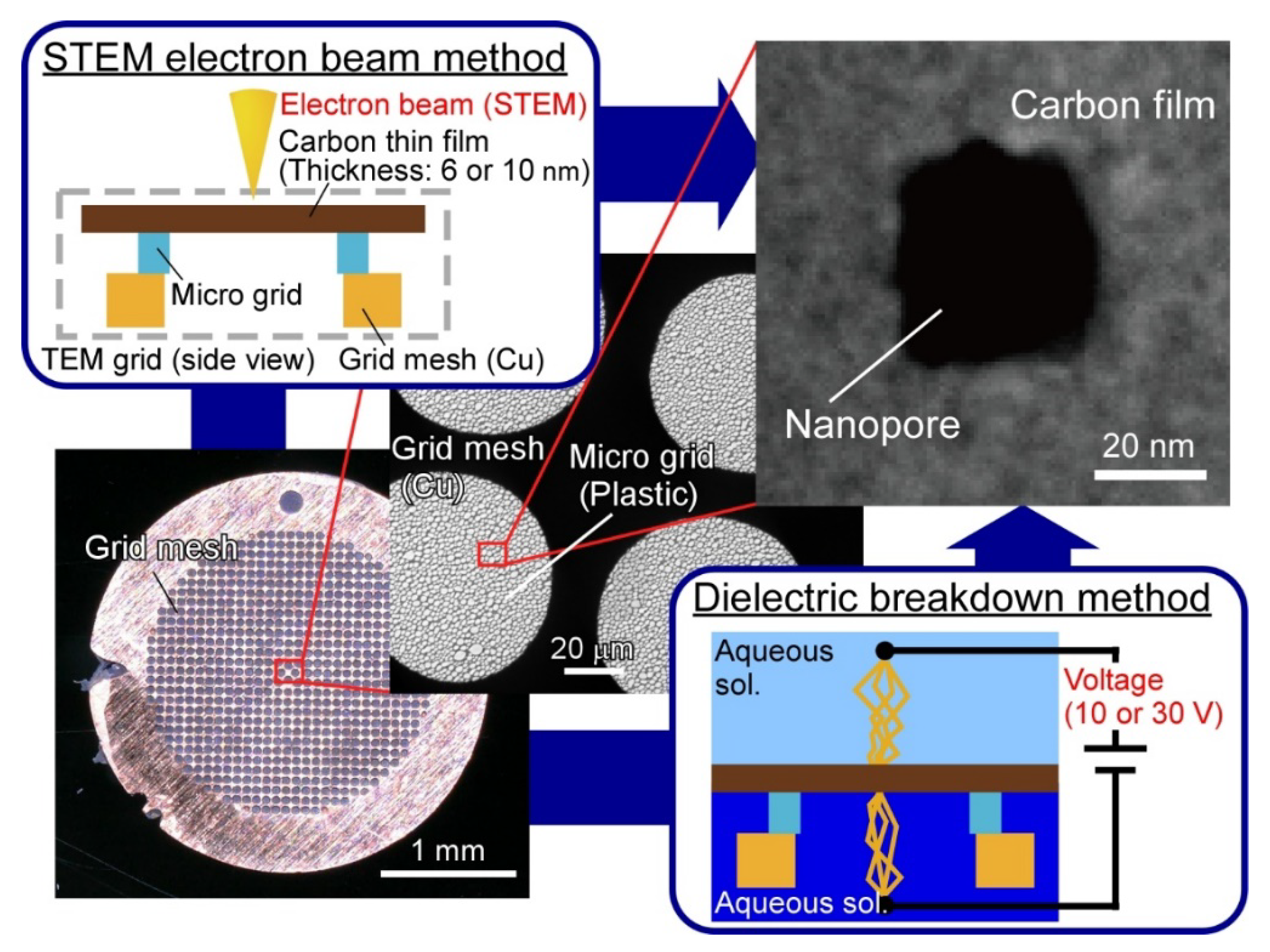
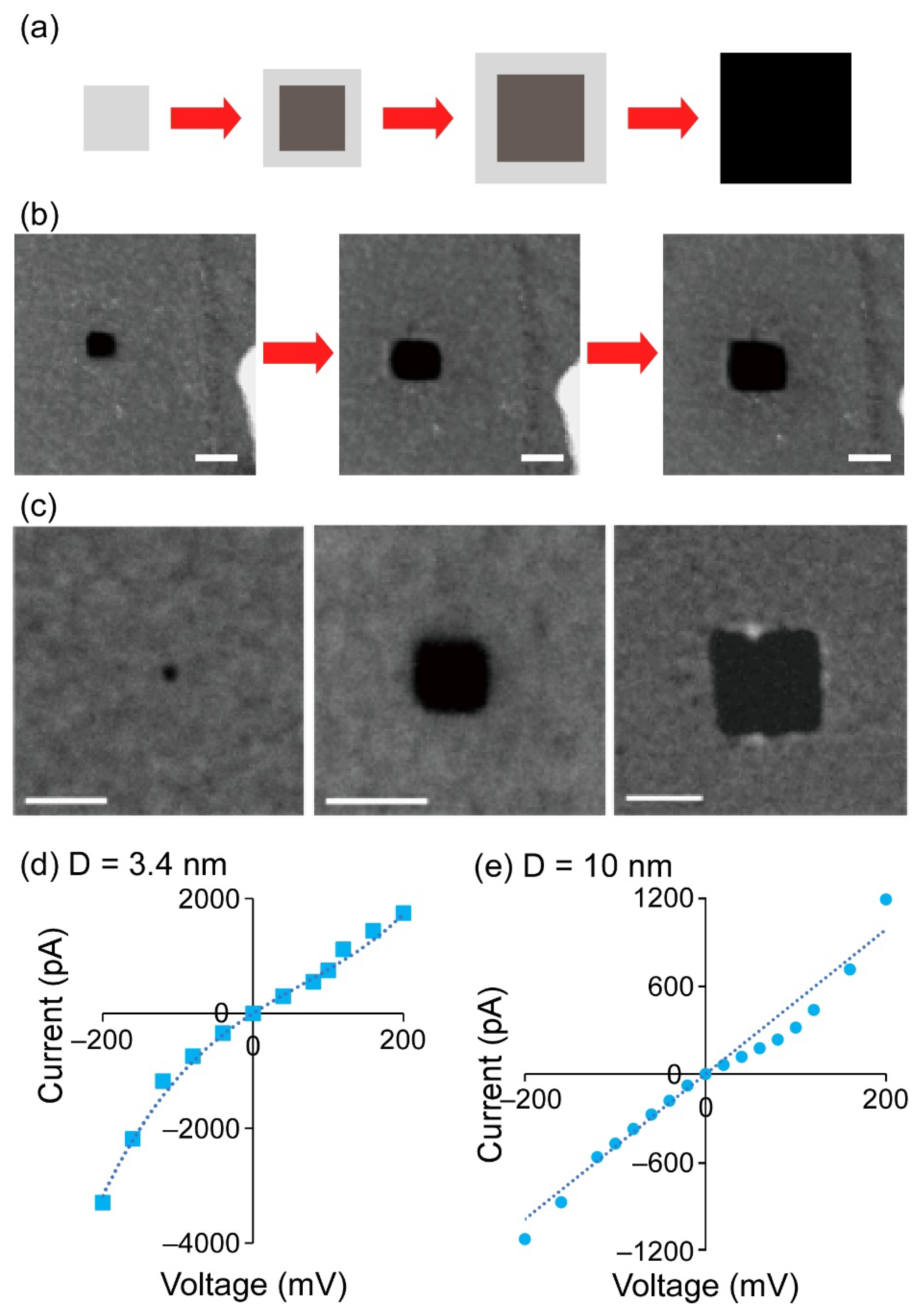
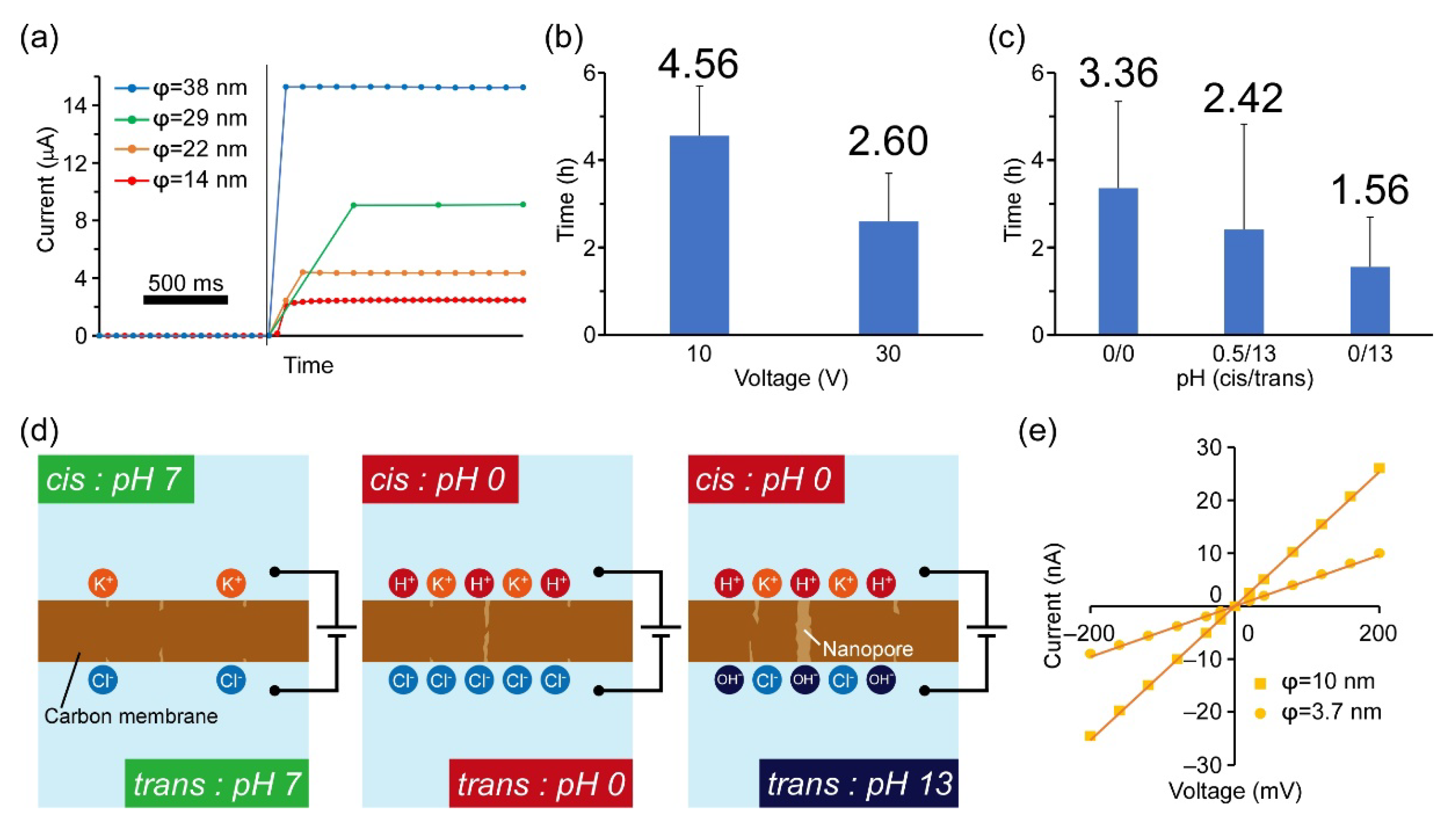
Solid-state nanopores are widely used as a platform for stochastic nanopore sensing because they can provide better robustness, controllable pore size, and higher integrability than biological nanopores. However, the fabrication procedures, including thin film preparation and nanopore formation, require advanced micro-and nano-fabrication techniques. Here, we describe the simple fabrication of solid-state nanopores in a commercially available material: a flat thin carbon film-coated micro-grid for a transmission electron microscope (TEM). We attempted two general methods for nanopore fabrication in the carbon film. The first method was a scanning TEM (STEM) electron beam method. Nanopores were fabricated by irradiating a focused electron beam on the carbon membrane on micro-grids, resulting in the production of nanopores with pore diameters ranging from 2 to 135 nm. The second attempt was a dielectric breakdown method. In this method, nanopores were fabricated by applying a transmembrane voltage of 10 or 30 V through the carbon film on micro-grids. As a result, nanopores with pore diameters ranging from 3.7 to 1345 nm were obtained. Since these nanopores were successfully fabricated in the commercially available carbon thin film using readily available devices, we believe that these solid-state nanopores offer great utility in the field of nanopore research.
Keywords: nanopore; solid-state nanopore; carbon thin film; dielectric breakdown nanopore; solid-state nanopore; carbon thin film; dielectric breakdown