Review

Engineered Microgels—Their Manufacturing and Biomedical Applications

by
Hamzah Alzanbaki
,
Manola Moretti
and
Charlotte A. E. Hauser
*
Laboratory for Nanomedicine, Division of Biological and Environmental Science and Engineering, King Abdullah University of Science and Technology, 4700 Thuwal, Jeddah 23955-6900, Saudi Arabia
*
Author to whom correspondence should be addressed.
Micromachines 2021, 12(1), 45; https://doi.org/10.3390/mi12010045
Submission received: 19 October 2020 / Revised: 24 December 2020 / Accepted: 24 December 2020 / Published: 1 January 2021

Abstract

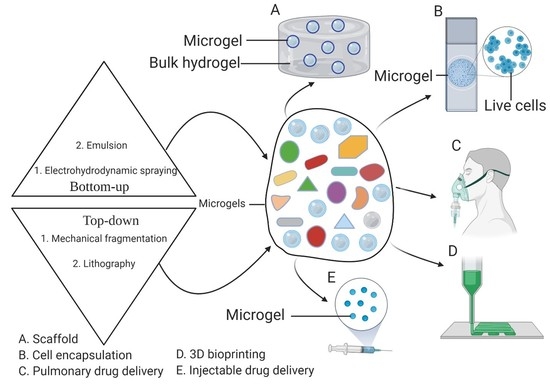
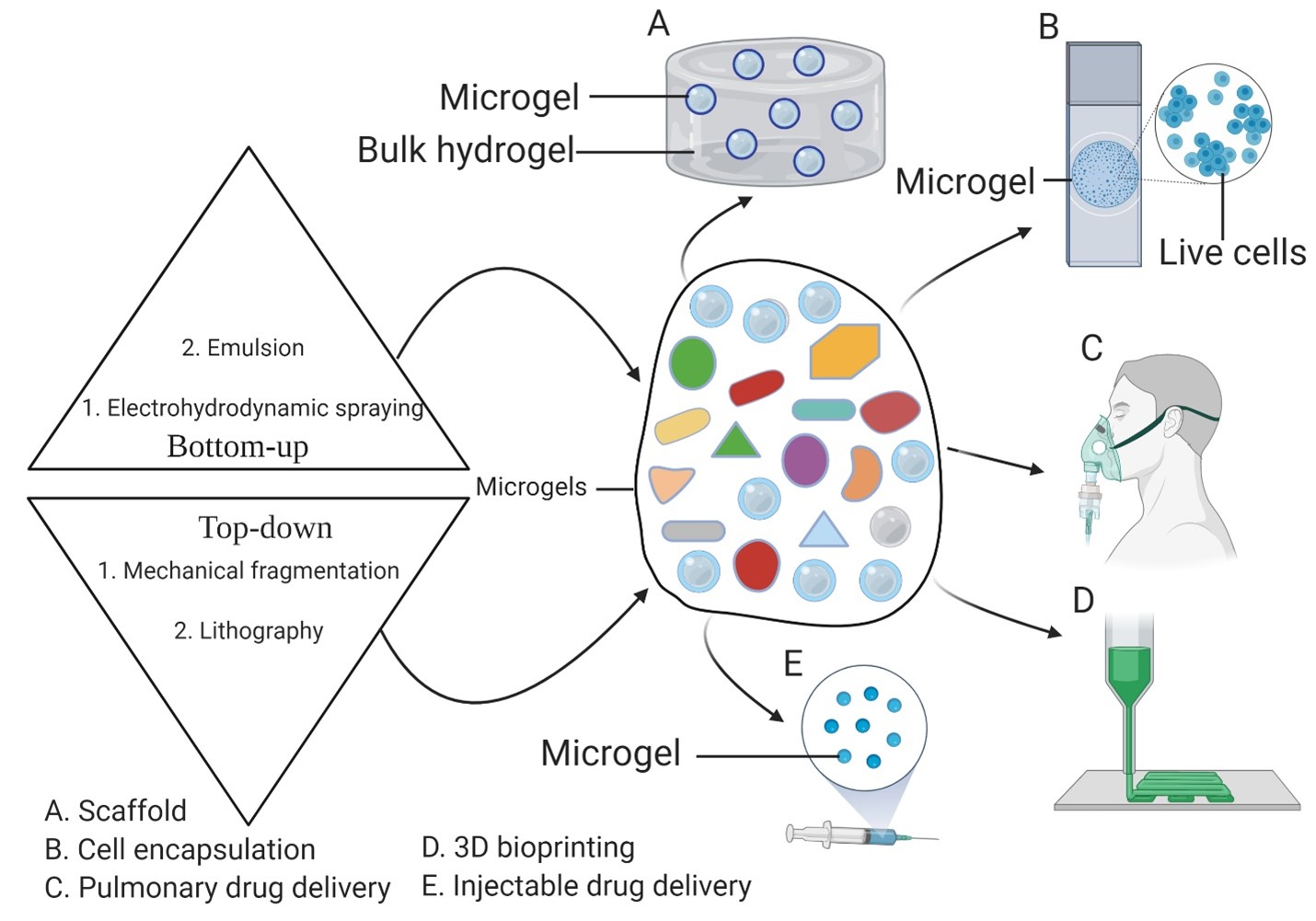
Microgels are hydrogel particles with diameters in the micrometer scale that can be fabricated in different shapes and sizes. Microgels are increasingly used for biomedical applications and for biofabrication due to their interesting features, such as injectability, modularity, porosity and tunability in respect to size, shape and mechanical properties. Fabrication methods of microgels are divided into two categories, following a top-down or bottom-up approach. Each approach has its own advantages and disadvantages and requires certain sets of materials and equipments. In this review, we discuss fabrication methods of both top-down and bottom-up approaches and point to their advantages as well as their limitations, with more focus on the bottom-up approaches. In addition, the use of microgels for a variety of biomedical applications will be discussed, including microgels for the delivery of therapeutic agents and microgels as cell carriers for the fabrication of 3D bioprinted cell-laden constructs. Microgels made from well-defined synthetic materials with a focus on rationally designed ultrashort peptides are also discussed, because they have been demonstrated to serve as an attractive alternative to much less defined naturally derived materials. Here, we will emphasize the potential and properties of ultrashort self-assembling peptides related to microgels.
Keywords: microgels; self-assembling peptides; biofabrication; 3D bioprinting; cell-laden constructs microgels; self-assembling peptides; biofabrication; 3D bioprinting; cell-laden constructs
Graphical Abstract