Review

Hemodiafiltration in Dialysis Practice: Global Adoption, Toxin Clearance, Inflammation Control, and Clinical Safety


1
Clinical Research, Global Medical Office, Fresenius Medical Care Deutschland GmbH, 61352 Bad Homburg, Germany
2
Product Development, Fresenius Medical Care Deutschland GmbH, 66606 Sankt Wendel, Germany
3
Clinical Research, Global Medical Office, Fresenius Medical Care, New York, NY 10065, USA
4
Katz School of Science and Health, Yeshiva University, New York, NY 10016, USA
*
Author to whom correspondence should be addressed.
Toxins 2026, 18(8), 329; https://doi.org/10.3390/toxins18080329

Submission received: 30 June 2026 / Revised: 23 July 2026 / Accepted: 24 July 2026 / Published: 28 July 2026

Abstract

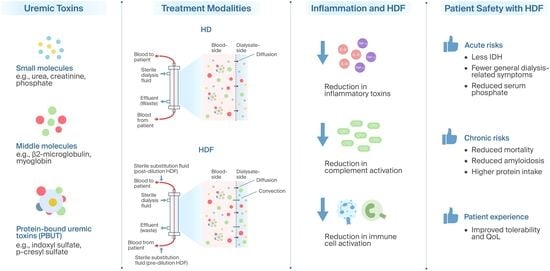
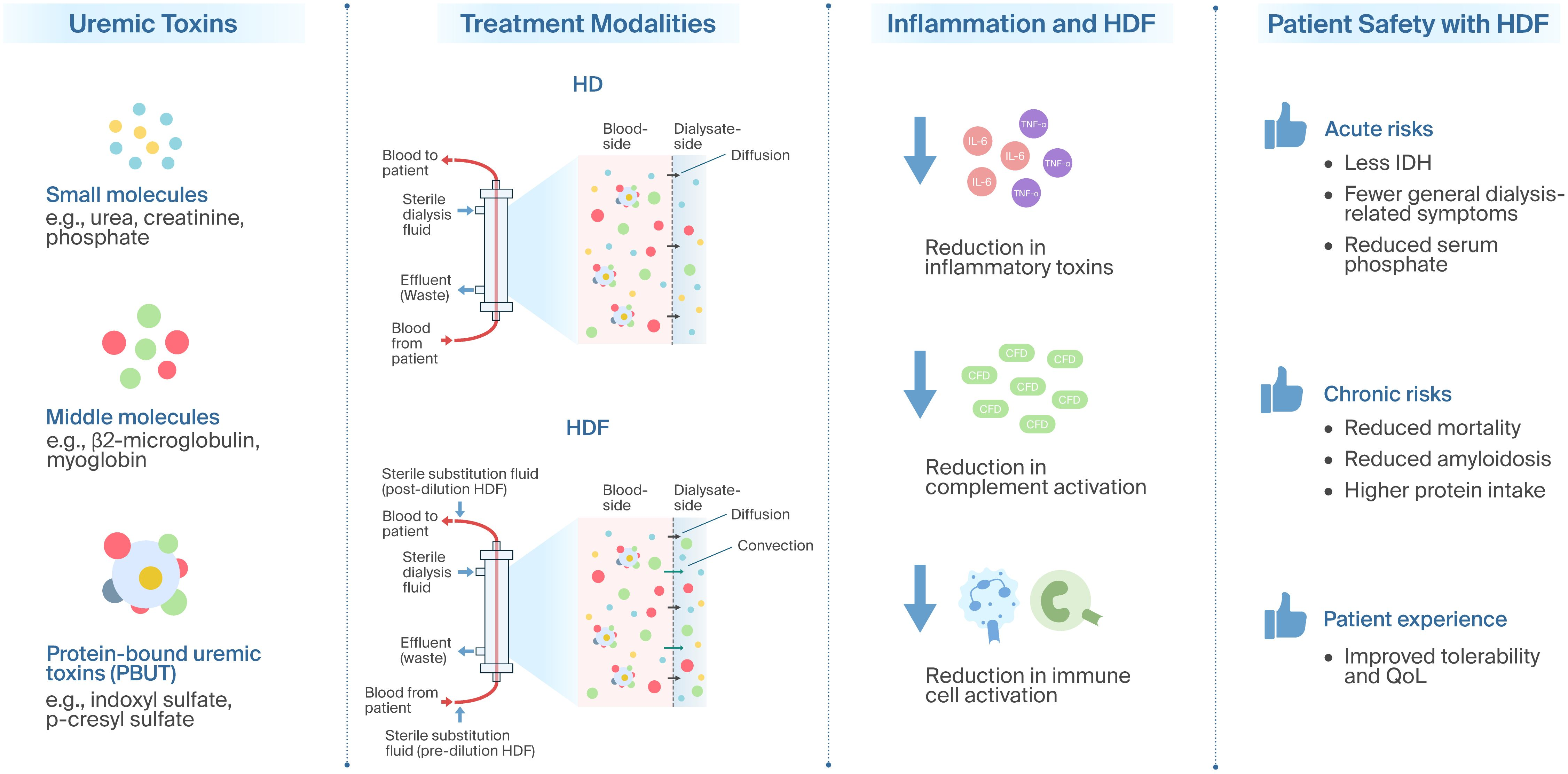
Hemodiafiltration (HDF) combines diffusion and convection to enhance solute removal compared with hemodialysis (HD). While widely adopted in Europe and parts of Asia, uptake elsewhere remains limited due to regulatory, reimbursement, and infrastructural constraints. Recent randomized trials, large observational studies, and meta-analyses have renewed interest in HDF, particularly post-dilution HDF achieving convection volumes of ≥23 L/session, in which the most consistent clinical benefits have been observed. This review summarizes the mechanistic rationale, clinical effects, and safety profile of high-volume HDF. Compared with HD, HDF provides consistently superior removal of middle molecules, whereas clearance of protein-bound uremic toxins (PBUTs) remains constrained by albumin binding and compartmental redistribution, resulting in only modest or variable advantages. Emerging strategies aimed at releasing or capturing PBUTs may address this gap. Beyond solute removal, evidence suggests that HDF may lower micro-inflammation by enhanced clearance of inflammatory mediators and reduced immune activation. When delivered with adequate infrastructure, monitoring, modern equipment, ultrapure fluids, trained staff, appropriate vascular access, and anticoagulation, high-volume HDF has a favorable safety profile and is associated with fewer intradialytic hypotension (IDH) events and improved treatment tolerability. Available evidence has not identified a consistent excess risk of device- or infection-related complications, although comparative data remain limited. Overall, current evidence supports clinically relevant advantages of high-volume HDF under optimal treatment conditions. However, important challenges remain, particularly the limited removal of PBUTs, underscoring the need for further innovation in uremic toxin management.
Keywords: small-molecule solutes; middle-molecule solutes; protein-bound uremic toxins; inflammation; safety small-molecule solutes; middle-molecule solutes; protein-bound uremic toxins; inflammation; safety
Graphical Abstract