Article

New Furoisocoumarins with Phytotoxic Activity from the Fungus Aspergillus calidoustus VKM F-4916


by
Tatiana V. Antipova
1,2,*,
Vsevolod R. Dubovik
2,
Anton N. Yurchenko
2,3,
Olesya I. Zhuravleva
3,
Valentina P. Zhelifonova
1,
Elizaveta G. Lukina
2,
Boris P. Baskunov
1,
Oussama Abdelhamid Mammeri
4,
Sergey N. Smirnov
4,
Natalya E. Ivanushkina
1,
Kirill V. Zaitsev
5,
Qunfang Weng
6,
Mikhail B. Vainshtein
1 and
Alexander O. Berestetskiy
2
1
G. K. Skryabin Institute of Biochemistry and Physiology of Microorganisms, Federal Research Center Pushchino Scientific Center for Biological Research of the Russian Academy of Sciences, Pushchino 142290, Russia
2
All-Russian Institute of Plant Protection, Saint-Petersburg 196608, Russia
3
G.B. Elyakov Pacific Institute of Bioorganic Chemistry, Far Eastern Branch of the Russian Academy of Sciences, Vladivostok 690022, Russia
4
Institute of Chemistry, Saint-Petersburg State University, Saint-Petersburg 199034, Russia
5
Department of Chemistry, Lomonosov Moscow State University, Moscow 119991, Russia
6
Faculty of Plant Protection, South China Agricultural University, Guangzhou 510642, China
*
Author to whom correspondence should be addressed.
Toxins 2026, 18(5), 234; https://doi.org/10.3390/toxins18050234
Submission received: 20 April 2026 / Revised: 15 May 2026 / Accepted: 17 May 2026 / Published: 20 May 2026
(This article belongs to the Special Issue Fungal Phytotoxins: A Themed Issue in Honor of Prof. Antonio Evidente)

Abstract

Aspergillus fungi are a source of low-molecular compounds of various structures possessing biological activities. We investigated the secondary metabolite profile of the soil fungus A. calidoustus VKM F-4916. The strain was found to synthesize new metabolites attributed to furoisocoumarins, which we named asperisocoumarin J and K, and a known siderophore desferritriacetylfusigen. The structure of asperisocoumarin J and K were determined by mass spectrometry and NMR spectroscopy. Asperisocoumarins J, K and desferritriacetylfusigen possessed a phytotoxicity, inhibiting the lettuce root growth. Sow thistle leaf and wheat leaf cuttings were sensitive to the action of asperisocoumarin J and K at a concentration of 5 mg/mL. Analysis of the structures of furoisocoumarins (asperisocoumarins J and K) using the online resource Pesti-DGI-Net showed that compounds had the physico-chemical properties favorable for pesticide development, in particular, fungicides and herbicides. An in-depth study of the phytotoxic properties of furoisocoumarins and their natural analogs is of interest in the context of the search for new herbicide compounds.
Key Contribution: The structure of a new metabolite belonging to furoisocoumarins was established using modern physicochemical methods. The compound exhibited phytotoxic properties. Furoisocoumarins have been shown to be promising for the development of new herbicides.

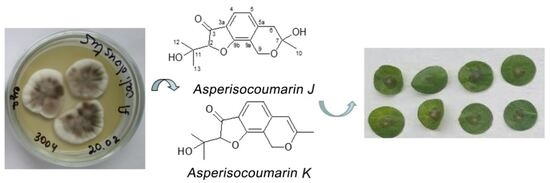
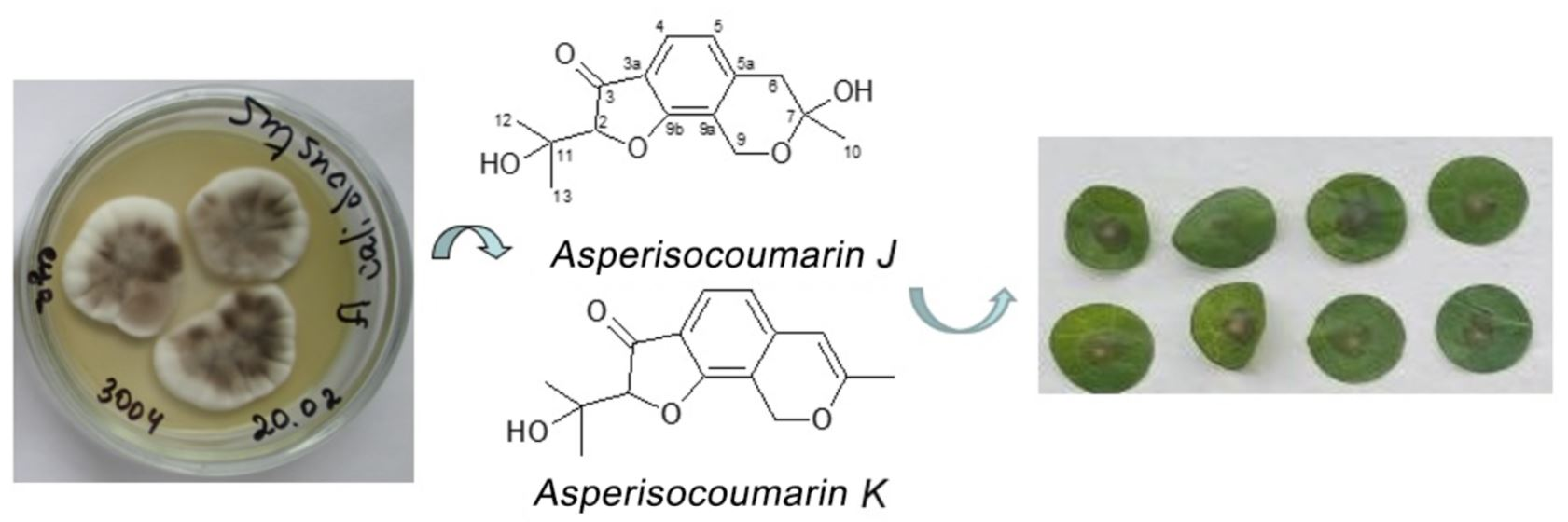
Graphical Abstract

1. Introduction

Fungi of the genus Aspergillus are well known for the production of numerous and diverse secondary metabolites with toxic or, in contrast, therapeutic potential [1]. Some of these metabolites can also be used as chemotaxonomic indicators to identify fungal species [2,3]. Structurally, these compounds belong to terpenoids, alkaloids, polyketides, etc. Several types of polyketides have been found in Aspergillus fungi, among which isocoumarins with various structural features are important natural compounds [4]. Although the structures of many secondary metabolites have already been established, chemotaxonomic studies have discovered many Aspergillus species that contain uncharacterized or unknown metabolites. Research on the latter is a way to discover new biologically active compounds of interest for various areas of the economy [5]. Recently, a promising area of research in plant protection against harmful organisms has been the search for natural compounds with pesticidal properties, since the excessive dependence of plant production on synthetic agrochemicals has led to negative consequences for humans and the environment [6,7].
The Aspergillus section Usti presents a huge diversity of representatives in various soils; they are also present in the air, on food products, plant residues, and industrial materials, and are known as causative agents of invasive infections in people with weakened immune systems [8,9]. Until the last decade, identification of A. ustus was based on phenotypic characteristics only, while high morphological variability was also observed between different strains of the same species. In recent years, the Aspergillus section Usti has been investigated with molecular tools, which have enabled the identification of new species within it [2]. These studies, along with molecular markers, used some species-specific markers, such as growth on selective media at a specific temperature, and features of the secondary metabolite spectrum. As a result, the A. ustus sensu lato species was divided into several, including A. ustus and A. calidoustus, with only the latter growing at 37 °C. During recent decades, studies have shown that clinical isolates of A. calidoustus have been obtained from immunocompromised patients, mainly during lung transplantation with azole treatment [10]. Austins, drimanes, ophiobolins G and H, TMC-120 B, and three unidentified compounds are considered to be chemotaxonomic markers among the secondary metabolites of A. calidoustus [2]. These metabolites have shown a wide diversity of biological activities. Further studies on A. calidoustus strains are, therefore, of significant interest to the research community.
To search for pesticide molecules, computational methods of chemo- and bioinformatics, tested for creating new drugs, are actively used. Several predictors that allow the selection of promising molecules have already been proposed, using existing experience in the creation of chemical pesticides and taking into account their biological activities, physicochemical properties, and mobility in plants [11,12]. To quantitatively assess pesticide likeness, a scoring function that includes a quantitative assessment of insecticide, fungicide, and herbicide likeness was established [13]. To date, an online platform, CoPLE, based on Pesti-DGI-Net has been developed. Pesti-DGI-Net serves as a valuable tool for the rational design of pesticide molecules [11].
This study is dedicated to the biosynthesis of secondary metabolites by A. calidoustus VKM F-4916 and their biological activity. The structures of new metabolites belonging to furoisocoumarins were established using modern physicochemical methods.

2. Results

2.1. Characteristics of the Strain

The cultural, morphological (phenotypic), and physiological characteristics of the VKM F-4916 strain revealed full compliance with the diagnostic features of the species A. calidoustus, including good growth at 37 °C (CYA 25–26 mm) and the violet coloration of agar blocks with mycelium using Ehrlich’s reagent [14]. At 25 °C, the diameters of colonies on the 7th day of growth were as follows: CYA, 30–31 mm; MEA, 44–45 mm; and YES, 35–36 mm. On CYA at 25 °C, the colonies were dense, woolly or velvety, and brown, and the reverse side was dull yellow. Conidiation was abundant; heads were spherical, loose, and disheveled; vesicles were 7–11 μm, spherical to elongated; and conidia were spherical, coarsely textured, and rough without spines, measuring 2.6–3.5 μm in diameter. The results of genotyping were consistent with the phenotypic study data of the culture. A high level of similarity of all sequences with the A. calidoustus type strain CBS 121601 (CaM, 100%; BenA, 99.77%; RPB2, 100%) and the reference strain A. calidoustus CBS 113228 (ITS, 99.89%) was demonstrated. All these data allowed us to identify VKM F-4916 as an A. calidoustus strain.

2.2. Determination of Secondary Metabolites from A. calidoustus Extract

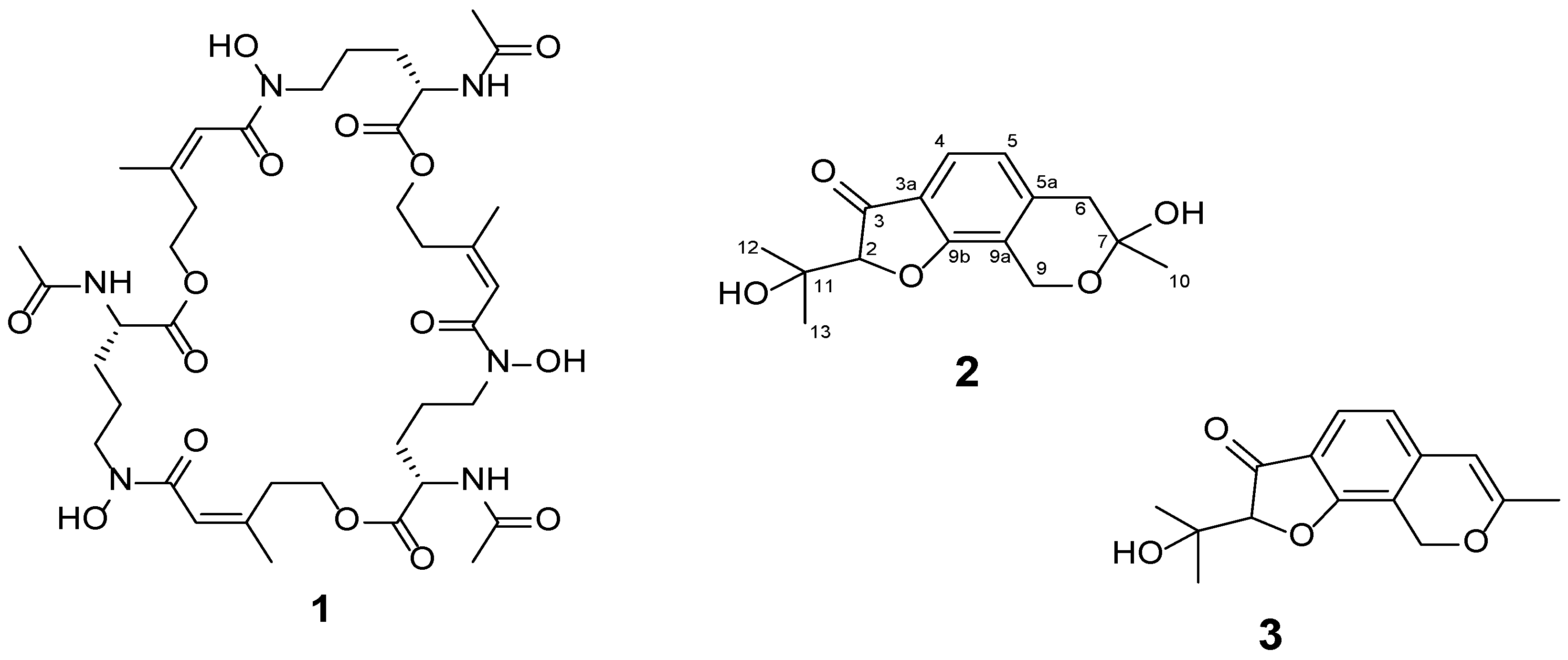
The extract contained the following metabolites (Table 1). Metabolite 1 reacted with the FeCl3 reagent to yield a brown coloration. No characteristic absorption bands in the UV spectrum were observed. Detection of molecular ions at 853 [M + H]+ and 851 [M − H], along with the sequential loss of m/z 284 fragments in the MS/MS spectra, indicated that this metabolite is formed by condensation of three identical-mass subunits. Based on its characteristics, metabolite 1 was identified as desferritriacetylfusigen (Figure 1). For metabolite 2, absorption bands at λmax 217, 265, and 329 nm were present in the UV spectrum; in the mass spectrum, molecular ions at 279 [M + H]+ and 277 [M − H] were observed. Metabolite 3 had absorption bands at λmax 214, 291, and 331 nm and a molecular mass of 260 Da.

2.3. Structure Elucidation of New Furoisocoumarins

Metabolite 2 was isolated as a yellowish amorphous powder. The molecular formula of the metabolite was determined as C15H18O5 based on a HR(+)ESI MS peak [M + Na]+ at m/z 301.1044 (calculated for C15H18O5Na 301.1046) and confirmed by 13C NMR spectral data; this formula corresponds to seven degrees of unsaturation.
A preliminary study of the 1H and 13C NMR spectra of compound 2 showed values close to those of asperisocoumarins [15]. According to the 1H NMR spectrum (Table 2, Figure S1), the molecule contained two aromatic protons H-4 and H-5 (δH 7.47 and 6.84 ppm) appearing as doublets (J = 8.0 Hz), two aliphatic methylene groups H2C-6 (δH 2.93, 3.00 ppm) and H2C-9 (δH 4.96, 4.88 ppm), one oxymethine proton H-2 (δH 4.37 ppm) and three methyl groups Me-10, Me-12 and Me-13 appearing as singlets (δH 1.60, 1.35, and 1.21 ppm).
According to 13C NMR spectral data (Table 2, Figure S2), the molecule contains 15 carbon atoms: one carbonyl carbon atom C-3 (δC 200.6 ppm), six aromatic carbon atoms C-3a, C-4, C-5, C-5a, C-9a, and C-9b (δC 119.55, 121.97, 123.40, 143.24, 119.30, and 169.1 ppm, respectively), two methylene carbon atoms C-6 and C-9 (δC 38.80 and 57.6 ppm), two quaternary carbon atoms C-7 and C-11 (δC 94.84 and 72.57 ppm), one oxymethine carbon atom C-2 (δC 89.82 ppm) and three methyl carbon atoms C-10, C-12 and C-13 (δC 29.4, 25.93, and 24.4 ppm).
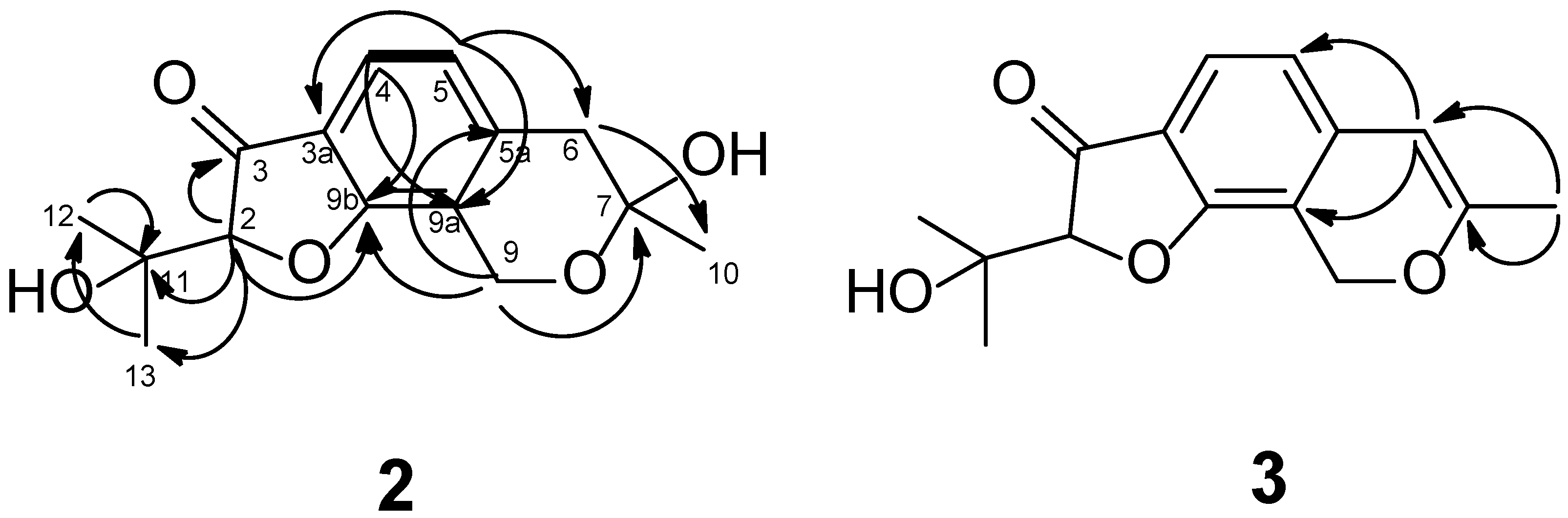
The HMBC correlations (Figure 2 and Figure S5) from H-2 to C-3 and C-9b, from H-4 to C-3, C-9b, and C-5a, from H-5 to C-3a, C-9a, and C-6, from H2-9 to C-5a, C-7, C-9a, and C-9b, and from H2-6 to C-5a, C-9a, and C-7 together with coupling constant 3J = 7.9 Hz between H-4 and H-5 confirmed the furoisocoumarin skeleton. HMBC correlations from H3-10 to C-7 and C-6, from H-2 to C-11, C-12, and C-13, from H3-12 to C-2, C-11, and C-12, and H3-13 to C-2, C-11, and C-13 indicated the location of Me-10 at C-7, and hydroxyisopropyl side chain at C-2. The presence of OH groups at C-7 and C-11 was suggested based on characteristic downfield shifts of these carbons. Thus, the structure of compound 2 was established as 7-hydroxy-2-(2-hydroxypropan-2-yl)-7-methyl-6,9-dihydro-7H-furo[3,2-h]isochromen-3(2H)-one, and it has been named asperisocoumarin J.
It should be noted that most of the signals in the 13C NMR spectrum are binary (Table 2, Figure S2). A similar split is also observed for H-2 and one of the H-9 signals (Table 2, Figure S1). This suggests that compound 2 is a mixture of two stereoisomers in a ratio of 1:1. Unfortunately, attempts to separate these stereoisomers using HPLC were unsuccessful.
The molecular formula of compound 3 was determined as C15H16O4 based on the HR(+)ESI MS containing the peak of the protonated molecule [M + H]+ (m/z 261.1120), which was confirmed by 13C NMR spectral data. The 1H and 13C NMR spectra of compound 3 (Table 2, Figures S6–S10) were very similar to those for compound 2, with the exception of the proton and carbon signals at C-5, C-5a, C-6, C-7, C-9, C-9a, and C-10 of the isochromene ring. The presence of an sp2 methine and a quaternary sp2 carbon in the NMR spectra of compound 3 instead of an sp3 methylene and an oxygenated quaternary sp3 carbon in compound 2, together with MS data and HMBC correlations (Figure 2 and Figure S11) from H3-10 (δH 1.98) to C-7 (δC 160.7) and C-6 (δC 101.7), and from H-6 (δH 5.69) to C-5 (δC 117.6), C-5a (δC 109.0), C-7, and C-10 (δC 20.1) revealed the structure of compound 3 as 2-(2-hydroxypropan-2-yl)-7-methyl-6,9-dihydro-7H-furo[3,2-h]isochromen-3(2H)-one, and it has been named asperisocoumarin K.
Unfortunately, compound 3 turned out to be unstable and completely degraded after the NMR spectra were obtained. For this reason, it was not possible to obtain the CD spectrum of this compound for further determination of the stereostructure.

2.4. Biological Activity of Secondary Metabolites

The antimicrobial activity study showed that these metabolites had no activity against Bacillus subtilis, Escherichia coli, or Candida albicans.
In the growth inhibition assay, asperisocoumarin J, asperisocoumarin K, and desferritriacetylfusigen at a concentration of 500 μg/mL suppressed the root growth of lettuce seedlings by 92%, 85%, and 87%, respectively.
In the leaf disc/segment-puncture assay, perennial sowthistle and wheat were sensitive to the action of asperisocoumarin J and asperisocoumarin K at a concentration of 5 mg/mL: the necrosis diameter in sowthistle leaf discs was 4.3 and 5.3 mm, and in wheat leaf segments, 1.1 and 3.3 mm (Figure S14), respectively. At a concentration of 1 mg/mL, the compounds demonstrated no phytotoxicity. Desferritriacetylfusigen was not phytotoxic in this bioassay.

2.5. Assessment of the Pesticide-likeness of Metabolites to Pesticides Using an Online Resource Pesti-DGI-Net

In this section, the structures of furoisocoumarin-type metabolites—asperisocoumarin J and K—were analyzed using the Pesti-DGI-Net online resource (Table 3). It was shown that asperisocoumarin J and K had the properties of pesticides, in particular, of fungicides and herbicides. Asperisocoumarin K (3) had a higher pesticide likeness coefficient (0.899) as compared to asperisocoumarin J (2) (0.765) and approximately the same level of herbicide likeness (0.818–0.820). The pesticidal activity of the detected metabolites is apparently due to the presence of the isochroman core, which has a high pesticide likeness coefficient (0.998) (Table 3).

3. Discussion

It is known that coumarins, isocoumarins, and their derivatives have attracted considerable interest in the field of developing new biorational herbicides due to their biological activities [16,17,18,19]. Phytotoxic and alleloherbicide activities have also been demonstrated for furanocoumarins [17]. The new metabolites, asperisocoumarin J and K, were attributed to furoisocoumarins. Furoisocoumarins are secondary metabolites that are relatively rare in fungi [20]. Most often, these metabolites are found in the genera Penicillium and Aspergillus [15,21,22,23,24,25]. These compounds have been shown to exhibit a variety of biological activities, including antibacterial, phytotoxic, and cytotoxic effects. Some asperisocoumarins have been shown to have moderate α-glucosidase inhibitory activity and antibacterial activity against Salmonella [15,24]. Pergillin has been shown to have approximately 50% inhibitory activity on wheat coleoptiles at a concentration of 10−3 M [21]. The addition of a double bond at C12–C13 to form dihydropergillin increases the inhibitory activity on wheat coleoptiles to 100% at a similar concentration [26]. Pseudodeflectusin, which differs from pergillin in the position of the hydroxyl group on the isochroman ring, exhibits cytotoxicity against several gastric, cervical, and peripheral blood cancer cell lines at 39 µM [23].
Desferritriacetylfusarin (desferritriacetylfusigen) is a cyclic triester belonging to the siderophore family. It consists of three N5-cis-anhydromevalonyl-N5-hydroxy-N2-acetyl-L-ornithine units connected via ester linkages and readily binds iron ions to yield triacetylfusarinine C (triacetylfusigen) [27,28]. Previously, four strains of A. calidoustus were found to synthesize it; apparently, this metabolite forms due to a lack of iron ions in the culture medium [9]. Desferritriacetylfusarin has previously been shown to exhibit antibiotic activity against Brevibacillus brevis, Pseudomonas fluorescens, Micrococcus luteus, and Proteus species [27]. Triacetylfusarinine C, a key metabolite produced by Ilyonectria fungi, serves as a critical link to root rot disease virulence in American ginseng (Panax quinquefolius) [29].
The study showed that A. calidoustus strain VKM F-4916 is a producer of asperisocoumarin J, K, and desferritriacetylfusarin, which exhibit phytotoxic activity. Pesticidal properties of these metabolites are theoretically predicted. Therefore, A. calidoustus strain VKM F-4916 forms secondary metabolites that can be considered potential biopesticides (herbicides) and their combined use may also enhance these properties through a synergistic effect.

4. Conclusions

Thus, the strain A. calidoustus VKM F-4916 synthesizes furoisocoumarins—the new metabolites asperisocoumarin J (2) and K (3), as well as the siderophore desferritriacetylfusigen (1). Analysis of the structures of asperisocoumarins J and K using the Pesti-DGI-Net online resource showed that all compounds had pesticidal properties, in particular fungicidal and herbicidal ones, which was due to the presence of the isochroman core. Our experiments showed asperisocoumarin J, K, and desferritriacetylfusigen to have phytotoxic activity. An in-depth assessment of the herbicidal potential of these furoisocoumarins and their analogs would be of interest in the future.

5. Materials and Methods

5.1. Strain

The object of the study was the A. calidoustus strain VKM F-4916, isolated from soil in the Krasnodar Territory, Russia, and stored in the All-Russian Collection of Microorganisms (VKM). Phenotypic characteristics were determined during cultivation on nutrient media: Czapek yeast extract agar (CYA), malt extract agar (MEA), yeast extract sucrose agar (YES) at a temperature of 25 °C, and on CYA at 37 °C for 7 days. Macroscopic (colony morphology, color, diameter) and microscopic (reproductive structures, shape and size of conidia) features were assessed [14]. Genotypic characteristics were determined using the universal fungal barcode of the internal transcribed spacer region (ITS), as well as three housekeeping genes encoding calmodulin (CaM), β-tubulin (BenA), and RNA polymerase II (RPB2) [30]. The obtained sequences were deposited in GenBank (ITS, PV799291; RPB2, PV839324; BenA, PV839325; CaM, PV839326).

5.2. Cultivation of the Strain

The strain was grown in a medium of the following composition (g/L distilled water): mannitol, 50.0; succinic acid, 5.4; MgSO4·7H2O, 0.3; KH2PO4, 1.0; ZnSO4·7H2O, 0.0066; pH was adjusted to 5.4 with a 25% NH4OH solution. The fungus was grown submerged on a shaker (220 rpm) at 24 ± 1 °C in 750 mL flasks containing 150 mL of liquid medium. The medium was inoculated with an aqueous spore suspension (1–2 × 10⁶ spores/mL) obtained from 14-day cultures grown on the surface of slanted malt extract agar. Cultivation was continued for 12 days.

5.3. Isolation and Identification of the Secondary Metabolites

The metabolites of the strain were extracted from the culture liquid filtrate (1.075 L) by three-fold extraction with chloroform. The chloroform extract was dried over anhydrous Na2SO4, filtered, and evaporated to dryness on a rotary evaporator under reduced pressure. The resulting precipitate was analyzed by physicochemical methods.
The extract was analyzed by TLC on silica gel plates (Silica gel F254, Merck, Darmstadt, Germany) using the solvent system CHCl3/MeOH (9:1). Metabolites were detected by absorption and fluorescence at 254 and 366 nm and after spraying the plates with 5% FeCl3 in methanol. The extracts were also analyzed by HPLC-MS-UV using an Acquity UPLC H-class chromatograph (Waters Corp., Milford, MA, USA) equipped with a diode array detector and a single quadrupole mass spectrometric detector (QDa, Waters Corp., Milford, MA, USA). A UPLC Acquity BEH C18 column (Waters Corp., Milford, MA, USA) measuring 2.1 × 50 mm with a particle size of 1.7 μm was used to separate the extracts. The dry residue of the extracts (1 mg) was dissolved in 1000 μL of acetonitrile. The extracts were eluted with a mixture of acetonitrile and 0.1% formic acid using a linear acetonitrile gradient (from 10 to 100% acetonitrile over 5 min). The eluent flow rate was 500 μL/min; the column temperature was 40 °C. Substances were detected in the wavelength range of 190–600 nm and over the m/z range of 100–1000 Da in positive and negative ion modes. MS spectra of the compounds were recorded using an LCQ Advantage MAX quadrupole mass spectrometer (Thermo Finnigan, Bremen, Germany) equipped with a single-channel syringe pump for direct sample injection into the atmospheric pressure chemical ionization (APCI) chamber. Preparative HPLC was performed on an Agilent 1100 chromatograph (Agilent Technologies, Santa Clara, CA, USA) equipped with an Agilent 1100 refractometer (Agilent Technologies, Santa Clara, CA, USA) using a YMC-Pack Pro C18 column (250 mm × 4.6 mm, YMC Co., Ishikawa, Japan). High-resolution mass spectra were obtained using a Shimadzu Nexera X2 LCMS-9030 quadrupole time-of-flight mass spectrometer (Shimadzu Corp., Kyoto, Japan) and a MaXis impact mass spectrometer (Bruker Daltonics GmbH, Rheinstetten, Germany).
The extract (243 mg) was loaded onto a column (3 × 7 cm) packed with silica gel (Silica gel 60, 0.063–0.1 mm, Merck, Germany). Elution was performed with a gradient of CHCl3/MeOH (100:0 to 1:1, v/v) to obtain six fractions (1–6). Fraction 2 was further separated by Sephadex LH-20 chromatography (CHCl3/MeOH, 1:1), which led to the purification of compound 2 (97 mg). Fraction 3 was purified by preparative TLC (plate: 20 × 20 cm; developing solvent: chloroform–methanol, 9:1) and then by HPLC (CH3CN–H2O, 40:60) to yield compound 3 (4.5 mg). Fraction 6 contained compound 1 (95 mg).

5.4. Establishment of the Structure of a New Furoisocoumarin

UV spectra of the compounds in methanol were obtained on a UV-160A spectrophotometer (Shimadzu Corp., Kyoto, Japan). NMR spectra were recorded in CDCl3 on a Bruker AVANCE III 400 MHz spectrometer (Bruker BioSpin GmbH, Rheinstetten, Germany) and a Bruker Avance III-500 spectrometer (Bruker BioSpin GmbH, Rheinstetten, Germany). The residual solvent signal (δH 7.26 ppm) for 1H NMR spectra and the CDCl3 carbon signal (δC 77.16 ppm) for 13C NMR spectra were used as reference values. COSY, HSQC, and HMBC experiments were performed using standard Bruker pulse programs. High-resolution mass spectra were obtained using a Shimadzu Nexera X2 LCMS-9030 quadrupole time-of-flight mass spectrometer (Japan) and a MaXis impact mass spectrometer (Bruker Daltonics GmbH, Rheinstetten, Germany).
Asperisocoumarin J (2): UV (MeOH) λmax (log ε) 215 (4.04), 265 (3.75), 329 (3.42) nm; 1H and 13C NMR data, see Figures S1–S5; HRESIMS m/z 301.1044 [M + Na]+ (calcd. for C15H18O5Na 301.1046, Δ −0.8 ppm) (Figure S12, Supplementary Materials).
Asperisocoumarin K (3): UV (MeOH) λmax (log ε) 214 (4.16), 291 (3.81), 331 (3.06) nm; 1H and 13C NMR data, see Figures S6–S11; HRESIMS m/z 261.1120 [M + H]+ (calcd. for C15H17O4 261.1121, Δ −0.5 ppm) (Figure S13, Supplementary Materials).

5.5. Evaluation of Biological Activity

The antimicrobial activity of desferritriacetylfusigen (1), asperisocoumarin J (2), and asperisocoumarin K (3) at a concentration of 500 μg per disk was studied against three microorganisms: Bacillus subtilis (ATCC 6633), Escherichia coli (ATCC 25922), and the yeast Candida albicans (NCPF 3179) using the disk diffusion method [31,32].
The phytotoxic activity of the isolated compounds was evaluated by growth inhibitory assay using lettuce (Lactuca sativa) seeds at a concentration of 500 μg/mL, and by leaf-puncture assay using leaf discs of perennial sowthistle (Sonchus arvensis) and leaf segments of common wheat (Triticum aestivum) at concentration of 1 and 5 mg/mL as previously described [31,32].
Pesticide likeness of the metabolites was assessed using the online resource Pesti-DGI-Net [11].

5.6. Statistical Analysis

The data obtained were subjected to various statistical procedures, including calculation of mean and standard error, using Excel for Windows 16.0.

Supplementary Materials

The following supporting information can be downloaded at: https://www.mdpi.com/article/10.3390/toxins18050234/s1, Figure S1: 1H NMR spectrum (400 MHz, CDCl3) of asperisocoumarin J (2); Figure S2: 13C NMR spectrum (100 MHz, CDCl3) of asperisocoumarin J (2); Figure S3: 1H−1H COSY NMR spectrum (400 MHz, CDCl3) of asperisocoumarin J (2); Figure S4: HSQC NMR spectrum (400 MHz, CDCl3) of asperisocoumarin J (2); Figure S5: HMBC NMR spectrum (400 MHz, CDCl3) of asperisocoumarin J (2); Figure S6: 1H NMR spectrum (500 MHz, CDCl3) of asperisocoumarin K (3); Figure S7: 13C NMR spectrum (125 MHz, CDCl3) of asperisocoumarin K (3); Figure S8: DEPT-135 spectrum (125 MHz, CDCl3) of asperisocoumarin K (3); Figure S9: 1H−1H COSY NMR spectrum (500 MHz, CDCl3) of asperisocoumarin K (3); Figure S10: HSQC NMR spectrum (500 MHz, CDCl3) of asperisocoumarin K (3); Figure S11: HMBC NMR spectrum (500 MHz, CDCl3) of asperisocoumarin K (3); Figure S12: HR (+) ESI mass spectrum of asperisocoumarin J (2); Figure S13: HR (+) ESI mass spectrum of asperisocoumarin K (3); Figure S14. The necrosis of sowthistle leaf discs and wheat leaf segments under action asperisocoumarins J (2) (a) and K (3) (b).

Author Contributions

Conceptualization, T.V.A. and V.R.D.; methodology, V.P.Z., E.G.L. and O.I.Z.; software, V.R.D. and A.N.Y.; validation, K.V.Z., A.N.Y. and Q.W.; formal analysis, M.B.V.; investigation, T.V.A., V.R.D., O.A.M., E.G.L. and O.I.Z.; resources, N.E.I. and V.P.Z.; data curation, S.N.S., B.P.B., O.A.M. and A.N.Y.; writing—original draft preparation, T.V.A., A.N.Y., V.R.D. and N.E.I.; writing—review and editing, A.N.Y., K.V.Z., A.O.B., Q.W. and M.B.V.; visualization, V.R.D.; supervision, A.O.B. and M.B.V.; project administration, A.O.B. and Q.W.; funding acquisition, A.O.B., Q.W. and M.B.V. All authors have read and agreed to the published version of the manuscript.

Funding

This research was supported by Russian Science Foundation (grant no. 24-46-00005) and the National Natural Science Foundation of China (grant no. 32361133546).

Institutional Review Board Statement

Not applicable.

Informed Consent Statement

Not applicable.

Data Availability Statement

The original contributions presented in this study are included in the article/Supplementary Material. Further inquiries can be directed to the corresponding author.

Acknowledgments

The study was carried out within the framework of the state assignments of the G.K. Scriabin Institute of Biochemistry and Physiology of Microorganisms of the Russian Academy of Sciences FMRM 2026-0015 and FMRM-2026-0020. The authors express their gratitude to St. Petersburg State University for NMR studies (project 125021702335-5). The NMR and MS spectra of compound 3 were obtained on the equipment of the Collective Facilities Center “The Far Eastern Center for Structural Molecular Research (NMR/MS) PIBOC FEB RAS”.

Conflicts of Interest

The authors declare no conflicts of interest.

References

  1. Vadlapudi, V.; Borah, N.; Yellusani, K.R.; Gade, S.; Reddy, P.; Rajamanikyam, M.; Vempati, L.N.S.; Gubbala, S.P.; Chopra, P.; Upadhyayula, S.M.; et al. Aspergillus secondary metabolite database, a resource to understand the secondary metabolome of Aspergillus genus. Sci. Rep. 2017, 7, 7325. [Google Scholar] [CrossRef]
  2. Samson, R.A.; Varga, J.; Meijer, M.; Frisvad, J.C. New taxa in Aspergillus section Usti. Stud. Mycol. 2011, 69, 81–97. [Google Scholar] [CrossRef]
  3. Frisvad, J.C.; Hubka, V.; Ezekiel, C.N.; Hong, S.B.; Nováková, A.; Chen, A.J.; Arzanlou, M.; Larsen, T.O.; Sklenář, F.; Mahakarnchanakul, W.; et al. Taxonomy of Aspergillus section Flavi and their production of aflatoxins, ochratoxins and other mycotoxins. Stud. Mycol. 2019, 93, 1–63. [Google Scholar]
  4. Bai, X.; Sheng, Y.; Tang, Z.; Pan, J.; Wang, S.; Tang, B.; Zhou, T.; Shi, L.; Zhang, H. Polyketides as secondary metabolites from the genus Aspergillus. J. Fungi 2023, 9, 261. [Google Scholar] [CrossRef] [PubMed]
  5. Frisvad, J.C.; Larsen, T.O. Chemodiversity in the genus Aspergillus. Appl. Microbiol. Biotechnol. 2015, 99, 7859–7877. [Google Scholar] [CrossRef]
  6. Abbas, T.; Zahir, Z.A.; Naveed, M.; Kremer, R.J. Chapter five—Limitations of existing weed control practices necessitate development of alternative techniques based on biological approaches. Adv. Agron. 2018, 147, 239–280. [Google Scholar]
  7. Berestetsky, A.O. Prospects for the development of new herbicides based on natural compounds. Plant Prot. News 2023, 106, 5–25. [Google Scholar] [CrossRef]
  8. Varga, J.; Houbraken, J.; van der Lee, H.A.L.; Verweij, P.E.; Samson, R.A. Aspergillus calidoustus sp. nov., causative agent of human infections previously assigned to Aspergillus ustus. Eukar. Cell 2008, 7, 630–638. [Google Scholar]
  9. Kozlovsky, A.G.; Antipova, T.V.; Zhelifonova, V.P.; Baskunov, B.P.; Ivanushkina, N.E.; Kochkina, G.A.; Ozerskaya, S.M. Secondary metabolites of fungi of the Usti section, genus Aspergillus and their application in chemosystematics. Mikrobiologiya 2017, 86, 164–171. [Google Scholar]
  10. Egli, A.; Fuller, J.; Humar, A.; Lien, D.; Weinkauf, J.; Nador, R.; Kapasi, A.; Kumar, D. Emergence of Aspergillus calidoustus infection in the era of posttransplantation azole prophylaxis. Transplant 2012, 94, 403–410. [Google Scholar]
  11. Yang, R.; Yan, Y.; Wei, Z.; Wang, F.; Yang, G. Pesti-DGI-Net: A multi-modal deep learning architecture based on dual interpretability for pesticide-likeness prediction. Comput. Electron. Agric. 2024, 217, 108660. [Google Scholar] [CrossRef]
  12. Hao, G.; Dong, Q.; Yang, G. Comparative study on the constitutive properties of marketed pesticides. Mol. Inf. 2011, 30, 614–622. [Google Scholar] [CrossRef]
  13. Avram, S.; Funar-Timofei, S.; Borota, A.; Chennamaneni, S.R.; Manchala, A.K.; Muresan, S. Quantitative estimation of pesticide-likeness for agrochemical discovery. J. Cheminform. 2014, 6, 42. [Google Scholar] [CrossRef]
  14. Houbraken, J.; Due, M.; Varga, J.; Meijer, M.; Frisvad, J.C.; Samson, R.A. Polyphasic taxonomy of Aspergillus section Usti. Stud. Mycol. 2007, 59, 107–128. [Google Scholar] [CrossRef]
  15. Guo, H.-X.; Huang, C.-Y.; Yan, Z.-Y.; Chen, T.; Hong, K.; Long, Y.-H. New furo[3,2-h]isochroman from the mangrove endophytic fungus Aspergillus sp. 085242. Chin. J. Nat. Med. 2020, 18, 855–859. [Google Scholar] [CrossRef]
  16. Araniti, F.; Mancuso, R.; Lupini, A.; Giofrè, S.V.; Sunseri, F.; Gabriele, B.; Abenavoli, M.R. Phytotoxic potential and biological activity of three synthetic coumarin derivatives as new natural-like herbicides. Molecules 2015, 20, 17883–17902. [Google Scholar] [CrossRef]
  17. Meepagala, K.M.; Briscoe, W.E.; Techen, N.; Johnson, R.D.; Clausen, B.M.; Duke, S.O. Isolation of a phytotoxic isocoumarin from Diaporthe eres-infected Hedera helix (English ivy) and synthesis of its phytotoxic analogs. Pest Manag. Sci. 2017, 74, 37–45. [Google Scholar] [CrossRef]
  18. Tang, Y.; Wang, Y.; Guo, X.; Xu, Y.; Wang, Z.; Wu, J. Recent advances of coumarin-type compounds in discovery of pesticides. J. Agric. Food Chem. 2024, 72, 26057–26073. [Google Scholar] [CrossRef] [PubMed]
  19. Yin, Y.; Zou, J.; Chen, Z.; Yang, Y.; Wu, C. Enhanced herbicidal activity of coumarin via carbon dot nanoformulation: Synthesis and evaluation. Pest Manag. Sci. 2025, 81, 4154–4167. [Google Scholar] [CrossRef] [PubMed]
  20. Saeed, A. Isocoumarins, miraculous natural products blessed with diverse pharmacological activities. Eur. J. Med. Chem. 2016, 116, 290–317. [Google Scholar] [CrossRef]
  21. Cutler, H.G.; Crumley, F.G.; Springer, J.P.; Cox, R.H.; Cole, R.J.; Dorne, J.W.; Thean, J.E. Pergillin: A nontoxic fungal metabolite with moderate plant growth inhibiting properties from Aspergillus ustus. J. Agric. Food Chem. 1980, 28, 989–991. [Google Scholar] [CrossRef]
  22. Lu, Z.Y.; Wang, Y.; Miao, C.D.; Liu, P.; Hong, K.; Zhu, W. Sesquiterpenoids and benzofuranoids from the marine-derived fungus Aspergillus ustus 094102. J. Nat. Prod. 2009, 72, 1761–1767. [Google Scholar] [CrossRef]
  23. Ogawa, A.; Murakami, C.; Kamisuki, S.; Kuriyama, I.; Yoshida, H.; Sugawara, F.; Mizushina, Y. Pseudodeflectusin, a novel isochroman derivative from Aspergillus pseudodeflectus a parasite of the sea weed, Sargassum fusiform, as a selective human cancer cytotoxin. Bioorg. Med. Chem. Lett. 2004, 14, 3539–3543. [Google Scholar] [CrossRef]
  24. Xiao, Z.; Chen, S.; Cai, R.; Lin, S.; Hong, K.; She, Z. New furoisocoumarins and isocoumarins from the mangrove endophytic fungus Aspergillus sp. 085242. Beilstein J. Org. Chem. 2016, 12, 2077–2085. [Google Scholar] [CrossRef] [PubMed]
  25. Trisuwan, K.; Rukachaisirikul, V.; Sukpondma, Y.; Phongpaichit, S.; Preedanon, S.; Sakayaroj, J. Furo[3,2-h]isochroman, furo[3,2-h]isoquinoline, isochroman, phenol, pyranone, and pyrone derivatives from the sea fan-derived fungus Penicillium sp. PSU-F40. Tetrahedron 2020, 66, 4484–4489. [Google Scholar] [CrossRef]
  26. Cutler, H.G.; Crumley, F.G.; Springer, J.P.; Cox, R.H. Dihydropergillin: A fungal metabolite with moderate plant growth inhibiting properties from Aspergillus ustus. J. Agric. Food Chem. 1981, 29, 981–983. [Google Scholar] [CrossRef]
  27. Anke, H. Metabolic products of microorganisms. 163. Desferritriacetylfusigen, an antibiotic from Aspergillus deflectus. J. Antibiot. 1977, 30, 125–128. [Google Scholar] [CrossRef]
  28. Hossain, M.B.; Eng-Wilmot, D.L.; Loghry, R.A.; Helm, D. Circular dichroism, crystal structure and absolute configuration of the siderophore ferric N,N′,N″-triacetylfusarinine, FeC39H57N6O15. J. Am. Chem. Soc. 1980, 102, 5766–5773. [Google Scholar] [CrossRef]
  29. Walsh, J.P.; DesRochers, N.; Renaud, J.B.; Seifert, K.A.; Yeung, K.K.; Sumarah, M.W. Identification of N,N′,N″-triacetylfusarinine C as a key metabolite for root rot disease virulence in American ginseng. J. Ginseng Res. 2021, 45, 156–162. [Google Scholar] [CrossRef]
  30. Houbraken, J.; Kocsubé, S.; Visagie, C.M.; Yilmaz, N.; Wang, X.C.; Meijer, M.; Kraak, B.; Hubka, V.; Bensch, K.; Samson, R.A.; et al. Classification of Aspergillus, Penicillium, Talaromyces and related genera (Eurotiales): An overview of families, genera, subgenera, sections, series and species. Stud. Mycol. 2020, 95, 5–169. [Google Scholar] [CrossRef] [PubMed]
  31. Dalinova, A.; Chisty, L.; Kochura, D.; Garnyuk, V.; Petrova, M.; Prokofieva, D.; Yurchenko, A.; Dubovik, V.; Ivanov, A.; Smirnov, S.; et al. Isolation and bioactivity of secondary metabolites from solid culture of the fungus, Alternaria sonchi. Biomolecules 2020, 10, 81. [Google Scholar] [CrossRef] [PubMed]
  32. Antipova, T.V.; Zhelifonova, V.P.; Dubovik, V.R.; Lukina, E.G.; Hu, C.; Kochkina, G.A.; Berestetsky, A.O. Metabolic potential of Pseudogymnoascus spp. fungi. Microbiology 2025, 94, 697–706. [Google Scholar] [CrossRef]
Figure 1. Structures of isolated compounds.
Toxins 18 00234 g001
Figure 2. The key HMBC (arrows) and 1H–1H COSY correlations in the compounds 2 and 3.
Toxins 18 00234 g002
Table 1. Physico-chemical properties of A. calidoustus secondary metabolites.
EntryMetabolitesUV Spectrum,
λmax, nm
Collision Energy/Molecular Ions and Characteristic Peaks in MS/MS Spectra (% of Intensity)
[M − H][M + H]+
1Desferritriacetylfusigen21025/851 (72), 739 (6), 679 (7), 568 (100), 457 (8), 283 (11)22/853 (100), 835 (41), 741 (97), 681 (5), 569 (41), 457 (4)
2 215, 265, 32919/277 (90), 219 (100)18/279 (70), 261 (25), 206 (100)
3 214, 291, 33127/259 (100), 241 (30), 231 (70), 217 (88), 199 (40)18/261 (60), 243 (82), 203 (100)
Table 2. 1H and 13C NMR spectral data of asperisocoumarin J (2) and asperisocoumarin K (3) in CDCl3.
No2 a3 b
δC, ppmδH, ppm (J in Hz)δC, ppmδH, ppm (J in Hz)
289.82/89.76, CH4.37, s/4.36, s89.7, CH4.37, s
3200.6, C 199.9, C
3a119.55/119.54, C 119.7, C
4121.97/121.95, CH7.46, d (7.9)124.3, CH7.47, d (7.9)
5123.40/123.39, CH6.82, d (7.9)117.6, CH6.63, d (7.9)
5a143.24/143.16, C 109.0, C
638.80/38.79, CH2a: 2.93, d (17.4)101.7, CH5.69, s
b: 3.00, d (17.4)
794.84/94.81, C 160.7, C
957.6, CH24.96, d (16.0)
4.88, d (15.6)/4.87, d (16.0)
62.8, CH25.22, d (13.2)
5.28, d (13.2)
9a119.30/119.29, C 142.6, C
9b169.1, C 168.0, C
1029.4/29.3, CH31.60, s20.1, CH31.98, s
1172.57/72.56, C 72.6, C
1225.93/25.88, CH31.35, br s26.2, CH31.37, s
1324.4/24.2, CH31.21, s24.1, CH31.19, s
a The 1H and 13C NMR spectra were obtained at 400 MHz and 100 MHz, respectively. b The 1H and 13C NMR spectra were obtained at 500 MHz and 125 MHz, respectively.
Table 3. Analysis of the relationship between metabolite structures and pesticidal properties using the online resource Pesti-DGI-Net.
MetaboliteDouble Interpretability *Likeness Probability Forecast Coefficient
Graph Influence MechanismGrad-CAMPesticideFungicideInsecticideHerbicide
Asperisocoumarin J (2)Toxins 18 00234 i001Toxins 18 00234 i0020.7650.6200.3890.818
Asperisocoumarin K (3)Toxins 18 00234 i003Toxins 18 00234 i0040.8990.5910.3570.820
IsochromanToxins 18 00234 i005Toxins 18 00234 i0060.9980.8620.6240.995
* Pesti-DGI-Net used the graph influence mechanism and Grad-CAM (gradient-weighted class activation mapping) to visualize the prediction results, where red regions in molecular graphs and highlighted regions in molecular images were recognized as key substructures.
Disclaimer/Publisher’s Note: The statements, opinions and data contained in all publications are solely those of the individual author(s) and contributor(s) and not of MDPI and/or the editor(s). MDPI and/or the editor(s) disclaim responsibility for any injury to people or property resulting from any ideas, methods, instructions or products referred to in the content.