A Critical Review of Mycotoxin Contamination in Food and Feed in the Democratic Republic of the Congo and Neighboring Countries: Challenges and Future Directions

 ,
,  ,
,  ,
,  and
and 
Abstract
1. Introduction
2. Review Methodology
2.1. Review Type and Overall Approach
2.2. Literature Search Strategy
2.3. Inclusion and Exclusion Criteria
2.4. Data Extraction and Analysis
3. The Democratic Republic of the Congo (DRC) and Its Border Countries
3.1. Geographic and Demographic Overview
3.2. Cross-Border Trade
4. Occurrence of Mycotoxins in Consumed Foods
4.1. Maize
4.2. Peanuts
4.3. Cassava
4.4. Other Food Commodities (Sorghum, Soybean, Millet, Beans, Milk, Insects, Fruits, Sunflower, Feed and Feed Ingredients)
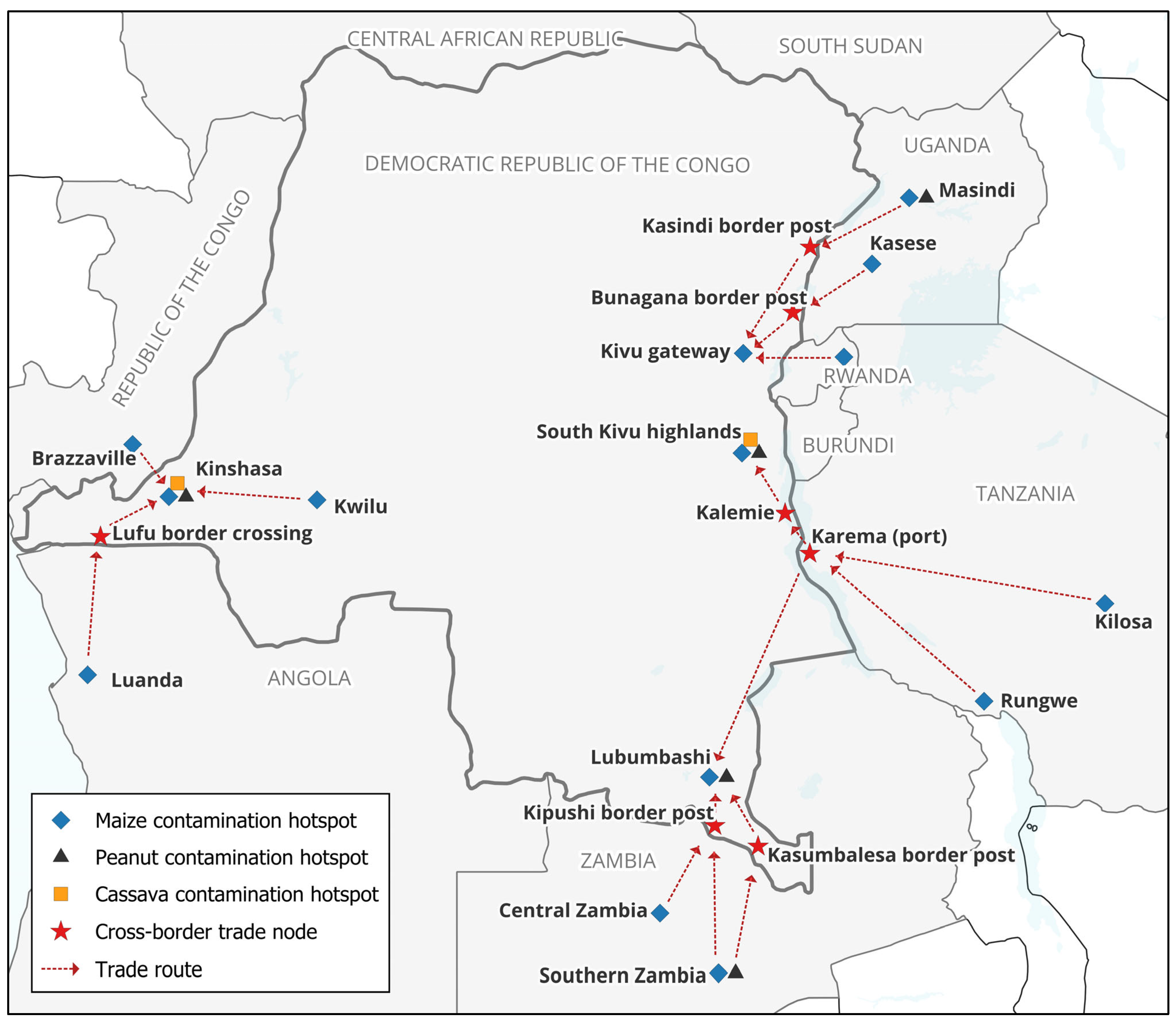
- Uganda (Masindi, Kasese) → eastern DRC via Kasindi and Bunagana;
- Tanzania (Kilosa, Rungwe) → Lake Tanganyika corridor (Karema–Kalemie) → eastern DRC (Kivu highlands) and southern DRC (Lubumbashi);
- Zambia (central and southern regions) → southern DRC (Lubumbashi) via Kasumbalesa and Kipushi;
- Angola (Luanda) → western DRC (Kinshasa) via the Lufu corridor;
- Internal redistribution along the Kwilu–Kinshasa corridor, highlighting the movement of contaminated commodities between production areas and major urban consumption centers.
5. Socio-Economic Risks and Impacts
5.1. Impact on Human and Animal Health
5.2. Economic Impact
6. Discussion
6.1. Major Food Commodities and Mycotoxins Associated with Contamination
6.2. Mycotoxin Contamination in the DRC and Neighboring Countries: Key Contributing Factors
6.2.1. Influence of Agroecological Zones
6.2.2. Impact of the Supply Chain
6.3. Cross-Border Trade and Its Role in Mycotoxin Spread
6.4. Co-Occurrence of Mycotoxins in Food Commodities
6.5. Exceedance of International Regulatory Limits
6.6. General Critique of Sampling Designs, Analytical Methods and Method Validation
6.7. Public Health and Socio-Economic Implications
- ➢
- Adapt strategies to agroecological gradients: Harvest calendars, drying windows, moisture thresholds, and technical advisories must be tailored to specific zones (equatorial, wet/dry savannas, highlands, and coastal areas), as contamination patterns are strongly climate dependent (Section 6.2.1).
- ➢
- Address post-harvest and livestock vulnerabilities: Expand hermetic storage, improve warehouse aeration, adopt mechanical/optical sorting where feasible, and systematically monitor feed ingredients to prevent AFM1 transfer into milk, particularly in high-risk areas.
- ➢
- Institutionalize integrated, risk-proportionate surveillance: Seasonal sampling plans, multi-mycotoxin LC-MS/MS methods to capture co-occurrence and emerging toxins, harmonized cross-border standards, and expanded use of rapid screening tools for large-scale sorting and early detection.
6.8. Regulatory Frameworks and Surveillance
6.9. Control and Mitigation Strategies
6.9.1. Awareness
6.9.2. Agricultural Practices
Pre-Harvest Practices
Practices During and After Harvest
6.9.3. Mycotoxin Monitoring Throughout the Value Chain
6.9.4. Management of Contaminated Foods and Feeds
6.10. Limitations of the Review
7. Conclusions and Future Directions
Supplementary Materials
Author Contributions
Funding
Institutional Review Board Statement
Informed Consent Statement
Data Availability Statement
Conflicts of Interest
References
- IARC. IARC Working Group on the Evaluation of Carcinogenic Risks to Humans. In Some Traditional Herbal Medicines, Some Mycotoxins, Naphthalene and Styrene; IARC Monographs on the Evaluation of Carcinogenic Risks to Humans; International Agency for Research on Cancer: Lyon, France, 2002; Volume 82, 556p. [Google Scholar]
- EFSA. EFSA Scientific Opinion on the Risks for Human and Animal Health Related to the Presence of Modified Forms of Certain Mycotoxins in Food and Feed. EFSA J. 2014, 12, 3916. [Google Scholar] [CrossRef]
- Awuchi, C.G.; Ondari, E.N.; Ogbonna, C.U.; Upadhyay, A.K.; Baran, K.; Okpala, C.O.R.; Korzeniowska, M.; Guiné, R.P.F. Mycotoxins Affecting Animals, Foods, Humans, and Plants: Types, Occurrence, Toxicities, Action Mechanisms, Prevention, and Detoxification Strategies—A Revisit. Foods 2021, 10, 1279. [Google Scholar] [CrossRef]
- Kępińska-Pacelik, J.; Biel, W. Mycotoxins—Prevention, Detection, Impact on Animal Health. Processes 2021, 9, 2035. [Google Scholar] [CrossRef]
- Nji, Q.N.; Babalola, O.O.; Mwanza, M. Aflatoxins in Maize: Can Their Occurrence Be Effectively Managed in Africa in the Face of Climate Change and Food Insecurity? Toxins 2022, 14, 574. [Google Scholar] [CrossRef]
- Gbashi, S.; Madala, N.E.; Saeger, S.D.; Boevre, M.D.; Adekoya, I.; Adebo, O.A.; Njobeh, P.B. The Socio-Economic Impact of Mycotoxin Contamination in Africa. In Mycotoxins—Impact and Management Strategies; Njobeh, P.B., Stepman, F., Eds.; IntechOpen: London, UK, 2018; ISBN 978-1-83881-847-0. [Google Scholar]
- Eskola, M.; Kos, G.; Elliott, C.T.; Hajšlová, J.; Mayar, S.; Krska, R. Worldwide Contamination of Food-Crops with Mycotoxins: Validity of the Widely Cited “FAO Estimate” of 25. Crit. Rev. Food Sci. Nutr. 2020, 60, 2773–2789. [Google Scholar] [CrossRef]
- Agriopoulou, S.; Stamatelopoulou, E.; Varzakas, T. Advances in Occurrence, Importance, and Mycotoxin Control Strategies: Prevention and Detoxification in Foods. Foods 2020, 9, 137. [Google Scholar] [CrossRef] [PubMed]
- Lukwago, F.B.; Mukisa, I.; Atukwase, A.; Kaaya, A.; Tumwebaze, S. Mycotoxins Contamination in Foods Consumed in Uganda: A 12-Year Review (2006–2018). Sci. Afr. 2019, 3, e00054. [Google Scholar] [CrossRef]
- Anukul, N.; Vangnai, K.; Mahakarnchanakul, W. Significance of Regulation Limits in Mycotoxin Contamination in Asia and Risk Management Programs at the National Level. J. Food Drug Anal. 2013, 21, 227–241. [Google Scholar] [CrossRef]
- Chilaka, C.A.; Obidiegwu, J.E.; Chilaka, A.C.; Atanda, O.O.; Mally, A. Mycotoxin Regulatory Status in Africa: A Decade of Weak Institutional Efforts. Toxins 2022, 14, 442. [Google Scholar] [CrossRef]
- EFSA. EFSA Scientific Opinion on the Risks to Human and Animal Health Related to the Presence of Beauvericin and Enniatins in Food and Feed. EFSA J. 2014, 12, 3802. [Google Scholar] [CrossRef]
- Jajić, I.; Dudaš, T.; Krstović, S.; Krska, R.; Sulyok, M.; Bagi, F.; Savić, Z.; Guljaš, D.; Stankov, A. Emerging Fusarium Mycotoxins Fusaproliferin, Beauvericin, Enniatins, and Moniliformin in Serbian Maize. Toxins 2019, 11, 357. [Google Scholar] [CrossRef]
- EFSA. EFSA Scientific Opinion on the Risks for Animal and Public Health Related to the Presence of Alternaria Toxins in Feed and Food. EFSA J. 2011, 9, 2407. [Google Scholar] [CrossRef]
- Fraeyman, S.; Croubels, S.; Devreese, M.; Antonissen, G. Emerging Fusarium and Alternaria Mycotoxins: Occurrence, Toxicity and Toxicokinetics. Toxins 2017, 9, 228. [Google Scholar] [CrossRef] [PubMed]
- Gruber-Dorninger, C.; Novak, B.; Nagl, V.; Berthiller, F. Emerging Mycotoxins: Beyond Traditionally Determined Food Contaminants. J. Agric. Food Chem. 2017, 65, 7052–7070. [Google Scholar] [CrossRef] [PubMed]
- Smith, M.-C.; Madec, S.; Coton, E.; Hymery, N. Natural Co-Occurrence of Mycotoxins in Foods and Feeds and Their in Vitro Combined Toxicological Effects. Toxins 2016, 8, 94. [Google Scholar] [CrossRef] [PubMed]
- Berthiller, F.; Crews, C.; Dall’Asta, C.; Saeger, S.D.; Haesaert, G.; Karlovsky, P.; Oswald, I.P.; Seefelder, W.; Speijers, G.; Stroka, J. Masked Mycotoxins: A Review. Mol. Nutr. Food Res. 2013, 57, 165–186. [Google Scholar] [CrossRef]
- Crudo, F.; Varga, E.; Aichinger, G.; Galaverna, G.; Marko, D.; Dall’Asta, C.; Dellafiora, L. Co-Occurrence and Combinatory Effects of Alternaria Mycotoxins and Other Xenobiotics of Food Origin: Current Scenario and Future Perspectives. Toxins 2019, 11, 640. [Google Scholar] [CrossRef]
- Chang, P.-K.; Ehrlich, K.C. What Does Genetic Diversity of Aspergillus flavus Tell Us about Aspergillus oryzae? Int. J. Food Microbiol. 2010, 138, 189–199. [Google Scholar] [CrossRef]
- Cunha, D.D.O.; Leão-Cordeiro, J.A.B.; Paula, H.D.S.C.D.; Ataides, F.S.; Saddi, V.A.; Vilanova-Costa, C.A.S.T.; Silva, A.M.T.C. Association between Polymorphisms in the Genes Encoding Toll-like Receptors and Dectin-1 and Susceptibility to Invasive Aspergillosis: A Systematic Review. Rev. Soc. Bras. Med. Trop. 2018, 51, 725–730. [Google Scholar] [CrossRef]
- Bhatnagar, D.; Rajasekaran, K.; Gilbert, M.; Cary, J.; Magan, N. Advances in Molecular and Genomic Research to Safeguard Food and Feed Supply from Aflatoxin Contamination. World Mycotoxin J. 2018, 11, 47–72. [Google Scholar] [CrossRef]
- Daou, R.; Joubrane, K.; Maroun, R.G.; Khabbaz, L.R.; Ismail, A.; Khoury, A.E. Mycotoxins: Factors Influencing Production and Control Strategies. AIMS Agric. Food 2021, 6, 416–447. [Google Scholar] [CrossRef]
- Mannaa, M.; Kim, K.D. Influence of Temperature and Water Activity on Deleterious Fungi and Mycotoxin Production during Grain Storage. Mycobiology 2017, 45, 240–254. [Google Scholar] [CrossRef]
- Milani, J. Ecological Conditions Affecting Mycotoxin Production in Cereals: A Review. Vet. Med. 2013, 58, 405–411. [Google Scholar] [CrossRef]
- Medina, A.; Gonzalez-Jardin, J.M.; Sainz, M.J. Impact of Global Warming on Mycotoxins. Curr. Opin. Food Sci. 2017, 18, 76–81. [Google Scholar] [CrossRef]
- Lv, C.; Jin, J.; Wang, P.; Dai, X.; Liu, Y.; Zheng, M.; Xing, F. Interaction of Water Activity and Temperature on the Growth, Gene Expression and Aflatoxin Production by Aspergillus flavus on Paddy and Polished Rice. Food Chem. 2019, 293, 472–478. [Google Scholar] [CrossRef] [PubMed]
- Blandino, M.; Scarpino, V.; Giordano, D.; Sulyok, M.; Krska, R.; Vanara, F.; Reyneri, A. Impact of Sowing Time, Hybrid and Environmental Conditions on the Contamination of Maize by Emerging Mycotoxins and Fungal Metabolites. Ital. J. Agron. 2017, 12, 215–224. [Google Scholar] [CrossRef]
- Blandino, M.; Scarpino, V.; Sulyok, M.; Krska, R.; Reyneri, A. Effect of Agronomic Programmes with Different Susceptibility to Deoxynivalenol Risk on Emerging Contamination in Winter Wheat. Eur. J. Agron. 2017, 85, 12–24. [Google Scholar] [CrossRef]
- Zambia: Government Addresses Concerns Over Elevated Aflatoxin Levels in Animal Feeds, Maize Grain, and Mealie Meal. Lusaka Time. 23 August 2024. Available online: https://www.lusakatimes.com/2024/08/23/government-addresses-concerns-over-elevated-aflatoxin-levels-in-animal-feeds-maize-grain-and-mealie-meal/ (accessed on 5 September 2025).
- Zambie: La Situation Alimentaire Compliquée Aggravée par des Champignons dans le Maïs. RFI. 23 August 2024. Available online: https://www.rfi.fr/fr/environnement/20240823-zambie-la-situation-alimentaire-compliqu%C3%A9e-aggrav%C3%A9e-par-des-champignons-dans-le-ma%C3%AFs (accessed on 20 November 2024).
- Agence Congolaise de Presse (ACP). Les Mesures Interdisant l’Importation Temporaire de la Semoule de Maïs en Zambie Saluées. ACP. 28 August 2024. Available online: https://acp.cd/economie/les-mesures-interdisant-limportation-temporaire-de-la-semoule-de-mais-en-zambie-saluees/ (accessed on 4 September 2025).
- Khan, R.; Anwar, F.; Ghazali, F.M. A Comprehensive Review of Mycotoxins: Toxicology, Detection, and Effective Mitigation Approaches. Heliyon 2024, 10, e28361. [Google Scholar] [CrossRef]
- Kpodo, K.A.; Bankole, S. Mycotoxin Contamination in Foods in West and Central Africa. In Mycotoxins: Detection Methods, Management, Public Health and Agricultural Trade; Leslie, J.F., Bandyopadhyay, R., Eds.; CABI: Wallingford, UK, 2008; pp. 103–116. [Google Scholar] [CrossRef]
- Misihairabgwi, J.M.; Ezekiel, C.N.; Sulyok, M.; Shephard, G.S.; Krska, R. Mycotoxin Contamination of Foods in Southern Africa: A 10-Year Review (2007–2016). Crit. Rev. Food Sci. Nutr. 2019, 59, 43–58. [Google Scholar] [CrossRef]
- Aasa, A.; Fru, F.; Oluwasola, A.; Oyeyinka, S.; Njobeh, P. A Review of Toxigenic Fungi and Mycotoxins in Feeds and Food Commodities in West Africa. World Mycotoxin J. 2022, 16, 33–47. [Google Scholar] [CrossRef]
- Pison, G.; Poniakina, S. The Population of the World (2024). Popul. Soc. 2024, 626, 1–8. [Google Scholar] [CrossRef]
- Tshibambe, G.N.; Byenda, A.A. De l’appartenance multiple de la republique democratique du congo aux organisations internationales africaines: Quels enjeux, quels avantages? Rev. Fac. Direito UFMG 2017, 70, 389–410. [Google Scholar] [CrossRef]
- Olodo, E. Maïs: La RDC Peut Devenir l’Acheteur Majeur de l’Afrique de l’Est. Bankable. 6 August 2024. Available online: https://bankable.africa/fr/agriculture/0608-133-mais-la-rdc-peut-devenir-l-acheteur-majeur-de-l-afrique-de-l-est (accessed on 4 September 2025).
- Tanzania to Export 500,000 Tonnes of Corn to the DRC. Milling Middle East and Africa Magazine. 23 May 2024. Available online: https://millingmea.com/tanzania-to-export-500000-tonnes-of-corn-to-the-drc/ (accessed on 4 September 2025).
- Ministry of Agriculture of the DRC; WFP; FAO. Sécurité Alimentaire, Niveau de Production Agricole et Animale, Évaluation de La Campagne Agricole 2017–2018 et Bilan Alimentaire Du Pays (Rapport Août 2018). 2018. Available online: https://faolex.fao.org/docs/pdf/cng211906.pdf (accessed on 4 September 2025).
- RDC-Ouganda: Le Volume des Échanges Commerciaux Évalué à 687,1 Millions USD en 2022. Zoom Eco. 28 February 2024. Available online: https://zoom-eco.net/a-la-une/rdc-ouganda-le-volume-des-echanges-commerciaux-evalue-a-6871-millions-usd-en-2022/ (accessed on 4 September 2025).
- Olodo, E. Ouganda: La Fin de l’Interdiction d’Exportation de Maïs vers le Kenya Tarde à se Concrétiser. Agence Ecofin. 26 March 2021. Available online: https://www.agenceecofin.com/commerce/2603-86576-ouganda-la-fin-de-l-interdiction-d-exportation-de-mais-vers-le-kenya-tarde-a-se-concretiser (accessed on 16 November 2024).
- Ntota, R. EAC: La RDC Représente 24.6% des Exportations de l’Ouganda. Afriquactu.net. 26 January 2024. Available online: https://afriquactu.net/2024/01/26/eac-la-rdc-represente-246-des-exportations-de-louganda/ (accessed on 4 September 2025).
- Bank of Tanzania. Annual Report 2022/23; Bank of Tanzania: Dar es Salaam, Tanzania, 2023. Available online: https://www.bot.go.tz/Publications/Regular/Annual%20Report/en/2023123114565911.pdf (accessed on 4 September 2025).
- Ayimpam, S.; Kimbu, T.K. Le couloir à la frontière entre la Zambie et le Congo (RDC). Mondialisation et petit commerce transfrontalier à Kasumbalesa. Suds 2023, 1, 165–192. Available online: https://journals.openedition.org/suds/382 (accessed on 4 September 2025). [CrossRef]
- Tshomba, K.J.; Kitsali, K.J.H.; Nkulu, M.F.J.; Kenda, T.F.; Mpata, M.P.; Kalambaie, B.M.M.M. Echanges Transfrontaliers Des Produits Agricoles Entre La RDC et La Zambie Par La Douane de Kipushi: Analyse Des Itinéraires Commerciaux. Int. J. Multidiscip. Curr. Res. 2022, 10, 204–212. [Google Scholar] [CrossRef]
- Coopération RDC-Zambie: Vers la Réalisation de la Route Likasi-Solwezi, Stratégique pour le Commerce Transfrontalier. Agence Ecofin. 14 February 2022. Available online: https://www.agenceecofin.com/transports/1402-95103-cooperation-rdc-zambie-vers-la-realisation-de-la-route-likasi-solwezi-strategique-pour-le-commerce-transfrontalier (accessed on 16 November 2024).
- Layinga, F. Les Dynamiques Transfrontalières d’Echange Commercial entre la République Démocratique du Congo et l’Angola dans la Province du Kongo-Central. Le Cas Marché de Lufu. Irénées.net. 9 April 2017. Available online: https://www.irenees.net/bdf_fiche-analyse-1102_fr.html (accessed on 12 November 2025).
- Mwanza, M.; Dzoma, B.; Nyirenda, M.; Bakunzi, F. Mycotoxins Occurrence in Selected Staple Food in Main Markets from Lubumbashi, Democratic Republic of Congo. J. Food Agric. Environ. 2013, 11, 51–54. [Google Scholar]
- Kamika, I.; Ngbolua, K.-T.-N.; Tekere, M. Occurrence of Aflatoxin Contamination in Maize throughout the Supply Chain in the Democratic Republic of Congo. Food Control 2016, 69, 292–296. [Google Scholar] [CrossRef]
- Kasongo, M.K.; Duki, A.M.; Mbinze, J.K.; Memvanga, P.B.; Masiala, C.T.; Saeger, S.D.; Diana Di Mavungu, J. Investigation of the Occurrence of Mycotoxins in Staple Foods Consumed in Kinshasa (DRC) by an LC-MS/MS-Based Multimycotoxin Analytical Approach. Orapuh J. 2024, 5, e1134. [Google Scholar]
- Udomkun, P.; Wossen, T.; Nabahungu, N.L.; Mutegi, C.; Vanlauwe, B.; Bandyopadhyay, R. Incidence and Farmers’ Knowledge of Aflatoxin Contamination and Control in Eastern Democratic Republic of Congo. Food Sci. Nutr. 2018, 6, 1607–1620. [Google Scholar] [CrossRef]
- Udomkun, P.; Mutegi, C.; Wossen, T.; Atehnkeng, J.; Nabahungu, N.L.; Njukwe, E.; Vanlauwe, B.; Bandyopadhyay, R. Occurrence of Aflatoxin in Agricultural Produce from Local Markets in Burundi and Eastern Democratic Republic of Congo. Food Sci. Nutr. 2018, 6, 2227–2238. [Google Scholar] [CrossRef] [PubMed]
- Probst, C.; Bandyopadhyay, R.; Cotty, P.J. Diversity of Aflatoxin-Producing Fungi and Their Impact on Food Safety in Sub-Saharan Africa. Int. J. Food Microbiol. 2014, 174, 113–122. [Google Scholar] [CrossRef] [PubMed]
- Matendo, R.; Imathiu, S.; Udomkun, P.; Mugumaarhahama, Y.; Ishara, J.; Atehnkeng, J.; Owino, W. Aflatoxin and Fumonisin Mycotoxins Contamination along the Maize Value Chain in the Eastern Democratic Republic of Congo. Afr. J. Food Agric. Nutr. Dev. 2022, 22, 19801–19821. [Google Scholar] [CrossRef]
- Kankolongo, M.A.; Hell, K.; Nawa, I.N. Assessment for Fungal, Mycotoxin and Insect Spoilage in Maize Stored for Human Consumption in Zambia. J. Sci. Food Agric. 2009, 89, 1366–1375. [Google Scholar] [CrossRef]
- Mukanga, M.; Derera, J.; Tongoona, P.; Laing, M.D. A Survey of Pre-Harvest Ear Rot Diseases of Maize and Associated Mycotoxins in South and Central Zambia. Int. J. Food Microbiol. 2010, 141, 213–221. [Google Scholar] [CrossRef] [PubMed]
- Kachapulula, P.W.; Akello, J.; Bandyopadhyay, R.; Cotty, P.J. Aflatoxin Contamination of Groundnut and Maize in Zambia: Observed and Potential Concentrations. J. Appl. Microbiol. 2017, 122, 1471–1482. [Google Scholar] [CrossRef] [PubMed]
- Wokorach, G.; Landschoot, S.; Anena, J.; Audenaert, K.; Echodu, R.; Haesaert, G. Mycotoxin Profile of Staple Grains in Northern Uganda: Understanding the Level of Human Exposure and Potential Risks. Food Control 2021, 122, 107813. [Google Scholar] [CrossRef]
- Murokore, B.J.; Masawi, A.N.; Wacoo, A.P.; Wangalwa, R.; Ajayi, C.O.; California, P.V. Aflatoxin Susceptible Food Consumption Frequency, Prevalence, and Levels in Household Foodstuffs in Southwestern Uganda. J. Food Qual. 2023, 2023, 4769432. [Google Scholar] [CrossRef]
- Mwesige, S.; Tushabe, F.; Okoth, T.; Kasamba, I.; Areu, D. Levels of Total Aflatoxins in Maize and Groundnuts across Food Value Chains, Gender and Agro-Ecological Zones of Uganda. Int. J. Life Sci. Res. Arch. 2023, 5, 090–097. [Google Scholar] [CrossRef]
- Kamala, A.; Ortiz, J.; Kimanya, M.; Haesaert, G.; Donoso, S.; Tiisekwa, B.; De Meulenaer, B. Multiple Mycotoxin Co-Occurrence in Maize Grown in Three Agro-Ecological Zones of Tanzania. Food Control 2015, 54, 208–215. [Google Scholar] [CrossRef]
- Geary, P.A.; Chen, G.; Kimanya, M.E.; Shirima, C.P.; Oplatowska-Stachowiak, M.; Elliott, C.T.; Routledge, M.N.; Gong, Y.Y. Determination of Multi-Mycotoxin Occurrence in Maize Based Porridges from Selected Regions of Tanzania by Liquid Chromatography Tandem Mass Spectrometry (LC-MS/MS), a Longitudinal Study. Food Control 2016, 68, 337–343. [Google Scholar] [CrossRef]
- Kimanya, M.E.; Shirima, C.P.; Magoha, H.; Shewiyo, D.H.; De Meulenaer, B.; Kolsteren, P.; Gong, Y.Y. Co-Exposures of Aflatoxins with Deoxynivalenol and Fumonisins from Maize Based Complementary Foods in Rombo, Northern Tanzania. Food Control 2014, 41, 76–81. [Google Scholar] [CrossRef]
- Magoha, H.; Kimanya, M.; Meulenaer, B.; Roberfroid, D.; Lachat, C.; Kolsteren, P. Association between Aflatoxin M-1 Exposure through Breast Milk and Growth Impairment in Infants from Northern Tanzania. World Mycotoxin J. 2014, 7, 277–284. [Google Scholar] [CrossRef]
- Boni, S.; Beed, F.; Kimanya, M.; Koyano, E.; Mponda, O.; Mamiro, D.; Kaoneka, B.; Bandyopadhyay, R.; Korie, S.; Mahuku, G. Aflatoxin Contamination in Tanzania: Quantifying the Problem in Maize and Groundnuts from Rural Households. World Mycotoxin J. 2021, 14, 553–564. [Google Scholar] [CrossRef]
- Umereweneza, D.; Kamizikunze, T.; Muhizi, T. Assessment of Mycotoxins Types in Some Foodstuff Consumed in Rwanda. Food Control 2018, 85, 432–436. [Google Scholar] [CrossRef]
- Niyibituronsa, M.; Mukantwali, C.; Nzamwita, M.; Hagenimana, G.; Niyoyita, S.; Niyonshima, A.; Hakizimana, C.; Ndilu, L.; Nyirahanganyamunsi, G.; Nkurunziza, E.; et al. Assessment of aflatoxin and fumonisin contamination levels in maize and mycotoxins awareness and risk factors in Rwanda. Afr. J. Food Agric. Nutr. Dev. 2020, 20, 16420–16446. [Google Scholar] [CrossRef]
- Ntwali, J.; Latif, S.; Müller, J. Assessment of Mycotoxin Contamination in Rwanda: A Comparison of Agro-Ecological Zones. Food Control 2024, 160, 110309. [Google Scholar] [CrossRef]
- Nsabiyumva, G.; Mutegi, C.K.; Wagacha, J.M.; Mohamed, A.B.; Njeru, N.K.; Ndayihanzamaso, P.; Niyuhire, M.C.; Atehnkeng, J.; Njukwe, E.; Callicott, K.A.; et al. Aflatoxin Contamination of Maize and Groundnut in Burundi: Distribution of Contamination, Identification of Causal Agents and Potential Biocontrol Genotypes of Aspergillus flavus. Front. Microbiol. 2023, 14, 1106543. [Google Scholar] [CrossRef]
- Manjula, K.; Hell, K.; Fandohan, P.; Abass, A.; Bandyopadhyay, R. Aflatoxin and Fumonisin Contamination of Cassava Products and Maize Grain from Markets in Tanzania and Republic of the Congo. Toxin 2009, 28, 63–69. [Google Scholar] [CrossRef]
- Panzo, J.D. The Incidence of Fungi and Their Mycotoxins in Angolan Food and Crops with Particular Reference to Maize. Master’s Thesis, University of Johannesburg, Johannesburg, South Africa, 2011. [Google Scholar]
- Kamika, I.; Takoy, L. Natural Occurrence of Aflatoxin B1 in Peanut Collected from Kinshasa, Democratic Republic of Congo. Food Control 2011, 22, 1760–1764. [Google Scholar] [CrossRef]
- Kamika, I.; Mngqawa, P.; Rheeder, J.P.; Teffo, S.L.; Katerere, D.R. Mycological and Aflatoxin Contamination of Peanuts Sold at Markets in Kinshasa, Democratic Republic of Congo, and Pretoria, South Africa. Food Addit. Contam. Part B 2014, 7, 120–126. [Google Scholar] [CrossRef] [PubMed]
- Bumbangi, N.F.; Muma, J.B.; Choongo, K.; Mukanga, M.; Velu, M.R.; Veldman, F.; Hatloy, A.; Mapatano, M.A. Occurrence and Factors Associated with Aflatoxin Contamination of Raw Peanuts from Lusaka District’s Markets, Zambia. Food Control 2016, 68, 291–296. [Google Scholar] [CrossRef]
- Njoroge, S.; Matumba, L.; Kanenga, K.; Siambi, M.; Waliyar, F.; Maruwo, J.; Machinjiri, N.; Monyo, E. Aflatoxin B1 Levels in Groundnut Products from Local Markets in Zambia. Mycotoxin Res. 2017, 33, 113–119. [Google Scholar] [CrossRef] [PubMed]
- Kitya, D.; Bbosa, G.S.; Mulogo, E. Aflatoxin Levels in Common Foods of South Western Uganda: A Risk Factor to Hepatocellular Carcinoma. Eur. J. Cancer Care 2010, 19, 516–521. [Google Scholar] [CrossRef]
- Osuret, J.; Musinguzi, G.; Mukama, T.; Halage, A.; Nati, A.; Ssempebwa, J.; Wang, J. Aflatoxin Contamination of Selected Staple Foods Sold for Human Consumption in Kampala Markets, Uganda. J. Biol. Sci. 2016, 16, 44–48. [Google Scholar] [CrossRef]
- Muzoora, S.; Khaitsa, M.L.; Bailey, H.; Vuzi, P. Status on Aflatoxin Levels in Groundnuts in Uganda. Pan Afr. Med. J. 2017, 27, 11. Available online: https://www.panafrican-med-journal.com/content/series/27/4/11/full/ (accessed on 5 April 2026).
- Baluka, S.A.; Schrunk, D.; Imerman, P.; Kateregga, J.N.; Camana, E.; Wang, C.; Rumbeiha, W.K. Mycotoxin and Metallic Element Concentrations in Peanut Products Sold in Ugandan Markets. Cogent Food Agric. 2017, 3, 1313925. [Google Scholar] [CrossRef]
- Sserumaga, J.P.; Wagacha, J.M.; Biruma, M.; Mutegi, C.K. Contamination of Groundnut (Arachis hypogaea L.) with Aspergillus Section Flavi Communities and Aflatoxin at the Post-Harvest Stage. Food Control 2021, 128, 108150. [Google Scholar] [CrossRef]
- Akullo, J.; Amayo, R.; Okello, D.; Mohammed, A.; Muyinda, R.; Magumba, D.; Gidoi, R.; Mweetwa, A. Aflatoxin Contamination in Groundnut and Maize Food Products in Eastern and Northern Uganda. Cogent Food Agric. 2023, 9, 2221015. [Google Scholar] [CrossRef]
- Atukwase, A.; Mutebi, R.; Acham, H.; Kaaya, A.; Wacoo, A. Aflatoxin Exposure and Risk Assessment among Peri-Urban Low Income Population in Kampala Capital City, Uganda. Meas. Food 2023, 13, 100122. [Google Scholar] [CrossRef]
- Kuhumba, G.D.; Simonne, A.H.; Mugula, J.K. Evaluation of Aflatoxins in Peanut-Enriched Complementary Flours from Selected Urban Markets in Tanzania. Food Control 2018, 89, 196–202. [Google Scholar] [CrossRef]
- Bidounga, J.; Moyen, R.; Mounkala, C.; Mokemiabeka, S.N. Occurrence of Mycotoxin-Producing Molds Isolated from Stored Peanut Grains from Different Markets in Brazzaville, Congo. Int. J. Sci. Res. Publ. 2023, 13, 81–91. [Google Scholar] [CrossRef]
- Chiona, M.; Ntawuruhunga, P.; Irm, B.; Matumba, L.; Moyo, C.C. Aflatoxins Contamination in Processed Cassava in Malawi and Zambia. Afr. J. Food Agric. Nutr. Dev. 2014, 14, 8809–8820. [Google Scholar] [CrossRef]
- Oyesigye, E.; Cervini, C.; Oluwakayode, A.; Mahuku, G.; Medina, A. First Evidence on the Occurrence of Multi-Mycotoxins and Dietary Risk Exposure to AFB1 along the Cassava Value Chain in Uganda. Mycotoxin Res. 2024, 40, 693–708. [Google Scholar] [CrossRef]
- Sulyok, M.; Beed, F.; Boni, S.; Abass, A.; Mukunzi, A.; Krska, R. Quantitation of Multiple Mycotoxins and Cyanogenic Glucosides in Cassava Samples from Tanzania and Rwanda by an LC-MS/MS-Based Multi-Toxin Method. Food Addit. Contam. Part A 2015, 32, 488–502. [Google Scholar] [CrossRef]
- Achiro, E.; Okidi, L.; Echodu, R.; Alarakol, S.P.; Anena, J.; Ongeng, D. Prevalence of Aflatoxin along Processing Points of Locally Made Complementary Food Formulae in Northern Uganda: Safety and Children’s Exposure across Seasons. Heliyon 2023, 9, e18564. [Google Scholar] [CrossRef]
- Niyibituronsa, M.; Onyango, A.; Gaidashova, S.; Imathiu, S.; Uwizerwa, M.; Wanjuki, I.; Nganga, F.; Muhutu, J.; Birungi, J.; Ghimire, S.; et al. Evaluation of Mycotoxin Content in Soybean (Glycine max L.) Grown in Rwanda. Afr. J. Food Agric. Nutr. Dev. 2018, 18, 13808–13824. [Google Scholar] [CrossRef]
- Kachapulula, P.W.; Akello, J.; Bandyopadhyay, R.; Cotty, P.J. Aflatoxin Contamination of Dried Insects and Fish in Zambia. J. Food Prot. 2018, 81, 1508–1518. [Google Scholar] [CrossRef] [PubMed]
- Kachapulula, P.W.; Bandyopadhyay, R.; Cotty, P.J. Aflatoxin Contamination of Non-Cultivated Fruits in Zambia. Front. Microbiol. 2019, 10, 1840. [Google Scholar] [CrossRef]
- Mmongoyo, J.A.; Wu, F.; Linz, J.E.; Nair, M.G.; Mugula, J.K.; Tempelman, R.J.; Strasburg, G.M. Aflatoxin Levels in Sunflower Seeds and Cakes Collected from Micro- and Small-Scale Sunflower Oil Processors in Tanzania. PLoS ONE 2017, 12, e0175801. [Google Scholar] [CrossRef] [PubMed]
- Mohammed, S.; Munissi, J.J.E.; Nyandoro, S.S. Aflatoxins in Sunflower Seeds and Unrefined Sunflower Oils from Singida, Tanzania. Food Addit. Contam. Part B 2018, 11, 161–166. [Google Scholar] [CrossRef] [PubMed]
- Nishimwe, K.; Bowers, E.; Ayabagabo, J.d.D.; Habimana, R.; Mutiga, S.; Maier, D. Assessment of Aflatoxin and Fumonisin Contamination and Associated Risk Factors in Feed and Feed Ingredients in Rwanda. Toxins 2019, 11, 270. [Google Scholar] [CrossRef]
- Kimanya, M.E.; De Meulenaer, B.; Roberfroid, D.; Lachat, C.; Kolsteren, P. Fumonisin Exposure through Maize in Complementary Foods Is Inversely Associated with Linear Growth of Infants in Tanzania. Mol. Nutr. Food Res. 2010, 54, 1659–1667. [Google Scholar] [CrossRef]
- Magoha, H.; Kimanya, M.; Meulenaer, B.D.; Roberfroid, D.; Lachat, C.; Kolsteren, P. Risk of Dietary Exposure to Aflatoxins and Fumonisins in Infants Less than 6 Months of Age in Rombo, Northern Tanzania. Matern. Child Nutr. 2014, 12, 516. [Google Scholar] [CrossRef]
- Shirima, C.P.; Kimanya, M.E.; Routledge, M.N.; Srey, C.; Kinabo, J.L.; Humpf, H.-U.; Wild, C.P.; Tu, Y.-K.; Gong, Y.Y. A Prospective Study of Growth and Biomarkers of Exposure to Aflatoxin and Fumonisin during Early Childhood in Tanzania. Environ. Health Perspect. 2015, 123, 173–178. [Google Scholar] [CrossRef]
- Kamala, A.; Kimanya, M.; Lachat, C.; Jacxsens, L.; Haesaert, G.; Kolsteren, P.; Ortiz, J.; Tiisekwa, B.; De Meulenaer, B. Risk of Exposure to Multiple Mycotoxins from Maize-Based Complementary Foods in Tanzania. J. Agric. Food Chem. 2017, 65, 7106–7114. [Google Scholar] [CrossRef]
- Chen, C.; Mitchell, N.J.; Gratz, J.; Houpt, E.R.; Gong, Y.; Egner, P.A.; Groopman, J.D.; Riley, R.T.; Showker, J.L.; Svensen, E.; et al. Exposure to Aflatoxin and Fumonisin in Children at Risk for Growth Impairment in Rural Tanzania. Environ. Int. 2018, 115, 29–37. [Google Scholar] [CrossRef] [PubMed]
- Kamala, A.; Shirima, C.; Jani, B.; Bakari, M.; Sillo, H.; Rusibamayila, N.; De Saeger, S.; Kimanya, M.; Gong, Y.Y.; Simba, A.; et al. Outbreak of an Acute Aflatoxicosis in Tanzania during 2016. World Mycotoxin J. 2018, 11, 311–320. [Google Scholar] [CrossRef]
- Massomo, S. Aspergillus flavus and Aflatoxin Contamination in the Maize Value Chain and What Needs to Be Done in Tanzania. Sci. Afr. 2020, 10, e00606. [Google Scholar] [CrossRef]
- Asiki, G.; Seeley, J.; Srey, C.; Baisley, K.; Lightfoot, T.; Archileo, K.; Agol, D.; Abaasa, A.; Wakeham, K.; Routledge, M.N.; et al. A pilot study to evaluate aflatoxin exposure in a rural Ugandan population. Trop. Med. Int. Health 2014, 19, 592–599. [Google Scholar] [CrossRef]
- Kang, M.-S.; Nkurunziza, P.; Muwanika, R.; Qian, G.; Tang, L.; Song, X.; Xue, K.; Nkwata, A.; Ssempebwa, J.; Lutalo, T.; et al. Longitudinal Evaluation of Aflatoxin Exposure in Two Cohorts in South-Western Uganda. Food Addit. Contam. Part A 2015, 32, 1322–1330. [Google Scholar] [CrossRef]
- Ochola, E.; Ocama, P.; Orach, C.G.; Nankinga, Z.K.; Kalyango, J.N.; McFarland, W.; Karamagi, C. High Burden of Hepatitis B Infection in Northern Uganda: Results of a Population-Based Survey. BMC Public Health 2013, 13, 727. [Google Scholar] [CrossRef]
- Lauer, J.M.; Duggan, C.P.; Ausman, L.M.; Griffiths, J.K.; Webb, P.; Wang, J.-S.; Xue, K.S.; Agaba, E.; Nshakira, N.; Ghosh, S. Maternal Aflatoxin Exposure during Pregnancy and Adverse Birth Outcomes in Uganda. Matern. Child Nutr. 2019, 15, e12701. [Google Scholar] [CrossRef]
- Collins, S.L.; Walsh, J.P.; Renaud, J.B.; McMillan, A.; Rulisa, S.; Miller, J.d.; Reid, G.; Sumarah, M.W. Improved Methods for Biomarker Analysis of the Big Five Mycotoxins Enables Reliable Exposure Characterization in a Population of Childbearing Age Women in Rwanda. Food Chem. Toxicol. 2021, 147, 111854. [Google Scholar] [CrossRef]
- Ortega-Beltran, A.; Bandyopadhyay, R. Contributions of Integrated Aflatoxin Management Strategies to Achieve the Sustainable Development Goals in Various African Countries. Glob. Food Secur. 2021, 30, 100559. [Google Scholar] [CrossRef]
- Udomkun, P.; Wiredu, A.N.; Nagle, M.; Bandyopadhyay, R.; Müller, J.; Vanlauwe, B. Mycotoxins in Sub-Saharan Africa: Present Situation, Socio-Economic Impact, Awareness, and Outlook. Food Control 2017, 72, 110–122. [Google Scholar] [CrossRef]
- Suleiman, R.; Rosentrater, K.A. Current Maize Production, Postharvest Losses and the Risk of Mycotoxins Contamination in Tanzania. In Proceedings of the 2015 ASABE Annual International Meeting, New Orleans, LA, USA, 26–29 July 2015; ASABE Paper No. 152189434; ASABE: St. Joseph, MI, USA, 2015. [Google Scholar][Green Version]
- Mugizi, A.; Imade, F.; Ahmad, T. Update on Mycotoxin Contamination of Maize and Peanuts in East African Community Countries. J. Food Sci. Nutr. Ther. 2021, 7, 001–010. [Google Scholar] [CrossRef]
- Kolawole, O.; Siri-Anusornsak, W.; Petchkongkaew, A.; Elliott, C. A Systematic Review of Global Occurrence of Emerging Mycotoxins in Crops and Animal Feeds, and Their Toxicity in Livestock. Emerg. Contam. 2024, 10, 100305. [Google Scholar] [CrossRef]
- Ferlay, J.; Soerjomataram, I.; Dikshit, R.; Eser, S.; Mathers, C.; Rebelo, M.; Parkin, D.M.; Forman, D.; Bray, F. Cancer Incidence and Mortality Worldwide: Sources, Methods and Major Patterns in GLOBOCAN 2012. Int. J. Cancer 2015, 136, E359–E386. [Google Scholar] [CrossRef]
- Partnership for Aflatoxin Control in Africa (PACA). PACA Strategy 2013–2022; African Union Commission: Addis Ababa, Ethiopia, 2013. [Google Scholar]
- Imade, F.; Ankwasa, E.M.; Geng, H.; Ullah, S.; Ahmad, T.; Wang, G.; Zhang, C.; Dada, O.; Xing, F.; Zheng, Y.; et al. Updates on Food and Feed Mycotoxin Contamination and Safety in Africa with Special Reference to Nigeria. Mycology 2021, 12, 245. [Google Scholar] [CrossRef]
- Nji, Q.N.; Babalola, O.O.; Ekwomadu, T.I.; Nleya, N.; Mwanza, M. Six Main Contributing Factors to High Levels of Mycotoxin Contamination in African Foods. Toxins 2022, 14, 318. [Google Scholar] [CrossRef] [PubMed]
- Lanubile, A.; Giorni, P.; Bertuzzi, T.; Marocco, A.; Battilani, P. Fusarium Verticillioides and Aspergillus flavus Co-Occurrence Influences Plant and Fungal Transcriptional Profiles in Maize Kernels and In Vitro. Toxins 2021, 13, 680. [Google Scholar] [CrossRef]
- Akullo, J.O.; Okello, D.K.; Mohammed, A.; Muyinda, R.; Amayo, R.; Magumba, D.; Gidoi, R.; Njoroge, S.; Mweetwa, A. A Comprehensive Review of Aflatoxin in Groundnut and Maize Products in Africa: Prevalence, Detection and Mitigation Strategies. J. Food Qual. 2025, 2025, 2810946. [Google Scholar] [CrossRef]
- Ono, L.T.; Silva, J.J.; Doná, S.; Martins, L.M.; Iamanaka, B.T.; Fungaro, M.H.P.; Pitt, J.I.; Taniwaki, M.H. Aspergillus Section Flavi and Aflatoxins in Brazilian Cassava (Manihot esculenta Crantz) and Products. Mycotoxin Res. 2021, 37, 221–228. [Google Scholar] [CrossRef] [PubMed]
- Nishimwe, K.; Hoffmann, V.; Herrman, T.J. Market-Driven Strategies for Combating Aflatoxins in Rwanda; Final Report RWA-21162; International Growth Centre (IGC): London, UK, 2022; Available online: https://www.theigc.org/sites/default/files/2022/05/Nishimwe-et-al-May-2022.pdf (accessed on 17 January 2026).
- Abass, A.B.; Awoyale, W.; Sulyok, M.; Alamu, E.O. Occurrence of Regulated Mycotoxins and Other Microbial Metabolites in Dried Cassava Products from Nigeria. Toxins 2017, 9, 207. [Google Scholar] [CrossRef] [PubMed]
- Mwakosya, A.W.; Limbu, S.M.; Majaliwa, N.; Zou, X.; Shi, J.; Kibazohi, O. Aflatoxin B1 Variations in Animal Feeds along the Supply Chain in Tanzania and Its Possible Reduction by Heat Treatment. Food Agric. Immunol. 2022, 33, 192–206. [Google Scholar] [CrossRef]
- African Union (AU). African Union Adopts the Statute for the Establishment of a Continental Food Safety Agency to Address Critical Health and Trade Challenges. AU, 2025. Available online: https://au.int/en/pressreleases/20250305/african-union-adopts-statute-establishment-continental-food-safety-agency (accessed on 4 September 2025).
- Ayalew, A.; Sintayehu, W.; Chunga-Sambo, W.; Edeme, J. Perspective on the New Africa Food Safety Agency. npj Sci. Food 2025, 9, 70. [Google Scholar] [CrossRef] [PubMed]
- Accord d’Exportation pour 20,000 Tonnes de Maïs Zambien vers la RDC et le Rwanda. Mining and Business. 26 July 2022. Available online: https://miningandbusiness.com/2022/07/26/accord-dexportation-pour-20-000-tonnes-de-mais-zambien-vers-la-rdc-et-le-rwanda/ (accessed on 4 September 2025).
- Afrique: La RDCet l’Ouganda s’Accordent sur la Construction d’une Route d’Interconnexion Estimée à, 334,5 Millions USD. Zoom Eco. 31 May 2021. Available online: https://zoom-eco.net/economie/afrique-la-rdc-et-louganda-saccordent-sur-la-construction-dune-route-dinterconnexion-estimee-a-3345-millions-usd/ (accessed on 4 September 2025).
- Negociations entre la RDC et la Tanzanie en Vue de la Construction d’un Port sec pour Faciliter le Passage des Marchandises Entre Dar es Salaam et Lubumbashi. Mining and Business. 3 August 2023. Available online: https://miningandbusiness.com/2023/08/03/negociations-entre-la-rdc-et-la-tanzanie-en-vue-de-la-construction-dun-port-sec-pour-faciliter-le-passage-des-marchandises-entre-dar-es-salaam-et-lubumbashi/ (accessed on 4 September 2025).
- Düzel, A. Detection and Detoxification Methods for Mycotoxins: From Classical to New Trends. In Research on Mycotoxins—From Mycotoxigenic Fungi to Innovative Strategies of Diagnosis, Control and Detoxification; Razzaghi-Abyaneh, M., Shams-Ghahfarokhi, M., Rai, M., Eds.; IntechOpen: London, UK, 2025; ISBN 978-1-83634-109-3. Available online: https://www.intechopen.com/chapters/1203861 (accessed on 12 November 2025).
- Aisoni, J.E.; Orole, O.O.; Fadayomi, V. Mycotoxins; a Burden in Africa. Int. J. Sci. Eng. Res. 2020, 11, 1005–1012. [Google Scholar]
- Habschied, K.; Kanižai Šarić, G.; Krstanović, V.; Mastanjević, K. Mycotoxins—Biomonitoring and Human Exposure. Toxins 2021, 13, 113. [Google Scholar] [CrossRef]
- Ezekiel, C.N.; Ayeni, K.I.; Sarkanj, B.; Sulyok, M.; Akinyemi, M.O.; Ogara, I.M.; Turner, P.C.; Warth, B.; Krska, R. Urinary Biomarker-Based Seasonal Mycotoxin Exposure Assessment in Rural Resident Populations of North-Central Nigeria. Environ. Int. 2025, 203, 109713. [Google Scholar] [CrossRef]
- Behr, A.; Fæste, C.K.; Azqueta, A.; Tavares, A.M.; Spyropoulou, A.; Solhaug, A.; Olsen, A.; Vettorazzi, A.; Mertens, B.; Zegura, B.; et al. Hazard Characterization of the Mycotoxins Enniatins and Beauvericin to Identify Data Gaps and Improve Risk Assessment for Human Health. Arch. Toxicol. 2025, 99, 1791–1841. [Google Scholar] [CrossRef]
- Nyangi, C.; Beed, F.; Mugula, J.K.; Boni, S.; Koyano, E.; Mahuku, G.; Sulyok, M.; Bekunda, M. Assessment of Pre-Harvest Aflatoxin and Fumonisin Contamination of Maize in Babati District, Tanzania. Afr. J. Food Agric. Nutr. Dev. 2016, 16, 11039–11053. [Google Scholar] [CrossRef]
- Omara, T.; Nassazi, W.; Omute, T.; Awath, A.; Laker, F.; Kalukusu, R.; Musau, B.; Nakabuye, B.V.; Kagoya, S.; Otim, G.; et al. Aflatoxins in Uganda: An Encyclopedic Review of the Etiology, Epidemiology, Detection, Quantification, Exposure Assessment, Reduction, and Control. Int. J. Microbiol. 2020, 2020, 4723612. [Google Scholar] [CrossRef]
- Mahuku, G.; Nzioki, H.S.; Mutegi, C.; Kanampiu, F.; Narrod, C.; Makumbi, D. Pre-Harvest Management Is a Critical Practice for Minimizing Aflatoxin Contamination of Maize. Food Control 2019, 96, 219–226. [Google Scholar] [CrossRef]
- Ncube, J.; Maphosa, M. Current State of Knowledge on Groundnut Aflatoxins and Their Management from a Plant Breeding Perspective: Lessons for Africa. Sci. Afr. 2020, 7, e00264. [Google Scholar] [CrossRef]
- Salano, E.N.; Mulwa, R.M.; Obonyo, M.A. Peanut (Arachis hypogea) Accessions Differentially Accumulate Aflatoxins upon Challenge by Aspergillus flavus: Implications for Aflatoxin Mitigation. J. Agric. Food Res. 2024, 15, 100923. [Google Scholar] [CrossRef]
- Institut Nationale Pour l’Etude et la Recherche Agronomiques (INERA). Apropos de l’Inerardc. Available online: https://inera-rdc.cd/a-propos-de-linera-rdc/ (accessed on 6 November 2024).
- Kagot, V.; Okoth, S.; De Boevre, M.; De Saeger, S. Biocontrol of Aspergillus and Fusarium Mycotoxins in Africa: Benefits and Limitations. Toxins 2019, 11, 109. [Google Scholar] [CrossRef]
- Degraeve, S.; Madege, R.R.; Audenaert, K.; Kamala, A.; Ortiz, J.; Kimanya, M.; Tiisekwa, B.; De Meulenaer, B.; Haesaert, G. Impact of Local Pre-Harvest Management Practices in Maize on the Occurrence of Fusarium Species and Associated Mycotoxins in Two Agro-Ecosystems in Tanzania. Food Control 2016, 59, 225–233. [Google Scholar] [CrossRef]
- Seetha, A.; Munthali, W.; Msere, H.W.; Swai, E.; Muzanila, Y.; Sichone, E.; Tsusaka, T.W.; Rathore, A.; Okori, P. Occurrence of Aflatoxins and Its Management in Diverse Cropping Systems of Central Tanzania. Mycotoxin Res. 2017, 33, 323–331. [Google Scholar] [CrossRef]
- East African Community (EAC). Limited Knowledge and Lack of Access to Appropriate Technologies Inhibiting Aflatoxin Prevention and Control in East Africa. EAC. 24 October 2023. Available online: https://www.eac.int/press-releases/141-agriculture-food-security/2888-limited-knowledge-and-lack-of-access-to-appropriate-technologies-inhibiting-aflatoxin-prevention-and-control-in-east-africa?utm_source=chatgpt.com (accessed on 1 September 2025).
- Kimanya, M.E.; Tiisekwa, B.; Mpolya, E. Country and Economic Assessment for Aflatoxin Contamination and Control in Tanzania; A Supplement to the 2012 Report; African Union Commission–Partnership for Aflatoxin Control in Africa (AUC-PACA): Addis Ababa, Ethiopia, 2016. [Google Scholar]
- Menya, J.; Kanyarusoke, K.; Musinguzi, W.B. Solar Food/Crop Drying Practices in Uganda: The State of the Art & Prospective Development. Int. J. Sci. Adv. 2024, 5, 375–383. [Google Scholar] [CrossRef]
- Baributsa, D. Commercialization of Hermetic Bags in Sub-Saharan Africa: The PICS Experience. In Imagining African Agrifood Systems: Looking Forward; Gitau, M.W., Hiablie, S., Ileleji, K., Srivastava, A., Eds.; American Society of Agricultural and Biological Engineers: St. Joseph, MI, USA, 2024; pp. 1–93. [Google Scholar]
- Agence Congolaise de Presse (ACP). Commerce Extérieur: La Population Sensibilisée à l’Utilisation d’Aflasafe RDC 01. ACP. 20 December 2024. Available online: https://acp.cd/economie/commerce-exterieur-la-population-sensibilisee-a-lutilisation-daflasafe-rdc-01/ (accessed on 4 September 2025).
- Benimana, G.U.; Ritho, D.C.; Irungu, D.P. Impact of Adopting Maize Hermetic Storage Technologies on Smallholder Farmers’ Income in Gatsibo District, Rwanda. Heliyon 2023, 9, e14592. [Google Scholar] [CrossRef] [PubMed]
- Temba, B.A.; Sultanbawa, Y.; Kriticos, D.J.; Fox, G.P.; Harvey, J.J.W.; Fletcher, M.T. Tools for Defusing a Major Global Food and Feed Safety Risk: Nonbiological Postharvest Procedures to Decontaminate Mycotoxins in Foods and Feeds. J. Agric. Food Chem. 2016, 64, 8959–8972. [Google Scholar] [CrossRef]
- Mtega, M.; Mgina, C.A.; Kaale, E.; Sempombe, J.; Kilulya, K.F. Occurrence of Aflatoxins in Maize and Maize Products from Selected Locations of Tanzania and the Effects of Cooking Preparation Processes on Toxin Levels. Tanzan. J. Sci. 2020, 46, 407–418. [Google Scholar]
- European Commission. Commission Regulation (EU) 2023/915 of 25 April 2023 on Maximum Levels for Certain Contaminants in Food and Repealing Regulation (EC) No 1881/2006. Off. J. Eur. Union. 2023, 119, 103–157. [Google Scholar]
- CXS 193-1995; General Standard for Contaminants and Toxins in Food and Feed. Codex Alimentarius Commission: Rome, Italy, 2019; pp. 1–66.
- National Grain and Feed Association (NGFA). FDA Mycotoxin Regulatory Guidance: A Guide for Grain Elevators, Feed Manufacturers, Grain Processors and Exporters; NGFA: Washington, DC, USA, 2022; Available online: https://www.ngfa.org/wp-content/uploads/NGFA-Industry-Notification-Mycotoxins-January-2024.pdf (accessed on 15 January 2026).

Disclaimer/Publisher’s Note: The statements, opinions and data contained in all publications are solely those of the individual author(s) and contributor(s) and not of MDPI and/or the editor(s). MDPI and/or the editor(s) disclaim responsibility for any injury to people or property resulting from any ideas, methods, instructions or products referred to in the content. |
© 2026 by the authors. Licensee MDPI, Basel, Switzerland. This article is an open access article distributed under the terms and conditions of the Creative Commons Attribution (CC BY) license.
Share and Cite
Kasongo, M.K.; Duki, A.M.; Masiala, C.T.; De Saeger, S.; Diana Di Mavungu, J. A Critical Review of Mycotoxin Contamination in Food and Feed in the Democratic Republic of the Congo and Neighboring Countries: Challenges and Future Directions. Toxins 2026, 18, 182. https://doi.org/10.3390/toxins18040182
Kasongo MK, Duki AM, Masiala CT, De Saeger S, Diana Di Mavungu J. A Critical Review of Mycotoxin Contamination in Food and Feed in the Democratic Republic of the Congo and Neighboring Countries: Challenges and Future Directions. Toxins. 2026; 18(4):182. https://doi.org/10.3390/toxins18040182
Chicago/Turabian StyleKasongo, Michel Kawayidiko, Arthur Mpanzu Duki, Christophe Tsobo Masiala, Sarah De Saeger, and José Diana Di Mavungu. 2026. "A Critical Review of Mycotoxin Contamination in Food and Feed in the Democratic Republic of the Congo and Neighboring Countries: Challenges and Future Directions" Toxins 18, no. 4: 182. https://doi.org/10.3390/toxins18040182
APA StyleKasongo, M. K., Duki, A. M., Masiala, C. T., De Saeger, S., & Diana Di Mavungu, J. (2026). A Critical Review of Mycotoxin Contamination in Food and Feed in the Democratic Republic of the Congo and Neighboring Countries: Challenges and Future Directions. Toxins, 18(4), 182. https://doi.org/10.3390/toxins18040182