Fusariumic Acids I and J, Two New Phytotoxic Isocassadiene-Type Diterpenoids from Tomato Fusarium Crown and Root Rot Pathogen Fusarium oxysporum f. sp. radicis-lycopersici


 and
and 
Abstract
1. Introduction
2. Results
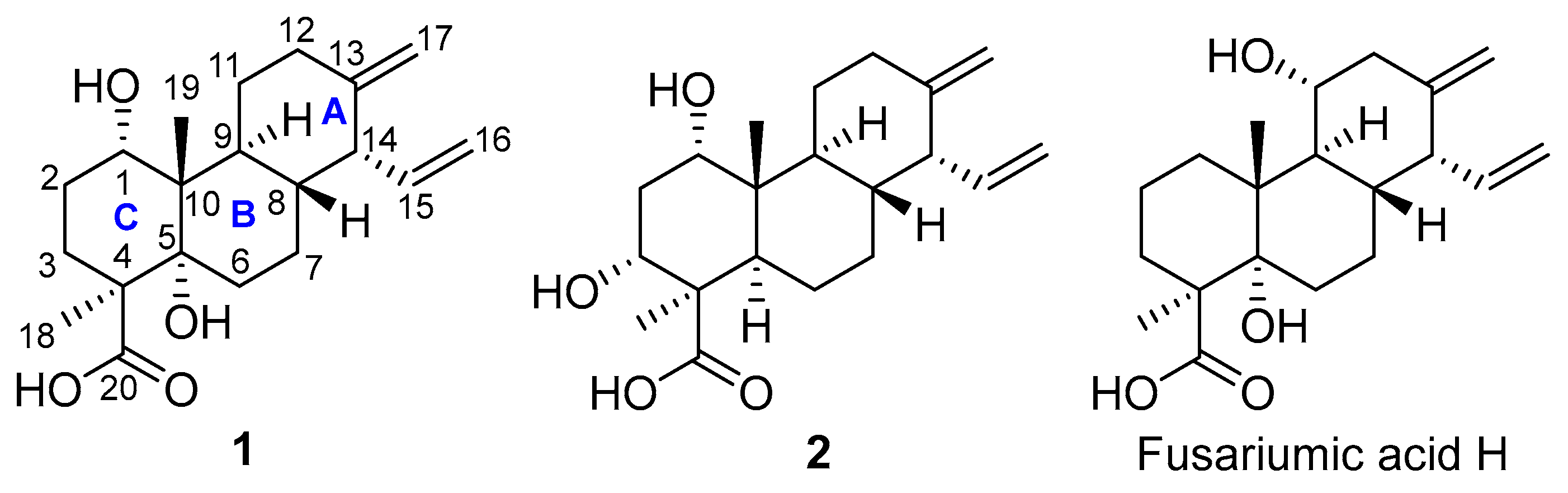
2.1. Structural Identification of Compounds 1 and 2
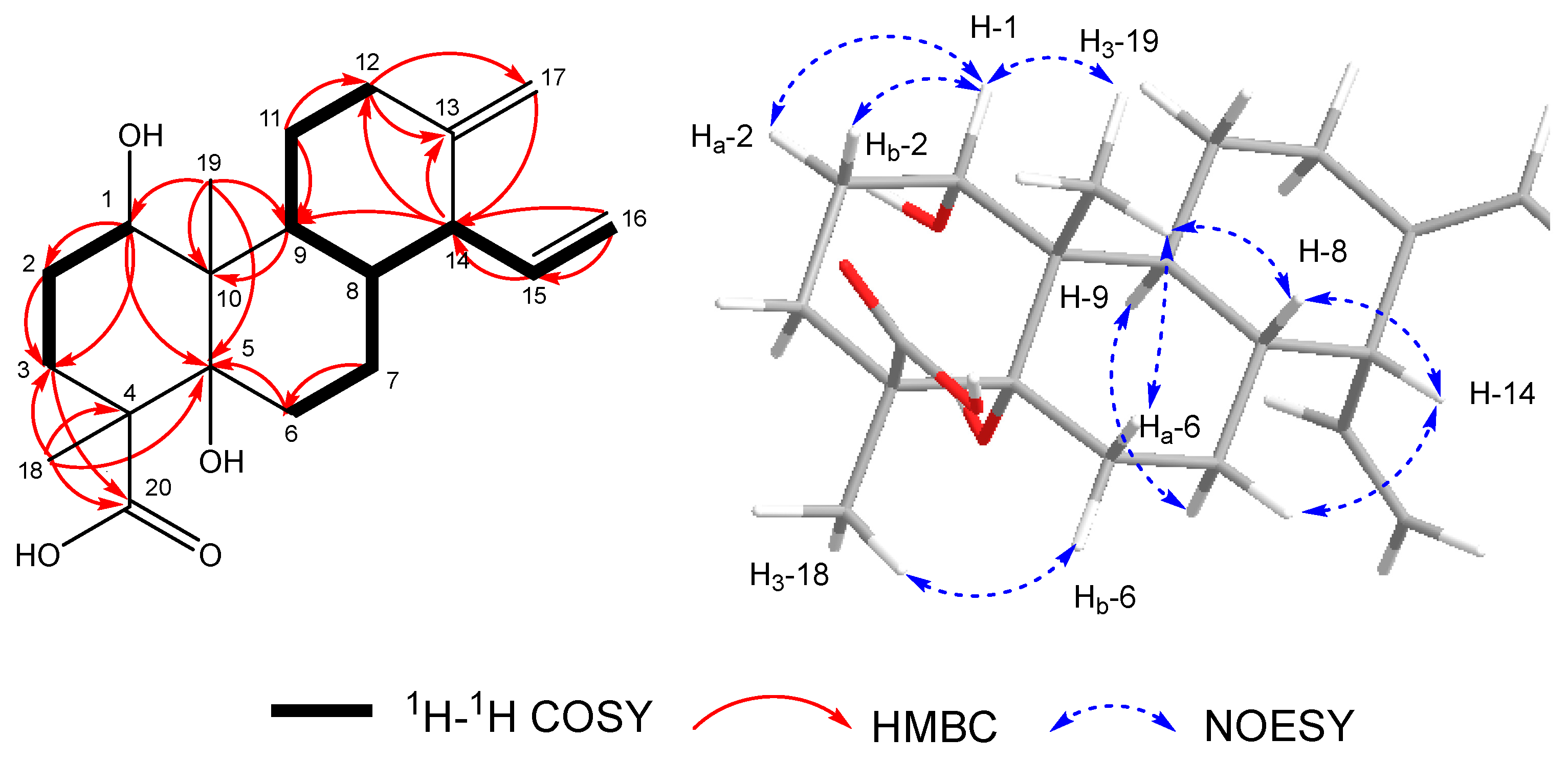
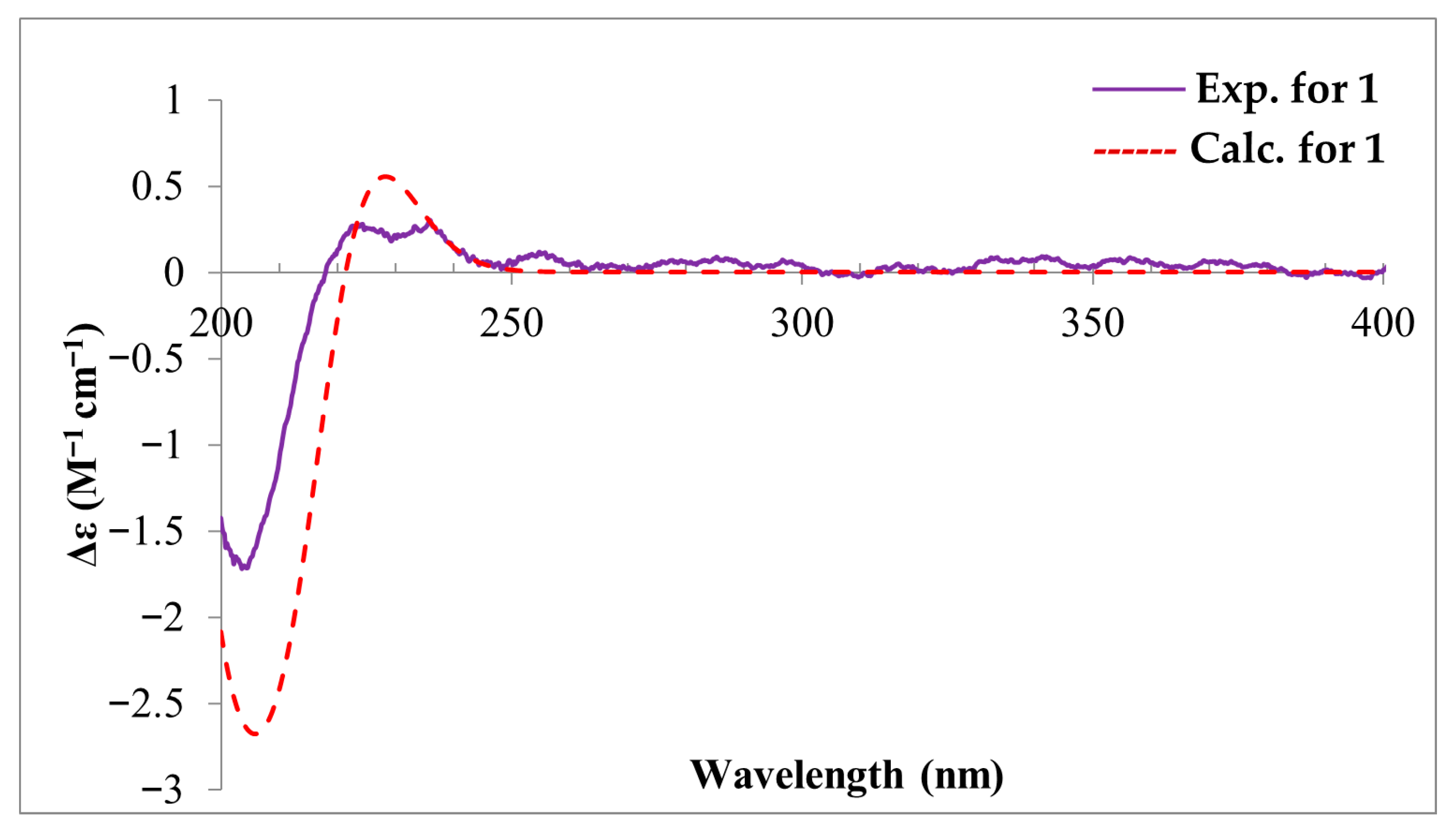
2.1.1. Identification of Compound 1
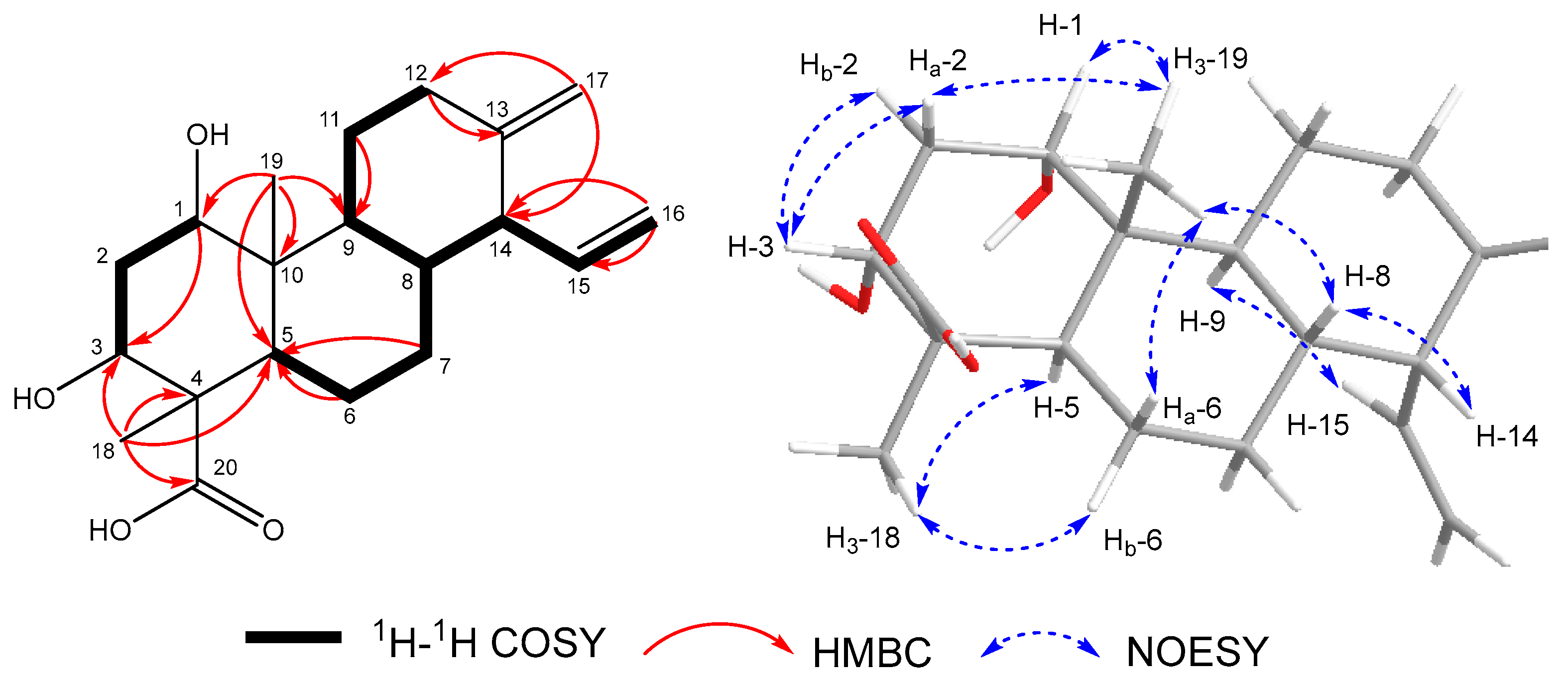
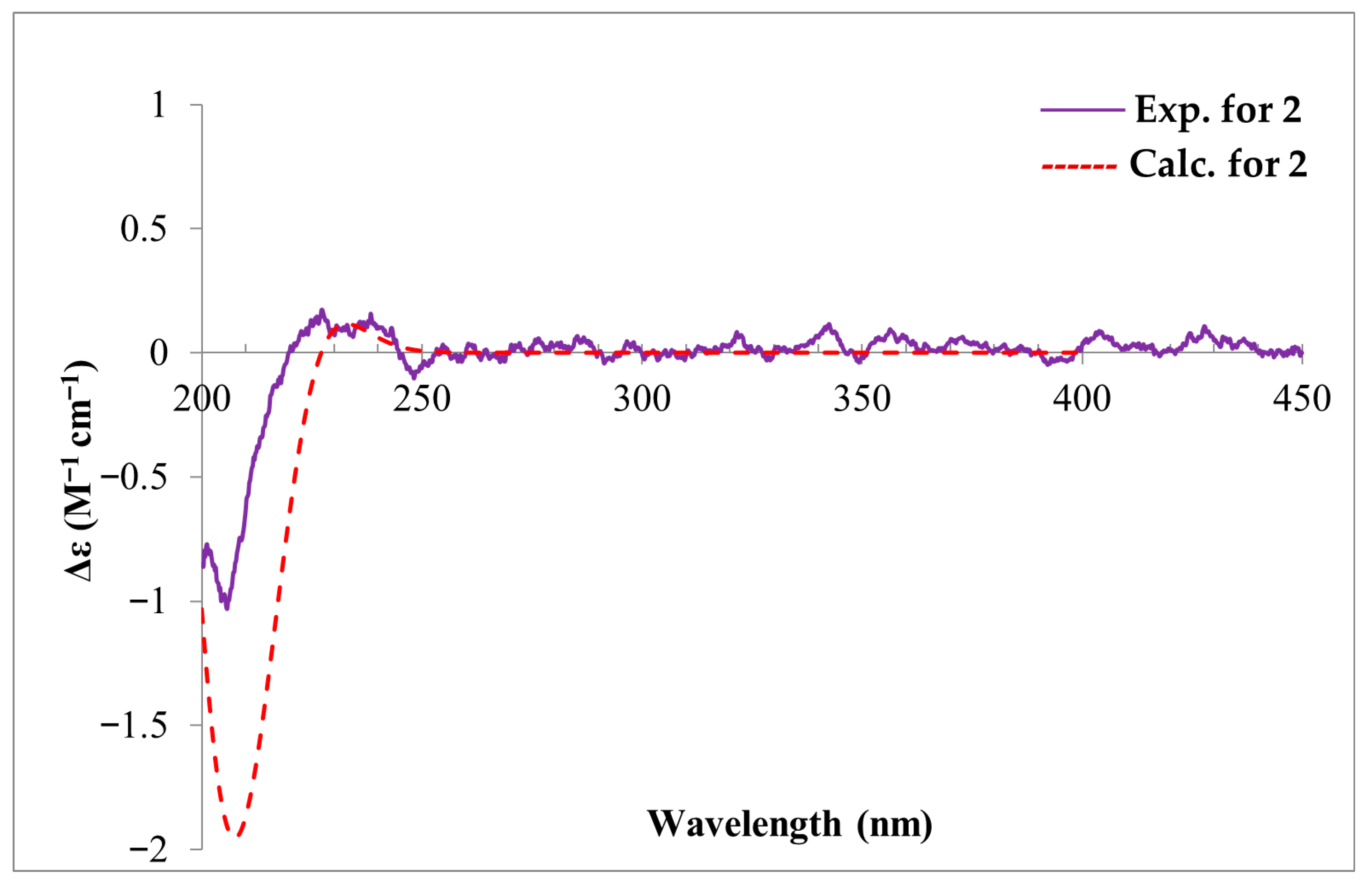
2.1.2. Identification of Compound 2
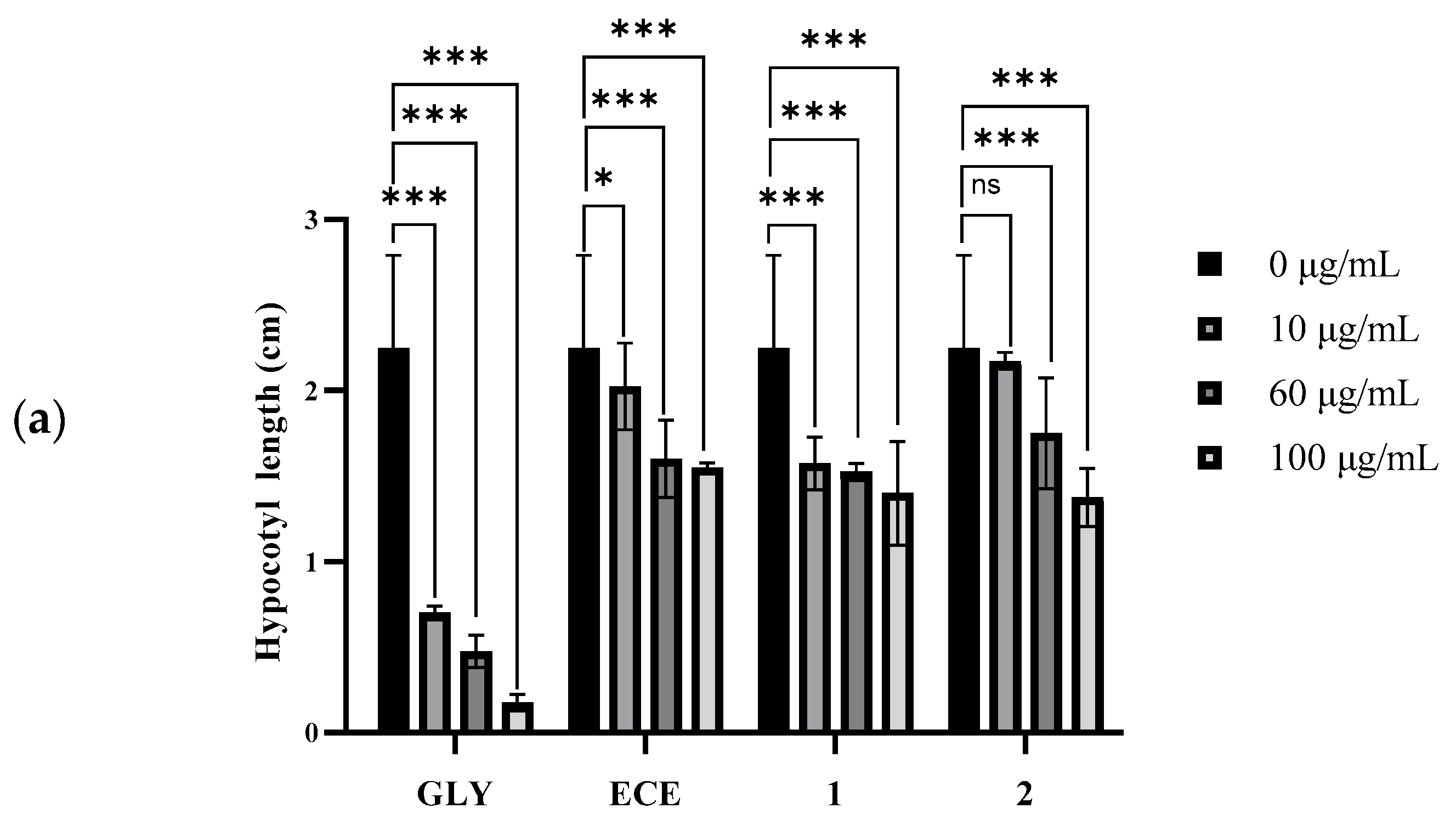
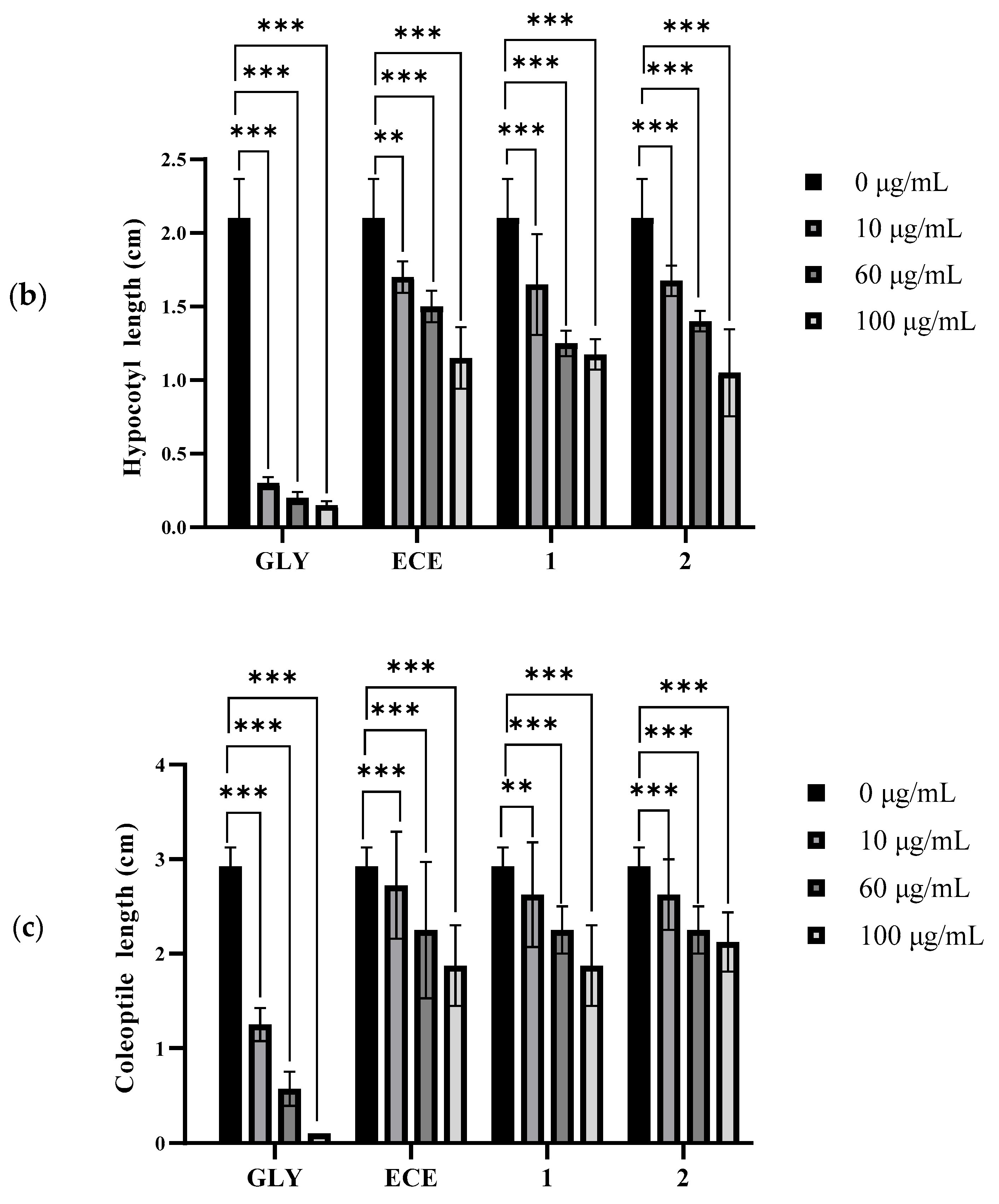
2.2. Phytotoxic Activity of Compounds 1 and 2
3. Discussion
3.1. Diversity of Forl Secondary Metabolites
3.2. Management of Tomato FCRR and Forl Phytotoxins
3.3. Biological Activities and Application Potentials of Forl Diterpenoids
4. Conclusions
5. Materials and Methods
5.1. Fungal Strain and Culture Conditions
5.2. Extraction and Isolation
5.3. General Structural Elucidation
5.4. Calculation of ECD
5.5. Phytotoxicity Assay
5.6. Cytotoxicity Assay
5.7. Statistical Analysis
Supplementary Materials
Author Contributions
Funding
Institutional Review Board Statement
Informed Consent Statement
Data Availability Statement
Acknowledgments
Conflicts of Interest
Abbreviations
| ATCC | American Type Culture Collection |
| 13C NMR | carbon nuclear magnetic resonance spectrum |
| CC | column chromatography |
| CD3OD | deuterated methanol |
| CD3COCD3 | deuterated acetone |
| DAD | diode array detector |
| ECE | ethyl acetate crude extract |
| ECD | electronic circular dichroism |
| EtOAc | ethyl acetate |
| FCRR | Fusarium crown and root rot |
| Forl | Fusarium oxysporum f. sp. radicis-lycopersici |
| GLY | glyphosate |
| 1H NMR | proton nuclear magnetic resonance spectrum |
| 1H–1H COSY | homonuclear chemical shift correlated spectroscopy |
| HMBC | heteronuclear multiple bond coherence spectrum |
| HPLC | high-performance liquid chromatography |
| HSQC | heteronuclear singular quantum correlation spectrum |
| HRESIMS | high-resolution electrospray ionization mass spectrometry |
| IC50 | median inhibitory concentration |
| J | coupling constant |
| MTT | 3-(4,5-dimethylthiazol-2-yl)-2,5-diphenyltetrazolium bromide |
| NOE | nuclear Overhauser effect |
| NOESY | nuclear Overhauser effect spectroscopy |
| PDA | potato dextrose agar |
| PSB | potato sucrose broth |
| Rt | retention time |
| SAR | structure-activity relationship |
| TDDFT | time-dependent density functional theory |
| VLC | vacuum liquid chromatography |
References
- Aravena, R.; Besoain, X.; Riquelme, N.; Salinas, A.; Valenzuela, M.; Oyanedel, E.; Barros, W.; Olguin, Y.; Madrid, A.; Alvear, M.; et al. Antifungal nanoformulation for biocontrol of tomato root and crown rot caused by Fusarium oxysporum f. sp. radicis-lycopersici. Antibiotics 2021, 10, 1132. [Google Scholar] [CrossRef] [Scilit]
- Yu, J.; Liu, J.; Sun, C.; Wang, J.; Ci, J.; Jin, J.; Ren, N.; Zheng, W.; Wei, X. Sensing technology for greenhouse tomato production: A systematic review. Smart Agric. Technol. 2025, 11, 101020. [Google Scholar] [CrossRef] [Scilit]
- Singh, V.K.; Singh, A.K.; Kumar, A. Disease management of tomato through PGPB: Current trends and future perspective. 3 Biotech 2017, 7, 255. [Google Scholar] [CrossRef] [Scilit]
- Bilgili, A.; Bilgili, A.V.; Tenekeci, M.E.; Karadag, K. Spectral characterization and classification of two different crown root rot and vascular wilt diseases (Fusarium oxysporum f. sp. radicis-lycopersici and Fusarium solani) in tomato plants using different machine learning algorithms. Eur. J. Plant Pathol. 2023, 165, 271–286. [Google Scholar] [CrossRef] [Scilit]
- McGovern, R.J. Management of tomato diseases caused by Fusarium oxysporum. Crop Prot. 2015, 73, 78–92. [Google Scholar] [CrossRef] [Scilit]
- Malathrakis, N.E. Tomato crown and root rot caused by Fusarium oxysporum f. sp. radicis-lycopersici in Greece. Plant Pathol. 1985, 34, 438–439. [Google Scholar] [CrossRef] [Scilit]
- Jacobs, A.; Van Heerden, S.W. First report of Fusarium oxysporum f. sp. radicis-lycopersici in South Africa. Australas. Plant Dis. Notes 2012, 7, 29–32. [Google Scholar] [CrossRef] [Scilit]
- Szczechura, W.; Staniaszek, M.; Habdas, H. Fusarium oxysporum f. sp. radicis-lycopersici—The cause of Fusarium crown and root rot in tomato cultivation. J. Plant Prot. Res. 2013, 53, 172–176. [Google Scholar] [CrossRef] [Scilit]
- Soliman, S.A.; Hafez, E.E.; Al-Kolaibe, A.M.G.; Abdel Razik, E.-S.S.; Abd-Ellatif, S.; Ibrahim, A.A.; Kabeil, S.S.A.; Elshafie, H.S. Biochemical characterization, antifungal activity, and relative gene expression of two Mentha essential oils controlling Fusarium oxysporum, the causal agent of Lycopersicon esculentum root rot. Plants 2022, 11, 189. [Google Scholar] [CrossRef] [Scilit] [PubMed]
- Ye, Q.; Wang, R.; Ruan, M.; Yao, Z.; Cheng, Y.; Wan, H.; Li, Z.; Yang, Y.; Zhou, Z. Genetic diversity and identification of wilt and root rot pathogens of tomato in China. Plant Dis. 2020, 104, 1715–1724. [Google Scholar] [CrossRef] [Scilit]
- Yang, J.; Han, J.; Jing, Y.; Li, S.; Lan, B.; Zhang, Q.; Yin, K. Virulent Fusarium isolates with diverse morphologies show similar invasion and colonization strategies in alfalfa. Front. Plant Sci. 2024, 15, 1390069. [Google Scholar] [CrossRef] [Scilit]
- Devi, N.O.; Devi, R.K.T.; Debbarma, M.; Hajong, M.; Thokchom, S. Effect of endophytic Bacillus and arbuscular mycorrhiza fungi (AMF) against Fusarium wilt of tomato caused by Fusarium oxysporum f. sp. lycopersici. Egypt. J. Biol. Pest Control 2022, 32, 1. [Google Scholar] [CrossRef] [Scilit]
- Gu, G.; Wang, L.; Lai, D.; Hou, X.; Pan, X.; Amuzu, P.; Jakada, M.A.; Xu, D.; Li, C.; Zhou, L. Phytotoxic isocassadiene-type diterpenoids from tomato Fusarium crown and root rot pathogen Fusarium oxysporum f. sp. radicis-lycopersici. J. Agric. Food Chem. 2024, 72, 18478–18488. [Google Scholar] [CrossRef] [Scilit] [PubMed]
- Hirota, A.; Ando, Y.; Monma, S.; Hirota, H. FCRR-Toxin, a novel phytotoxin from Fusarium oxysporum f. sp. radicis-lycopersici. Biosci. Biotechnol. Biochem. 1994, 58, 1931–1932. [Google Scholar] [CrossRef] [Scilit]
- Peter, R.J. Two rings in them all: The labdane-related diterpenoids. Nat. Prod. Rep. 2010, 27, 1521–1530. [Google Scholar] [CrossRef] [Scilit] [PubMed]
- Sun, X.; Fang, X.; Wang, D.; Jones, D.A.; Ma, L. Transcriptome analysis of Fusarium-tomato interaction based on an updated genome annotation of Fusarium oxysporum f. sp. lycopersici identifies novel effector candidates that suppress or induce cell death in Nicotiana benthamiana. J. Fungi 2022, 8, 672. [Google Scholar] [CrossRef] [Scilit]
- Yu, D.S.; Outram, M.A.; Smith, A.; McCombe, C.L.; Khambalkar, P.B.; Rima, S.A.; Sun, X.; Ma, L.; Ericsson, D.J.; Jones, D.A.; et al. The structural repertoire of Fusarium oxysporum f. sp. lycopersici effectors reveals by experimental and computational studies. eLife 2023, 12, RP89280. [Google Scholar] [CrossRef]
- Sabry, S.; Khairy, A.M.; Ramadan, M.M.; Aioub, A.A.A.; El-Ashry, R.M.; Ali, A.A.I. Isolation and identification of Fusarium isolates from Cucumis sativus roots in Egypt. J. Crop Health 2026, 78, 8. [Google Scholar] [CrossRef] [Scilit]
- Taiebikhah, N.; Mirtalebi, M.; Gharin, R. Antagonistic potential of arugula vermicompost-derived fungi for controlling tomato crown and root rot caused by Fusarium oxysporum f. sp. radicis-lycopersici. Physiol. Mol. Plant Pathol. 2026, 141, 102982. [Google Scholar] [CrossRef] [Scilit]
- Datnoff, L.E.; Nemec, S.; Pernezny, K. Biological control of Fusarium crown and root rot of tomato in Florida using Trichoderma harzianum and Glomus intraradices. Biol. Control 1995, 5, 427–431. [Google Scholar] [CrossRef] [Scilit]
- Myresiotis, C.K.; Karaoglanidis, G.S.; Vryzas, Z.; Papadopoulou-Mourkidou, E. Evaluation of plant-growth-promoting rhizobacteria, acibenzolar-S-methyl and hymexazol for integrated control of Fusarium crown and root rot on tomato. Pest Manag. Sci. 2012, 68, 404–411. [Google Scholar] [CrossRef] [Scilit]
- Yilar, M.; Kadioglu, I. Antifungal activities of some Salvia species extracts on Fusarium oxysporum f. sp. radicis-lycopersici (Forl) mycelium growth in vitro. Egypt. J. Biol. Pest Control 2016, 26, 115–118. [Google Scholar]
- Ortiz, D.J.V.; Munoz, D.G.A.; Lopez, M.C.C.; Espinosa, D.V.C.; Castro, M.R.; Montejo, F.E.J. Comparison of secondary metabolite extraction methods in Hamelia patens Jacq. and their inhibitory effect on Fusarium oxysporum f. sp. radicis-lycopersici. Metabolites 2025, 15, 23. [Google Scholar] [CrossRef] [Scilit] [PubMed]
- Mahmoud, N.; Shaar, M.A.; El-Rahiye, Q. The role of compost in biological control of tomato crown and root rot disease caused by the fungus Fusarium oxysporum f. sp. radicis-lycopersici under protected cultivation conditions. Arab J. Plant Prot. 2024, 42, 526–533. [Google Scholar] [CrossRef] [Scilit]
- Shaar, M.B.; El-Rhaya, Q.; Mahmoud, N. Efficiency of compost supplemented with beneficial microorganisms in the biological control of tomato crown and root rot in protected agriculture. Arab J. Plant Prot. 2025, 43, 226–234. [Google Scholar]
- Jaiswal, A.K.; Alkan, N.; Elad, Y.; Sela, N.; Philosoph, A.M.; Graber, E.R.; Frenkel, O. Molecular insights into biochar-mediated plant growth promotion and systemic resistance in tomato against Fusarium crown and root rot disease. Sci. Rep. 2020, 10, 13934. [Google Scholar] [CrossRef] [Scilit]
- Ramakrishnan, J.; Rathore, S.S.; Raman, T. Review on fungal enzyme inhibitors–potential drug targets to manage human fungal infections. RSC Adv. 2016, 6, 42387–42401. [Google Scholar] [CrossRef] [Scilit]
- Duffy, B.K.; Defago, G. Zinc improves biocontrol of Fusarium crown and root rot of tomato by Pseudomonas fluorescens and represses the production of pathogen metabolites inhibitory to bacterial antibiotic biosynthesis. Phytopathology 1997, 87, 1250–1257. [Google Scholar] [CrossRef] [Scilit]
- Lou, J.; Fu, L.; Peng, Y.; Zhou, L. Metabolites from Alternaria fungi and their bioactivities. Molecules 2013, 18, 5891–5935. [Google Scholar] [CrossRef] [Scilit] [PubMed]
- Xu, D.; Xue, M.; Shen, Z.; Jia, X.; Hou, X.; Lai, D.; Zhou, L. Phytotoxic secondary metabolites from fungi. Toxins 2021, 13, 261. [Google Scholar] [CrossRef] [Scilit] [PubMed]
- Li, P.; Su, R.; Yin, R.; Lai, D.; Wang, M.; Liu, Y.; Zhou, L. Detoxification of mycotoxins through biotransformation. Toxins 2020, 12, 121. [Google Scholar] [CrossRef] [Scilit]
- Macias-Rubalcava, M.L.; Garrido-Santos, M. Phytotoxic compounds from endophytic fungi. Appl. Microbiol. Biotechnol. 2022, 106, 931–950. [Google Scholar] [CrossRef] [Scilit]
- Bendejacq-Seychelles, A.; Gibot-Leclerc, S.; Guillemin, J.-P.; Mouille, G.; Steinberg, C. Phytotoxic fungal secondary metabolites as herbicides. Pest. Manag. Sci. 2024, 80, 92–102. [Google Scholar] [CrossRef] [Scilit]
- Li, Y.; Song, Z.; Wang, E.; Dong, L.; Bai, J.; Wang, D.; Zhu, J.; Zhang, C. Potential antifungal targets based on histones post-translational modifications against invasive aspergillosis. Front. Microbiol. 2022, 13, 980615. [Google Scholar] [CrossRef] [Scilit] [PubMed]
- Ren, Z.; Liu, N.; Jia, H.; Sun, M.; Ma, S.; Zhao, B.; Chen, Y.; Miao, X.; Cao, Z.; Dong, J. Discovery of aldehyde dehydrogenase as a potential fungicide target and screening of its natural inhibitors against Fusarium verticillioides. J. Agric. Food Chem. 2024, 72, 19424–19435. [Google Scholar] [CrossRef] [Scilit] [PubMed]
- Evidente, A.; Cimmino, A.; Masi, M. Phytotoxins produced by pathogenic fungi of agrarian plants. Phytochem. Rev. 2019, 18, 843–870. [Google Scholar] [CrossRef] [Scilit]
- Berestetskiy, A. Modern approaches for the development of new herbicides based on natural compounds. Plants 2023, 12, 234. [Google Scholar] [CrossRef] [Scilit]
- Guevara-Suarez, M.; Cano-Lira, J.F.; Cepero de Garcia, M.C.; Sopo, L.; De Bedout, C.; Cano, L.E.; Garcia, A.M.; Motta, A.; Amezquita, A.; Cardenas, M.; et al. Genotyping of Fusarium isolates from onychomycoses in Colombia: Detection of two new species within the Fusarium solani species complex and in vitro antifungal susceptibility testing. Mycopathologia 2016, 181, 165–174. [Google Scholar] [CrossRef] [Scilit]
- Srinivas, C.; Devi, D.N.; Murthy, K.N.; Mohan, C.D.; Lakshmeesha, T.R.; Singh, B.; Kalagatur, N.K.; Niranjana, S.R.; Hashem, A.; Alqarawi, A.A.; et al. Fusarium oxysporum f. sp. lycopersici causal agent of vascular wilt disease of tomato: Biology to diversity—A review. Saudi J. Biol. Sci. 2019, 26, 1315–1324. [Google Scholar] [CrossRef] [Scilit]
- Hou, X.; Xue, M.; Gu, G.; Xu, D.; Lai, D.; Zhou, L. Ustisorbicillinols G and H, two new antibacterial sorbicillinoids from the albino strain LN02 of rice false smut fungus Villosiclava virens. Molecules 2025, 30, 3039. [Google Scholar] [CrossRef] [Scilit] [PubMed]
- Shao, Y.; Molnar, L.F.; Jung, Y.; Kussmann, J.; Ochsenfeld, C.; Brown, S.T.; Gilbert, A.T.B.; Slipchenko, L.V.; Levchenko, S.V.; O’Neill, D.P.; et al. Advances in methods and algorithms in a modern quantum chemistry program package. Phys. Chem. Chem. Phys. 2006, 8, 3172–3191. [Google Scholar] [CrossRef] [Scilit]
- Bruhn, T.; Schaumloeffel, A.; Hemberger, Y.; Bringmann, G. SpecDis: Quantifying the comparison of calculated and experimental electronic circular dichroism spectra. Chirality 2013, 25, 243–249. [Google Scholar] [CrossRef] [Scilit] [PubMed]
- Sun, W.; Wang, A.; Xu, D.; Wang, W.; Meng, J.; Dai, J.; Liu, Y.; Lai, D.; Zhou, L. New ustilaginoidins from rice false smut balls caused by Villosiclava virens and their phytotoxic and cytotoxic activities. J. Agric. Food Chem. 2017, 65, 5151–5160. [Google Scholar] [CrossRef] [Scilit] [PubMed]
- Li, P.; Gu, G.; Hou, X.; Xu, D.; Dai, J.; Kuang, Y.; Wang, M.; Lai, D.; Zhou, L. Detoxification of ustiloxin A through oxidative deamination and decarboxylation by endophytic fungus Petriella setifera. Toxins 2025, 17, 48. [Google Scholar] [CrossRef] [Scilit] [PubMed]



| Position | δH, Mult. (J in Hz) | δC, Type |
|---|---|---|
| 1 | 3.77 t (3.0) | 73.4 CH |
| 2 | 2.26 m; 1.61 m | 28.1 CH2 |
| 3 | 1.80 m; 1.76 m | 27.8 CH2 |
| 4 | 50.4 C | |
| 5 | 80.4 C | |
| 6 | 2.19 m; 1.74 m | 29.4 CH2 |
| 7 | 1.78 m; 1.21 m | 27.0 CH2 |
| 8 | 1.57 m | 41.1 CH |
| 9 | 2.49 td (12.1, 3.5) | 36.1 CH |
| 10 | 44.7 C | |
| 11 | 1.84 m; 1.08 dd (12.6, 4.3) | 28.0 CH2 |
| 12 | 2.26 m; 2.17 m | 32.4 CH2 |
| 13 | 153.8 C | |
| 14 | 2.85 dd (9.0, 4.4) | 56.3 CH |
| 15 | 6.16 dd (16.8, 10.4, 9.0) | 139.1 CH |
| 16 | 5.03 m; 5.00 m | 116.1 CH2 |
| 17 | 4.63 d (2.4); 4.54 d (2.4) | 106.8 CH2 |
| 18 | 1.18 s | 24.6 CH3 |
| 19 | 0.78 s | 15.2 CH3 |
| 20 | 181.3 C |
| Position | δH, Mult. (J in Hz) | δC, Type |
|---|---|---|
| 1 | 3.72 t (3.2) | 73.2 CH |
| 2 | 2.32 dt (14.9, 3.2); 1.92 m | 32.4 CH2 |
| 3 | 4.03 t (3.2) | 72.9 CH |
| 4 | 48.6 C | |
| 5 | 1.79 m | 43.7 CH |
| 6 | 1.91 m; 1.84 m | 23.7 CH2 |
| 7 | 1.50 m; 1.20 ddt (13.1, 12.5, 4.5) | 33.4 CH2 |
| 8 | 1.53 m | 41.7 CH |
| 9 | 2.02 m | 40.7 CH |
| 10 | 42.5 C | |
| 11 | 1.83 m; 1.01 m | 27.4 CH2 |
| 12 | 2.18 m; 2.11 m | 31.9 CH2 |
| 13 | 153.4 C | |
| 14 | 2.86 m | 56.0 CH |
| 15 | 6.10 dt (16.9, 9.7) | 138.9 CH |
| 16 | 5.00 m; 4.98 m | 115.9 CH2 |
| 17 | 4.62 d (2.0); 4.52 d (2.0) | 106.6 CH2 |
| 18 | 1.29 s | 24.7 CH3 |
| 19 | 0.71 s | 13.3 CH3 |
| 20 | 179.3 C |
Disclaimer/Publisher’s Note: The statements, opinions and data contained in all publications are solely those of the individual author(s) and contributor(s) and not of MDPI and/or the editor(s). MDPI and/or the editor(s) disclaim responsibility for any injury to people or property resulting from any ideas, methods, instructions or products referred to in the content. |
© 2026 by the authors. Licensee MDPI, Basel, Switzerland. This article is an open access article distributed under the terms and conditions of the Creative Commons Attribution (CC BY) license.
Share and Cite
Amuzu, P.; Gu, G.; Hou, X.; Sun, J.; Jakada, M.A.; Odigie, E.; Lai, D.; Zhou, L. Fusariumic Acids I and J, Two New Phytotoxic Isocassadiene-Type Diterpenoids from Tomato Fusarium Crown and Root Rot Pathogen Fusarium oxysporum f. sp. radicis-lycopersici. Toxins 2026, 18, 173. https://doi.org/10.3390/toxins18040173
Amuzu P, Gu G, Hou X, Sun J, Jakada MA, Odigie E, Lai D, Zhou L. Fusariumic Acids I and J, Two New Phytotoxic Isocassadiene-Type Diterpenoids from Tomato Fusarium Crown and Root Rot Pathogen Fusarium oxysporum f. sp. radicis-lycopersici. Toxins. 2026; 18(4):173. https://doi.org/10.3390/toxins18040173
Chicago/Turabian StyleAmuzu, Prosper, Gan Gu, Xuwen Hou, Jiahang Sun, Muhammad Abubakar Jakada, Eromosele Odigie, Daowan Lai, and Ligang Zhou. 2026. "Fusariumic Acids I and J, Two New Phytotoxic Isocassadiene-Type Diterpenoids from Tomato Fusarium Crown and Root Rot Pathogen Fusarium oxysporum f. sp. radicis-lycopersici" Toxins 18, no. 4: 173. https://doi.org/10.3390/toxins18040173
APA StyleAmuzu, P., Gu, G., Hou, X., Sun, J., Jakada, M. A., Odigie, E., Lai, D., & Zhou, L. (2026). Fusariumic Acids I and J, Two New Phytotoxic Isocassadiene-Type Diterpenoids from Tomato Fusarium Crown and Root Rot Pathogen Fusarium oxysporum f. sp. radicis-lycopersici. Toxins, 18(4), 173. https://doi.org/10.3390/toxins18040173