Review

Membrane-to-Patient Optimization: Individualized Dialyzer Selection for Extracorporeal Dialysis

by
Mariana Murea
1,*,
Alaa S. Awad
2,
Vandana D. Niyyar
3,
Tibor Fülöp
4,5,
Akihiro C. Yamashita
6,
Tadashi Tomo
7 and
Masanori Abe
8,*
1
Department of Internal Medicine, Section on Nephrology, Wake Forest School of Medicine, Winston-Salem, NC 27157, USA
2
Division of Nephrology, University of Florida, Jacksonville, FL 32209, USA
3
Division of Nephrology, Department of Medicine, Emory University, Atlanta, GA 30322, USA
4
Division of Nephrology, Department of Medicine, Medical University of South Carolina, Charleston, SC 29425, USA
5
Nephrology Section, Medical Services, Ralph H. Johnson VA Medical Center, Charleston, SC 29401, USA
6
Department of Chemical Science and Technology, Faculty of Bioscience and Applied Chemistry, Hosei University, Tokyo 184-8584, Japan
7
Faculty of Medicine, Clinical engineering Research Center, Oita University, Oita 879-5593, Japan
8
Division of Nephrology, Hypertension, and Endocrinology, Department of Internal Medicine, School of Medicine, Nihon University, Tokyo 173-8610, Japan
*
Authors to whom correspondence should be addressed.
Toxins 2026, 18(4), 156; https://doi.org/10.3390/toxins18040156
Submission received: 16 February 2026 / Revised: 13 March 2026 / Accepted: 19 March 2026 / Published: 25 March 2026

Abstract

Extracorporeal dialysis for uremic toxin removal and fluid regulation relies on specialized dialyzers whose membranes differ markedly in polymer chemistry, pore architecture, adsorption capacity, surface bioactivity, and convective performance. These structural and material distinctions result in wide variation in the clearance of chemically diverse uremic solutes. Despite the expanding range of dialyzer options, membrane selection in clinical practice remains largely non-individualized. In this review, we propose a phenotype-based model for dialyzer membrane selection. We outline how distinct membrane families achieve differential solute clearance and integrate these functional characteristics into a framework that considers residual kidney function, nutritional and inflammatory status, cardiovascular physiology, protein-bound toxin burden, and hemodynamic vulnerability. Because access to advanced membranes varies across regions and dialysis providers, implementation will require adaptation to local formulary constraints. Nevertheless, aligning membrane properties with patient-specific toxin profiles offers a promising strategy to optimize extracorporeal therapy and improve outcomes in chronic dialysis.
Key Contribution: A phenotype-based approach to dialyzer membrane selection can enhance the individualization of extracorporeal dialysis by aligning membrane permeability, adsorption capacity, and pore architecture with patient-specific toxin burdens, inflammatory profiles, and nutritional status. Medium-cut-off, super-high-flux, and adsorptive membranes can provide differential benefits across phenotypes; however, membrane availability varies substantially between regions and dialysis providers, requiring clinicians to adapt selection to local formulary constraints while applying core principles of toxin- and phenotype-guided prescribing grounded in patient-level longitudinal biological variation.

1. Introduction

The biological complexity of uremic toxicity continues to challenge the efficacy of extracorporeal dialysis. Hemodialysis (HD) and hemodiafiltration (HDF) remain the cornerstone modalities; however, their ability to clear the broad spectrum of retained solutes is fundamentally limited by the dialyzer membrane—the true biochemical interface between patient and treatment [1]. Over the past decade, membrane technology has advanced rapidly, with innovations that differ substantially in pore architecture, sieving characteristics, adsorption capacity, and biocompatibility [2,3,4]. Such properties influence not only solute clearance profiles but also inflammatory responses, oxidative stress, complement activation, and ultimately clinical outcomes.
In this review, we synthesize current knowledge on uremic toxin biology, membrane engineering, solute transport mechanisms, and associated clinical outcomes to propose a phenotype-driven framework for individualized dialyzer selection. While this review focuses on dialyzer membrane characteristics, membrane choice represents only one determinant of dialysis adequacy and individualization. Treatment duration and frequency are other factors that determine solute depuration and should be co-optimized with membrane properties in individualized prescriptions. Because practice patterns and device availability vary globally—conventional high-flux HD remains predominant in many settings, and access to on-line HDF (which requires ultrapure water and certified hemodiafilters) and to adsorptive membranes is region- and provider-dependent—our framework should be viewed as guidance to be adapted to local formulary, reimbursement, and infrastructure constraints.

2. Mechanisms of Uremic Toxin Removal in Extracorporeal Dialysis

Over 150 uremic toxins have been identified, spanning diverse physicochemical properties, biological origins, and pathogenic effects [5,6,7,8]. Contemporary classifications consider molecular size, protein-binding affinity, charge, hydrophobicity, origin, and post-translational modifications. Table 1 lists the major uremic retention solutes, their molecular characteristics, protein-binding properties, and primary removal mechanisms.
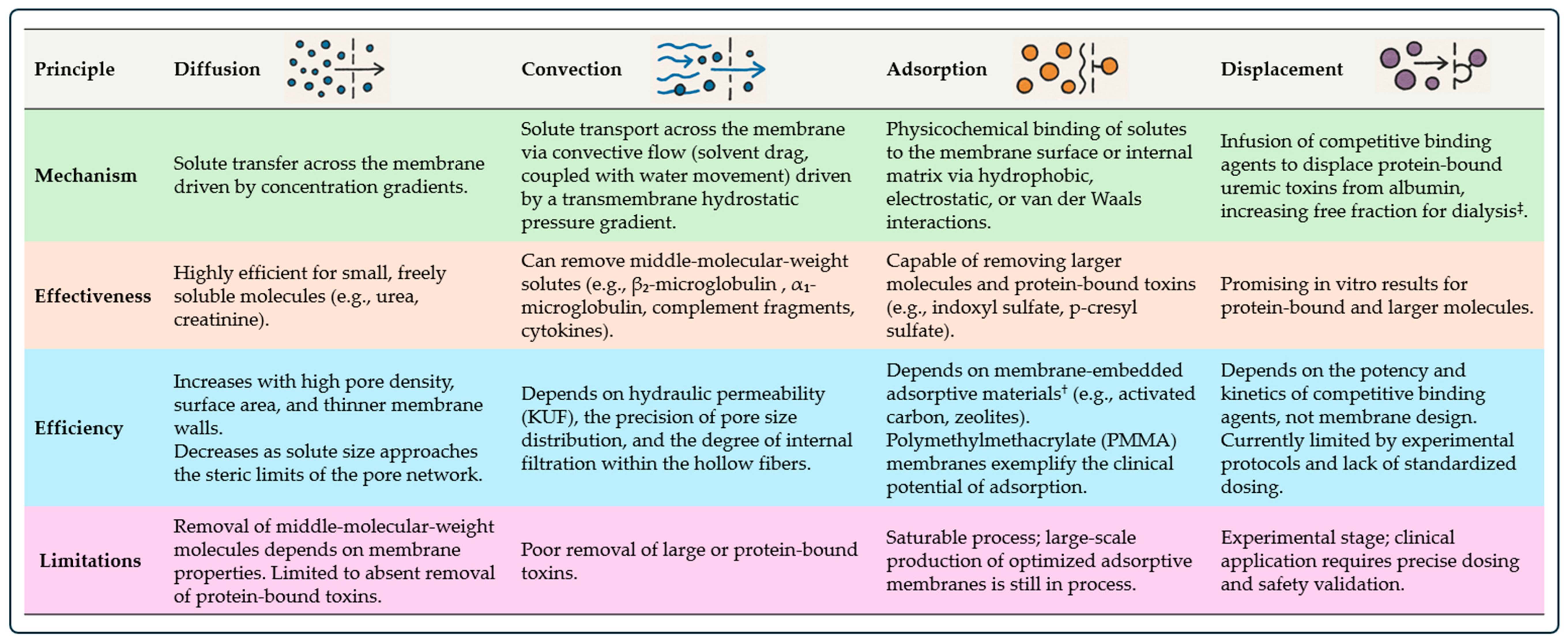
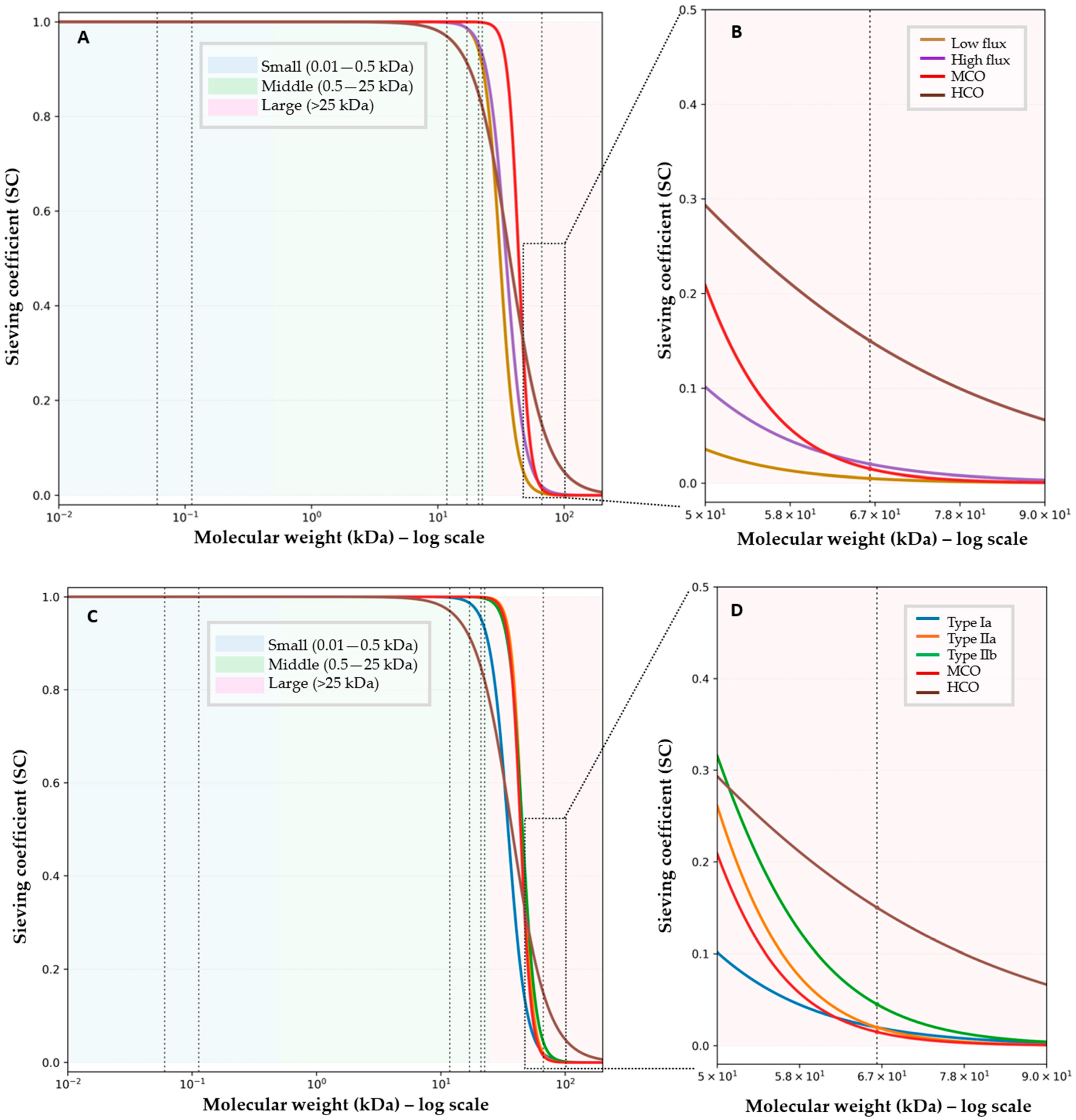
Extracorporeal removal occurs through four mechanisms: diffusion, convection, adsorption, and displacement (Figure 1) [4,5,6,7,8,9,10]. The efficiency and interplay of solute removal are largely determined by dialyzer membrane characteristics, summarized in Table 2 and detailed below. Small water-soluble solutes such as urea and creatinine are readily cleared by diffusion, even with low-flux membranes, due to their low molecular weight and hydrophilicity [9]. Diffusive transport is enhanced by high pore density, large surface area, and thin membranes, but becomes inefficient as solute size approaches pore limits. Middle molecules, in contrast, require larger and uniformly distributed pores for effective clearance. Their accumulation drives inflammation, cardiovascular injury, and dialysis-related amyloidosis, making convective transport essential [10,11]. High-flux and super-high-flux membranes leverage convection, while membranes called ‘medium-cut-off’ (MCO) optimize internal filtration without excessive albumin loss [12]. The boundary between desirable middle-molecule removal and unwanted protein leakage depends on pore size sharpness and uniformity [13]. To visualize how membrane architecture governs solute selectivity, Figure 2 presents conceptual sieving curves comparing different types of dialyzers.
Protein-bound uremic toxins (PBUTs) present unique challenges since only the unbound fraction can cross membranes. Their clearance relies on adsorption, which is influenced by polymer chemistry, surface hydrophilicity, charge distribution, and microdomain architecture [14,15]. Displacement is an emerging concept stimulated by the challenge of protein-bound uremic toxins. Competitive binding agents temporarily displace toxins from albumin, increasing the freely circulating fraction accessible to diffusion or adsorption [11,16,17]. Finally, large–middle molecules, including free light chains, myoglobin, and certain pro-inflammatory mediators, require higher permeability or internal convection to be removed effectively.

3. Dialyzer Engineering Principles

Dialyzers have advanced substantially in their material composition, surface chemistry, and structural engineering, all of which influence pore architecture, biocompatibility, and adsorption capacity [18]. As summarized in Table 3, each advancement in membrane engineering has progressively improved the removal of uremic toxins at the higher end of the spectrum—those with larger molecular weight and protein-binding affinity.
Material composition has evolved from early cellulosic designs to advanced synthetic polymers. Unmodified cellulose membranes, such as Cuprophane, were hydrophilic but triggered strong complement activation and provided only diffusive clearance of small solutes [2]. Acetylation in modified cellulose membranes improved biocompatibility but did not overcome limitations in permeability and convective performance compared with synthetic polymers [2,18]. The transition to synthetic membranes marked a major engineering advance. Polysulfone (PS) and polyethersulfone (PES), often blended with hydrophilic additives like polyvinylpyrrolidone (PVP), became dominant due to their mechanical stability, thermal resistance, and ability to support high hydraulic permeability [3]. These membranes underpin high-flux and HDF dialyzers by combining strong diffusive and convective transport with low albumin sieving. Other synthetic polymers, such as polyacrylonitrile (PAN), polyester polymer alloy (PEPA), and ethylene-vinyl alcohol (EVAL), offer favorable hemodynamic compatibility and are used primarily in Japan and Europe [4]. Polymethylmethacrylate (PMMA) membranes occupy a unique niche. Their microporous matrix contains internal adsorptive domains that bind hydrophobic and protein-bound uremic toxins, including cytokines, while maintaining excellent biocompatibility [19]. These properties make PMMA suitable for patients with inflammation, malnutrition, or high protein-bound uremic toxin burden, consistent with its classification as Type S (adsorptive) in the Japanese system [20].
Advances in pore-engineering and fiber-spinning technologies have enabled the development of MCO membranes that feature tightly controlled pore size distributions and enhanced internal filtration to expand clearance to large–middle molecules (25–45 kDa) without clinically significant albumin loss [21,22]. At the upper end of the permeability spectrum, high-cut-off (HCO) membranes demonstrate pore diameters approaching the size of albumin, extending clearance to solutes up to ~60 kDa [23]. Although highly effective for free light chains, myoglobin, and other large inflammatory mediators, their broader pore size distribution results in significant albumin loss, restricting their use to acute indications such as multiple myeloma cast nephropathy and rhabdomyolysis [24].
Hemodiafilters designed for on-line HDF represent a distinct subset of high-performance synthetic membranes engineered to sustain large convection volumes and high transmembrane pressures. Compared with standard HD dialyzers, HDFs typically incorporate thinner fiber walls, larger effective surface areas, and substantially higher hydraulic permeability (KUF), enabling controlled internal filtration and augmented middle-molecule transport [25]. Their pore size distribution must remain sufficiently uniform to prevent clinically significant albumin loss despite high convective fluxes, and due to the direct infusion of replacement fluid, HDF-certified devices undergo additional endotoxin retention testing and biocompatibility validation to meet regulatory requirements. Although many hemodiafilters are constructed from similar base polymers as high-flux dialyzers (e.g., PS or PES), their structural and hydraulic performance characteristics are measurably different, resulting in enhanced clearance of solutes such as β2-microglobulin, α1-microglobulin, and other middle molecules [25].

4. Current Dialyzer Classifications

Dialyzers are classified according to how membrane material and engineering features influence diffusion, convection, adsorption, and albumin retention. The most widely used frameworks include the international system and the Japanese system (Table 4).
The international classification system separates the dialyzers primarily according to flux characteristics [2,10,26,27]. Low-flux dialyzers, traditionally composed of modified cellulosic or early-generation synthetic membranes, feature limited pore size distributions and rely predominantly on diffusion, making them suitable only for small-solute clearance. High-flux dialyzers, which emerged following advances in synthetic polymer engineering, incorporate larger and more uniform pores, higher ultrafiltration coefficients, and improved hydraulic permeability, enabling effective convective removal of middle molecules and supporting modalities such as on-line HDF. Although the international system groups high-flux dialyzers and HDF-compatible hemodiafilters together, only a subset of high-flux membranes meet the engineering and regulatory criteria for on-line HDF. Certified hemodiafilters are designed to deliver convection volumes ≥20–24 L per session, incorporate reinforced hollow fibers, and demonstrate reliable endotoxin retention properties in accordance with on-line HDF safety standards [28]. Despite the simplicity and widespread use of the international classification system, this system does not account for clinically relevant attributes such as adsorption capacity, pore size uniformity, or controlled albumin passage [26].
The original Japanese classification system categorized dialyzers into Types I–V based on β2-microglobulin clearance [17]. Type I represented low-flux membranes, while Types II–V indicated progressively higher middle-molecule permeability, with Type V achieving super-high-flux performance (β2-microglobulin clearance ≥ 70 mL/min). This approach recognized β2-microglobulin as a clinically significant middle molecule linked to inflammation, mortality, and dialysis-related amyloidosis [11,29,30]. By prioritizing β2-microglobulin clearance, the Japanese system provided a toxin-oriented framework that better reflected solute removal profiles than the international low-/high-flux dichotomy.
As dialyzer materials, surface chemistry, and pore-engineering advanced, Japan adopted an updated classification system that builds on the original framework by incorporating membrane composition and albumin permeability. The current scheme designates Type Ia (standard-flux), Type Ib (high-flux with mild albumin passage), Types IIa and IIb (super-high-flux with progressively larger pores and internal filtration), and Type S for adsorptive membranes such as PMMA [11]. This approach acknowledges that adsorption and material-dependent interactions with hydrophobic solutes and protein-bound toxins significantly influence performance. For example, Type S membranes exhibit strong binding affinity for protein-bound uremic toxins and inflammatory mediators while preserving albumin, a feature not captured by flux-based criteria [11,29,30].
Neither classification formally includes MCO membranes, yet their design—narrow pore size distribution, internal filtration, and controlled albumin passage—aligns most closely with the Japanese super-high-flux category (Type IIb) [31,32,33]. HCO membranes exceed the permeability range of both systems because their pores approach albumin size, causing significant albumin loss and limiting use to acute conditions such as myeloma cast nephropathy [34,35,36,37]. Hemodiafilters occupy the high-permeability end of the continuum alongside MCO and super-high-flux designs but maintain stricter albumin-retention thresholds than HCO membranes.
Dialyzer class performance differences are summarized in Table 5, which links material properties to permeability, sieving behavior, and solute removal capacity. Variations in KoA, KUF, β2-microglobulin clearance, albumin sieving, and pore size uniformity form the structural and functional basis of both international and Japanese classification systems. However, neither framework fully captures the interplay among membrane material, pore architecture, transport mechanisms, and clinical outcomes. As newer designs—such as MCO membranes, advanced adsorptive polymers, and hybrid configurations—emerge, a more integrated, physiology-driven, and toxin-oriented classification may be needed.

5. Evidence from Clinical Studies Evaluating Dialyzer Membranes

Clinical studies assessing dialyzer performance have historically centered on comparisons between high-flux and low-flux membranes, yielding mixed or modest results that failed to indicate advantages of dialyzer mechanistic distinctions. The apparent neutrality of many RCTs could, however, be explained by the absence of phenotype-driven membrane selection: most trials did not target patients with middle-molecule or protein-bound toxin-dominant profiles, populations in which membrane differences are most likely to translate into clinical benefit. Viewed through a mechanistic lens, Table 6 summarizes patterns of relationship between membrane type, solute-removal phenotype, and clinical outcomes [11,17,26,27,29,30,38,39,40,41,42,43,44,45,46].
The HEMO trial compared high-flux with low-flux dialyzers in chronic HD and found no overall difference in all-cause mortality, but did report a significant reduction in cardiac mortality and a trend toward benefit in subgroups with longer dialysis vintage or higher β2-microglobulin levels [38]. The MPO Study, which randomized patients with serum albumin <4 g/dL to high- versus low-flux membranes, demonstrated a significant survival benefit with high-flux membranes in the low-albumin subgroup, again suggesting that nutritionally vulnerable and inflammatory phenotypes respond to enhanced middle-molecule clearance [39]. These findings were not observed in higher-albumin cohorts, reinforcing the principle that membrane efficacy is phenotype-dependent [26,27,40].
Residual kidney function (RKF) also modulates the impact of membrane selection. High-flux membranes have not demonstrated a survival advantage in patients with substantial RKF. However, in anuric individuals, high-flux membranes are associated with reduced mortality, underscoring the importance of membrane choice in patients with minimal or absent RKF [27,47].
Large-scale registry data from Japan, encompassing over 240,000 patients classified using the Type I–V dialyzer system based on β2-microglobulin clearance, demonstrated lower all-cause mortality associated with Type V (super-high-flux) membranes after multivariable adjustment and propensity score matching [11,29]. International cohort analyses similarly report reduced mortality with super-high-flux and protein-leaking membranes [29]. Observational studies further highlighted the potential benefits of adsorptive membranes. PMMA dialyzers have been associated with reduced adjusted mortality rates compared to PS and other synthetic membranes, particularly after accounting for nutritional and inflammatory status [17,42]. These membranes may confer additional cardiovascular protection by attenuating pro-inflammatory mediators such as soluble CD40 ligand (sCD40L), TNF-α, and IL-6 [48].
Beyond survival, patient-reported outcomes provide additional insight into the clinical relevance of membrane selection. High-flux-with-MCO membranes have been linked to improvements in physical functioning, reduced pruritus, and shorter post-dialysis recovery times compared to conventional high-flux dialysis [43,49]. These advanced membranes also exhibit favorable effects on oxidative stress and endothelial function, as demonstrated by metabolomic and proteomic analyses [50]. A comparative study by Maduell and colleagues systematically evaluated four MCO dialyzers (Phylther 17-SD, Vie-18X, Elisio HX19, and Theranova 400) against high-flux HD and post-dilution HDF in 23 patients undergoing six dialysis sessions each [51]. The study demonstrated that differences in efficacy between dialyzers were minimal for small molecules and solutes up to the size of β2-microglobulin. However, substantial differences emerged for larger middle molecules: all four MCO dialyzers achieved significantly higher reduction ratios for myoglobin, κ free light chains, prolactin, α1-microglobulin, and λ free light chains compared with high-flux HD, while being slightly inferior to post-dilution HDF. Importantly, the four MCO dialyzers demonstrated similar efficacy to each other, with no significant performance differences between brands. Albumin losses were acceptable across all MCO dialyzers (1.5–2.5 g per session), comparable to HDF and substantially higher than high-flux HD (<1 g). A global removal score integrating clearance across molecular-weight ranges confirmed the superiority of HDx over high-flux HD, with efficacy approaching that of post-dilution HDF. These findings establish that MCO-based expanded hemodialysis (HDx) occupies an intermediate position between high-flux HD and HDF for large-middle-molecule clearance, offering a practical alternative for centers without HDF infrastructure while achieving near-equivalent performance for solutes in the 15–45 kDa range.
Hemodynamic instability requires approaches that limit inflammatory surges and improve hemocompatibility. In this context, high-volume hemodiafiltration (HDF) has emerged as a strategy that extends middle-molecule removal while conferring potential survival benefits. The CONVINCE trial, a pragmatic multinational randomized controlled trial of 1360 patients, showed that high-dose HDF (convection volume ≥ 23 L per session) reduces all-cause mortality by 23% compared with conventional high-flux HD (HR 0.77; 95% CI 0.65–0.93) over a median follow-up of 30 months [52]. Subgroup analyses from CONVINCE and a subsequent individual patient data meta-analysis of five randomized trials (>4000 patients) identified patient characteristics associated with differential benefit [53]. The survival benefit appeared most pronounced in patients without preexisting cardiovascular disease or diabetes mellitus, where HDF showed substantial risk reductions. In contrast, among patients with established cardiovascular disease or diabetes, hazard ratios approached unity, suggesting attenuated benefit in these subgroups. Observational and registry studies complement these findings. A large 2019 Japanese cohort study of approximately 10,000 patients reported that pre-dilution on-line HDF was associated with a 17% reduction in all-cause mortality compared with standard HD, with the greatest benefit observed in patients receiving high substitution volumes (~40 L/session) [54]. A recent individual patient data meta-analysis of five RCTs (n = 4153 patients) confirmed that post-dilution on-line HDF reduces all-cause mortality (HR 0.84, 95% CI 0.74–0.95) with a dose-dependent relationship between convection volume and survival benefit [53].
Direct comparative data on pre- versus post-dilution HDF remains limited. A recent study by Xu et al. compared mixed-dilution HDF (which combines pre- and post-dilution) with pure pre-dilution and post-dilution modes, finding that mixed-dilution achieved similar small- and middle-molecule clearance to post-dilution while offering improved transmembrane pressure control [55]. The Kidney Health Initiative consensus notes that post-dilution provides the highest solute clearances for the lowest convection volume and is more cost-effective, while pre-dilution requires approximately twice the convection volume to achieve similar solute clearances [28]. Thus, pre-dilution HDF is typically used when desired convection volumes cannot be achieved in post-dilution mode due to unfavorable hemorheologic conditions. Building on these data, a 2026 Japanese expert consensus proposes a national transition toward optimized post-dilution HDF to enhance resource efficiency while maintaining clinical effectiveness [56]. Parallel recommendations from the 2025 ERA EuDial Working Group conclude that HDF appears associated with improved survival when high convection volumes are consistently achieved, even while acknowledging methodological limitations in the existing evidence base [57]. Together, these studies support the integration of high-volume HDF—particularly post-dilution—as an effective strategy for patients with substantial middle-molecule burden, recurrent intradialytic instability, or persistent inflammation. However, the heterogeneity in modality availability, water quality standards, and regional prescribing norms underscores the need to contextualize HDF adoption within local infrastructure constraints.
HCO dialyzers have been studied in multiple myeloma and rhabdomyolysis but remain largely restricted to research protocols or select centers. Trials show that while HCO membranes reduce serum free light chains, they have not consistently improved dialysis independence or survival compared with high-flux dialysis and carry risks such as infection and albumin loss [36,58,59]. In rhabdomyolysis, pilot studies confirm myoglobin removal without clear clinical benefit [60]. Overall, HCO dialyzers are investigational, and larger studies are needed to define their role and safety.

6. Albumin Loss with Extracorporeal Dialysis Filters

As illustrated by the albumin-region magnification of the sieving curves (Figure 2), membranes with similar middle-molecule clearance may differ substantially in cut-off sharpness and albumin permeability. Hypoalbuminemia is a recognized mortality risk factor, yet its interpretation is confounded by inflammation and malnutrition, making it difficult to isolate the impact of dialytic albumin loss [61,62]. A better-quality renal dialysis may improve liver synthesis and counteract ongoing albumin losses. The albumin-region zoom in Figure 2 underscores that tight pore size distributions (e.g., Type IIa and MCO) preserve albumin despite enhanced middle-molecule clearance, whereas broader cut-offs (Type IIb and HCO) are associated with progressively greater albumin loss. Evidence linking albumin leakage to outcomes remains inconsistent, and no definitive threshold for safe loss has been established. In trials comparing high- and low-flux membranes, overall mortality was unaffected, although high-flux dialyzers may reduce cardiovascular mortality and improve outcomes in subgroups with low serum albumin, diabetes, or longer dialysis vintage [27]. Albumin loss with these membranes is minimal (<1 g/session) and not associated with harm.
Albumin losses are greater with protein-leaking, adsorptive, and super-high-flux membranes, but long-term safety remains uncertain. Some studies suggest potential benefits—such as improved anemia correction and enhanced toxin removal—yet routine use is unsupported by outcome data, and tolerable albumin loss for chronic therapy is undetermined [61]. Albumin is also a carrier of protein-bound uremic toxins and a filtering loss through the membrane could be one way of removing protein-bound uremic toxins, provided that loss of albumin does not exceed the liver’s synthesis capacity. MCO dialyzers typically cause moderate loss (1–3 g/session), whereas HCO membranes may exceed 20 g/session, a level generally unacceptable for long-term use [63]. Comparative studies between HD with MCO dialyzer (dubbed expanded HD) and HDF showed similar efficacy for toxin clearance, with higher albumin loss in some MCO membranes but no short-term differences in serum albumin or clinical outcomes [64,65].
Although albumin leakage is more pronounced with MCO and HCO membranes than with high-flux dialyzers, meta-analyses indicate no consistent association with increased all-cause mortality, provided nutritional status is maintained and inflammation is controlled [49,61,66]. Comparative studies have shown similar rates of hospitalization and treatment-related complications between patients treated with high-flux, MCO, and PMMA dialyzers [27]. Furthermore, PMMA membranes, through their biocompatible and adsorptive properties, may offer additional protection against inflammation-mediated complications, potentially contributing to improved cardiovascular and overall outcomes [48].
Overall, current evidence supports the safety of advanced membranes when matched to patient phenotype. Albumin loss <2–3 g/session is generally considered safe; higher losses may be acceptable in select cases prioritizing middle-molecule clearance, though long-term safety remains uncertain. Continuous monitoring of nutritional and inflammatory markers is essential. Further research should clarify the clinical impact of albumin loss, especially with emerging membrane technologies.

7. Patient-Centered Dialyzer Selection Framework

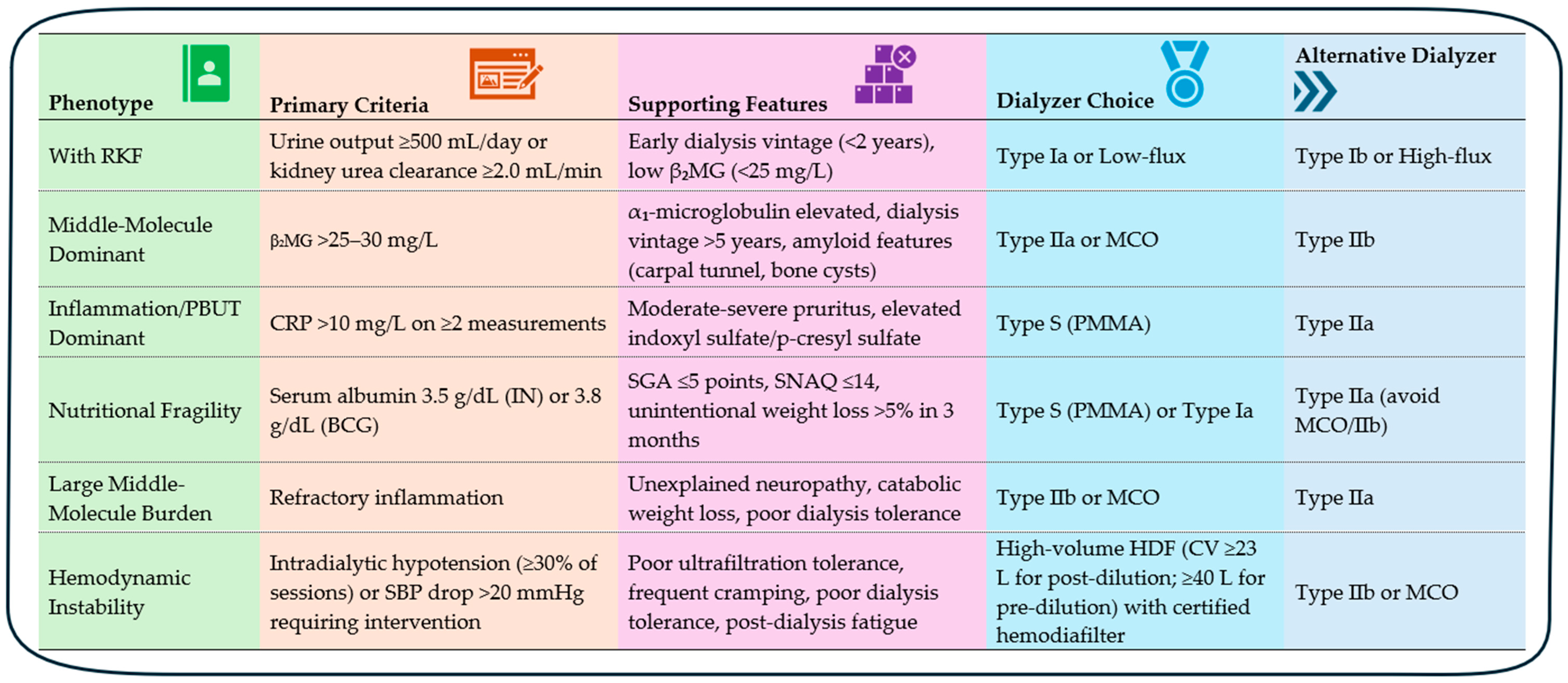
Uremic toxin accumulation in patients on chronic dialysis varies within and between individuals, reflecting differences in solute physicochemistry, inflammatory activation, nutritional status, RKF, comorbidities, and acute intercurrent illnesses. To align dialyzer membrane properties with biologically anchored phenotypes, we propose a framework for dialyzer selection based on dominant toxin drivers, clinical vulnerabilities, and therapeutic priorities (Figure 3).
Patients with preserved RKF or early dialysis initiation often achieve adequate clearance with standard low- or high-flux membranes (Type Ia/Ib) [11,17,47]. RKF disproportionately clears middle molecules and protein-bound toxins such as indoxyl sulfate and p-cresyl sulfate [27,47,67]. Thus, early use of MCO or Type IIb membranes or HDF is generally unwarranted unless baseline inflammatory or amyloidogenic burden is high [31,49].
Middle-molecule-dominant phenotypes exhibit elevated β2-microglobulin, α1-microglobulin, osteoprotegerin, complement fragments, and mid-range cytokines, contributing to amyloidosis, vascular stiffness, pruritus, and chronic inflammation—factors linked to mortality and cardiovascular events [17,42]. European Best Practice Guidelines recommend β2-microglobulin monitoring and removal [68], and Japanese dialyzer classification is based on β2-microglobulin clearance. Patients with β2-microglobulin > 25 mg/L or clinical signs of toxin burden may benefit from MCO membranes. Type IIa/IIb designs, with high convective transport and uniform pore architecture, achieve superior clearance of these solutes. MCO membranes extend removal into the 25–45 kDa range via a narrow pore size distribution and optimized hydraulic performance [31,49]. Registry analyses from Japan reporting lower mortality with Type IIa and IIb membranes further support the relevance of enhanced middle-molecule clearance in improving outcomes [29].
Large–middle-molecule phenotypes (30–60 kDa), often marked by high free light chains, IL-6, myoglobin, and fibrinogen fragments, present with refractory inflammation, catabolic weight loss, neuropathy, and poor dialysis tolerance. Type IIb and MCO membranes improve clearance while maintaining acceptable albumin retention [31,49]. HCO membranes provide maximal removal but cause excessive albumin loss, restricting their short-term use in acute conditions such as myeloma cast nephropathy or rhabdomyolysis [36,58,59].
Protein-bound toxin-dominant states involve indoxyl sulfate, p-cresyl sulfate, CMPF, and other hydrophobic solutes that drive cardiovascular risk. Their clearance depends on adsorption rather than permeability. PMMA membranes offer high-capacity binding through a microporous polymer matrix and have demonstrated reductions in inflammatory cytokines and oxidative stress [29]. Surface-modified PS membranes provide moderate adsorption but lack PMMA’s efficacy [11].
Inflammation-dominant phenotypes feature elevated CRP, IL-6, TNF-α, and oxidative stress markers, often with vascular access dysfunction and intradialytic hypotension. Hydrophobic mediators respond to PMMA membranes, while larger cytokines require the convective permeability of Type IIb or MCO membranes. Both have shown biomarker reductions in clinical studies [31,32,33].
Nutritional fragility and hypoalbuminemia demand membranes with minimal albumin leakage. PMMA membranes combine strong adsorption with negligible albumin loss, making them ideal for malnourished patients [48]. PEPA membranes offer an alternative with adsorptive properties and excellent biocompatibility [69], though registry data have not confirmed equivalent mortality benefits in this population [17,42]. Type IIa membranes offer improved middle-molecule clearance with minimal albumin passage, whereas MCO or Type IIb membranes should be reserved for nutritionally stable individuals [27].
Hemodynamic instability requires strategies to mitigate inflammatory surges and improve hemocompatibility. PMMA membranes enhance intradialytic stability, while HDF outperforms high-flux HD in patients with high cardiovascular risk, high infection risk, or inadequate middle-molecule clearance. HDF provides survival and inflammation benefits when high convection volumes (≥23 L/session) are achieved [70,71].
This phenotype-based selection framework is constrained by several evidence gaps. No randomized or observational studies inform dialyzer selection in pregnancy, and physiologic changes in plasma volume, albumin kinetics, and toxin generation preclude extrapolation from nonpregnant populations. Similarly, the safety and efficacy of transitioning patients back to lower permeability membranes after improvement in inflammatory or toxin-dominant states remain unstudied, as the existing literature focuses on outcomes with higher-performance membranes and provides little de-escalation guidance. Published trials also rarely stratify results by evolving nutritional status, RKF, or inflammatory activity, limiting longitudinal decision-making. Finally, operational and resource constraints—such as ultrapure water availability, HDF capability, dialyzer availability, and regional prescribing practices—shape membrane selection. In centers without HDF infrastructure, MCO membranes offer a practical alternative for extended middle-molecule clearance via internal filtration. In centers lacking ultrapure water, equipment, or staffing for HDF, MCO membranes provide a practical alternative, approximating hemodiafilter performance through internal filtration and uniform pore architecture [49,72]. Access to advanced membranes varies globally. Super-high-flux (Type IIa/IIb), PMMA, and certain MCO membranes are widely used in Japan and parts of Europe but are not available in the United States and many low-resource settings. Two advanced dialyzers available in the United States are compared with Japanese dialyzers in Table 7. Fresenius FX CorAL, a next-generation high-flux dialyzer, optimizes middle-molecule clearance while preserving albumin and aligns most closely with the Japanese Type Ib high-flux category. Baxter’s Theranova MCO dialyzer provides clearance of conventional and large–middle molecules up to approximately 45 kDa. Although its functional profile overlaps partially with the large–middle molecule clearance achieved by Japanese Type IIb membranes, Theranova is not a true equivalent, owing to key differences in pore size uniformity and albumin sieving characteristics. Thus, while phenotype-driven selection represents an ideal precision dialysis model, implementation must adapt to local formulary limitations and procurement pathways. Even within these constraints, applying core principles—matching membrane characteristics to toxin burden, inflammatory state, nutritional status, and RKF—can optimize outcomes using available options.
A limitation of this review is its focus on membrane-specific determinants of toxin removal, without detailed consideration of treatment duration and frequency—parameters that independently influence solute clearance and interact with membrane properties. Small water-soluble solutes equilibrate rapidly between compartments and are efficiently cleared even during short sessions, whereas middle molecules and protein-bound toxins require longer treatment times for optimal removal. Protein-bound uremic toxins present a particular challenge because only the unbound fraction crosses dialyzer membranes, and dissociation from carrier proteins is time-dependent [8]. Extended dialysis sessions—whether through nocturnal hemodialysis (6–8 h, 3–6 nights per week) or prolonged intermittent hemodialysis—permit greater cumulative dissociation and enhanced removal. Middle molecules similarly benefit from extended treatment; β2-microglobulin clearance increases with session duration due to continued convective transport and equilibration from the interstitial compartment, and high-volume HDF achieves superior middle-molecule clearance in part through sustained convection over longer effective treatment times [1,2,4]. Thus, potential synergies exist between membrane selection and treatment schedule. Patients with protein-bound toxin-dominant phenotypes may benefit from combining adsorptive membranes (e.g., PMMA) with extended session duration, while those with middle-molecule-dominant phenotypes may achieve optimal clearance by pairing MCO or super-high-flux membranes with adequate session length (≥4 h) or high-volume HDF. Conversely, patients with preserved RKF may achieve adequate clearance with standard membranes and conventional schedules, reserving intensified regimens for those with declining RKF or emerging toxin burden. A comprehensive framework integrating membrane selection with individualized treatment duration and frequency remains an important area for future research and guideline development.


8. Emerging Membrane Technologies and Strategies

Current dialyzer membranes, despite advances in permeability and biocompatibility, remain limited in their capacity to remove PBUTs, which are strongly associated with cardiovascular morbidity and mortality. Several innovative approaches are under development to address these limitations.

8.1. Mixed-Matrix Membranes

Mixed-matrix membranes (MMMs) represent a hybrid technology that incorporates sorbent particles—typically activated carbon—within a polymer membrane matrix [73]. This design combines diffusive and convective transport with adsorptive removal, enabling clearance of PBUTs that conventional membranes cannot effectively eliminate [16]. Preclinical studies have demonstrated that MMMs achieve significantly higher removal of indoxyl sulfate and p-cresyl sulfate compared with conventional high-flux membranes, with one study reporting more than 100% better removal compared to commercial dialysis membranes [73]. Dual-layer MMM designs featuring an inner blood-contacting selective layer and an outer sorbent-containing layer have shown superior removal of protein-bound toxins while maintaining acceptable hemocompatibility [74,75]. In vitro assessments following ISO 10993-4 standards indicate that low-flux MMMs successfully prevent blood contact with activated-carbon particles and demonstrate hemocompatibility comparable to membranes currently used in clinical practice [74]. However, clinical translation remains in early stages, and challenges include optimizing sorbent loading without compromising membrane integrity, ensuring long-term biocompatibility, scaling manufacturing for clinical use, and balancing flux characteristics with albumin retention [75,76].

8.2. Electrokinetic and Novel Filtration Approaches

Electrokinetic separation, which exploits differences in solute charge and mobility under an applied electric field, has been proposed for selective toxin removal [73,77]. Early-stage prototypes using electroosmotic flow through charged membranes have demonstrated transport of urea, creatinine, and other uremic solutes, with one study achieving intensive electroosmotic flux of 1–2 mL/cm2/h [77]. Ion concentration polarization techniques have shown up to 99.7% retention of albumin while separating neutral metabolites and excess fluid from blood plasma [73]. However, energy requirements, membrane fouling, device complexity, and the need for specialized materials present barriers to clinical adoption. Similarly, biomimetic membranes, nanomaterial-enabled hybrid architectures, and AI-assisted membrane design are being explored but remain largely preclinical [78].

9. Conclusions and Future Directions

Clinical studies showed a critical role of membrane characteristics—permeability, adsorptive capacity, and biocompatibility—in shaping outcomes such as mortality, cardiovascular risk, inflammation, and patient-reported quality of life. A phenotype-driven approach to dialyzer selection, informed by RKF, nutritional status, uremic toxin burden, and inflammatory burden, can enable clinicians to optimize solute clearance while minimizing risks such as albumin loss and inflammatory activation. However, membrane selection represents only one dimension of dialysis individualization. Treatment duration and frequency independently influence toxin clearance and may synergize with membrane properties to enhance the removal of middle molecules and protein-bound solutes. Prospective studies evaluating phenotype-driven membrane selection in combination with individualized treatment schedules are needed to establish integrated prescriptions that address the full spectrum of uremic toxicity. Integrating membrane choice into individualized dialysis prescriptions represents a pivotal opportunity to advance therapeutic efficacy, reduce complications, and improve the lived experience of patients with kidney failure. Continued investment in translational research and well-designed clinical trials will be essential to determine whether emerging membrane technologies can meaningfully improve outcomes for patients on chronic dialysis.

Author Contributions

Conceptualization, M.M.; writing—original draft preparation, M.M.; writing—review and editing, A.S.A., V.D.N., T.F., A.C.Y., T.T. and M.A. All authors have read and agreed to the published version of the manuscript.

Funding

This research received no external funding.

Institutional Review Board Statement

Not applicable.

Informed Consent Statement

Not applicable.

Data Availability Statement

No new data were created or analyzed in this study.

Conflicts of Interest

The authors declare no conflicts of interest. Fülöp is a current employee of the United States Veterans Health Administration. However, the opinions and views expressed in this paper are the Authors’ own and do not represent the official views or policies of the United States Veteran Health Administrations.

Abbreviations

The following abbreviations are used in this manuscript:
ADMAAsymmetric dimethylarginine
α1MGAlpha-1 Microglobulin
β2MGBeta-2 Microglobulin
CMPF3-Carboxy-4-Methyl-5-Propyl-2-Furanpropionic Acid
CRPC-Reactive Protein
EVALEthylene–Vinyl Alcohol
HCOHigh Cut-Off
HDHemodialysis
HDFHemodiafiltration
HFHemodiafilter
IL-6Interleukin-6
KoAMass Transfer Area Coefficient
KUFUltrafiltration Coefficient
MCOMedium Cut-Off
PANPolyacrylonitrile
PBUTProtein-Bound Uremic Toxins
PEPAPolyester Polymer Alloy
PESPolyethersulfone
PMMAPolymethylmethacrylate
PSPolysulfone
PVPPolyvinylpyrrolidone
RCTRandomized Controlled Trial
RKFResidual Kidney Function
sCD40LSoluble CD40 Ligand
TNF-αTumor Necrosis Factor Alpha

References

  1. Meyer, T.W.; Hostetter, T.H. Uremia. N. Engl. J. Med. 2007, 357, 1316–1325. [Google Scholar] [CrossRef] [PubMed]
  2. Ronco, C.; Clark, W.R. Haemodialysis membranes. Nat. Rev. Nephrol. 2018, 14, 394–410. [Google Scholar] [CrossRef]
  3. Haroon, S.; Davenport, A. Choosing a dialyzer: What clinicians need to know. Hemodial. Int. 2018, 22, S65–S74. [Google Scholar] [CrossRef]
  4. Davenport, A. The changing face of dialyzer membranes and dialyzers. Semin. Dial. 2025, 38, 25–34. [Google Scholar] [CrossRef]
  5. Rosner, M.H.; Reis, T.; Husain-Syed, F.; Vanholder, R.; Hutchison, C.; Stenvinkel, P.; Blankestijn, P.J.; Cozzolino, M.; Juillard, L.; Kashani, K.; et al. Classification of Uremic Toxins and Their Role in Kidney Failure. Clin. J. Am. Soc. Nephrol. 2021, 16, 1918–1928. [Google Scholar] [CrossRef]
  6. Cozzolino, M.; Magagnoli, L.; Ciceri, P. From Physicochemical Classification to Multidimensional Insights: A Comprehensive Review of Uremic Toxin Research. Toxins 2025, 17, 295. [Google Scholar] [CrossRef]
  7. Glorieux, G.; Burtey, S.; Evenepoel, P.; Jankowski, J.; Koppe, L.; Masereeuw, R.; Vanholder, R. A guide to uraemic toxicity. Nat. Rev. Nephrol. 2025, 22, 50–68. [Google Scholar] [CrossRef]
  8. Lee, S.; Sirich, T.L.; Meyer, T.W. Improving Solute Clearances by Hemodialysis. Blood Purif. 2022, 51, 20–31. [Google Scholar] [CrossRef]
  9. Pastan, S.; Bailey, J. Dialysis therapy. N. Engl. J. Med. 1998, 338, 1428–1437. [Google Scholar] [CrossRef] [PubMed]
  10. Canaud, B. Recent advances in dialysis membranes. Curr. Opin. Nephrol. Hypertens. 2021, 30, 613–622. [Google Scholar] [CrossRef] [PubMed]
  11. Abe, M.; Kikuchi, K.; Wada, A.; Nakai, S.; Kanda, E.; Hanafusa, N. Current dialyzer classification in Japan and mortality risk in patients undergoing hemodialysis. Sci. Rep. 2024, 14, 10272. [Google Scholar] [CrossRef]
  12. Ronco, C.; Marchionna, N.; Brendolan, A.; Neri, M.; Lorenzin, A.; Martinez Rueda, A.J. Expanded haemodialysis: From operational mechanism to clinical results. Nephrol. Dial. Transplant. 2018, 33, iii41–iii47. [Google Scholar] [CrossRef]
  13. Khulbe, K.; Feng, C.; Matsuura, T. Synthetic Polymorphic Membranes; Springer: Berlin/Heidelberg, Germany, 2008; Volume 5. [Google Scholar]
  14. Gomez, M.; Bañon-Maneus, E.; Arias-Guillén, M.; Maduell, F. Assessment of removal and adsorption enhancement of high-flux hemodialyzers in convective therapies by a novel in vitro uremic matrix. Sci. Rep. 2020, 10, 17403. [Google Scholar] [CrossRef]
  15. Maheshwari, V.; Thijssen, S.; Tao, X.; Fuertinger, D.H.; Kappel, F.; Kotanko, P. In silico comparison of protein-bound uremic toxin removal by hemodialysis, hemodiafiltration, membrane adsorption, and binding competition. Sci. Rep. 2019, 9, 909. [Google Scholar] [CrossRef]
  16. Rodrigues, F.S.C.; Faria, M. Adsorption- and Displacement-Based Approaches for the Removal of Protein-Bound Uremic Toxins. Toxins 2023, 15, 110. [Google Scholar] [CrossRef]
  17. Abe, M.; Hamano, T.; Wada, A.; Nakai, S.; Masakane, I.; Renal Data Registry Committee, Japanese Society for Dialysis Therapy. Effect of dialyzer membrane materials on survival in chronic hemodialysis patients: Results from the annual survey of the Japanese Nationwide Dialysis Registry. PLoS ONE 2017, 12, e0184424. [Google Scholar] [CrossRef] [PubMed]
  18. Nguyen, T.-T.; Jang, K.; Her, N.; Kim, C.S.; Kim, S.W.; Kim, I.S. Fabrication of hollow fiber membranes with different inner diameters for enhanced uremic toxins removal in hemodialysis: Exploring from high-flux to high molecular weight retention onset classes. J. Membr. Sci. 2022, 663, 121065. [Google Scholar] [CrossRef]
  19. Torii, Y.; Yamada, S.; Yajima, M.; Sugata, T. Polymethylmethacrylate Membrane Dialyzer: Historic but Modern. Blood Purif. 2022, 52, 8–14. [Google Scholar] [CrossRef]
  20. Castellano, G.; Netti, G.S.; Cantaluppi, V.; Losappio, V.; Spadaccino, F.; Ranieri, E.; Marengo, M.; Borzumati, M.; Alfieri, C.; Stallone, G. PMMA dialyzers modulate both humoral and cell-mediate immune response to anti-COVID-19 vaccine (BNT162b2) in a cohort of chronic hemodialyzed patients. Sci. Rep. 2024, 14, 12217. [Google Scholar] [CrossRef]
  21. Fiorentino, M.; La Fergola, F.; De Rosa, S. Medium cut-off dialyzer for middle molecular uremic toxins in AKI and chronic dialysis. J. Nephrol. 2024, 37, 23–37. [Google Scholar] [CrossRef] [PubMed]
  22. Kim, H.J.; Song, S.H. Clinical benefits and future directions of medium cut-off membranes in hemodialysis: A comprehensive review. Korean J. Intern. Med. 2025, 40, 557–570. [Google Scholar] [CrossRef]
  23. Reis, T.; Anwar, S.; Neves, F.; Ronco, C. Disruptive technologies for hemodialysis: Medium and high cutoff membranes. Is the future now? J. Bras. Nefrol. 2021, 43, 410–416. [Google Scholar]
  24. Belmouaz, M.; Goussard, G.; Joly, F.; Sibille, A.; Martin, C.; Betous, T.; Thierry, A.; Bauwens, M.; Bridoux, F. Comparison of High-Flux, Super High-Flux, Medium Cut-Off Hemodialysis and Online Hemodiafiltration on the Removal of Uremic Toxins. Blood Purif. 2023, 52, 309–318. [Google Scholar] [CrossRef]
  25. Kuhlmann, M.K. 12—Hemofiltration and Hemodiafiltration. In Handbook of Dialysis Therapy, 6th ed.; Nissenson, A.R., Fine, R.N., Mehrotra, R., Zaritsky, J., Eds.; Elsevier: New Delhi, India, 2023; pp. 135–140. [Google Scholar]
  26. Palmer, S.C.; Rabindranath, K.S.; Craig, J.C.; Roderick, P.J.; Locatelli, F.; Strippoli, G.F. High-flux versus low-flux membranes for end-stage kidney disease. Cochrane Database Syst. Rev. 2012, 2012, Cd005016. [Google Scholar] [CrossRef]
  27. Daugirdas, J.T.; Depner, T.A.; Inrig, J.; Mehrotra, R.; Rocco, M.V.; Suri, R.S.; Weiner, D.E.; Greer, N.; Ishani, A.; MacDonald, R.; et al. KDOQI Clinical Practice Guideline for Hemodialysis Adequacy: 2015 Update. Am. J. Kidney Dis. 2015, 66, 884–930. [Google Scholar] [CrossRef]
  28. Canaud, B.; Vienken, J.; Ash, S.; Ward, R.A.; Kidney Health Initiative HDF Workgroup. Hemodiafiltration to Address Unmet Medical Needs ESKD Patients. Clin. J. Am. Soc. Nephrol. 2018, 13, 1435–1443. [Google Scholar] [CrossRef] [PubMed]
  29. Abe, M.; Masakane, I.; Wada, A.; Nakai, S.; Nitta, K.; Nakamoto, H. Dialyzer Classification and Mortality in Hemodialysis Patients: A 3-Year Nationwide Cohort Study. Front. Med. 2021, 8, 740461. [Google Scholar] [CrossRef]
  30. Abe, M.; Masakane, I.; Wada, A.; Nakai, S.; Kanda, E.; Nitta, K.; Nakamoto, H. High-performance dialyzers and mortality in maintenance hemodialysis patients. Sci. Rep. 2021, 11, 12272. [Google Scholar] [CrossRef] [PubMed]
  31. Belmouaz, M.; Bauwens, M.; Hauet, T.; Bossard, V.; Jamet, P.; Joly, F.; Chikhi, E.; Joffrion, S.; Gand, E.; Bridoux, F. Comparison of the removal of uraemic toxins with medium cut-off and high-flux dialysers: A randomized clinical trial. Nephrol. Dial. Transplant. 2020, 35, 328–335. [Google Scholar] [CrossRef] [PubMed]
  32. Kirsch, A.H.; Lyko, R.; Nilsson, L.G.; Beck, W.; Amdahl, M.; Lechner, P.; Schneider, A.; Wanner, C.; Rosenkranz, A.R.; Krieter, D.H. Performance of hemodialysis with novel medium cut-off dialyzers. Nephrol. Dial. Transplant. 2017, 32, 165–172. [Google Scholar] [CrossRef]
  33. Lukkanalikitkul, E.; Kidkaem, H.; Phonrat, M.; Prathompong, P.; Anutrakulchai, S. A randomized trial comparing medium cut-off membrane dialyzers with online hemodiafiltration for uremic toxins clearance in hemodialysis patients. Sci. Rep. 2025, 15, 5467. [Google Scholar] [CrossRef] [PubMed]
  34. Gondouin, B.; Hutchison, C.A. High cut-off dialysis membranes: Current uses and future potential. Adv. Chronic Kidney Dis. 2011, 18, 180–187. [Google Scholar] [CrossRef]
  35. Girndt, M.; Fiedler, R.; Martus, P.; Pawlak, M.; Storr, M.; Bohler, T.; Glomb, M.A.; Liehr, K.; Henning, C.; Templin, M.; et al. High cut-off dialysis in chronic haemodialysis patients. Eur. J. Clin. Investig. 2015, 45, 1333–1340. [Google Scholar] [CrossRef]
  36. Bridoux, F.; Carron, P.L.; Pegourie, B.; Alamartine, E.; Augeul-Meunier, K.; Karras, A.; Joly, B.; Peraldi, M.N.; Arnulf, B.; Vigneau, C.; et al. Effect of High-Cutoff Hemodialysis vs Conventional Hemodialysis on Hemodialysis Independence Among Patients with Myeloma Cast Nephropathy: A Randomized Clinical Trial. JAMA 2017, 318, 2099–2110. [Google Scholar] [CrossRef]
  37. Heybeli, C.; De Simone, E.; Leung, N. The Role of Extracorporeal Therapy in Light Chain Cast Nephropathy. Am. J. Nephrol. 2025, 1–12. [Google Scholar] [CrossRef] [PubMed]
  38. Eknoyan, G.; Beck, G.J.; Cheung, A.K.; Daugirdas, J.T.; Greene, T.; Kusek, J.W.; Allon, M.; Bailey, J.; Delmez, J.A.; Depner, T.A.; et al. Effect of dialysis dose and membrane flux in maintenance hemodialysis. N. Engl. J. Med. 2002, 347, 2010–2019. [Google Scholar] [CrossRef] [PubMed]
  39. Locatelli, F.; Martin-Malo, A.; Hannedouche, T.; Loureiro, A.; Papadimitriou, M.; Wizemann, V.; Jacobson, S.H.; Czekalski, S.; Ronco, C.; Vanholder, R. Effect of membrane permeability on survival of hemodialysis patients. J. Am. Soc. Nephrol. 2009, 20, 645–654. [Google Scholar] [CrossRef]
  40. Argyropoulos, C.; Roumelioti, M.E.; Sattar, A.; Kellum, J.A.; Weissfeld, L.; Unruh, M.L. Dialyzer Reuse and Outcomes of High Flux Dialysis. PLoS ONE 2015, 10, e0129575. [Google Scholar] [CrossRef]
  41. Asci, G.; Tz, H.; Ozkahya, M.; Duman, S.; Demirci, M.S.; Cirit, M.; Sipahi, S.; Dheir, H.; Bozkurt, D.; Kircelli, F.; et al. The impact of membrane permeability and dialysate purity on cardiovascular outcomes. J. Am. Soc. Nephrol. 2013, 24, 1014–1023. [Google Scholar] [CrossRef]
  42. Abe, M.; Hamano, T.; Wada, A.; Nakai, S.; Masakane, I. High-Performance Membrane Dialyzers and Mortality in Hemodialysis Patients: A 2-Year Cohort Study from the Annual Survey of the Japanese Renal Data Registry. Am. J. Nephrol. 2017, 46, 82–92. [Google Scholar] [CrossRef]
  43. Lim, J.H.; Park, Y.; Yook, J.M.; Choi, S.Y.; Jung, H.Y.; Choi, J.Y.; Park, S.H.; Kim, C.D.; Kim, Y.L.; Cho, J.H. Randomized controlled trial of medium cut-off versus high-flux dialyzers on quality of life outcomes in maintenance hemodialysis patients. Sci. Rep. 2020, 10, 7780. [Google Scholar] [CrossRef]
  44. Kim, H.J.; Seong, E.Y.; Lee, W.; Kim, S.; Ahn, H.S.; Yeom, J.; Kim, K.; Kwon, C.H.; Song, S.H. Comparative analysis of therapeutic effects between medium cut-off and high flux dialyzers using metabolomics and proteomics: Exploratory, prospective study in hemodialysis. Sci. Rep. 2021, 11, 17335. [Google Scholar] [CrossRef]
  45. Cho, N.J.; Park, S.; Islam, M.I.; Song, H.Y.; Lee, E.Y.; Gil, H.W. Long-term effect of medium cut-off dialyzer on middle uremic toxins and cell-free hemoglobin. PLoS ONE 2019, 14, e0220448. [Google Scholar] [CrossRef]
  46. Mitchell, C.R.; Hornig, C.; Canaud, B. Systematic review to compare the outcomes associated with the modalities of expanded hemodialysis (HDx) versus high-flux hemodialysis and/or hemodiafiltration (HDF) in patients with end-stage kidney disease (ESKD). Semin. Dial. 2023, 36, 86–106. [Google Scholar] [CrossRef]
  47. Kim, H.W.; Kim, S.H.; Kim, Y.O.; Jin, D.C.; Song, H.C.; Choi, E.J.; Kim, Y.L.; Kim, Y.S.; Kang, S.W.; Kim, N.H.; et al. Comparison of the impact of high-flux dialysis on mortality in hemodialysis patients with and without residual renal function. PLoS ONE 2014, 9, e97184. [Google Scholar] [CrossRef] [PubMed]
  48. Marengo, M.; Migliori, M.; Merlotti, G.; Naso, E.; Dellepiane, S.; Medica, D.; Cappellano, G.; Cortazzi, S.; Colombatto, A.; Quercia, A.D.; et al. High-flux hemodialysis with polymethylmethacrylate membranes reduces soluble CD40L, a mediator of cardiovascular disease in uremia. Nephrol. Dial. Transplant. 2025, 40, 2131–2142. [Google Scholar] [CrossRef]
  49. Kosmadakis, G.; Necoara, A.; Baudenon, J.; Deville, C.; Enache, I.; Chelaru, E. The Multidimensional Impact of Expanded Hemodialysis: A Comprehensive Review. Semin. Dial. 2025, 38, 176–186. [Google Scholar] [CrossRef] [PubMed]
  50. Zickler, D.; Schindler, R.; Willy, K.; Martus, P.; Pawlak, M.; Storr, M.; Hulko, M.; Boehler, T.; Glomb, M.A.; Liehr, K.; et al. Medium Cut-Off (MCO) Membranes Reduce Inflammation in Chronic Dialysis Patients—A Randomized Controlled Clinical Trial. PLoS ONE 2017, 12, e0169024. [Google Scholar] [CrossRef] [PubMed]
  51. Maduell, F.; Broseta, J.J.; Rodriguez-Espinosa, D.; Del Risco, J.; Rodas, L.M.; Arias-Guillen, M.; Vera, M.; Fontsere, N.; Salgado, M.D.C.; Rico, N. Comparison of four medium cut-off dialyzers. Clin. Kidney J. 2022, 15, 2292–2299. [Google Scholar] [CrossRef]
  52. Blankestijn, P.J.; Vernooij, R.W.M.; Hockham, C.; Strippoli, G.F.M.; Canaud, B.; Hegbrant, J.; Barth, C.; Covic, A.; Cromm, K.; Cucui, A.; et al. Effect of Hemodiafiltration or Hemodialysis on Mortality in Kidney Failure. N. Engl. J. Med. 2023, 389, 700–709. [Google Scholar] [CrossRef]
  53. Vernooij, R.W.M.; Hockham, C.; Strippoli, G.; Green, S.; Hegbrant, J.; Davenport, A.; Barth, C.; Canaud, B.; Woodward, M.; Blankestijn, P.J.; et al. Haemodiafiltration versus haemodialysis for kidney failure: An individual patient data meta-analysis of randomised controlled trials. Lancet 2024, 404, 1742–1749. [Google Scholar] [CrossRef] [PubMed]
  54. Kikuchi, K.; Hamano, T.; Wada, A.; Nakai, S.; Masakane, I. Predilution online hemodiafiltration is associated with improved survival compared with hemodialysis. Kidney Int. 2019, 95, 929–938. [Google Scholar] [CrossRef] [PubMed]
  55. Xu, Z.; Wang, D.; Wang, K.; Liang, G. Comparative Analysis of Hemodiafiltration Methods: Efficacy and Safety in Maintenance Hemodialysis. Med. Sci. Monit. 2025, 31, e948227. [Google Scholar] [CrossRef] [PubMed]
  56. Sakurai, K.; Masakane, I.; Yamashita, A.C.; Kawanishi, H.; Canaud, B. Advancing Postdilution Hemodiafiltration for Global Sustainability: A Japanese Blueprint. Semin. Dial. 2026. [Google Scholar] [CrossRef]
  57. Battaglia, Y.; Shroff, R.; Meijers, B.; Nistor, I.; Alfano, G.; Franssen, C.; Luyckx, V.; Liakopoulos, V.; Mantovani, A.; Baciga, F.; et al. Haemodiafiltration versus high-flux haemodialysis-a Consensus Statement from the EuDial Working Group of the ERA. Nephrol. Dial. Transplant. 2025, 40, 1590–1614. [Google Scholar] [CrossRef]
  58. Hutchison, C.A.; Cockwell, P.; Moroz, V.; Bradwell, A.R.; Fifer, L.; Gillmore, J.D.; Jesky, M.D.; Storr, M.; Wessels, J.; Winearls, C.G.; et al. High cutoff versus high-flux haemodialysis for myeloma cast nephropathy in patients receiving bortezomib-based chemotherapy (EuLITE): A phase 2 randomised controlled trial. Lancet Haematol. 2019, 6, e217–e228. [Google Scholar] [CrossRef]
  59. Steiner, N.; Abdel Hamid, A.; Kronbichler, A.; Neuwirt, H.; Myslivecek, M.; Kollar, M.; Lachmanova, J.; Rysava, R.; Hruskova, Z.; Spicka, I.; et al. Real world analysis of high-cut-off (HCO) hemodialysis with bortezomib-based backbone therapy in patients with multiple myeloma and acute kidney injury. J. Nephrol. 2021, 34, 1263–1270. [Google Scholar] [CrossRef]
  60. Weidhase, L.; Borrmann, A.; Willenberg, A.; Mende, M.; Scharf-Janßen, C.; Petros, S.; de Fallois, J. Kidney REPLACEment therapies in patients with acute kidney injury and RHABDOmyolysis (ReplaceRhabdo): A pilot trial. BMC Nephrol. 2025, 26, 23. [Google Scholar] [CrossRef]
  61. Van Gelder, M.K.; Abrahams, A.C.; Joles, J.A.; Kaysen, G.A.; Gerritsen, K.G.F. Albumin handling in different hemodialysis modalities. Nephrol. Dial. Transplant. 2018, 33, 906–913. [Google Scholar] [CrossRef]
  62. Ward, R.A.; Beck, W.; Bernardo, A.A.; Alves, F.C.; Stenvinkel, P.; Lindholm, B. Hypoalbuminemia: A price worth paying for improved dialytic removal of middle-molecular-weight uremic toxins? Nephrol. Dial. Transplant. 2019, 34, 901–907. [Google Scholar] [CrossRef]
  63. Mafrici, B.; Viramontes-Hörner, D.; Gardner, D.S.; Smith, K.; Taal, M.W.; Selby, N.M.; Hall, M. Amino Acid and Protein Losses in Adult Patients Receiving Maintenance Dialysis: A Literature Review. J. Ren. Nutr. 2025, 36, 30–48. [Google Scholar] [CrossRef]
  64. Martínez-Miguel, P.; Gimena Muñoz, R.; Barrionuevo González, M.; López-Ongil, S.; Moro, M.; Lizasoain, I.; Rodríguez-Puyol, D.; García Segura, J.M. Comparison of 2 medium cutoff dialyzers versus on-line hemodiafiltration regarding depurative ability and albumin loss: An uncontrolled clinical research. Artif. Organs 2023, 47, 589–594. [Google Scholar] [CrossRef]
  65. Marcello, M.; Simonini, M.; Lorenzin, A.; Corradi, V.; Virzì, G.M.; Caprara, C.; Brendolan, A.; Benedetti, C.; Lentini, P.; Zanella, M.; et al. Assessment of Safety and Efficacy of Expanded Hemodialysis with Medium Cut-Off Dialyzer Compared to Haemodiafiltration. J. Clin. Med. 2025, 14, 1798. [Google Scholar] [CrossRef]
  66. Zhou, Z.; Kuang, H.; Wang, F.; Liu, L.; Zhang, L.; Fu, P. High cut-off membranes in patients requiring renal replacement therapy: A systematic review and meta-analysis. Chin. Med. J. 2023, 136, 34–44. [Google Scholar] [CrossRef]
  67. Toth-Manikowski, S.M.; Sirich, T.L.; Meyer, T.W.; Hostetter, T.H.; Hwang, S.; Plummer, N.S.; Hai, X.; Coresh, J.; Powe, N.R.; Shafi, T. Contribution of ‘clinically negligible’ residual kidney function to clearance of uremic solutes. Nephrol. Dial. Transplant. 2020, 35, 846–853. [Google Scholar] [CrossRef] [PubMed]
  68. EBPGE Group. Section II. Haemodialysis adequacy. Nephrol. Dial. Transplant. 2002, 17, 16–31. [Google Scholar]
  69. Takemoto, Y.; Nakatani, T.; Sugimura, K.; Yoshimura, R.; Tsuchida, K. Endotoxin adsorption of various dialysis membranes: In vitro study. Artif. Organs 2003, 27, 1134–1137. [Google Scholar] [CrossRef]
  70. Stuard, S.; Maddux, F.W.; Canaud, B. Why High-Volume Post-Dilution Hemodiafiltration Should be the New Standard in Dialysis Care: A Comprehensive Review of Clinical Outcomes and Mechanisms. J. Clin. Med. 2025, 14, 4860. [Google Scholar] [CrossRef]
  71. Canaud, B.; Strippoli, G.; Davenport, A. High-Volume Hemodiafiltration Versus High-Flux Hemodialysis: A Narrative Review for the Clinician. J. Clin. Med. 2025, 14, 2614. [Google Scholar] [CrossRef] [PubMed]
  72. Ronco, C.; Maduell, F.; Kalantar-Zadeh, K.; Madero, M.; Reis, T. The Role of Online Hemodiafiltration in Contemporary Kidney Care. Clin. J. Am. Soc. Nephrol. 2025. [Google Scholar] [CrossRef] [PubMed]
  73. Raharjo, Y.; Ismail, A.F.; Dzarfan Othman, M.H.; Fahmi, M.Z.; Saiful Santoso, D.; Nugroho, M.I.; Merna, D.; Arief, M.D.; Pratama, R.C. Selectively mixed matrix hemodialysis membrane for adequate clearance of p-cresol by the incorporation of imprinted zeolite. RSC Adv. 2023, 13, 2972–2983. [Google Scholar] [CrossRef] [PubMed]
  74. Geremia, I.; Bansal, R.; Stamatialis, D. In vitro assessment of mixed matrix hemodialysis membrane for achieving endotoxin-free dialysate combined with high removal of uremic toxins from human plasma. Acta Biomater. 2019, 90, 100–111. [Google Scholar] [CrossRef]
  75. Wang, S.; Chen, Y.; Tong, D.; Li, Y.; Su, B.; Zhao, W. Adsorption Removal of Protein-Bound Uremic Toxins: Material Strategies, Dissociation Mechanisms, and Clinical Challenges. ACS Appl. Mater. Interfaces 2025, 17, 61626–61646. [Google Scholar] [CrossRef] [PubMed]
  76. Ter Beek, O.E.M.; van Gelder, M.K.; Lokhorst, C.; Hazenbrink, D.H.M.; Lentferink, B.H.; Gerritsen, K.G.F.; Stamatialis, D. In vitro study of dual layer mixed matrix hollow fiber membranes for outside-in filtration of human blood plasma. Acta Biomater. 2021, 123, 244–253. [Google Scholar] [CrossRef]
  77. Maheshwari, V.; Tao, X.; Thijssen, S.; Kotanko, P. Removal of Protein-Bound Uremic Toxins Using Binding Competitors in Hemodialysis: A Narrative Review. Toxins 2021, 13, 622. [Google Scholar] [CrossRef]
  78. Kofler, M.; Lenninger, M.; Mayer, G.; Neuwirt, H.; Grimm, M.; Bechtold, T. Multi-chamber electroosmosis using textile reinforced agar membranes--A promising concept for the future of hemodialysis. Carbohydr. Polym. 2016, 136, 81–86. [Google Scholar] [CrossRef] [PubMed]
Figure 1. Mechanisms of toxin removal in extracorporeal dialysis. Note: “Solute” refers to any substance dissolved in a solvent (e.g., blood plasma) for removal during dialysis. “Molecule” denotes the chemical entity itself, which may be small (e.g., urea, creatinine), middle-sized (e.g., alpha-1 microglobulin; beta-2 microglobulin), or protein-bound (e.g., indoxyl sulfate, p-cresyl sulfate). The solute can be a molecule (e.g., urea), an ion (e.g., sodium, chloride), or even a macromolecule (e.g., albumin). “Toxins” specifically indicate uremic retention solutes that exert biological harm, including small molecules, middle molecules, and protein-bound uremic toxins. Adsorptive membranes (also called mixed matrix membranes [MMMs]) incorporate adsorptive fillers (e.g., activated carbon, zeolites) into polymer matrices. Dual-layer hollow fibers are under experimentation to prevent direct blood contact with adsorbents. Examples of competitive binding agents include tryptophan, loop diuretics, medium-chain fatty acids, salvianolic acids, and ibuprofen.
Toxins 18 00156 g001
Figure 2. Conceptual sieving curves by dialyzer category with albumin-region zoom. Panel (A) displays sieving coefficient (SC) versus molecular weight (kDa, log scale) between international flux classes and cut-off membranes. Panel (C) contrasts SC between Japanese classes and cut-off membranes. Background shading colors denote molecular-size ranges. Vertical dashed guides mark representative solutes (from left to right): urea (0.06 kDa), creatinine (0.113 kDa), β2-microglobulin (11.8 kDa), TNF-α (~17 kDa), IL-6 (~21 kDa), κ light chain (~22.5 kDa), and albumin (66.5 kDa). The dashed rectangle outlines the magnified region. Panels (B,D) represent a magnified view of the 0.0–0.5 SC and 50–90 kDa molecular-weight region. The dashed vertical line at 66.5 kDa marks albumin. Notes: Curves are anchored to representative albumin SC values by category; transition steepness reflects pore size distribution (tighter → steeper). Low-flux membranes (dark yellow) demonstrate a sharp decline in SC at relatively low molecular weights, reflecting small pore size, diffusion-dominant transport, and negligible clearance of middle molecules. Albumin SC remains near zero, but middle-molecule permeability is limited. High-flux membranes (purple) exhibit a rightward shift of the sieving curve with increased SC for middle molecules, reflecting larger pores and enhanced convective transport while maintaining low albumin permeability. The transition zone is broader than in low-flux membranes, allowing β2-microglobulin clearance with minimal albumin loss. Type Ia (blue) and Type IIa (orange) exhibit low albumin SC; Type IIa shows a steeper cut-off consistent with tight/very narrow pore distribution. Medium-cut-off (MCO) membranes (red) demonstrate a similarly steep cut-off with preserved albumin retention but extend permeability into the large–middle-molecule range (≈25–45 kDa) through optimized internal filtration rather than increased pore heterogeneity. Type IIb (green) has a gentler transition (moderate–wide distribution). High-cut-off (HCO) membranes display a markedly broadened transition zone with elevated albumin SC, reflecting pore sizes that approach the albumin molecular radius and result in clinically significant albumin loss, which restricts their use to acute indications. Type Ib dialyzer is not displayed due to insufficient published characterization to conceptualize a representative sieving curve.
Toxins 18 00156 g002
Figure 3. Clinical phenotype-driven dialyzer selection. Notes: In patients with overlapping phenotypes, prioritize dialyzer selection based on the more dominant phenotype. Low-flux dialyzer is acceptable early; reassess as RKF declines or middle-molecule/inflammatory burden emerges. RKF disproportionately clears middle molecules and protein-bound toxins such as indoxyl sulfate and p-cresyl sulfate. Thus, early use of MCO or Type IIb membranes or HDF is generally unwarranted unless baseline inflammatory or amyloidogenic burden is high. CRP thresholds for clinically significant inflammation in hemodialysis patients are not well-standardized; the threshold of CRP > 2× local upper limit of normal on ≥2 measurements (typically >10 mg/L) is proposed to identify patients with inflammation above the typical baseline elevation seen in dialysis populations. Abbreviations: BCG, bromocresol green; CV, convection volume; HCO, high cut-off; HDF, hemodiafiltration; IN, immunonephelometry; MCO, medium cut-off; PBUT, protein-bound uremic toxins; PMMA, polymethylmethacrylate; RKF, residual kidney function; SBP, systolic blood pressure; SGA, Subjective Global Assessment; SNAQ, Simplified Nutritional Appetite Questionnaire; β2MG, beta-2 microglobulin.
Toxins 18 00156 g003
Table 1. Classification and characteristics of major uremic toxins.
Toxin CategoryRepresentative SolutesMW (Da)Protein BindingNormal RangeUremic Range (Patients on Chronic Dialysis)Primary RemovalPathophysiological Effects
Small Water-SolubleUrea60Minimal2.5–7.5 mM15–30 mMDiffusionCarbamylation, oxidative stress
Creatinine113Minimal60–110 μM800–1200 μMDiffusionMarker of kidney function
ADMA202Low0.4–0.6 μM1.5–3.0 μMDiffusionEndothelial dysfunction, CVD
Middle Moleculesβ2MG11,800Minimal1–3 mg/L20–50 mg/LConvectionAmyloidosis, inflammation, mortality
α1MG27,000–33,000Minimal5–15 mg/L50–150 mg/LConvectionOxidative stress, inflammation
IL-6~21,000Minimal5 pg/mL10–50 pg/mLConvectionInflammation, CVD
TNF-α~17,000Minimal10 pg/mL20–100 pg/mLConvectionInflammation, cachexia
Large–Middle Moleculesκ free light chains~22,500Minimal3–19 mg/L50–500 mg/LConvection (HCO)Cast nephropathy, inflammation
Myoglobin~17,000Minimal70 μg/LVariable (↑ in rhabdomyolysis)Convection (HCO)Acute kidney injury
Protein-BoundIndoxyl sulfate213>90%0.7–6.3 μM50–150 μMAdsorptionCVD, CKD progression, oxidative stress
p-Cresyl sulfate188>95%0–38 μM80–250 μMAdsorptionCVD, mortality, endothelial dysfunction
CMPF240>95%2 μM10–30 μMAdsorptionEndothelial dysfunction
Abbreviations: ADMA, asymmetric dimethylarginine; α1MG, alpha-1 microglobulin; β2MG, beta-2 microglobulin; CKD, chronic kidney disease; CMPF, 3-carboxy-4-methyl-5-propyl-2-furanpropionic acid; CVD, cardiovascular disease; HCO, high cut-off (dialyzer/membrane category); IL-6, interleukin-6; κ, kappa (light-chain isotype); MW (Da), molecular weight (daltons); TNF-α, tumor necrosis factor-alpha. ↑ denotes elevated.
Table 2. Determinants of dialyzer membrane performance.
CharacteristicDescription & Role in PerformanceInfluence on Solute ClearanceInfluence on Albumin Retention
PermeabilityAbility of membrane to allow passage of water/solutes; depends on pore size, distribution, thickness, and materialHigher permeability increases clearance of small and middle moleculesExcessive permeability risks albumin loss
Pore SizeDiameter of membrane pores; key determinant of molecular selectivityLarger pores enhance middle molecule clearanceLarger pores increase risk of albumin leakage
Pore DistributionUniformity and density of pores across membrane surfaceUniform distribution optimizes clearanceNon-uniformity may cause unpredictable protein loss
Membrane ThicknessDistance solutes must traverse; thinner membranes favor rapid transportThinner membranes improve small solute clearanceMay increase risk of protein loss if not balanced
Hydraulic PermeabilityCapacity for water transport under pressure; measured as ultrafiltration coefficient (KUF)Higher KUF increases convective clearanceHigh KUF may increase albumin loss if cut-off is not controlled
FluxCapacity for convective transport; determined by pore size, distribution, and hydraulic permeability (KUF)High-flux improves clearance of middle and some large molecules by enabling convection in addition to diffusionHigher flux increases risk of albumin leakage if molecular-weight cut-off is not tightly controlled
Internal Filtration Movement of fluid within the dialyzer fibers, as localized filtration and backfiltration without net ultrafiltration #Boosts middle-molecule clearance during hemodialysisRisk of albumin loss if pores are large
Molecular-Weight Cut-offMaximum molecular size allowed to pass; defines selectivityHigher cut-off allows larger-toxin removalMust be below albumin molecular weight (~66 kDa) to prevent loss
Sieving Coefficient (SC)Ratio of solute concentration in ultrafiltrate vs. plasma; reflects membrane selectivity (range: 0–1)
  • The SC trends high for small solutes, increased for middle molecules with high-flux/HDF/MCO, and low for albumin
  • For convective transport, solute clearance increases with the SC
  • Plotting of plot SC against the solute size (molecular weight) yields the membrane’s sieving curve
  • A low sieving coefficient for albumin is generally desirable to minimize albumin loss
  • A sharper sieving-curve cut-off (steeper drop in SC with increasing size) is desirable for selective removal of middle molecules while retaining albumin §
Material CompositionPolymer type, hydrophilicity, charge, and surface propertiesAffects adsorption, biocompatibility, and selectivityInfluences protein binding and risk of immunologic reactions
Adsorption CapacityAbility to bind solutes to membrane surfaceEnhances removal of protein-bound toxinsMay cause non-selective loss of beneficial proteins
Notes: The combination of all characteristic elements determines the balance between effective solute clearance and retention of essential proteins such as albumin. For example, increasing pore size and hydraulic permeability improves middle-molecule removal but risks albumin loss if molecular-weight cut-off and sieving coefficient are not tightly controlled. # Internal filtration is a passive process within hollow fibers caused by pressure gradients along the dialyzer: at the inlet, higher blood pressure drives fluid from blood to dialysate (filtration); at the outlet, pressure reversal can cause backfiltration from dialysate to blood. This phenomenon is most pronounced in high-flux and MCO membranes with high hydraulic permeability (KUF). It enhances convective clearance of middle molecules. May risk albumin loss. It requires ultrapure dialysate to prevent contamination. Can reach 20–40 mL/min in super-high-flux dialyzers, and is not controlled by dialysis machine. § Sieving cut-off refers to the transition region on the sieving curve where the SC drops sharply from ~1 (freely passing) to ~0 (effectively retained). A “sharp cut-off” means that the transition is steep (tight selectivity); a “broad/wide cut-off” means the transition is gradual (less selective). Membranes that maintain a very low albumin SC exhibit a sharp cut-off around albumin’s size; higher albumin SC indicates a broader cut-off extending into albumin.
Table 3. Dialyzer design parameters.
Membrane Material/ClassPerformance ClassStructural FeaturesBiocompatibility ProfileSolute Transport Key Design ParametersClinical Implications
Cellulosic (unmodified)Low-fluxHydroxyl-rich cellulose; hydrophilicHigh complement activationDiffusion onlyLow permeability; narrow pore distributionObsolete; poor middle-molecule clearance
Modified Cellulose (e.g., cellulose acetate, cellulose triacetate)Low-fluxAcetylated cellulose; reduced hydroxyl groupsImproved complement profileLimited convectionSlightly improved permeabilityAcceptable biocompatibility; inferior to synthetics
Polysulfone (PS)/Polyethersulfone (PES) + Polyvinylpyrrolidone (PVP)High-fluxHydrophobic polymer + hydrophilic additiveGood hemocompatibility; low foulingDiffusion + convectionHigh KUF; uniform pores; MW cut-off ~30–35 kDaStandard high-flux HD; reliable β2MG clearance
Polymethylmethacrylate (PMMA)Adsorptive (Type S)Microporous adsorptive matrixExcellent biocompatibilityAdsorption (PBUTs, cytokines)High adsorption capacity; moderate permeabilityOptimal for inflammation, high burden of protein-bound uremic toxins, malnutrition
Polyacrylonitrile (PAN), Polyester polymer alloy (PEPA), Ethylene-vinyl alcohol (EVAL)High-fluxSynthetic hydrophilic polymersGood hemodynamic compatibilityModerate convection; limited adsorptionModerate permeability; MW cut-off ~30 kDaUsed mainly in Japan/Europe; good middle-molecule clearance
PS/PESMCO (Medium Cut-Off)Tight pore size distribution; internal filtrationGood biocompatibilityConvection + large–middle-molecule accessHigh KUF; internal filtration; MW cut-off ~45 kDaAlternative to HDF; robust clearance without infrastructure
PS/PESHCO (High Cut-Off)Very high permeability (near albumin radius)AcceptableMaximal large-molecule removalVery high KUF; MW cut-off ~60 kDaAcute use only; albumin loss risk
PS/PESHemodiafilters (HF)Thinner walls; reinforced fibers; endotoxin retentionHigh biocompatibilityHigh-volume convectionVery high KUF; uniform pores; certified endotoxin retentionOptimal for HDF; superior β2MG, α1MG clearance
α1MG denotes α1-microglobulin; β2MG, β2-microglobulin; HDF, hemodiafiltration; MW, molecular weight; PBUT, protein-bound uremic toxins.
Table 4. Dialyzer classification systems.
Guiding Classification PrincipleCategoryDefining CriteriaMechanistic FeaturesTypical MaterialsClinical Implications
International System
Permeability- and flux-based classification using KUF and β2MG clearance as surrogates for pore size and hydraulic conductanceLow-fluxKUF < 15 mL/h/mmHg; minimal β2MG clearanceDiffusion-dominant; minimal convectionModified cellulose, early PS/PESAdequate for small solutes; poor middle molecule clearance
High-fluxKUF ≥ 15; β2MG clearance ≥ 15 mL/minDiffusion + convection; low albumin passagePS/PES + PVP; PEPAEnables HDF; improves β2MG and middle molecule removal
Protein-leaking (subset)Mild albumin leakagePermeability increases PBUT transport; limited adsorptionSelect PS variantsNot widely adopted; niche indications
Original Japanese Classification (Type I–V)
β2MG-clearance-based classification; β2MG used as a functional biomarker of middle-molecule permeability and amyloidogenic toxin burdenType Iβ2MG clearance < 10 mL/minSmall-solute diffusion onlyCellulose, modified celluloseBaseline HD
Type IIβ2MG clearance 10–20 mL/minEarly middle-molecule permeabilityPS/PESTransitional performance
Type IIIβ2MG clearance 20–30 mL/minImproved convectionPS/PES, PEPAMiddle-molecule access increased
Type IVβ2MG clearance 30–50 mL/minHigh convection; low albumin lossHigh-flux PS/PESModern high-flux HD
Type Vβ2MG clearance ≥ 70 mL/minSuper-high-flux performance; internal filtrationAdvanced PS/PESAssociated with improved outcomes in Japanese registry
Current Japanese Classification (Ia–Ib–IIa–IIb–S)
Hybrid classification integrating membrane flux, β2MG clearance, albumin sieving coefficient, and membrane material (adsorptive vs. synthetic)Type IaLow-flux or lower-performance high-flux dialyzersDiffusion of small solutesModified cellulose, PSBaseline HD
Type IbHigh-flux with mild albumin permeabilityModerate convectionPS/PESIntermediate clearance
Type IIaSuper-high flux, minimal albumin leakageStrong convection; uniform poresHigh-performance PS/PESImproved β2MG and middle-molecule clearance, similar to MCO performance
Type IIbSuper-high flux with controlled albumin lossAccess to large–middle moleculesAdvanced PS/PESImproved large–middle-molecule clearance and mild albumin leakage
Type SAdsorptive membranesHigh PBUT and cytokine adsorptionPMMAIdeal in inflammation, high protein-bound uremic toxin burden, malnutrition
Hemodiafilters (HF)Certified for on-line HDFHigh KUF; endotoxin retentionHigh-volume convectionHigh-performance PS/PESStrong middle molecule and large–middle-molecule clearance; optimal when HDF feasible
Emerging/Unclassified
Mechanistic selectivity and pore-architecture-based classification emphasizing internal filtration and albumin-sieving precisionMCOUniform pore size distribution; internal filtrationConvection + internal solute dragSpecialized PS/PESHDx therapy; alternative to HDF; minimal albumin loss
HCOVery high permeability; albumin threshold exceededMaximal large-middle-molecule clearanceEngineered PS/PESHigh albumin loss; restricted to acute indications
β2MG denotes β2-microglobulin; HD, hemodialysis; HDF, hemodiafiltration; HDx, expanded HD; HCO, high cut-off; KUF, ultrafiltration coefficient; MCO, medium cut-off; PBUT, protein-bound uremic toxins; PEPA, polyester polymer alloy; PES, polyethersulfone; PMMA, polymethylmethacrylate; PS, polysulfone; PVP, polyvinylpyrrolidone.
Table 5. Dialyzer functional characteristics by dialyzer category *.
SystemCategoryKoA (Urea) (mL/min)KUFβ2MG Clearance (mL/min)Albumin SCβ2MG SCMean Pore Radius (nm)Pore Size Distribution Dialyzer Names & Manufacturers
InternationalLow (or standard)-flux500–800<15<15<0.01<0.2~3–5NarrowFX 8 (Fresenius), Polyflux 14L (Vantive), Elisio-13H (Nipro)
High-flux800–120020–6040–60 (HD), up to 80–100 (HDF)0.01–0.030.5–0.8~5–10Narrow–ModerateFX CorDiax 80 (Fresenius), Polyflux 170H (Vantive), Elisio-19H (Nipro), Revaclear 400 (Vantive)
Protein leaking/adsorptive900–120030–8060–900.05–0.10.8–1.0~10–20Uniform (adsorptive)BG-U (Toray, PMMA), Filtryzer BK (Toray, PMMA), Nephral ST (Vantive, AN69-ST)
Japanese 2005Type I500–800<15<10<0.01<0.2~3–5NarrowFX 8 (Fresenius), Polyflux 14L (Vantive) Elisio-15L (Nipro), Sureflux-15L(Nipro)
Type II800–100015–30<300.01–0.030.5–0.7~5–10ModeratePolyflux 17L (Vantive), Sureflux-15G (Nipro), Sureflux-15E (Nipro)
Type III1000–120030–60<500.02–0.050.7–0.8~10–15ModeratePolyflux 170H (Vantive) Elisio-15K (Nipro), CELLENTIA (Nipro),FB-15U (Nipro),
Type IV1100–130060–80<700.05–0.10.8–1.0~15–20Moderate–WideRevaclear 400 (Vantive), FX-80 (Fresenius), Nephral ST (Vantive, AN69-ST), Polyflux 170H (Vantive), Elisio-21H (Nipro), Sureflux-15UX (Nipro)
Type V1200–1300>80≥700.08–0.150.9–1.0~20–25Moderate–WideElisio-21HX (Nipro)
APS-21EX (Asahi)
Japanese 2023Type Ia500–1300<80<70< 0.030.5–1.0~5–20Narrow–ModerateFX 8 (Fresenius), Polyflux 14L (Vantive), Elisio-15L (Nipro), Sureflux-15L (Nipro), Polyflux 17L (Vantive), Sureflux-15G (Nipro), Sureflux-15E (Nipro), Polyflux 170H (Vantive), Elisio-15K (Nipro), CELLENTIA (Nipro), FB-15U (Nipro), Filtryzer BK-2.1U (Toray, PMMA), Revaclear 400 (Vantive), FX-80 (Fresenius), Nephral ST (Vantive, AN69-ST), Polyflux 170H (Vantive), Elisio-21H (Nipro), Sureflux-15UX (Nipro)
Type IIa1200–1300>80≥70~0.020.9–1.0~20–25Tight/Very narrowFX 180 CorDiax (Fresenius), Elisio-21HX (Nipro)
Type IIb1200–1300>80≥70~0.04–0.050.9–1.0~20–25Moderate–WidePES-17Dα(Nipro)
Type S900–120030–8060–900.05–0.10.8–1.0~10–20Uniform (adsorptive)BG-U (Toray, PMMA), Filtryzer BK (Toray, PMMA)
OtherHemodiafilter (HDF)1100–1500≥60–10060–100 (HD), 80–120 (HDF)0.01–0.030.8–1.0~10–15Narrow–ModerateFX CorDiax 100/120 (Fresenius), Polyflux 210H/170H (Vantive), Elisio-19H (Nipro)
MCO (Medium Cut-Off)900–120035–6070–1000.01–0.020.9–1.0~8–15Tight/Very narrowTheranova 400/500/600 (Vantive), MCO series (B. Braun)
HCO (High Cut-Off)1200–150060–12090–1200.10–0.20≈1.0~20–30Very wideHCO 1100/2100 (Baxter/Gambro), SepteX HCO series (Fresenius)
Notes: * Functional characteristics values listed in this table are representative and may vary by specific dialyzer model, manufacturer, and prescription (HD vs. HDF). For precise values, consult manufacturer datasheets and published comparative studies. Pore size distribution describes how tightly or broadly pore diameters are spread in the membrane: a narrow (tight) distribution produces a sharper sieving cut-off, while a wide distribution yields a gentler cut-off and greater likelihood of large-pore passage. Tight (very narrow) denotes highly uniform pores, sharp sieving cut-off, typical of modern PES/high-flux and MCO membranes. Moderate distribution denotes broader spread than tight, typical of many conventional high-flux designs. Wide/Very wide distribution denotes broader tail toward large pores, less sharp cut-off, used here for HCO (albumin-permeable). Uniform (adsorptive) indicates homogeneous pore structure with significant adsorption-mediated removal (e.g., PMMA/Type S), not large-pore-driven passage. Examples are based on typical dialyzer models and manufacturers that fit the described classification criteria in the provided table. Actual product availability and classification may vary by region and over time. Contemporary hollow-fiber dialyzers are engineered with a membrane wall thickness of approximately 35 μm and an inner lumen diameter of roughly 200 μm—dimensions optimized to balance hydraulic permeability, mechanical stability, and internal filtration dynamics across membrane types. Exact specifications vary by dialyzer model and manufacturer; detailed performance parameters should be verified from product datasheets. β2MG clearance, β2-microglobulin clearance, is a marker for middle-molecule removal. KoA (urea) denotes mass transfer area coefficient for urea, indicating dialyzer efficiency for small solutes (mL/min). KUF, ultrafiltration coefficient, represents the parameter of a dialyzer membrane that quantifies its ability to allow water (plasma water) to pass through under a given transmembrane pressure (mL/h/mmHg). The sieving coefficient (SC) can vary between manufacturers and are highly dependent on test conditions (blood flow, ultrafiltration rate, plasma source). Albumin SC values: <0.01 indicates negligible albumin loss; 0.01–0.03 is low; 0.05–0.15 is moderate to high and may result in clinically significant albumin loss. β2MG SC values: Higher values indicate better middle-molecule removal. HD, hemodialysis; HDF, hemodiafiltration.
Table 6. Summary of randomized controlled trials and large-scale studies comparing dialyzer membrane types and clinical outcomes.
Trial Name [Ref.]Population StudiedDialyzers Studied (n/Group)Follow-Up DurationPrimary Outcome & Results
HEMO Study [38]Maintenance HD patients (n = 1846), US, prevalentHigh-flux (n = 902) vs. Low-flux (n = 944)Median 2.8 yearsAll-cause mortality: No significant difference (HR 0.94, 95% CI 0.81–1.10, p = 0.44); Cardiac mortality lower in high-flux (p = 0.03)
MPO Study [39]Incident HD patients (n = 738), Europe, stratified by albuminHigh-flux (n = 367) vs. Low-flux (n = 371)Median 3.7 yearsAll-cause mortality: No difference overall; Lower mortality in high-flux for albumin ≤ 4 g/dL (RR 0.49, 95% CI 0.28–0.87, p = 0.032)
EGE Study [41]Maintenance HD patients (n = 704), EuropeHigh-flux vs. Low-fluxUp to 7.5 yearsFatal/nonfatal CV events: No significant difference (HR 0.73, 95% CI 0.49–1.08, p = 0.1)
Japanese Registry (2010–2013) [29]Maintenance HD patients (n = 238,321), JapanLow-flux, High-flux, Protein-leaking (Type I–V)3 yearsAll-cause mortality: Lower in protein-leaking vs. high-flux (HR 0.95, 95% CI 0.92–0.98, p = 0.006); Type V lower than Type IV (HR 0.91, 95% CI 0.88–0.94, p < 0.0001)
Japanese Registry (2008–2009) [30]Maintenance HD patients (n = 203,008), JapanType I–V dialyzers1 yearAll-cause mortality: Type V lower than Type IV (HR 0.93, 95% CI 0.89–0.97, p < 0.001)
Japanese Registry (2017–2019) [11]Maintenance HD patients (n = 181,804), JapanType Ia, IIa, IIb, S (PMMA)2 yearsAll-cause mortality: Lower in IIa (HR 0.91, p < 0.001), IIb (HR 0.85, p < 0.001), S (HR 0.93, p < 0.001) vs. Ia
Japanese Registry (2008–2009) [17]Maintenance HD patients (n = 142,412), JapanPS, CTA, PES, PEPA, PMMA, PAN, EVAL1 yearAll-cause mortality: Lower in PMMA (HR 0.84, 95% CI 0.76–0.93, p < 0.001) and PES (0.88, 95%CI 0.82–0.94, p < 0.001) vs. PS after adjustment
Cochrane Meta-analysis [26]ESKD patients (n = 3820), 33 RCTsHigh-flux vs. Low-flux2 years (median)CV mortality lower in high-flux (RR 0.83, 95% CI 0.70–0.99, p = 0.04); no difference in all-cause mortality (RR 0.95, 95% CI 0.87–1.04, p = 0.26)
Lim et al. 2020 RCT [43]Maintenance HD patients (n = 49), KoreaMCO (Theranova 400) vs. High-flux (FX CorDiax)12 weeksQOL: Physical functioning higher in MCO (p = 0.042); pruritus lower in MCO (p = 0.034)
Kim et al. 2021 Prospective Study [44]Maintenance HD patients (n = 20), KoreaMCO vs. High-flux (cross-over)15 weeksMetabolomics/proteomics: Significant differences in profiles (p < 0.05 for key metabolites/proteins)
Cho et al. 2019 Cohort [45]Maintenance HD patients (n = 57), KoreaMCO vs. High-flux12 monthsMiddle-molecule reduction ratio higher in MCO; no significant long-term change in serum levels (p > 0.05)
Mitchell et al. 2023 Systematic Review [46]ESKD patients, RCTs and observational studiesHDx (MCO) vs. High-flux HD vs. HDF12 weeks–1 year (HDx); up to 7 years (HDF)Mortality: No difference HDx vs. HDF; QoL benefits with HDx in some studies (p < 0.05)
Table 7. Functional correspondence between U.S.-available dialyzers and the current Japanese classification.
Japanese CategoryClosest U.S. FDA-Approved Dialyzer or Category
Type IaU.S. low-flux dialyzers (various FDA-cleared models)
Type IbFresenius FX CorAL (high-flux)
Type IIaNo U.S. equivalent available
Type IIbBaxter Theranova (MCO) is the closest functional neighbor, has partial functional overlap, but is not equivalent
Type S (PMMA adsorptive)None (PMMA not marketed or FDA-cleared in the U.S.)
Disclaimer/Publisher’s Note: The statements, opinions and data contained in all publications are solely those of the individual author(s) and contributor(s) and not of MDPI and/or the editor(s). MDPI and/or the editor(s) disclaim responsibility for any injury to people or property resulting from any ideas, methods, instructions or products referred to in the content.