Study on the Competitive Substitution of Four Polyphenolic Compounds on the HSA-Bound α-Zearalenol In Vitro Simulated Modeling




Abstract
1. Introduction
2. Results
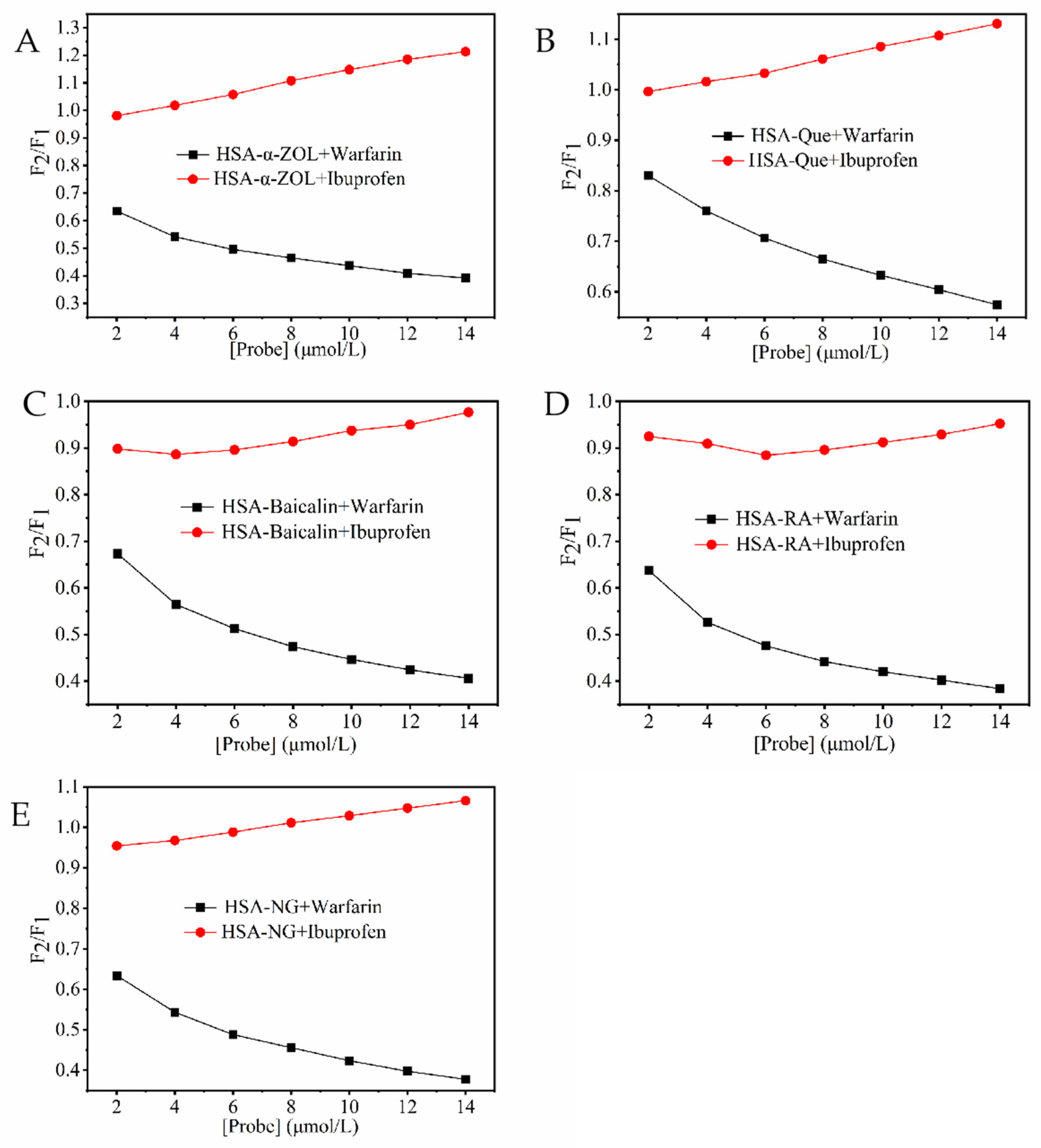
2.1. Competitive Binding of Polyphenols and α-ZOL at the HSA Binding Site
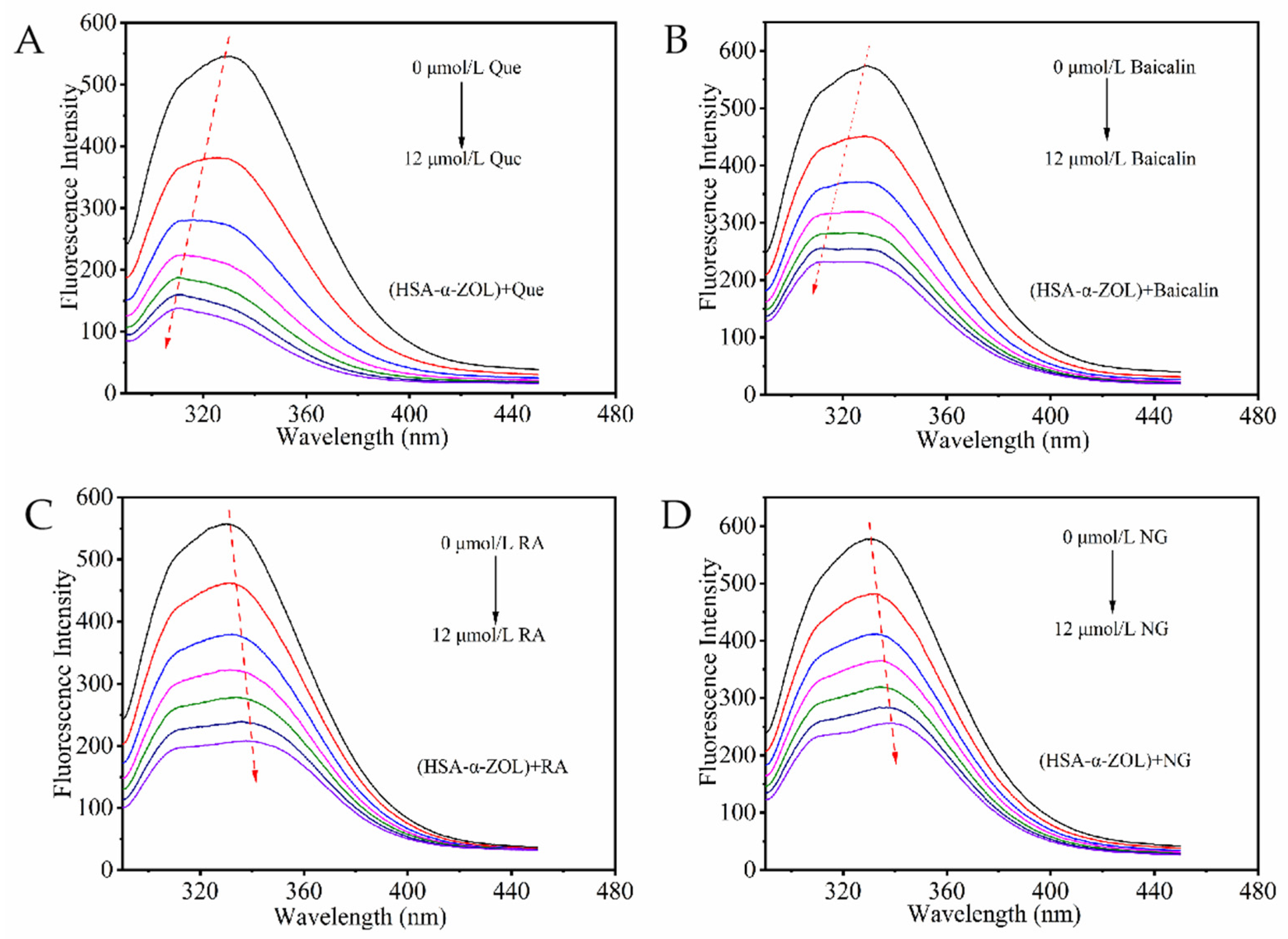
2.2. Effects of Polyphenolic Compounds on the HSA-α-ZOL System
2.3. Competitive Binding of Polyphenolic Compounds and α-ZOL to HSA
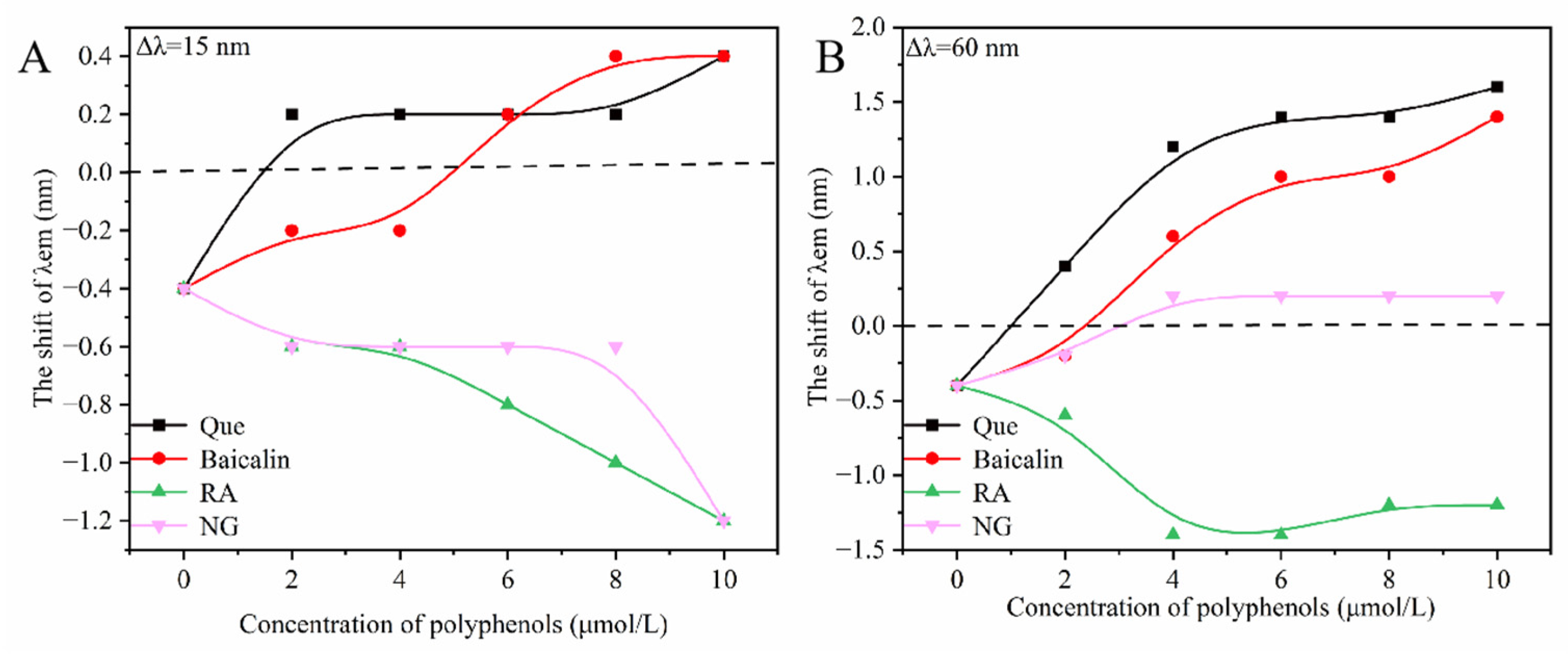
2.4. Effects of Polyphenolic Compounds on the Microenvironment of Amino Acid Residues in the HSA-α-ZOL System
2.5. Competitive Displacement of α-ZOL by Polyphenolic Compounds
3. Discussion
4. Conclusions
5. Materials and Methods
5.1. Reagents
5.2. Fluorescence Quenching Spectroscopy
5.3. Synchronous Fluorescence Spectroscopy
5.4. Site Marker Competitive Binding Assay
5.5. Determination of Competitive Displacement Ratio
5.6. HPLC Analysis
5.7. Data Analysis
Author Contributions
Funding
Institutional Review Board Statement
Informed Consent Statement
Data Availability Statement
Conflicts of Interest
References
- Rudrapal, M.; Rakshit, G.; Singh, R.P.; Garse, S.; Khan, J.; Chakraborty, S. Dietary polyphenols: Review on chemistry/sources and potential health benefits. Nutrients 2024, 16, 1986. [Google Scholar]
- Li, A.N.; Li, S.; Zhang, Y.J.; Xu, X.-R.; Chen, Y.-M.; Li, H.-B. Resources and biological activities of natural polyphenols. Nutrients 2021, 13, 2738. [Google Scholar] [CrossRef]
- Tsao, R. Chemistry and biochemistry of dietary polyphenols. Nutrients 2010, 2, 1231–1246. [Google Scholar] [CrossRef]
- Zekrumah, M.; Essuman, E.K.; Boakye, A.A.; Wahab, J.; Moffo, N.; Ivane, A.; Oman, M.; Elrashied, H.; Zou, X.; Zhang, D. Role of dietary polyphenols in non-communicable chronic diseases. Crit. Rev. Food Sci. Nutr. 2023, 63, 3129–3146. [Google Scholar]
- Liang, J.; Li, H.; Han, M.; Gao, Z. Polysaccharide–polyphenol interactions: A comprehensive review from food processing to digestion and metabolism. Crit. Rev. Food Sci. Nutr. 2024, 65, 3459–3475. [Google Scholar] [CrossRef] [PubMed]
- Yang, Z.; Xue, S.K.; Sun, X.; Williams, P.L.; Wang, J.-S.; Tang, L. Toxicogenomic responses to zearalenone in Caenorhabditis elegans reveal possible molecular mechanisms of reproductive toxicity. Food Chem. Toxicol. 2018, 122, 49–58. [Google Scholar] [CrossRef] [PubMed]
- Chang, H.; Kim, W.; Park, J.; Kim, D.; Kim, C.-R.; Chung, S.; Lee, C. The occurrence of zearalenone in South Korean feedstuffs between 2009 and 2016. Toxins 2017, 9, 223. [Google Scholar] [CrossRef] [PubMed]
- Gratz, S.W.; Currie, V.; Dundan, G.; Jackson, D. Multimycotoxin exposure assessment in UK children using urinary biomarkers—A pilot survey. J. Agric. Food Chem. 2020, 68, 351–357. [Google Scholar] [CrossRef]
- Freire, L.; Sant’Ana, A.S. Modified mycotoxins: An updated review on their formation, detection, occurrence, and toxic effects. Food Chem. Toxicol. 2018, 111, 189–205. [Google Scholar] [CrossRef]
- Catteuw, A.; Broekaert, N.; De Baere, S.; Lauwers, M.; Gasthuys, E.; Huybrechts, B.; Callebaut, A.; Ivanova, L.; Uhlig, S.; De Boevre, M.; et al. Insights into in vivo absolute oral bioavailability, biotransformation, and toxicokinetics of zearalenone, α-zearalenol, β-zearalenol, zearalenone-14-glucoside, and zearalenone-14-sulfate in pigs. J. Agric. Food Chem. 2019, 67, 3448–3458. [Google Scholar] [CrossRef]
- Fujii, Y.; Suhara, Y.; Sukikara, Y.; Teshima, T.; Hirota, Y.; Yoshimura, K.; Osakabe, N. Elucidation of the interaction between flavan-3-ols and bovine serum albumin and its effect on their in vitro cytotoxicity. Molecules 2019, 24, 3667. [Google Scholar] [CrossRef] [PubMed]
- Nakashima, F.; Shibata, T.; Uchida, K. A unique mechanism for thiolation of serum albumins by disulphide molecules. J. Biochem. 2020, 167, 165–171. [Google Scholar] [CrossRef] [PubMed]
- Wani, T.A.; Bakheit, A.H.; Zargar, S.; Rizwana, H.; Al-Majed, A.A. Evaluation of competitive binding interaction of neratinib and tamoxifen to serum albumin in multidrug therapy. Spectrochim. Acta A Mol. Biomol. Spectrosc. 2020, 227, 117691. [Google Scholar] [CrossRef]
- Poór, M.; Kunsági-Máté, S.; Bencsik, T.; Petrik, J.; Vladimir-Knežević, S.; Kőszegi, T. Flavonoid aglycones can compete with ochratoxin A for human serum albumin: A new possible mode of action. Int. J. Biol. Macromol. 2012, 51, 279–283. [Google Scholar] [CrossRef]
- Tan, H.; Chen, L.; Ma, L.; Liu, S.; Zhou, H.; Zhang, Y.; Guo, T.; Liu, W.; Dai, H.; Yu, Y. Fluorescence spectroscopic investigation of competitive interactions between quercetin and aflatoxin B1 for binding to human serum albumin. Toxins 2019, 11, 214. [Google Scholar] [CrossRef] [PubMed]
- Grosse, Y.; Chekir-Ghedira, L.; Huc, A.; Huc, A.; Obrecht-Pflumio, S.; Dirheimer, G.; Bacha, H.; Pfohl-Leszkowicz, A. Retinol, ascorbic acid and α-tocopherol prevent DNA adduct formation in mice treated with the mycotoxins ochratoxin A and zearalenone. Cancer Lett. 1997, 114, 225–229. [Google Scholar] [CrossRef]
- Li, Y.; Tan, H.; Zhou, H.; Guo, T.; Zhou, Y.; Zhang, Y.; Liu, X.; Ma, L. Study of competitive displacement of curcumin on α-zearalenol binding to human serum albumin complex using fluorescence spectroscopy. Toxins 2022, 14, 123. [Google Scholar] [CrossRef]
- Dai, J.; Zou, T.; Wang, L.; Zhang, Y.; Liu, Y. Investigation of the interaction between quercetin and human serum albumin by multiple spectra, electrochemical impedance spectra and molecular modeling. Luminescence 2014, 29, 1154–1161. [Google Scholar] [CrossRef]
- Bi, S.; Ding, L.; Tian, Y.; Song, D.; Zhou, X.; Liu, X.; Zhang, H. Investigation of the interaction between flavonoids and human serum albumin. J. Mol. Struct. 2004, 703, 37–45. [Google Scholar] [CrossRef]
- Peng, X.; Wang, X.; Qi, W.; Su, R.; He, Z. Affinity of rosmarinic acid to human serum albumin and its effect on protein conformation stability. Food Chem. 2016, 192, 178–187. [Google Scholar] [CrossRef]
- Tu, B.; Wang, Y.; Mi, R.; Ouyang, Y.; Hu, Y.-J. Evaluation of the interaction between naringenin and human serum albumin: Insights from fluorescence spectroscopy, electrochemical measurement and molecular docking. Spectrochim. Acta A Mol. Biomol. Spectrosc. 2015, 149, 536–543. [Google Scholar] [CrossRef]
- Eftink, M.R. Fluorescence techniques for studying protein structure. Methods Biochem. Anal. 1991, 35, 127–205. [Google Scholar] [PubMed]
- Wang, L.; Wu, X.; Yang, Y.; Liu, X.; Zhu, M.; Fan, S.; Wang, Z.; Xue, J.; Hua, R.; Wang, Y.; et al. Multi -spectroscopic measurements, molecular modeling and density functional theory calculations for interactions of 2,7-dibromocarbazole and 3,6-dibromocarbazole with serum albumin. Sci. Total Environ. 2019, 686, 1039–1048. [Google Scholar] [CrossRef]
- Lakowicz, J.R.; Weber, G. Quenching of fluorescence by oxygen: Probe for structural fluctuations in macromolecules. Biochemistry 1973, 12, 4161–4170. [Google Scholar] [CrossRef] [PubMed]
- Gu, J.; Zhao, H.; Liu, L.; Yang, D.; Chen, H.; Sun, T. Investigation of the binding interactions between dimethyl phthalate and its metabolite with bovine serum albumin by multispectroscopy. Spectrochim. Acta A Mol. Biomol. Spectrosc. 2020, 228, 117771. [Google Scholar] [CrossRef]
- Mohseni-Shahri, F.S.; Housaindokht, M.R.; Bozorgmehr, M.R.; Moosavi-Movahedi, A.A. The influence of the flavonoid quercetin on the interaction of propranolol with human serum albumin: Experimental and theoretical approaches. J. Luminescence 2014, 154, 229–240. [Google Scholar] [CrossRef]
- Lu, Y.; Wang, Y.L.; Gao, S.H.; Wang, G.-K.; Yan, C.-L.; Chen, D.-J. Interaction of quercetin with ovalbumin: Spectroscopic and molecular modeling studies. J. Luminescence 2009, 129, 1048–1054. [Google Scholar] [CrossRef]
- Koszegi, T.; Poor, M. Ochratoxin A: Molecular Interactions, Mechanisms of Toxicity and Prevention at the Molecular Level. Toxins 2016, 8, 111. [Google Scholar] [CrossRef]
- Yamasaki, K.; Chuang, V.T.; Maruyama, T.; Otagiri, M. Albumin–drug interaction and its clinical implication. Biochim. Biophys. Acta 2013, 1830, 5435–5443. [Google Scholar] [CrossRef]
- Rasouli, H.; Nayeri, F.D.; Khodarahmi, R. May phytophenolics alleviate aflatoxins-induced health risks? Front. Nutr. 2022, 9, 981984. [Google Scholar] [CrossRef]
- Fliszár-Nyúl, E.; Faisal, Z.; Skaper, R.; Lemli, B.; Bayartsetseg, B.; Hetényi, C.; Gömbös, P.; Szabó, A.; Poór, M. Interaction of the emerging mycotoxins beauvericin, cyclopiazonic acid, and sterigmatocystin with human serum albumin. Biomolecules 2022, 12, 1106. [Google Scholar] [CrossRef]
- Faisal, Z.; Lemli, B.; Szerencsés, D.; Kunsági-Máté, S.; Bálint, M.; Hetényi, C.; Kuzma, M.; Mayer, M.; Poór, M. Interactions of zearalenone and its reduced metabolites α-zearalenol and β-zearalenol with serum albumins: Species differences, binding sites, and thermodynamics. Mycotoxin Res. 2018, 34, 269–278. [Google Scholar] [CrossRef]
- Slobodchikova, I.; Sivakumar, R.; Rahman, M.S.; Vuckovic, D. Characterization of Phase I and Glucuronide Phase II Metabolites of 17 Mycotoxins Using Liquid Chromatography—High-Resolution Mass Spectrometry. Toxins 2019, 11, 433. [Google Scholar] [CrossRef] [PubMed]
- Mukherjee, D.; Royce, S.G.; Alexander, J.A.; Buckley, B.; Isukapalli, S.S.; Bandera, E.V.; Zarbl, H.; Georgopoulos, P.G. Physiologically-based toxicokinetic modeling of zearalenone and its metabolites: Application to the Jersey Girl Study. PLoS ONE 2014, 9, e113632. [Google Scholar] [CrossRef] [PubMed]
- Rabbani, G.; Lee, E.J.; Ahmad, K.; Baig, M.H.; Choi, I. Binding of tolperisone hydrochloride with human serum albumin: Effects on the conformation, thermodynamics, and activity of HSA. Mol. Pharm. 2018, 15, 1445–1456. [Google Scholar] [CrossRef] [PubMed]



| Systems | Ksv (×105 L/moL) | Kq (×1013 L/moL·s) | Ka (×104 L/moL) | n |
|---|---|---|---|---|
| HSA-α-ZOL | 1.91 | 1.91 | 5.25 | 0.9288 |
| (HSA-α-ZOL) + Que | 2.14 | 2.14 | 39.91 | 0.9440 |
| (HSA-α-ZOL) + Baicalin | 1.01 | 1.01 | 48.62 | 1.0903 |
| (HSA-α-ZOL) + RA | 0.65 | 0.65 | 15.37 | 0.9899 |
| (HSA-α-ZOL) + NG | 0.76 | 0.76 | 7.39 | 0.9163 |
| Systems | Ksv (×105 L/moL) | Kq (×1013 L/mol·s) | Ka (×104 L/moL) | n |
|---|---|---|---|---|
| HSA-α-ZOL | 1.91 | 1.91 | 5.25 | 0.9288 |
| (HSA-Que) + α-ZOL | 0.79 | 0.79 | 0.60 | 0.7954 |
| (HSA-Baicalin) + α-ZOL | 1.61 | 1.61 | 0.67 | 0.7458 |
| (HSA-RA) + α-ZOL | 1.82 | 1.82 | 1.76 | 0.8135 |
| (HSA-NG) + α-ZOL | 1.01 | 1.01 | 1.84 | 0.8766 |
| Concentration Ratios | Systems | |||
|---|---|---|---|---|
| HSA:α-ZOL:Que | HSA:α-ZOL:Baicalin | HSA:α-ZOL:RA | HSA:α-ZOL:NG | |
| 1:1:0.5 | 24.12 ± 3.40% a | 22.71 ± 1.33% a | 20.36 ± 1.15% b | 18.27 ± 1.12% c |
| 1:1:1 | 35.08 ± 5.22% a | 33.12 ± 1.61% a | 30.29 ± 0.38% b | 27.21 ± 0.05% c |
| 1:1:2 | 54.21 ± 4.52% a | 52.44 ± 1.07% a | 49.93 ± 1.98% b | 40.41 ± 0.76% c |
Disclaimer/Publisher’s Note: The statements, opinions and data contained in all publications are solely those of the individual author(s) and contributor(s) and not of MDPI and/or the editor(s). MDPI and/or the editor(s) disclaim responsibility for any injury to people or property resulting from any ideas, methods, instructions or products referred to in the content. |
© 2025 by the authors. Licensee MDPI, Basel, Switzerland. This article is an open access article distributed under the terms and conditions of the Creative Commons Attribution (CC BY) license.
Share and Cite
Chen, C.; Chen, L.; Zhou, H.; Shen, X.L.; Ma, L. Study on the Competitive Substitution of Four Polyphenolic Compounds on the HSA-Bound α-Zearalenol In Vitro Simulated Modeling. Toxins 2026, 18, 7. https://doi.org/10.3390/toxins18010007
Chen C, Chen L, Zhou H, Shen XL, Ma L. Study on the Competitive Substitution of Four Polyphenolic Compounds on the HSA-Bound α-Zearalenol In Vitro Simulated Modeling. Toxins. 2026; 18(1):7. https://doi.org/10.3390/toxins18010007
Chicago/Turabian StyleChen, Cheng, Lu Chen, Hongyuan Zhou, Xiao Li Shen, and Liang Ma. 2026. "Study on the Competitive Substitution of Four Polyphenolic Compounds on the HSA-Bound α-Zearalenol In Vitro Simulated Modeling" Toxins 18, no. 1: 7. https://doi.org/10.3390/toxins18010007
APA StyleChen, C., Chen, L., Zhou, H., Shen, X. L., & Ma, L. (2026). Study on the Competitive Substitution of Four Polyphenolic Compounds on the HSA-Bound α-Zearalenol In Vitro Simulated Modeling. Toxins, 18(1), 7. https://doi.org/10.3390/toxins18010007