Review

Central and Peripheral Sensitization in Temporomandibular Disorders: Proposed Mechanisms of Botulinum Toxin Therapy


by
Basit Ali Chaudhry
1,2,
Christopher L. Robinson
3,
Edoardo Caronna
4,5,
Freda Dodd-Glover
6,
Amrittej Singh Virk
7,
Mario Fernando Prieto Peres
8,9,
Hope L. O’Brien
10,
Marcela Romero-Reyes
11,*,† and
Sait Ashina
2,12,13,*,†
1
Department of Neurology, Danish Headache Center, Copenhagen University Hospital—Rigshospitalet, 2100 Copenhagen, Denmark
2
Department of Clinical Medicine, Faculty of Health and Medical Sciences, University of Copenhagen, 2200 Copenhagen, Denmark
3
Department of Anesthesiology and Critical Care Medicine, The John Hopkins University School of Medicine, Baltimore, MD 21205, USA
4
Headache and Neurological Pain Research Group, Vall d’Hebron Institut de Recerca (VHIR), Department of Medicine, Universitat Autònoma de Barcelona, 08035 Barcelona, Spain
5
Headache Unit, Neurology Department, Vall d’Hebron University Hospital, 08035 Barcelona, Spain
6
Department of Medicine and Therapeutics, Korle Bu Teaching Hospital, Accra P.O. Box 77, Ghana
7
Texas TMJ Sleep & Facial Pain, Southlake, TX 76092, USA
8
Instituto de Psiquiatria, HCFMUSP, Faculdade de Medicina da Universidade de São Paulo, São Paulo 05403-903, Brazil
9
Department of Neurology, Hospital Albert Einstein, São Paulo 05403-903, Brazil
10
Headache Center of Hope, Cincinnati, OH 45236, USA
11
Department of Pain and Neural Sciences, Brotman Facial Pain Clinic, University of Maryland School of Dentistry, Baltimore, MD 21201, USA
12
Department of Neurology, BIDMC Comprehensive Headache Center, Harvard Medical School, Beth Israel Deaconess Medical Center, Boston, MA 02215, USA
13
Department of Anesthesia, Critical Care and Pain Medicine, BIDMC Comprehensive Headache Center, Harvard Medical School, Beth Israel Deaconess Medical Center, Boston, MA 02215, USA
*
Authors to whom correspondence should be addressed.
These authors contributed equally to this work.
Toxins 2026, 18(1), 28; https://doi.org/10.3390/toxins18010028
Submission received: 21 November 2025 / Revised: 17 December 2025 / Accepted: 26 December 2025 / Published: 6 January 2026

Abstract

Temporomandibular disorders (TMDs) are common musculoskeletal chronic orofacial pain conditions involving peripheral and central sensitization within trigeminal nociceptive pathways, manifesting as mechanical allodynia and functional impairment. Botulinum toxin type A (BoNT-A) has been explored as a treatment targeting both muscle hyperactivity and nociceptive modulation. Preclinical and clinical evidence demonstrate that BoNT-A reduces peripheral neurotransmitter release, neurogenic inflammation, and central neuronal excitability, leading to attenuation of mechanical allodynia in TMD models and patients. Clinical trials show modest and variable analgesic effects, with patients displaying sensory sensitization appearing to respond more favorably, though methodological heterogeneity limits definitive conclusions. Safety concerns related to muscle weakening, changes in bone density, and structural changes underscore the need for standardized protocols optimizing dosing and monitoring, in addition to prospective studies. These findings suggest that BoNT-A may serve as an adjunctive, mechanism-based therapy within multimodal TMD management. Future research should focus on standardized sensory phenotyping and trial design to clarify BoNT-A’s role in modulating central sensitization and improving patient outcomes.
Key Contribution: This review summarizes central and peripheral sensitization in temporomandibular disorders, critically appraises evidence for botulinum toxin and defines key mechanistic targets and knowledge gaps.

1. Introduction

Temporomandibular disorders (TMD) encompass a group of musculoskeletal conditions affecting the temporomandibular joint (TMJ), muscles of mastication, and associated structures [1,2,3]. They represent one of the most common causes of chronic orofacial pain, with lifetime prevalence estimated at 25–35% [4,5,6]. Although the majority of TMDs are acute and temporary, tending toward remission or improvement in symptoms, a substantial subset may develop persistent pain and dysfunction, causing psychosocial distress affecting quality of life [7]. TMDs are complex and multifactorial, and evidence has shown that the establishment of the cycle of persistent pain involves different biopsychosocial factors in addition to comorbidities particularly overlapping pain conditions, such as primary headache disorders (including migraine and medication overuse headache), anxiety and depression, irritable bowel syndrome (IBS), fibromyalgia, lower back pain, sleep disorders, vulvodynia, and chronic fatigue, together influencing pain amplification [8,9].
The most common painful TMDs, as defined by current DC/TMD criteria, include arthralgia, myalgia, myofascial pain, and headache attributed to TMD [10]. Patients often present with more than one diagnosis. However, myogenous disorders, particularly myalgia and myofascial pain, remain the most prevalent [10,11,12]. It is important to mention that patients may present more than one TMD diagnosis, but from all TMDs, the most common are of masticatory muscle origin, such as myalgia and myofascial pain [11,12].
Chronic temporomandibular disorders share neurobiological features with primary headache disorders, particularly migraine. Furthermore, studies show that migraine is the most common primary headache disorder with a prevalence of 40% in TMD patients [13]. Both involve abnormal trigeminal nociceptive processing characterized by cutaneous allodynia, lowered pain thresholds, and impaired descending inhibition, all markers of central sensitization [2]. Importantly, not all TMD cases exhibit cutaneous allodynia. In chronic TMD, central sensitization may develop, manifested clinically as allodynia and hyperalgesia upon examination. Peripheral sensitization, such as that arising from TMJ injury, could evolve into central sensitization over time. Myofascial pain provides the clearest example of cutaneous allodynia, followed by TMJ arthralgia in selected cases [14,15]. Inflammation of the masseter muscle may contribute to intracranial nociceptive signaling and serve as a priming mechanism for central sensitization. In preclinical studies, inflammation of the masseter as a surrogate of masticatory TMD mediated intracranial nociception and priming [16]. Functional imaging demonstrated overlapping alterations in thalamic, insular, and brainstem pain networks, suggesting a shared pathophysiological substrate [17,18]. In chronic TMD, sensitization manifests as pain spread beyond the orofacial region and heightened excitability within trigeminal and extra-trigeminal pathways [15,19,20,21,22,23,24,25]. These features correlate with a higher pain intensity, greater disability, and reduced response to conventional therapies [26,27], underscoring the need to address both peripheral and central pain mechanisms.
TMD management is recommended to be conservative and reversible [3,28]. This involves an integrated patient-centered plan tailored to the diagnosis and patient needs, combining non-pharmacological and pharmacological modalities. This includes education and self-management, physical therapy, behavioral therapy, intraoral orthotics (such as stabilization appliances, trigger point injection therapy, and simple analgesics), anti-inflammatories, and muscle relaxants. Sometimes, it may include the use of antidepressants such as tricyclics [3,28]. Yet, in many patients, pain persists despite adequate conservative therapy. In some individuals, this reflects central sensitization, while in others, persistent pain may relate to an underlying structural abnormality. Refractory cases, therefore, highlight the need for treatments that can target both peripheral pathology and central pain mechanisms.
Botulinum toxin type A (BoNT-A) has been used in TMD and sleep bruxism to reduce masticatory muscle hyperactivity and local myofascial pain [29,30,31]. The evidence indicates broader mechanisms, including inhibition of neurotransmitters such as glutamate and substance P, modulation of transient receptor potential channels, and attenuation of peripheral sensitization via C fiber inhibition [32,33]. Additional findings suggest retrograde axonal transport and possible modulation of nociceptive signaling within the trigeminal nucleus caudalis (TNC) and higher brain regions [34,35,36]. These data provide a biological rationale for targeting both peripheral and central sensitization in TMD.
Despite this mechanistic rationale, clinical findings remain inconsistent. Differences in study design, dosing, injection mapping, and outcome measures, together with insufficient characterization of central sensitization, have limited comparability across trials. This review critically appraises current evidence linking central sensitization and allodynia to TMD pathophysiology and evaluates how BoNT-A may modulate these mechanisms at both peripheral and central levels. By focusing on the interface between neurobiology and clinical efficacy, we aim to clarify whether BoNT-A’s analgesic effects in TMD extend beyond muscle relaxation to genuine desensitization of the trigeminal system. Unlike existing systematic and umbrella reviews that primarily evaluate clinical efficacy, this narrative review focuses on the mechanistic and pathophysiological basis underlying heterogeneous clinical responses to BoNT-A in TMD, integrating evidence across experimental, translational, and clinical domains.

2. Search Strategy and Review Approach

This article is a narrative review synthesizing experimental, clinical, and translational evidence on TMD, central sensitization, and BoNT-A mechanisms. We searched PubMed for “temporomandibular disorder” or “TMD” in combination with the terms “myalgia”, “myofascial pain”, “jaw muscle pain”, “arthralgia”, “central sensitization”, “cutaneous allodynia”, “hyperalgesia”, “trigeminal system”, “trigeminal nociception”, “trigeminal nucleus caudalis”, “peripheral sensitization”, “masseter inflammation”, “botulinum toxin”, “BoNT-A”, and “onabotulinumtoxinA”. We also searched for clinical trials by combining “TMD” or “temporomandibular disorder” with “botulinum toxin”, “BoNT-A”, “onabotulinumtoxinA”, and “randomized controlled trial”. Additional relevant articles were identified by reviewing the reference lists of key publications. As this is a narrative review, no formal systematic methodology was applied, and studies were selected based on relevance to the mechanistic and clinical questions addressed. The literature search was conducted and last updated in November 2025.

3. Anatomy and Pathophysiology of TMD Pain

Anatomical Consideration

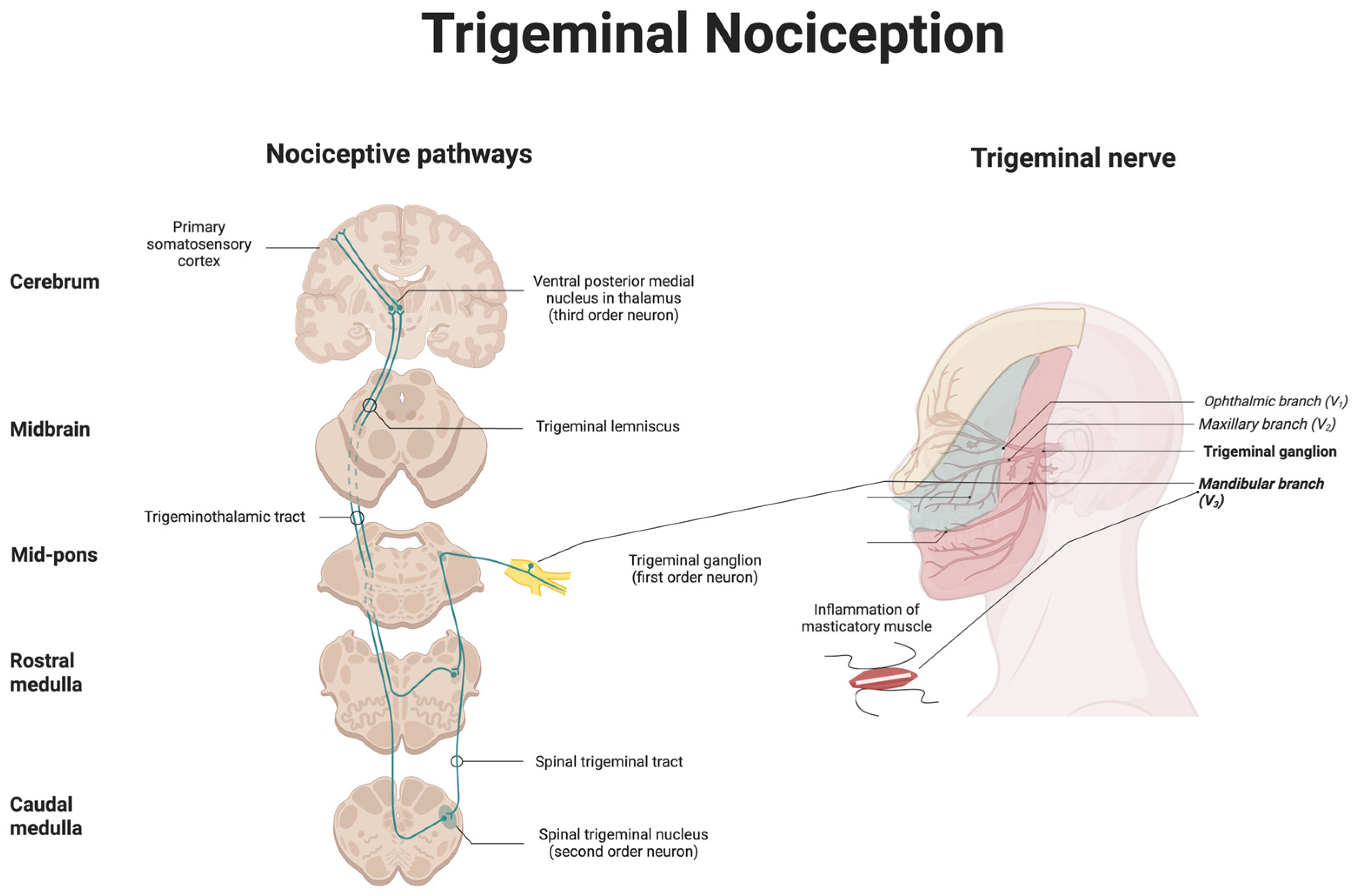
Temporomandibular disorders develop within a complex anatomical and neurofunctional system integrating joint structures, masticatory muscles, and the trigeminal pathway [1]. The TMJ is a synovial articulation between the mandibular condyle and the temporal bone, separated by a fibrocartilaginous disk that permits both rotational and translational movement during mastication and speech [1]. These motions are coordinated by the masseter, temporalis, and medial and lateral pterygoid muscles under precise motor control from the mandibular branch (V3) of the trigeminal nerve. The same division provides dense sensory innervation to the TMJ capsule, ligaments, periarticular tissues, and orofacial skin, forming an extensive afferent network rich in nociceptors and mechanoreceptors [1]. This organization enables fine motor coordination, creating a substrate through which mechanical overload, microtrauma, or inflammation can activate peripheral nociceptors and drive convergent input to second-order neurons in the TNC, an early step in the development of temporomandibular disorders, pain, and sensitization of these neurons [20,37,38]. Ascending projections from the TNC relay through third-order neurons in the thalamus, particularly the ventroposteromedial nucleus (VPM), to somatosensory, insular, and anterior cingulate cortices, where further amplification and maladaptive plasticity can occur [39]. Central sensitization in chronic TMD is characterized by increased activation of the somatosensory cortex, prefrontal cortex, and anterior cingulate in addition to reduced thalamic activation [18,40,41]. Anatomical convergence between masticatory nociceptive inputs can engage trigeminal pathways implicated in migraine and other cephalalgias, predisposing TMD to central sensitization [16,42] (see Figure 1).

4. Peripheral and Central Mechanisms

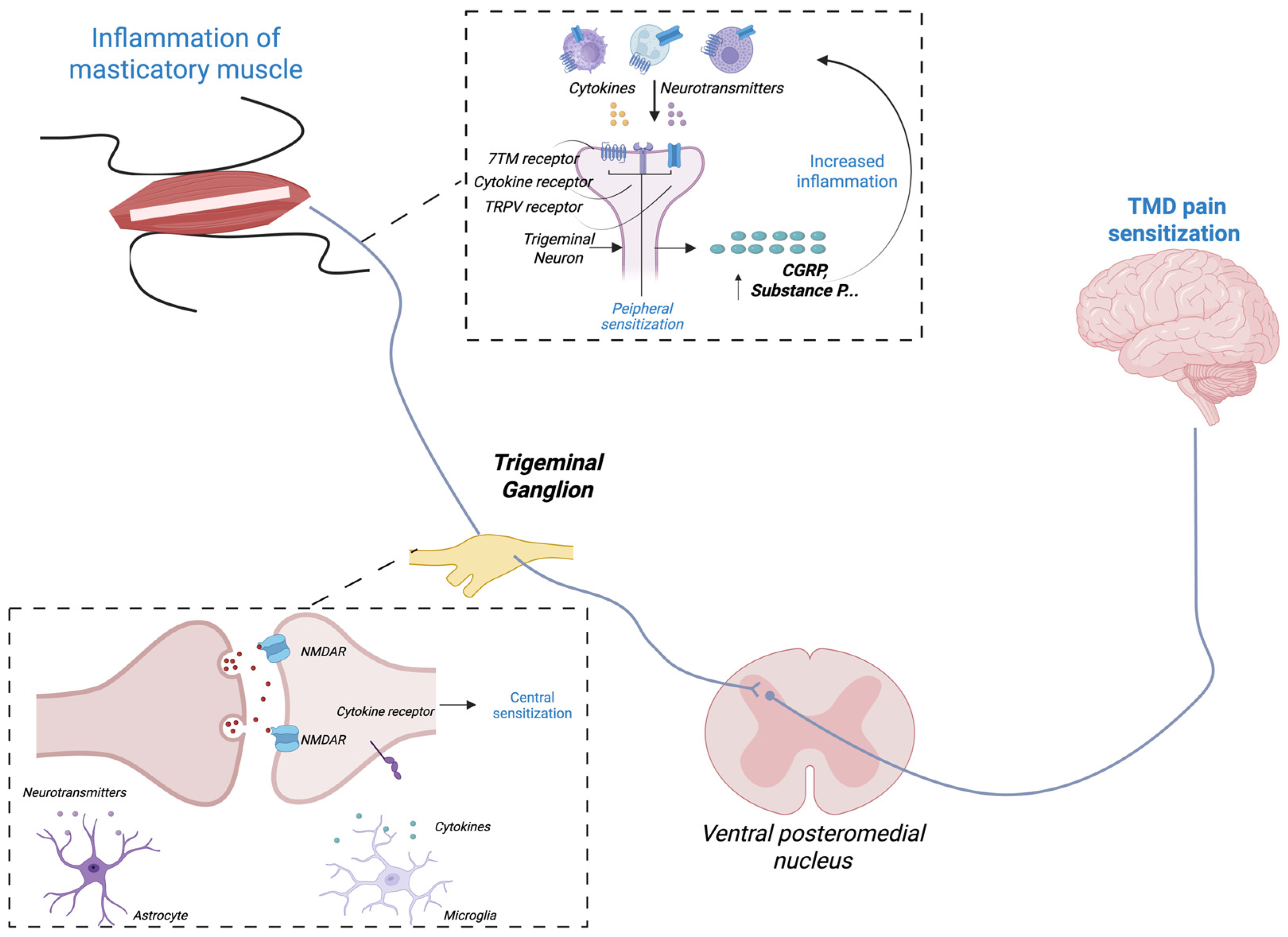
Once activated, peripheral nociceptors innervating the TMJ, masticatory muscles, and associated structures undergo sensitization that amplifies and prolongs pain signaling in TMD [38,44]. The afferents of the mandibular branch (V3) of the trigeminal nerve terminate in the TMJ capsule, ligaments, and periarticular tissues [45]. Mechanical overload, ischemia, or inflammation triggers release of excitatory neurotransmitters and neuropeptides such as glutamate, substance P, and calcitonin gene-related peptide (CGRP), promoting neurogenic inflammation and amplifying nociceptive transmission [46,47,48,49]. Ion channels, including transient receptor potential vanilloid 1 (TRPV1) and acid-sensing ion channels, become sensitized in this inflammatory milieu, lowering activation thresholds and sustaining peripheral hyperexcitability [50,51]. Recent evidence indicates that inflammatory mediators play a central role in the pathophysiology of temporomandibular myalgia, with elevated cytokines, chemokines, and prostaglandins contributing to persistent nociceptor sensitization and muscle pain [52]. Within the trigeminal ganglion (TG), interactions between neurons and satellite glial cells further maintain this state through the release of proinflammatory cytokines and chemokines that reinforce nociceptor excitability [32,53,54]. These processes may collectively constitute peripheral sensitization, characterized clinically by local tenderness and a reduced pressure pain threshold (PPT), with pain that is typically evoked or exacerbated by mandibular movement or palpation. Such peripheral events not only initiate local hyperalgesia but also serve as the afferent driver for central sensitization in chronic TMD, which may underlie the development of cutaneous allodynia and widespread pain hypersensitivity. Evidence from clinical studies supports the presence of central sensitization in patients with painful TMD, emphasizing its contribution to symptom persistence and therapeutic challenges [15] (see Figure 2).

5. Clinical Manifestations

Patients with chronic TMD present with a heterogeneous constellation of signs and symptoms, including lower sensory thresholds, pain amplification, amplification of the receptive field, and even extracephalic/extratrigeminally areas reflecting involvement of both peripheral and central pain mechanisms [15,40,62].
Chronic myofascial pain may be one of the classic examples of the presence of this central sensitization phenomenon, with persistent pain and the referral pattern of pain beyond the boundaries of the muscle being palpated. This has very important clinical implications, since this referral may even be experienced as dental pain or even otologic complaints, such as ear fullness, tinnitus, or referred otalgia when there is no pathology present in these structures [3,63]. Furthermore, the presence of overlapping pain conditions plays a critical role in the enhancement of central sensitization, maintaining the persistent pain and supporting chronicity. Many patients report coexisting headache symptoms such as headache attributed to TMD, as well as TMD comorbid with migraine or tension-type headache, with migraine having almost twice the prevalence of tension-type headache in these patients, making treatment even more difficult [13,64]. This overlap is highly relevant in clinical practice, where migraine may be misdiagnosed as TMD or, conversely, TMD may be overlooked in patients with migraine. Bruxism is another contributing factor in TMD that may exacerbate, perpetuate, or initiate symptomatology in some individuals [30,64].
In chronic arthralgia and myofascial pain associated with TMD, cutaneous allodynia can occur within both trigeminal and extra-trigeminal regions, indicating that pain amplification extends beyond the initial peripheral site [14,15,20]. Its presence correlates with higher pain intensity, greater functional limitation, and poorer response to conventional therapies, establishing allodynia as a clinical marker of disease severity and prognosis [65]. Hypersensitivity to mechanical and intra-articular electrical stimulation has been demonstrated in individuals with painful temporomandibular joints, further supporting peripheral and central sensitization mechanisms in TMD [14]. Other psychophysical manifestations of central sensitization include reduced PPT and enhanced temporal summation of pain, both consistently observed in TMD cohorts [15].

6. Preclinical Mechanistic Evidence

6.1. BoNT-A Actions at the Molecular Level

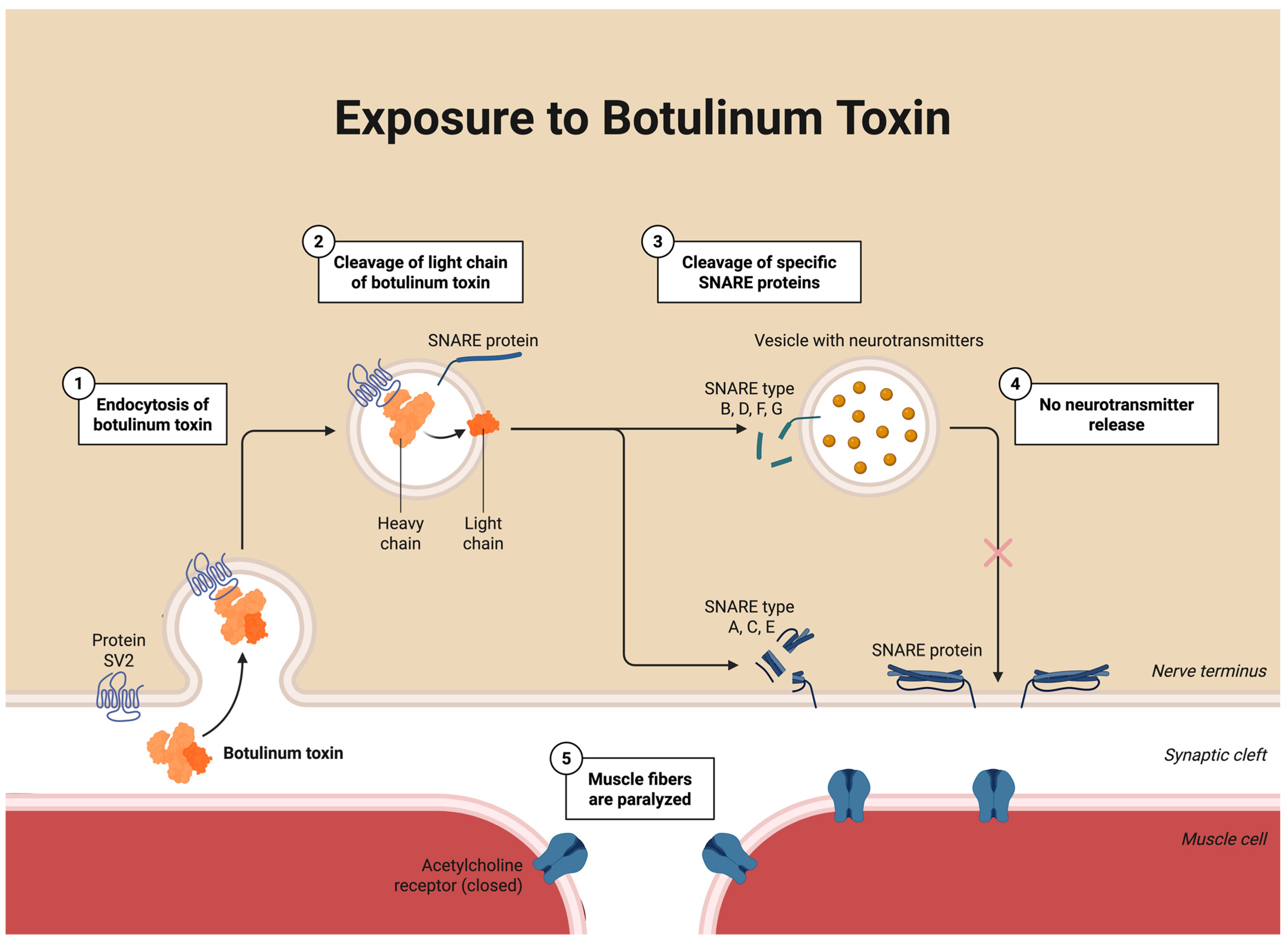
Understanding how BoNT-A modulates nociceptive processing requires examination of its molecular actions in sensory and motor neurons. The antinociceptive properties of BoNT-A originate from its enzymatic action within presynaptic neurons [66,67]. Structurally, BoNT-A consists of a heavy chain (100 kDa) and a light chain (50 kDa), which function together to mediate neuronal binding, endocytosis, and intracellular proteolysis [67,68]. Following injection, the heavy chain binds to synaptic vesicle glycoprotein 2 on the nerve terminal membrane, initiating endocytosis [67,68]. Endosomal acidification subsequently enables translocation of the light chain into the cytosol [67,68]. Once internalized, the light chain acts as a zinc-dependent endopeptidase that cleaves synaptosomal-associated protein of 25 kDa (SNAP-25), a component of the soluble N-ethylmaleimide-sensitive factor attachment protein receptor (SNARE) complex, which is required for vesicular docking and neurotransmitter release (see Figure 3) [68,69].
These molecular events are not only responsible for muscle relaxation but also form the foundation of BoNT-A’s proposed antinociceptive and anti-allodynic actions. This protelyctic cleavage prevents exocytosis of acetylcholine at the neuromuscular junction, producing muscle relaxation [70], but similar cleavage occurs in sensory neurons, where it suppresses release of excitatory mediators, including glutamate, substance P, and CGRP [71]. Studies in the TG and dorsal root ganglion confirm that BoNT-A reduces depolarization-evoked release of CGRP and substance P [71], supporting a direct sensory modulatory action relevant to TMD pain. In addition, preclinical evidence indicates that BoNT-A can modulate nociceptor sensitivity through noncanonical mechanisms, including reduced trafficking of TRPV1 and purinergic P2X3 receptors to the membrane, and attenuation of glial activation [69,72]. These effects suggest a broader anti-inflammatory and antinociceptive profile beyond SNAP-25 cleavage alone. Together, these cellular effects provide a mechanistic link between BoNT-A and modulation of peripheral nociceptive drive, a prerequisite for reducing central sensitization.
Although such mechanisms offer a coherent biological rationale for targeting both peripheral and central sensitization in TMD, their clinical significance remains unclear [73]. Most mechanistic evidence comes from rodent or in vitro models using toxin concentrations or exposure durations higher than those encountered in humans. The extent of sensory terminals undergoing SNAP-25 cleavage at therapeutic doses, and the duration of truncated SNAP-25 fragments, have not been systematically measured. Moreover, while limited retrograde axonal transport and transcytosis to second-order neurons have been observed in animal models, their role in human central pain modulation is uncertain [74,75].
Figure 3. Mechanism of action of botulinum toxin type A at the neuromuscular junction. Botulinum toxin type A (BoNT-A) inhibits neurotransmitter release at the neuromuscular junction by targeting SNARE-mediated vesicle fusion. (1) BoNT-A binds to the presynaptic membrane via synaptic vesicle protein 2 (SV2) and undergoes endocytosis. (2) The toxin’s light chain is released into the cytosol, where it acts as a zinc-dependent endopeptidase. (3) The light chain cleaves the SNARE protein SNAP-25, essential for vesicular docking and acetylcholine release. (4) This blockade prevents exocytosis of acetylcholine into the synaptic cleft, leading to (5) temporary paralysis of the targeted muscle fibers [76]. This figure was created using BioRender.
Toxins 18 00028 g003

6.2. Peripheral Effects on Nociception and Inflammation

Preclinical evidence demonstrates that BoNT-A reduces neurogenic inflammation and modulates nociceptor excitability [66,76]. In rodent models of orofacial inflammatory pain, peripheral BoNT-A injections decreased plasma extravasation and tissue edema, effects attributed to inhibition of CGRP, and substance P-mediated vascular responses [66,77,78]. In parallel, BoNT-A has been shown to downregulate TRPV1 expression and activity in trigeminal sensory neurons [50,79]. This is of importance, as TRPV1 sensitization contributes to mechanical allodynia and thermal hyperalgesia [80]. Additional data indicate suppression of peripheral inflammatory signaling through reduced activation of mitogen-activated protein kinase and extracellular-signal-regulated kinase (ERK) pathways and decreased expression of interleukin-1β and tumor necrosis factor-α in local tissues [81,82]. Together, these peripheral effects demonstrate that BoNT-A not only interrupts neurotransmitter release but also reduces the excitability of nociceptors and links to the reduction in peripheral sensitization. By diminishing the intensity and frequency of peripheral nociceptive input, these actions may indirectly dampen central excitability and mitigate the development of allodynia [83]. Recent data also suggest an immune component to BoNT-A’s peripheral action [84]. In vivo imaging in female mice showed that BoNT-A shifted meningeal macrophages from a pro- to an anti-inflammatory phenotype after cortical spreading depression. Although derived from migraine models, the trigeminal immune milieu is shared with TMD, supporting a unified framework in which BoNT-A exerts immune-neural modulation across craniofacial pain disorders [85].
Nevertheless, substantial heterogeneity exists among studies. Experimental designs differ in administration route, tissue target, and dosage, with some studies using direct muscle injections, while others deliver BoNT-A perineurally or intra-articularly [66,86,87,88]. These variations affect tissue diffusion, local concentration, and the pattern of neuronal exposure. Furthermore, the endpoints used to infer anti-inflammatory activity, such as plasma extravasation or edema, are indirect and may be influenced by anesthesia, stress, or systemic factors. The mechanistic relevance of TRPV1 modulation is also debated, as it remains unclear whether BoNT-A directly alters channel expression or merely reduces upstream inflammatory signaling [89,90]. Few studies provide time-course data linking TRPV1 downregulation to behavioral improvement, which limits causal interpretation [91,92].

6.3. Central Effects of Peripheral BoNT-A Administration

Beyond the periphery, BoNT-A produces measurable downstream effects within central nociceptive circuits, raising the possibility of secondary modulation of central sensitization. Although BoNT-A is administered peripherally, converging evidence from animal studies suggests secondary effects on central nociceptive circuits [35,66]. In models of TMJ inflammation, peripheral BoNT-A injections reduce c-Fos expression in the TNC, indicating diminished activation of second-order nociceptive neurons [35,36,66,93]. Other studies demonstrated suppression of microglial activation and reduced expression of proinflammatory cytokines such as interleukin-1β and TNF-α within the brainstem and spinal dorsal horn [36,94]. Electrophysiological recordings from wide dynamic range neurons revealed attenuated hyperexcitability and decreased responses to noxious stimulation, findings consistent with reduced central sensitization [36,95]. Together, these findings imply that BoNT-A can dampen central nociceptive processing, either through reduced afferent input or limited retrograde signaling along sensory pathways. This reduction in central markers of activation aligns with preclinical evidence in migraine and supports the hypothesis that BoNT-A may indirectly attenuate central allodynia through reduced peripheral drive [36,96].
Interpretation of these data, however, requires caution. The reduction in c-Fos expression, while often interpreted as a central effect, may simply reflect suppression of peripheral nociceptor drive [97,98]. Evidence for retrograde axonal transport of BoNT-A remains indirect, based primarily on immunohistochemical detection of cleaved SNAP-25 fragments in central tissues [34,35,98,99]. Moreover, reports of glial modulation vary in timing, regional specificity, and methodological rigor, making it difficult to distinguish primary central actions from secondary adaptations to reduced peripheral signaling [34,98]. Overall, the weight of evidence indicates that peripheral BoNT-A administration decreases central nociceptive activity in trigeminal circuits, but whether this results from central penetration or downstream modulation of peripheral input remains unresolved. Thus, while preclinical studies consistently demonstrate decreased central excitability following peripheral BoNT-A administration, definitive evidence for direct central action in humans remains elusive and represents a key gap in translation.

6.4. Effect on Allodynia

Among preclinical observations, perhaps the most clinically relevant is BoNT-A’s ability to attenuate allodynia, a behavioral marker of central sensitization, in models of pain in trigeminal and temporomandibular disorders [100,101,102]. In inflammatory TMD models, intra-articular or intramuscular BoNT-A reduced mechanical and thermal allodynia [66,82,86]. These changes paralleled decreased activity of TRPV1-positive afferents and reduced release of CGRP and substance P, together with lower expression of sensitization markers, such as phosphorylated ERK and c-Fos in the brainstem, suggesting dampened peripheral drive and downstream central desensitization [66,82,86].
Interpretation of these findings, however, requires caution. Behavioral assays such as von Frey testing are vulnerable to experimenter bias and methodological variability, and blinding or randomization is not consistently reported [102,103]. The duration and dose–response relationships of the anti-allodynic effects also vary substantially across models. Moreover, contralateral improvements may reflect systemic diffusion or autonomic changes rather than genuine central action, and temporal dissociation between molecular markers and behavioral recovery complicates causal inference [66,82,86]. Thus, while preclinical data consistently support an anti-allodynic effect of BoNT-A and position allodynia reversal as a tangible readout of its impact on trigeminal nociceptive processing, the precise mechanisms and their translational relevance to human TMD pain remain to be fully established.

6.5. Methodological Considerations and Translational Limitations

Although preclinical studies provide a coherent mechanistic framework for BoNT-A-induced analgesia, several methodological constraints limit translation to clinical contexts. Experimental doses often exceed human-equivalent concentrations, and diffusion from the injection site is rarely quantified, leaving the effective tissue exposure uncertain. Variability in administration routes and timing of assessments further complicates interpretation, as molecular changes are frequently measured hours after injection while behavioral effects emerge days later. Common readouts, such as c-Fos or cytokine levels, are indirect indices of nociceptive modulation, and reproducibility is limited by inconsistent blinding and randomization. Another important limitation concerns model specificity. Many experimental paradigms employ formalin-induced or neuropathic orofacial pain models (e.g., whisker pad or infraorbital nerve stimulation) rather than true representation TMD models as musculoskeletal pains involving the masseter muscle or TMJ. While these approaches capture key trigeminal nociceptive mechanisms, they may not fully reproduce the biomechanical loading, joint microenvironment, chronic myofascial features, and the full complexity and heterogeneity characteristic of human TMD. Consequently, extrapolating these findings to clinical TMD requires caution.
Despite these caveats, the collective evidence supports a multimodal antinociceptive profile of BoNT-A, encompassing inhibition of neuropeptide release, suppression of peripheral inflammation, and attenuation of allodynia that may prevent or revert central sensitization. Refining orofacial models and aligning molecular and behavioral endpoints will be key to improving mechanistic precision and bridging preclinical insights to clinical application.

7. Human Clinical Studies

7.1. Clinical Efficacy

Interpretation of clinical BoNT-A studies is inherently complicated by the diagnostic diversity encompassed under TMD. More than 30 conditions fall within the DC/TMD taxonomy, each with distinct structural, functional, and psychosocial contributors to pain [10]. Despite this heterogeneity, many painful TMD phenotypes share common pathways of peripheral and central sensitization, providing a mechanistic rationale for applying BoNT-A across these conditions. In human studies, reductions in PPT and quantitative sensory testing (QST) serve as perceptual correlates of peripheral and central sensitization. One of the most methodologically rigorous early randomized controlled trials evaluated BoNT-A in patients with persistent myofascial TMD pain using bilateral masseter and temporalis injections under strict blinding [31]. Although the treatment failed to outperform the placebo on the primary pain endpoint, it produced modest, short-term reductions in pain and small increases in PPT, indicating partial attenuation of mechanical hypersensitivity consistent with reduced allodynia [104,105]. These limited sensory improvements parallel preclinical findings showing that BoNT-A dampens nociceptor excitability and central sensitization [103,105,106], suggesting that its modest clinical effect reflects incomplete engagement of sensitization mechanisms rather than a pure muscle relaxant response.
The largest randomized controlled trial to date, a five-arm dose-ranging study, enrolled 100 women with chronic myofascial TMD pain who received three BoNT-A doses, oral appliance (OA) therapy, or a placebo over 24 weeks [107]. BoNT-A produced significant reductions in pain intensity and increases in PPT versus placebo, reflecting attenuation of mechanical hypersensitivity consistent with reduced allodynia, yet it failed to outperform OA at the study end. Psychosocial scores for pain-related disability, depression, and somatization improved similarly with BoNT-A and OA, underscoring overlapping efficacy. Imaging follow-up revealed dose-dependent declines in masticatory muscle thickness and mandibular bone volume, confirming biological activity but exposing a functional cost at higher doses. Overall, BoNT-A achieved modest analgesia and sensory desensitization relative to placebo but offered no clear clinical advantage over conservative therapy.
In a companion randomized trial comparing three BoNT-A doses with a placebo in 80 women with chronic myofascial TMD pain [108], BoNT-A showed significantly improved pain-free mouth opening and reduced muscle tenderness at 28 and 180 days, with no dose–response gradient. The analgesic effect persisted beyond expected motor recovery, implying mechanisms beyond muscle relaxation. Improvement in mechanical sensitivity mirrored prior PPT increases, consistent with partial reversal of peripheral sensitization. Nonetheless, concurrent electromyography (EMG) studies documented reduced masticatory activity, suggesting that analgesia may occur at the cost of transient functional weakness. Overall, BoNT-A provides a dose-independent sensory benefit but a narrow therapeutic window between pain relief and muscle impairment.
Smaller controlled studies support modest analgesic effects but emphasize methodological variability. In a double-blind randomized trial, 24 patients with myofascial pain were assigned with and without temporomandibular joint disc displacement, to BoNT-A or a placebo in the masseter and temporalis muscles [109]. BoNT-A reduced pain and improved jaw function at 14 and 28 days, accompanied by an approximately 80% transient decline in masseter EMG activity consistent with reversible neuromuscular inhibition. However, the small sample, subjective endpoints, and lack of blinded evaluation limit interpretation. In another study, a comparison of single-session BoNT-A with fascial-manipulation therapy in 30 patients showed significant pain reduction at three months in both groups, with minimal between-group differences and slightly greater improvement after fascial manipulation [110]. However, unbalanced baseline pain levels and the absence of blinding further obscure pharmacologic attribution. Overall, these studies suggest a short-term benefit from BoNT-A but indicate that nonspecific or comparator effects may account for part of the observed improvement.
Arthrogenic and mixed TMD phenotypes demonstrate even greater variability. In a double-blind randomized trial, 15 U of BoNT-A was injected into the lateral pterygoid of 18 patients with painful TMJ clicking, and outcomes were compared with 18 placebo controls [111]. Both groups showed significant pain improvement at three months, but the differences between groups were not significant. BoNT-A modestly increased lateral mandibular movement and transiently reduced click severity, though the low-dose, single-site injection and the small sample size likely limited effect detection. Concomitant NSAID and muscle-relaxant use further confounded the results. These findings suggest that while lateral pterygoid injection may relieve localized discomfort, robust evidence for BoNT-A efficacy in arthrogenic TMD remains absent.
Studies focusing on physiological endpoints have confirmed predictable motor effects. In a crossover RCT, BoNT-A markedly reduced EMG activity and maximal bite force for several months, with full recovery by six to eight months [112]. These findings validate on-target neuromuscular pharmacodynamics but highlight a trade-off between analgesia and muscle function [113].
Two consistent patterns emerge. First, BoNT-A reliably improves mechanical sensitivity (PPT and QST) over global pain ratings, echoing preclinical evidence for modulation of peripheral and central sensitization. Second, although the largest placebo-controlled trial showed efficacy versus placebo [107], the most rigorous earlier placebo-controlled study did not, underscoring that group-level analgesic effects remain modest and sensitive to methodological differences [31]. Taken together, clinical evidence suggests that BoNT-A engages mechanisms related to sensitization modulation but that these effects are small, variable, and constrained by dosage.

7.2. Methodological Heterogeneity in Trials

Marked heterogeneity in study design, injection mapping, and outcome selection underlies the inconsistent results across BoNT-A trials in TMD. Doses typically range from 20 to 50 U per masseter and 10 to 30 U per temporalis, yet the number of injection points, per-muscle dose density, and inclusion of additional targets such as the lateral pterygoid or TMJ capsule are rarely standardized. Few studies employ image guidance or validated anatomical grids. One trial [29] used fixed multisite injections under strict blinding and an inert placebo but showed no clear analgesic superiority [31], whereas dose-ranging arms and mechanistic readouts improved interpretability but revealed that analgesic gains were counterbalanced by structural and functional costs [114]. Studies using active comparators such as acupuncture or fascial manipulation complicate attribution of pharmacologic specificity. Investigations emphasizing EMG and bite-force endpoints consistently confirm neuromuscular inhibition without proportionate improvement in pain outcomes.
Outcome heterogeneity further complicates synthesis. Investigators variously report visual analogue scale pain ratings, PPT, jaw function indices, Helkimo scores, EMG, occlusal force, and global-impression scales, but, more importantly, in some, the diagnostic criteria for TMD are not used, and there is no distinction of what type or types of TMD the patient population presented using “TMD” as a diagnosis. Positive findings in one domain often fail to replicate in others. Reporting of randomization, allocation concealment, and power calculations is inconsistent, particularly in smaller trials. These issues underscore the need for standardized primary endpoints and validated multidimensional pain measures in future research. In contrast with migraine research, which benefits from detailed methodological guidelines issued by the International Headache Society (IHS) for acute and preventive treatment trials [115,116], no equivalent standards exist for TMDs. The Diagnostic Criteria for Temporomandibular Disorders (DC/TMD) consortium provides validated diagnostic and psychosocial assessment frameworks but does not specify trial design parameters, such as primary efficacy endpoints, responder thresholds, or control conditions [10]. This methodological gap is complicated by the broad diagnostic spectrum of TMDs. Although more than 30 different disorders fall under the TMD umbrella, BoNT-A is used only for well-selected cases of myogenous TMD, myalgia, and myofascial pain that remain refractory to conservative care. Clear clinical evaluation and precise diagnosis are, therefore, essential, as mixing different TMD subtypes obscures treatment effects and limits interpretability. Development of standardized trial recommendations analogous to IHS guidelines would substantially improve reproducibility and accelerate progress toward evidence-based implementation of BoNT-A therapy in TMD.

7.3. Predictor Response

Several studies indicate that baseline sensory phenotype influences responsiveness to BoNT-A [117,118,119]. Patients exhibiting greater mechanical allodynia or evidence of central sensitization appear more likely to achieve meaningful reductions in pain and increases in PPT. Patients with a higher burden of mechanical allodynia or central sensitization, as assessed by QST, appear more likely to benefit from treatment [118,120]. These findings align with mechanistic models in which BoNT-A acts not only by reducing muscle hyperactivity but also by modulating peripheral and central sensitization [87]. In a dose-ranging RCT, a larger relative benefit among participants with lower baseline PPTs was observed, suggesting preferential efficacy in hypersensitive individuals. Smaller cohorts employing QST show similar trends, although these trials were underpowered to test statistical interaction effects. Future prospective studies combining sensory phenotyping with objective functional monitoring are needed to refine candidate selection and optimize dose–response balance.

7.4. Safety Considerations

The short-term safety profile of BoNT-A in TMD parallels that seen in other craniofacial applications, with most adverse events being mild, local, and reversible. Common effects include chewing weakness, transient facial asymmetry, and dysphagia attributable to toxin diffusion into adjacent muscles [99]. Electromyography and occlusal force studies corroborate sustained but reversible reductions in muscle activity following injection [100,101]. Localized muscle atrophy has also been reported following BoNT-A administration in masticatory muscles, consistent with reduced muscle activation and unloading. Experimental and imaging studies suggest that prolonged reduction in masticatory muscle activity may alter mandibular loading and temporomandibular joint biomechanics, with potential downstream effects on alveolar and mandibular bone density. One study documented dose-related decreases in muscle thickness and reductions in mandibular condylar and coronoid bone volume [21]. Preclinical data indicate that prolonged unloading can induce local bone remodeling and reduced mineral density [121,122,123]. Although the long-term clinical relevance and reversibility of these structural changes remain incompletely understood, they warrant careful consideration, particularly with repeated injections or higher cumulative doses. Accordingly, restrained dosing strategies, extended reinjection intervals, and periodic functional or imaging surveillance may be prudent for patients receiving repeated BoNT-A treatments. Future clinical trials should incorporate objective monitoring of muscle function and craniofacial bone integrity to better define the long-term safety profile of BoNT-A in TMD. Hence, while BoNT-A appears safe and reversible, optimizing dosing to balance anti-sensitization efficacy with preservation of masticatory function remains a critical clinical and mechanistic challenge.

8. Conclusions

Although multiple systematic and umbrella reviews have evaluated the clinical efficacy of BoNT-A for TMDs and reported overall moderate evidence with substantial heterogeneity, the present review focuses on integrating experimental, translational, and clinical data to elucidate the mechanistic basis underlying heterogeneous clinical responses and to inform mechanism-driven patient stratification and trial design. The use of BoNT-A in TMD is not FDA-approved, and it is not the first line of management; therefore, it is only reserved for refractory cases [124]. However, preclinical and clinical evidence suggest that BoNT-A may modulate nociceptive processing in TMD by reducing peripheral excitability and central sensitization, with possible attenuation of mechanical allodynia. These effects may extend beyond muscle relaxation, though clinical efficacy remains modest and variable. Clinical trials remain heterogeneous, with mixed efficacy but signals of benefit in sensitized subgroups, emphasizing the need for stratified, mechanism-based treatment approaches. Future research should employ standardized sensory phenotyping, optimized dosing, and objective monitoring of muscle and bone safety to identify patients most likely to benefit from BoNT-A. Within multimodal management, BoNT-A could be considered as a potential adjunctive, mechanism-based therapy. Development of consensus methodological guidelines, similar to those in migraine research, will be essential to improve reproducibility and accelerate clinical translation.

Author Contributions

B.A.C. and S.A. contributed to the conception and design of this review. B.A.C. drafted the original manuscript. B.A.C., C.L.R., E.C., F.D.-G., A.S.V., M.F.P.P., H.L.O., M.R.-R. and S.A. contributed to figure preparation. All authors have read and agreed to the published version of the manuscript.

Funding

This research received no external funding.

Data Availability Statement

No new data were created or analyzed in this study.

Conflicts of Interest

B.A.C reports personal and travel fees from Pfizer, outside the submitted work. E.C has received honoraria from Novartis, Chiesi, Lundbeck, MedScape, Lilly, TEVA, Organon, and Dr Reddy’s. His salary has been partially funded by the Río Hortega grant Acción Estratégica en Salud 2017–2020 from the Instituto de Salud Carlos III (CM20/00217) and the Juan Rodés fellowship, Subprograma Estatal de Incorporación de la Acción Estratégica en Salud 2023 (JR23/00065). He is a junior editor for Cephalalgia. M.F.P.P discloses honoraria from Abbvie, Libbs, Lundbeck adn Eurofa. H.L.O discloses participating in a speaker bureau for AbbVie, Eli Lilly, Pfizer, Biohaven (past), BDSI (past), and Scimed; participating on an advisory board for AbbVie, Eli Lilly, Pfizer, Biohaven (past), and BDSI (past); participating as a consultant for Medscape and Guidepoint; and Editorial Royalties for UpToDate and research Funding from AbbVie, Eli Lilly, and Vector Psychometric Group. She also reports being the American Academy of Neurology Vice-Chair MMC and an invited speaker; an American Headache Society committee member, the past chair for the underrepresented committee, and an invited speaker; a United Council of Neurological Subspecialties accreditation committee member; a National Headache Foundation Board member; a UC Master of Health Administration Program Advisory board member; a Cincinnati Eye Institute Foundation board member; and a Medscape Migraine Center of Excellence Faculty consultant. M.R.R. reports consultancy fees/honoraria from Pfizer, Kallyope, Pain Medicine (as a co-section editor of Headache & Facial Pain), and Headache Cooperative of the Pacific; has received research support from Amgen Inc., the US Department of Defense (DoD), and the National Institutes of Health (NIH/NINDS); and is a member of the large board of directors of the AHS (all unrelated to this work). S.A. has served as a consultant or on advisory board for Abbvie, Eli Lilly, Linpharma, Lundbeck, Satsuma, Teva, Theranica, Percept, Pfizer, and Impel NeuroPharm.

Abbreviations

The following abbreviations were used in this manuscript:
BoNT-ABotulinum toxin type A
CGRPCalcitonin gene-related peptide
EMGElectromyography
ERKExtracellular-signal-regulated kinase
IHSInternational Headache Society
NMDAN-methyl-D-aspartate
OAOral appliance
PPTPressure pain threshold
QSTQuantitative sensory testing
RCTRandomized clinical trial
TMDsTemporomandibular disorders
TMJTemporomandibular joint
TGTrigeminal ganglion
TNCTrigeminal nucleus caudalis
TRPV1Transient receptor potential vanilloid-1
VPM ventroposteromedial nucleus

References

  1. Scrivani, S.J.; Keith, D.A.; Kaban, L.B. Temporomandibular Disorders. N. Engl. J. Med. 2008, 359, 2693–2705. [Google Scholar] [CrossRef]
  2. List, T.; Jensen, R.H. Temporomandibular Disorders: Old Ideas and New Concepts. Cephalalgia 2017, 37, 692–704. [Google Scholar] [CrossRef]
  3. Klasser, G.D.; Reyes, M.R. Orofacial Pain for Assessment, Diagnosis, and Management, 7th ed.; Kocanda, Z., Ed.; Quintessence Publishing: Batavia, IL, USA, 2023. [Google Scholar]
  4. Kapos, F.; Look, J.; Zhang, L.; Hodges, J.; Schiffman, E. Predictors of Long-Term Temporomandibular Disorder Pain Intensity: An 8-Year Cohort Study. J. Oral Facial Pain Headache 2018, 32, 113–122. [Google Scholar] [CrossRef] [PubMed]
  5. Ohrbach, R.; Dworkin, S.F. Five-Year Outcomes in TMD: Relationship of Changes in Pain to Changes in Physical and Psychological Variables. Pain 1998, 74, 315–326. [Google Scholar] [CrossRef]
  6. Ashina, S.; Robertson, C.E.; Srikiatkhachorn, A.; Di Stefano, G.; Donnet, A.; Hodaie, M.; Obermann, M.; Romero-Reyes, M.; Park, Y.S.; Cruccu, G.; et al. Trigeminal Neuralgia. Nat. Rev. Dis. Primers 2024, 10, 39. [Google Scholar] [CrossRef]
  7. Pigozzi, L.B.; Pereira, D.D.; Pattussi, M.P.; Moret-Tatay, C.; Irigaray, T.Q.; Weber, J.B.B.; Grossi, P.K.; Grossi, M.L. Quality of Life in Young and Middle Age Adult Temporomandibular Disorders Patients and Asymptomatic Subjects: A Systematic Review and Meta-Analysis. Health Qual. Life Outcomes 2021, 19, 83. [Google Scholar] [CrossRef] [PubMed]
  8. Thomas, D.C.; Khan, J.; Manfredini, D.; Ailani, J. Temporomandibular Joint Disorder Comorbidities. Dent. Clin. N. Am. 2023, 67, 379–392. [Google Scholar] [CrossRef]
  9. Ashina, S.; Terwindt, G.M.; Steiner, T.J.; Lee, M.J.; Porreca, F.; Tassorelli, C.; Schwedt, T.J.; Jensen, R.H.; Diener, H.C.; Lipton, R.B. Medication Overuse Headache. Nat. Rev. Dis. Primers 2023, 9, 5. [Google Scholar] [CrossRef] [PubMed]
  10. Schiffman, E.; Ohrbach, R.; Truelove, E.; Look, J.; Anderson, G.; Goulet, J.-P.; Svensson, P.; Gonzalez, Y. Diagnostic Criteria for Temporomandibular Disorders (DC/TMD) for Clinical and Research Applications: Recommendations of the International RDC/TMD Consortium Network * and Orofacial Pain Special Interest Group. J. Oral Facial Pain Headache 2014, 28, 6. [Google Scholar] [CrossRef]
  11. Kuć, J.; Szarejko, K.D.; Gołębiewska, M. The Prevalence and Overlaps of Temporomandibular Disorders in Patients with Myofascial Pain with Referral—A Pilot Study. Int. J. Environ. Res. Public Health 2021, 18, 9842. [Google Scholar] [CrossRef]
  12. Fernández-De-Las-Peñas, C.; Svensson, P. Myofascial Temporomandibular Disorder. Curr. Rheumatol. Rev. 2016, 12, 40–54. [Google Scholar] [CrossRef] [PubMed]
  13. Yakkaphan, P.; Smith, J.G.; Chana, P.; Renton, T.; Lambru, G. Temporomandibular Disorder and Headache Prevalence: A Systematic Review and Meta-Analysis. Cephalalgia Rep. 2022, 5, 25158163221097352. [Google Scholar] [CrossRef]
  14. Ayesh, E.; Jensen, T.; Svensson, P. Hypersensitivity to Mechanical and Intra Articular Electrical Stimuli in Persons with Painful. J. Dent. Res. 2007, 86, 1187–1192. [Google Scholar] [CrossRef]
  15. Campi, L.B.; Jordani, P.C.; Tenan, H.L.; Camparis, C.M.; Gonçalves, D.A.G. Painful Temporomandibular Disorders and Central Sensitization: Implications for Management—A Pilot Study. Int. J. Oral Maxillofac. Surg. 2017, 46, 104–110. [Google Scholar] [CrossRef] [PubMed]
  16. Akerman, S.; Romero-Reyes, M. Preclinical Studies Investigating the Neural Mechanisms Involved in the Co-Morbidity of Migraine and Temporomandibular Disorders: The Role of CGRP. Br. J. Pharmacol. 2020, 177, 5555–5568. [Google Scholar] [CrossRef]
  17. Messina, R.; Rocca, M.A.; Goadsby, P.J.; Filippi, M. Insights into Migraine Attacks from Neuroimaging. Lancet Neurol. 2023, 22, 834–846. [Google Scholar] [CrossRef]
  18. Yin, Y.; He, S.; Xu, J.; You, W.; Li, Q.; Long, J.; Luo, L.; Kemp, G.J.; Sweeney, J.A.; Li, F.; et al. The Neuro-Pathophysiology of Temporomandibular Disorders-Related Pain: A Systematic Review of Structural and Functional MRI Studies. J. Headache Pain 2020, 21, 78. [Google Scholar] [CrossRef]
  19. Menéndez-Torre, Á.; Martin-Pintado-Zugasti, A.; Paris-Alemany, A.; Bocos-Corredor, E.; Molina-Álvarez, M.; Arribas-Romano, A.; Fernández-Carnero, J. Pain Sensitization and Pain-Related Psychological Factors in Patients with Temporomandibular Disorders: An Observational Cross-Sectional Study. Clin. Oral Investig. 2024, 28, 594. [Google Scholar] [CrossRef]
  20. Cayrol, T.; Van Den Broeke, E.N.; Gerard, E.; Meeus, M.; Mouraux, A.; Roussel, N.; Pitance, L. Chronic Temporomandibular Disorders Are Associated with Higher Propensity to Develop Central Sensitization: A Case-Control Study. Pain 2023, 164, E251–E258. [Google Scholar] [CrossRef]
  21. Campi, L.; Visscher, C.; Ongaro, P.; Braido, G.; Fernandes, G.; Gonçalves, D. Widespread Pain and Central Sensitization in Adolescents with Signs of Painful Temporomandibular Disorders. J. Oral Facial Pain Headache 2020, 34, 83–91. [Google Scholar] [CrossRef] [PubMed]
  22. La Touche, R.; Paris-Alemany, A.; Hidalgo-Pérez, A.; López-de-Uralde-Villanueva, I.; Angulo-Diaz-Parreño, S.; Muñoz-García, D. Evidence for Central Sensitization in Patients with Temporomandibular Disorders: A Systematic Review and Meta-Analysis of Observational Studies. Pain Pract. 2018, 18, 388–409. [Google Scholar] [CrossRef]
  23. Romaniello, A.; Cruccu, G.; Frisardi, G.; Arendt-Nielsen, L.; Svensson, P. Assessment of Nociceptive Trigeminal Pathways by Laser-Evoked Potentials and Laser Silent Periods in Patients with Painful Temporomandibular Disorders. Pain 2003, 103, 31–39. [Google Scholar] [CrossRef] [PubMed]
  24. Zhou, P.; Lic, Y.; Zhang, J.; Chen, Y.; Wang, K.; Svensson, P. Temporal Summation of Painful Heat Stimulation Is Facilitated in Trigeminal and Extratrigeminal Regions in Painful Myofascial Temporomandibular Disorders: Evidence from a Case-Control Study. J. Oral Facial Pain Headache 2019, 33, 174–182. [Google Scholar] [CrossRef]
  25. Frisardi, G.; Chessa, G.; Sau, G.; Frisardi, F. Trigeminal Electrophysiology: A 2 × 2 Matrix Model for Differential Diagnosis between Temporomandibular Disorders and Orofacial Pain. BMC Musculoskelet. Disord. 2010, 11, 141. [Google Scholar] [CrossRef]
  26. Seweryn, P.; Waliszewska-Prosol, M.; Straburzynski, M.; Smardz, J.; Orzeszek, S.; Bombala, W.; Bort, M.; Jenca, A., Jr.; Paradowska-Stolarz, A.; Wieckiewicz, M. Prevalence of Central Sensitization and Somatization in Adults with Temporomandibular Disorders—A Prospective Observational Study. J Oral Facial Pain Headache 2024, 38, 33. [Google Scholar] [CrossRef] [PubMed]
  27. Asquini, G.; Devecchi, V.; Viscuso, D.; Bucci, R.; Michelotti, A.; Liew, B.X.W.; Falla, D. An Exploratory Data-Driven Approach to Classify Subgroups of Patients with Temporomandibular Disorders Based on Pain Mechanisms. J. Pain 2025, 26, 104721. [Google Scholar] [CrossRef]
  28. Manfredini, D.; Häggman-Henrikson, B.; Al Jaghsi, A.; Baad-Hansen, L.; Beecroft, E.; Bijelic, T.; Bracci, A.; Brinkmann, L.; Bucci, R.; Colonna, A.; et al. Temporomandibular Disorders: INfORM/IADR Key Points for Good Clinical Practice Based on Standard of Care. Cranio-J. Craniomandib. Sleep Pract. 2025, 43, 1–5. [Google Scholar] [CrossRef]
  29. De la Torre Canales, G.; Câmara-Souza, M.B.; Poluha, R.L.; de Figueredo, O.M.C.; Nobre, B.B.d.S.; Ernberg, M.; Conti, P.C.R.; Rizzatti-Barbosa, C.M. Long-Term Effects of a Single Application of Botulinum Toxin Type A in Temporomandibular Myofascial Pain Patients: A Controlled Clinical Trial. Toxins 2022, 14, 741. [Google Scholar] [CrossRef]
  30. Ondo, W.G.; Simmons, J.H.; Shahid, M.H.; Hashem, V.; Hunter, C.; Jankovic, J. Onabotulinum Toxin-A Injections for Sleep Bruxism. Neurology 2018, 90, e559–e564. [Google Scholar] [CrossRef]
  31. Ernberg, M.; Hedenberg-Magnusson, B.; List, T.; Svensson, P. Efficacy of Botulinum Toxin Type A for Treatment of Persistent Myofascial TMD Pain: A Randomized, Controlled, Double-Blind Multicenter Study. Pain 2011, 152, 1988–1996. [Google Scholar] [CrossRef]
  32. Song, Q.X.; Zhang, Y.Y.; Li, Y.L.; Liu, F.; Liu, Y.J.; Li, Y.K.; Li, C.J.; Zhou, C.; Shen, J.F. The Crucial Role of NR2A Mediating the Activation of Satellite Glial Cells in the Trigeminal Ganglion Contributes to Orofacial Inflammatory Pain during TMJ Inflammation. Neuropharmacology 2024, 261, 110173. [Google Scholar] [CrossRef]
  33. Li, Y.L.; Zhang, Y.Y.; Song, Q.X.; Liu, F.; Liu, Y.J.; Li, Y.K.; Zhou, C.; Shen, J.F. N-Methyl-D-Aspartate Receptor Subunits 2A and 2B Mediate Connexins and Pannexins in the Trigeminal Ganglion Involved in Orofacial Inflammatory Allodynia during Temporomandibular Joint Inflammation. Mol. Neurobiol. 2025, 62, 1247–1265. [Google Scholar] [CrossRef] [PubMed]
  34. Marinelli, S.; Vacca, V.; Ricordy, R.; Uggenti, C.; Tata, A.M.; Luvisetto, S.; Pavone, F. The Analgesic Effect on Neuropathic Pain of Retrogradely Transported Botulinum Neurotoxin A Involves Schwann Cells and Astrocytes. PLoS ONE 2012, 7, e47977. [Google Scholar] [CrossRef] [PubMed]
  35. Nemanić, D.; Mustapić, M.; Matak, I.; Bach-Rojecky, L. Botulinum Toxin Type a Antinociceptive Activity in Trigeminal Regions Involves Central Transcytosis. Eur. J. Pharmacol. 2024, 963, 176279. [Google Scholar] [CrossRef]
  36. Bagues, A.; Hu, J.; Alshanqiti, I.; Chung, M.K. Neurobiological Mechanisms of Botulinum Neurotoxin-Induced Analgesia for Neuropathic Pain. Pharmacol. Ther. 2024, 259, 108668. [Google Scholar] [CrossRef]
  37. Raciti, L.; Ferrillo, M.; Ammendolia, A.; Raciti, G.; Curci, C.; Calafiore, D.; Onesta, M.P.; Calabrò, R.S.; Longo, U.G.; de Sire, A. Neurophysiological Examination for the Diagnosis of Orofacial Pain and Temporomandibular Disorders: A Literature Review. Diagnostics 2025, 15, 1035. [Google Scholar] [CrossRef] [PubMed]
  38. Alshanqiti, I.; Son, H.; Shannonhouse, J.; Hu, J.; Kumari, S.; Parastooei, G.; Raman, S.; Wang, S.; Ro, J.Y.; Kim, Y.S.; et al. Posttraumatic Hyperalgesia and Associated Peripheral Sensitization after Temporomandibular Joint Injury in Mice. Pain 2025, 166, 1597–1609. [Google Scholar] [CrossRef]
  39. Sessle, B.J. Peripheral and Central Mechanisms of Orofacial Pain and Their Clinical Correlates. Minerva Anestesiol. 2005, 71, 117–136. [Google Scholar]
  40. Dubner, R.; Harper, D.E.; Schrepf, A.; Clauw, D.J. Pain Mechanisms and Centralized Pain in Temporomandibular Disorders. J. Dent. Res. 2016, 95, 1102–1108. [Google Scholar] [CrossRef]
  41. Ferrillo, M.; Giudice, A.; Marotta, N.; Fortunato, F.; Di Venere, D.; Ammendolia, A.; Fiore, P.; de Sire, A. Pain Management and Rehabilitation for Central Sensitization in Temporomandibular Disorders: A Comprehensive Review. Int. J. Mol. Sci. 2022, 23, 12164. [Google Scholar] [CrossRef]
  42. Romero-Reyes, M.; Klasser, G.; Akerman, S. An Update on Temporomandibular Disorders (TMDs) and Headache. Curr. Neurol. Neurosci. Rep. 2023, 23, 561–570. [Google Scholar] [CrossRef]
  43. Teixeira, J.M.; Pimentel, R.M.; Abdalla, H.B.; de Sousa, H.M.X.; Macedo, C.G.; Napimoga, M.H.; Tambeli, C.H.; Oliveira-Fusaro, M.C.G.; Clemente-Napimoga, J.T. P2X7-Induced Nociception in the Temporomandibular Joint of Rats Depends on Inflammatory Mechanisms and C-Fibres Sensitization. Eur. J. Pain 2021, 25, 1107–1118. [Google Scholar] [CrossRef]
  44. Akita, K.; Sakaguchi-Kuma, T.; Fukino, K.; Ono, T. Masticatory Muscles and Branches of Mandibular Nerve: Positional Relationships Between Various Muscle Bundles and Their Innervating Branches. Anat. Rec. 2019, 302, 609–619. [Google Scholar] [CrossRef]
  45. Suttle, A.; Wang, P.; Dias, F.C.; Zhang, Q.; Luo, Y.; Simmons, L.; Bortsov, A.; Tchivileva, I.E.; Nackley, A.G.; Chen, Y. Sensory Neuron-TRPV4 Modulates Temporomandibular Disorder Pain Via CGRP in Mice. J. Pain 2023, 24, 782–795. [Google Scholar] [CrossRef]
  46. Lam, D.K.; Sessle, B.J.; Cairns, B.E.; Hu, J.W. Neural Mechanisms of Temporomandibular Joint and Masticatory Muscle Pain: A Possible Role for Peripheral Glutamate Receptor Mechanisms. Pain Res. Manag. 2005, 10, 145–152. [Google Scholar] [CrossRef]
  47. Masuoka, T.; Yamashita, Y.; Yoshida, J.; Nakano, K.; Tawa, M.; Nishio, M.; Ishibashi, T. Sensitization of Glutamate Receptor-Mediated Pain Behaviour via Nerve Growth Factor-Dependent Phosphorylation of Transient Receptor Potential V1 under Inflammatory Conditions. Br. J. Pharmacol. 2020, 177, 4223–4241. [Google Scholar] [CrossRef] [PubMed]
  48. Romero-Reyes, M.; Pardi, V.; Akerman, S. A Potent and Selective Calcitonin Gene-Related Peptide (CGRP) Receptor Antagonist, MK-8825, Inhibits Responses to Nociceptive Trigeminal Activation: Role of CGRP in Orofacial Pain. Exp. Neurol. 2015, 271, 95–103. [Google Scholar] [CrossRef]
  49. Lukacs, V.; Yudin, Y.; Hammond, G.R.; Sharma, E.; Fukami, K.; Rohacs, T. Distinctive Changes in Plasma Membrane Phosphoinositides Underlie Differential Regulation of TRPV1 in Nociceptive Neurons. J. Neurosci. 2013, 33, 11451–11463. [Google Scholar] [CrossRef] [PubMed]
  50. Duzhyy, D.E.; Voitenko, N.V.; Belan, P.V. Peripheral Inflammation Results in Increased Excitability of Capsaicin-Insensitive Nociceptive DRG Neurons Mediated by Upregulation of ASICs and Voltage-Gated Ion Channels. Front. Cell. Neurosci. 2021, 15, 723295. [Google Scholar] [CrossRef] [PubMed]
  51. Farré-Guasch, E.; Aliberas, J.T.; Spada, N.F.; de Vries, R.; Schulten, E.A.J.M.; Lobbezoo, F. The Role of Inflammatory Markers in Temporomandibular Myalgia: A Systematic Review. Jpn. Dent. Sci. Rev. 2023, 59, 281–288. [Google Scholar] [CrossRef]
  52. Takeda, M.; Tanimoto, T.; Kadoi, J.; Nasu, M.; Takahashi, M.; Kitagawa, J.; Matsumoto, S. Enhanced Excitability of Nociceptive Trigeminal Ganglion Neurons by Satellite Glial Cytokine Following Peripheral Inflammation. Pain 2007, 129, 155–166. [Google Scholar] [CrossRef]
  53. Hanani, M.; Spray, D.C. Emerging Importance of Satellite Glia in Nervous System Function and Dysfunction. Nat. Rev. Neurosci. 2020, 21, 485–498. [Google Scholar] [CrossRef] [PubMed]
  54. Luz, L.L.; Fernandes, E.C.; Dora, F.; Lukoyanov, N.V.; Szucs, P.; Safronov, B.V. Trigeminal Ad-and C-Afferent Supply of Lamina i Neurons in the Trigeminocervical Complex. Pain 2019, 160, 2612–2623. [Google Scholar] [CrossRef]
  55. Quartana, P.J.; Finan, P.H.; Smith, M.T. Evidence for Sustained Mechanical Pain Sensitization in Women with Chronic Temporomandibular Disorder Versus Healthy Female Participants. J. Pain 2015, 16, 1127–1135. [Google Scholar] [CrossRef] [PubMed]
  56. Dieb, W.; Hafidi, A. Mechanism of GABA Involvement in Post-Traumatic Trigeminal Neuropathic Pain: Activation of Neuronal Circuitry Composed of PKCγ Interneurons and PERK1/2 Expressing Neurons. Eur. J. Pain 2015, 19, 85–96. [Google Scholar] [CrossRef]
  57. Wei, B.; Kumada, T.; Furukawa, T.; Inoue, K.; Watanabe, M.; Sato, K.; Fukuda, A. Pre- and Post-Synaptic Switches of GABA Actions Associated with Cl- Homeostatic Changes Are Induced in the Spinal Nucleus of the Trigeminal Nerve in a Rat Model of Trigeminal Neuropathic Pain. Neuroscience 2013, 228, 334–348. [Google Scholar] [CrossRef] [PubMed]
  58. Gajtkó, A.; Bakk, E.; Hegedűs, K.; Ducza, L.; Holló, K. IL-1β Induced Cytokine Expression by Spinal Astrocytes Can Play a Role in the Maintenance of Chronic Inflammatory Pain. Front. Physiol. 2020, 11, 543331. [Google Scholar] [CrossRef]
  59. Ji, R.R.; Berta, T.; Nedergaard, M. Glia and Pain: Is Chronic Pain a Gliopathy. Pain 2013, 154, S10–S28. [Google Scholar] [CrossRef]
  60. Chung, M.K.; Wang, S.; Yang, J.; Alshanqiti, I.; Wei, F.; Ro, J.Y. Neural Pathways of Craniofacial Muscle Pain: Implications for Novel Treatments. J. Dent. Res. 2020, 99, 1004–1012. [Google Scholar] [CrossRef]
  61. Svensson, P.; Graven-Nielsen, T. Craniofacial Muscle Pain: Review of Mechanisms and Clinical Manifestations. J. Oral Facial Pain Headache 2001, 15, 117–145. [Google Scholar]
  62. Barad, M.; Romero-Reyes, M. Orofacial Pain. Continuum 2024, 30, 1397–1426. [Google Scholar] [CrossRef]
  63. Romero-Reyes, M.; Akerman, S.; Rapoport, A.M. Optimising Combined Treatment for Migraine and Temporomandibular Disorders (TMDs). Cephalalgia 2025, 45, 03331024251368882. [Google Scholar] [CrossRef] [PubMed]
  64. Ohrbach, R.; Fillingim, R.B.; Mulkey, F.; Gonzalez, Y.; Gordon, S.; Gremillion, H.; Lim, P.F.; Ribeiro-Dasilva, M.; Greenspan, J.D.; Knott, C.; et al. Clinical Findings and Pain Symptoms as Potential Risk Factors for Chronic TMD: Descriptive Data and Empirically Identified Domains from the OPPERA Case-Control Study. J. Pain 2011, 12, T27–T45. [Google Scholar] [CrossRef]
  65. Muñoz-Lora, V.R.M.; Dugonjić Okroša, A.; Matak, I.; Del Bel Cury, A.A.; Kalinichev, M.; Lacković, Z. Antinociceptive Actions of Botulinum Toxin A1 on Immunogenic Hypersensitivity in Temporomandibular Joint of Rats. Toxins 2022, 14, 161. [Google Scholar] [CrossRef]
  66. Binz, T.; Rummel, A. Cell Entry Strategy of Clostridial Neurotoxins. J. Neurochem. 2009, 109, 1584–1595. [Google Scholar] [CrossRef] [PubMed]
  67. Wheeler, A.; Smith, H.S. Botulinum Toxins: Mechanisms of Action, Antinociception and Clinical Applications. Toxicology 2013, 306, 124–146. [Google Scholar] [CrossRef] [PubMed]
  68. Matak, I.; Bölcskei, K.; Bach-Rojecky, L.; Helyes, Z. Mechanisms of Botulinum Toxin Type A Action on Pain. Toxins 2019, 11, 459. [Google Scholar] [CrossRef]
  69. Brin, M.F.; Burstein, R. Botox (OnabotulinumtoxinA) Mechanism of Action. Medicine 2023, 102, E32372. [Google Scholar] [CrossRef]
  70. Belinskaia, M.; Wang, J.; Kaza, S.K.; Antoniazzi, C.; Zurawski, T.; Dolly, J.O.; Lawrence, G.W. Bipartite Activation of Sensory Neurons by a TRPA1 Agonist Allyl Isothiocyanate Is Reflected by Complex Ca2+ Influx and CGRP Release Patterns: Enhancement by NGF and Inhibition with VAMP and SNAP-25 Cleaving Botulinum Neurotoxins. Int. J. Mol. Sci. 2023, 24, 1338. [Google Scholar] [CrossRef]
  71. Finocchiaro, A.; Marinelli, S.; De Angelis, F.; Vacca, V.; Luvisetto, S.; Pavone, F. Botulinum Toxin b Affects Neuropathic Pain but Not Functional Recovery after Peripheral Nerve Injury in a Mouse Model. Toxins 2018, 10, 128. [Google Scholar] [CrossRef]
  72. Aoki, K.R.; Francis, J. Updates on the Antinociceptive Mechanism Hypothesis of Botulinum Toxin A. Park. Relat. Disord. 2011, 17, S28–S33. [Google Scholar] [CrossRef] [PubMed]
  73. Matak, I.; Lacković, Z. Botulinum Toxin A, Brain and Pain. Prog. Neurobiol. 2014, 119–120, 39–59. [Google Scholar] [CrossRef]
  74. Antonucci, F.; Rossi, C.; Gianfranceschi, L.; Rossetto, O.; Caleo, M. Long-Distance Retrograde Effects of Botulinum Neurotoxin A. J. Neurosci. 2008, 28, 3689–3696. [Google Scholar] [CrossRef] [PubMed]
  75. Aoki, K.R. Review of a Proposed Mechanism for the Antinociceptive Action of Botulinum Toxin Type A. NeuroToxicology 2005, 26, 785–793. [Google Scholar] [CrossRef]
  76. Moore, A.A.; Nelson, M.; Wickware, C.; Choi, S.; Moon, G.; Xiong, E.; Orta, L.; Brideau-Andersen, A.; Brin, M.F.; Broide, R.S.; et al. OnabotulinumtoxinA Effects on Trigeminal Nociceptors. Cephalalgia 2023, 43, 03331024221141683. [Google Scholar] [CrossRef] [PubMed]
  77. Lora, V.R.M.M.; Clemente-Napimoga, J.T.; Abdalla, H.B.; Macedo, C.G.; Canales, G.d.l.T.; Barbosa, C.M.R. Botulinum Toxin Type A Reduces Inflammatory Hypernociception Induced by Arthritis in the Temporomadibular Joint of Rats. Toxicon 2017, 129, 52–57. [Google Scholar] [CrossRef]
  78. Shimizu, T.; Shibata, M.; Toriumi, H.; Iwashita, T.; Funakubo, M.; Sato, H.; Kuroi, T.; Ebine, T.; Koizumi, K.; Suzuki, N. Reduction of TRPV1 Expression in the Trigeminal System by Botulinum Neurotoxin Type-A. Neurobiol. Dis. 2012, 48, 367–378. [Google Scholar] [CrossRef]
  79. Ma, W.; Quirion, R. Inflammatory Mediators Modulating the Transient Receptor Potential Vanilloid 1 Receptor: Therapeutic Targets to Treat Inflammatory and Neuropathic Pain. Expert. Opin. Ther. Targets 2007, 11, 307–320. [Google Scholar] [CrossRef]
  80. Novo Pereira, I.; De la Torre Canales, G.; Durão, S.; Shado, R.; Braga, A.C.; Almeida, A.M.; Hassan, H.; Manso, A.C.; Faria-Almeida, R. Botulinum Toxin Effects on Biochemical Biomarkers Related to Inflammation-Associated Head and Neck Chronic Conditions: A Systematic Review of Preclinical Research. Toxins 2025, 17, 377. [Google Scholar] [CrossRef]
  81. Manuel Muñoz-Lora, V.R.; Abdalla, H.B.; Del Bel Cury, A.A.; Clemente-Napimoga, J.T. Modulatory Effect of Botulinum Toxin Type A on the Microglial P2X7/CatS/FKN Activated-Pathway in Antigen-Induced Arthritis of the Temporomandibular Joint of Rats. Toxicon 2020, 187, 116–121. [Google Scholar] [CrossRef]
  82. Baron, R.; Hans, G.; Dickenson, A.H. Peripheral Input and Its Importance for Central Sensitization. Ann. Neurol. 2013, 74, 630–636. [Google Scholar] [CrossRef]
  83. Schain, A.J.; Delgado Fajardo, D.; Strassman, A.M.; Kulkarni, S.; Broide, R.S.; Brideau-Andersen, A.D.; Adams, A.M.; Brin, M.F.; Burstein, R. OnabotulinumtoxinA Alters Pro- and Anti-Inflammatory Dural Macrophage Response to CSD in Female Mice. Cephalalgia 2025, 45, 03331024251378730. [Google Scholar] [CrossRef]
  84. Zhang, P.; Bi, R.Y.; Gan, Y.H. Glial Interleukin-1β Upregulates Neuronal Sodium Channel 1.7 in Trigeminal Ganglion Contributing to Temporomandibular Joint Inflammatory Hypernociception in Rats. J. Neuroinflamm. 2018, 15, 117. [Google Scholar] [CrossRef]
  85. Béret, M.; Barry, F.; Garcia-Fernandez, M.J.; Chijcheapaza-Flores, H.; Blanchemain, N.; Chai, F.; Nicot, R. Efficacy of Intra-Articular Injection of Botulinum Toxin Type A (IncobotulinumtoxinA) in Temporomandibular Joint Osteoarthritis: A Three-Arm Controlled Trial in Rats. Toxins 2023, 15, 261. [Google Scholar] [CrossRef]
  86. Kim, E.; Son, H.; Zhang, Y.; Shannonhouse, J.; Gomez, R.; Han, D.; Park, J.T.; Kim, S.T.; Amarista, F.; Perez, D.; et al. BoNT Injection into Temporomandibular Joint Alleviates TMJ Pain in Forced Mouth Opening Mouse Model. J. Neurosci. 2025, 45, e2035242025. [Google Scholar] [CrossRef] [PubMed]
  87. Coskun, U.; Altintas, N.Y. Structural Changes in the Temporomandibular Joint After Botulinum Toxin Injection Into the Masseter Muscle in Experimentally Induced Osteoarthritis in Rats. J. Oral Rehabil. 2025, 52, 1801–1809. [Google Scholar] [CrossRef] [PubMed]
  88. Li, X.; Coffield, J.A. Structural and Functional Interactions between Transient Receptor Potential Vanilloid Subfamily 1 and Botulinum Neurotoxin Serotype A. PLoS ONE 2016, 11, e0143024. [Google Scholar] [CrossRef]
  89. Fan, C.; Chu, X.; Wang, L.; Shi, H.; Li, T. Botulinum Toxin Type A Reduces TRPV1 Expression in the Dorsal Root Ganglion in Rats with Adjuvant-Arthritis Pain. Toxicon 2017, 133, 116–122. [Google Scholar] [CrossRef]
  90. Qiao, H.; Gao, Y.; Zhang, C.; Zhou, H. Increased Expression of TRPV1 in the Trigeminal Ganglion Is Involved in Orofacial Pain during Experimental Tooth Movement in Rats. Eur. J. Oral Sci. 2015, 123, 17–23. [Google Scholar] [CrossRef]
  91. Thammanichanon, P.; Kaewpitak, A.; Binlateh, T.; Pavasant, P.; Leethanakul, C. Varied Temporal Expression Patterns of Trigeminal TRPA1 and TRPV1 and the Neuropeptide CGRP during Orthodontic Force-Induced Pain. Arch. Oral Biol. 2021, 128, 105170. [Google Scholar] [CrossRef] [PubMed]
  92. Filipović, B.; Matak, I.; Bach-Rojecky, L.; Lacković, Z. Central Action of Peripherally Applied Botulinum Toxin Type a on Pain and Dural Protein Extravasation in Rat Model of Trigeminal Neuropathy. PLoS ONE 2012, 7, e29803. [Google Scholar] [CrossRef]
  93. Zychowska, M.; Rojewska, E.; Makuch, W.; Luvisetto, S.; Pavone, F.; Marinelli, S.; Przewlocka, B.; Mika, J. Participation of Pro- and Anti-Nociceptive Interleukins in Botulinum Toxin A-Induced Analgesia in a Rat Model of Neuropathic Pain. Eur. J. Pharmacol. 2016, 791, 377–388. [Google Scholar] [CrossRef]
  94. Moreau, N.; Korai, S.A.; Sepe, G.; Panetsos, F.; Papa, M.; Cirillo, G. Peripheral and Central Neurobiological Effects of Botulinum Toxin A (BoNT/A) in Neuropathic Pain: A Systematic Review. Pain 2024, 165, 1674–1688. [Google Scholar] [CrossRef] [PubMed]
  95. De Tommaso, M.; Brighina, F.; Delussi, M. Effects of Botulinum Toxin a on Allodynia in Chronic Migraine: An Observational Open-Label Two-Year Study. Eur. Neurol. 2019, 81, 37–46. [Google Scholar] [CrossRef] [PubMed]
  96. Matak, I.; Rossetto, O.; Lacković, Z. Botulinum Toxin Type A Selectivity for Certain Types of Pain Is Associated with Capsaicin-Sensitive Neurons. Pain 2014, 155, 1516–1526. [Google Scholar] [CrossRef] [PubMed]
  97. Matak, I.; Tékus, V.; Bölcskei, K.; Lacković, Z.; Helyes, Z. Involvement of Substance P in the Antinociceptive Effect of Botulinum Toxin Type A: Evidence from Knockout Mice. Neuroscience 2017, 358, 137–145. [Google Scholar] [CrossRef]
  98. Matak, I.; Bach-Rojecky, L.; Filipović, B.; Lacković, Z. Behavioral and Immunohistochemical Evidence for Central Antinociceptive Activity of Botulinum Toxin A. Neuroscience 2011, 186, 201–207. [Google Scholar] [CrossRef]
  99. Dubner, R.; Yang, K.Y.; Kim, M.J.; Ju, J.S.; Park, S.K.; Lee, C.G.; Kim, S.T.; Bae, Y.C.; Ahn, D.K. Antinociceptive Effects of Botulinum Toxin Type A on Trigeminal Neuropathic Pain. J. Dent. Res. 2016, 95, 1183–1190. [Google Scholar] [CrossRef]
  100. Burstein, R.; Zhang, X.C.; Levy, D.; Aoki, K.R.; Brin, M.F. Selective Inhibition of Meningeal Nociceptors by Botulinum Neurotoxin Type A: Therapeutic Implications for Migraine and Other Pains. Cephalalgia 2014, 34, 853–869. [Google Scholar] [CrossRef]
  101. Lackovic, Z.; Filipovic, B.; Matak, I.; Helyes, Z. Activity of Botulinum Toxin Type A in Cranial Dura: Implications for Treatment of Migraine and Other Headaches. Br. J. Pharmacol. 2016, 173, 279–291. [Google Scholar] [CrossRef]
  102. Noma, N.; Watanabe, K.; Sato, Y.; Imamura, Y.; Yamamoto, Y.; Ito, R.; Maruno, M.; Shimizu, K.; Iwata, K. Botulinum Neurotoxin Type A Alleviates Mechanical Hypersensitivity Associated with Infraorbital Nerve Constriction Injury in Rats. Neurosci. Lett. 2017, 637, 96–101. [Google Scholar] [CrossRef]
  103. Paterson, K.; Ephane Lolignier, S.; Wood, J.N.; Mcmahon, S.B.; Bennett, D.L.H. Botulinum Toxin-A Treatment Reduces Human Mechanical Pain Sensitivity and Mechanotransduction. Ann. Neurol. 2014, 75, 591–596. [Google Scholar] [CrossRef]
  104. Ranoux, D.; Attal, N.; Morain, F.; Bouhassira, D. Botulinum Toxin Type A Induces Direct Analgesic Effects in Chronic Neuropathic Pain. Ann. Neurol. 2008, 64, 274–283. [Google Scholar] [CrossRef]
  105. Hammer, R.E.; A. Omoniyi, A.; Richner, M.; Lezmi, S.; B. Vaegter, C.; Kalinichev, M.; Karlsson, P.; R. Nyengaard, J. The Effect of Recombinant Botulinum Neurotoxin A on Neuropathic Pain in the Spared Nerve Injury Mouse Model. J. Neural Transm. 2025, 132, 1779–1795. [Google Scholar] [CrossRef]
  106. Oehler, B.; Périer, C.; Martin, V.; Fisher, A.; Lezmi, S.; Kalinichev, M.; McMahon, S.B. Evaluation of Recombinant Botulinum Neurotoxin Type A1 Efficacy in Peripheral Inflammatory Pain in Mice. Front. Mol. Neurosci. 2022, 15, 909835. [Google Scholar] [CrossRef]
  107. De la Torre Canales, G.; Poluha, R.; Pinzón, Y.; Conti, P.; Manfredini, D.; Sánchez-Ayala, A.; Rizzatti-Barbosa, C. Effects of Botulinum Toxin Type A on the Psychosocial Features of Myofascial Pain TMD Subjects: A Randomized Controlled Trial. J. Oral Facial Pain Headache 2021, 35, 288–296. [Google Scholar] [CrossRef] [PubMed]
  108. De la Torre Canales, G.; Poluha, R.L.; Pinzón, N.A.; Da Silva, B.R.; Almeida, A.M.; Ernberg, M.; Manso, A.C.; Bonjardim, L.R.; Rizzatti-Barbosa, C.M. Efficacy of Botulinum Toxin Type-A I in the Improvement of Mandibular Motion and Muscle Sensibility in Myofascial Pain TMD Subjects: A Randomized Controlled Trial. Toxins 2022, 14, 441. [Google Scholar] [CrossRef] [PubMed]
  109. Kurtoglu, C.; Gur, O.H.; Kurkcu, M.; Sertdemir, Y.; Guler-Uysal, F.; Uysal, H. Effect of Botulinum Toxin-A in Myofascial Pain Patients with or Without Functional Disc Displacement. J. Oral Maxillofac. Surg. 2008, 66, 1644–1651. [Google Scholar] [CrossRef] [PubMed]
  110. Guarda-Nardini, L.; Stecco, A.; Stecco, C.; Masiero, S.; Manfredini, D. Myofascial Pain of the Jaw Muscles: Comparison of Short-Term Effectiveness of Botulinum Toxin Injections and Fascial Manipulation Technique. Cranio-J. Craniomandib. Sleep Pract. 2012, 30, 95–102. [Google Scholar] [CrossRef]
  111. Rezazadeh, F.; Esnaashari, N.; Azad, A.; Emad, S. The Effects of Botulinum Toxin A Injection on the Lateral Pterygoid Muscle in Patients with a Painful Temporomandibular Joint Click: A Randomized Clinical Trial Study. BMC Oral Health 2022, 22, 217. [Google Scholar] [CrossRef]
  112. Sitnikova, V.; Kämppi, A.; Teronen, O.; Kemppainen, P. Effect of Botulinum Toxin Injection on EMG Activity and Bite Force in Masticatory Muscle Disorder: A Randomized Clinical Trial. Toxins 2022, 14, 545. [Google Scholar] [CrossRef]
  113. Zhang, L.D.; Liu, Q.; Zou, D.R.; Yu, L. feng Occlusal Force Characteristics of Masseteric Muscles after Intramuscular Injection of Botulinum Toxin A(BTX–A)for Treatment of Temporomandibular Disorder. Br. J. Oral Maxillofac. Surg. 2016, 54, 736–740. [Google Scholar] [CrossRef]
  114. De La Torre Canales, G.; Câmara-Souza, M.B.; Poluha, R.L.; Grillo, C.M.; Conti, P.C.R.; de Sousa, M.d.L.R.; Rodrigues Garcia, R.C.M.; Rizzatti-Barbosa, C.M. Botulinum Toxin Type A and Acupuncture for Masticatory Myofascial Pain: A Randomized Clinical Trial. J. Appl. Oral Sci. 2021, 29, e20201035. [Google Scholar] [CrossRef]
  115. Diener, H.C.; Tassorelli, C.; Dodick, D.W.; Silberstein, S.D.; Lipton, R.B.; Ashina, M.; Becker, W.J.; Ferrari, M.D.; Goadsby, P.J.; Pozo-Rosich, P.; et al. Guidelines of the International Headache Society for Controlled Trials of Preventive Treatment of Migraine Attacks in Episodic Migraine in Adults. Cephalalgia 2020, 40, 1026–1044. [Google Scholar] [CrossRef]
  116. Diener, H.C.; Tassorelli, C.; Dodick, D.W.; Silberstein, S.D.; Lipton, R.B.; Ashina, M.; Becker, W.J.; Ferrari, M.D.; Goadsby, P.J.; Pozo-Rosich, P.; et al. Guidelines of the International Headache Society for Controlled Trials of Acute Treatment of Migraine Attacks in Adults: Fourth Edition. Cephalalgia 2019, 39, 687–710. [Google Scholar] [CrossRef] [PubMed]
  117. Khawaja, S.N.; Scrivani, S.J.; Holland, N.; Keith, D.A. Effectiveness, Safety, and Predictors of Response to Botulinum Toxin Type A in Refractory Masticatory Myalgia: A Retrospective Study. J. Oral Maxillofac. Surg. 2017, 75, 2307–2315. [Google Scholar] [CrossRef] [PubMed]
  118. Sitnikova, V.; Kämppi, A.; Kämppi, L.; Alvesalo, E.; Burakova, M.; Kemppainen, P.; Teronen, O. Clinical Benefit of Botulinum Toxin for Treatment of Persistent TMD-Related Myofascial Pain: A Randomized, Placebo-Controlled, Cross-over Trial. Pain Pract. 2024, 24, 1014–1023. [Google Scholar] [CrossRef] [PubMed]
  119. Patel, A.A.; Lerner, M.Z.; Blitzer, A. IncobotulinumtoxinA Injection for Temporomandibular Joint Disorder: A Randomized Controlled Pilot Study. Ann. Otol. Rhinol. Laryngol. 2017, 126, 328–333. [Google Scholar] [CrossRef]
  120. De la Torre Canales, G.; Poluha, R.L.; Bonjardim, L.R.; Ernberg, M.; Conti, P.C.R. Botulinum Toxin-A Effects on Pain, Somatosensory and Psychosocial Features of Patients with Refractory Masticatory Myofascial Pain: A Randomized Double-Blind Clinical Trial. Sci. Rep. 2024, 14, 4201. [Google Scholar] [CrossRef]
  121. Balanta-Melo, J.; Toro-Ibacache, V.; Kupczik, K.; Buvinic, S. Mandibular Bone Loss after Masticatory Muscles Intervention with Botulinum Toxin: An Approach from Basic Research to Clinical Findings. Toxins 2019, 11, 84. [Google Scholar] [CrossRef]
  122. Raphael, K.G.; Janal, M.N.; Tadinada, A.; Santiago, V.; Sirois, D.A.; Lurie, A.G. Effect of Multiple Injections of Botulinum Toxin into Painful Masticatory Muscles on Bone Density in the Temporomandibular Complex. J. Oral Rehabil. 2020, 47, 1319–1329. [Google Scholar] [CrossRef] [PubMed]
  123. Romero-Reyes, M.; Arman, S.; Teruel, A.; Kumar, S.; Hawkins, J.; Akerman, S. Pharmacological Management of Orofacial Pain. Drugs 2023, 83, 1269–1292. [Google Scholar] [CrossRef] [PubMed]
  124. Rossetto, O.; Pirazzini, M.; Montecucco, C. Botulinum Neurotoxins: Genetic, Structural and Mechanistic Insights. Nat. Rev. Microbiol. 2014, 12, 535–549. [Google Scholar] [CrossRef] [PubMed]
Figure 1. Trigeminal nociceptive pathway and peripheral innervation relevant to TMD. Schematic overview of the trigeminal pain pathway, highlighting nociceptive processing relevant to temporomandibular disorders (TMD). First-order neurons in the trigeminal ganglion transmit nociceptive input primarily from the temporomandibular joint (TMJ) and masticatory muscles via the mandibular branch (V3), which mediates pain in both arthrogenous and myogenous forms of TMD. To a lesser extent, afferents from adjacent orofacial tissues project through the ophthalmic (V1) and maxillary (V2) branches. These fibers converge on second-order neurons in the spinal trigeminal nucleus (TNC) within the caudal medulla, where integration of craniofacial nociceptive input occurs. Ascending axons travel through the trigeminothalamic tract to third-order neurons in the ventroposteromedial (VPM) thalamic nucleus, and finally to cortical regions such as the primary somatosensory, insular, and anterior cingulate cortices, where higher-order processing and sensitization take place. Emphasis on the mandibular branch (V3), TMJ, and masticatory muscles distinguishes TMD-related nociception from other orofacial pain syndromes [43]. This figure was created using BioRender (BioRender.com, Toronto, Canada; web-based platform, accessed November 2025).
Toxins 18 00028 g001
Figure 2. Trigeminal pathways with peripheral and central sensitization nodes. Schematic illustration of peripheral and central sensitization mechanisms contributing to pain in temporomandibular disorders (TMDs). Inflammatory activity of the masticatory muscles activates trigeminal afferents through receptors such as TRPV and cytokine receptors, promoting peripheral sensitization and release of neuropeptides, notably calcitonin gene-related peptide (CGRP) and substance P. CGRP plays a key role in neurogenic inflammation and amplification of trigeminal nociceptive signaling, as demonstrated in experimental models of TMD [49]. Persistent nociceptive input from the masticatory muscle enhances excitatory neurotransmission and cytokine signaling within the trigeminal ganglion and central nuclei, facilitating central sensitization and ultimately TMD-related pain hypersensitivity. NMDAR: N-methyl-D-aspartate receptor; CGRP: calcitonin gene-related peptide. This figure was created using BioRender. Persistent nociceptive input from the periphery activates second-order neurons in the TNC [55]. Afferents from the TMJ, masticatory muscles, and orofacial skin converge within the TNC, creating a substrate for central sensitization [55]. Repetitive C-fiber stimulation induces sustained increases in neuronal firing through N-methyl-D-aspartate (NMDA) receptor activation, calcium influx, and downstream kinase signaling, which strengthen synaptic efficacy and expand receptive fields [55]. These changes mirror mechanisms described in migraine and other centrally sensitized pain states, underscoring shared pathophysiological principles [16,56]. These changes result in pain amplification, hyperalgesia, and spread of pain beyond the original site of injury [53]. Disinhibition further reinforces this process. Reduced GABAergic and glycinergic tone, combined with impaired descending inhibitory control from supraspinal centers, increases the excitability of trigeminal nociceptive neurons [57,58]. Glial activation adds an additional layer of modulation: astrocytes and microglia release cytokines such as interleukin-1β and tumor necrosis factor-α, as well as brain-derived neurotrophic factor, which sustain NMDA receptor phosphorylation and maintain neuronal hyperexcitability [59,60]. Ascending projections from the TNC synapse onto third-order neurons in the ventroposteromedial nucleus of the thalamus, which relay nociceptive signals to cortical regions, including the primary and secondary somatosensory cortices, insula, and anterior cingulate cortex. Maladaptive plasticity within these thalamo-cortical networks contributes to abnormal pain perception, affective amplification, and persistence of pain even after peripheral inputs subside [61]. Collectively, these processes may constitute the neurobiological basis of central sensitization in chronic TMD, particularly chronic myofascial pain manifesting clinically as muscle hyperalgesia and allodynia, temporal summation, and extra-trigeminal pain spread (see this figure). Arrows indicate the direction of nociceptive signal transmission and facilitatory interactions between peripheral and central trigeminal pathways.
Toxins 18 00028 g002
Disclaimer/Publisher’s Note: The statements, opinions and data contained in all publications are solely those of the individual author(s) and contributor(s) and not of MDPI and/or the editor(s). MDPI and/or the editor(s) disclaim responsibility for any injury to people or property resulting from any ideas, methods, instructions or products referred to in the content.