Proteinaceous Toxins in the Mucus and Proboscis of the Ribbon Worm Cephalothrix cf. simula (Palaeonemertea: Nemertea)

 , ,
, ,
Abstract
1. Introduction
2. Results
3. Discussion
4. Materials and Methods
4.1. Animal Collection
4.2. Sample Preparation
4.3. Protein Extraction
4.4. HPLC-MALDI-TOF-TOF-MS/MS Analysis
4.5. Protein Identification and Bioinformatics Analysis
4.6. qRT-PCR
4.7. Feeding Experiments
Supplementary Materials
Author Contributions
Funding
Institutional Review Board Statement
Informed Consent Statement
Data Availability Statement
Acknowledgments
Conflicts of Interest
References
- Göransson, U.; Jacobsson, E.; Strand, M.; Andersson, H.S. The toxins of nemertean worms. Toxins 2019, 11, 120. [Google Scholar] [CrossRef]
- Kem, W.R. Structure and action of nemertine toxins. Integr. Comp. Biol. 1985, 25, 99–111. [Google Scholar] [CrossRef]
- Kajihara, H.; Chernyshev, A.V.; Sun, S.; Sundberg, P.; Crandall, F.B. Checklist of nemertean genera and species published between 1995 and 2007. Species Divers. 2008, 13, 245–274. [Google Scholar] [CrossRef]
- Strand, M.; Norenburg, J.L.; Alfaya, J.E.J.E.; Ángel Fernández-Álvarez, F.; Andersson, H.S.; Andrade, S.C.S.; Bartolomaeus, T.; Beckers, P.; Bigatti, G.; Cherneva, I.; et al. Nemertean taxonomy—Implementing changes in the higher ranks, dismissing Anopla and Enopla. Zool. Scr. 2019, 48, 118–119. [Google Scholar] [CrossRef]
- Chernyshev, A.V. An updated classification of the phylum Nemertea. Invertebr. Zool. 2021, 18, 188–196. [Google Scholar] [CrossRef]
- McDermott, J.J. The role of hoplonemerteans in the ecology of seagrass communities. Hydrobiologia 1988, 156, 1–11. [Google Scholar] [CrossRef]
- Thiel, M.; Kruse, I. Status of the Nemertea as predators in marine ecosystems. Hydrobiologia 2001, 456, 21–32. [Google Scholar] [CrossRef]
- Prezant, R.S.; Gruber, G.; Counts, C.L. Predator repellents of benthic macroinvertebrates. Am. Zool. 1981, 21, 1022. [Google Scholar]
- Gibson, R. The nutrition of Paranemertes peregrina (Rhynchocoela: Hoplonemertea). II. Observations on the structure of the gut and proboscis, site and sequence of digestion, and food reserves. Biol. Bull. 1970, 139, 92–106. [Google Scholar] [CrossRef] [PubMed]
- Sundberg, P. Tubulanus annulatus, an aposemantic nemertean? Biol. J. Linn. Soc. 1979, 12, 177–179. [Google Scholar] [CrossRef]
- McDermott, J.J. The feeding biology of Nipponnemertes pulcher (Johnston) (Hoplonemertea), with some ecological implications. Ophelia 1984, 23, 1–21. [Google Scholar] [CrossRef]
- McDermott, J.J.; Roe, P. Food, feeding behavior and feeding ecology of nemerteans. Am. Zool. 1985, 25, 113–125. [Google Scholar] [CrossRef]
- Stricker, S.A.; Cloney, R.A. The ultrastructure of venom-producing cells in Paranemertes peregrina (Nemertea, Hoplonemertea). J. Morphol. 1983, 177, 89–107. [Google Scholar] [CrossRef] [PubMed]
- Montalvo, S.; Junoy, J.; Roldán, C.; García-Corrales, P. Ultrastructural study of sensory cells of the proboscidial glandular epithelium of Riseriellus occultus (Nemertea, Heteronemertea). J. Morphol. 1996, 229, 83–96. [Google Scholar] [CrossRef]
- Montalvo, S.; Roldán, C.; Junoy, J.; García-Corrales, P. Ultrastructural study of two glandular systems in the proboscidial glandular epithelium of Riseriellus occultus (Nemertea, Heteronemertea). Zoomorphology 1998, 117, 247–257. [Google Scholar] [CrossRef]
- Junoy, J.; Montalvo, S.; Roldán, C.; García-Corrales, P. Ultrastructural study of the bacillary, granular and mucoid proboscidial gland cells of Riseriellus occultus (Nemertini, Heteronemertini). Acta Zool. 2000, 81, 235–242. [Google Scholar] [CrossRef]
- Tanu, M.B.; Mahmud, Y.; Arakawa, O.; Takatani, T.; Kajihara, H.; Kawatsu, K.; Hamano, Y.; Asakawa, M.; Miyazawa, K.; Noguchi, T. Immunoenzymatic visualization of tetrodotoxin (TTX) in Cephalothrix species (Nemertea: Anopla: Palaeonemertea: Cephalotrichidae) and Planocera reticulata (Platyhelminthes: Turbellaria: Polycladida: Planoceridae). Toxicon 2004, 44, 515–520. [Google Scholar] [CrossRef]
- Malykin, G.V.; Chernyshev, A.V.; Magarlamov, T.Y. Intrabody tetrodotoxin distribution and possible hypothesis for its migration in ribbon worms Cephalothrix cf. simula (Palaeonemertea, Nemertea). Mar. Drugs 2021, 19, 494. [Google Scholar] [CrossRef]
- Verdes, A.; Taboada, S.; Hamilton, B.R.; Undheim, E.A.B. Evolution, expression patterns and distribution of novel ribbon worm predatory and defensive toxins. Mol. Biol. Evol. 2022, 39, msac096. [Google Scholar] [CrossRef] [PubMed]
- Kem, W.R.; Abbott, B.C.; Coates, R.M. Isolation and structure of a hoplonemertine toxins. Toxicon 1971, 9, 15–22. [Google Scholar] [CrossRef]
- Gibson, R. Nemerteans, 1st ed.; Hutchinson University Library: London, UK, 1972; ISBN 0091119901. [Google Scholar]
- Stricker, S.A. The stylet apparatus of monostiliferous hoplonemerteans. Integr. Comp. Biol. 1985, 25, 87–97. [Google Scholar] [CrossRef]
- Chernyshev, A.V. Comparative Morphology, Systematics and Phylogeny of the Nemerteans; Dalnauka: Vladivostok, Russia, 2011. [Google Scholar]
- Magarlamov, T.Y.; Turbeville, J.M.; Chernyshev, A.V. Pseudocnidae of ribbon worms (Nemertea): Ultrastructure, maturation, and functional morphology. PeerJ 2021, 9, e10912. [Google Scholar] [CrossRef]
- Kem, W.R. A study of the occurrence of anabaseine in Paranemertes and others nemerteans. Toxicon 1971, 9, 23–32. [Google Scholar] [CrossRef]
- Kem, W.R.; Scott, K.N.; Dunkan, J.H. Hoplonemertine worms—A new source of pyridine neurotoxins. Specialia 1976, 32, 684–686. [Google Scholar] [CrossRef]
- Kem, W.R.; Soti, F.; Wildeboer, K.; LeFrancois, S.; MacDougall, K.; Wei, D.Q.; Chou, K.C.; Arias, H.R. The nemertine toxin anabaseine and its derivative DMXBA (GTS-21): Chemical and pharmacological properties. Mar. Drugs 2006, 4, 255–273. [Google Scholar] [CrossRef]
- Kem, W.R.; Junoy, J. Discovery of the nicotinic receptor toxin anabaseine in a polystyliferan nemertine. Toxicon 2012, 60, 125–126. [Google Scholar] [CrossRef]
- Kem, W.R. Pyridine alkaloid distribution in the hoplonemertines. Hydrobiologia 1988, 151, 145–151. [Google Scholar] [CrossRef]
- Miyazawa, K.; Higashiyama, M.; Ito, K.; Noguchi, T.; Arakawa, O.; Shida, Y.; Hashimoto, K. Tetrodotoxin in two species of ribbon worm (Nemertini), Lineus fuscoviridis and Tubulanus punctatus. Toxicon 1988, 26, 867–874. [Google Scholar] [CrossRef]
- Ali, A.E.; Arakawa, O.; Noguchi, T.; Miyazawa, K.; Shida, Y.; Hashimoto, K. Tetrodotoxin and related substances in a ribbon worm Cephalothrix linearis (Nemertean). Toxicon 1990, 28, 1083–1093. [Google Scholar] [CrossRef]
- Asakawa, M.; Toyoshima, T.; Ito, K.; Bessho, K.; Yamaguchi, C.; Tsunetsugu, S.; Shida, Y.; Kajihara, H.; Mawatari, S.F.; Noguchi, T.; et al. Paralytic toxicity in the ribbon worm Cephalothrix species (Nemertea) in Hiroshima Bay, Hiroshima Prefecture, Japan and the isolation of tetrodotoxin as a main component of its toxins. Toxicon 2003, 41, 747–753. [Google Scholar] [CrossRef] [PubMed]
- Melnikova, D.I.; Magarlamov, T.Y. An overview of the anatomical distribution of tetrodotoxin in animals. Toxins 2022, 14, 576. [Google Scholar] [CrossRef]
- Whelan, N.V.; Kocot, K.M.; Santos, S.R.; Halanych, K.M. Nemertean toxin genes revealed through transcriptome sequencing. Genome Biol. Evol. 2014, 6, 3314–3325. [Google Scholar] [CrossRef] [PubMed]
- Luo, Y.J.; Kanda, M.; Koyanagi, R.; Hisata, K.; Akiyama, T.; Sakamoto, H.; Sakamoto, T.; Satoh, N. Nemertean and phoronid genomes reveal lophotrochozoan evolution and the origin of bilaterian heads. Nat. Ecol. Evol. 2018, 2, 141–151. [Google Scholar] [CrossRef]
- von Reumont, B.M.; Lüddecke, T.; Timm, T.; Lochnit, G.; Vilcinskas, A.; von Döhren, J.; Nilsson, M.A. Proteo-transcriptomic analysis identifies potential novel toxins secreted by the predatory, orey-piercing ribbon worm Amphiporus lactifloreus. Mar. Drugs 2020, 18, 407. [Google Scholar] [CrossRef]
- Vlasenko, A.E.; Kuznetsov, V.G.; Magarlamov, T.Y. Investigation of peptide toxin diversity in ribbon worms (Nemertea) using a transcriptomic approach. Toxins 2022, 14, 542. [Google Scholar] [CrossRef]
- Sonoda, G.G.; Tobaruela, E.d.C.; Norenburg, J.; Fabi, J.P.; Andrade, S.C.S. Venomous noodles: The evolution of toxins in Nemertea through positive selection and gene duplication. Toxins 2023, 15, 650. [Google Scholar] [CrossRef]
- Jacobsson, E.; Strömstedt, A.A.; Andersson, H.S.; Avila, C.; Göransson, U. Peptide toxins from Antarctica: The nemertean predator and scavenger Parborlasia corrugatus (McIntosh, 1876). Toxins 2024, 16, 209. [Google Scholar] [CrossRef]
- Kuznetsov, V.G.; Melnikova, D.I.; Shabelnikov, S.V.; Magarlamov, T.Y. Proteotranscriptomic profiling of the toxic mucus of Kulikovia alborostrata (Pilidiophora, Nemertea). Toxins 2025, 17, 5. [Google Scholar] [CrossRef] [PubMed]
- Kajihara, H. Resolving a 200-year-old taxonomic conundrum: Neotype designation for Cephalothrix linearis (Nemertea: Palaeonemertea) based on a topotype from Bergen, Norway. Fauna Nor. 2019, 39, 39–76. [Google Scholar] [CrossRef]
- Chernyshev, A.V. Nemerteans from the Far Eastern Seas of Russia. Russ. J. Mar. Biol. 2020, 46, 141–153. [Google Scholar] [CrossRef]
- Chernyshev, A.V.; Polyakova, N.E. An integrative description of a new Cephalothrix species (Nemertea: Palaeonemertea) from the South China Sea. Zootaxa 2021, 4908, 584–594. [Google Scholar] [CrossRef] [PubMed]
- Asakawa, M.; Ito, K.; Kajihara, H. Highly toxic ribbon worm Cephalothrix simula containing tetrodotoxin in Hiroshima Bay, Hiroshima Prefecture, Japan. Toxins 2013, 5, 376–395. [Google Scholar] [CrossRef]
- Vlasenko, A.E.; Magarlamov, T.Y. Tetrodotoxins in ribbon worms Cephalothrix cf. simula and Kulikovia alborostrata from Peter the Great Bay, Sea of Japan. Toxins 2023, 15, 16. [Google Scholar] [CrossRef] [PubMed]
- Malykin, G.V.; Velansky, P.V.; Magarlamov, T.Y. Levels and profile of tetrodotoxins in spawning Cephalothrix mokievskii (Palaeonemertea, Nemertea): Assessing the potential toxic pressure on marine ecosystems. Toxins 2025, 17, 25. [Google Scholar] [CrossRef]
- Turner, A.D.; Fenwick, D.; Powell, A.; Dhanji-Rapkova, M.; Ford, C.; Hatfield, R.G.; Santos, A.; Martinez-Urtaza, J.; Bean, T.P.; Baker-Austin, C.; et al. New invasive nemertean species (Cephalothrix simula) in England with high levels of tetrodotoxin and a microbiome linked to toxin metabolism. Mar. Drugs 2018, 16, 452. [Google Scholar] [CrossRef]
- The UniProt Consortium. UniProt: The universal protein knowledgebase in 2025. Nucleic Acids Res. 2025, 53, D609–D617. [Google Scholar] [CrossRef]
- Waterhouse, A.M.; Procter, J.B.; Martin, D.M.A.; Clamp, M.; Barton, G.J. Jalview Version 2—A multiple sequence alignment editor and analysis workbench. Bioinformatics 2009, 25, 1189–1191. [Google Scholar] [CrossRef]
- Kelley, L.a.; Mezulis, S.; Yates, C.M.; Wass, M.N.; Sternberg, M.J.E. Europe PMC funders group the Phyre2 web portal for protein modelling, prediction and analysis. Nat. Protoc. 2015, 10, 845–858. [Google Scholar] [CrossRef]
- Pettersen, E.F.; Goddard, T.D.; Huang, C.C.; Couch, G.S.; Greenblatt, D.M.; Meng, E.C.; Ferrin, T.E. UCSF Chimera—A visualization system for exploratory research and analysis. J. Comput. Chem. 2004, 25, 1605–1612. [Google Scholar] [CrossRef]
- Islam, S.M.A.; Kearney, C.M.; Baker, E.J. Assigning biological function using hidden signatures in cystine-stabilized peptide sequences. Sci. Rep. 2018, 8, 9049. [Google Scholar] [CrossRef] [PubMed]
- Malykin, G.V.; Velansky, P.V.; Magarlamov, T.Y. Tetrodotoxin and its analogues (TTXs) in the food-capture and defense organs of the palaeonemertean Cephalothrix cf. simula. Toxins 2024, 16, 43. [Google Scholar] [CrossRef]
- Chernyshev, A.V.; Magarlamov, T.Y. Proboscis apparatus: What do we know (and not know) about nemerteans? Invertebr. Zool. 2025, 22, 30–43. [Google Scholar] [CrossRef]
- Melnikova, D.I.; Chernyshev, A.V.; Magarlamov, T.Y.U. DNA metabarcoding to assess the diet of a highly toxic ribbon worm Cephalothrix cf. simula (Nemertea: Palaeonemertea). Invertebr. Biol. 2025, 144, e00010. [Google Scholar] [CrossRef]
- Chu, Y.Y.; Qiu, P.J.; Yu, R.L. Centipede venom peptides acting on ion channels. Toxins 2020, 12, 230. [Google Scholar] [CrossRef] [PubMed]
- Adams, M.E. Agatoxins: Ion channel specific toxins from the american funnel web spider, Agelenopsis aperta. Toxicon 2004, 43, 509–525. [Google Scholar] [CrossRef] [PubMed]
- Iwama, R.E.; Tessler, M.; Siddall, M.E.; Kvist, S. The origin and evolution of antistasin-like proteins in leeches (Hirudinida, Clitellata). Genome Biol. Evol. 2021, 13, evaa242. [Google Scholar] [CrossRef] [PubMed]
- Cooley, J.; Takayama, T.K.; Shapiro, S.D.; Schechter, N.M.; Donnell, E.R. The serpin MNEI inhibits elastase-like and chymotrypsin-like serine proteases through efficient reactions at two active sites. Biochemistry 2001, 40, 15762–15770. [Google Scholar] [CrossRef]
- Nagai, H.; Oshiro, N.; Takuwa-kuroda, K.; Iwanaga, S.; Nozaki, M.; Nakajima, T. Novel proteinaceous toxins from the nematocyst venom of the Okinawan sea anemone Phyllodiscus semoni Kwietniewski. Biochem. Biophys. Res. Commun. 2002, 294, 760–763. [Google Scholar] [CrossRef]
- Vlasenko, A.E.; Magarlamov, T.Y. Tetrodotoxin and its analogues in Cephalothrix cf. simula (Nemertea: Palaeonemertea) from the Sea of Japan (Peter the Great Gulf): Intrabody distribution and secretions. Toxins 2020, 12, 745. [Google Scholar] [CrossRef]
- Almagro Armenteros, J.J.; Tsirigos, K.D.; Sønderby, C.K.; Petersen, T.N.; Winther, O.; Brunak, S.; von Heijne, G.; Nielsen, H. SignalP 5.0 improves signal peptide predictions using deep neural networks. Nat. Biotechnol. 2019, 37, 420–423. [Google Scholar] [CrossRef]
- Kaas, Q.; Yu, R.; Jin, A.H.; Dutertre, S.; Craik, D.J. ConoServer: Updated content, knowledge, and discovery tools in the conopeptide database. Nucleic Acids Res. 2012, 40, 325–330. [Google Scholar] [CrossRef]
- Ye, J.; Coulouris, G.; Zaretskaya, I.; Cutcutache, I.; Rozen, S.; Madden, T.L. Primer-BLAST: A tool to design target-specific primers for polymerase chain reaction. BMC Bioinform. 2012, 13, 134. [Google Scholar] [CrossRef] [PubMed]
- Pfaffl, M.W. A new mathematical model for relative quantification in real-time RT-PCR. Nucleic Acids Res. 2001, 29, 2003–2007. [Google Scholar] [CrossRef] [PubMed]



| Protein | UniProt Accession | Transcript ID | E-Value | Whole Seq. Length | Mature Peptide Length | Seq. Coverage (%) |
|---|---|---|---|---|---|---|
| Protease inhibitors | ||||||
| Antistasin | P38977 | ORF|026229 | 6.00 × 10⁻²⁰ | 132 | 106 | 97 |
| Leukocyte elastase inhibitor | Q5I0S8 | ORF|039238 | 1.00 × 10−103 | 388 | - | 94 |
| Neurotoxin | ||||||
| U-scoloptoxin(05)-Er3a | P0DPY0 | ORF|093517 | 1.00 × 10⁻⁸ | 144 | 121 | 92 |
| Protein | UniProt Accession | Transcript ID | E-Value | Whole Seq. Length | Mature Peptide Length | Seq. Coverage (%) |
|---|---|---|---|---|---|---|
| Pore-forming toxin | ||||||
| DELTA-alicitoxin-Pse2a | P58911 | ORF|010939 | 3.00 × 10−58 | 424 | 404 | 86 |
| ORF|012501 | 5.00 × 10−59 | 445 | 425 | 92 | ||
| ORF|050110 | 8.00 × 10⁻²⁶ | 236 | 216 | 83 | ||
| Enzymes | ||||||
| Acidic phospholipase A2 2 | Q9W7J3 | ORF|004160 | 4.00 × 10⁻¹⁸ | 160 | 138 | 69 |
| Sphingomyelinase C | P17627 | ORF|062113 | 2.00 × 10⁻¹⁸ | 356 | 317 | 72 |
| Transcript ID | Probability Score | ||||
|---|---|---|---|---|---|
| Ion Channel Blocker | Antimicrobial Peptide | Acetylcholine Receptor Inhibitor | Serine Protease Inhibitor | Hemolytic Peptide | |
| Mucus | |||||
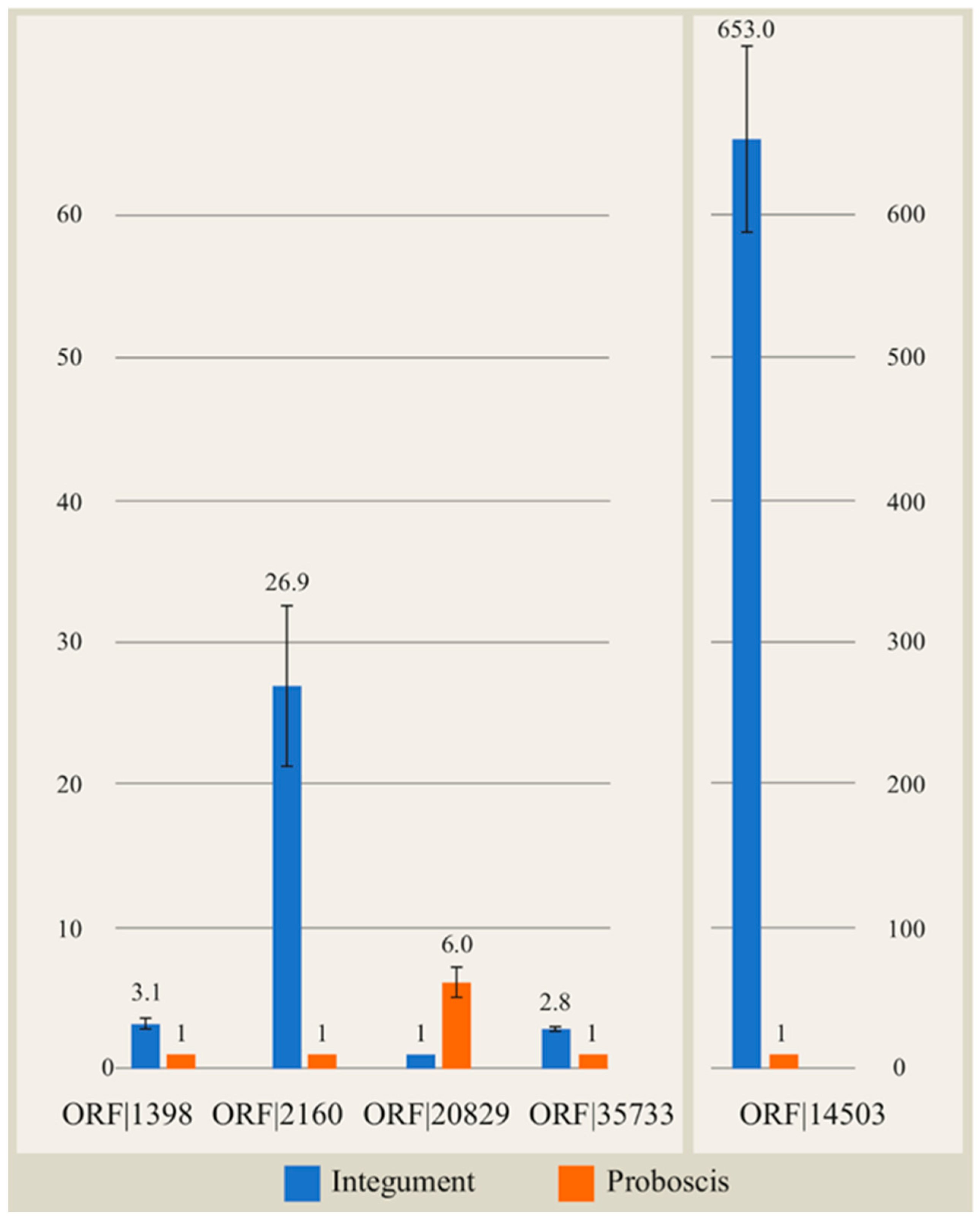
| ORF|114503 | 0.71 | 0.35 | 0.0 | 0.0 | 0.06 |
| ORF|035733 | 0.03 | 1.0 | 0.03 | 0.0 | 0.2 |
| ORF|002160 | 0.09 | 0.86 | 0.0 | 0.0 | 0.0 |
| ORF|001398 | 0.13 | 0.05 | 0.0 | 0.0 | 0.29 |
| Proboscis | |||||
| ORF|020829 | 0.13 | 0.19 | 0.0 | 0.0 | 0.01 |
| Gene | Forward Primer 5′-3′ | Reverse Primer 5′-3′ | Amplicon |
|---|---|---|---|
| C.sim_GAPDH | TAATGACAACTGTACACGCA | TCGAAGCTGGGATAATGTTT | 111 bp |
| Uni_act-1a 1 | TCATCAGGGTGTCATGGT | AGGATACCTCTCTTGCTCTG | 78 bp |
| C.sim_ORF114503 | ATTTCTGGTGATTGATGGAGGG | TGGACATTCTCCATAAGTTGCT | 136 bp |
| C.sim_ORF035733 | CATGGCCTTGCATGGTTTAC | GTGACCGCGTTACCCATTT | 113 bp |
| C.sim_ORF002160 | GGCACTTCTTTTTCTGGTACAC | TACTGGCACCCCACCATTT | 96 bp |
| C.sim_ORF001398 | GCGTGTTTGTTTTTGCATCTC | CTTCGTCCCACTTCTCACC | 107 bp |
| C.sim_ORF020829 | AAAAACGGGGCTGTAATGGT | GTGACCTTCTTGGACACACA | 134 bp |
Disclaimer/Publisher’s Note: The statements, opinions and data contained in all publications are solely those of the individual author(s) and contributor(s) and not of MDPI and/or the editor(s). MDPI and/or the editor(s) disclaim responsibility for any injury to people or property resulting from any ideas, methods, instructions or products referred to in the content. |
© 2025 by the authors. Licensee MDPI, Basel, Switzerland. This article is an open access article distributed under the terms and conditions of the Creative Commons Attribution (CC BY) license.
Share and Cite
Kuznetsov, V.G.; Melnikova, D.I.; Shabelnikov, S.V.; Magarlamov, T.Y. Proteinaceous Toxins in the Mucus and Proboscis of the Ribbon Worm Cephalothrix cf. simula (Palaeonemertea: Nemertea). Toxins 2026, 18, 17. https://doi.org/10.3390/toxins18010017
Kuznetsov VG, Melnikova DI, Shabelnikov SV, Magarlamov TY. Proteinaceous Toxins in the Mucus and Proboscis of the Ribbon Worm Cephalothrix cf. simula (Palaeonemertea: Nemertea). Toxins. 2026; 18(1):17. https://doi.org/10.3390/toxins18010017
Chicago/Turabian StyleKuznetsov, Vasiliy G., Daria I. Melnikova, Sergey V. Shabelnikov, and Timur Yu. Magarlamov. 2026. "Proteinaceous Toxins in the Mucus and Proboscis of the Ribbon Worm Cephalothrix cf. simula (Palaeonemertea: Nemertea)" Toxins 18, no. 1: 17. https://doi.org/10.3390/toxins18010017
APA StyleKuznetsov, V. G., Melnikova, D. I., Shabelnikov, S. V., & Magarlamov, T. Y. (2026). Proteinaceous Toxins in the Mucus and Proboscis of the Ribbon Worm Cephalothrix cf. simula (Palaeonemertea: Nemertea). Toxins, 18(1), 17. https://doi.org/10.3390/toxins18010017