Article

Modelling the Bioaccumulation of Ciguatoxins in Parrotfish on the Great Barrier Reef Reveals Why Biomagnification Is Not a Property of Ciguatoxin Food Chains

by
Michael J. Holmes
* and
Richard J. Lewis
Institute for Molecular Bioscience, The University of Queensland, Brisbane 4072, Australia
*
Author to whom correspondence should be addressed.
Toxins 2025, 17(8), 380; https://doi.org/10.3390/toxins17080380

Submission received: 17 June 2025 / Revised: 16 July 2025 / Accepted: 28 July 2025 / Published: 30 July 2025
(This article belongs to the Collection Ciguatoxin)

Abstract

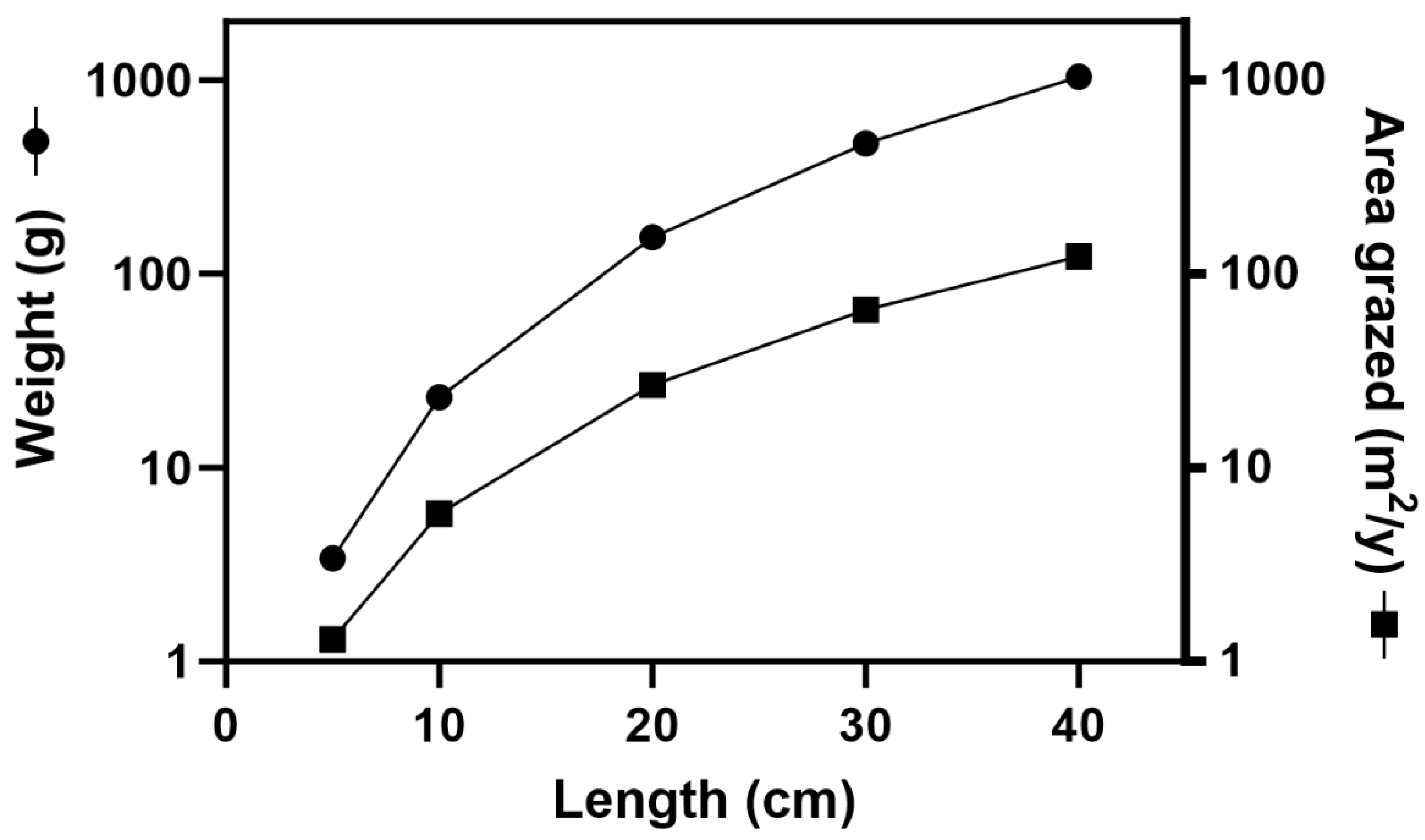
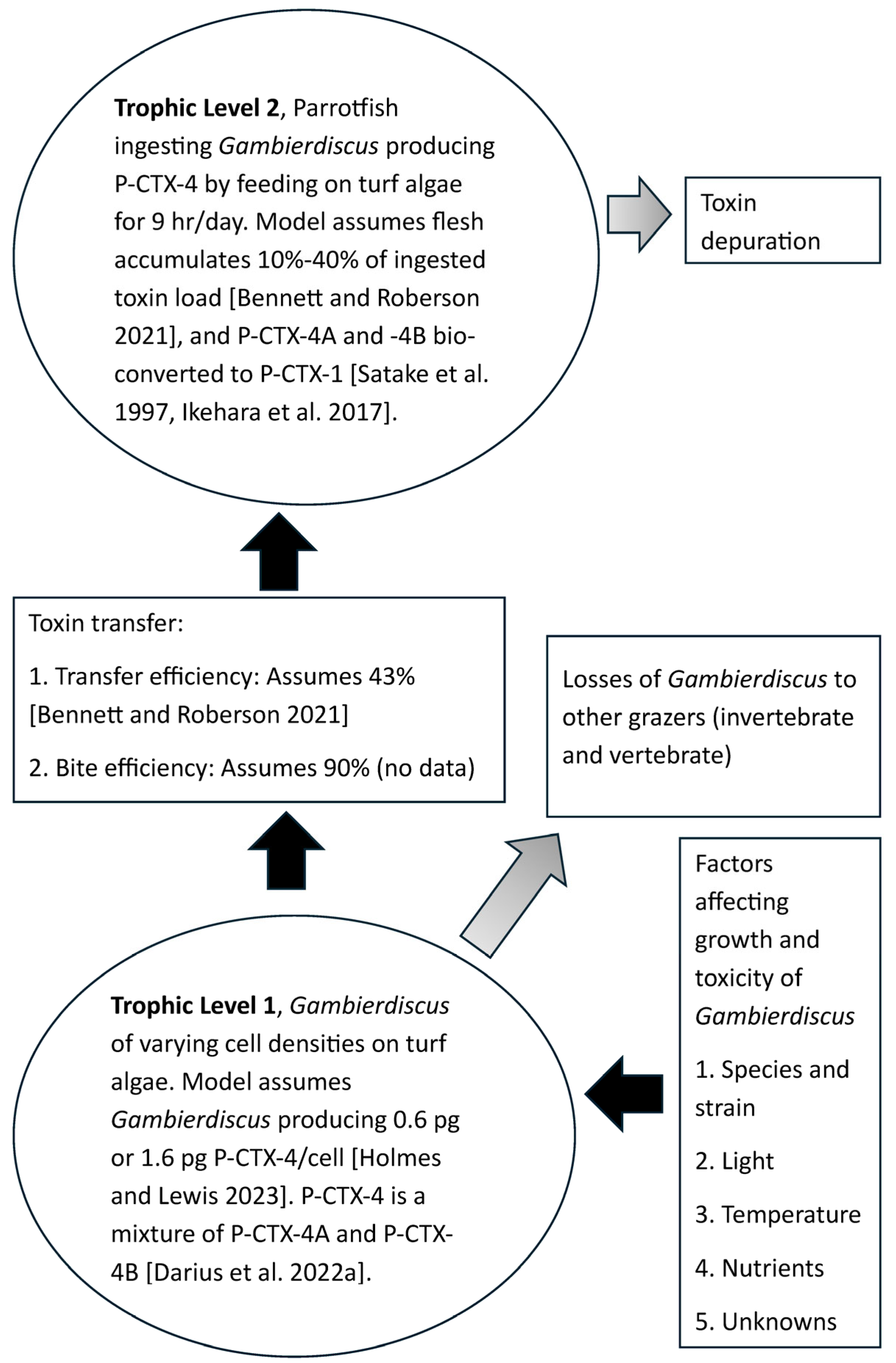
We adapt previously developed conceptual and numerical models of ciguateric food chains on the Great Barrier Reef, Australia, to model the bioaccumulation of ciguatoxins (CTXs) in parrotfish, the simplest food chain with only two trophic levels. Our model indicates that relatively low (1 cell/cm2) densities of Gambierdiscus/Fukuyoa species (hereafter collectively referred to as Gambierdiscus) producing known concentrations of CTX are unlikely to be a risk of producing ciguateric fishes on the Great Barrier Reef unless CTX can accumulate and be retained in parrotfish over many months. Cell densities on turf algae equivalent to 10 Gambierdiscus/cm2 producing known maximum concentrations of Pacific-CTX-4 (0.6 pg P-CTX-4/cell) are more difficult to assess but could be a risk. This cell density may be a higher risk for parrotfish than we previously suggested for production of ciguateric groupers (third-trophic-level predators) since second-trophic-level fishes can accumulate CTX loads without the subsequent losses that occur between trophic levels. Our analysis suggests that the ratios of parrotfish length-to-area grazed and weight-to-area grazed scale differently (allometrically), where the area grazed is a proxy for the number of Gambierdiscus consumed and hence proportional to toxin accumulation. Such scaling can help explain fish size–toxicity relationships within and between trophic levels for ciguateric fishes. Our modelling reveals that CTX bioaccumulates but does not necessarily biomagnify in food chains, with the relative enrichment and depletion rates of CTX varying with fish size and/or trophic level through an interplay of local and regional food chain influences. Our numerical model for the bioaccumulation and transfer of CTX across food chains helps conceptualize the development of ciguateric fishes by comparing scenarios that reveal limiting steps in producing ciguateric fish and focuses attention on the relative contributions from each part of the food chain rather than only on single components, such as CTX production.
Keywords: ciguatera; ciguatoxin; Gambierdiscus; Fukuyoa; Scarus; Chlorurus; parrotfish; Great Barrier Reef; biomagnification ciguatera; ciguatoxin; Gambierdiscus; Fukuyoa; Scarus; Chlorurus; parrotfish; Great Barrier Reef; biomagnification