Article

Comparing Computational Peritoneal Dialysis Models in Pigs and Patients


by
Sangita Swapnasrita
1,2,
Joost C. de Vries
2,
Joanna Stachowska-Piętka
3,
Carl M Öberg
4,
Karin G. F. Gerritsen
2,*,† and
Aurélie Carlier
1,*,†
1
MERLN Institute for Regenerative Medicine, Maastricht University, Universiteitssingel 40, 6229 ER Maastricht, The Netherlands
2
Department of Nephrology and Hypertension, University Medical Center Utrecht, Heidelberglaan 100, 3584 CX Utrecht, The Netherlands
3
Nalecz Institute of Biocybernetics and Biomedical Engineering, Polish Academy of Sciences, Ks. Trojdena 4, 02-109 Warsaw, Poland
4
Department of Clinical Sciences Lund, Division of Nephrology, Skåne University Hospital, Lund University, 221 85 Lund, Sweden
*
Authors to whom correspondence should be addressed.
These authors contributed equally to this work.
Toxins 2025, 17(7), 329; https://doi.org/10.3390/toxins17070329

Submission received: 28 May 2025 / Revised: 22 June 2025 / Accepted: 26 June 2025 / Published: 28 June 2025

Abstract

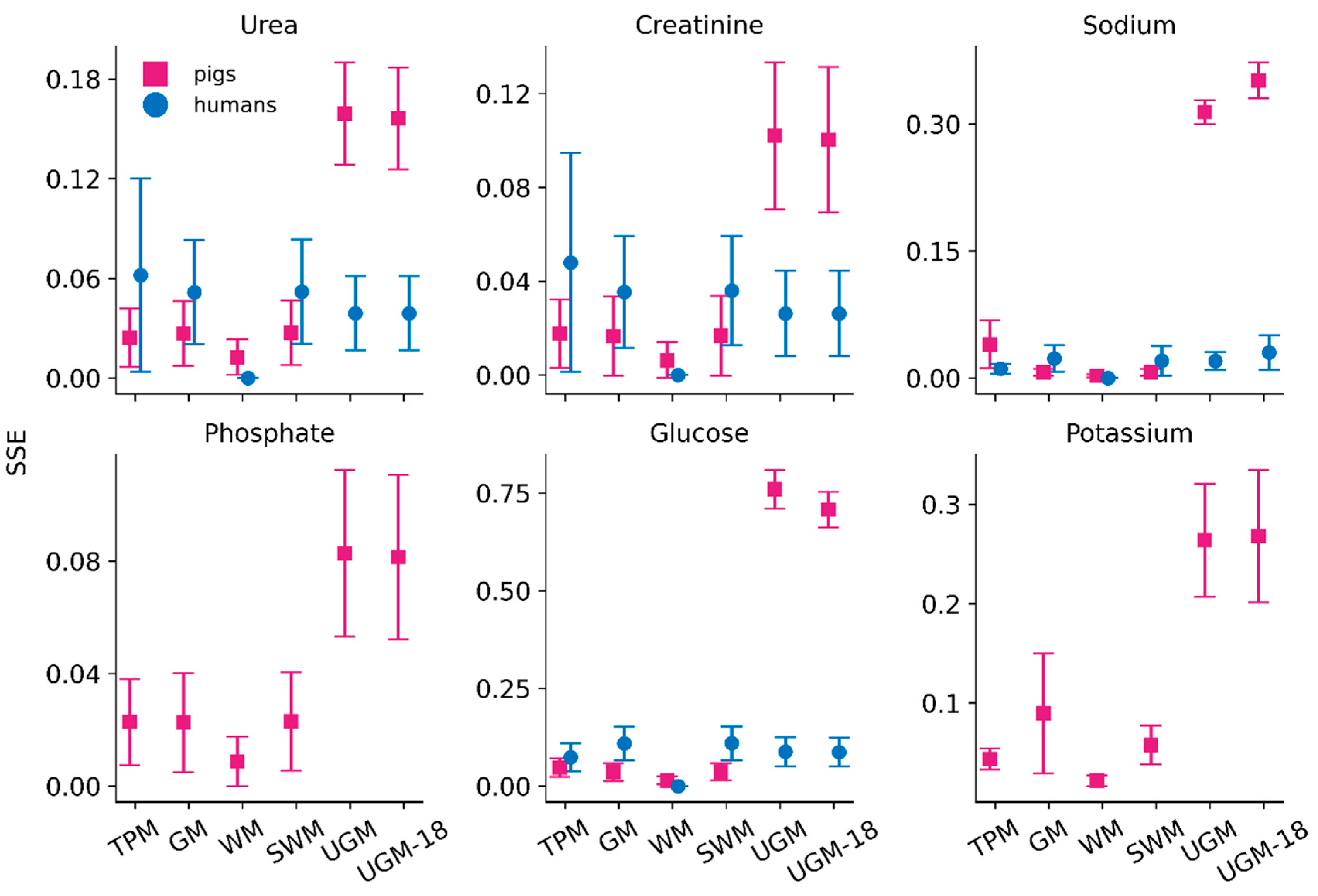
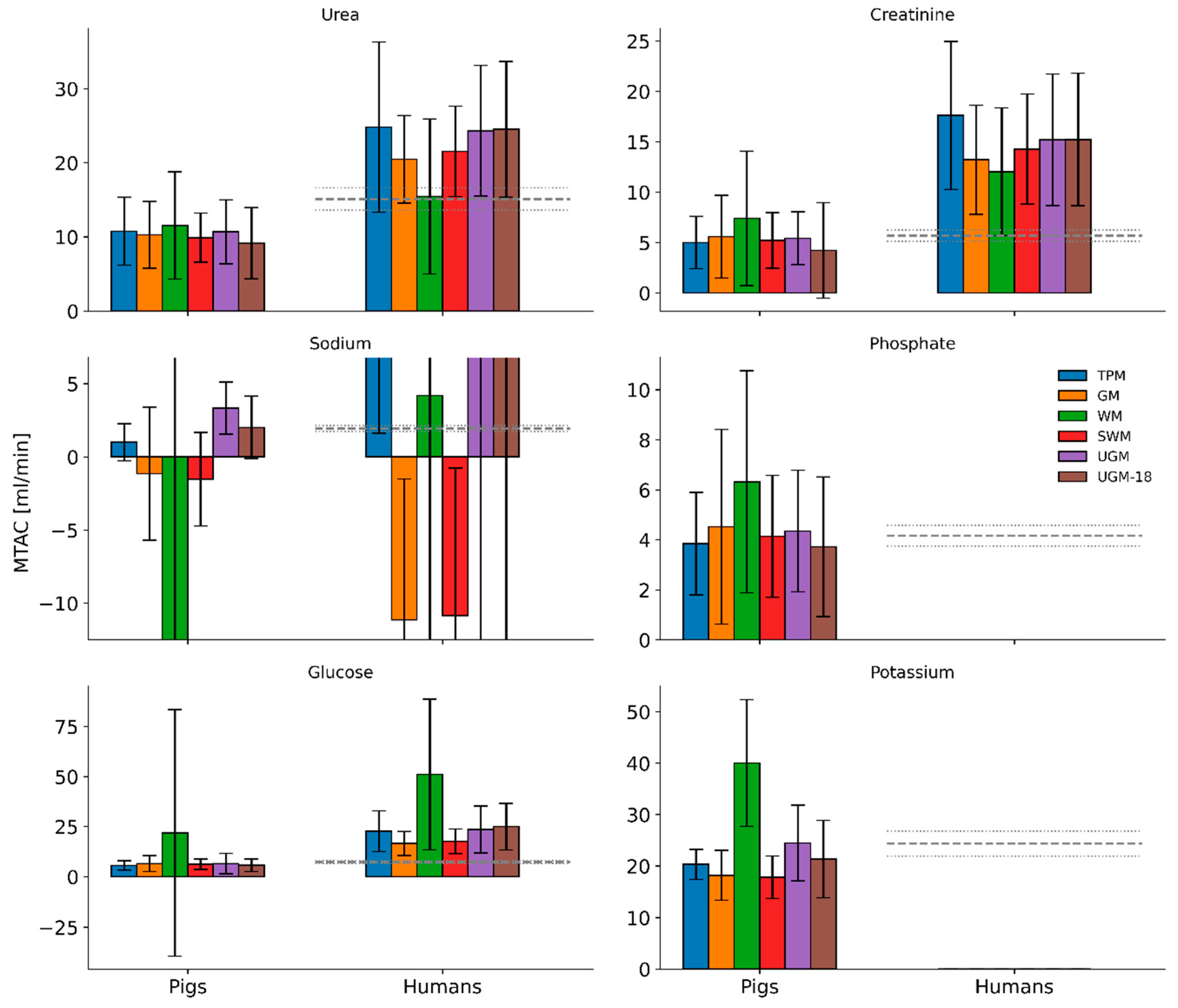
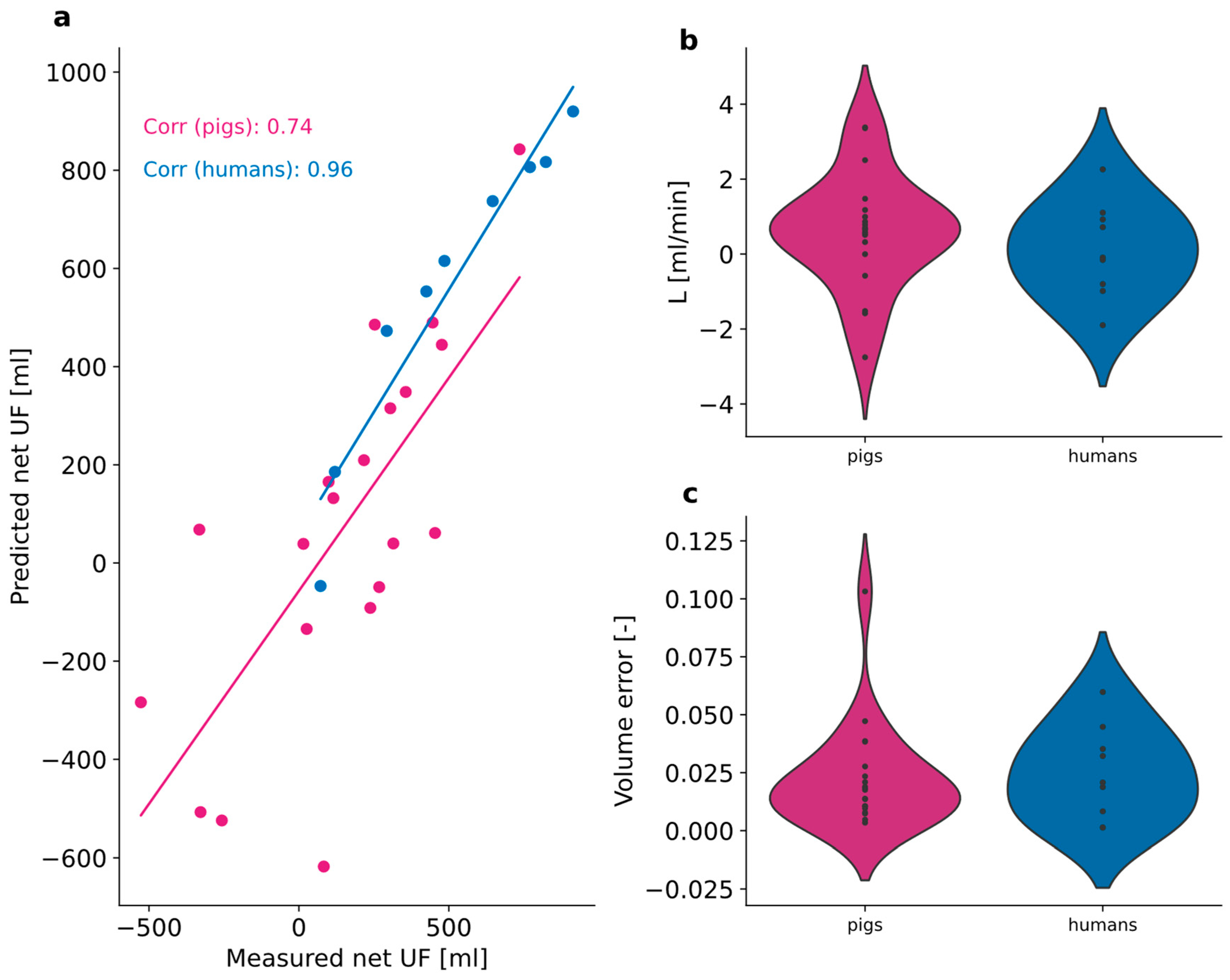
Computational models of peritoneal dialysis (PD) are increasingly useful for optimizing treatment in patients with kidney disease requiring dialysis (KDRD). However, although several mathematical models have been developed in the past few decades, a direct comparison of the models’ accuracy with respect to predicting in vivo data is needed to further create robust personalized models. Here, we used a dataset obtained in a previous in vivo experimental model of PD in pigs (23 sessions of 4 h 2 L dwells in four pigs) and humans (20 sessions in 20 patients) to compare six computational models of PD: the Graff model (UGM), the three-pore model (TPM), the Garred model (GM), and the Waniewski model (WM), as well as two variations of these (UGM-18, SWM). We conducted this comparison to predict the dialysate concentrations of key uremic toxins and electrolytes (four in humans) throughout a 4 h dwell. The model predictions can provide insight into inter-individual differences in ultrafiltration, which are critical for tailoring PD regimens in KDRD. While TPM offered improved physiological reality, its computational cost suggests a trade-off between model complexity and clinical applicability for real-time or portable kidney support systems. In future applications, such models could provide adaptive PD regimens for tailored care based on patient-specific toxin kinetics and fluid dynamics.
Keywords: peritoneal dialysis; three-pore model; uremic toxin; mathematical modeling; personalization peritoneal dialysis; three-pore model; uremic toxin; mathematical modeling; personalization